Project Report
Water Reuse and Communities Toolkit
Module 1: Community Perceptions and Barriers to Water Reuse
A report of a study funded by the
Australian Water Recycling Centre of Excellence
Water Reuse and Communities Toolkit
Module 1: Community perceptions and barriers to water reuse
This report has been prepared as part of the National Demonstration, Education and Engagement Program (NDEEP). This Program has developed a suite of high quality, evidence-based information, tools and engagement strategies that can be used by the water industry when considering water recycling for drinking purposes. The products are fully integrated and can be used at different phases of project development commencing at ‘just thinking about water recycling for drinking water purposes as an option’ to ‘nearly implemented’.
Project Leaders
Dr Daniel Ooi, Prof. Adrian Fisher and Prof. John Cary College of Arts
Victoria University PO Box 14428
Melbourne VIC 8001 AUSTRALIA
Contact: Daniel Ooi [[email protected]]
Partners
Victoria University
About the Australian Water Recycling Centre of Excellence
The mission of the Australian Water Recycling Centre of Excellence is to enhance management and use of water recycling through industry partnerships, build capacity and capability within the recycled water industry, and promote water recycling as a socially, environmentally and economically
sustainable option for future water security.
The Australian Government has provided $20 million to the Centre through its National Urban Water and Desalination Plan to support applied research and development projects which meet water recycling challenges for Australia’s irrigation, urban development, food processing, heavy industry and water utility sectors. This funding has levered an additional $40 million investment from more than 80 private and public organisations, in Australia and overseas.
ISBN 978-1-922202-19-2
ACN 072 233 204
© Australian Water Recycling Centre of Excellence
This work is copyright. Apart from any use permitted under the Copyright Act 1968, no part of it may be
reproduced by any purpose without the written permission from the publisher. Requests and inquiries concerning reproduction right should be directed to the publisher.
Date of publication: November 2014
Publisher:
Australian Water Recycling Centre of Excellence Level 5, 200 Creek Street, Brisbane, Queensland 4000 www.australianwaterrecycling.com.au
This report was funded by the Australian Water Recycling Centre of Excellence through the Australian Government’s National Urban Water and Desalination Plan.
Disclaimer
TABLE OF CONTENTS
Executive Summary……… 4
Community response to reuse around the world………….. …….. 5
Public perceptions of reuse in the Australian context……… 7
What are the key barriers in the eyes of non-accepters?... 8
Who are the accepters?... 10
The effect of information on attitudes to potable reuse……….. 13
4 | P a g e
Water Reuse and Communities Toolkit Module 1: Community Perceptions and Barriers to Water Reuse
Water Reuse and Communities Toolkit
Module 1: Community Perceptions and Barriers to Water Reuse
Executive Summary
1. A survey of the existing literature reveals significant differences in community acceptance of potable reuse projects around the world. Highly successful attempts include NEWater in Singapore, and Direct Potable Reuse (DPR) in Windhoek, Namibia. On the other hand, highly unsuccessful attempts include the Toowoomba wastewater treatment plant (WWTP), and the early phases of the San Diego WWTP.
2. The factors underlying these differences are not fully clear, but important variables include: (a) differences in community outreach campaigns; (b) different levels of water scarcity shaping perceived need; and (c) differing levels of perceived environmental benefit.
3. Comparative analysis of a variety of public opinion studies has found that support for ‘water recycling’ is slowly increasing. Several factors have been attributed as the cause of this: (a) gradual acceptance based on experience of existing projects; (b) worsening conditions of water scarcity; and (c) an increased consciousness around issues of recycling and sustainability.
4. All studies referred to show increasing caution with reuse water as the vector of contact comes closer to the body. Highest levels of acceptance were found for activities such as gardening and toilet flushing, moderate levels of acceptance for bathing and washing dishes, and lower levels of acceptance for cooking and ingestion.
5. Establishing the need to consider water reuse by highlighting perceived individual and community environmental benefits is critical to effective communication. Any education and engagement program must place a heavy emphasis on promoting the ecological and sustainability benefits of water reuse.
Water Reuse and Communities Toolkit
Module 1: Community Perceptions and Barriers to Water Reuse
Community response to reuse around the world
Community response to water reuse projects has varied significantly around the world. In some cases there has been relatively little opposition, and in other cases there has been significant opposition. In those cases where there has been opposition to water recycling, the media has played an important role in sharpening opposition around particular concerns, such as safety or cost. Some of the most successful water reuse projects in finding community acceptance include:
• Singapore NEWater: since its introduction in 2003, this has been one of the most widely
accepted of all water recycling schemes. Ching & Yu (2009) argue, based on their own regression analysis of media content in the Singaporean and Queensland cases, that the two most important variables underlying norm formation were time and emotional response. They highlight the importance of positive media in the early stages of opinion formation, contrasting between the media focus on the technical and strategic benefits in the Singaporean case, and the focus on health and social issues in the Queensland case. A significant factor underlying the positive response to the scheme was the relative importance of NEWater in the Public Utilities Board’s ‘Four National Taps’ campaign, which promoted the importance of the three domestic taps; catchment water, desalination, and water recycling, in national autonomy from the fourth tap – imported water from Malaysia.
• Orange County, California: Potable reuse (PR) via aquifer replenishment has existed since
1976, with a major expansion in 2007. PR currently supplies 50% of Orange County’s water, with fairly wide public acceptance. Orange County Water District has engaged in a serious program of public engagement. This program seems to have been fairly successful and might be adapted with contextual differences in mind.
• London: In London, there was little community opposition to water recycling. However,
wastewater was treated to a tertiary level before entering the Thames. From there it was reintroduced into the water system and treated. In this case, it was river water rather than wastewater concentrate acting as the feed, thus this was a case of planned indirect potable reuse (IPR) downstream.
• Bora Bora, French Polynesia: Lazarova (2011) examined the consultation and education process that accompanied the introduction of water reuse on Bora Bora, including end-users and the tourism industry (hotels and tourist facilities). He concluded that the stressing of socio-economic, environmental, and technical benefits in this process helped to build public trust. This trust from the public, coupled with support from elected officials and health officers, saw the successful introduction of water reuse.
• Torreele, Veurne, Belgium: Water recycling began in 2002, with recharge of treated water
6 | P a g e
Water Reuse and Communities Toolkit Module 1: Community Perceptions and Barriers to Water Reuse
• Aurora Water Prairie Waters Project, Colorado: Treated wastewater was used to replenish
groundwater via the Colorado River, with natural filtration through soil layers into the aquifer. The groundwater is then pumped to customers, supplying 20% of residential water. The introduction of treated wastewater was relatively uncontroversial.
• Goreangab Water Reclamation Plant, Windhoek, Namibia: This is a very historically significant case in pioneering Direct Potable Reuse (DPR). Public acceptance here is high, and DuPisani (2006) attributes this to the fact that there are simply no other surface or groundwater sources available in the proximity. Thus, the environmental need for DPR has led to public acceptance based on a focus on the obligatory benefit, without focusing on risk. Similarly, the perceived need may be an important driver for acceptance in the two other major examples of DPR. In Cloudcroft, New Mexico, a mountain town, and in Big Spring, Texas, located in the desert, environmental conditions play a significant part in community acceptance.
Contrasting these relatively successful case studies to unsuccessful ones is important in determining what factors underlie success or failure. Two important case studies of controversial water reuse projects are:
• Toowoomba Water Futures Referendum, Queensland: The July 2006 referendum held in
the City of Toowoomba directly shaped the political landscape for water recycling in Australia by demonstrating the potential political cost of successful opposition to water recycling schemes. The final referendum was lost with 62% opposing and 38% supporting.
• San Diego Wastewater Treatment Plant: Initial attempts to introduce water recycling to San
Diego were fraught with community opposition, beginning in the 1970s and continuing into the 1990s. The long road to public acceptance resulted from small but steadily increasing levels of public acceptance, after a structured series of community engagement campaigns, involving educational material, alliances with community groups interested in the environmental benefits of water recycling, and improvements in technology. Tours of a demonstration plant also resulted in positive approval.
Public perceptions of reuse in the Australian context
Much of the work done on public attitudes to water reuse in Australia is very recent, only emerging in the last decade. For example, the review of current research in the field by Dylan (2000) lists only two social studies, those of the CSIRO group then headed by Geoff Syme (Perth), and the PhD work of June Marks (Mawson Lakes, SA, as well as Florida, USA). Since then, social studies on the perception of water recycling have proliferated, in the form of large scale surveys about community attitudes towards stormwater recycling, dual pipeline supply, and potable reuse.
Marks (2003) survey of two sites in Adelaide found that “nearly three-quarters of respondents would be happy to use recycled water for household purposes (including drinking), though most would do so with some hesitation” (p. 96). However when presented with the option of water recycling or treated rainwater, most preferred the latter option. The figure below, reproduced from Dolnicar and Sanders (2006), shows the mean opposition percentages to particular uses of water published in seven US studies and one Australian study of public acceptance of water reuse. These were: Bruvold & Ward (1970, 1972); Kasperson et al (1974); Sims and Baumann (1974); Olsen et al (1979); Bruvold, Olsen, and Rigby (1981); Milliken and Lohman (1985); and Po, Kaercher, and Nancarrow (2004).
8 | P a g e
Water Reuse and Communities Toolkit Module 1: Community Perceptions and Barriers to Water Reuse
One of the fundamental findings of the varied body of research over the last few decades has been the separation of levels of support based on use, with the public much more comfortable with water reuse as the proximity to the body becomes more distant.
From these studies, it can be concluded that:
- Meta-analysis of public opinion studies has found that support for ‘water recycling’ is slowly increasing. Several factors have been attributed as the cause of this: (a) gradual acceptance based on experience of existing projects; (b) worsening conditions of water scarcity; and (c) an increased consciousness around issues of recycling and sustainability.
- All studies referred to show increasing caution with reuse water as the vector of contact comes closer to the body. Highest levels of acceptance were found for activities such as gardening and toilet flushing, moderate levels of acceptance for bathing and washing dishes, and lower levels of acceptance for cooking and ingestion.
What are the key barriers in the eyes of non-accepters?
A number of studies have attempted to make comprehensive lists of the barriers to reuse. Most influential of these has been Po et al (2003), in the CSIRO Land & Water team. The list used by Po et al contains the following list of major factors engendering public acceptance of various levels of water reuse:
• disgust, or the yuk factor; • perceptions of risk;
• specific uses of recycled wastewater; • sources of recycled wastewater; • ability to have choice to reuse; • trust and knowledge;
• existing environmental attitudes; • environmental justice issues; • cost of wastewater reuse; • socio-demographic factors;
The basic list appears in a number of other publications and reports. For example, it is reused by McGuinness & Van Buynder (2003); and adopted as the framework for elaboration by Anderson et al (2008); a similar (earlier) list also appears in Dylan (2000). A more recent paper by Alexander (2010), also from CSIRO, contains significant overlap, utilising slightly different categories, and importantly, placing ‘health issues’ at the fore:
• health issues;
• system function and maintenance; • fairness and justice in planning;
• transparency and inclusion in governance; • environmental factors;
In December 2004, the Department of Health, WA held a seminar under the title ‘Public Perceptions of Wastewater Reuse’. The following list published in that report focused on similar issues to the two lists above, despite coming from the health perspective. Hartley (2006), based on four papers examining the US context (Bruvold, 1998; Lawrence, 2000; Jeffery, 2001; and Lohman & Milliken, 1984), concluded that public acceptance of water reuse seems to be higher when the:
• Degree of human contact is minimal; • Protection of public health is clear;
• Protection of the environment is a clear benefit of the reuse; • Promotion of water conservation is a clear benefit of the reuse;
• Cost of treatment and distribution technologies and systems is reasonable; • Perception of wastewater as the source of reclaimed water is minimal; • Awareness of water supply problems in the community is high;
• Role of reclaimed water in overall water supply scheme is clear; • Perception of the quality of reclaimed water is high;
• Confidence in local management of public utilities and technologies is high.
Focus groups conducted by CSIRO in Adelaide as part of the Managed Aquifer Recharge and Stormwater Use Options (MARSUO) research project suggest that gaining public support for reusing storm water and aquifer recharge is possible; however this is dependent on two factors (Alexander, 2011). These are the cost of water, and the opportunity for community education about the benefits and risks of the system. In these focus groups, storm water was referred to as recycled wastewater; however participants were willing to consider the latter if assurances could be made about safety. A landmark report published by the Australian Academy of Technological Sciences and Engineering (2004) recognized the following key issues:
1. The ‘yuk factor’ or fear of ‘toilet to tap’;
2. Public, and thus industry, support may be driven by preconceptions rather than facts;
3. The recycling ethic (of paper and plastic) has been beneficial for the acceptance of recycled water (Holliman, 1998, quoted in AATSE, 2004);
4. There still remains reluctance to use the water itself, even amongst those who accepted the idea in theory.
Community trust in authority and procedural justice in water infrastructure planning are crucial. Syme and Nancarrow (2003) have used structural equation modelling to show that one key determinant of community acceptance of desalination was a perception of adequate and inclusive consultation. Not only does inadequate consultation led to oversights in planning, but the consultation process itself is empowering. King and Murphy (2010) have shown that in the case of the Wonthaggi Desalination Plant, those surveyed had a higher level of acceptance for the project when they felt consulted, even if their material costs and benefits stayed the same, a concept often referred to as procedural justice.
10 | P a g e
Water Reuse and Communities Toolkit Module 1: Community Perceptions and Barriers to Water Reuse
states where the water crisis is most pronounced, the highest support levels result, whereas in those states with the highest rainfall, support levels are lower. The knowledge gap here needs to be addressed, in generating a map of all available data showing changes in public support for both water use reduction (water saving campaigns) and supply augmentation (rainwater tanks, desalination plants, recycled water), both geographically and temporally, correlated to available dam storage levels and rainfall.
One possible tool that has been proposed as part of an NDEEP is the video Downstream, produced by the WateReuse Foundation. Downstream is a potentially useful tool, in stressing the water cycle and thus dissociating the distinction between ‘new’ and ‘used’ water, particularly in contexts where unintentional reuse already occurs. However, care must be taken to ensure that the message is consistent with the existing messages water authorities are sending to the community, particularly in cases where protected catchments are stressed. However, care must be taken in providing rigorous evidence of unintentional reuse in Australia, and some thought about how this message might be consistent with existing water authorities messages. Knowledge gaps that exist that might be useful to establish in the Australian context and to incorporate into educational material are:
1. Establishing the degree of unintentional reuse occurring in Australia;
2. Establishing if there are regulatory differences governing emissions in rivers in Australia that are different from other contexts (USA, Europe);
3. Establishing how the downstream message fits into, or conflicts with, existing water industry messages (for example educational material on protected catchments or ‘catchment to tap’ cycles).
Who are the accepters?
McKay (2003) points out the need to differentially target groups based on age, ethnicity, education, and political sympathy. A preliminary analysis of the Hawkesbury Water Recycling Scheme by Attwater and Derry (2005) argued that a pluralist approaches for managing risk communication were needed depending on the 'community of practice'.
In order to understand the relative weighting of the key barriers to potable reuse described above, various techniques are needed to assess relative weighting. One of the most important early attempts to model the cognitive variables underlying acceptance of water reuse was undertaken by Baumann (1983). His work found that the main factors behind acceptance were:
• awareness of the public about water supply, distribution and treatment;
• the perception of the adequacy of existing supplies;
• income.
Peripheral factors cited were:
• age;
• political affiliation;
• attitudes to local government.
In his model, price was not important in terms of willingness to accept.
12 | P a g e
Water Reuse and Communities Toolkit Module 1: Community Perceptions and Barriers to Water Reuse
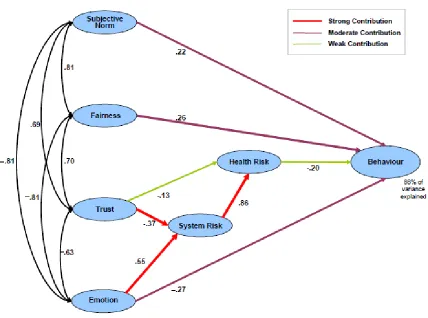
Figure 2: Structural Equation Model from Nancarrow et al. (2007) showing components contributing to intention to drink PRW in SE Queensland.
A structural equation with similar factor relations has been applied by Hurlimann et al (2008) to model data from Mawson Lakes, SA, where a dual pipeline system providing recycled water and non-recycled water to residents is in operation. Most interestingly, the dependent (endogenous) variable in this model is actual customer satisfaction, rather than hypothetical acceptance as in most other studies. Nancarrow et al. (2009 & 2010) have shown that there is a significant gap between in-principle support for water reuse at the conceptual level, and actual use upon implementation. Thus, a degree of caution needs to be exercised in extrapolating from self-reported attitudes of ‘willingness to accept’, to actual expectations that individuals will behaviourally accept when implementation occurs. This difference between hypothetical attitude and actual behaviour upon implementation is one significant knowledge gap in the literature on community acceptance. The case of Singapore, for example, where acceptance developed quickly upon implementation, would be important to consider from this perspective.
in the four communities, with residents of Brisbane and the Gold Coast more likely to accept PRW. Their findings, with a small sample size, indicate that the distinguishing feature of accepters was their trust in the ‘legal and legislative framework’ (p. 23) underpinning the treatment system. For non-accepters, the primary motivation for their decision was health concerns, exacerbated at times of system failure.
Others have pointed out a number of important reasons as that can be specified in individual cases, water authorities need to note these experiences in order to ameliorate these concerns of the public. Hurlimann and Dolnicar (2010) identify the important role political interests and controlling information flow played in the defeat of the referendum in Toowoomba, Queensland. In that case, fear of contaminants and hormone levels played a key role in turning public opinion away from potable water reuse (WateReuse Association, 2010). Alemmano et al. (2012) have pointed out, with regard to international food scares, a process by which public perceptions can lead into public regulation, thus creating a cycle of more public concern. This cycle starts as public perceptions weaken consumer confidence in the safety of the food products, leading to public concern. This, in turn, leads to regulation, and thus fuels the social fear of risks that need to be regulated.
Bridgeman (2004) argues that differential success between Noosa (Australia) and the UK, were due to a more consultative process taking place in the Australian case. Based on case studies of three outreach programs in California (South Bay, Montebello Forebay, and San Diego), he concludes that community outreach programs must be tailored to the specificities of target communities, and that public outreach must be proactive and not reactive.
Hurlimann (2007) tested five hypotheses about factors related to acceptance of recycled water through phone interviews with residents of Mawson Lakes, SA (n-162), where a dual pipeline of recycled water had been introduced to complement non-recycled water. In this study it was found that there was support for four of the hypotheses, namely that assessment of risk from recycled water was: (1) positively correlated to increased personal proximity in use (lower risk for more distant uses, higher risk for personal use); (2) negatively correlated to levels of satisfaction with the recycled water system; (3) negatively correlated to the level of trust in the water authority and perception of fairness; and (4) negatively correlated to perception of integrity and good communication on the part of the water authority. The one hypothesis that was not supported was the perception of vested interest on the part of the Water Authority.
In 2005, the US Water Environment Research Foundation commissioned an integrative social science study on public perception of water reuse. The results, published in Hartley (2006), identified the following five themes as critical to building public confidence in water reuse decision making in the case studies of San Antonio, Georgia, and San Diego.
• Managing information for all stakeholders
• Maintaining individual motivation and demonstrating organization commitment
14 | P a g e
Water Reuse and Communities Toolkit Module 1: Community Perceptions and Barriers to Water Reuse
• Ensuring fair and sound decision-making processes and outcomes
• Building and maintaining trust
Various attempts to construct structural equation models weighting the contribution of a number of factors in willingness to accept potable reuse (such as Syme), and case studies of relative successes and failures (such as Bridgeman, 2004) yield the following common conclusions:
• The importance of perceived individual and community environmental benefits. Any
education and engagement program must place a heavy emphasis on promoting the ecological and sustainability benefits of water reuse.
• The importance of trust and transparency. Any attempt to remove barriers to the acceptance
of potable reuse must focus on making all information available and building trust relationships with the community. This could be done by co-involvement of environmental and community groups in the consultation process.
The effect of information on attitudes to potable reuse
A number of studies have examined the impact of providing information about recycled water in willingness to consider its use. Simpson & Stratton (2011) highlight the important role of language in terminology in the perception of recycled water. They questioned a sample of 600 participants in Southeast Queensland, half of whom had received educational information about recycled water, and half of whom hadn't. They concluded that the improved knowledge attained had increased participants confidence and acceptance of recycling. Additionally, they concluded that the respondents preferred way of describing water was based on the uses for which it was suitable, rather than its origin. Therefore they suggest considering the use of 'purified water' and 'drinking water' rather than source descriptions such as 'recycled' and 'reused'.
In the context of Sydney, and based on a survey of 3059 respondents, Naomi Roseth (2008) concluded that;
“exposure to a brief, objective and attractive information leaflet can enhance support for the use of recycled water, though not dramatically. The information leaflet has a greater impact on people’s rational rather than emotional response to recycled water. Water authorities need to consider whether more substantial communication initiatives might achieve greater levels of understanding and support for recycled water schemes.” (page 68).
16 | P a g e
Water Reuse and Communities Toolkit Module 1: Community Perceptions and Barriers to Water Reuse
References
Alexander, K.S. (2010). Managed Aquifer Recharge and Urban Stormwater Use Options: Social Analysis Literature Review. CSIRO: Water for a Healthy Country National Research Flagship. Alexander, K. (2011). ‘Community attitudes towards Managed Aquifer Recharge and stormwater use
in Adelaide, Australia’. Paper presented at [insert] conference in Barcelona by CSIRO Land & Water research group.
Attwater, R. and Derry. C. (2005). 'Engaging communities of practice for risk communication in the Hawkesbury Water Recycling Scheme'. Action Research 3(2): 193-209.
Baumann, D. D. (1983). 'Social acceptance of water reuse'. Applied Geography 3(1): 79-84.
Bridgeman, J. (2004). ‘Public Perception towards Water Recycling in California’. Water and
Environment Journal 18(3): 150-154.
Brown, R. R. and Farrelly, M. A. (2007). Advancing Urban Stormwater Quality Management in Australia: Survey Results of Stakeholder Perceptions of Institutional Drivers and Barriers.
Report No. 07/05. National Urban Water Governance Program, Monash University. ISBN:
978-0-9804298-1-7.
Browne, A. L., Leviston, Z., Po Greenhill, M., Nancarrow, B. E., Tucker, D. I., and Porter, N. B. (2007). Structuring Dimensions of Risk: Technical and Community Perceptions of Risk in the Reuse of Wastewater for Irrigation and Indirect Potable Supply. CSIRO: Perth.
Browne, A. L., Leviston, Z., Green, M. J, Nancarrow, B. E. (2008). Technical and Community Perspectives of Risks Associated with Purified Recycled Water in South East Queensland: A
Q-Study. Urban Water Security Research Alliance .Technical Report No. 4. ISSN 1836-5566
(online).
Bruvold, W. H. and Ward, P. C. (1970). ‘Public attitudes toward uses of reclaimed wasterwater’.
Water Sewage Works, April (1970): 120-122.
Bruvold, W. H. and Ward, P. C. (1972). Public attitudes towards reuse of reclaimed water. Contribution 137, University of California Water Resource Centre.
Bruvold, W. H., Olsen, B. H., and Rigby, M. (1981). ‘Public policy for the use of reclaimed water.
Environmental Management 5(2): 95-107.
Bruvold, W. H. (1998). Public opinion on water reuse options. Journal of the Water Pollution Control
Federation 60(1): 45–50.
Cary, J. W. (2008). Influencing attitudes and changing consumers’ household water consumption behaviour. Water Science & Technology: Water Supply 8(3).
Dillon, P. (2000). ‘Water reuse in Australia: current status, projections and research’. Proceedings of
Water Recycling Australia 2000, Adelaide, 19-20 Oct 2000 (ed. P.J. Dillon) p. 99-104.
Dingfelder, S. (2004). ‘From toilet to tap’. APA Monitor 35(8). American Psychological Association. Dolnicar, S., and Sanders, C. (2006). 'Recycled water for consumer markets - a marketing research
Dolnicar, S., and Schäfer, A. I. (2006). 'Public perception of desalinated versus recycled water in Australia'. CD Proceedings of the AWWA Desalination Symposium 2006.
Dolnicar, S., and Hurlimann, A. (2009). 'Drinking water from alternative water sources: di erences in beliefs, social norms and factors of perceived behavioural control across eight Australian locations. Water Science & Technology 60(6): 1433-1444.
Dolnicar, S, and Schäfer, A. I. (2009). 'Desalinated versus recycled water: public perceptions and profiles of the accepters'. Journal of Environmental Management 90: 888-900.
Dolnicar, S., and Hurlimann, A (2010). 'Desalinated versus Recycled Water - What Does the Public Think?', in I. Escobar & A. Schäfer (eds.), Sustainable Water for the Future: Water Recycling
Versus Desalination (pp. 375-388). Amsterdam: Elsevier.
Dolnicar. S., Hurlimann, A., and Grün, B. (2010). 'What affects public acceptance of recycled and desalinated water?'. Water Research 45: 933-943.
Dolnicar, S., Hurlimann, A., and Nghiem, L. D. (2010). The effect of information on public acceptance - The case of water from alternative sources. Journal of Environmental Management 91: 1288-1293.
Dupont, D. P. (2005). “Tapping into Consumers’ Perceptions of Drinking Water Quality in Canada: Capturing Customer Demand to Assist in Better Management of Water Resources”. Canadian
Water Resources Journal 30(1), 11-20.
Franzen, A. (2003). 'Environmental Attitudes in International Comparison: An Analysis of the ISSP Surveys 1993 and 2000' in Social Science Quarterly 84(2).
Gendall, P., Smith, T. W., and Russell, D. (2005). "Knowledge of Scientific and Environmental Facts: A Comparison of Six Countries" in Marketing Bulletin 6. pages 65-74.
Hartley, T. W. (2006). 'Public perception and participation in water reuse'. Desalination 187: 115– 126.
Holliman, T.R. (1998). ‘Reclaimed Water distribution and storage’, in T Asano (ed.), Wastewater
Reclamation and Reuse, Ch 9. Technomic Publishing, Lancaster, PA.
Hurlimann, A. C. (2007a). 'Is recycled water use risky? An Urban Australian community’s perspective'. Environmentalist 27:83–94.
Hurlimann, A. (2007b). Community Attitudes to Recycled Water Use: an Urban Australian Case Study – Part 1. CRC for Water Quality and Treatment: SA.
Hurlimann, A., and McKay, J. (2007). 'Urban Australians using recycled water for domestic non-potable use: An evaluation of the attributes price, saltiness, colour and odour using conjoint analysis'. Journal of Environmental Management 83: 93–104.
Hurlimann, A. (2008). Community Attitudes to Recycled Water Use: An Urban Australian Case Study –
Part 2. Research Report No. 56. Cooperative Research Centre for Water Quality and
Treatment, Adelaide, SA..
Jeffery, P. (2001). Understanding public receptivity issues regarding “in-house” water recycling.
18 | P a g e
Water Reuse and Communities Toolkit Module 1: Community Perceptions and Barriers to Water Reuse
Jeffrey, P. (2002). 'Public Attitudes to Introduction of In-House Water Recycling in England and Wales'. Journal of the CIWEM 16.
Kasperson, R. E., Baumann, D., Dwarkin, D., McCauley, D, Reynolds, J, and Sims, J. (1974). Community adoption water reuse system in the United States. Office of Water Resources Research. US Department of the Interior. Washington DC.
Keremane, G., McKay, J. and Wu, Z. (2011). ‘No stormwater in my tea cup: An internet survey of residents in three Australian cities’. Water 38(2): 118-124. Australian Water Association. Lawrence, G. (2000). Survey of Orange County Voters within the Orange County Water District, Santa
Ana. CA: Lawrence Research-Public Affairs and Marketing.
Lohman, L.C. and Milliken, J.G. (1984). Public attitudes toward potable wastewater reuse: a longitudinal case study. Proceedings of the Water Reuse Symposium III: Future of Water
Reuse 1: 109–121.
Marks J. S. (2006). ‘Taking the public seriously: the case of potable and non-potable reuse’.
Desalination 187: 137-47.
Marks, J., Martin, B., and Zadoroznyj, M. (2008). 'How Australians order acceptance of recycled water: National baseline data'. Journal of Sociology 44: 83.
McGuinness, N., & Van Buynder, P., (2005). Public Perceptions of Wastewater Reuse.
http://www.health.wa.gov.au/pophealth/ehsymposium/presentations/public%20perception s%20of%20wastewater%20reuse.pps.
Nancarrow, B. E., Leviston, Z., Tucker, D., Po, M., Price, J. and Dzidic, P. (2007). Community Acceptability of the Indirect Potable Use of Purified Recycled Water in South East Queensland and Preferences for Alternative Water Sources: A Baseline Measure. CSIRO: Perth.
Nancarrow, B.E., Leviston, Z., Po, M., Porter, N.B. and Tucker, D.I., (2008). ‘What drives communities’ decisions and behaviours in the reuse of wastewater’. Water Science and Technology 7(4): 485-491.
Nancarrow, B.E., Leviston, Z. and Tucker. D.I. (2009). Measuring the predictors of communities’ behavioural decisions for potable reuse of wastewater. Water Science and Technology
60(12): 3199-209.
Nancarrow, B.E., Porter, N.B. and. Leviston, Z. (2010). ‘Predicting community acceptability of alternative urban water supply systems: A decision making model’, Urban Water Journal 7: 197-210.
Olsen, B. H., Henning, J. A., Marshack, R. A., and Rigby, M. G. (1979). Educational and social factors
affecting public acceptance of reclaimed water. Water Reuse Symposium, Denver, Colorado,
1979. pp 1219-1231.
Po, M., Kaercher, J. D., and Nancarrow, B. E. (2004). Literature review of factors influencing public
Po M., Nancarrow B.E., Leviston Z., Porter N.B., Syme G.J., Kaercher J.D. (2005). Predicting Community Behaviour in Relation to Wastewater Reuse: What Drives Decisions to Accept or
Reject? Water for a Healthy Country National Research Flagship, CSIRO Land and Water;
Perth, WA: 2005.
Roseth, N. (2008). Community Views on Recycled Water – the Impact of Information. Research Report 48, CRC for Water Quality and Treatment, SA. ISBN 1876616741.
Ryan, A., Spash, C.L., and Measham, T.G. (2009). ‘Socio-economic and Psychological Predictors of Domestic Greywater and Rainwater Collection: Evidence from Australia’. Journal of
Hydrology 379: 164–171.
Simpson, J. M. (1999). 'Changing community attitudes to potable reuse in south-east Queensland'.
Water Science & Technology 40: 4-51.
Simpson J and Stratton H 2011, Talking about water: words and images that enhance understanding, Waterlines report, National Water Commission, Canberra.
Sims, J. H. and Baumann, D. (1974). Renovated waste water: the question of public acceptance.
Water Resources Research 10(4): 659-665.
Syme, G. J., & Williams, K. D. (1993). “The psychology of drinking water quality: an exploratory study”. Water Resources Research 29(12), 4003–4010.
Syme, G.J. and B.E. Nancarrow. (2006). ‘Social psychological considerations in the acceptance of reclaimed water for horticultural irrigation’, in D. Stevens (Ed.) Growing Crops with