Salus: A System for Server-Aided
Secure Function Evaluation
Seny Kamara ∗ Payman Mohassel † Ben Riva ‡
Abstract
Secure function evaluation (SFE) allows a set of mutually distrustful parties to evaluate a function of theirjoint inputs without revealing their inputs to each other. SFE has been the focus of active research and recent work suggests that it can be made practical. Unfortunately, current protocols and implementations have inherent limitations that are hard to overcome using standard and practical techniques. Among them are: (1) requiring participants to do work linear in the size of the circuit representation of the function; (2) requiring all parties to do the same amount of work; and (3) not being able to provide complete fairness.
A promising approach for overcoming these limitations is to augment the SFE setting with a small set of untrusted servers that have no input to the computation and that receive no output, but that make their computational resources available to the parties. In this model, referred to as
server-aided SFE, the goal is to tradeoff the parties’ work at the expense of the servers. Motivated by the emergence of public cloud services such as Amazon EC2 and Microsoft Azure, recent work has explored the extent to which server-aided SFE can be achieved with a singleserver.
In this work, we revisit the sever-aided setting from a practical perspective and design single-server-aided SFE protocols that are considerably more efficient than all previously-known protocols. We achieve this in part by introducing several new techniques for garbled-circuit-based protocols, including a new and efficient input-checking mechanism for cut-and-choose and a new pipelining technique that works in the presence of malicious adversaries. Furthermore, we extend the server-aided model to guarantee fairness which is an important property to achieve in practice.
Finally, we implement and evaluate our constructions experimentally and show that our protocols (regardless of the number of parties involved) yield implementations that are 4 and 6 times faster than the most optimized two-party SFE implementation when the server is assumed to be malicious and covert, respectively.
Keywords: secure computation, server-aided computation, multi-party computation, cloud com-puting
1
Introduction
Secure function evaluation (SFE) allows a set ofn parties, each with a private input, to securely and jointly evaluate ann-ary functionf over their inputs. Roughly speaking, a SFE protocol guarantees (at least) that: (1) the parties will not learn any information from the interaction other than their output and what is inherently leaked from it; and (2) that the functionality was computed correctly. SFE is useful in any setting where mutually distrustful parties need to cooperate but do not wish to reveal their inputs to each other. This often occurs in practice, for example, during negotiations, auctions, data mining, and voting.
∗
Microsoft Research. [email protected] †
University of Calgary. [email protected].
‡
Towards practical SFE. Early work on SFE—and the more general notion of multi-party computa-tion (MPC)—focused on feasibility results; that is, demonstrating thatevery function can be computed securely [57, 58, 24, 10]. Motivated by these results, much of the work in SFE focused on improving the security definitions [44, 9], on strengthening the adversarial models, on decreasing the round and communication complexity and on improving efficiency [43, 45,7, 38, 41, 4, 6, 52]. The special case of two-party SFE (2SFE) in particular has been improved extensively with more efficient semi-honest-to-malicious compilation techniques [43, 45, 56, 38, 41, 35, 40, 55], garbled circuit constructions and implementations [49,35,52,29,42], and oblivious transfer protocols [48,30,50]. In fact, recent work on practical SFE has even led to the design and implementation of several SFE/MPC frameworks such as Fairplay [43,4], VIFF [15], Sharemind [5], Tasty [28], HEKM [29] and VMCrypt [42].
Limitations of standard SFE. While these advances have resulted in great improvements in effi-ciency and have effectively taken SFE from a purely theoretical idea to a potentially practical technol-ogy, there are inherent limitations to these optimizations. Indeed, in all current implementations—even with the state-of-the-art protocols and optimizations—the parties’ running time islinear in the size of the circuit representation of the function they wish to evaluate.
Unfortunately, the circuit representation of most functions of practical interest can be quite large. For example, note that the circuit for evaluating the AES function requires roughly 30,000 gates, while a circuit that evaluates the edit distance between two 50 character strings requires about 250,000 gates (see Section4.2). It is easy to think of interesting functionalities with circuits that go up to billions of gates.
An additional limitation of standard SFE is that the workload issymmetric in the sense that each party has to do the same amount of computation. In many real-world applications, however, some parties are weaker than others. Consider, e.g., a mobile device that retrieves location-based information from a server; or a PC that searches a distributed database hosted by a large-scale cluster of machines. In each case, SFE would allow the parties involved to perform the computation while keeping their inputs (i.e., the location and the search term) private. Unfortunately, standard protocols— all of which require a symmetric amount of work—are ill-suited for these settings since the size of both parties’ inputs is bounded by the resources available to the weakest device. In other words, the mobile device would only be able to search through a small amount of location data, and the PC could only search through a small fraction of the database.
Finally, achieving fairness is not always possible with standard SFE. Roughly speaking, fairness ensures that either all the parties learn the output of the function being evaluated or none will. This is crucial in many real-world applications such as auctions, electronic voting, or collective financial analysis, where a dishonest participant should not be able to disrupt the protocol if it is not satisfied with the outcome of the computation. In 1986, Cleve showed that complete fairness is impossible in general, unless the majority of the players are honest [12]. A number of constructions try to achieve fairness for a specific class of functionalities [27], or consider limited (partial) notions of fairness instead [51,19,26].
the expense of the servers. Server-aided SFE with two or more servers has been considered in the past [16,17] and even deployed in practice [6].
Currently, there are two approaches to designing single-server-aided SFE protocols: (1) combining fully-homomorphic encryption (FHE) [21] with a proof system [3,1]; or (2) using Yao’s garbled circuit technique [57, 58]. The latter was proposed by Feige, Killian and Naor [18] in the semi-honest model and recently formalized and extended to stronger models by Kamara, Mohassel and Raykova [32]. The FHE-based approach is asymptotically optimal, but currently only of theoretical interest. The garbled circuit approach is slightly less efficient asymptotically but yields protocols that are efficient in practice. In addition, it can benefit from almost all the optimizations discussed above so it is complementary to previous work on practical SFE.
While the garbled-circuit approach yields practical protocols, we note that it is in a weaker adver-sarial model than the FHE-based solutions. In standard SFE it is assumed that if two or more parties are dishonest, they will collude. The protocols of [18] and [32], however, are only secure in settings where some of the dishonest partiesdo not collude. There are many settings in practice where collusion does not occur, e.g., due to physical restrictions, legal constraints and/or economic incentives. In a server-aided setting where the server is a large cloud provider (e.g., Amazon, Google or Microsoft), it is reasonable—given the consequences of legal action and bad publicity—to assume that the server will not collude with the parties.
Another limitation of the garbled circuit approach is that it yields protocols where at least one of the parties (other than the server) has to do linear work (throughout we will assume this party to be the first party P1). It is shown in [32] that any non-interactive single-server-aided protocol without
this limitation would imply a secure non-interactive delegated computation scheme which, currently, we only know how to construct based on FHE.
Deploying server-aided SFE. Even with the limitations outlined above, we believe that the garbled-circuit approach to single-server-aided SFE could be useful in many real-world scenarios. Con-sider, for example, the case of an enterprise (e.g., a small-to-medium-sized one) that may want to use SFE to provide better privacy for itself and its customers. The limitations of standard SFE out-lined above would make this completely impractical—especially if the enterprise’s clients are resource-constrained devices such as smartphones or tablets.
A better approach would be to use server-aided SFE where the server is instantiated by a public cloud (e.g., Amazon EC2, Windows Azure or Google Compute Engine), the enterprise plays the role of P1 and its clients play the roles of the remaining parties. Note that such a setup is very natural
in the setting of cloud computing since many business’s already make use of public clouds to deliver services to their own clients (e.g., Netflix, Instagram) and since they have significantly more resources than their clients.
1.1 Background on Garbled Circuits
We make use of several cryptographic building blocks in our protocols, including garbled circuits, oblivious transfer (OT) [53] and secret sharing [54]. We omit formal descriptions of these building blocks due to lack of space and refer the reader to [22]. However, we briefly review garbled circuits before describing our contributions.
resulting in a set of output labels; and (4) a decoding procedure that recovers the output from the output labels.
The main security property provided by garbled circuits isinput privacy, which guarantees that no information about the inputs is revealed by the evaluation and decoding procedures beyond what can be inferred from the output. Our protocols will rely on a slightly different property calledinput/output privacy which guarantees that no information about the inputs or outputs are revealed by the evaluation procedure (these properties are implied by the security proof of [39]). Another useful property of garbled circuits isunforgeability which, informally, guarantees that an incorrect evaluation can be detected with all but negligible probability. This property has also been noted and used in works as early as [49], but pointed out more explicitly in [20].
Cut-and-choose and input-consistency. A difficulty that often comes up when designing proto-cols based on garbled circuits is verifying whether a circuit was garbled correctly (this occurs when adversaries can be malicious). Several mechanisms exist to address this but the most efficient is cut-and-choose [47, 43, 45, 34, 56, 38]. With cut-and-choose, the garbler starts by constructing many garbled circuits. The evaluator chooses a random subset of these circuits and verifies their correctness by asking the garbler to reveal the secrets it used. If the verification goes through, the evaluator is left with several unopened garbled circuits and, with high probability, most of them are properly constructed (otherwise at least one malconstructed garbled circuit would have been detected during verification). The evaluator then evaluates the remaining garbled circuits and outputs the majority value.
This last step, however, introduces new problems and to avoid subtle attacks the evaluator has to check that the garbler used the same inputs for all the remaining circuits. This input checking step can be handled using several techniques. Mohassel and Franklin [45] and Lindell and Pinkas [38] extend the cut-and-choose technique to cover the input labels as well. Unfortunately, this requires a quadratic (in the security parameter) number of commitments. Another approach is to use specially-designed zero-knowledge proofs [40,55] which, under specific number-theoretic assumptions, require only a linear number of exponentiations.
The techniques of [45] and [38] are extended to the server-aided setting in [32], where an input checking mechanism is described that requires a quadratic number of commitments.
Pipelined execution. Finally, since circuits can grow very large, garbling and evaluating them in memory can be expensive. Several implementations, therefore, pipeline the generation and evaluation of garbled circuits [31,28,29,42] by having the garbler send (or stream) the garbled gates immediately after generating them and having the evaluator evaluate (or verify) them on the fly. Using this approach, the parties store in memory only the intermediate wires needed for the rest of the evaluation. This leads to very efficient implementations since the parties only need to store intermediate values and garbled gates on disk. Moreover, it improves the latency of the protocol since the garbler and the evaluator can operate simultaneously. Previous work, however, has only shown how to pipeline garbled circuits in the presence of semi-honest adversaries.
1.2 Our Contributions
Today, the server-aided approach seems to be one of the most promising directions for scaling SFE and overcoming the inherent limitations of the optimization techniques discovered in previous work. In addition, given the recent emergence of public clouds, such as Amazon EC2 and Microsoft Azure, server-aided SFE can be implemented broadly and at low-cost.
In this work, we revisit the server-aided setting from a more practical point of view and explore the extent to which we can take advantage of this model and design protocols that are more efficient and practical than what was previously known [18,32]. Our findings are quite positive as we make the following contributions.
Fairness. We extend the server-aided model to provide fairness, which guarantees that either all parties will receive their outputs or none will. Fairness is an important property to achieve in the context of practical SFE as it provides an incentive for parties not to abort the protocol after receiving their outputs.
A generic transformation. We give a black-box transformation from any two-party SFE protocol secure against malicious adversaries to a multi-party server-aided SFE protocol. This yields a generic compiler for designing efficient server-aided SFE protocols and provides a point of comparison for custom-designed constructions.
Efficient server-aided protocols. We design two new single-server-aided multi-party SFE pro-tocols. Both are based on garbled circuits, achieve fairness and are more efficient than any of the previously-known protocols [18, 32], or the generic construction mentioned above. In addition, the efficiency of the first protocol can be increased if it is used in the presence of a covert server (i.e., a server that wants to cheat but does not want to be caught) [2].
One of the reasons behind the improved efficiency is a new input checking mechanism for the cut-and-choose step that only requires alinear number of commitments (in the total length of the inputs), as opposed to previously-known alternatives that either require a quadratic number of commitments (in the security parameter) or a linear number of exponentiations.
In settings where the total input length is relatively small compared to the square of the security parameter (which is roughly 17,000) our approach is significantly more efficient. For example, for the AES circuit our construction reduces the total size of the commitments from more than 100MB (in the quadratic case) to around 1MB.
Pipelining with malicious adversaries. We introduce a new pipelining technique that works in the presence of a malicious adversary. As discussed above, previous solutions were only applicable to the semi-honest setting and did not work when considering malicious adversaries. We note that in independent and concurrent work, Kreuter, shelat and Shen [36] describe an approach similar to ours.
Experimental evaluation. We implement our protocols and evaluate their efficiency empirically over two large circuits: (1) the AES circuit which has roughly 30,000 gates; and (2) the edit distance circuit for 50 character strings of 8 bits each which has roughly 250,000 gates. Naturally, all parties butP1 have to do very little work. Interestingly, however, our experiments show a significant reduction
in the total running times—even for the server and P1. For AES, our first protocol (which is secure
2
Model and Definitions
Practical server-aided SFE with a single server has only been achieved in certain specific adversarial models. In particular, as shown in [32], the garbled-circuit-based protocol of Feige, Killian and Naor from [18] is a secure sever-aided SFE protocol against a set of non-colluding semi-honest adversaries, that is, adversaries that follow the protocol and are independent in the sense that they do not share any information before or after the protocol execution. [32] also gives protocols that are secure in the presence ofnon-cooperating adversaries which, roughly speaking, are adversaries that deviate from the protocol but do not send information other than what prescribed by the protocol (note that a non-cooperating adversary isstronger than a semi-honest adversary).
A natural question, therefore, is whether these relaxations of the adversarial model are necessary in order to achieve practical server-aided SFE and all the advantages it provides, such as asymmetric efficiency (i.e., different parties needing different amounts of resources) and sub-linear work.
Asymmetric efficiency in the standard model? Consider a solution that does not make use of the relaxations described above. In particular, one might attempt to design an efficient server-aided protocol between parties (P1. . . , Pn) and a serverS, such that: (1) a subset of the parties do sub-linear work; and (2) the server and the remaining parties do work that is polynomial in the size of the circuit. Such a protocol with security in thestandard adversarial model, however, would yield a 2SFE protocol with low communication and computation for one party 1 which, currently, can only be constructed based on FHE [14].
Server-aided SFE from any two-party SFE. A second promising attempt (and a successful one) is to take advantage of the fact that the server and P1 are never simultaneously malicious. With this
assumption in place, one can indeed design practical protocols wherein all the parties but P1 perform
very little work (only proportional to their own input). The idea is as follows: the players (P2, . . . , Pn) share their inputs between Sand P1, and let them run a general-purpose 2SFE protocol (with security
against malicious adversaries) for computing the desired function on the players’ inputs. This approach is promising but for it to work one needs to enhance the 2SFE protocol with mechanisms to convince the players that: (1) their real inputs were used (note that the security of 2SFE does not imply this); and (2) the output of the 2SFE is delivered back to them (2SFE guarantees output correctness but not honest delivery of the output to P2 through Pn).
We now describe an efficient solution that addresses both issues, and works with any general-purpose 2SFE protocol with security against malicious adversaries. This, of course, is the most general case one can hope for in the context of server-aided SFE so we get a positive feasibility result that 2SFE implies server-aided SFE—though perhaps not with optimal efficiency.
Recall that we have parties (P1, . . . , Pn), each with a secret inputxi, and a serverS with no input or output. LetCbe the circuit they wish to evaluate. The high-level idea of the reduction is as follows: the parties (P2, . . . , Pn) share their inputs betweenS andP1 who run the 2SFE protocol (with security
against malicious adversaries) to evaluate the circuitCSh computes C(x01⊕x11, . . . , x0n⊕x1n), wherex0i and x1i are the shares of xi. This solution is not sufficient, however, since the 2SFE protocol cannot prevent maliciousS and P1 from changing their inputs. Similarly, the party that learns the output of
the 2SFE can simply lie about it to the other parties.
To solve these problems, we make use of a one-time message authentication code (MAC) in the 2SFE evaluation. To verify the outputs, each party Pj picks at random two l-bit strings vj0 and vj1.
1
Now, instead of evaluating the circuit C they evaluate the circuit CR that receives x and the n−1 pairs (vj0, vj1)j∈[n−1], evaluates C(x) and outputs the values vC
(x) 2 , . . . , v
C(x)
n . The parties then share their inputs (including the pairs (v0
j, vj1)j∈[n−1) betweenP1 and S who run the 2SFE protocol with the
circuitCSh◦CR. P1 /S send to party Pj the valuevjC(x). Pj verifies that the string he receives is one of vj0 and v1j and determines the right output based on that. Note that this technique increases the input length by 2ln for each bit of the output. This overhead could be decreased by a factor of nby using only a single pair (v0, v1) that is generated obliviously by all parties. We omit the details of this
optimization.
A similar but slightly more sophisticated technique can be used for the verification of the inputs. Let b be a bit of a share that party j sent to P1 in the above protocol. The process we explain next
needs to be repeated for every such b. Party Pj picks two l-bit strings k0 and k1 at uniformly at
random, shares them betweenP1 andS, and sends kb toP1. Now, P1 andS execute a 2SFE protocol
where, P1’s input is the shares of k0, k1 and kb, and S’s input is its shares of k0, k1. The circuit they
evaluate is a circuit the reconstructs k0, k1 from the given shares, checks to see if kb is equal to one of the keys (if not it aborts), and uses the value ofb as the input for the circuit CSh◦CR. Note that in order to flip the bitb, P1 has to guess S’s share ofk1−b, and assuming we use the XOR of random l-bit values for secret sharing, this happens with only negligible probability inl. Of course, the same technique should be repeated for each bit of the shares held byP1 and S, therefore increasing the total
input length by a factor of 2l.
We also point out that the same technique can be used to design amulti-server-aided SFE protocol from standard multi-party SFE in a black-box way. One can simply have the parties share their input between k servers, and run a k-party SFE protocol between them that evaluates a circuit similar to the one described above. The security of the multi-party SFE protocol will imply the security of the multi-server-aided SFE protocol as long as at least one of the servers is not malicious.
Better efficiency than 2SFE? An important question is whether the server-aided setting can lead to more efficient protocols than the standard setting or whether the best we can hope for is to achieve the complexity of existing 2SFE protocols. Unfortunately, the latter is indeed the casein general, i.e., if we insist on security with respect to all possible adversarial settings. Suppose, for example, that we require the server-aided protocol to be secure in the presence of either: (1) a malicious server and a single malicious party (sayPt); or (2) an honest server and all but one malicious parties. The overall complexity of such a protocol (even if carefully optimized) will always be greater than the complexity of the most efficient 2SFE protocol with security against malicious adversaries.
To see why, we sketch how one can use such a protocol to construct a 2SFE protocol secure against malicious adversaries. Let A and B be the two parties who want to engage in a 2SFE protocol. A
runs the server-aided protocol simulating the server and Pt with A’s input, and B runs the protocol simulating the rest of the parties (and sharing his input between them). IfA is malicious, the security of the server-aided protocol against a malicious server and a malicious Pt guarantees security. If B is malicious, the security of the server-aided protocol against an honest server and a colluding set of all but one malicious parties (Pt in this case) implies security for the 2SFE protocol.
2.1 Formal Model
We recall the ideal/real-model security definition for MPC in the presence of non-cooperative adver-saries presented in [32]. At a high level, the definition compares the real-model execution of a protocol for computing an n-party function f to the ideal-model evaluation of f by a trusted party in the presence ofm independent adversaries (A1, . . . ,Am) that are assumed not to collude.
Non-collusion in MPC. The standard adversarial models for MPC include: (1)semi-honest adver-saries which follow the protocol but attempt to learn extra information from their view of the execution; and (2) malicious adversaries which can deviate arbitrarily from the protocol. The recently proposed notion ofnon-cooperative adversaries [32] captures adversaries that may deviate from the protocol but that do not share any information that is not prescribed by the protocol.
Definition 2.1 (Non-cooperative adversary [32]). An adversaryAi is non-cooperative with respect to adversary Aj if the messagesAi sends to Aj reveal no information about Ai’s private values (i.e., its
coins and input) to Aj beyond what can be inferred from Aj’s outputfj(x).
Note that the notion of non-cooperation only restricts the information revealed by Ai’s messages and does not imply thatAiis semi-honest. Indeed,Aicould deviate from the protocol without revealing any information to Aj about its private values, e.g., by garbling a function f0 6= f when required to garblef.
2.2 Security Definition
Our security definition is similar to the one presented in [32] with the exception that it guarantees fairness and handles the case when the server is covert. (See [22] for more details about the idea-model/real-model security for MPC.) At a high level, fairness is guaranteed by modifying the behavior of the trusted party in the ideal-model execution so that it sends⊥to all parties if any party chooses to abort (note that the fairness guarantee does not extend to the server). We capture covertness using the explicit cheat formulation of [2] which augments the ideal-model execution by allowing a covert adversary A to send acheat instruction to the trusted party. Upon receiving this instruction, the trusted party sends A all the inputs and takes one of two possible actions: with probability it discloses to all parties thatA cheated and with probability 1−it does not.
Real-model execution. The real-model execution of protocol Π takes place between parties (P1, . . . , Pn), serverPn+1 and adversaries (A1, . . . ,Am+1), where m≤n.
At the beginning of the execution, each party (P1, . . . , Pn) receives its input xi, a set of random coinsri, and an auxiliary inputzi while the server Pn+1 receives only a set of random coins rn+1 and
an auxiliary inputzn+1. Each adversary (A1, . . . ,Am) receives an index i∈Ithat indicates the party it corrupts, while adversaryAm+1 receives a set of indices that indicate the parties it will corrupt (this
captures the fact that these parties collude).
For all honest partiesPi, letoutidenote its output and for all corrupted partiesPi, letoutidenote its view during the execution of Π. The ith partial output of a real-model execution of Π between parties (P1, . . . , Pn+1) in the presence of adversariesA= (A1, . . . ,Am+1) is defined as
real(i)(k,x;r)def= outj :j ∈H ∪outi.
Ideal-model execution. In the ideal-model execution, all the parties interact with a trusted party that evaluatesf. As in the real-model execution, the ideal execution begins with each party (P1, . . . , Pn) receiving its inputxi, its coinsriand an auxiliary inputzi, while the serverPn+1receives only its coins
rn+1 and an auxiliary inputzn+1. Each party (P1, . . . , Pn) sendsx0i to the trusted party, where x0i =xi if Pi is semi-honest and x0 is an arbitrary value if Pi is either malicious or non-cooperating. If any x0i=⊥or if the server sends an abort message, the trusted party returns⊥to all parties. If the server
Pn+1 is covert, it can send a cheat instruction to the trusted party. Upon receiving this instruction,
the trusted party tosses some coins and with probability 1−discloses the server’s cheating (and the other parties output⊥) and with probability does not. In the latter case, the trusted party sends (x01, . . . , x0n) to the server, receives (y1, . . . , yn) in response, and returnsyi toPi. If the server did not sendcheat, the trusted party returns fi(x01, . . . , x0n) to party Pi.
For all honest partiesPi, let outi denote the output returned to Pi by the trusted party, and for all corrupted parties letouti be some value output by Pi. The ith partial output of an ideal-model execution between parties (P1, . . . , Pn+1) in the presence of independent simulatorsS = (S1, . . . ,Sm+1)
is defined as
ideal(i)(k,x;r)def= outj :j∈H ∪outi.
whereH denotes the set of honest parties andr= (r1, . . . , rn+1).
We now present our formal definition of security which, intuitively, guarantees that executing a protocol Π in the real model is equivalent to executing Π in an ideal model with a trusted party.
Definition 2.2 (Security). An-party protocolΠsecurely computesf if there exists a set{Simi}i∈[m+1] of polynomial-size transformations such that for all polynomial-size adversaries A = (A1, . . . ,Am+1),
for all x and z, and for all i∈[m+ 1],
real(i)(k,x;r)
k∈N
c ≈
ideal(i)(k,x;r)
k∈N
where S= (S1, . . . ,Sm+1) and Si =Simi(Ai) and where r is chosen uniformly at random.
We now present a Lemma from [32] that we will use to prove security. Informally, it asserts that to prove a protocol Π secure in the presence of a non-cooperative adversary Ai it suffices to show that the protocol is secure in the semi-honest model (i.e., where all the adversaries follow the protocol) and that it is secure when Ai is malicious and all the other parties are honest.
Lemma 2.3 ([32]). If a multi-party protocol Π between n parties (P1, . . . , Pn) securely computes f
in the presence of (1) independent and semi-honest adversaries and (2) a malicious Ai and honest {Aj}j6=i; then Π is also secure in the presence of an adversary Ai that is non-cooperative with respect
to all other semi-honest adversaries.
3
Our Protocols
We describe our server-aided SFE protocols which are secure in the presence of a covert and malicious server, respectively. For simplicity of the description, we assume the output of the computation is a single bit. Extending it to more than one output bit is straightforward.
Notations and primitives. Denote byinp(Pi) the set of input wires for Pi’s input bits and let m be the total number of input bits, i.e., m=P
LetCbe a circuit that computes the functionf. LetGC(C;r) be an algorithm that, given a boolean circuitC and random coins r, outputs a garbled circuit Ce. LetGI(m;r) be an algorithm that, given an input lengthm and coins r, returns 2m input labels:
W=
w01 . . . w0m w1
1 . . . w1m
,
such that wi0 and w1i are the labels of 0 and 1, respectively, for the ith input wire. If x is an m-bit string, we denote byW|x the label vector (wx11, . . . , wmxm). LetGO(r) be an algorithm that, given coins r, returns two output labels (ω0, ω1) and let Dec(ω;r) be a decoding algorithm that, given an output label ω and coins r, returns a bit b. Finally, let Eval(Ce,W|x) be an evaluation algorithm that, given a garbled circuitCe and a set of input labels W|x, returns an output labelω. We require that for all circuitsCand all coins r,
Eval
GC C;r,W|x
=ωf(x),
and that forb ∈ {0,1},Dec ωb;r =b, where W:= GI(m;r) and (ω0, ω1) :=GO(r). For security, we also require input/output privacy which guarantees that a pair (Ce,W|x) reveal no partial information aboutx and f(x); and unforgeability which guarantees that an incorrect evaluation can be detected.
Our protocols make use of several standard cryptographic primitives, including pseudo-random functions, commitments, secret sharing and symmetric key encryption (see [23] and references therein for thorough discussion of their security property and pointers to instantiations). We will denote by
FK(·) a pseudo-random function with key K. Let H(·) be a one-way function (we use SHA, but we only need its one-wayness property); Com(m) be a commitment to message m; and Enc(k, m) be a (deterministic) symmetric encryption of a message m under a key K. Any standard instantiation of the above primitives works for us but following previous implementations [52], we use SHA-1 and SHA-256 as pseudo-random functions and use them to implement all other primitives (see Section4.1).
Sharewill denote the sharing algorithm of an-out-of-nsecret sharing scheme, i.e.,Share(n, x) outputs
nshares (σ1, . . . , σn) of x such that no partial information aboutx can be recovered unless all shares are held. Throughout, we will assume that sharing is instantiated with the simple XOR secret sharing scheme which, given an inputx, returnsnshares (r1, . . . , rn−1,Lin=1−1ri⊕x), where eachri is a |x|-bit string chosen uniformly at random. Last, we denote by [n] the set{1, . . . , n}.
3.1 Security Against a Covert Server
Our first protocol is fair and secure in the presence of acovert server which, roughly speaking, means that the server is dishonest but does not want to get caught. The covert adversarial model was intro-duced by Aumann and Lindell [2] and allows for more efficient protocols than the standard malicious model. Assuming that the server is covert (as opposed to fully malicious) seems natural in settings where there are strong incentives not to cheat. If the server is a large cloud provider (e.g., Amazon or Microsoft), this assumption is quite reasonable since the provider’s reputation is at stake. We note that for our protocol, if the communication between all parties and the server is digitally signed, the parties can use the transcript as a proof that the server cheated.
As for fairness, we observe that although it is unachievable in the standard SFE setting (with a dishonest majority), it is achievable in the server-aided setting, hence providing a stronger security guarantee than standard SFE in this respect.
that represents the joint input of all the parties. Our construction makes use of garbled circuits and a distributed OT protocol. Next, we provide a high level overview of the protocol. A detailed description can be found in Figures1 and2.
Overview. S garbles a small numbers1 (e.g., 16) of circuits and sends them toP1. It then shares the
input labels for all the wires between all the parties (i.e., each party receives a share of each label of each wire) and sends them some secret information. Each partyPi communicates with all the other parties once and uses the secret information it received from S and the messages exchanged to generate the label corresponding to his input. This mechanism can be viewed as a special distributed OT protocol (where the server plays the role of the sender) that allows each partyPi to learn the label for its input xi, without the server or the other parties{Pj}j6=i learning anything about it.
P1 then picks a circuit at random and asks the server to reveal the randomness it used to construct
all the other circuits. This randomness also includes the coins used for the secret sharing of the labels.
P1 checks that this randomness is indeed correct and all the parties verify that their shares are derived
from it. Finally, all the parties send their labels to P1 who evaluates the remaining circuit and returns
the result to all the parties.
Distributed OT. As discussed above, the distributed OT protocol allows the parties to privately retrieve their labels from the server, i.e., without the server or the other parties learning anything about them. We construct such a protocol based on black-box access to a PRF and without invoking a standard OT protocol.
The server holds two inputs a0 and a1, and one of the parties Pj holds a bit b. The distributed OT should let Pj learn ab without revealing any additional information. The intuition behind the construction is as follows: the server secret shares a0 and a1 between all the parties, permuting each
pair of shares randomly. The server sends toPj the permutations that he used for all the parties. Pj asks for one share from each party according to the bit b and the random permutations he receives from the server. Note that the parties do not learn any information about b since they do not know the random permutations and Pj only learns one of a0 and a1 (assuming that at least one party does
not cooperate withPj). This solution, however, is not enough since if one of the shares is wrong, there is no way to determine if it is the server’s fault or one of the parties. Thus, the server commits to all the shares and sends those commitments to the parties. Before requesting a share,Pj checks with the other parties that they received the same commitments, and only then proceeds with choosing the share.
Achieving fairness. Unfortunately, the protocol as described above does not provide fairness since
P1 can abort after seeing the output. We fix this by hiding the output from P1 until all the parties
receive the same output label. Consider a single output wirewi. The output of the garbled circuit on this wire is a label and its translation to the real output bit is only known toS. After P1 sends this
Setup and inputs: Each partyPihas anmi-bit input while the server has no input. Letm=Pi∈[n]mi.
The serverS holds a secret key K for a pseudo-random function F. s is a statistical security parameter. Cis the circuit that computes f.
Distributed OT :
For all`∈[s1]:
1. S computesr`:=FK(`). All the coins used byS for the`th circuit will be derived fromr`,
2. S computes W` := GI(m;r`) and for all i ∈ [m], (σ01,i, . . . , σn,i0 ) ← Share(n, w0i) and
(σ1
1,i, . . . , σn,i1 )←Share(n, w1i),
3. Sthen samples an×mbinary matrixP`uniformly at random and generates then×mmatrix S` defined as:
S`=
P`11
σ01,1, σ11,1
. . . P`1m
σ10,m, σ11,m
..
. ...
P`n1
σ0
n,1, σ1n,1
. . . P` nm
σ0
n,m, σn,m1
,
whereP`ij
v0, v1def=
vP`ij, v1−P ` ij
,
4. S then constructs then×m matrix C` such that C`ij =
Com S`ij[1]
,Com S`ij[2]
, where
S`ij[a] fora∈ {1,2}denotes theath element of the pair stored at locationij ofS`,
5. for alli∈[n],
(a) S sends theith rows ofS` and
C`and the associated decommitments toPi,
(b) if the decommitments are invalidPi accusesS and aborts,
(c) for allj∈inp(Pi),S sends thejth column of P`to Pi,
6. S sends to all parties Q`0 :=Com(ω0
`) and Q `
1:=Com(ω`1), and,H(ω0`) and H(ω1`) permuted
in a random order, where (ω0
`, ω`1) :=GO(r`).
Cut-and-choose :
1. For all`∈[s1],S sendsCe`:=GC(C;r`) toP1.
2. P1 sendse $
←[s1] toS.
3. S sends{ri}i∈[s1]−e toP1 who in turn sends it to all the parties.
4. All parties verify that all the values received from S in the previous steps were constructed properly from the appropriate randomness. If not, they accuseS and abort.
Input label reconstruction forPi :
For allj∈inp(Pi)
1. for alli0 6=i:
(a) Pi sendsbi0j :=xj⊕Pei0j toPi0
(b) Pi0returnsSei0j[bi0j] (recall thatPi0 received thei0th row fromSin step 5(a) of th distributed
OT phase).
2. Pi reconstructsw xj
j using thenshares obtained in the previous steps.
Commitment consistency check :
For alli∈[n],j∈inp(Pi) andi06=i:
1. S sendsCei0j toPi,
2. PiandPi0 check that they have the same commitments (simply by sending them to each other).
If not, they accuseS and abort. More precisely:
(a) for allj∈inp(Pi)∪inp(Pi0) they check that they both received the same commitmentsCeij
orCe
i0j (depending on who owns wirej),
(b) they check that they received the sameQe0 andQe1,
3. Pi0 sends toPi decommitments toCei0j[bi0j]. If any decommitment is invalid,Pi accusesPi0 and
aborts.
Garbled circuit evaluation :
1. All the parties send their input labels forCee toP1.
2. P1 evalautesCeeand returns the garbled outputz to all the parties.
Revealing the output :
1. Each partyPi computes a hash ofz and verifies that it matches one of the two hashesH(ω0e)
andH(ω1
e) the server sent earlier. If so, it sends an ACK message to the server.
2. After receiving an ACK messages from all players,S sends the decommitments toQe
0 andQe1
to all parties.
3. Using the decommitments andz, each party can determine the output bit.
Figure 2: Protocol 1 - Covert Server (Part 2)
Asymptotic efficiency. Letsbe a statistical security parameters, n the number of parties, andm
be the combined length of all parties’ inputs. With our protocol,SandP1 work in timeO(s·|C|+smn) while the other parties work in timeO(sm), where for the specific valuess= 16 (as suggested in [52]) we obtain a complexity ofO(16· |C|+ 16mn) and O(16m), respectively. We emphasize that we only useinexpensive cryptographic primitives such as hash functions and commitments.
Security. We now turn to security and show in the following Theorem that our protocol is secure according to Definition2.2.
Theorem 3.1. The protocol fairly and securely computes the circuitCin the following two corruption scenarios: (1) The server is covert (but non-cooperative with respect to the parties), while all other parties are semi-honest,(2)the server is semi-honest, while all but one of the parties is malicious (but non-cooperative with respect to the server).
Proof. Fairness is achieved because the server reveals the translation of the outputs only after all the parties confirm that they have received the same answer. Next we focus on a simulation-based proof of privacy and correctness.
For the above protocol, our server-aided security definition requires a simulation-based privacy and correctness guarantee in the following two scenarios: (1) the server S is covert and non-cooperative, while the parties aresemi-honest; and (2) the server issemi-honest, and all but one of the parties are malicious. The malicious parties can collude between themselves.
the case when the server is covert and the parties are honest, and finally we prove security in the case where the server is honest and all but one of the parties are malicious. The Lemma then extends these security guarantees to the case where the honest parties/server are replaced by semi-honest ones as mentioned above. We consider each claim separately.
Claim. The protocol securely computes the circuit C in presence of a semi-honest server AS, and semi-honest parties (all parties are independent).
We describe three independent simulators SimS, Sim1 and Simi, simulating the independent ad-versariesAS,A1 and Ai who corrupt the server, party P1 and parties Pi (fori >1) respectively.
• SimS simulatesAS as follows. The simulation in this case is quite straightforward. AS’s view in the real execution only consists of the random indexesent to it byP1and the final ACK messages
from all parties at the end. SimS generates an identical view forAS in the ideal execution. Note that since the parties are semi-honest there will be no abort.
• Sim1 receives P1’s input x1 and sends it to the trusted party in order to receive C(x). It then
randomly guesses the index e0 and creates the correct garbled circuits Cej forj ∈[s1]−e0, but a fake garbled circuitCee0 that evaluates toC(x) on all inputs. When they reach the cut-and-choose step, A1 sends an index e. If e 6= e0, Sim1 rewinds the protocol and starts the process again.
After an expected O(1/s1) times, its guess e0 will be right one. At this point, Sim1 createsA1’s
view in the ideal execution by sending it all the messages an honest server would (he can do so since the server has no inputs), and does the same on behalf of all the other parties, but using fake inputs for them (since he doesn’t know their real inputs). The claim is thatA1’s view in the real
and ideal executions are indistinguishable. The two main differences in the views are that a fake garbled circuit Cee is sent toA1 in the ideal execution. But as shown in previous work on Yao’s garbled circuit construction [38], it is possible to efficiently generate a fake garbled circuit with the same output, such that the real and the fake circuits are computationally indistinguishable to A1. Another component of A1’s view that is different in the ideal execution is the fact that Sim1 uses fake inputs for other parties. Since A1 only sees random XOR shares of those inputs,
however, this component of the views will be uniformly random and identical in both executions.
• Simi’s description is very similar toSim1 and is even simpler sinceAifori >1 does not need to receive the complete garbled circuits but only commitments to outputs and shares of the garbled inputs.
This ends the proof of our first claim.
Claim. The protocol securely computes the circuit C in the presence of a covert server and honest parties.
For this claim, we only need to provide a simulatorSimS for the adversaryAS but unlike the previous claim,AS is not semi-honest and can actively cheat.
SimS plays the role of the honest parties using fake inputs for each. It receives garbled circuits, commitments and hash values fromAS. It then plays the role of the honest P1 by sending a random
knows, for all circuits and commitments, whether they are correct or not. There are three cases now. First, if at least two circuits (or their commitments or hashes) are incorrect, it sends an abort message to the trusted party, simulates P1 aborting and outputs whatever AS does. Second, if exactly one of the circuits/commitments/hashes is incorrect, it sends the “cheat” instruction to the trusted party to notify it of being corrupted. If the trusted party discloses the cheating, SimS rewinds to the cut-and-choose step, chooses a value e where the server gets caught, simulates P1 aborting, and outputs
whateverAS does. If the trusted party does not disclose the cheating, it rewinds to the cut-and-choose step, chooses e such that the server does not get caught, and outputs whateverAS does. Third, if all circuits/commitments/hashes are correct, it sends an ACK message on behalf of each party to AS and outputs what he does.
This ends the simulation. Note that if more than two bad circuits/commitments/hashes exists, the honest parties in the ideal execution and the real execution both abort. If there is exactly one bad circuit, this will happen in both models with probability 1−1/s1, and if everything is done correctly,
both the real and the ideal executions finish successfully and with correct outputs for the honest parties.
Claim. The protocol securely computes the circuitCin presence of an honest server, and an all-but-one set of malicious parties.
Our final claim is for the case where all-but-one of the parties may be malicious and even collude. Consider the adversary A corrupting a subset of the parties. Without loss of generality, we assume thatP1is among the corrupted parties. The reason is that the case whereP1is not among the corrupted
parties can easily be proved as a special case of the former.
One may wonder if the proof for this case is identical to the proof of the first claim in the case whereP1 is semi-honest. Unfortunately, however, a complication arises here that is not present in that
case. Since P1 is malicious, we need to extract his input during the simulation in order to obtain the
output from the trusted party, and then use the output to create a consistent fake garbled circuit. But the input distribution stage does not take place until after the garbled circuits are sent to P1. Hence,
we need a slightly different simulation strategy.
Simulator Sim plays the role of the honest server S and at least one honest party Pi during the interaction with the rest of the parties. It starts by guessinge(the index of the evaluated circuit) and by preparing correct garbled circuits for allCeiwherei∈[s1]−{e}. ForCee, it garbles a circuit that outputs
P1’s first input bit (of course, with many dummy gates to make the garbled circuit indistinguishable
from a valid circuit). The simulator runs the protocol until the cut-and-choose stage. If e was not selected by P1, it rewinds the protocol and starts again. After an expected O(1/s1) times, its guess
will be right. In that case, the simulation continues, and in the step in whichP1 (and the rest of the
parties) ask Pi for their shares, the simulator learns the inputs of those parties (since it knows the permutations). The simulator then sends to the trusted party those inputs and receives the output of the computation.
Now, it changes the share thatPi has forP1’ s first input bit in such a way thatP1’s garbled circuit
evaluation will yield an output token that decodes to the correct output. Note that this can be done because we use XOR to share the input tokens. Indeed, the simulated Pi can flip P1’s input bit by
simply XORing the shares with the input tokens it wantsP1 to recover. The commitments for those
shares are recomputed and the protocol continues until the end, when the server andPi send the same commitments to the other parties. Note that now Aevaluates the circuit that returns the first bit of his input, and his first bit is the actual output bit. IfP1 returns an invalid output, he sends an abort
It is easy to show that the corrupted parties’ view when interacting with the simulator is indistin-guishable from their view in the real protocol: first, due to the security properties of Yao’s garbled circuits, the fake circuit generated by the simulator is indistinguishable from a real one, and second, the corrupted parties’ view of the honestPi’s input only consist of uniformly random shares and hence is identical in both executions.
The above three claims combined, complete the proof of security for our first server-aided SFE protocol with a covert server.
3.2 Security Against a Malicious Server
Our second protocol is secure against a malicious server and is described in detail in Figure3. We now provide an overview.
Overview. In this protocol we assume the parties share randomness in the beginning. This can be achieved by simply running a simulatable coin tossing protocol [37, 33]. Such a protocol emulates the usual coin-flipping functionality in the presence of arbitrary malicious adversaries and allows a simulator who controls a single player to control the outcome of the coin flip.
Here,P1 is the garbler andS is the evaluator. P1 uses the shared randomness to generatesgarbled
circuits which it sends to the serverS. To verify the correctness of the garbling step,S andP1 execute
a cut-and-choose protocol. At the end of the cut-and-choose, S is left with λ circuits, the majority of which are properly garbled (with high probability). Then, all the parties send the labels for their input wires toS (they can compute these labels using the shared randomness). Since this is done for multiple circuits, we have to ensure that each party uses the same input in all the circuits.
Input checking. There are several mechanisms to check and enforce input consistency [45, 38, 40, 55,32] but we deviate from previous approaches and introduce a new mechanism that is more efficient. In particular, we require that for each wire i ∈ [m], each party send to S the following two hashes permuted at random: H w01,i| · · · |w0λ,i and H w11,i| · · · |w1λ,i, where wbj,i is the input label for bit bof theith wire of thejth circuit (forj∈[λ]). The server verifies that the hashes it received from different parties are the same. Assuming that at least one party is honest, this implies the hash was honestly computed. Then, given the labels for theith input wire, S can compute their hash and verify that the result indeed matches one of the two previously accepted hashes for the same wire. If the check passes for all input wires, the server proceeds to the evaluation of the remainingλcircuits. At the end of the evaluation,S is left withλoutput labels (the results of the λevaluations). If the server directly sends these labels to the parties, however, it will leak additional information to them (as already pointed out in [32]).
We use a new technique for resolving this issue, that allows the server to output a single value that represents the majority output without revealing any additional information. This new technique is more efficient than the oblivious cut-and-choose technique of [32].
Asymptotic efficiency. The complexity of the protocol is as follows: letsbe the security parameter (the number of garbled circuits),λ < sbe the number of circuits used for evaluation,nbe the number of parties, and m be the total length of all the parties’ inputs combined. S and P1 work in time
Setup and inputs: Each party Pi has anmi-bit input while the server has no input. Let m=Pi|mi|.
All the parties share a secret keyK. sandλare statistical security parameters.
Setup shared randomness :
1. For all`∈[s], the players computer`=FK(`) (these will be used to garblescircuits).
2. The players computeγ0 :=FK(s+ 1) and γ1:=FK(s+ 2) (these will be used to decode the
final output).
Circuit Garbling :
For all`∈[s],P1sendsCe`:=GC(C;r`) toS.
Garbled Circuit Verification :
1. S picks a setT ⊂[s] of sizes−λat random, and sendsT to P1.
2. P1 sends tor` for all`∈T, toS.
3. For all` ∈T, S checks thatCe` was created usingr`. If so, it sendsr` to all the parties who
verify that it is equal to the randomness they computed earlier.
Input label transfer :
LetE= [n]−T be the set of indices of non-verified circuits. Each partyPicomputesW`:=GI(m;r`)
for all`∈E. It then sends all its input labels to S. Denote by w`,j the labelS receives for thejth
input wire of the`th circuit.
Input label consistency check :
Forj ∈[m]:
1. All the players send the hash valueshw,b=H(wb`1,j| · · · |w
b
`λ,j) forb∈ {0,1}in a random order,
where`1, . . . , `λ∈E.
2. S checks that it receives the same hash values from all the players.
3. S checks that one of the hashes equalsH(w`1,j| · · · |w`λ,j).
Garbled circuit evaluation :
S evaluates the circuitsCe` for all`∈E. Denote the output ofCe` byz`.
Majority output :
For all`∈E:
1. each party sends the two ciphertextsEnc(ω0
`, γ0) and Enc(ω`1, γ1) toS permuted in a random
order, where (ω0
`, ω`1) :=GO(r`),
2. S checks that the pairs of encryptions it receives from all the players are identical and aborts otherwise,
3. S decrypts the two ciphertexts usingz` and recoversγ` andγ`0.
S sends to all parties the valueW that appears the most among the set {γ`, γ`0}`∈E.
Output recovery :
Players output the bitbsuch thatγb=W.
Figure 3: Protocol 2 - Malicious Server
Comparison to oblivious cut-and-choose. The oblivious cut-and-choose technique of [32] (exe-cuted betweenS and P1) works in time O(s· |C|+s2m) and each party Pi (for i >1) works in time O(λ2mi) where mi is the length of his own input. Hence, the price of checking input consistency is quadratic in the security parameter (alternatively, using the techniques of [40, 55] this can be done at the cost of a linear number of exponentiations). In many settings, the size of the input is not too large, and as such, it is more efficient to have the parties work in time that is proportional to thetotal input size than in time that is quadratic in the security parameter. Furthermore, our approach can be composed with the oblivious cut-and-choose technique so that a partyPi can either work in time that is quadratic in the security parameter (but only linear in his own input length), or add to the work of all other parties, by having them do additional work linear toPi’s input length.
Security. In the following Theorem, we show that our protocol is secure according to Definition2.2.
Theorem 3.2. The protocol fairly and securely computes the circuitCin the following two corruption scenarios: (1) The server is malicious (but non-cooperative with respect to the parties), while all other parties are semi-honest, (2) the server is semi-honest, while all but one of the parties is malicious (but non-cooperative with respect to the server).
Proof. Fairness is achieved naturally here since the server reveals the same output to all the parties. Next we focus on a simulation-based proof of privacy and correctness.
Our server-aided security definition requires a simulation-based privacy/correctness guarantee in the following two scenarios: (1) the serverS isnon-cooperative, while the parties are semi-honest; and (2) the server is semi-honest, and all but one of the parties are malicious. The malicious parties can collude between themselves.
The proof has a very similar structure to that of the first protocol and contains three different claims. Lemma 2.3ensures that proving the following three claims is sufficient to prove security in the above two scenarios.
Claim. The protocol securely computes the circuit C, in the presence of a semi-honest serverAS, and semi-honest parties (all parties are independent).
As before, we describe three independent simulatorsSimS,Sim1 andSimi, simulating the independent adversariesAS,A1 and Ai corrupting the server, party P1 and partiesPi (for i >1) respectively.
• SimS simulates AS in the following simple fashion: SimS plays the role of the semi-honest parties using fake inputs for each, and following the steps of the protocol. We need to show that this strategy produces a view that is indistinguishable from the real one. AS’s view in the real execution consists of the garbled circuits, the party’s input labels for the unopened circuits, and randomly permuted hashes of the output labels. His view, however, does not include the output of the computation. By the security properties of Yao’s garbled circuits, we have that the combination of the input labels and the garbled circuit are indistinguishable for any two inputs. Combined with the hiding property of the commitment scheme, and the fact that the hashes are randomly permuted, this implies that AS’s view is indistinguishable in the real and the ideal executions.
• Sim1 receivesP1’s input x1 and sends it to the trusted party in order to receive C(x). He also extracts the shared randomness r as part of the secure coin-tossing algorithm. It then plays the role of the honest Pi’s and the server while interacting with A1 until the final step when
in creating the garbled circuits and the final output C(x), he can compute the output label corresponding toC(x) on his own and send it toA1. It is easy to see thatA1’s view is identical
in the real and ideal execution given a secure coin-tossing algorithm.
• Simi’s description and proof of security are essentially identical to that of Sim1 and hence
omitted.
This ends the proof of our first claim.
Claim. The protocol securely computes the circuitCin the presence of a malicious server and honest parties.
For this claim, we only need to provide a simulator SimS for the adversaryAS but unlike the previous claim,AS is no longer semi-honest and can actively cheat.
Once againSimS plays the role of the semi-honest parties using fake inputs for each, and following the steps of the protocol. IfAS returns the wrong majority output, SimS sends abort to the trusted party, simulates the honest parties aborting in order to simulate AS’s view in the real protocol, and outputs whatever AS does. To show indistinguishability of the views note that if AS behaves semi-honestly, the argument for our first claim still holds, but if AS returns an incorrect majority output label, he will receive an abort message from the honest parties with all but negligible probability ins
(in the real model) and receives an abort fromSimS (in the ideal execution). The honest parties’ views are also the same in both models as they receive an abort from the trusted party in the ideal model whenAS cheats by sending the wrong majority output, and otherwise receive their correct output.
Claim. The protocol securely computes the circuitCin presence of an honest server and an all-but-one set of malicious parties.
Sim needs to simulate A who corrupts a subset of the parties in the real execution. The simula-tion works as follows. Sim extracts the shared randomness r by playing the role of the honest party
Pi during the coin-tossing protocol and uses it to recover the input labels for all possible inputs. Then, when the parties send to the server the labels for their inputs, the simulator can learn their actual inputs and send it to the trusted party in order to receive the output of the computation. It then follows the protocol (sending an abort to the trusted party if it detects cheating byA) until the stage in which it returns the output toA. Here, instead of returning the majority value, it returns the output labelωb for the output it received from the trusted party (it knows this value since it knowsr). Note that although the simulator uses correct garbled circuits with random inputs, the output it returns to the parties is exactly the output of the ideal functionality.
As a result, A’s view is indeed indistinguishable in the two models, and the honest Pi will either abort or learn the correct output with similar distributions in both models.
3.3 Pipelining with Malicious Garblers
As demonstrated in [29,42], pipelining the execution of garbled circuits (i.e., garbling and evaluation) can lead to better running times and less memory consumption. In a pipelined execution, each gate is garbled and evaluated “on the fly” and the result of the evaluation is only stored while still needed for future gates. This results in better running times since the evaluator can start the evaluation while the garbler is still garbling the circuit. Furthermore, there is no need to store the entire garbled circuit (which can be several Gigabytes large) at any point during the execution, which leads to better memory usage.
Unfortunately, the pipelining technique is not applicable in the malicious setting and particularly when one applies choose techniques. The difficulty with pipelning when one uses cut-and-choose is that for the evaluator to verify/evaluate a garbled gate he needs to know from the beginning of the execution either the circuit’s randomness (for verification) or the garbler’ s label (for evaluation). However, if the garbler can determine which circuits will be verified and which will be evaluated while the execution is occurring then he can easily cheat, e.g., by sending an invalid garbled circuit for those being evaluated and valid circuits for those being verified.
Our solution to this problem is to let the evaluator learn the required informationobliviouslyin the beginning of the protocol, without giving it any information. This is done by executing an OT protocol for each circuit, where the garbler plays the sender in the OT and has two inputs: (1) the randomness used to garble the circuit; and (2) its input labels for the circuit. The evaluator plays the receiver in the OT and decides whether it wants to either learn the randomness and verify the garbled circuit, or learn the garbler’s labels and evaluate the circuit. Transforming our protocols to use this technique is straightforward. For example, for our second protocol, we replace the Garbled Circuit Verification and Input Label Transfer stages with the following: for each ` ∈ [s], all players share an input key
K`. Before the Circuit Garbling stage, all players send their inputs to all circuits, encrypted under the input keys. Then, the above OT is executed, whereP1’s inputs are the pairs (r`, K`), and S’s inputs are its choices in the cut-and-choose. Now,P1 sends the garbled circuits and S can either evaluate or
verify them on-the-fly. Last, S reveals its choices and they continue the rest of the protocol.
While we use this new pipelining technique in the server-aided setting, the same approach can be used in the standard SFE setting against malicious adversaries.
4
Evaluation
To evaluate the performance of our protocols we designed and built a framework on top of which we can implement any server-aided (and even standard 2SFE) protocol.
4.1 Our Framework
Our framework consists of the following modules:
Circuit generator - Generates a textual representation of a boolean circuit. The circuit can be specified using the FairPlay format [43], or using object-oriented python code similarly to [29,42].
Garbled circuit - Given a circuit representation and a PRF key, it garbles the circuit using ran-domness generated by the PRF. Given input labels and a garbled circuit, it evaluates the circuit and returns the result. Given a garbled circuit and a key to a PRF, it verifies that the given circuit was generated properly using that key. All these functionalities are designed to work in a pipelined fashion (more details below).
Communication library - Handles communication between a set of parties, either peer-to-peer or broadcast.
Since the focus of our work is on efficiency, we do not consider the cost of generating circuit representations. Our design allows us to use any circuit generator, even ones that generate circuits “on-the-fly” such as [29,42].
Circuit representation. The particular circuit representation we use is similar to FairPlay’s format [43] where each gate has a unique identifier and the circuit is represented by specifying the identifiers of the inputs for each gate. As an example, the string "354 120 380 AND" represents an AND gate with identifier 354 that uses inputs from gates 120 and 380. We slightly augment the FairPlay format with information that is needed for pipelining the circuits. This is because during pipelining we have to determine in realtime whether a gate is needed to evaluate future gates or not (in which case we can free the memory used for storing its value).
Pipelining. We now discuss how pipelining is implemented. Note that the work of garbler is fairly simple and space-efficient. It goes over the circuit specification and, for each gate, uses the PRF to generate the labels for the input and output wires of the gate. Similar work is done by the evaluator when verifying a circuit.
If, on the other hand, the evaluator evaluates the circuit, pipelining becomes more difficult since it needs to store intermediate values. We can view the pipelining process as a topological ordering of the gates that minimizes the number oflive gates (i.e., gates that are still needed) in each part of the ordering. Obviously, the optimal ordering can be pre-computed during a pre-processing phase so we assume that the circuit representation is already ordered optimally. During the protocol execution, the evaluator maintains a list of all live gates. When a gate is not needed anymore, the garbler notifies the evaluator that it can free that gate. As a result, the evaluator maintains only the required intermediate values for the rest of the process.
Free XOR. Finally, we mention that we also use the free XOR technique of Kolesnikov and Schneider [35] that is now standard in any garbled circuit implementation. This technique allows us to construct a circuit in such a way that XOR operations are “free” in the sense that they do not require any cryptographic operations.
4.2 Experimental Results
We use two circuits in our experiments: (1) a circuit that given a 128-bit message and a 1408-bit (expanded) key, computes the AES encryption of the message under the key 2; and (2) a circuit that computes the edit distance of two 50 character strings of 8 bit characters. The size of the AES circuit
2
is 31512 gates of which 13904 are non-XOR gates. We generated the edit distance circuit according to the suggestions of [29]. The size of that circuit is 254930 gates, 94472 of which are non-XOR gates.
For our experiments we used two Intel Core 2 Duo 3GHz machines with 4GB RAM connected through a switched LAN. The first was used for executing the protocol ofS, and the second one forP1
and the rest of the parties. As suggested in [52] we use a security level of 2−40 for the malicious case and of 2−4 for the covert case.
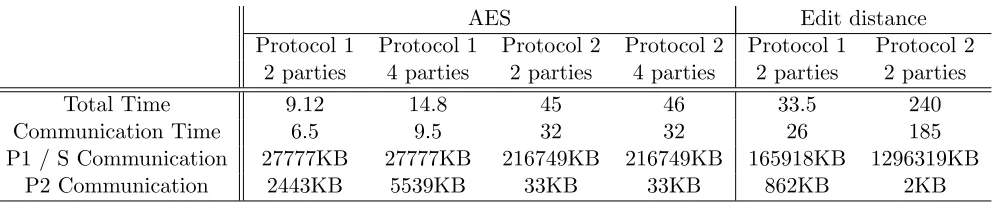
In Tables1 we present a summery of our experiments. These results are with SHA-1 as the under-lying hash function. The use of SHA-256 increases the total time by 5%−10% and the communication of P2 (and the other weak parties) by 30% on average in the first protocol (since the size of the
commitments is affected). We do not include the running time of the weaker parties since they were significantly smaller than S andP1 (e.g., 2 seconds for protocol 2 with AES).
We conclude from the above numbers that: (1) our first protocol requires more communication from the weak parties which makes it suitable mainly for weak devices that have high bandwidth; (2) the complexity of our second protocol is almost independent in the number of parties. The communication and running time of our first protocol, however, increases as the number of parties grows. The main overhead in both protocols is the communication of the garbled circuits.
Comparison to previous implementations. There are many factors that affect performance in practice. For example, size and structure of the circuit, communication latency, the security parameters, etc. However, the important and most objective parameters for evaluating any system are the total running time and the communication time. Thus, we try to compare our results with previous ones with respect to these parameters as much as possible 3
As we showed in Section 2, any secure 2SFE can be used to achieve the security we require. The question, however, is whether current 2SFE constructions give us better performance. The most efficient 2SFE implementation for semi-honest adversaries is the one of [29], which can securely compute AES in 0.2s. For the case of a covert adversary, the best result is 60 seconds [52] (in the random oracle model), whereas our first protocol takes around 9 seconds for 2 parties.
As for the more interesting case of 2SFE secure in the malicious model, the implementation of [52] runs in 1114 seconds, whereas the best known result is 192 seconds [55]. We note that the latter excludes communication and that our second protocol is more than four times faster including communication (which is of similar size to that of [55]).
A different but relevant class of protocols is, of course, that of secure multi-party SFE. In this case, the performance of current implementations is a step behind that of 2SFE implementations. For example, in the work of [13], one 32-bit multiplication takes roughly 9ms. Since it is based on arithmetic circuits, however, it is not clear how to best compare it to our work. If we multiply its running time by the number of non-XOR gates of the AES circuit, we get around 125s—which is almost three times slower than our second protocol. This performance, however, is for four parties with at most one malicious party, whereas our protocol with four parties allows up to three malicious parties. Moreover, it is shown in [13] that as the number of parties grows, the performance per multiplication gate gets worse (e.g., for seven parties with at most two malicious, it takes 28ms) whereas the performance of our protocol is almost independent of the number of parties.
The work of [11] considers secure multi-party computation with boolean circuits, but only for semi-honest parties. They do not use the AES benchmark but they show that it takes roughly 3−8 seconds for three parties to evaluate a circuit with 5500 AND gates. This means that in order to be faster than our second protocol, a semi-honest-to-malicious transformation would need to have an multiplicative
3