Wheatgrass Establishment
with Tillage and Herbicides in a
Mesic Medusahead Community1
JAMES A. YOUNG, RAYMOND A. EVANS, AND RICHARD E. ECKERT, JR. Range Scientists, Crops Research Division., Agricultural
Research Service, U.S.D.A., Reno, Nevada.
Highlight
Intermediate wheatgrass seedlings were successfully es- tablished in a medusahead community in 1965, 1966, and 1967 with mechanical or chemical-fallow treatments. Sum- mer fallowing by disk harrowing was the most successful treatment. The most productive wheatgrass stands sup- pressed but did not eliminate medusahead.
Medusahead
(Taeniatherum
asperum
(Sim.)
Nevski) poses a difficult problem for ranchers and
resource managers in California,
Idaho, Nevada,
Oregon and Washington.
When this winter annual
grass becomes
established
on depleted
ranges,
forage productivity
is drastically
reduced (Tore11
et al., 1961; Turner et al., 1963). Grazing capacity
on some ranches has been decreased as much as
757,
(Major et al., 1960).
The ultimate
control of medusahead
over the
millions of acres of rangeland that it now occupies
is basically a matter of suppression by well-managed
perennial grasses (Torell,
1967). By the time medu-
sahead becomes established and occupies extensive
areas in a rangeland
community,
the perennial
grass component of the community
is too depleted
to respond to management.
In these situations the
need for range seeding is imperative.
The extreme competition
offered by dense me-
dusahead stands makes weed control essential for
establishment
of perennial
grass seedlings.
Kay
and McKell
(1963)
used several
preemergence
herbicides
to aid in establishment
of rose clover
(Trifolium
hirtum
All.) and hardinggrass
(Phalaris
tuberosa
L. var.
stenoptera
(Hack.) in medusahead
stands. The most widely tested herbicide
for me-
dusahead
control
is 2,4-dichloropropionic
acid
(dalapon).
This
herbicide
has successfully
con-
trolled
medusahead
in California,
Idaho,
and
l Received July 12, 1968; accepted for publication September 6, 1968. Cooperative investigation of the Crops Research Division, Agricultural Research Service, U.S. Department of Agriculture and the Agricultural Experiment Station, University of Nevada, Reno. Journal Series No. 93. The authors gratefully acknowledge the cooperation given by Phillip Martinelli, Nevada Department of Agriculture. Our appreciation is extended to Harry Drackert for fur- nishing land for the experimental plots and to L. N. Langen of the Soil Conservation Service, U.S. Depart- ment of Agriculture for his technical advice and assistance in soil description interpretation.
Oregon (Kay, 1963; Turner
et al., 1963; Torell,
1967). On the California
annual range, control of
medusahead
with low rates of l, l’-dimethyl-4,4’-
bipyridinium
salts (paraquat)
has been extremely
effective in the establishment
of hardinggrass
and
annual clovers (Kay, 1966).
Our objectives in this study were: (1) to evaluate
tillage and herbicide
treatments for control of me-
dusahead;
(2) to determine
the most effective
method for establishment
of perennial
grasses in
conjunction
with medusahead control; and (3) to
ascertain the best adapted perennial
grass species
for seeding on the medusahead site being investi-
gated.
Methods
We conducted
this investigation
at Verdi, Ne-
vada (11 miles west of Reno at the base of the Sierra
Nevada Mountains).
The medusahead
infestation
is found on a formerly
cultivated,
unimproved
pasture.
The experimental
plots were established
on a long 5% slope facing east-to-southeast.
Soil
moisture increases along a gradient beginning with
dry rangeland at the upper end and ending in a wet
meadow at the lower. The upper portion of the
slope is occupied almost entirely by medusahead.
Small areas disturbed by rodents or grazing animals
supported sparse stands of downy brome
(Bromus
tectorum
L.) and hairy chess
(B. commutatus
Schrad.). Growing intermixed with, but suppressed
by the medusahead
population,
were scattered
plants of field bindweed
(Convolvulus
arvensis
L.)
and poverty weed
(Iva axillaris
Pursh.).
The only
remaining
perennial
grasses on the upper portion
of the site were scattered bunches of squirreltail
(Sitanion hystrix
(Nutt.) J. G. Smith) and isolated
rhizomatous
clumps
of streambank
wheatgrass
(Agropyron riparium
Scribn. and Smith). The more
mesic lower slope supported a thick stand of me-
dusahead
around
dense clumps of Baltic
rush
(Juncus balticus
Willd.).
A thin remnant stand of
pine bluegrass
(Poa scabrella
(Thurb.)
Benth.) and
meadow barley
(Hordeum
brachyantherum
Nevski)
was interspersed in the medusahead.
Precipitation
amounts and distribution
were ex-
tremely variable during the investigation.
In 1963-
64 (July-June)
13.4 inches of precipitation
were
received.
The
1964-65
precipitation
was 12.8
inches.
In 1965-66 virtually no precipitation
fell
after January
and the total was
7.3
inches.
The
winter and spring of 1966-67 were extremely wet
with 33 inches of precipitation
recorded.
Reno,
Nevada has a long-time average annual precipita-
tion of 7.73 inches, while at Truckee,
California,
25 miles west of Verdi and higher in the moun-
tains, the annual precipitation
averages over 30
inches ([J.S.D.A.,
1941).
152
YOUNG
ET AL.
laquolls. They have developed in gravelly alluvium
from andesite, tuffs, and tuff breccias.
Design of all field trials involving
logarithmic
spraying of herbicides
was a four-replicated
split
plot with systematic arrangement
of subplots (rates)
(Cochran & Cox, 1950).
We visually evaluated weed control through the
growing season on all plots. Oven-dry yields of the
mature weeds were used to evaluate season-long
control.
We evaluated stand establishment
of perennial
grasses by lst-year seedling counts and height mea-
surements
made in late July after annual plants
had died. In 1964, perennial grass seedlings were
counted several times during the growing season,
to study time of stress and mortality of seedlings.
To further evaluate stand establishment,
vigor,
and productivity,
we clipped perennial
grasses for
yield in successive years after establishment.
1964
Experiments.-We
applied paraquat and 2-
chloro-4-ethylamino-6-isopropylamino-s-triazine
(at-
razine) logarithmically
at rates ranging from 2.0
to 0.25 lb/acre and dalapon ranging from 6.0 to
0.75 lb/acre on plots 8
x 100ft on April 24, 1964.
Herbicides
were applied in water at 58 gpa and
30 psi. The surfactant
X-772 at 0.1% v/v was
used with all spray solutions.
Other treatments
were disk-harrowing,
furrow-
ing, and control.
The disk-harrowing
was done
with an offset-disk harrow. Furrows, 4 to 6 inches
deep and 4 inches across at the bottom and 10 to 12
inches at the top, were made with shovels attached
to a toolbar.
We seeded two rows of intermediate
wheatgrass
(Agropyron
intermedium
(Host) Beauv.) and one
row each of standard
crested wheatgrass
(Agro-
pyron desertorum
(Fisch.)
Schult.)
and Russian
wildrye
(EZymus junceus
Fisch.) immediately
after
treatment except for the plots treated with dalapon
and atrazine.
Plots treated with dalapon
were
seeded two weeks later using the same species; plots
treated with atrazine
were left unseeded.
The
perennial
grass seedlings failed to become estab-
lished in any of the treatments.
On November 24,
1964, all treatments
that had been seeded in the
spring of 1964 were reseeded with two rows of
Amur intermediate
wheatgrass and one row each of
standard
crested wheatgrass
and fairway crested
wheatgrass
(Agropyron
cristatum
(L.) Gaertn.).
A
dense stand of field bindweed developed in 1965 on
all plots where medusahead was controlled.
To re-
duce the field bindweed competition,
we applied 1
lb /acre acid equivalent
of propylene glycol butyl
ether
esters
of 2,4-dichlorophenoxyacetic
acid
(2,4-D) on May 21 and July 3, 1965.
1965
Experiments.-We
disk-harrowed
a 50
X 100ft block on May 5, 1965. The disk-harrowing
2 X-77 is a trade-mark surfactant containing alkylarylpoly-oxyethylene glycols, free fatty acids, and isopropanol.
provided
a summer-fallow
free of medusahead
plants although we had to spray the area on May
24 and June 16 with 2 lb/acre of 2,4-D to reduce
the bindweed population.
We seeded the fallow on
October
1, 1965, with Amur intermediate
wheat-
grass.
1966
Experiments.-We
repeated the most suc-
cessful
1964 treatments-disk-harrowing,
furrow-
ing, and dalapon-in
1966. The very low precipita-
tion during the winter of 1965-66 permitted earlier
application
of treatments
in 1966 than in 1964.
Using the same experimental
design as the one em-
ployed in 1964, we seeded disk-harrowed
and fur-
rowed plots to Amur intermediate
wheatgrass on
March 15, 1966. Because of incomplete emergence
of the medusahead population,
the 3 lb/acre dala-
pon treatment
was delayed until April 19. Plots
treated with dalapon were seeded on May 3, 1966
to intermediate
wheatgrass.
The disk-harrow and
furrow treatments were repeated on April 19, a date
comparable
to the 1964 treatments.
Field bind-
weed was again a serious problem.
We sprayed all
treatments with 1.5 lb/acre of 2,4-D on May 4 and
June 15, 1966. Perennial
grass stands on both the
March and April plots were unsatisfactory;
we
therefore reseeded all plots with Amur intermedi-
ate wheatgrass on October 11, 1966.
Red
ts
1964 Experiments.-
Paraquat
caused consider-
able discoloration
of medusahead leaves soon after
application.
After a few weeks the medusahead
plants completely
recovered and no weed control
was obtained.
Atrazine at rates ranging from 1 to
2 lb/acre controlled
medusahead
on the drier,
upper slope portion of the plots. The treatments
located on the moist lower slope required
2 lb,
acre of atrazine to control medusahead.
Dalapon
at rates ranging from 2 to 6 lb/acre resulted in
excellent
control.
The
disk-harrowed
and fur-
rowed plots were essentially
free of medusahead.
All treatments
that reduced
medusahead
were
followed by a heavy infestation
of field bindweed.
No seedlings of any perennial
grass species sur-
vived after August 1. More seedlings of intermedi-
ate wheatgrass emerged and lived longer than the
other three grass species tested. Also, more seed-
lings emerged and lived longer in the disked and
furrowed treatments
than m the dalapon-treated
areas (Fig. 1). The dalapon treatment
had the
disadvantage of a 2-week delay of seeding. Residual
herbicidal
activity of dalapon in the soil made this
delay necessary (Holstun and Loomis, 1956).
WHEATGRASS
FURROWS
O l S K HIRROW - - - OALlPON 6185 ,bCRE - - - -
2 7
FIG. 1. Intermediate wheatgrass seedling survival in relation to weed control treatments. All treatments were applied and seeded in the spring of 1964.
with atrazine had unsatisfactory
wheatgrass stands,
except at the 2 lb/acre rate which had a fair stand.
Two lb/acre of atrazine and disk-harrowing
mark-
edly reduced medusahead
yield below the control
population.
The 0.5 lb/acre atrazine treatment in-
creased medusahead production.
An important
factor in the successful establish-
ment of the wheatgrass
seedlings
was the sup-
pression of field bindweed
with application
of
2,4-D.
Plots that were disk-harrowed or which had been
sprayed with higher rates of dalapon in 1964 pro-
duced more intermediate
wheatgrass and less me-
dusahead in 1966 than the other 1964 treatments
(Table
2). In 1967, the plots sprayed with 6 lb/
acre of dalapon or disk-harrowed
in 1964 produced
significantly
more intermediate
wheatgrass
than
the other treatments.
The plots treated with atra-
zine in 1964 supported vigorous wheatgrass plants,
but stands were too sparse for satisfactory yields.
In the very wet season of 1967, medusahead growth
Table 1. Medusahead yield and wheatgrass seedlings per ft of row 1964 fall seeded treatments.a
Wheatgrass seedlings/ft of row
Inter- Standard Fairway Medusahead mediate Crested Crested Treatment Yield lb/Ah Whtg Whtg Whtg
Dalapon (lb/A)
6 280b 6.2 0.4 0.1
3 200bc 6.0 0.1 0.2
1.5 15oc 6.0 0.0 0.0
0.75 270b 5.5 0.1 0.1
Atrazine (lb/A)
2 120dc 1.2 0.1 0
1 230b 0.9 0.1 0.1
0.5 440a 0.2 0.0 0
Disk harrow 14oc 6.2 0.7 0.1
Furrows 200bc 5.4 0.3 0.6
Control 280b 0.4 0.0 0.0
“Medusahead yield was taken the fallow year (1964) and seedling counts were made the seedling year (1965).
b Means followed by the same letter are not significantly different at 0.5 probability level as determined by Duncan’s Range Test.
ESTABLISHMENT
153
Table 2. Yield in lb/acre dry matter of medusahead and intermediate wheatgrass for two and three years after establishment of perennial grass seedlings.*
1966 1967
Inter- Inter-
Rate mediate Medusa- mediate Medusa- Treatment (lb/A) Whtg head Whtg head
Dalapon 6 940a 39oc 1600a 770b
3 860b 590b 1llOb 750bc
1.5 920ab 510bc 1 IOOb 71oc
0.75 380d 460~ 560~ 830b
Atrazine 2 54oc 740a 640~ 760b
1 360d 640a 460~ 740bc
Disk-harrow 1lOOa 280d 1540a 770b
Furrows 600~ 45oc 980b 820b
Control Oe 650a Od 13OOa
“Weed control treatments applied in spring, 1964; intermediate wheatgrass seeded in fall, 1964.
bMeans followed by the same letter are not significantly different at the 0.5 probability level as determined by Duncan’s Range Test. All comparisons are made vertically.
was significantly
suppressed by all treatments;
but
yield of medusahead in successful wheatgrass stands
exceeded that of control plots in 1966. The most
productive
wheatgrass stands suppressed, but did
not eliminate medusahead.
A few scattered plants of standard and fairway
crested wheatgrass were established in the dalapon,
disk-harrowed and furrowed treatments, but stands
were too sparse for yield measurements.
The con-
trol plots were devoid of all wheatgrass plants by
the 1966 sampling.
1965 Experiments.-The
50
x100 ft block that
was summer fallowed by disk-harrowing
in 1965,
and seeded in October, 1965, produced an excellent
stand of intermediate
wheatgrass in 1966.
More
than five perennial
grass seedlings/ft
of row be-
came established
in spite of the extremely
dry
spring and summer of 1966. Because the block was
used for other experiments,
2nd year wheatgrass
yields were not taken.
1966
Experiments.-
Plots furrowed
and ones
disk-harrowed
in March, 1966 produced marginal
stands of intermediate
wheatgrass seedlings in 1966
(Table 3). Treatments
applied in April 1966 were
complete failures.
When intermediate
wheatgrass
Table 3. Intermediate wheatgrass seedlings per ft of row 1966 treatments (All seedings made in 1966).
Seeded Reseeded Seeded Reseeded Treatment March October April October
Furrowed 1.8 9.0 0 4.3
Disk-harrow 1.1 7.0 0 6.2
Dalapon, 3 lb/A Ob 2.0 Ob 1.9
Control 0 0.4 0 0
“Seedling counts made in late July 1966 and 1967.
154
YOUNG
ET AL.
was reseeded in October,
1966, plots treated in
March produced more seedlings than those treated
in late April.
Discussion
Intermediate
wheatgrass seedlings were success-
fully established
in a medusahead
community
in
1965, 1966, and 1967 with mechanical
or chemical-
fallow treatments.
With the exception of the 1965
summer fallow by disk-harrowing,
treatments were
not exclusively
designed to create a fallow. How-
ever, the summer fallow option was always much
more successful than spring seeding and summer
fallowing by disk-harrowing
was the most successful
treatment.
The advantages of summer fallowing
for seeding perennial wheatgrass on downy brome-
infested
rangelands
have been demonstrated
by
Eckert and Evans (1967).
During years of average
or above average precipitation,
the Verdi site is too
wet and muddy to permit weed control and seeding
treatments
until late in the spring. This severely
limits the chances of success with spring seeding.
During the very dry spring of 1966, it was possible
to apply treatments and seed in March, but result-
ing wheatgrass stands were marginal.
Using similar
weed control techniques
on sites in Nevada where
early spring treatment
is possible,
Evans et al.
(1967) have been successful in establishing
wheat-
grass in downy brome communities
with spring
seedings.
Any reduction
in medusahead
density at Verdi
resulted in an increase in field bindweed.
The sup-
pression of the field bindweed by spraying 2,4-D
during the summer fallow and the seedling years
aided establishment
of wheatgrass seedlings. Tore11
(1967) reported similar problems with other broad-
leaf species in Idaho.
Downy brome did not significantly
increase on
plots treated with dalapon at Verdi.
This species
has significantly
increased
on other medusahead
sites and caused severe competition
to wheatgrass
seedlings
following
dalapon
fallow
treatments
(Torell, 1967).
The disk-harrowing,
furrowing, and higher rates
of dalapon treatments virtually eliminated
the me-
dusahead population
for one year. Even though
wheatgrass seedlings
completely
stocked plots so
treated, medusahead reinvaded the plots during the
seedling year. Wheatgrass
stands, after the seed-
ling year, suppressed growth of medusahead,
but
certainly did not eliminate it. Turner, et al. (1963)
advocated weed control treatments
to remove me-
dusahead from established
stands of wheatgrass.
On the Verdi medusahead
site, Amur interme-
diate wheatgrass was superior to standard or fair-
way crested wheatgrass in seedling stand establish-
ment.
The site at Verdi is representative
of the margins
of wet meadows in degraded condition
found in
the Great Basin.
Medusahead
is evidently
well-
adapted to these environmental
conditions.
The
discontinuous
distribution
of meadows in the Great
Basin should hinder the spread of medusahead.
However, no matter how remote and disjunct these
meadow sites may be, competitive
species such as
baltic rush are omnipresent.
Given time, medusa-
head may become widely distributed
on these re-
stricted sites.
The generally steep and rocky terrain of much
medusahead-infested
rangeland imposes limitations
on the feasibility
of applying the tillage methods
developed at Verdi to all medusahead infestations.
The acreage of rangelands
infested with medusa-
head where these tillage methods may be applied
is small in comparison to the total acreage infested
by the species, but the tillable sites are usually the
most productive
and offer the greatest return of
investment.
If weed control necessary to establish
wheatgrass seedlings could be accomplished
by a
chemical fallow, thousands of acres ordinarily tilled
only with difficulty, could be seeded with a heavy
rangeland
drill.
Conclusions
Intermediate
wheatgrass seedlings were success-
fully established
in a medusahead
community
in
1965, 1966, and 1967 with mechanical
or chemical-
fallow treatments.
Summer fallowing with a disk
harrow was the most successful treatment.
How-
ever, chemical-fallowing
with dalapon offers the
possibility of extending the technique
to areas not
suitable for tillage.
The fallow treatments were much more success-
ful for wheatgrass establishment
than spring seed-
ing following tillage or herbicide
treatments.
Any reduction
in medusahead
density resulted
in an increase in field bindweed.
The suppression
of field bindweed
by spraying 2,4-D during the
summer fallow and seedling years aided establish-
ment of wheatgrass seedlings.
Intermediate
wheatgrass produced the best stands
among all grasses seeded regardless of weed con-
trol method.
Established
stands of intermediate
wheatgrass greatly suppressed but did not eliminate
medusahead.
LITERATURE CITED
COCHRAN, W. G., AND G. M. Cox. 1950.
Experimental
designs. John Wiley & Sons, Inc., New York. 454 p. ECKERT, R. E., AND R. A. EVANS. 1967. A chemical-fallowtechnique for control of downy brome and establishment of perennial grasses on rangeland. J. Range Manage. 29:35-41.
EVANS, R. A., R. E. ECKERT, JR., AND B. L. KAY. 1967. Wheatgrass establishment with paraquat and tillage on downy brome ranges. Weeds 15:50-55.
TOBOSA
GRASS
155
KAY, B. L. 1963. Effects of dalapon on a
medusahead
TORELL, P. J. 1967. Dowpon-an aid to reseeding me- community. Weeds 3:207-209. dusahead-infested rangeland. Down to Earth 23:6-S. KAY, B. L. 1966. Paraquat for range seeding without cul- TORELL, P. J., L. C. ERICKSEN, AND R. H. HAAS. 1961.tivation. California Agr. 20:2-4. The medusahead problem in Idaho. Weeds 9: 124-131. KAY, B. L., AND C. M. MCKELL. 1963.
Preemergence
TURNER, R. B., C. E. POULTON, AND W. L. GOULD. 1963.herbicides as an aid in seeding annual rangelands. Weeds Medusahead-A threat to Oregon rangeland. Special Rep. 11: 260-264. 149, State Univ. Corvallis, Oregon. 37 p.
MAJOR, J., C. M. MCKELL, AND L. J. BERRY. 1960. Im- U. S. DEPARTMENT AGRICULTURE. 1941. Climate and Man. provement of medusahead-infested rangeland. Calif. Expt. Yearbook of Agriculture, U. S. Government Printing Sta. Ser. Leaf. 123. 3 p. Office, Washington, D. C. 1248 p.
Chemical Composition of Tobosa
Grass Collected by Hand-Plucking
and Esophageal-Fistulated Steers’
H. E. KIESLING, A. B. NELSON,AND C. H. HEBBEL2
Graduate Student and Professor, Department of Animal, Range and Wildlife Sciences, New Mexico State University,
Las Cruces; and Range Scientist, Jornada Experimental Range, Crops Research Div., Agricultural Research
Service, U.S.D.A., Las Cruces.
Highlight
Organic matter recovery of seven feeds collected through esophageal fistulae of three steers averaged 90.4%. Six of the seven fistula samples contained significantly more ash than the feeds offered. Fistula samples of grazed tobosa (Hiluriu muticu (Buckl.) Benth.) contained less A.O.A.C. fiber but more silica, ash, protein, ether extract, detergent fiber and detergent lignin than hand-plucked grass. Except for ash, the differences in chemical composition between hand-plucked and esophageal-fistula samples were appar- ently due to selectivity by the grazing steers. We assume that samples collected by means of an esophageal fistula are more nearly representative of the forage consumed by graz- ing steers than samples hand-plucked by a technician.
Esophageal-fistulated
animals have been proposed
as a means of determining
the nutrient
content
of the diet of grazing animals.
Several researchers
(Bath et al., 1956; Lesperance et al., 1960; Lombard
and Van Schalkwyk,
1963; Marshall
et al., 1967;
Campbell et al., 1968) have compared the chemical
composition
of feeds offered with samples of these
l Published as Journal Series No. 306, Agricultural Experi- ment Station, New Mexico State University, Las Cruces, New Mexico. Cooperative investigations of the Depart- ment of Animal, Range and Wildlife Sciences, New Mexico Agricultural Experiment Station and the Crops Research Division, Agricultural Research Service, U.S.D.A. Par- tially supported by Western Regional Research Project W-94. Received May 17, 1968; accepted for publication November 15, 1968.
^The assistance of Dr. Jack Ruttle in the preparation of the fistulated steers and of Mr. Monte Mauldin in conduct- ing part of the chemical analysis is gratefully acknowledged.
feeds collected through an esophageal fistula. Some
(Edlefsen et al., 1960; Campbell et al., 1968) have
compared
the chemical
composition
of fistula
samples with hand-plucked
grass while others have
compared fistula samples with clipped forage (Bath
et al., 1956; Weir and Torell,
1959; Bredon et al.,
1967).
The purpose of this study was to compare the
chemical composition
of esophageal-fistula
samples
with both feed and hand-plucked
grass samples.
Methods
Experiment
l.-
Each of seven feeds was divided
into four portions.
One portion
was used for
chemical analysis and the others were fed to each
of three esophageal-fistulated
Hereford steers which
had been kept off feed overnight.
Two hundred
and fifty grams of tobosa hay and 451 to 454 g each
of alfalfa hay, ground milo, cottonseed meal, pel-
leted mixture, alfalfa hay mixture and cottonseed
hull mixture were fed to and consumed by each
steer (see Table
1 for ingredient
content of mix-
tures). There were no feed refusals.
Esophageal-
fistula samples were collected in a plastic bag within
a canvas bag positioned below the fistula. All saliva
collected remained as part of the sample. All sam-
ples were weighed and dried at 70 C in a forced-air
oven, ground through a 60-mesh screen in a Wiley
mill and analyzed for dry matter, ash, crude pro-
tein, ether extract, and fiber (A.O.A.C.,
1960).
TOBOSA
GRASS
155
KAY, B. L. 1963. Effects of dalapon on a
medusahead
TORELL, P. J. 1967. Dowpon-an aid to reseeding me- community. Weeds 3:207-209. dusahead-infested rangeland. Down to Earth 23:6-S. KAY, B. L. 1966. Paraquat for range seeding without cul- TORELL, P. J., L. C. ERICKSEN, AND R. H. HAAS. 1961.tivation. California Agr. 20:2-4. The medusahead problem in Idaho. Weeds 9: 124-131. KAY, B. L., AND C. M. MCKELL. 1963.
Preemergence
TURNER, R. B., C. E. POULTON, AND W. L. GOULD. 1963.herbicides as an aid in seeding annual rangelands. Weeds Medusahead-A threat to Oregon rangeland. Special Rep. 11: 260-264. 149, State Univ. Corvallis, Oregon. 37 p.
MAJOR, J., C. M. MCKELL, AND L. J. BERRY. 1960. Im- U. S. DEPARTMENT AGRICULTURE. 1941. Climate and Man. provement of medusahead-infested rangeland. Calif. Expt. Yearbook of Agriculture, U. S. Government Printing Sta. Ser. Leaf. 123. 3 p. Office, Washington, D. C. 1248 p.
Chemical Composition of Tobosa
Grass Collected by Hand-Plucking
and Esophageal-Fistulated Steers’
H. E. KIESLING, A. B. NELSON,AND C. H. HEBBEL2
Graduate Student and Professor, Department of Animal, Range and Wildlife Sciences, New Mexico State University,
Las Cruces; and Range Scientist, Jornada Experimental Range, Crops Research Div., Agricultural Research
Service, U.S.D.A., Las Cruces.
Highlight
Organic matter recovery of seven feeds collected through esophageal fistulae of three steers averaged 90.4%. Six of the seven fistula samples contained significantly more ash than the feeds offered. Fistula samples of grazed tobosa (Hiluriu muticu (Buckl.) Benth.) contained less A.O.A.C. fiber but more silica, ash, protein, ether extract, detergent fiber and detergent lignin than hand-plucked grass. Except for ash, the differences in chemical composition between hand-plucked and esophageal-fistula samples were appar- ently due to selectivity by the grazing steers. We assume that samples collected by means of an esophageal fistula are more nearly representative of the forage consumed by graz- ing steers than samples hand-plucked by a technician.
Esophageal-fistulated
animals have been proposed
as a means of determining
the nutrient
content
of the diet of grazing animals.
Several researchers
(Bath et al., 1956; Lesperance et al., 1960; Lombard
and Van Schalkwyk,
1963; Marshall
et al., 1967;
Campbell et al., 1968) have compared the chemical
composition
of feeds offered with samples of these
l Published as Journal Series No. 306, Agricultural Experi- ment Station, New Mexico State University, Las Cruces, New Mexico. Cooperative investigations of the Depart- ment of Animal, Range and Wildlife Sciences, New Mexico Agricultural Experiment Station and the Crops Research Division, Agricultural Research Service, U.S.D.A. Par- tially supported by Western Regional Research Project W-94. Received May 17, 1968; accepted for publication November 15, 1968.
^The assistance of Dr. Jack Ruttle in the preparation of the fistulated steers and of Mr. Monte Mauldin in conduct- ing part of the chemical analysis is gratefully acknowledged.
feeds collected through an esophageal fistula. Some
(Edlefsen et al., 1960; Campbell et al., 1968) have
compared
the chemical
composition
of fistula
samples with hand-plucked
grass while others have
compared fistula samples with clipped forage (Bath
et al., 1956; Weir and Torell,
1959; Bredon et al.,
1967).
The purpose of this study was to compare the
chemical composition
of esophageal-fistula
samples
with both feed and hand-plucked
grass samples.
Methods
Experiment
l.-
Each of seven feeds was divided
into four portions.
One portion
was used for
chemical analysis and the others were fed to each
of three esophageal-fistulated
Hereford steers which
had been kept off feed overnight.
Two hundred
and fifty grams of tobosa hay and 451 to 454 g each
of alfalfa hay, ground milo, cottonseed meal, pel-
leted mixture, alfalfa hay mixture and cottonseed
hull mixture were fed to and consumed by each
steer (see Table
1 for ingredient
content of mix-
tures). There were no feed refusals.
Esophageal-
fistula samples were collected in a plastic bag within
a canvas bag positioned below the fistula. All saliva
collected remained as part of the sample. All sam-
ples were weighed and dried at 70 C in a forced-air
oven, ground through a 60-mesh screen in a Wiley
mill and analyzed for dry matter, ash, crude pro-
tein, ether extract, and fiber (A.O.A.C.,
1960).
156
KIESLING
ET AL.
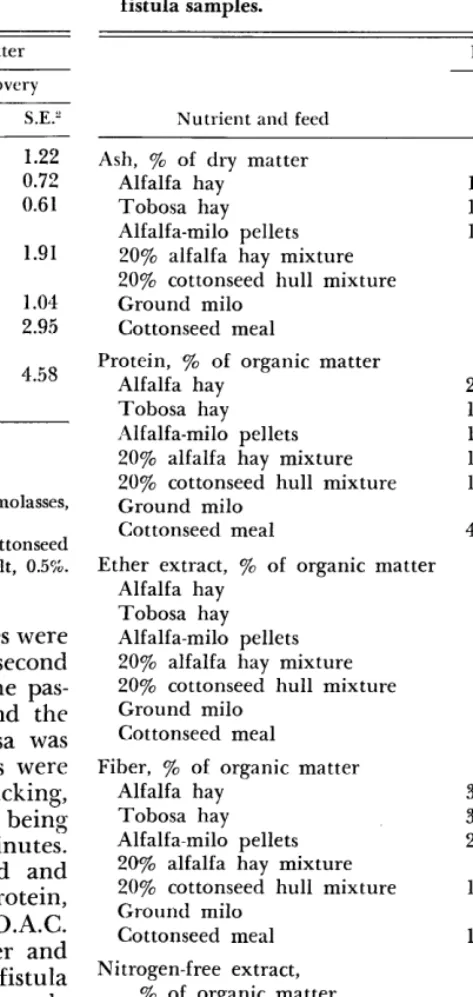
Table 1. Time required for feed consumption and organic Table 2. Chemical composition of feeds and esophageal matter recovery through the esophageal fistula.1 fistula samples.
Organic Matter Consumption
Total min G/min
Alfalfa hay 12 32 Tobosa hay 12 17 Pellets” 8 47 Alfalfa hay
mixture4 7 56 Cottonseed hull
mixture5 6 65 Ground milo 7 57 Cottonseed
meal 9 45 Average
IAverage of three steers. 2Standard error.
Grams Recovery consumed % S.E.”
381.3 88.0 1.22 205.6 92.0 0.72 378.9 95.2 0.61
388.2 87.5 1.91
387.9 91.7 1.04 397.0 90.4 2.95
403.9 88.2 4.58 90.4
Percent composition Fistula Nutrient and feed Feed Mean1 SE.
Ash, % of dry matter Alfalfa hay Tobosa hay Alfalfa-milo pellets 20% alfalfa hay mixture 20% cottonseed hull mixture Ground milo
Cottonseed meal
11.1”” 14.2 0.17
12.7”” 15.6 0.16
10.9”” 12.6 0.10
5.0” 6.1 0.22
5.2* 6.2 0.14
1.5” 2.6 0.19
7.1 8.3 0.30
3Alfalfa hay, 70%; milo, 25%; molasses, 5%.
4Steam rolled milo, 74.5%; ground alfalfa hay, 20.0%; molasses, 5.0%; salt, 0.5%.
6Steam rolled mile, 66.9%; cottonseed hulls, 20.0%; cottonseed meal, 7.0%; molasses, 5.0%; ground limestone, 0.6%; salt, 0.5%.
Protein, % of organic matter Alfalfa hay
Tobosa hay Alfalfa-milo pellets 20% alfalfa hay mixture 20% cottonseed hull mixture Ground milo
Cottonseed meal
22.5 23.6 0.48
12.2 12.5 0.15
17.1 17.4 0.10
12.4 12.2 0.01
12.5 12.4 0.24
7.9” 8.2 0.05
48.1 47.4 0.20 ter
ings of three consecutive days. Three pastures were
sampled on the first day, two pastures on the second
day and two pastures on the third day. The pas-
tures were nearly pure stands of tobosa and the
steers were restricted
to areas where tobosa was
the only forage. The hand-plucked
samples were
obtained by a technician breaking off, or plucking,
parts of plants similar
to those observed
being
consumed by a steer grazing for about 15 minutes.
The
hand-plucked
samples were ground and
analyzed for dry matter, ash, silica, crude protein,
ether extract, and fiber according to the A.O.A.C.
(1960) methods and for acid-detergent
fiber and
lignin by the Van Soest (1963) method. The fistula
samples were frozen and a representative
sample
was taken from each collection by sawing out cross
sections.
Part of each sample was dried at 70 C in
a forced-air
oven, ground and analyzed for dry
matter, ash, silica, crude protein, ether extract, and
A.O.A.C. fiber. Wet fistula samples were used for
the acid-detergent
fiber and lignin determinations.
The Student’s
t
was used as a test of significance
for the chemical
composition
between
feed and
fistula samples. Analysis of variance and Duncan’s
multiple range tests were used for the hand-plucked
and fistula comparisons (Steel and Torrie, 1960).
Ether extract, “/o of organic mat Alfalfa hay
Tobosa hay Alfalfa-milo pellets 20% alfalfa hay mixture 20% cottonseed hull mixture Ground milo
Cottonseed meal
1.2 1.0 0.06
1.2 1.0 0.00
1.5”” 1.0 0.02
2.8”* 2.4 0.02
2.8”” 2.3 0.04
3.0** 2.1 0.03
4.0 3.8 0.12 Fiber, “/o of organic matter
Alfalfa hay Tobosa hay Alfalfa-milo pellets 20% alfalfa hay mixture 20% cottonseed hull mixture Ground milo
Cottonseed meal
30.5” 32.4 0.21
36.4” 35.2 0.26
24.3 25.5 0.55
6.1 6.4 0.16
10.3 10.5 0.42
2.8 3.2 0.26
10.4 11.7 0.19 Nitrogen-free extract,
% of organic matter Alfalfa hay
Tobosa hay Alfalfa-milo pellets 20% alfalfa hay mixture 20% cottonseed hull mixture Ground milo
Cottonseed meal
45.8 43.0 0.75 50.2 51.2 0.42 57.2 56.1 0.51 78.7 79.0 0.28 74.3 74.8 0.30 86.3 86.5 0.24 37.5 37.1 0.46
l Average of three steers.
+ P < .05 for feed vs. fistula samples. +* P < .Ol for feed vs. fistula samples.
Results and Discussion
Experiment 1
The feeds offered were eaten in a relatively short
period (Table l), and no difficulty was encountered
in collecting
the samples through the fistula. The
pellets, concentrates
and high-concentrate
mixtures
were consumed at a much faster rate than the hays.
Tobosa
was consumed
at the slowest rate with
alfalfa hay intermediate
between tobosa hay and
the other feeds.
The organic matter recoveries
varied from 87.5 to 95.2y0 and were similar to those
reported by Campbell et al. (1968) for concentrate-
type feeds but considerably
higher than those for
clipped grasses.
TOBOSA
GRASS
157
content was significantly
higher in the fistula sam-
ples for all feeds except cottonseed
meal.
This
increased
ash was apparently
due to saliva con-
tamination,
and is in agreement
with the results
reported by other researchers
including
Campbell
et al. (1968), Hoehne et al. (1967) and Lesperance
et al. (1960).
Because of increased ash, McManus
(1961) and Grimes
et al. (1965) suggested that
chemical composition
be expressed on an ash-free
or organic matter basis.
Only in the case of ground milo was the protein
content significantly
higher in the fistula samples
than in the feed samples.
Since saliva dry matter
contains about 4.51 y0 protein (Bailey and Balch,
196 I), large amounts of saliva collected
with a
sample could increase the protein content.
HOW-
ever, Bath et al. (1956),
Edlefsen
et al. (1960),
Lesperance et al. (1960) and Campbell et al. (1968)
have reported no increase of protein in esophageal
fistula samples.
Hoehne et al. (1967) found that
fistula samples of prairie sandreed and blue grama,
which were squeezed to remove excess saliva, were
lower in protein than feed samples, and that non-
squeezed fistula samples of prairie sandreed were
significantly
higher than squeezed samples.
The ether extract content of the three mixed
feeds and ground milo was significantly
higher in
the feed than in the fistula samples.
Bath et al.
(1956), Campbell
et al. (1968), Lesperance
et al.
(1960) and Lombard
and Van Schalkwyk
(1963)
have reported
no significant
difference
in ether
extract for similar feeds.
Fiber content
of the fistula samples was sig-
nificantly
higher
for alfalfa hay and lower for
tobosa hay than the feed offered. Lesperance
et al.
(1960)
reported
an increase
of fiber in fistula
samples while Bath et al. (1956), Lombard and Van
Schalkwyk
(1963) and Campbell
et al. (1968) re-
ported no significant change in fiber.
None of the differences
in nitrogen-free
extract
was significant.
This agrees with the findings of
Bath et al. (1956) for alfalfa hay, and with Camp-
bell et al. (1968) f or concentrate-type
feeds. With
their clipped grass, however, the fistula samples
were lower in nitrogen-free
extract.
Lombard and
Van Schalkwyk (1963) also reported a decrease in
nitrogen-free
extract
of fistula samples for hays
and green feeds.
Experiment 2
Chemical composition of hand-plucked
grass and
esophageal-fistula
samples is given in Table
3.
The fistula samples contained
significantly
more
ash and protein, but less A.O.A.C. fiber, than hand-
plucked grasses. This agrees with the results of
most researchers
and apparently
reflects the ash
added by saliva and selection of a higher quality
diet by grazing steers. Weir and Tore11 (1959) re-
ported
that sheep consistently
selected
forage
higher in protein and lower in fiber than hand
clipped grasses. Bredon et al. (1967) stated that
fistula samples of tropical forage contained
more
protein and less fiber than clipped forage.
Fistula samples also contained more silica, ether
extract,
detergent
fiber,
and detergent
lignin.
Edlefsen et al. (1960), however, found that fistula
samples were significantly
lower in lignin;
and
Campbell et al. (1968) reported that fistula samples
of bermudagrass
were lower in ether extract than
hand-plucked grass.
Acid-detergent
fiber
was significantly
higher
than 14.0.A.C.
fiber for both hand-plucked
and
fistula samples in all pastures. Pasture differences
were also significant
for both methods.
Since de-
tergent fiber was determined on wet fistula samples
which were not ground and, therefore,
contained
many large particles of forage, incomplete digestion
during refluxing
could have resulted
in higher
values for the detergent fiber.
However, this was
not true for hand-plucked
samples, since the prep-
aration of the samples was the same for both fiber
determinations.
Pasture differences
were signifi-
cant for all constituents
except ash. The forage
sprayed with molasses plus urea was highest in pro-
tein and lowest in nitrogen-free
extract, but that
sprayed with molasses only contained the least pro-
tein and most nitrogen-free
extract. These pasture
samples also contained
significantly
less A.O.A.C.
fiber and detergent
fiber.
Samples of grass from
pasture 3 (fed tobosa hay) contained
more lignin
than samples from the other pastures.
The pasture x method interaction
was significant
for ash, protein, and detergent fiber. These inter-
actions were probably
due to the pasture treat-
ments.
Pasture differences
within methods were
considerable
and are shown in Table 3. For ash
there was a significant difference between methods
in all pastures. The fistula samples from the pas-
ture in which cottonseed meal pellets were fed and
the control pasture contained more protein, while
fistula
samples from the pasture sprayed with
molasses plus urea contained
less protein
thanhand-plucked
grass.
Conclusions
Organic matter recovery of seven feeds collected
through esophageal fistulae of three steers averaged
90.4%.
The
fistula
samples
were significantly
higher in ash for all feeds except cottonseed meal,
in protein for ground milo, and in A.O.A.C. fiber
for alfalfa hay; but they were lower in ether extract
for a pelleted mixture, alfalfa hay mixture, cotton-
seed hulls mixture,
and ground
milo and in
A.O.A.C. fiber for tobosa hay. Chemical composi-
tion of feed samples collected through an esopha-
geal fistula should be expressed on an organic
matter basis.
158
KIESLING
ET AL.
Table 3. Chemical composition (%) of hand-plucked grass aI-4 esophageal-fistula samples.1
Composition of organic matter
Pasture Method Silica Ash Protein extract Ether A.O.A.C. fiber extract N-free Detergent fiber Detergent lignin
1 Fertilized 2 Cottonseed meal pellets 3 Tobosa hay
4 Burned 5 Molasses 6 Molasses
and urea
7
ControlMean
Plucked 7.23
Fistula 7.66
Difference 0.43
Mean 7.44bc
Plucked Fistula Difference Mean
6.06 2.15j
8.53 6.25~~
2.47 4.10”
7.3Obc 4.20 Plucked Fistula Difference Mean 1 9.74
IO.08
0.34 9.91a Plucked Fistula Difference Mean8.83 2.14j
9.75 5.87~
0.92 3.73”
9.20ab 4.00 Plucked
Fistula Difference Mean
7.48 3.62’
9.72 6.34~~
2.24 2.72”
8.60~“~ 4.98 Plucked
Fistula Difference Mean
5.83 3.62’
8.43 6.08~~
2.60 2.46”
7.13bc 4.85 Plucked
Fistula Difference Mean
6.33 2.8Oij
7.01 6.78~
0.68 3.98”
6.67~ 4.79 Plucked
Fistula Difference
7.36 2.79 4.70
8.71 6.13 5.68
1.35”” 3.34”” 0.98”” 2.46j 5.51y 3.05” 4.08 2.77j 5.9oy 3.13” 4.22 5.06j 6.26~~ 1.20 5.66” 3.64jkl 5.58~ 1.94” 4.61cd 4.76jk 6.36~~’ 1.60” 5.56bc 3.33k’ 4.87~2 1.54” 4.10d 2.29kl 3.792 1.50 3.04e 10.06’ 7.51x 2.55” 8.78a 3.76jkl 5.43y 1.69” 4.58d
1.06 40.42 1.01 38.21
0.05 2.21
1.04d 39.31n
53.46 58.26j 8.59
54.52 59.98s 5.98
1.06 1.72 0.39
53.99b 59.1 led 8.79”
0.99 40.62 1.27 39.04
0.28 1.58
1.13bcd 39.838
54.76 57.08j 8.80
54.12 64.92x 9.38
0.64 7.84” 0.58
54.44b 6 1 .OO”c 9.09b 0.94 41.38
1.20 37.98
0.26 3.40
1.07” 39.68a
52.92 62.76’ 10.60
54.45 67.77~ 10.42
1.53 5.01* 0.18
53.68b 65.27a 10.51a 1.13 40.80
1.71 37.65
0.58 3.15
1.42a 39.23a
54.74 60.22ij 8.62
55.77 67.70~ 9.64
1.03 7.48” 1.02
55.26” 63.96a” 9.13b 0.98 35.28
1.55 34.06
0.57 1.22
1.27abc 34.67b
61.45 53.13k 7.54
60.60 58.28~ 9.21
0.85 5.15* 1.67
61.02a 55.70e 8.38b
0.90 36.29 1.31 36.85
0.41 0.56
l.lOcd 36.57”
52.75 53.12k 7.86
54.33 60.92s 9.72
1.58 7.80” 1.86
53.54b 57.02de 8.79” 1.16 41.88
1.44 38.17
0.28 3.71
1.30ab 40.02a
53.22 58.9Oj 8.04
55.30 59.91s 9.88
2.08 1.01 1.84
54.26b 59.40cd 8.96”
1.02 39.52 54.76
1.36 37.42 55.58
0.34”” 2.10”” 0.82
57.64 8.58
62.78 9.60
5.14** 1.02””
1 Average of three samples for each method.
abcde Pasture means within the same column with different letter superscripts are significantly different (P < .05).
IJkl Pasture means within hand plucked samples in the same column with different letter superscripts are significantly different (P < .05).
XV Pasture means within fistula samples in the same column with different letter superscripts are significantly different (P < .05). * P < .05 for method differences.
#+ P < .Ol for method differences.
nificantly
more silica, ash, protein, ether extract,
LITERATURE
CITED
detergent
fiber,
and detergent
lignin,
but less
A.O.A.C. fiber than hand-plucked samples obtained
A.O.A.C. 1960. Official Methods of Analysisfrom seven pastures of tobosa. Pasture differences
.
.^_
__1
Association of Official Agricultural Chemists. ton, D.C.(9th ed.). Washing-
were significant
ior all constituents
except ash and
the pasture x method interaction
was significant for
ash and protein.
Except for ash, the differences
in chemical com-
position
between
hand-plucked
and esophageal-
fistula samples were apparently due to selectivity by
the grazing steers. We assume, therefore, that sam-
ples collected
by means of an esophageal
fistula
are more nearly representative
of the forage con-
sumed by grazing steers than samples hand-plucked
by a technician.
BAILEY, C. B., AND C. C. BALCH. 1961. Salivary secretion and its relation to feeding in cattle. Part I: The composi-
tion and rate
of secretion to parotid saliva in a smallsteer.
Brit. J. Nutr. 15:371-382.BATH, D. L., W. C. WEIR, AND D. T. TORELL. 1956.
The use of the esophageal fistula for the determination of composition and digestibility of pasture forage by sheep. J. Anim. Sci. 15:1166-1171.
BREDON, R. M., D. T. TORELL, AND B. MARSHALL. 1967.
CHAPARRAL
MANIPULATION
159
CA~IPBELL, C. M., K. S. ENG, JR., A. B. NELSON, AND L. S. MARSHALL, B., D. T. TORELL, AND R. M. BREDON. 1967.
POPE. 1968. Use of the esophageal fistula in diet sam-
pling with beef cattle. J. Anim. Sci. 27:231-233. Comparison of tropical forages of known composition with EDLEFSEN, J. L., C. W. COOK, AND J. T. BLAKE. 1960. Nu- samples of these forages collected by esophageal fistulated
trient content of diet as determined by hand plucked animals. J. Range Manage. 2O:3 10-313.
and esophageal fistula samples. J. Anim. Sci. 19:560- MCMANUS, W. R. 1961. Properties of roughage feed-
567. stuffs collected from oesophageal fistulas. Aust. J. Exp.
GRIMES, R. C., B. R. WATKINS, AND P. F. MAY. 1965. The Agr. Anim. Husb. 1: 159-163.
botanical and chemical analysis of herbage samples ob- STEEL, R. G- D-9 AND
J- He TORRIE. 1960.
Principles and tained from sheep fitted with oesophageal fistulae. J. Procedures of Statistics. McGraw-Hill Book Company,Brit. Grassl. Sot. 20: 168-173. Inc., New York.
HOEHNE, 0. E., D. C. CLANTON, AND C. L. STREETER. 1967. TORELL, D. T.
Chemical changes in esophageal fistula samples caused 1954. An esophageal fistula for animal by salivary contamination and sample preparation. J. nutrition studies. J. Anim. Sci. 13:878-884.
Anim. Sci. 26: 628-63 1. VAN SOEST, P. J. 1963. Use of detergents in the analysis
LESPERANCE, A. L., V. R. BOHMAN, AND D. M. MARBLE. of fibrous feeds. II. A rapid method for the determination 1960. Development of techniques for evaluating grazed of fiber and lignin. J. Ass. Offici. Agr. Chem. 46:829-835. forage. J. Dairy Sci. 43:682-689. WEIR, W. C., AND D. T. TORELL. 1959. Selective grazing LOMBARD, P. E., AND A. VAN SCHALK~YK. 1963. Verande- by sheep as shown by a comparison of the chemical com-
ringe in samestelling van voere tydens monsterneming position of range and pasture forage obtained by hand met behulp van’n slukdermfistel. S. Afr. J. Agr. Sci. 6:
205-211. J. Anim. Sci. 18:641-649. clipping and that collected by esophageal-fistulated sheep.
9
Chaparral Manipulation Affects
Soil Moisture Depletion Patterns
and Seedling Establishment
1
CYRUS M. MCKELL, J. R. GOODIN, AND CAMERON DUNCAN2
Professor of Agronomy, Assistant Professor, and Laboratory Technician I, Agronomy Department,
University of California, Riverside.
Highlight
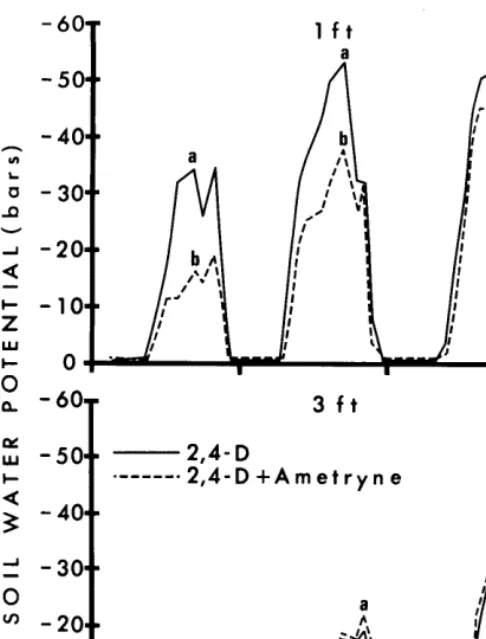
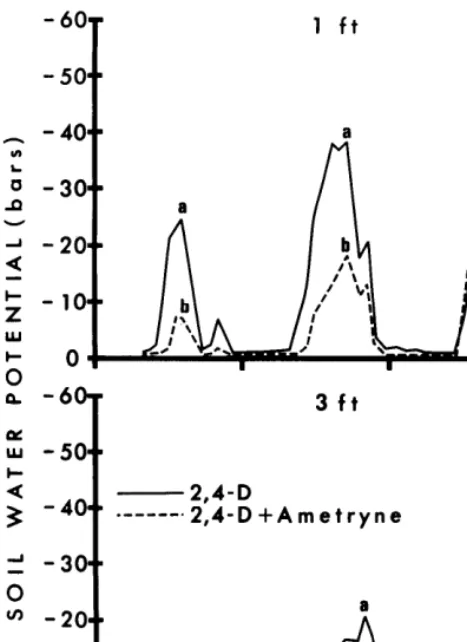
Soil moisture depletion in the first 3 ft of soil under chaparral reaches high levels of stress each dry season. Hand clearing the chaparral or spraying with a brush- killer herbicide decreases soil moisture stress and increases the chance for successful perennial grass establishment.
Approximately
ten million
acres of California
land supports
a vegetation
cover of chaparral.
These lands are increasingly
important
as water-
sheds, grazing lands, recreation
areas, homesites,
and for their esthetic
value.
To increase
land
values for these uses and yet to reduce fire and
erosion hazards of areas not subject to soil slippage,
conversion of certain chaparral areas from brush to
perennial
grass has been recommended.
The re-
1 Research supp orted by funds from Grant W121, Water Re- sources Center, University of California. Received *June 24, 1968; accepted for publication October 28, 1968.
2Grateful acknowledgment is given to Mr. and Mrs. Bud Pepper in San Diego County and to Oak Glen Investments, Inc., in Long Beach for the use of their property as sites for these studies.