Mapping Quantitative Trait Loci Using Generalized Estimating Equations
Christoph Lange*
,†and John C. Whittaker*
*School of Applied Statistics, University of Reading, Reading RG6 6FN, United Kingdom and†Department of Biostatistics,
Harvard School of Public Health, Boston, Massachusetts 02115 Manuscript received November 17, 2000 Accepted for publication August 29, 2001
ABSTRACT
A number of statistical methods are now available to map quantitative trait loci (QTL) relative to markers. However, no existing methodology can simultaneously map QTL for multiple nonnormal traits. In this article we rectify this deficiency by developing a QTL-mapping approach based on generalized estimating equations (GEE). Simulation experiments are used to illustrate the application of the GEE-based approach.
O
VER the last 10 years, there has been a great deal data (LiangandZeger1986;Diggleet al.1996). The advantage of the GEE methodology is its semiparametric of interest in the development of methodology tomap quantitative trait loci (QTL) relative to a known character: Correct specification of the mean and covari-ance structure of the model is sufficient to guarantee marker map in populations derived from inbred line
crosses. Perhaps the most commonly used current tech- asymptotically unbiased parameter estimates, regardless of the actual underlying probability model. In fact, esti-niques for univariate traits are based on the work of
Jansen(1994) andZeng(1994). These assume a normal mation of mean parameters (we see below that these include the QTL location and effect) is also robust to distribution for the environmental errors and solve the
resulting likelihood equations via the expectation-max- misspecification of the covariance structure, although efficiency of estimation is higher the better specified imization (EM) algorithm (Dempsteret al.1997). These
methods naturally extend to simultaneous QTL map- the covariance structure is.
In this article we concentrate on F2 populations, but
ping of several normally distributed traits (Jiangand
Zeng1995). This is useful because when the environ- the proposed methodology can easily be applied to any genetic design; we need only derive appropriate mean mental correlation structure is modeled properly,
simul-taneous QTL mapping improves the efficiency of pa- and variance assumptions for the design of interest. rameter estimates (Korol et al. 1995; Henshall and
Goddard1999). Furthermore, pleiotropic effects can
METHODS be included and estimated. Analogues of these methods
based on least-squares also exist (Haley and Knott We begin by introducing the GEE concept. We can 1992;Martı´nezandCurnow1992;KnottandHaley give only an intuitive motivation of the concept here; 2000) and in most, although not all (Xu 1995; Kao more formal treatments can be found inMcCullagh 2000), situations give very similar results to the likeli- and Nelder (1989), Diggle et al. (1996), or Heyde hood-based methods, with reduced computational com- (1997).
plexity (KnottandHaley2000). Consider a vector of responsesYsuch that the expecta-In contrast, relatively little work has been done on tion ofYcan be writtenE(Y)⫽ (␥) for some function mapping procedures for nonnormally distributed traits , where␥is a vector of parameters we wish to estimate. (but see Hackett and Weller 1995; Visscher et al. Intuitively, a sensible way to do this would be to choose␥ˆ 1996a,b;HenshallandGoddard1999). In particular, to makeY⫺ (␥) “small.” We might therefore consider no methods map QTL of several correlated nonnormally choosing estimates of ␥ˆ that solve the set of equations distributed traits simultaneously. This may be because
A(Y⫺ (␥ˆ))⫽ 0 (1)
of the difficulty in specifying a full probability model for such data: This makes likelihood-based approaches
for a suitably chosen matrixA. In fact, it can be shown difficult to implement.
that in many situations the optimal choice of A isDT
Here we avoid these difficulties by using the
general-V(, ␣)⫺, where V(, ␣) is the covariance matrix for ized estimating equation (GEE) approach to correlated
Y, which may depend both on the mean and on a vector of other parameters␣, and the matrix of derivativesDis given byDir⫽i/␥r. This can be shown to give consistent
Corresponding author:Christoph Lange, Department of Biostatistics,
estimates of ␥ that are highly efficient relative to
full-Harvard School of Public Health, 655 Huntington Ave., Boston, MA
02115. E-mail: [email protected] likelihood methods for many underlying probability
1326 C. Lange and J. C. Whittaker
TABLE 1
Typical link and variance functions
Trait type Link functionh()⫽ Distribution Range φ Variance functionV()
Continuous Normal ⺢ 2 1
Count ln() Poisson ⺞0 1
Proportion ln
冢
1⫺
冣
Binomial {1, . . . ,n} 1n (1⫺ )
Positive continuous 1 Gamma ⺢⬎0
1
2
Inverse Positive continuous 1
2 Gaussian ⺢⬎0
2 3
els. As an example, note that the usual least-squares esti- proximate covariance matrix. GEE methods thus rely on the attractive property that consistent estimates of␥ mates for linear models are of this form, with ⫽ X␥
givingD⫽XandV(,␣) proportional to the identity can be obtained even ifV(,␣) is not the true covari-ance matrix ofY. Some efficiency is lost relative to use matrix so that we get the familiar estimating equations
of the correctV(,␣), but the loss is often slight,
particu-XTY⫺ XTX␥ ⫽0. (2)
larly for large samples.
Finally, note that an alternative motivation of GEE is We often have a number of correlated observations
possible by defining thequasi-likelihood(QL)q(;Y) via on independent individuals, so that the matrixV(,␣)
becomes block diagonal: Alternatively, the estimating q(;Y)
⫽V(,␣)⫺(Y⫺ ). (4) equations may be written as a sum over individuals,
兺
nj⫽1
DT
j Vj(j,␣)⫺(Yj⫺ j(␥ˆ)) ⫽0, (3) The function q(;Y) has many of the properties of a
log-likelihood, and in particular the estimates of␥given by the above estimating equation can be viewed as max-where the subscript j refers to the jth individual and
Vj(,␣)⫺denote the generalized inverse. We are often imizing q(;Y). Unfortunately, there is in general no
guarantee that a solution of Equation 4 exists, and in unsure about the precise covariance structure for
obser-vations taken on the same individuals, so generalized fact for the QTL mapping application of interest here, Equation 4 cannot be solved. We therefore rely on the estimating equations are often used for block diagonal
V(, ␣): These replace V(, ␣) by a “working” or ap- motivation via estimating functions given above.
TABLE 2
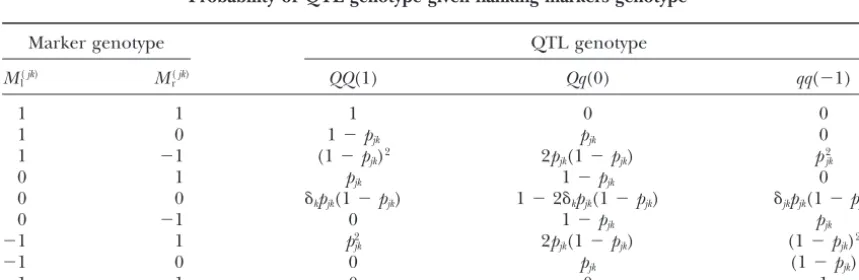
Probability of QTL genotype given flanking markers genotype
Marker genotype QTL genotype
M(jk)
l M(rjk) QQ(1) Qq(0) qq(⫺1)
1 1 1 0 0
1 0 1⫺pjk pjk 0
1 ⫺1 (1⫺pjk)2 2pjk(1⫺pjk) p2jk
0 1 pjk 1⫺pjk 0
0 0 ␦kpjk(1⫺pjk) 1⫺2␦kpjk(1⫺pjk) ␦jkpjk(1⫺pjk)
0 ⫺1 0 1⫺pjk pjk
⫺1 1 p2
jk 2pjk(1⫺pjk) (1⫺pjk)2
⫺1 0 0 pjk (1⫺pjk)
⫺1 ⫺1 0 0 1
pjk⫽rjk/rM(ljk)Mr(jk), ␦jk⫽r2M(ljk)Mr(jk)/((1⫺rMl(jk)M(rjk))2⫹r2M(ljk)M(rjk)), where rjk is the recombination frequency
between markerM(jk)
l and QTLQin thejth individual andrM (jk)
l M
(jk)
r is the recombination frequency between
markersM(jk)
l andM
(jk)
TABLE 3
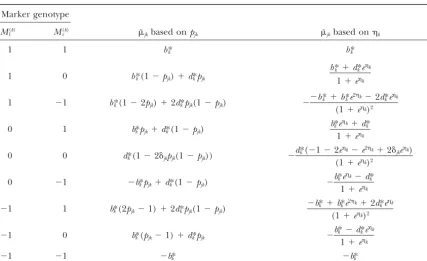
˜jkconditional on flanking markers’ genotype, assuming complete interference
Marker genotype
M(k)
l M(rk) ˜jkbased onpjk ˜jkbased onk
1 1 b*k b*k
1 0 b*k(1⫺pjk)⫹d*kpjk
b*k ⫹d*kek
1⫹ek
1 ⫺1 b*k(1⫺2pjk)⫹2d*kpjk(1⫺pjk) ⫺⫺
b*k ⫹b*ke2k⫺2d*kek
(1⫹ek)2
0 1 b*kpjk⫹d*k(1⫺pjk)
b*kek⫹d*k
1⫹ek
0 0 d*k(1⫺2␦jkpjk(1⫺pjk)) ⫺
d*k(⫺1⫺2ek⫺e2k⫹2␦jkek)
(1⫹ek)2
0 ⫺1 ⫺b*kpjk⫹d*k(1⫺pjk) ⫺
b*kek⫺d*k
1⫹ek
⫺1 1 b*k(2pjk⫺1)⫹2d*kpjk(1⫺pjk)
⫺b*k ⫹b*ke2k⫹2d*kek
(1⫹ek)2
⫺1 0 b*k(pjk⫺1)⫹d*kpjk ⫺
b*k ⫺d*kek
1⫹ek
⫺1 ⫺1 ⫺b*k ⫺b*k
In conclusion, provided we can specify the mean func- be dealt with below—and introduce the GEE approach tion(␥) and the covariance matrixV(␣), we can obtain using the familiar special case of normally distributed consistent estimates of the parameters of interest␥using traits. Denoting the phenotypic value of the kth trait GEE. We now derive a suitable mean and variance struc- in thejth individual byyjk, the corresponding random
ture for multivariate QTL mapping. variable by Yjk, and the random variable of the
unob-QTL mapping via GEE:Suppose we havenindividuals served QTL score byQjk, we assume the connection
be-from an F2population resulting from a cross between tween the phenotypic informationYijandQjkis given by
two inbred lines, with observations on m quantitative
Yjk⫽b*kQjk⫹ d*k1{Qjk⫽0}⫹xjk ⫹ εjk, (5)
traits and on a number of codominant genetic markers for each individual. The markers are recorded as 1 and
whereb*k is the additive effect of the QTL that is to be
⫺1 for the homozygotes in the two parental lines and
mapped for thekth trait,d*k is the dominance effect of
0 for the heterozygotes. The same notation is also
ap-the QTL that is to be mapped for ap-the kth trait, Xj ⫽
plied for the unobserved QTL genotypes, with
homozy-(xt
j1, . . . ,xtjm)t 僆 ⺢m⫻p is the design matrix and xjk 僆
gotes coded as 1 and⫺1 and heterozygotes as 0. We
⺢1⫻p,k⫽1, . . . ,mis the design vector of other predictor
assume that a marker map exists, although we show
variables for thejth individual,僆⺢pis the parameter
below that uncertainty about intermarker
recombina-vector,1{.}is the indicator function, andεjkis the error
tion fractions can easily be accommodated.
term. Note thatXjmay include other markers fitted as
We now derive the mean and variance structure
re-cofactors, as is standard in univariate QTL mapping, to quired for our GEE model. We begin by considering
give an approximate multiple-QTL model. Alternatively, the estimation of location and effect for a single QTL
we can easily extend Equation 5 to include multiple for each trait—we consider how multiple QTL might
QTL for each trait by adding appropriate terms depen-dent on a second unobserved QTL score,Q⬘jk. For ease
TABLE 4 of explanation we omitted epistatic and pleiotropic ef-fects, but these can also easily be added to Equation 5. Locations and distributions of the QTL
Let the random variables representing the marker genotype of the left and right flanking markers in the Traitk Position Distribution k φk b*k d*k
jth individual and thekth trait beM(jk)
l andM(rjk),
respec-1 3 Poisson 3.00 1.00 0.20 ⫺0.10
tively, and the realized values of these random variables 2 94 Binomial 0.00 1⁄
10 0.30 0.15
bex(jk)
1328 C. Lange and J. C. Whittaker
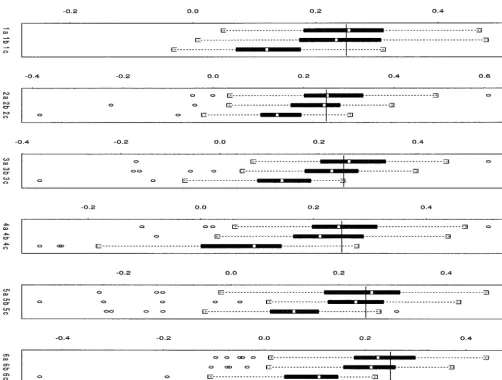
Figure1.—Simulation experiment. Comparison of simultaneous QTL-mapping methods for two nonnormal traits. The box plots for the estimates for the QTL location of the first trait and second trait are shown. The plots are described in Table 5.
we are allowing the marker interval containing the QTL genotype, the phenotypic distribution is a mixture of to be mapped for thekth trait to depend onk.Assume components corresponding to the unknown QTL geno-that the environmental random errors (εj1, . . . , εjm) type, we average out the unknown QTL genotypes to
have a multivariate normal distribution with mean zero get the conditional mean. Our approach can therefore and covariance matrix 兺(␣) 僆 ⺢m⫻m dependent on a be seen to be a generalization of the mean assumption of parameter vector␣僆⺢s: Errors are assumed
indepen-the least-squares-based QTL-mapping methods (Haley dent across individuals, but correlated across traits. De- andKnott1992;Martı´nezandCurnow1992) to mul-noting the mean of Yij conditional on the flanking tivariate data.
marker information, M(jk)
l ⫽ x(ljk)and Mr(jk)⫽ x(rjk), and Now consider the second moment assumption. To
other potentially genetically determined predictor vari- simplify notation, we initially derive the “working” vari-ables,Xjk⫽ xjk, by ance matrix under the simplest possible model. We
as-sume that there is no gene-environment or genetic inter-jk⫽E(Yjk|Ml(jk)⫽ x(ljk),M(rjk)⫽ xr(jk),Xjk⫽xjk), (6)
action and that the predictor variablesXjkare independent
we formulate our first moment assumption as of the flanking marker score. Then the variance of Yjk conditional on the flanking marker information can be
jk⫽E(b*kQjk⫹d*k1{Qjk⫽0}|M(ljk)⫽x(ljk),M(rjk)⫽x(rjk))⫹xjki.
written as Note the distinction between this and the
full-likeli-hood approach ofJiangandZeng(1995): Rather than Var
Yj1|M(lj1) ⫽ x(lj1),Mr(j1) ⫽x(rj1),Xj1 ⫽xj1
⯗
Yjm|M(ljm)⫽x(ljm),Mr(jm)⫽x(rjm),Xjm⫽xjm
Figure1.—Continued.
⫽Var
b*1Qj1⫹d*11{Q j1⫽0}|M(lj1) ⫽x(lj1),M(rj1)⫽x(rj1),Xj1 ⫽xj1
⯗
bm*Qjm⫹d*m1{Q jm⫽0}|M(ljm)⫽x(ljm),Mr(jm)⫽x(rjm),Xjm⫽xjm
Var
Yj1|M(lj1) ⫽x(lj1),Mr(j1)⫽x(rj1),Xj1 ⫽xj1 ⯗
Yjm|M(ljm)⫽x(ljm),Mr(jm)⫽x(rjm),Xjm⫽xjm
≈Var
εj1
εjm
. (8)
Again this is the variance assumption taken by the
least-⫹Var
εj1
εjm
. (7) squares-based QTL mapping methods (Haley and
Knott1992;Martı´nezandCurnow1992). The limita-This is the well-known decomposition of the phenotypic
tions of variance assumption (8), which are primarily variance Var(Yjk | M(ljk) ⫽ x(ljk), M(rjk) ⫽ x(rjk)) into the due to ignoring variance due to the segregation of QTL
genetic variance due to segregation of the QTL within within marker classes, have been discussed in detail by marker classes and the environmental variance Var(εjk) Xu (1995) and Kao (2000). However, recall that, in
1330 C. Lange and J. C. Whittaker
Figure2.—Simulation experiment. Comparison of simultaneous QTL-mapping methods for two nonnormal traits. The box plots for the estimates for additive effect and for the dominance effect of the first trait are shown. The plots are described in Table 5.
tion and multiple QTL, the GEE approach based on such that we can transform the mean ofYjk, conditional
on the explanatory variables, to be a linear function variance assumption (8) will provide consistent
esti-mates for all mean parameters and correct standard of those explanatory variables. Although there are no general rules of thumb for the choice of the link func-errors for these estimates. Although a misspecified
vari-ance assumption might have an influence on the effi- tion, it is usually suggested to choose the link function so that the data, after being transformed by the link ciency of the estimates, the loss of efficiency is usually
function, look as “normal” as possible (Johnson and slight, even if the working variance matrix (8) is
substan-Wichern1992). For some typical traits,e.g., continuous tially misspecified (LiangandZeger1986;Lianget al.
phenotype, counts, proportions, Table 1 lists some ap-1992). The use of a GEE approach thus largely
compen-propriate link functions that are commonly used for sates for the limitations of variance assumption (8).
GEE models (McCullaghandNelder 1989). We now extend this model to deal with nonnormal
The variance matrix is then constructed on the basis traits. This is easily done by applying a link function
of the link function. We assume that a correlation matrix hk(jk) to the conditional mean ofYjk(McCullaghand
R(␣) 僆 ⺢m⫻m is given that depends upon correlation Nelder1989), which gives the following mean
assump-parameter vector␣僆⺢qthat can be interpreted as the
tion:
environmental correlation. When more sophisticated hk(jk)⫽E(b*kQjk⫹d*k1{Q jk⫽0}|Ml(jk)⫽x(ljk)Mr(jk)⫽x(rjk))
variance structures are modeled ␣ might also contain
⫹xjk. (9)
Figure2.—Continued.
trix for nonnormal traits by rescaling the correlation are based on a graphical data analysis where one tries to investigate functional relationship between the variance matrixR(␣) with the corresponding variance functions
and dispersion parameters;i.e., and the mean. Typical choices for dispersion parame-ters and variance functions are listed in Table 1 (McCul-laghandNelder1989).
Vj⫽ Var
冢
Yj兩
冢
M(j1)
l ⫽ x(lj1),M(rj1) ⫽x(rj1),Xj1 ⫽ xj1
⯗ M(jm)
l ⫽x(ljm),Mr(jm)⫽x(rjm),Xjm⫽xjm
冣冣
Calculation of the conditional means:Here we show howto calculate the expectations given marker genotypes ⫽ ⌽1
2A
1/2
j R(␣)A1/2j ⌽1/2, (10) required in
jk; that is, we calculate
˜jk⫽ b*k
兺
1qjk⫽⫺1
qjkp(qjk|M(ljk)⫽xl(jk),M(rjk)⫽x(rjk))
where Aj ⫽ diag(V1(j1), . . . , Vm(jm)) is a diagonal
matrix of variance functions and⌽ ⫽diag(φ1, . . . ,φm) ⫹
d*kp(0|M(ljk)⫽xl(jk),Mr(jk)⫽x(rjk)). (11)
is a diagonal matrix of the dispersion parameters for
themtraits. The variance functions and dispersion pa- The conditional probability p(qjk|M(ljk)⫽ x(ljk),M(rjk)⫽
rameters must also be specified by the scientist. They x(jk)
r ) is easily done given a model for recombination.
1332 C. Lange and J. C. Whittaker
Figure3.—Simulation experiment. Comparison of simultaneous QTL-mapping methods for two nonnormal traits. The box plots for the estimates for the additive effect and for the dominance effect of the second trait are shown. The plots are described in Table 5.
JiangandZeng(1995) assumed complete interference the conditional meanjkin Table 3 is influenced only
within marker intervals (i.e., no double recombinants) by the marker interval length for marker score (0, 0). in the multivariate approach. Either assumption is easily It can be shown that whenkis estimated instead ofrjk,
incorporated into the GEE approach. For simplicity, we the conditional mean˜jkin Table 3 is virtually
indepen-consider here only the complete interference case. dent of the marker interval lengthrM(ljk)M(rjk)(appendix).
Following the complete interference assumption of The GEE approach with parameterization (12) is there-Jiang and Zeng (1995), expressions for p(qjk|M(lk)⫽ fore also robust against misspecification of the
marker-x(jk)
l ,M(rk)⫽xr(jk)) and hence forjkcan be easily derived; interval length, which allows QTL analysis to be
per-these are given in Tables 2 and 3. Further, when we formed even if the intermarker distances are unknown, reparameterize the recombination fraction between the provided the marker ordering is known reliably. This left-flanking marker and the QTL by is potentially valuable since StringhamandBoehnke (2001) reported that misspecification of the marker rjk⫽
exp(k)
1⫹exp(k)
rM(ljk)M(rjk), (12) map can have a substantial effect on likelihood analysis
for human data. For parameterization (12) the analyti-cal expressions for˜jkare also shown in Table 3. Note
where rM(ljk)M(rjk) is the recombination fraction between
that when the marker-interval lengths are known param-the flanking markers, parameterpjkin Table 2 becomes
Figure3.—Continued.
parameterization that the estimate for the QTL location
兺
nj⫽1
DT
j Vj(j,␣)⫺(Yj⫺ j(␥ˆ))⫽ 0. (13)
is range preserving; i.e., the estimated QTL position
must lie between the flanking markers, which give much HereV
j(,␣) is the working variance described above
improved numerical properties. andj⫽(j1, . . . ,jm), wherejkis the expected value Parameterization (12) also gives robustness to varia- of the kth trait for the jth individual, which is easily calculated under either the complete interference as-tion in map lengths between individuals, for example,
sumption or the no-interference assumption: because of sex effects, although in practice sex-averaged
recombination rates usually give satisfactory results with
jk⫽ E(Yjk)⫽h⫺j 1
共
˜jk⫹兺
ixkii
兲
. (14)most methods. Finally, note that these results also hold for the no-interference case.
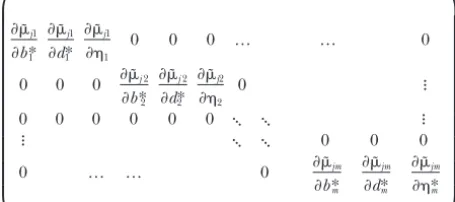
Equation 3 also involves the matrix of derivatives of
Parameter estimation: Parameter estimation is
per-each individual’s phenotypic means,Dj, which is given by
formed using a simple extension of the standard GEE approach described byLiangandZeger (1986). The
details, which are by their nature rather technical, can Dj⫽diag
冢
h⫺1 1 ()
兩
⫽h1(j1)
, . . . ,h
⫺1 m ()
兩
⫽h1(jm)
冣
(X˜j|Xj)
be found inLange(2000); here we sketch the key steps of the estimation procedure. Recall from Equation 3
1334 C. Lange and J. C. Whittaker
TABLE 5
Description of plots for Figures 1–3: notation for the combinations of QTL-mapping methods and environmental
correlations
˜j1
b*1
˜j1
d*1
˜j1
1
0 0 0 … … 0
0 0 0 ˜j2
b*2
˜j2
d*2
˜j2
2
0 ⯗
0 0 0 0 0 0 ⯗ ⯗ ⯗
⯗ ⯗ ⯗ 0 0 0
0 … … 0 ˜jm
b*m ˜jm
d*m ˜jm *m
. Environmental correlationMethod ⫺0.6 ⫺0.3 0.0 0.3 0.6 0.9
I 1a 2a 3a 4a 5a 6a
II 1b 2b 3b 4b 5b 6b
III 1c 2c 3c 4c 5c 6c
The partial derivatives in matrixX˜jare easily computed
Method I, GEE approach using link functions and untrans-from the expressions given in Table 2.
formed data; method II, transforming the data to normality Equation 3 can then be solved by a two-step procedure
and using the GEE approach under normality assumption; that iterates between an updating step for the mean
method III, ignoring the nonnormality of the data and using parameter estimates, on the basis of the current values the GEE approach under normality assumption.
of the variance parameters, and an updating step for The solid lines in the box plots in Figures 2–4 show the the variance parameters, on the basis of the current true QTL positions. Box plots show the median, 25th, and estimates of the mean parameters. In the first step, the 75th percentiles, together with whiskers showing the range of estimates of the mean parameter vector ␥ ⫽ (b*1,d*1, the data provided it is ⬍1.5 times the interquartile range;
points beyond this are marked as outliers. 1, . . . ,b*m,d*m,m,T) are updated by
␥ˆt⫹1⫽ ␥ˆt
types relies on searching the genome for putative QTL
⫹
冦
兺
nj⫽1
DT
j(␥ˆt)V⫺(␥ˆt,␣ˆt)Dj(␥ˆt)
冧
⫺locations, which give maxima in the likelihood or min-ima in the residual sum of squares, according to the
⫻
冦
兺
nj⫽1
DT
j(␥ˆt)V⫺(␥ˆt,␣ˆ)
共
yj⫺(j1(␥ˆt), . . . ,jm(␥ˆt))T)冧
approach chosen; approximate multiple-QTL models (15) are usually fitted by selecting a set of markers, usually with yj⫽ (yj1, . . . ,yjm)T. Then in the second step new via a model selection criterion such as AIC, to include
estimates for the variance parameters are calculated as as cofactors when scanning the genome. The evidence follows. We compute the residuals bysjk⫽ (yjk ⫺ ˆjk)/ for a QTL at any location can then be assessed.
(Vk(ˆjk))0.5, estimate the dispersion parameters byφˆk⫽ In the above we have shown how QTL location and
1/(n⫺ 3m⫺p)
兺
nj⫽1s2jk, compute the standardized re- effect size can be estimated for a given set of marker
siduals bysˆ⬘jk⫽ rjk/
√
φˆk, and estimate the correlation pa- intervals using our GEE approach, but we have not yetrameter vector␣by moment-based estimators using the considered how models for different marker intervals standardized residuals sˆ⬘jk. This two-step procedure is can be compared. It is not obvious how to do this in the
then repeated until parameter estimates converge. GEE framework: One of the strengths of the approach is Note that this gives estimates of all parameters, includ- that we need not specify a full probability model for ing the QTL locations , conditional on the specified the data, so we have no likelihood to use in model flanking markers. Refitting with QTL at a number of comparison. The quasi-likelihood defined above can points within the specified marker intervals to produce sometimes be used to play a similar role, but we have a residual sum of squares (RSS) surface as is usual in already commented that quasi-likelihood is not available least-squares-base QTL mapping is not required. for our QTL model.
An attractive property of this procedure is that under A natural alternative to quasi-likelihood is the general-mild conditions, notably that the moment-based estima- ized Pearson chi-square statistic
tors␣ˆ andφˆ1, . . .,φˆmare consistent, the GEE estimate␥ˆG
is also consistent and asymptotically multivariate normal,
d*⫽
兺
n
j⫽1
(yj⫺j)TV⫺j (j)(yj⫺ j). (16)
i.e.,n1/2 (␥ˆG ⫺ ␥) is asymptotically multivariate normal
with mean zero and covariance matrixVGgiven by
Loosely, d* is a weighted sum of residuals with the
VG⫽lim
n→∞n
冢冢
兺
nj⫽1
DT jV⫺jDj
冣
⫺
冢
兺
nj⫽1
DTV⫺
jCov(Yj)V⫺jDj
冣冢
兺
nj⫽1
DT jV⫺j Dj
冣
⫺
冣
weights calculated from the variance matrix calculated at the parameter estimates. Other statistics could be utilized here, butd* is attractive since it fulfills all the with Yj⫽(Yj1, . . . ,Yjm)T.requirements of a goodness-of-fit statistic (Coxand Hink-It is important to note that the validity of this result
ley 1974) and has attractive theoretical properties does not depend on the correct specification of the
(Lange2000);i.e.,d* is a second-order approximation variance assumption. Regardless of the degree of
mis-of the true quasi-deviance function. specification, the mean parameter estimates are always
Models can now be compared just as for the least-consistent and the standard errors provided are correct.
2000) by replacing the usual RSS byd*. However, as with data. This is of interest sinceVisscheret al.(1996a,b) the least-squares-based methods, significance thresholds found that assuming normality often works well for should be obtained by permutation (Doerge and univariate binary traits.
Churchill1996) or by use of the parametric bootstrap,
A relatively simple experiment is sufficient to compare rather than by reliance on asymptotic results.
Further-these methods. We simulate a single chromosome with more, analogues of the standard model selection criteria
16 uniformly distributed markers; the marker interval used for linear models can then be defined by replacing
length is 10 cM, giving a total length of 150 cM. Data the usual residual sum of squares byd*. For example,
are simulated using the following mean assumption: we can define the Akaike information criterion (AIC)
for a given GEE model to be
qjk⫽1: E(Yjk)⫽hk⫺1(k⫹b*k)
qjk⫽0: E(Yjk)⫽ hk⫺1(k⫹ d*k)
AIC ⫽d*⫹2number of predictor variables
sample size . qjk⫽ ⫺1:E(Yjk)⫽hk⫺1(k⫺ b*k). (17)
Alternatively, the AIC-value approximation for general- Two traits are simulated, both representing count data, ized estimating equations byPan(2001) may be applied with the first generated by a Poisson distribution and
here. the second from a binomial distribution on 10 trials.
Any of the standard approaches for QTL analysis can The parameter values used can be found in Table 4. now be implemented. For instance, to reproduce the By standard theory, the appropriate transformations to original interval-mapping approach of Lander and normality for use in method II are thus ln (·) for the Botstein(1988) for a single trait using GEE we would first trait and ln{(·/10)/(1⫺·/10)} for the second trait. simply fit a single-QTL model for each interval in turn The simulation was conducted for environmental corre-using the procedure outlined above. This provides esti- lation values
mates of QTL location and effect, together with a value
ofd*, corresponding to a model with a single QTL in ⫺0.6,⫺0.3, 0.0, 0.3, 0.6, and 0.9, the interval currently under consideration. The interval
with sample size 600 in each case and 200 replicates. with the smallest value ofd* is then selected, and the
Results are summarized using box plots displaying the corresponding estimates of QTL location and effect are
median, 25th percentile, 75th percentile, and the range recorded. The QTL will be declared significant ifd* is
of the estimated location; and additive and dominance below an appropriate threshold, determined by
permu-effects over the 200 replicates. The results are in Figures tation or simulation as in the least-squares-based
ap-1–3 and Table 5. It is immediately obvious that the proaches.
efficiency of the methods differs substantially. Method Equivalents to composite interval mapping (Zeng
I gives more efficient estimates of QTL location and 1994) or multiple-QTL mapping (Jansen 1994) can
additive effect, with methods II and III giving estimates be produced by including markers, usually selected by
of additive effect with considerable bias. Thus even mar-stepwise variable selection using AIC or similar criteria,
ginal transformation to normality followed by an analy-as cofactors to control for the presence of QTL outside
sis assuming multivariate normality (method II), al-the interval currently under consideration. It is also of
though an improvement on use of the untransformed course possible to fit models containing QTL in several
data, is less efficient than the pure GEE approach. Nor-intervals simultaneously, by adding the appropriate terms
mal theory alone is clearly not sufficient to cope with to the models described above. Tests to dissect the genetic
architecture of multiple traits can be defined as inKnott nonnormally distributed traits.
andHaley(2000), withd* replacing the RSS. In particu- The poor performance of method III above shows lar, a test of a single pleiotropic QTL against linked QTL, that the good performance of method III for univariate each affecting a single trait, is produced by comparing binary traits observed byVisscheret al.(1996a,b) does thed* values for the relevant models. not generalize. We can explain the good performance of method III for univariate binary traits by noting that RESULTS for univariate binary data the score equation of the GEE
model for method I is given by
Simultaneous QTL mapping for two nonnormally dis-tributed traits:Here we compare the GEE approach to
two alternatives that do not explicitly model the nonnor- 0⫽
兺
n
j⫽1
冦
h⫺1()
兩
⫽h(j)(X˜j|Xj)冧
φ⫺1V⫺(j)(Yj⫺ j())mality of the data. The methods used were as follows:
⫽
兺
nj⫽1
兵
V(j)(X˜j|Xj)其
φ⫺1V⫺(j)(Yj⫺ j())Method I: The GEE approach described above. Method II: The data are transformed to normality and
⫽φ⫺1
兺
nj⫽1
(X˜j|Xj)(Yj⫺h⫺1)
兵
(X˜j|Xj)其
) (18)the appropriate GEE for multivariate normal re-sponses is used (i.e., identity link function, etc.).
withj() = (j1(), . . . ,jm()). Since the inverse link
Method III: The GEE method appropriate for
1336 C. Lange and J. C. Whittaker
binary data is a rather “linear” function that can locally could be obtained by bootstrapping as in Visscher et al.(1996a,b). However, multivariate QTL mapping by its be approximated very well by its first-order Taylor
ap-proximation, Equation 18 can be approximated by nature becomes increasingly computationally demanding as the number of responses increases, so these
com-φ⫺1
兺
nj⫽1
(X˜j|Xj)(Yj ⫺
兵
(X˜j|Xj)˜其
), (19) puter-intensive techniques may be at present limited torelatively small numbers of responses. These are in any which is the estimating equation of method III. Thus case the situation where application of multivariate tech-for univariate binary data methods I and III give almost niques seems most likely, but less computationally de-equivalent estimating equations, but this will not be true manding solutions to the threshold/confidence interval
in general. problems would nonetheless be useful, and this subject
Note that this argument applies also to univariate deserves further study. Finally we note that the GEE likelihood-based methods, since in the univariate case approach developed here has obvious applications to the likelihood score and GEE score are identical. marker-assisted selection for multivariate nonnormal
traits. We hope to investigate this elsewhere. DISCUSSION
We thank Dr. Zhao-Bang Zeng and the unknown referee for their
We have introduced a method to allow the simultane- constructive comments on an earlier draft of this article. This research was supported by grant MH59532 of The National Institutes of Health.
ous mapping of QTL for several nonnormal traits. Ex-plicitly multivariate analyses of this sort have several advantages over the alternative approach based around
a number of single-trait analyses, notably the ease of LITERATURE CITED
interpretation of results and the increased efficiency of Cox, D. R., andD. V. Hinkley, 1974 Theoretical Statistics.Chapman &
Hall, London/New York.
multivariate analyses (JiangandZeng1995;Korolet
Dempster, A. P., N. M. LairdandD. B. Rubin, 1977 Maximum
al. 1995). It is also possible to test for pleiotropy,
al-likelihood from incomplete data via the EM-algorithm. J. R. Stat.
though in practice it is very difficult to distinguish be- Soc.39:1–38.
Diggle, P. J., K.-Y. LiangandS. L. Zeger, 1996 Analysis of
Longitudi-tween several linked QTL, each affecting a single trait,
nal Data.(Oxford Statistical Science Series). Oxford University
and a single QTL with pleiotropic effects.
Press, London/New York/Oxford.
However, full probability models for multivariate non- Doerge, R. W., andG. A. Churchill, 1996 Permutation tests for
multiple loci affecting a quantitative character. Genetics142: normal responses are very difficult to specify, and it is
285–294.
therefore tempting to either ignore the nonnormality
Falconer, D. S., andT. F. C. Mackay, 1997 Introduction to
Quantita-or marginally transfQuantita-orm the data to nQuantita-ormality and then tive Genetics.Longman, New York.
Hackett, C. A., andJ. I. Weller, 1997 Genetic mapping of
quantita-assume multivariate normality in analysis. As the
simula-tive trait loci for traits with ordinal distributions. Biometrics51: tion experiment shows, doing this can give poor results.
1252–1263.
Instead we avoided the difficulties of full-likelihood Haley, C. S., andS. A. Knott, 1992 A simple regression method
for mapping quantitative trait loci in line crosses using flanking
methods by adopting a semiparametric approach based
markers. Heredity69:315–324.
on GEE. The key advantages are the avoidance of
distri-Haley, C. S., andS. A. Knott, 2000 Multitrait least squares for
butional assumptions, the ease and flexibility of model quantitative trait loci detection. Genetics158:899–911.
Henshall, J. M., andM. E. Goddard, 1999 Multiple-trait mapping
specification [for example, the model presented here
of quantitative trait loci after selective genotyping using logistic
could be easily extended to incorporate factors such as
regression. Genetics151:885–894.
epistasis or parent of origin (imprinting) effects], and the Heyde, C., 1997 Quasi-likelihood and Its Application.Springer Series
in Statistics, Berlin/Heidelberg, Germany/New York.
robustness of estimates of QTL parameters to
misspeci-Jansen, R. C., 1994 High resolution of quantitative traits into
multi-fication of the underlying variance structure. We have
ple loci via interval mapping. Genetics136:1447–1455.
also shown that a simple reparameterization leads to a Jiang, C., and Z-B. Zeng, 1995 Multiple trait analysis of genetic
mapping for quantitative trait loci. Genetics140:1111–1127.
method for which the intermarker distances need not
Johnson, R. A., andD. W. Wichern, 1992 Applied Multivariate
Statisti-be known.
cal Analysis.Prentice-Hall International, Englewood Cliffs, NJ.
GEE methods are often almost as efficient as full- Kao, C.-H., 2000 On the differences between maximum likelihood
and regression interval mapping in the analysis of quantitative
likelihood approaches using the correct probability
trait loci. Genetics156:855–865.
model, while being more robust. Nonetheless, it would
Knott, S. A., and C. S. Haley, 2000 Multitrait least squares for
be interesting to develop full-likelihood approaches and quantitative trait loci detection. Genetics158:899–911.
Korol, A. B., Y. T. RoninandV. M. Kirzhner, 1995 Interval
map-to compare these with the GEE approach. This should
ping of quantitative trait loci employing correlated trait
com-be possible for at least some special cases, possibly using
plexes. Genetics140:1137–1147.
generalized linear mixed models or hierarchical models Lander, E. S., andD. Botstein, 1988 Mapping Mendelian factors
underlying quantitative traits using RFLP linkage maps. Genetics
implemented in a Bayesian framework via the Markov
121:185–199.
chain Monte Carlo method. However, such an approach
Lange, C., 2000 Generalized estimating equation methods in
statisti-will be extremely computationally demanding, even for cal genetics. Ph.D. Thesis, University of Reading, Reading, UK.
Liang, K.-Y., andS. L. Zeger, 1986 Longitudinal data analysis using
relatively small numbers of traits.
generalized linear models. Biometrika73(1): 13–22.
Significance thresholds for the GEE approach can
Liang, K.-Y., S. L. ZegerandB. Qaqish, 1992 Multivariate
regres-be calculated by the usual permutation or simulation sion analyses for categorical data. J. R. Stat. Soc. B54(1): 3–40.
Martı´nez, O., andR. N. Curnow, 1992 Estimating the locations
and the sizes of the effects of quantitative trait loci using flanking markers. Theor. Appl. Genet.85:480–488.
McCullagh, P.,andJ. A. Nelder, 1989 Generalized Linear Models,
Ed. 2. Chapman & Hall, London/New York.
Pan, W., 2001 Akaike’s information criterion in generalized estimat-ing equations. Biometrics57:120–125.
Stringham, H. M.,andM. Boehnke, 2001 Lod scores for gene mapping in the presence of marker map uncertainty. Genet. Epidemiol.21:31–39.
Visscher, P. M., C. S. Haleyand S. A. Knott, 1996a Mapping QTLs for binary traits in backcross and F2 generation. Genet. Res.68:55–63.
Visscher, P. M., R. ThompsonandC. S. Haley, 1996b Confidence intervals in QTL mapping by bootstrapping. Genetics140:1013– 1020.
Xu, S.,1995 Letter to the editor: A comment on the simple regres-sion method for interval mapping. Genetics141:1657–1659.
Zeng, Z-B., 1994 Precision mapping of quantitative trait loci. Genet-ics136:1457–1468.
Communicating editor:Z-B. Zeng
APPENDIX
Robustness of reparameterization (12):We can inves-tigate the influence of the marker interval length rM(ljk)M(ljk)on the component of the conditional mean for
marker class (0, 0) that depends onrM(ljk)M(ljk)by plotting
f(,x)⫽{1⫺ 2·␦jkpjk(1⫺ pjk)} (20)
against x, the marker interval width in centimorgans, and, the relative location of the QTL. This is shown as the top surface in Figure A1. The bottom surface
presents the relative frequency of marker class (0, 0) FigureA1.—Relative influence of the marker-interval size on the mean equation for the marker-score (0, 0). The top dependent on the marker interval width in
centi-plane shows the relative dependency of the mean equation morgans; Haldane’s mapping function has been used to
for marker score (0, 0) as a function of the marker interval convert distances in centimorgans into recombination length and the relative QTL position, assuming complete in-fractions. We see that the conditional mean is only terference. The bottom plane shows the frequency of marker weakly dependent onx and that marker-class (0, 0) is score (0, 0) as a function of the marker interval length and