SHIELD: Scalable Homomorphic
Implementation of Encrypted Data-Classifiers
Alhassan Khedr,
Member, IEEE,
Glenn Gulak,
Senior Member, IEEE,
and Vinod Vaikuntanathan
Abstract—Homomorphic encryption (HE) systems enable computations on encrypted data, without decrypting and without knowledge of the secret key. In this work, we describe an optimized Ring Learning With Errors (RLWE) based implementation of a variant of the HE system recently proposed by Gentry, Sahai and Waters (GSW). Although this system was widely believed to be less efficient than its contemporaries, we demonstrate quite the opposite behavior for a large class of applications.
We first highlight and carefully exploit the algebraic features of the system to achieve significant speedup over the state-of-the-art HE implementation, namely the IBM homomorphic encryption library (HElib). We introduce several optimizations on top of our HE implementation, and use the resulting scheme to construct a homomorphic Bayesian spam filter, secure multiple keyword search, and a homomorphic evaluator for binary decision trees.
Our results show a factor of10×improvement in performance (under the same security settings and CPU platforms) compared to IBM HElib for these applications. Our system is built to be easily portable to GPUs (unlike IBM HElib) which results in an additional speedup of up to a factor of103.5×to offer an overall speedup of1035×.
Index Terms—Homomorphic Encryption, FHE, Ring LWE, Bayesian Filter, Secure Search, Decision Trees, Implementation, GPU.
F
1
I
NTRODUCTIONA
fully homomorphic encryption scheme (FHE) is an encryption scheme that allows evaluation of arbitrary functions on encrypted data. Starting with Gentry’s mathematical breakthrough constructing the first plausible FHE scheme [1], we have seen rapid development in the theory and implementation of homomorphic encryption (HE) schemes. HE schemes can now be based on a variety of cryptographic assumptions – approximate greatest common divisors [2], [3], learning with errors (LWE) [4], [5], [6], [7], and Ring-LWE (RLWE) [8], [9], [10].Due to the growing use of cloud computing, privacy concerns have begun to escalate. Secure data classifiers constructed from FHE schemes can present a very useful tool to provide an answer for these concerns. It is important that these secure data classifiers protect the privacy of the input data and also the classifier model itself.
Consider the secure email spam filter as a representative example for data-classifier class of applications. In the training phase, the spam filter creates its model from plaintext emails. In the testing phase however, the secure email spam filter is required to classify the input encrypted email as a spam or not without any knowledge about the actual contents of the email. The same concept can be applied to the secure search application, which is basically
• Alhassan Khedr is with the Department of Electrical and Computer Engineering, University of Toronto, Toronto, ON, Canada.
E-mail: [email protected]
• Glenn Gulak is with the Department of Electrical and Computer Engi-neering, University of Toronto, Toronto, ON, Canada.
E-mail: [email protected]
• Vinod Vaikuntanathan is with the Department of Computer Science and Artificial Intelligence Laboratory, MIT, Cambridge, MA, USA.
E-mail: [email protected]
a variant of the spam filter. In the secure search problem, it is also required to search for multiple encrypted keywords inside files and return the number of matching keywords without the knowledge of the file contents.
The main contribution of this paper is the construction of a secure email spam filter and a secure multi-keyword search. We have also prototyped a secure binary decision trees as a proof of concept and compare our work to other similar implementations [11]. Detailed algorithms for building those applications, using the GSW HE scheme, are presented in this work along with their GPU performance results. Our data-classifier takes the idea of Private Information Retrieval (PIR) one step forward, and homomorphically computes on the encrypted data retrieved by the PIR to obtain useful pieces of information. We show that a careful consideration of the mathematics underlying the recently proposed GSW scheme and Brakerski and Vaikuntanathan (BV) scheme [7], together with the features of the specific applications, results in significant speedups. The performance of the data-classifier as well as the secure search engine depends on the size of the database/file and can be as low as a few seconds with present off-the-shelf technology.
error growth. As an illustrative example of this feature, consider evaluating an expression of the form
F(x1, . . . , xv) =
X
(y1,...,yv)∈S
v
Y
i=1
(xi⊕yi)
!
(1)
where x1, . . . , xv are v-tuples of input encrypted bits,
y1, . . . , yv are v-tuples of bits in some set S, operation (xi⊕yi)represents binary XNOR between bits xi and yi.
Since the form of the expression in (1) guarantees us that exactly one of the terms may survive (F = 1 when x1, . . . , xv ∈ S, otherwise F = 0), the homomorphic
evaluator is guaranteed to have a small total error growth (even though the evaluator does not know precisely which term will survive). It can be noticed that (1) is identical to the server’s computation in a PIR scheme. Indeed, the same format appears in several applications, including the ones we discuss in Section 5.
In this work, algorithmic optimizations were also introduced to the work in [6], [7] to reduce their computational complexity as will be discussed in Sections 3.1 and 3.1.1. We also introduce the notion of
decrypting a flag submerged in noisedescribed in Section 5.1
which can be used to argue that a decryption error in fact gives us a meaningful bit of information! This is unlike all other lattice-based HE schemes that we are aware of where one gives up hope the moment the error exceeds a certain threshold.
Implementation Results: We carefully exploit the
parallelism in the encryption system by implementing it on a GPU platform. The number theoretic transform (NTT) engine was carefully designed to address the limitations present in current GPUs. Our GPU implementation of the HE scheme scores a ciphertext (Ctxt) multiplication run time of3.477milliseconds with a1035×speedup over IBM HElib for circuits depth more than 5 and 80-bit security. Also for the same security level, our ciphertext size is smaller than HElib by a factor of 1.5×. Our improvement is realized through a reduction in parameters for the same security level and homomorphic capacity, stemming from our observations about noise growth. This ultimately leads to faster implementation and smaller ciphertext sizes. Our data-classifiers are completely scalable and their running time can be reduced proportional to the number of GPU cores utilized.
The rest of the paper is organized as follows. Sec-tion 2 presents related work. In SecSec-tion 3 we introduce the improved encryption scheme. Next in Section 4, the NTT architecture and Solinas primes used in our system are introduced. The encrypted data-classifier design, secure multiple keyword search engine and encrypted binary de-cision trees are introduced in Section 5. Performance results are introduced in Section 6. Finally we conclude in Section 7.
2
R
ELATEDW
ORKPrevious constructions of RLWE-based FHE schemes include [4], [5], [10]. One of the drawbacks of these schemes
is the need to maintain a so-called “modulus chain” which increases the size of the prime number and consequently increases the ring dimension for the same security level. They also need to perform expensive modulus and key switching operations. Bootstrapping was introduced to the GSW scheme in [12], [13], with the bootstrapping in [13] completing in under a second.
Based on [4], Halevi and Shoup designed a homomorphic encryption library “IBM HElib” [10], [14], but due to the need of some additional large data structures and functions, the performance of their library has large execution time. A performance comparison between our library and the IBM HElib library is presented in Section 6. In [9] they implemented a variant of the RLWE FHE scheme. Our results also show considerable speedups over their implementation. Another homomorphic library was developed by Rohloff, Cousins, and Peikert [15]. In their paper they implement primary building blocks in hardware to accelerate their system. There are no performance results available yet publicly to compare our library with theirs. In [16] significant speedups were gained from the use of GPU computing, but their implementation suffered from having very large memory requirements, which eventually becomes the bottleneck of their implementation. Other implementation attempts were made but they were either incomplete implementations of an HE scheme capable only of performing one multiplication operation [17], or based on other cryptographic assumptions [18], [19], [20].
Applications analyzed in this paper were primarily in-spired from [9], [21]. We extend their ideas and devel-oped full algorithms. The work on CryptDB [22] used a combination of very simple HE schemes to implement a subset of encrypted SQL queries, and the work on “ML Confidential” [23] implemented simple classification tasks on encrypted data. Secure computations on binary decision trees were introduced in [11], yet they have long execution time due to the use of the IBM HElib library. Searching an encrypted database was previeously addressed by [24], [25], [26], [27]. One drawback in [24], [25] was the need for a special key to aid the server in performing the search request. They achieve a weaker security notion, namely one where partial information about the data access pattern is leaked. In particular, in the work of [26], the same server requests would generate the same tags. For a simple and general overview of homomorphic encryption concepts the reader is encouraged to read [28], [29], [30].
3
T
HEE
NCRYPTIONS
YSTEMNotation:For an odd prime numberqwe identify the ring Z/qZ(orZq) with the interval(−q/2, q/2)∩Z. The notation
[x]qdenotes reducingxmoduloq. Our implementation uses
polynomial rings defined by the cyclotomic polynomials R=Z[X]/Φm(X), whereΦm(X) =xn+1is the irreducible
mth cyclotomic polynomial, in whichnis a power of 2 and m = 2n. We let Rq = R/qR. Any type of multiplication
defined asAM×N, whereAij∈RqandM, Nare the matrix
dimensions. IN×N represents the identity matrix of rings.
Row vectors are represented as [a b], where a and b are the vector elements. Column vectors on the other hand are represented as[a; b].
Ring Learning With Errors:The ring learning with errors problem (RLWE) was introduced in [31]. It is the mapping of the LWE problem from the vectors overZqto polynomial
rings overRq. The RLWE problem is to distinguish between
the following two distributions. The first distribution is to draw(a, b)uniformly fromR2
q. The second is to first draw
tuniformly fromRq. Then sample(a, b)as follows. Drawa
uniformly fromRq, sampleefrom a discrete Gaussian error
distributione←DRq,σ, and setb=a·t+e.
3.1 The Encryption Scheme
The parameters of the system are n, the degree of the number field; q, the modulus; σk and σc, the standard
deviation of the discrete Gaussian error distribution in the keyspace and ciphertext space, respectively; ` =∆ dlogqe; and N = 2` that governs the number of ring elements in a ciphertext. The setting of these parameters depends on the security level λ (e.g., λ = 80 or 128 bits) as well as the complexity of functions we expect to evaluate on ciphertexts.
Bit Decompose Function “BD()”: The bit decompose
function BD(integer) takes an `-bit input integer, then outputs a row vector with size ` containing the bit decomposition of this integer. Similarly, BD(polynomial)
takes an input polynomial of size n, where each coefficient is an `-bit integer, then outputs an `-sized row vector of polynomials (each of size n) containing the bit decomposition of each coefficient of the input polynomial, yielding a matrix of size l × n. Finally,
BD(Matrix of polynomials) takes an input matrix of
polynomials of sizex×y(each polynomial is of sizenwith integer coefficients), then outputs a matrix of polynomials expanded by a factor `in the column dimension, yielding a matrix of sizex×y`, where each consecutive`elements along the row contain the bit representation of each coefficient of each of the input polynomials. For example, the bit decompose of the input polynomial matrixBx×y×n
is BD(Bx×y×n) = βx×y`×n. The reader should note that
despite the fact that the polynomial coefficients of matrix βx×y`×n are single bit values, the storage requirement of
matrixβ in CPU or GPU memory is not equal tox×y`×n bits. This is due to the fact that the smallest addressable unit of memory is a byte (i.e., Byte Addressable). Hence, β requires x×y`×nbytes of storage. This results in the further observation that the storage requirement ofβx×y`×n
is8×the storage requirement ofBx×y×n.
Bit Decompose Inverse Function “BDI()”: As the name
reveals, the BDI() function is the inverse of BD(). The
BDI() function groups consecutive ` coefficients along a row (the coefficients don’t need to be binary), and outputs the integer corresponding to those ` bits. Mathematically, the BDI() function can be defined as multiplying the
expanded matrix of polynomials βx×y` from the right by
the matrix αy`×y defined in (2) (polynomial dimension n
will be omitted from this point forward for clarity). Hence Bx×y =BDI(βx×y`) =βx×y`·αy`×y.
αy`×y=
1 0 0 · · · 0
2 0 0 · · · 0
..
. ... ... . .. ...
2` 0 0 · · · 0
0 1 0 · · · 0
0 2 0 · · · 0
..
. ... ... . .. ...
0 2` 0 · · · 0
0 0 1 · · · 0
..
. ... ... ... ...
0 0 0 · · · 1
0 0 0 · · · 2
..
. ... ... . .. ...
0 0 0 · · · 2`
(2)
In this work, we introduced some algorithmic optimiza-tions to the encryption system in [6], [7] in order to reduce computational complexity and to speedup our operations, as will be detailed below. Our encryption system works as follows.
• Keygen(1λ): Choose polynomial t ← D
Rq,σk. The secret key sk = s2×1 ← [1;−t] ∈ R2q. Uniformly
samplea← Rq,e ← DRq,σk, setb =a·t+e, The public keypk=A1×2= [b a]. Note that
A1×2·s2×1=b−a·t=e (3)
where “·” is the inner product over the ringRq. • Enc(pk, µ): The message space of our encryption
scheme is Rq. rN×1 is a matrix that consists ofN
polynomials with random coefficients in the range {0,1}, EN×2 ← DRN×2
q ,σc, encrypt the plain text polynomialµ∈Rqby calculating
CN×2=µ·BDI(IN×N) +rN×1·A1×2+EN×2 (4)
(as opposed toCN×N in [6], [7], we have a smaller
ciphertext by a factor of8×as discussed previously in theBD()definition.)
• Dec(sk, C): Given the ciphertext C, the plaintext µ ∈ Rq is restored by multiplyingC by the
secret-keysas follows :
CN×2 · s2×1= (µ·BDI(IN×N)
+rN×1·A1×2+EN×2)·s2×1 =µ·BDI(IN×N)·s2×1
+rN×1 · A1×2 · s2×1+EN×2 · s2×1 =µ·BDI(IN×N)·s2×1
+rN×1·e+EN×2·s2×1 =µ·BDI(IN×N)·s2×1+error
(as opposed to Dec(sk, C) = CN×N ·vN×1 in [6],
[7], we have fewer operations inDecby a factor of` times)
Observe that the first`coefficients in the first term of the last equation in (5) are in the form µ,2µ,· · ·,2`−1µ. This means that the element at locationi ∈ [0, `−1]is in the formµ·2i+error
. That is, the most significant bit of each entry carries a single bit from the numberµassuming that error < q/2 and there is no wrap-around mod q as was described in [6].
3.1.1 Homomorphic Operations
For input ciphertexts CN×2 and DN×2 ∈ RNq ×2
encrypt-ing µ1 and µ2 respectively, homomorphic operations are
defined as follows.
• ADD(C, D): To add the two ciphertexts CN×2 and DN×2, simply output CN×2 +DN×2, which is an
entry-wise addition.
• MULT(C, D): To multiply the two ciphertextsCN×2
andDN×2, outputBD(CN×2)·DN×2.
(as opposed to MULT(C, D) = FLATTEN(CN×N ·
DN×N)in [6], [7], whereFLATTEN(A)is defined as
BD(BDI(A)). We have fewer operations inMULTby a factor of at least`times)
Correctness of homomorphic addition is immediate, however it is not that obvious for the homomorphic multiplication. It is clear that the multiplication algorithm is asymmetric in the input ciphertexts C and D. That is, we treat the components of D as a whole, whereas the components of C are broken up into their “bit-wise decompositions”. This is a “feature” that is inherited from the work of BV [7]. It is shown below that this multiplication method is correct and gives a slow noise-growth rate.
The correctness of the multiplication operation can be noticed from the decryption operation in (6). Matrix dimensions are removed for clarity.
BD(C)·D·s=BD(C)·(µ2·BDI(I) +r2·A+E2)·s
=BD(C)·(µ2·BDI(I)·s+r2·e+E2·s) =µ2·C·s+BD(C)·(r2·e+E2·s) =µ2·(µ1·BDI(I)·s+r1·e+E1·s)
+BD(C)·(r2·e+E2·s)
=µ2·µ1·BDI(I)·s+µ2·(r1·e+E1·s) +BD(C)·(r2· e+E2·s)
=µ2·µ1·BDI(I)·s+µ2·error1 +BD(C)·error2
=µ2·µ1·BDI(I)·s+error
(6)
It can be noticed from the last line in (6) that it is the encryption of µ = µ2 · µ1. Note that
BD(CN×2)· BDI(IN×N) =IN×N · CN×2=C.
Noise Analysis: Correct decryption depends crucially on
the ciphertext noise being bounded. Thus, it is important
Function 1:Multiply”v”Ciphertexts Function Input:”v”, Ctxts:C1, C2,· · ·, Cv
Output:Caccum
The multiplication result of”v”input Ctxts.
Caccum=C1
Forifrom2tov{ Caccum=Caccum×Ci
}
ReturnCaccum
to understand how homomorphic operations increase ci-phertext noise. Let C be a fresh ciphertext. We make the following observations, after [7].
• Homomorphic addition ofvciphertexts increases the noise by a factor ofv in the worst case. In practice, since the coefficients of the error polynomials follow a Gaussian distribution, the factor is closer toO(√v). • Homomorphic multiplication is significantly more interesting. Multiplication of two ciphertexts C = Enc(µ1) and D = Enc(µ2) with error magnitudes B1 and B2, respectively, increases
the error to O(B1 · kµ2k1 + B2 · nlogq) in the
worst case, and O(B1 · kµ2k1 +B2 · √
nlogq) in practice. Here, kµk1 denotes the `1 norm of the
message polynomialµ.The key fact to note here is that the error dependence on the two ciphertexts is asymmetric.
Better Error in Homomorphic Multiplication:To multiply
v ciphertexts it is crucial to pay attention to the order of multiplication. In the applications presented in this work, input µ will typically be 0 or 1, meaning that the growth is simply additive with respect toB1. Thus, the best way
to multiply v ciphertexts with (the same) error level B is through an accumulator-like algorithm as in Function 1, rather than using a binary tree of multiplications (which grows the error at superpolynomial rates). The resulting error growth is O(B · vnlogq) in the worst case, and O(B· √vnlogq)in practice.
For example consider (1), the noise grows to O(B · vnlog q · |S|) in the worst case, or O(B·p
vnlog q|S|)in the typical case. This is in contrast to O(B·p
(nlogq)logv|S|)when using the
Brakerski-Gentry-Vaikuntanathan [4] encryption scheme, implemented in IBM HElib. Indeed, such expressions, as in (1), are far from atypical – they occur quite naturally in evaluating decision trees and PIR-like functions as will be discussed in Section 5.
Zero Plaintext, Zero Error: Yet another source of
im-provement is evident when we inspect the error term B1 · kµ2k1 +B2 · nlogq. When we multiply using an
accumulator as in Function 1, B2 represents the smaller
error in the fresh ciphertextsCi, andB1represents the larger
error in the accumulated ciphertextCaccum. We see that if
Ciencryptsµ2 = 0, then the larger error termB1vanishes
in the error expression!
Table 1
Parameter Selection and Keys/Ctxt Sizes.
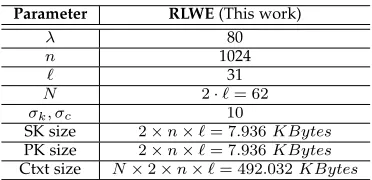
Parameter RLWE(This work)
λ 80
n 1024
` 31
N 2·`= 62
σk, σc 10
SK size 2×n×`= 7.936KBytes
PK size 2×n×`= 7.936KBytes
Ctxt size N×2×n×`= 492.032KBytes
products in (1), the error grows proportional not to v, the total number of multiplications, but rather with k, the longest continuous chain of 1’s starting from the end. This is because the last time a zero is encountered in the multiplication chain, the error vanishes, by the observation above. Assuming thatS is a “typical set”, the expected length of a continuous chain of trailing 1’s is Pv
i=1i·2− i < 2
. In other words, the multiplicative factor ofvvanishes from the error expression as well, and we get error growth close toO(B· p
nlogq|S|). This is the same effect as if one were merely adding|S|ciphertexts.
How to Set Parameters: Let f be the function that we
are evaluating, for example the expression in (1). Let
errorf(B, n, q) denote how much the error grows when
evaluating a functionf on ciphertexts inRq with an initial
error of magnitudeB. For correct decryption, we need
errorf(B, n, q)< q/2 (7)
Since errors grow slower in our scheme, q can be set to be correspondingly smaller for the same security level. Following the analysis of Lindner and Peikert [32], for a security level ofλbits, we need
n >log(q/σ)(λ+ 110)/7.2 (8)
Since our logq is smaller, we can set our n to be smaller, for the same security level λ. In turn, since we now have a smaller n, our newerrorf(B, n, q) is smaller, leading to
an even smallerq, and so on. The optimal parameters are obtained by solving both the above inequalities together. Table 1 summarizes our final parameter selection.
4
P
OLYNOMIALM
ULTIPLICATION 4.1 Number Theoretic TransformThe Number Theoretic Transform (NTT), analogous to the well known FFT, is used to speedup the polynomial convolution operation to O(nlog(n)) for the finite field modular polynomial multiplications as was described in Schonhage-Strassen multiplication algorithm [33]. Our target hardware platform is a GPU, however, random memory access on GPUs may hurt the performance. Having this in mind, the NTT engine was carefully chosen to exploit serial memory accesses. In [34], several designs for FFT engines were introduced, one of which was explicitly designed for sequential data accesses and storage, which is more suited for a GPU global memory architecture. This design was also attractive due to its hardware regularity,
x[0]
x[1]
x[2]
x[3]
x[4]
x[5]
x[6]
x[7]
X[0]
X[4]
X[2]
X[6]
X[1]
X[5]
X[3]
X[7]
W0
W4
W0
W12
W1
W5
W3
W15
W2
W6
W6
W18
W3
W7
W9
W21
W0
W8
W0
W8
W4
W12
W4
W12
W0
W8
W0
W8
W0
W8
W0
W8
Fig. 1. Forward 8-point NTT engine optimized for sequential data ac-cesses and storage.
which is also better suited for the GPU kernels.
To convert the polynomial to its NTT representation we evaluate the polynomial at the roots of unity of Φm. The
roots of unity ofΦm(X) =xn+ 1 are in the form of odd
powers of ζ (i.e. roots=ζ2k+1
for 0 ≤ k < n), where ζ is thenthroot of unity. Forζ to be a validnth root of unity, it must satisfy both these conditions: a)ζ2n= 1 modqand
b)ζi 6= 1 modq fori < 2n. The equation for the N-point
forward NTT transform is
X(k) = N−1
X
n=0
x(n)Wn(2k+1) ,0≤k < N (9)
where W = ζ. W is also called the twiddle factor. The analysis made in [34] was followed to port the NTT equation to the samen·log(n)FFT architecture.
The final NTT architecture for an 8-point NTT is shown in Fig. 1. This architecture has the same structure for each level and supports sequential memory accesses, which is well suited for our GPU implementation. The twiddle fac-tors of the modified NTT engine in Fig. 1 are re-formatted to reduce the number of modulus operations needed. The N-point inverse NTT equation is shown in (10). The final inverse NTT engine can be seen if Fig. 1 is viewed from the right side.
x(n) = 1 N
N−1
X
k=0
X(K)WN−n(2k+1) ,0≤n < N (10)
4.2 Solinas Prime Numbers
number bit width ` = 31 bits. For example, if an input numberais in the form of
a=a1 · 2` + a0 (11)
the modulus operation modulo q = 0 ×7F F E001 will simply be
amodq=a0−a1+ (a1<<17) (12)
where “<<” is a shift left operation.
5
C
ANDIDATEA
PPLICATIONS 5.1 Homomorphic Spam FilterWe implement a homomorphic version of Bayesian spam filters [36]. The main idea behind a Bayesian classifier is that words have certain probabilities of occurrence in
authenticemails (sometimes calledhamemails) and inspam
emails. Since the filter doesn’t know these probabilities in advance, email training sets are used to estimate these probabilities. The training phase is assumed to take place on unencrypted training sets, and results in a database of words together with probabilities associated to each word arising in spam e-mails. Once this database is created, the word probabilities are used to classify new emails.
Let pw denote the probability that a word w
oc-curs in spam e-mails. Given an e-mail with key words
(w1, . . . , wK), there are many techniques to combine the
probabilities of each word to compute a final estimate of whether the e-mail should be classified as spam [37]. The simplest perhaps is to use Bayes rule. This results in the following expression for p, the probability that the e-mail will be classified as spam.
p= pw1pw2· · ·pwK
pw1pw2· · ·pwK+ (1−pw1)(1−pw2)· · ·(1−pwK) (13) At a high level, the email server will receive encrypted words wi, and map them, homomorphically, into the
numberspw. Once we obtain these numberspw, we wish to
compute the expression in (13) to obtainp.
The first downside of (13), when it comes to homomor-phic computations, is that integer divisions are extremely expensive to carry out using current homomorphic encryp-tion schemes. In order to overcome this, we make a number of reformulations of the equation above, as follows.
η= log(1∆ −p)−logp= K
X
i=1
(log(1−pwi)−logpwi) (14)
and we will let
ηwi
∆
= log(1−pwi)−logpwi (15) In other words, the email training phase will store the numbersηwfor each wordwin the dictionary (rather than
the numberspw). The numbersηware represented as binary
fixed-point numbers, whose bits are encoded into the coefficients of polynomial πw. For example, ηw = 101b is
represented as the polynomialπw =x0+x2. The addition
of two binary polynomials will not generate a carry
between adjacent polynomial elements, rather polynomial elements will grow individually and will be appropriately reconstructed after decryption (e.g. 101b + 111b = 212,
which will be constructed back after decryption to 1100b).
The encrypted spam filter computation will take as input an encrypted wordw, map it first into an encryptedηw as
will be described in Function 5, and then simply perform a homomorphic addition of the ηw to get an encryptedη.
This is then sent back to the client who decrypts, recovers ηusing her secret key, and computesp= 1/(2η+ 1)in the
clear.
The only remaining question is how to map encrypted wordswinto encryptedηw. When input e-mails and words
are not encrypted, matching a certain word is an easy task. Each email word can be searched across the database. If the word is found, the corresponding numberηwis fetched. On
the other hand, when input emails are encrypted, matching words become much harder. This “lookup problem” is the same as the problem of private information retrieval (PIR) [38], [39]. Our data-classifier takes the idea of PIR one step forward, it homomorphically computes on the encrypted data retrieved by the PIR to obtain useful pieces of information. Other PIR constructions [5], [38], [39], [40], [41], [42] cannot implement data-classifiers the way we do because they either: (a) cannot compute with the PIR responses, or, (b) their plaintext field is only mod 2 (or modulo a small prime, for efficiency purposes) and thus they cannot do integer addition as required by (14). Our HE on the other hand has the advantage of being able to use the full modulo-q domain for plaintext additions. As should be clear from the description above, spam filtering is just an example of a class of “lookup-and-compute” type of applications for which we can use our HE scheme.
Function 2 shows how to encrypt individual words in a given list (email). Function 3 shows how we match an input encrypted word versus another unencrypted word from the database. The matching function in Function 3 can be used to construct our encrypted-email spam-filter by simply multiplying the database word probabilities by the ”match” output as in Function 5. Only the words that find a match in the database will contribute towards the final probability. It is also possible to keep the database encrypted to protect it from outside attackers. To do this, the matching function should be replaced byEncWordMatch
presented in Function 4, which performs bit matching for two encrypted inputs, but at an extra cost of two extra Ctxt multiplications to implement the XNOR operation.
In order to increase the performance and efficiency of the spam filter, several optimizations are introduced:
Optimization 1: By storing probability numbers in a
single polynomial entry (ex. η = 5, π = 5x0), the other
polynomial entries will be unused. This will also lead to the rapid growth of the final result. We decided to store a probability number as binary bits in adjacent polynomial entries (e.g. η = 5 = 101b, π = x0 +x2). By doing so,
Function 2:Word List Encryption Input: Set of words in a list (email) Output: Encrypted words using HE
For each word in the list{ a= Hash( word ). For each bitiina{
Ci= Encrypt(ai).
StoreCito the output list.
} }
Function 3:Word MatchingWordMatch
Input1: Encrypted bits of Word1(Ci)
Input2: Plaintext Word2
Output: Encrypted binary bit ”match” = 1 if words match, 0 otherwise
match= 1
a= Hash( Word2).
For each bitiina{ If (ai= 1)
Bi=Ci
Else
Bi= 1−Ci
match=match×Bi
}
Returnmatch
Function 4:Enc. Word MatchingEncWordMatch
Input1: Encrypted bits of Word1(Ci)
Input2: Encrypted bits of Word2(Di)
Output: Encrypted binary bit ”match” = 1 if words match, 0 otherwise
match= 1
For each biti{ Bi=Ci⊕Di
match=match×Bi
}
Returnmatch
Function 5:Homomorphic Email Spam Filter
Input1: Encrypted email
Input2: Spam database (DB)
Output: Encrypted email spam/ham probability
prob= 0
For each encrypted word ”i” in the email{ For each word ”j” in the database{
match=WordMatch(EmailW ordi, DBW ordj)
prob + =match×W ordP robabilityj
} }
Returnprob
in individual slots will grow much slower than before (grows logarithmically). By having individual polynomial slot values grow logarithmically, we will also have a logarithmic growth in the Ctxt noise as was discussed in Section 3.1.1.
Optimization 2: The matching Function 3 was stated
naively for simplicity. This is done by matching bits one-by-one to get the matching flag. Another more clever way to do the same task when database words are not encrypted, we can rearrange database entries in ascending order. By doing so, we can infer consecutive matching bits in adjacent plaintext entries in the database to skip redundant computations. As a simple example, assume the following two 4-bit database entries: 1001 and 1011, both those entries share the left-most two bits ”10”. Instead of doing 6 multiplication operations to match an input encrypted word with those two entries as in Function 3, we can store partial matching results of the left-most two bits ”10” and reduce these multiplication operations to 4 operations. Experimental results for a database of size105
and hash numbers of size 32-bits show that the number of multiplications needed for matching one word across the entire database decrease from32·105to16·105which is a
factor of 2 reduction in the number of multiplications.
Optimization 3:The interesting property of zero plaintext, zero error, described in Section 3.1.1, can be used for appli-cations where we can correctly decrypt a binary flag even when it is totally submerged in noise! For example, if the application in hand needs many multiplication operations to be done to match one entry as in (1), this may lead to the rapid growth of the noise in the Ctxt to the limit that it may not be decrypted correctly. On the other hand, as discussed in Section 3.1.1, in the case of non-matching items, the result will have much less noise. This means that when the resulting flag is ”0”, it will most probably be decrypted correctly. Otherwise, if we get an error in decryption, this most probably means that the resulting flag was a ”1”.
5.2 Secure Multiple Keyword Search
Another interesting problem is the problem of searching for a set of input encrypted keywords in encrypted files [21]. Consider an application at an airport where an agent can encrypt passenger names and search for them in an en-crypted watchlist present in the cloud. This would be crucial to preserve the security of the watchlist without compromis-ing the privacy of the passengers. Another useful security application would be in monitoring encrypted emails for keywords without compromising the privacy of users. This problem is somewhat parallel to the problem of the data classifier discussed in Section 5.1. The only difference is that Function 5 will be replaced by Function 6 which will compute the number of matched keywords in a given file. The computational complexity of this search problem can be decreased if the input keywords are not encrypted (plaintext keywords) but still the files being searched are still en-crypted (henceforth referred to as Partially Secure Keyword Search). In this case, EncWordMatch can be replaced by
WordMatchdefined in Function 3, which is computationally
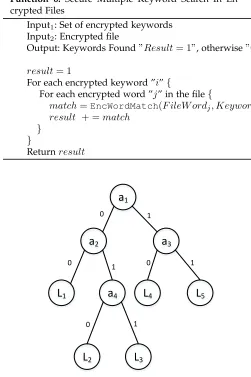
Function 6: Secure Multiple Keyword Search In En-crypted Files
Input1: Set of encrypted keywords
Input2: Encrypted file
Output: Keywords Found”Result= 1”, otherwise”0”
result= 1
For each encrypted keyword ”i”{
For each encrypted word ”j” in the file{
match=EncWordMatch(F ileW ordj, Keywordi)
result + =match }
}
Returnresult
a
1a
2a
3L
5L
4L
1a
4L
2L
30 1
0 0
0
1
1 1
Fig. 2. Binary Decision Tree with nodesaiand leafsLi.
5.3 Binary Decision Trees
Binary decision trees are classifiers consisting of interior nodes and leaf nodes. Interior nodes are decision nodes which decide which direction the tree should follow. Leaf nodes are the final tree decision. Binary decision trees are considered as a simplified version of the spam filter described previously, which is considered as a complete decision tree. Fig. 2 shows an example of a binary decision tree with 4 nodes and 5 leafs.
The decision tree in Fig. 2 can be expressed as polyno-mial equation as in (16). Such a polynopolyno-mial equation can be efficiently implemented using our HE scheme.
T(a1, a2, a3, a4) =a1(a3·L5+ (1−a3)·L4)
+ (1−a1)(a2(a4·L3+ (1−a4)·L2) + (1−a2)·L1)
(16)
5.4 Security against attacks
Our homomorphic encryption scheme and algorithms, and indeed all known FHE schemes, are proven secure in the IND-CPA sense (i.e., under a chosen plaintext attack). This is
Table 2 Design Environment.
Item Specification
CPU Intel Core-i7 5930K
# of CPU Cores 4
# of Threads 8
CPU Frequency 3.5 GHz
Cache Size 15 MB
System Memory 32 GB DDR4
Operating System Windows 8.1 Ultimate
64-bits
Programming IDE Visual Studio 2012
Ultimate edition
GPU NVIDIA GeForce GTX980
Maxwell Version GM204
# of CUDA Cores 2048
GPU Core Frequency 1126 MHz
GPU Memory 4 GB
GPU L2 Cache 2 MB
the standard notion of security for FHE schemes as in [1], [5], [43]. The algorithms in Section 5 are secure against external attackers. They are also secure against an honest but curious server that wants to learn the underlying encrypted data without trying to actively change it. It is trivial that any homomorphic encryption scheme can be broken by CCA2 (i.e., if the adversary can make decryption queries after the challenge). It can also be broken by CCA1 attacks [44] (i.e., if the adversary can make decryption queries, but only before the challenge). The correctness of any FHE algorithm relies on the honesty of the server that it will execute the exact algorithm.
6
P
ERFORMANCER
ESULTSDesign Environment: A summary of the specifications of
the system used to implement our work for the purpose of benchmarking is found in Table 2.
Test Environment:Visual studio instrumentation profiling and CUDA NSIGHT performance analyzer were used in measuring the performance of our code. Performance results presented in this section were measured using two experi-ments
• Ctxt Multiplication time vs. Circuit Depth: The circuit depthdof a circuit is the number of multiplication levels needed to implement a certain function. For example, multiplying 32 numbers requires a circuit depth d = 5. To test the running time of Ctxt multiplication, correctness must be tested as well. To test the running time of the executable with specific parameters for circuit leveld,2d
Ctxts are indepen-dently created each encrypting a ”1” polynomial. All
2dCtxts are multiplied into one accumulator which is
0.001 0.01 0.1 1 10
1 2 3 4 5 6 7 8 9 10
Ctx
t
Multip
lic
at
io
n
Time
(S
ec
onds)
Circuit Depth
IBM HElib (CPU) This Work (CPU) This Work (GPU)
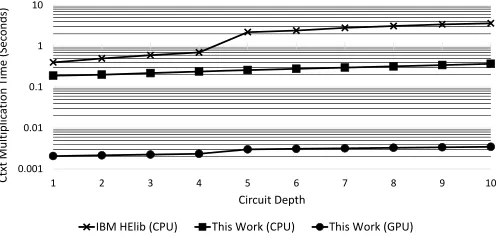
Fig. 3. Ctxt multiplication time of our work when a) running on a single CPU core b) running on a GPU, compared to the IBM HElib when running on a single CPU core across different circuit depths. The running time is plotted on a log scale.
• Algorithm Implementation: The running time of our algorithms are tested by averaging 10 full iterations of each algorithm using the appropriate parameters.
6.1 Ctxt Multiplication
Ctxt multiplication is considered the main bottleneck for most of the homomorphic applications. Thus, we next report the performance of the Ctxt multiplication operation on different platforms (CPU and GPU). To exploit the parallelism in our work, the GPU implementation partitioned the polynomial operations across GPU cores. The downside of the IBM HElib is that it is not parallelizable.
The performance of the Ctxt multiplication in our library a) running on a single CPU core and b) running on a GPU, compared to the IBM HElib library running on a single CPU core, across different circuit depths, is shown in Fig. 3. It can be noticed from Fig. 3 that our CPU and GPU implementations for our library scores speedups up to 10× and 1035× respectively, compared to IBM HElib, across circuit depths larger than 5. Note also that there is a jump in the running time of the IBM library between circuit depth 4 and 5; this is due to a large increase in the polynomial degree used in the IBM HElib to maintain the same security level and correctness of the scheme. This is an implementation dependent choice by the HElib developers in the selection of parameters in the IBM HElib library.
Table 3 summarizes the performance results of the complete homomorphic operations for our library compared to [9], [14] at a circuit depth equal 10. It can be seen from this table that we have a10×speedup for the multiplication operation of our CPU implementation compared to the IBM HElib library. By additionally exploring the parallelizable properties that our HE library has, we get another103.5×speedup by distributing the HE computations on the GPU cores. This resulted in an overall
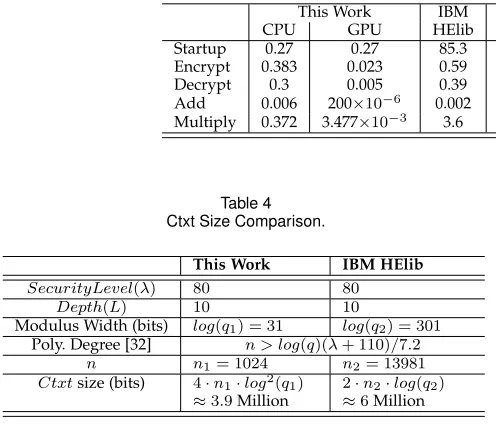
1035×speedup for the multiplication operations compared to the IBM HElib library and a 36310× compared to [9]. The comparison between the Ctxt size of this work and the Ctxt in the IBM HElib library is shown in Table 4. It can be noticed from Table 4 that the Ctxt size in the IBM HElib is about1.5×larger than the Ctxt size in this work.
0.1 1 10 100 1000 10000
30 40 50 60 70 80 90 100 110 120 130 140
Se
ar
ch
ti
me
(s
ec
onds)
File Size (in words)
Partially Secure Keyword Search (GPU) Fully Secure Keyword Search (GPU) Partially Secure Keyword Search (HElib) Fully Secure Keyword Search (HElib)
300× 300×
Fig. 4. Fully Secure and Partially Secure keyword search running time, for single keyword, versus different file sizes compared to IBM HElib (Fully Secure search means both the input keywords and the files being searched are encrypted, whereas Partially Secure search means input keywords are in plaintext but the files being searched are still encrypted).
This is due to the fact that in the IBM HElib, the need for a chain of moduli required for the noise management leads to a modulus width approximately 10× larger. Since the polynomial degree is directly related to the modulus width by equation (8), this resulted in another10×growth in the polynomial degree in the IBM HElib. This increase in the modulus size and the polynomial degree resulted in a Ctxt in the IBM HElib 1.5× larger than this work despite the log(q)difference present in the equation of the Ctxt size in Table 4.
6.2 Secure Multiple Keyword Search Performance
The performance of the Fully Secure and Partially Secure keyword search engines, described in Section 5.2, compared to IBM HElib versus different file sizes is shown in Fig. 4. We observe a300×speedup for the Fully Secure keyword search on a GPU compared to IBM HElib (and 1035× speedup for circuit depth ≥ 5 as indicated in Fig. 3). It is worth mentioning that our implementation is totally scalable and parallelizable. Increasing the number of GPUs inside the server by a factor G, will automatically scale down the running time of the our search engine by the same ratio.
6.3 Secure Binary Decision Tree Performance
The performance of the decision tree depends on the tree structure and the number of nodes and leafs, which will affect our parameter selection and Ctxt operation running times. The decision tree running time depends mainly on the number of multiplications needed. For example, the polyno-mial equation in (16) that describes the tree in Section 5.3 has 8 multiplication operations, each multiplication operation takes 3.477 milliseconds, which results in a total running time of 27 milliseconds compared to multiple seconds in [11].
7
C
ONCLUSIONTable 3
Performance comparison between this work and the IBM HElib. Running time is in seconds.
This Work IBM GPU Speedup Work in [9] GPU Speedup
CPU GPU HElib over IBM HElib over [9]
Startup 0.27 0.27 85.3 316× 5 18.5×
Encrypt 0.383 0.023 0.59 25.6× 4.8 208.7×
Decrypt 0.3 0.005 0.39 78× 2.27 454×
Add 0.006 200×10−6 0.002 10× 0.013 65×
Multiply 0.372 3.477×10⁻³ 3.6 1035× 126.25 36310×
Table 4 Ctxt Size Comparison.
This Work IBM HElib
SecurityLevel(λ) 80 80
Depth(L) 10 10
Modulus Width (bits) log(q1) = 31 log(q2) = 301
Poly. Degree [32] n > log(q)(λ+ 110)/7.2
n n1= 1024 n2= 13981
Ctxtsize (bits) 4·n1·log2(q1)
≈3.9Million
2·n2·log(q2)
≈6Million
encrypted spam filters, secure multiple keyword search, and secure binary decision trees, using this HE scheme. Com-pared to the IBM HElib library, our GPU implementation scores a speedup of 1035× in Ctxt multiplication, which represents the bottleneck for most HE schemes. Our secure search engine application runs in a few seconds on small to moderate file sizes, and our decision tree computations run in a milliseconds for moderate size decision trees.
A
CKNOWLEDGMENTSThe authers would like to thank Tancr`ede Lepoint, Peter Scholl, and Nigel Smart for pointing out a typo in our paper. We would like also to thank NSERC for financial support.
R
EFERENCES[1] C. Gentry, “A fully homomorphic encryption scheme,” Ph.D.
dissertation, Stanford University, 2009, crypto.stanford.edu/craig.
[2] J.-S. Coron, A. Mandal, D. Naccache, and M. Tibouchi, “Fully
Homomorphic Encryption over the Integers with Shorter Public
Keys,” in Advances in Cryptology – CRYPTO 2011, ser. Lecture
Notes in Computer Science, P. Rogaway, Ed. Springer Berlin
Heidelberg, 2011, vol. 6841, pp. 487–504. [Online]. Available: dx.doi.org/10.1007/978-3-642-22792-9 28
[3] M. Dijk, C. Gentry, S. Halevi, and V. Vaikuntanathan, “Fully
Homomorphic Encryption over the Integers,” in Advances in
Cryptology – EUROCRYPT 2010, ser. Lecture Notes in Computer
Science, H. Gilbert, Ed. Springer Berlin Heidelberg, 2010,
vol. 6110, pp. 24–43. [Online]. Available: dx.doi.org/10.1007/ 978-3-642-13190-5 2
[4] Z. Brakerski, C. Gentry, and V. Vaikuntanathan, “(Leveled) Fully
Homomorphic Encryption Without Bootstrapping,” inProceedings
of the 3rd Innovations in Theoretical Computer Science Conference, ser. ITCS ’12, New York, NY, USA, 2012, pp. 309–325. [Online]. Available: doi.acm.org/10.1145/2090236.2090262
[5] Z. Brakerski and V. Vaikuntanathan, “Efficient Fully
Homomor-phic Encryption from (Standard) LWE,” inFoundations of Computer
Science (FOCS), 2011 IEEE 52nd Annual Symposium on, 2011, pp. 97– 106.
[6] C. Gentry, A. Sahai, and B. Waters, “Homomorphic
Encryption from Learning with Errors:
Conceptually-Simpler, Asymptotically-Faster, Attribute-Based,” in Advances
in Cryptology – CRYPTO 2013, ser. Lecture Notes in Computer
Science, R. Canetti and J. Garay, Eds. Springer Berlin
Heidelberg, 2013, vol. 8042, pp. 75–92. [Online]. Available: dx.doi.org/10.1007/978-3-642-40041-4 5
[7] Z. Brakerski and V. Vaikuntanathan, “Lattice-based FHE As
Secure As PKE,” in Proceedings of the 5th Conference on
Innovations in Theoretical Computer Science, ser. ITCS ’14, New York, NY, USA, 2014, pp. 1–12. [Online]. Available: doi.acm.org/10.1145/2554797.2554799
[8] ——, “Fully Homomorphic Encryption from Ring-LWE and
Security for Key Dependent Messages,” in Advances in
Cryptology – CRYPTO 2011, ser. Lecture Notes in Computer
Science, P. Rogaway, Ed. Springer Berlin Heidelberg, 2011,
vol. 6841, pp. 505–524. [Online]. Available: dx.doi.org/10.1007/ 978-3-642-22792-9 29
[9] M. Naehrig, K. Lauter, and V. Vaikuntanathan, “Can
Homomorphic Encryption Be Practical?,” in Proceedings of
the 3rd ACM Workshop on Cloud Computing Security Workshop, ser. CCSW ’11, New York, NY, USA, 2011, pp. 113–124. [Online]. Available: doi.acm.org/10.1145/2046660.2046682
[10] C. Gentry, S. Halevi, and N. Smart, “Homomorphic Evaluation
of the AES Circuit,” in Advances in Cryptology – CRYPTO
2012, ser. Lecture Notes in Computer Science, R. Safavi-Naini
and R. Canetti, Eds. Springer Berlin Heidelberg, 2012, vol.
7417, pp. 850–867. [Online]. Available: dx.doi.org/10.1007/ 978-3-642-32009-5 49
[11] R. Bost, R. A. Popa, S. Tu, and S. Goldwasser, “Machine Learning Classification over Encrypted Data,” Cryptology ePrint Archive, Report 2014/331, 2014, http://eprint.iacr.org/.
[12] J. Alperin-Sheriff and C. Peikert, “Faster Bootstrapping with
Polynomial Error,” inAdvances in Cryptology – CRYPTO 2014, ser.
Lecture Notes in Computer Science, J. Garay and R. Gennaro, Eds. Springer Berlin Heidelberg, 2014, vol. 8616, pp. 297–314. [Online]. Available: http://dx.doi.org/10.1007/978-3-662-44371-2 17 [13] L. Ducas and D. Micciancio, “FHE Bootstrapping in less than a
second,” Cryptology ePrint Archive, Report 2014/816, 2014, http: //eprint.iacr.org/.
[14] S. Halevi and V. Shoup. (2013) Design and Implementa-tion of a Homomorphic-EncrypImplementa-tion Library. researcher.ibm.com/ researcher/files/us-shaih/he-library.pdf.
[15] D. Cousins, K. Rohloff, C. Peikert, and R. Schantz, “An update on SIPHER (Scalable Implementation of Primitives for Homomorphic
EncRyption) ; FPGA implementation using Simulink,” in High
Performance Extreme Computing (HPEC), 2012 IEEE Conference on, 2012, pp. 1–5.
[16] W. Wang, Y. Hu, L. Chen, X. Huang, and B. Sunar, “Exploring the
Feasibility of Fully Homomorphic Encryption.” Los Alamitos,
CA, USA: IEEE Computer Society, 2013, vol. 99, pp. 1–10. [17] M. Yasuda, T. Shimoyama, J. Kogure, K. Yokoyama, and
T. Koshiba, “Secure pattern matching using somewhat
homomorphic encryption,” in Proceedings of the 2013 ACM
Workshop on Cloud Computing Security Workshop, ser. CCSW ’13, New York, NY, USA, 2013, pp. 65–76. [Online]. Available: http://doi.acm.org/10.1145/2517488.2517497
[18] W. Wang, Y. Hu, L. Chen, X. Huang, and B. Sunar, “Accelerating
fully homomorphic encryption using GPU,” inHigh Performance
Extreme Computing (HPEC), 2012 IEEE Conference on, 2012, pp. 1–5. [19] M. Brenner, H. Perl, and M. Smith. (2011) Scarab library . hcrypt.
com/scarab-library/.
of the Fully Homomorphic Smart-vercauteren Crypto-system,” in Proceedings of the 18th ACM Conference on Computer and Communications Security, ser. CCS ’11, New York, NY, USA, 2011, pp. 837–840. [Online]. Available: doi.acm.org/10.1145/2046707. 2093506
[21] E. M. RUSLI. (2014) A Darpa Director on Fully
Ho-momorphic Encryption (or One Way the U.S. Could
Collect Data) . http://blogs.wsj.com/digits/2014/03/
09/a-darpa-director-on-fully-homomorphic-encryption/ -or-one-way-the-u-s-could-collect-data/.
[22] R. A. Popa, C. M. S. Redfield, N. Zeldovich, and H. Balakrishnan, “CryptDB: Protecting Confidentiality with Encrypted Query
Processing,” in Proceedings of the Twenty-Third ACM Symposium
on Operating Systems Principles, ser. SOSP ’11, New York, NY, USA, 2011, pp. 85–100. [Online]. Available: doi.acm.org/10.1145/ 2043556.2043566
[23] T. Graepel, K. Lauter, and M. Naehrig, “ML Confidential:
Machine Learning on Encrypted Data,” in Information Security
and Cryptology – ICISC 2012, ser. Lecture Notes in Computer
Science, T. Kwon, M.-K. Lee, and D. Kwon, Eds. Springer
Berlin Heidelberg, 2013, vol. 7839, pp. 1–21. [Online]. Available: dx.doi.org/10.1007/978-3-642-37682-5 1
[24] D. Boneh, G. D. Crescenzo, R. Ostrovsky, and G. Persiano, “Public Key Encryption with Keyword Search,” 2004, pp. 506–522. [25] J. Baek, R. Safavi-Naini, and W. Susilo, “Public Key Encryption
with Keyword Search Revisited,” in Computational Science
and Its Applications – ICCSA 2008, ser. Lecture Notes in Computer Science, O. Gervasi, B. Murgante, A. Lagan`a,
D. Taniar, Y. Mun, and M. Gavrilova, Eds. Springer Berlin
Heidelberg, 2008, vol. 5072, pp. 1249–1259. [Online]. Available: dx.doi.org/10.1007/978-3-540-69839-5 96
[26] D. Boneh, C. Gentry, S. Halevi, F. Wang, and D. Wu, “Private Database Queries Using Somewhat Homomorphic
Encryption,” in Applied Cryptography and Network Security, ser.
Lecture Notes in Computer Science, M. Jacobson, M. Locasto,
P. Mohassel, and R. Safavi-Naini, Eds. Springer Berlin
Heidelberg, 2013, vol. 7954, pp. 102–118. [Online]. Available: dx.doi.org/10.1007/978-3-642-38980-1 7
[27] D. Cash, S. Jarecki, C. Jutla, H. Krawczyk, M.-C. Ros¸u, and M. Steiner, “Highly-Scalable Searchable Symmetric Encryption
with Support for Boolean Queries,” in Advances in Cryptology
– CRYPTO 2013, ser. Lecture Notes in Computer Science,
R. Canetti and J. Garay, Eds. Springer Berlin Heidelberg, 2013,
vol. 8042, pp. 353–373. [Online]. Available: dx.doi.org/10.1007/ 978-3-642-40041-4 20
[28] C. Aguilar-Melchor, S. Fau, C. Fontaine, G. Gogniat, and R. Sirdey, “Recent Advances in Homomorphic Encryption: A Possible Fu-ture for Signal Processing in the Encrypted Domain,” 2013, vol. 30, no. 2, pp. 108–117.
[29] B. Hayes, “Alice and Bob in Cipherspace,” 2012, vol. 100, no. 5, pp. 362–367.
[30] J. Benaloh and V. Vaikuntanathan. (2013) Homomorphic En-cryption: What, How, and Why . people.csail.mit.edu/vinodv/ Homomorphic-TECHFEST-Final.ppsx.
[31] V. Lyubashevsky, C. Peikert, and O. Regev, “On Ideal Lattices
and Learning with Errors over Rings,” inAdvances in Cryptology
– EUROCRYPT 2010, ser. Lecture Notes in Computer Science, H. Gilbert, Ed. Springer Berlin Heidelberg, 2010, vol. 6110, pp. 1– 23. [Online]. Available: dx.doi.org/10.1007/978-3-642-13190-5 1 [32] R. Lindner and C. Peikert, “Better Key Sizes (and Attacks) for
LWE-based Encryption,” in Proceedings of the 11th International
Conference on Topics in Cryptology: CT-RSA 2011, ser. CT-RSA’11. Berlin, Heidelberg: Springer-Verlag, 2011, pp. 319–339. [Online]. Available: http://dl.acm.org/citation.cfm?id=1964621.1964651 [33] A. Sch ¨onhage and V. Strassen, “Schnelle multiplikation großer
zahlen,” Computing, vol. 7, no. 3-4, pp. 281–292, 1971. [Online].
Available: http://dx.doi.org/10.1007/BF02242355
[34] A. V. Oppenheim and R. W. Schafer, Discrete-Time Signal
Processing. Pearson Education, 2006. [Online]. Available: books. google.ca/books?id=geTn5W47KEsC
[35] J. A. Solinas, “Generalized Mersenne Numbers,” University of Waterloo, Tech. Rep. CORR 99-39, 1999.
[36] M. Sahami, S. Dumais, D. Heckerman, and E. Horvitz, “A
Bayesian Approach to Filtering Junk E-Mail,” in Learning for
Text Categorization: Papers from the 1998 Workshop. Madison, Wisconsin: AAAI Technical Report WS-98-05, 1998. [Online]. Available: citeseer.ist.psu.edu/sahami98bayesian.html
[37] Wikipedia. (2004) Naive Bayes spam filtering . http://en. wikipedia.org/wiki/Naive Bayes spam filtering.
[38] Y. Doroz, B. Sunar, and G. Hammouri, “Bandwidth Efficient PIR
from NTRU,” inCryptology ePrint Archive, 2014, pp. 1–12.
[39] X. Yi, M. G. Kaosar, R. Paulet, and E. Bertino, “Single-Database Pri-vate Information Retrieval from Fully Homomorphic Encryption,” May 2013, vol. 25, no. 5, pp. 1125–1134.
[40] C. Aguilar-melchor and P. Gaborite, “A Lattice-Based
Computationally-Efficient Private Information Retrieval
Protocol,” inWEWoRC 2007, 2007, pp. 1–13.
[41] N. Fotiou, D. Trossen, G. Marias, A. Kostopoulos, and G. Polyzos, “Enhancing information lookup privacy through
homomorphic encryption,”Security and Communication Networks,
vol. 7, no. 12, pp. 2804–2814, 2014. [Online]. Available: http://dx.doi.org/10.1002/sec.910
[42] C. A. Melchor, “High-Speed Single-Database PIR
Implementa-tion,” inThe 8th Privacy Enhancing Technologies Symposium (PETS
2008), 2008, pp. 1–12.
[43] C. Gentry, “Fully Homomorphic Encryption Using Ideal Lattices,” in Proceedings of the 41st Annual ACM Symposium on Theory of Computing, ser. STOC ’09, New York, NY, USA, 2009, pp. 169–178. [Online]. Available: doi.acm.org/10.1145/1536414.1536440 [44] M. Chenal and Q. Tang, “On Key Recovery Attacks against
Existing Somewhat Homomorphic Encryption Schemes,” inThe
third International Conference on Cryptology and Information Security in Latin America, Latincrypt 2014, 2014, pp. 1–28. [Online]. Available: https://orbilu.uni.lu/handle/10993/18106
Alhassan Khedrreceived his M.Sc and B.Sc degrees from Electronics and Electrical Com-munications Engineering Department, Faculty of Engineering, Cairo University, Cairo, Egypt in 2008 and 2011 respectively. After graduation, he was appointed as a Teaching Assistant in Cairo University and American University of Cairo for 3 years. He received numerous awards for his excellence as a student and as a teaching as-sistant. He was among the team responsible for developing and fabricating CUSPARC the first fully developed Egyptian embedded processor. Alhassan joined Elec-tronics and Computer Engineering Department at University of Toronto to pursue his PhD degree in 2011. Alhassan main research interests include algorithm optimization and VLSI implementation of high perfor-mance algorithms. He is also interested in parallel and multi/many core processor architecture design and computer arithmetic.