Experimental Study on the Performance of
Corn Cob Ash as Partial Cement
Replacement in Mortar
1Olulope, O.R. and 2Popoola, O.O.1,2Department of Civil Engineering, Federal Polytechnic, Ado-Ekiti, Nigeria
. Abstract
This paper presents the findings of an investigation on the effects of corn cob ash (CCA) as a partial cement replacement in mortar. The investigation was done to search out a possible alternative to cement since the continuous increase in the price of cement has been identified as one of the major factors hindering the provision of affordable housing in Nigeria. The CCA was obtained by burning corn cobs (a waste) in a furnace at a temperature 600ᵒC for a period of 6 hours. The effect of CCA was explored at replacement levels of 0%, 10% and 15% by weight of cement in mortar. The result of the oxide composition shows that CCA has a combined SiO2, Al2O3 and Fe2O3 content of
73.5% thus the CCA is categorized as a Class N pozzolan according to the ASTM C618 classification. The flowability of the mortars is not significantly affected by replacement levels. The compressive strength decreased as the replacement level of cement with CCA increased due to dilution effect. Mortar density increased with advancement in age irrespective of the mix constituent percentages and CCA as a pozzolan does not significantly affect the density of the mortar. The extent of abrasion resistance in CCA mortars decreased with increase in corn cob ash content and the C-10CCAM gave higher resistance to chloride attack compared to both the control mortar and the mortar with higher ash content. It is recommended that CCA can be safely used in environments with mild durability conditions and further tests should be performed on CCA mortars.
Keywords: Corn cob ash, affordable housing, pozzolans, compressive strength, durability.
1. Introduction
Cement production is characterized with the emission of huge amounts of greenhouse gases most of which is CO2 as each ton of cement produced is
reported to release an equivalent ton of CO2 to the
environment (Karim et al, 2011). Also, clinker is
burnt at a high temperature of about 1450°C, a reason for the high market price of cement and the cause of global warming (Arum et al, 2013 and Olutoge et al, 2013). The natural raw materials for the production of Portland cement (limestone, sand, shale, clay, and iron ore) are depleting daily, posing a threat to sustainability. The challenges associated with the application of Portland cement include the excessive high heat generated in early hydration which results in cracking as a result of rapid volume changes, the poor durability performance in some environments especially chloride and sulphate rich environments and the high cost of service life cycle of structures (Lawrence, 1998). Researchers and engineers are therefore in continuous search for alternative materials that would be more environmentally friendly, cheaper and of excellent performance to substitute or partially replace cement in construction. The use of supplementary materials for cement has been widely recognized as a sustainable alternative. Generally, natural Pozzolans, ashes from industrial processes (such as fly ash, silica fume, slag, GGBS) and ashes from agricultural wastes (such as cassava peels, rice husks, groundnut husk, corn cob ash) which may have pozzolanic or hydraulic properties are being investigated as supplementary materials to cement.
Availability of affordable housing is an urgent need for developing countries especially Nigeria where the national housing deficit escalated from 7 million units in 1991 to 17 million in 2013 and is still rising continuously every year with increasing population (Alitheia, 2012,; Adegboye, 2012). The continuous increase in the price of cement is one of the major factors hindering the provision of affordable housing.
lime and Pozzolan generates less heat, resulting in reduced thermal cracking when Pozzolans partially replace cement and also reduced sulphate attack by tying up free lime that otherwise could combine with sulphate to create destructive expansion (Safiuddin et al., 2011, Ahmad et al., 2008, and Ghassan et al., 2013).
Corn cob is one of the major wastes littering the environment in Nigeria especially in the summer when corn/ maize are harvested in large quantity. The use of corn cob ash as partial cement replacement in mortar is one potential mean of generating affordable binder for construction and is a way of effectively converting the waste to wealth. Nevertheless, it is expedient to investigate the strength and other structural properties of corn cob ash in mortar so as to generate proven and reliable data base for its application in construction. Therefore, the objectives of this work are to investigate the chemical composition of corn cob ash in order to determine its pozzolanic reactivity and to determine the compressive strength as well as the durability performance of cement-corn cob ash mortar.
2. Experimental Details 2.1 Materials
The corn cobs used in this work were gathered from roasted cob sellers and dump sites in Ado- Ekiti, the state capital of Ekiti state, south-western Nigeria. Portland limestone cement (CEM II B-L 32.5N) produced by Lafarge Nigeria was purchased from one of the commercial cement sale points in the local construction market in Ado-Ekiti.
The corn cobs were sundried and chopped into smaller sizes before being taken to the furnace where they were burned at a controlled temperature of 500ᵒ C for a period of 6 hours in the department of Science Technology Federal Polytechnic, Ado- Ekiti. The samples were completely calcined and left to cool for 48 hours. The ash was sieved through a 45µm sieve. The specific gravity of the corn cob ash and the cement are 1.36 and 3.15 respectively.
The fine aggregate used was natural sharp river sand collected from Ado/Afao –Ekiti. The fineness modulus of the sand is 2.68 and the specific gravity is 2.53. The mixing water is obtained from the bore hole in the school of Engineering, Federal Polytechnic, Ado- Ekiti.
3. Methods
3.1 Oxide Compositions
The oxide compositions of the cement and the corn cob ash were determined in the Central Research Laboratory of FUTA with the aid of Minipal 4 Energy Dispensing X-ray Fluorescence Spectrometer (EDXRF). The major oxides especially for classifying pozzolans as well as other chemical compositions are determined for the cement and the corn cob ash. The loss on ignition LOI is also determined.
3.2 Mixes
A mortar mix of binder: sand ratio 1:3 was adopted for the production of mortar cubes. The term binder in this work refers to a manual blend of cement and corn cob ash CCA at selected replacement levels. The cement content was partially replaced by 0%, 10% and 15% CCA. These percentages of replacement were taken for this work based on recommendations by who had earlier investigated the suitability of various agricultural wastes as pozzolans. All specimens were prepared at the same water/ binder ratio of 0.5. The mix samples were labeled as CM (cement mortar), C-10CCAM (mortar with 10% corn cob ash replacing cement), and C-15CCAM (mortar with 15% corn cob replacing cement). The mix constituent proportioning is presented in Table 1.
Table 1: Mix Design for Mortar Constituents
The mortar was manually mixed in the laboratory. The fresh mortar was tested for wet/fresh properties workability (flowability). Then it was scooped into prepared moulds in three layers; each layer was rammed 25 times with a tamping rod. The filled cubes were left undisturbed on a flat surface in the laboratory. The specimens were carefully demoulded after 24 hours.
Mortar
Ingredients CM C-10CCAM C-15CCAM
Cement (kg) 4.50 4.05 3.825
Corn cob ash (kg)
0 0.45 0.675
Water/ binder ratio
0.5 0.5 0.5
3.3 Determination of workability
The flowability/filling-ability test was used to determine and compare the workability of cement mortar (CM) and cement-corn cob ash mortar (CCAM). The test was conducted using a V-funnel apparatus as described by Kyahat, (2004). The test shows that the shorter the time taken, the higher the flowability and better the workability of the mortar mix.
3.4 Density
Density was determined for the various mortar cubes at each replacement level and crushing age. The density was determined prior to the determination of the compressive strength
3.5 Compressive strength
100 mm x 100 mm x 100 mm mortar cubes were used for compressive strength test. The casting and curing of the mortar cubes were done in accordance to BS Cubes for compressive strength were cured in water till the testing ages of 7, 14, and 28 days. Three mortar cubes were crushed at each replacement level and maturity age.
3.6 Durability testing
Abrasion is the process of scratching, wearing down, marring or rubbing away of a surface. The factors that affect abrasion resistance relate greatly to the proper selection, composition and application of mortar and concrete as regards specific type of service condition. Abrasion can be undesirable effect of exposure to normal use or exposure to undesirable elements. The sample mortar cubes used for abrasion testing are weighed using a sensitive weighing device to get the initial weight (W1). The cube is then subject to abrasion by
brushing for 50 continuous cycles using a hard wire brush and the cube is then reweighed after the abrasion exercise (W2). The loss in weight is
expressed as the extent of resistance to abrasion. 3.7 Chloride attack
100 mm x 100 mm x 100 mm mortar cubes prepared with the different cement replacement levels were cured in sodium chloride solution for 28 days to determine the durability performance in such an aggressive environment. The weight of the specimens was determined and the cubes were crushed after the period of exposure to chloride rich environment. 3 cubes were used for each sample testing and the
average represents the sample result. The results are compared with that of the cement mortar cured in the same solution.
4. Results and Discussion 4.1 Chemical Composition
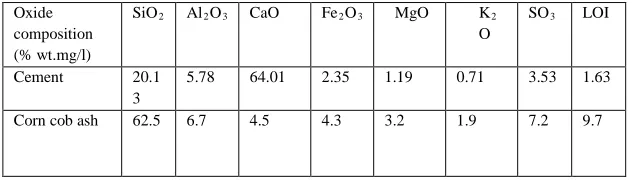
The results of the oxide composition of both cement and corn cob ash are presented in Table 2. ASTM C618 stipulates that the sum of the percentage composition of SiO2, Al2O3 and Fe2O3 must not be
less than 70%. Table 2 shows that the sum of the three oxides is 73.5% thus identifying corn cob ash as a possible pozzolan. The magnesium oxide content is 3.2% which is below 4%. It indicates that the pozzolan has good soundness. The loss on ignition is found to be 9.7% which is lower than the maximum stipulated value of 10%. The result of the LOI implies that the corn cob ash has low unburned carbon content which may not really affect its Pozzolanic reactivity. In general the CCA can be categorized as a Class N pozzolan according to the ASTM C618 classification.
Table 2: Chemical Composition
4.2 Flowability test on Mortar
The results of the flowability test on cement-mortar CM, cement-10% corn cob ash C-10CCAM and 15% corn cob ash mortar C-15 are shown in Table 3. It is seen that the longer the time taken, the lower the flowability of the mortar. The flowability improves slightly with increase in percentage replacement of CCA. Although the time taken for the control mortar to flow is lower than the time taken for the cement ash mortar. This result agrees well with the observation of Arum et al, (2013). It can be said that replacement levels (10% and 15%) in this study do not significantly affect the flowability of the mortar. Oxide
composition (% wt.mg/l)
SiO2 Al2O3 CaO Fe2O3 MgO K2
O
SO3 LOI
Cement 20.1
3
5.78 64.01 2.35 1.19 0.71 3.53 1.63
Table 3: Flowability test on Mortar
4.3 Compressive strength
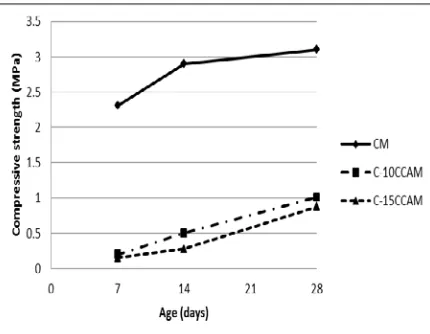
The results of the compressive strength are presented in Figures 1and 2. The results indicate that the compressive strength increases with advancement in age for the control mortar and the mortars incorporating CCA at both 10% and 15% replacement levels. This effect is attributed to increase in hydration products as age increases as similarly reported by Neville, (2003). The results also show that the compressive strength decreased as the replacement of cement with CCA increased from 0 to 15 %. This effect may be attributed to dilution effect due to saturation of the cement mix with oxides of K2O and MgO in CCA which may prevent the
formation of strength giving calcium silicate hydrates during cement hydration. Elinwa and Abdulkadir (2011) reported similar observation on sawdust ash in concrete.
Figure 1: Effect of age on the compressive strength of PC/CCA mortar
Figure 2: Effect of replacement level on the compressive strength of PC/CCA mortar
4.4 Pozzolanic Activity Index
The pozzolanic activity index is a number based on the compressive strength of mortar samples such that the average compressive strength of test mix containing pozzolan (A) is divided by the average compressive strength of pozzolan-free mortar test cube (B) multiplied by 100%. The results of the strength pozzolanic reactivity indices of mortars containing 10% and 15% corn cob ash are 32.6% and 28.4% as shown in Table 4. It is seen that the index reduced with increase in replacement level and ash content. The Pozzolanic reactivity index for 10% and 15% replacement levels (32.6% and 28.4% respectively) values are far below the 75% minimum value specified for utilization of a pozzolana in concrete as stipulated by the ASTM.
Table 4: The Pozzolanic activity index of corn cob ash CCA mortar
4.5 Density
Table 5 presents the result of the density of mortars produced from 100% Portland cement and those made from 90% and 85% Portland cement. The mortars with 90% and 85% Portland cement incorporated 10% and 15% corn cob ash respectively. Sample ID CM C-10CCAM C-15CCAM
Time taken (seconds)
8 10 9
CCA% Replacement Pozzolanic activity index
10% 32.6%
The result shows that mortar density increased with advancement in age irrespective of the mix constituent percentages. It is observed that more than 80% of the ultimate density was attained at 7 days for all specimens, Newman and Choo (2003) reported similar observation. There was no notable difference in the density of mortars with 100% PC and those with CCA replacement percentages especially at 28 days. Thus, CCA as a pozzolan does not significantly affect the density of mortar.
Table 5: Density of mortar containing corn cob ash
CCA replacement level (%)
Testing age of mortars
7days 14 days 28 days
0 1833 2033 2067
10 2023 2200 2283
15 1817 2000 2200
4.6 Abrasion Resistance
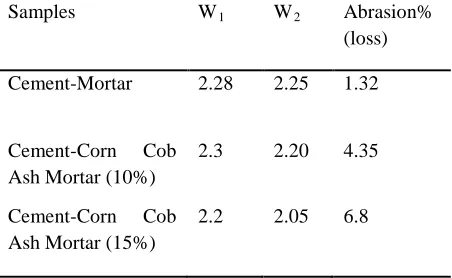
The result of the abrasion test on mortars incorporating corn cob ash is shown in table 6. It is observed that the control (cement mortar) gave a lower abrasion loss of 1.32% compared to the samples containing CCA which gave higher abrasion loss. It is also seen that the extent or degree of abrasion resistance decreased with increase in corn cob ash content. The C-10CCAM with 10% ash only experienced a loss of 4.35% while C-15CCAM recorded 6.8% loss. This result can be attributed to the effect of compressive strength on abrasion resistance. The samples with higher compressive strength are those that gave higher abrasion resistance and lower loss. In application, the mortar containing CCA may be used in mild condition of abrasion as this may also promote the durability of such structure.
Table 6: Abrasion resistance of mortar containing corn cob ash
Samples W1 W2 Abrasion%
(loss)
Cement-Mortar 2.28 2.25 1.32
Cement-Corn Cob Ash Mortar (10%)
2.3 2.20 4.35
Cement-Corn Cob Ash Mortar (15%)
2.2 2.05 6.8
4.7 Chloride attack
Table 7 shows the result of the chloride attack on mortars containing CCA. The result reveals how deteriorating chloride attack can be on mortars strength generally. It is observed that the C-10CCAM gave higher resistance to chloride attack compared to both the control mortar and the mortar with higher ash content. This can be attributed to the effective nature of pozzolans to reduce chloride attack. The result is similar to that observed by Patil and Kumbhar (2012) while determining the strength and durability of concrete containing metakaolin.
Table 7: Chloride attack of mortar containing corn cob ash
S/N Mix description
28 days Compressive strength N/mm2
Compressive strength on exposure to Chloride attack N/mm2
% resistance
1 CM 3.1 0.8 26
2
C-10CCAM
1.01 0.3 30
3
C-15CCAM
0.88 0.21 24
5 Conclusion
The corn cob ash CCA gave high tendency of pozzolanic reactivity, with a combined SiO2, Al2O3
and Fe2O3 content of 73.5% thus implying that it
iii) The compressive strengths of mortars incorporating CCA decreased with increase in CCA content i.e. the control mortar gave higher compressive strength than mortars with 10% and 15% CCA.
iv) The pozzolanic activity index decreased with increase in CCA percentage in mortar. The pozzolanic activity index values were very low compared with the required value recommended by standards.
There was no notable difference in the density of mortars with 100% PC and those incorporating CCA as replacement.
v) The extent or degree of abrasion resistance decreased with increase in corn cob ash content. The C-10CCAM with 10% ash only experienced a loss of 4.35% while C-15CCAM recorded 6.8% loss. This result is attributed to the effect of compressive strength on abrasion resistance.
6 Recommendation
Further tests should be done to mortars incorporating CCA can be used for mild construction where the durability exposure is not very severe. Research should be conducted to investigate the performance of a blend of corn cob ash and rice husk ash as partial replacement for cement in mortar.
References
Adegboye, K. (2012) “52 Years of Homelessness: Experts Proffer Solutions to Dearth of Affordable Housing,” Van-guard Mobile Edition.
http://www.vanguardngr.com/2012/10/52-years-of- homelesness-experts-proffer-solutions-to-dearth-of-affordable-housing/
Ahmad, M. H., Omar, R .C., Malek, M. A., Noor, N. and Thiruselvam, S., (2008), Compressive Strength of Palm Oil Fuel Ash Concrete, ICCBT, A-(27), 297-306.
Alitheia, C., (2012) “Housing - Creating the Right Environment. Lessons from other economies in tackling the housing crisis,” Vol. 24, http://www.thealitheia.com/newsletters/Alitheia Capital REInsight.pdf
Arum, C., Ikumapayi, C.M, Aralepo, G.O.( 2013) Ashes of Biogenic Wastes—Pozzolanicity, Prospects for Use, and Effects on Some Engineering Properties of Concrete, Materials Sciences and Applications, 4, 521-527.
ASTM C618 (2008) Specification for Pozzolanas. America Standard of Testing Material International, 1916 Race street,Philadelphia,Pa 19103, USA British Standards Institution, “Testing Concrete— Part 116: Method for Determination of Compressive Strength of Concrete Cubes,” BS 1881, BSI, London, 1983.
British Standards Institution (2000), “Testing Concrete—Part 7: Density of Hardened Concrete,” BS 12390, BSI, London.
Elinwa, A.U. and Abdulkadir, S. (2011) Characterizing Sawdust Ash for used as an Inhibitor for Reinforcement Corrosion, New Clues in Science, vol. 1, pp. 1-10. www.woaj.org/NCS
Ghassan, K.A., Mouin, A. and Panagiotsis, G.A. (2013), Natural Pozzolans as partial substitute for cement in concrete. The open construction and building TechnologyJournal vol 7(11) pp. 33-42. Karim, M.R., Zain, M. F. M., Jamil, M. Lai, F. C. and Islam, F. C. (2011) “Necessity and Opportunity of Sustainable Concrete from Malaysia’s Waste Materials,” Australian Journal of Basic and Applied Sciences, Vol. 5, No. 5, pp. 998-1006.
Khayat, K.H., and Morin R. (2004) Performance of self-consolidating concrete used to repair parapet wall in Montreal in: Proceeding of the 1st North American conference on the design and use of self-consolidating, concrete. 475–481.
Lawrence, C.D., (1998) Lea’s Chemistry of Cement and Concrete, Hewlett, P.C, 4th ed., Arnold, New-York, pp. 1051-1054.
Newman, J. and Choo S.G., (2003), Advanced Concrete Technology- Concrete Properties, Elsevier, pp.1-5
Neville, A.M. (2003) Properties of concrete, Fourth edition, Pearson Education Singapore.
Olutoge, F.A.,Buari, T.Aand Adeleke, J.S, (2013) Characteristics Strength and Durability of Groundnut Shell Ash (GSA) Blended Cement Concrete in Sulphate Environments, International Journal of Scientific & Engineering Research, Vol. 4, Issue 7.
International Journal of Modern Engineering Research (IJMER), (2,3) pp-1099-1104 www.ijmer.com