DIFFUSION IN THE FACE OF FAILURE: THE EVOLUTION OF A
MANAGEMENT INNOVATION
Abstract
Recent work has questioned the institutional model of management innovation by
highlighting interactions between the field-level actors engaged in diffusing innovations,
and implementation of the innovation at organization level. Focussing on the adaptation of
management innovations to their context, rather than their creation, we review this work
and use it to analyse the global diffusion of Resource Planning (RP), counterposing this case
with the widely studied example of TQM. Both of these innovations experienced a high level
of failure when implemented by organizations. TQM’s diffusion was characterised by a
‘boom and bust’ cycle. RP, however, has continued to spread globally in the form of its
variants; MRP, MRPII and ERP. Our analysis seeks to account for the long run diffusion of
RP through a processual model which highlights the interplay between RP’s discursive
framing at field-level, the affordances of the innovation itself, and its adaptation within
organizations. This demonstrates how objectifying RP in software not only helped to spread
the innovation, but also allowed field-level actors to differentiate its development as a
successful innovation from the many failures experienced by organizations attempting to
adapt it.
Introduction
Management innovation is a term used to refer to the generation and implementation of
new management practices, processes, structures and techniques that are intended to further
organizational goals (Birkinshaw et al, 2008; Vaccaro et al, 2012). Innovation here means
new to the organization, rather than new to the world (Birkinshaw et al., 2008). This paper
considers how the spread of such innovations across organizations is influenced by the
experience of implementing such innovations within organizations. This question is relevant
to management innovations because they are characterized by high degrees of ambiguity,
context dependency and ‘interpretive flexibility’ (Abrahamson, 1996). As such, they typically
undergo significant adaptation when implemented and their ‘success’ is often difficult to
assess (Ansari et al., 2010).
Social or institutional models of diffusion help to explain the spread of management
innovations because they consider the ways in which social and institutional mechanisms
drive diffusion and adoption (Strang and Meyer, 1993; Ansari et al. 2010). While other work
emphasizes technical or economic benefits as drivers of diffusion, the focus of institutional
models is on the way in which certain innovations come to be seen as legitimate or even
‘must-have’ features of organizational life. At the extreme, as with the study of management
fashions, the spread of new management practices may be seen as driven by ‘bandwagons’
and ‘success stories’ that have little to do with their performance benefits for organizations
(Abrahamson, 1996; Scarbrough and Swan, 2001). Institutional models thus provide a
complementary alternative to the view that innovations spread because of their comparative
performance benefits (Kennedy and Fiss, 2009), and it is to this line of inquiry that we
contribute here.
To date, however, institutional accounts have focussed mainly on field level processes (e.g.
isomorphism), with insufficient consideration of how innovations are reinvented and evolve
as they diffuse (cf. Rogers, 1995), or of managers’ agency in adapting them as they
implement and use them (Vaccaro et al., 2012; Ansari et al, 2014). Work on the
implementation of management innovations, by contrast, has tended to focus on firm, or
2008, for a critique). There is still relatively little understanding therefore of the processes
through which field-level diffusion and organizational-level implementation interact and
how this drives the evolution of management innovation. In response, our study seeks to
develop, as its principal theoretical contribution, a processual model of the evolution of
management innovation that accounts for the interplay between diffusion and
implementation.
To develop such a model requires a multi-level approach; one capable of relating the
implementation of new practices within local settings to the emergence of field-level actors
and their influences upon the spread of innovation. This, it has been argued, is especially the
case with management innovations because their spread and adoption is highly influenced
by both field and organization level influences (Birkinshaw et al., 2008). Such a multi-level
analysis enables us to address a ‘dearth of attempts to bridge inter-organizational
mechanisms of diffusion with intra-organizational implementation and adaptation’ (Ansari
et al., 2010: 68).
In the next section, we review existing studies of the evolution of management innovations
and use the particular example of TQM (Total Quality Management). From this we begin to
draw out the elements of a provisional processual model and identify key research
questions. In the sections that follow we develop our processual model through a theory
development case study (Abrahamson and Eisenmann, 2008) centred on an historical
analysis of the evolution of Resource Planning (RP). This innovation involves the use of
cross-functional integrated systems to plan and control the flow of resources in
organizations. It is considered to be one of the most important, and widely spread,
management innovations of recent years (Mol and Birkinshaw, 2008). Although it involves a
core of technical knowledge, this innovation also involves changes across management
practices, processes and structures, thus blurring the conventional distinction between
‘administrative’ and ‘technological’ innovation (cf. Damanpour, 1987 and 2010). It therefore
provides a good case from which to build theory by developing our multi-level, processual
model.
In the final section, we discuss the elements of this model, highlighting processes that
In particular, a distinctive feature of this management innovation is its successful global
diffusion in the face of widely reported, high levels of implementation failure, and
associated detrimental effects on organizational performance. Our model provides
explanatory power for this phenomenon because it relates distinctive features of the
innovation, and its adaptation by organizations, to the way success and failure were framed
by its promoters.
The Evolution of Management Innovations: The Need for a Processual View
In discussing institutional influences on diffusion, it is important to distinguish between
macro-level institutional factors, which help to explain the spread of innovations across
national contexts (Guler at al., 2002), and the field-level factors which help to explain their
spread across organizations. For the latter, the institutional model can be contrasted with
‘classical’ (Rogers, 1995) or ‘rational’ models of diffusion (Damanpour, 1987, 2010,
Wischnevsky et al., 2011; Ansari et al., 2010). The institutional model suggests that, while
early adopters may be motivated by performance benefits, as the innovation spreads,
adopting organizations become more concerned with seeking legitimacy through a process
of isomorphism (Meyer and Rowan, 1977; Tolbert and Zucker, 1983). Diffusion thus may, in
some cases, be driven by fashion or social bandwagon effects (Strang and Meyer, 1993;
Abrahamson, 1991).
However, recent work has begun to question some aspects of this model, with studies
highlighting both the agency of the groups involved (Lounsbury, 2002; Henfridsson and
Yoo, 2013), and variations in the adoption of innovative practices at the organization-level.
These studies have suggested that innovations may not only be more or less extensively
implemented (Westphal and Zajac, 2001), but that they may also be more or less
‘customized’ to local contexts (Zilber, 2006; Lounsbury, 2007). This work questions an
over-reliance on isomorphism as an explanation for the spread of innovation. Rather, it suggests
that greater attention needs to be given to the role of both field-level and organizational
Work on institutional entrepreneurship has attempted to better account for agency in the
institutional model (Maguire et al. 2004; Dorado, 2005; Munir and Phillips, 2005; Greenwood
and Suddaby 2006; Battilana et al, 2009; Henfridsson and Yoo, 2013). This work has
connected field-level shifts in institutional arrangements to the micro-level actions of
individual agents who are effectively able to ‘leverage resources to create new institutions or
to transform existing ones’ (Maguire et al., 2004: 657). Institutional entrepreneurs (Garud et
al, 2002) are thus found to play an important role in ‘igniting’ organizational changes that
may eventually lead to changes in the trajectory of innovations (Henfridsson and Yoo, 2013).
Such actors ‘skilfully draw on established practices as they envision alternative futures…
providing the basis for field-level changes when they are successful’ (Henfridsson and Yoo,
2013: 944). This work is important in showing how actors’ discursive strategies play an
important role in framing alternative possibilities (Munir and Phillips, 2005; Maguire et al.,
2004). More broadly, it emphasises the need for multi-level, processual theories that can
better account for how embedded actors shape field-level change (Battilana et al, 2009).
However, it is relatively silent on the innovation itself and, in particular, on how the
experiences of implementation and adaptation shape wider diffusion processes.
Recent contributions are thus advocating a perspective on theat evolution of innovations
that takes account of the ‘emergent, processual, and recursive character of implementation
and diffusion’ (Ansari et al., 2010: 84). The need for such a view is reinforced by work on one
of the most widely studied management innovations, namely TQMi. This research has been used previously to highlight the influence of social bandwagon effects upon the spread of
innovations. David and Strang (2006), for example, describe how the spread of TQM
underwent three phases of a ‘boom and bust’ cycle. First, a ‘pre-boom’ period, when TQM
emerged from a mix of corporate quality programs, quality gurus and professional experts.
Second, a ‘boom period’ marked by high levels of media attention and widespread, but
‘superficial’, implementation, aided by large numbers of generalist consulting firms. Third, a
‘post-boom’ period, characterised by rational and technical interests, where ‘exchanges of
information and analysis…replaced celebratory success stories’ (David and Strang, 2006:
Unpacking the ‘boom and bust’ cycle of TQM helps to reveal the importance of the interplay
between field-level activities promoting diffusion and firm-level implementations of the
innovation. First, in common with the work on institutional entrepreneurship noted above,
this study highlights the importance of the ‘discursive framing’ of an innovation by
field-level actors (Hargadon and Douglas, 2001; Nicolini, 2010; Maguire et al., 2004). Thus, in the
pre-boom period, specialist consultants framed TQM as a ‘solution’ to the professional
management of quality issues. The boom period was characterised by the framing of TQM
as a ‘success story’ fuelled by generalist management consultancies and widespread media
attention. This was followed by the downswing phase which saw a shake-out in the
consultancy providers, and the development of a more technically-oriented discourse.
Second, we can identify a relationship between field-level framing and organizational
implementation. The rhetoric of the boom period helped to promote the spread of the
innovation, but was also seen as encouraging ‘superficial’ rather than ‘deep’
implementation. Cole notes, for instance; ‘Because of the vagueness of the concept (TQM)
….firms and industries were free within a certain range to interpret it, position it and adopt
those practices that fit particular corporate traditions and industry imperatives.’ (Cole, 1999:
11). In other words, the meaning of the innovation was enacted and adapted to particular
organizational contexts, leading to variations in practice (cf. Zbaracki, 1998; Kennedy and
Fiss, 2009; Purdy and Gray, 2009).
As Ansari et al. (2010) observe, such ‘adaptations’ raise the question of whether certain
innovations lend themselves to different interpretations and enactments. For example, the
flexible interpretations of TQM can be contrasted with the more constrained interpretations
which apply to ISO 9000 as a management practice which is embodied in industry standards
more or less independent from field level actors and adopting organizations (Guler et al.,
2002). The contrast between these two management practices thus highlights how
innovations may be more, or less, amenable to flexible interpretation by organizations, thus
enabling, or constraining, the possibility for local adaptation. It also highlights the role of
field–level actors, including consultants, in simplifying the ambiguous ideas (that they have
vested interests in promoting) so as to encourage their adoption by organizations (Clark et
Ansari et al. (2010) identify interpretive flexibility as one of the ‘affordances’ of an
innovation, which is mediated by, but transcends, perceptions (other affordances that they
identify include ‘divisibility’ and ‘complexity’). Affordances are described as characteristics
that can offer opportunities for action but also, potentially, place constraints upon action,
making it more or less likely that a practice will be adopted (Hutchby, 2001). Aside from the
work on TQM, we know relatively little about how such affordances operate upon the
adopters of management innovations, particularly where their effect is to constrain, rather
than enable, adaptation.
Over time, variety in the enactment and outcomes of implemented innovations helps to
increase the knowledge and experience available to potential adopters (Strang and Macy,
2001; David and Strang, 2006). In the case of TQM, such vicarious experience seems to have
contributed to this innovation’s boom and bust cycle, with ‘success stories’ helping to drive
its spread, and ‘failure stories’ contributing to the downswing in the cycle. This highlights
how the experience gleaned from previous adopters, as well as the number of such adopters,
can play a role in driving or dampening the spread of an innovation. The importance of
such vicarious experience for management innovation has also been highlighted by previous
work (Abrahamson, 1991). What is less understood, however, is how this vicarious
experience may be filtered and framed, and what role may be played by adopting
organizations, as well as by field-level actors, in acting as the ‘sensegivers’ as well as
sense-takers of the meaning of a diffusing practice (Fiss and Zajac, 2006). As Strang and Macy
(2001) note ‘while much work emphasizes the impact of adoptions elsewhere, there is little
attention to how actors respond to the results experienced by others’ (p. 151). This lack of
attention is difficult to justify in the light of evidence on the activities of prospective adopter
organizations who, according to Swanson and Ramiller ‘search and probe and engage the
interpretations of others’ (Swanson and Ramiller, 1997: 460).
Wider work on the diffusion of innovations in health and public policy provides some clues,
however, as to how this vicarious experience may be conveyed to organizational actors. This
highlights, in particular, the important mediating role of professionals in promoting or
inhibiting the spread of innovations through their adoption of particular forms of innovation
(Ferlie et al., 2005). Experience conveyed through such professional networks plays a
legitimacy among potential recipients (Swan et al., 1999a). Research on policy
implementation shows, further, how entrepreneurial actors, who have detailed local
knowledge of their own organization and pan-organizational contexts, are adept in both
adapting innovations for use locally and also in proactively shaping and contributing to
policy mandates (Fitzgerald et al., 2002; McDermott et al., 2013). Thus ‘first-order change
recipients’ can act as ‘second-order change agents’ by using their local and contextualised
experience to tailor, adapt and change policy mandates (McDermott et al., 2013). This
research highlights the importance of considering vested interests of different groups (e.g.
professionals, commercial suppliers) in the spread of management innovation. It also shows
the blurred distinctions between ‘users’ or ‘adopters’ of innovation at the organizational
level and ‘producers’ or ‘suppliers’ (policy makers, in this case) at the field level. However,
this work is silent on how particular ways of framing vicarious experience (e.g. as ‘success’
or ‘failure’) encourage or discourage the evolution and spread of innovation over time.
In summary, the variation in the framing, interpretation and enactment of new management
practices seen, for example, with TQM, brings into question an established institutional
model of diffusion (Lounsbury, 2002). Diffusion of management innovations is seen to be a
complex process in which the interpretation of the innovation is more or less flexible and is
influenced, not only by the framing of field-level actors and entrepreneurs, but also, in a
cyclical fashion, by the vicarious experience that accumulates from organization-level
adaptations. In our analysis, from which we develop our processual model of management
innovation, we seek to contribute to this emerging perspective in the literature. We focus our
empirical study around the following questions which are crucial to developing the more
processual model of the spread of innovations called for by Ansari et al. (2010).
1. How do the affordances of the innovation influence its interpretation, enactment and
adaptation within adopting organizations?
2. How does the emerging vicarious experience of an innovation’s adaptation within
organizations, including accounts of ‘failure’ and ‘success’, come to influence its framing by
field-level actors and onward spread amongst other organizations?
3. What are the implications of this recursive relationship between field-level framing and
Research Methods and Context
In explaining the evolution of RP, a longitudinal, multi-level and diachronic study
was needed in which the interaction of field-level and firm-level phenomena over significant
time spans could be analysed. This involves a process-oriented, historical perspective
capable of grasping interactions across levels of analysis (c.f. Lawrence, 1984; Pettigrew et al.
2001; Van De Ven and Huber, 1990; Mol and Birkinshaw, forthcoming2014). An historical
perspective differs from an historical analysis in that history provides the raw materials,
rather than the object of analysis, and is used to make sense of the present rather than the
past (e.g. Leblebici et al., 1991). As Lawrence notes; ‘It pushes thinking about alternative
explanations for phenomena…..controlling for longitudinal, cohort, and period effects’
(1984: 311). By relying solely on secondary sources, such accounts may neglect the ‘concrete
details that shape and constitute actions’ and impose a ‘retrospective gloss’ on events
(Hargadon and Douglas, 2001: 478). To address this, we were able to draw upon a range of
primary sources – some derived from our own empirical work - in combination with
secondary sources. This allowed us to triangulate, and as far as possible verify assertions
and, identify the dynamics occurring at the field level, at different times in the past.
Historical accounts are particularly amenable to multi-level analysis, since this allows the
complex interplay of causal relationships to become more fully apparent (Barley and
Tolbert, 1997). Hargadon and Douglas (2001) note that ‘historical case studies also provide a
perspective that covers the decades often necessary to observe an innovation’s emergence
and stabilization’ (p. 485). Hence the multi-level, historical design enabled an analysis of the
recursive patterns of development of RP innovation. Few empirical studies of RP (or indeed
The evolutionary path of RP innovation that we trace began with the ideas/actions of a small
group of individuals in the 1960s in developing a computerised approach to plan the
materials required for production. This became known as Material Requirements Planning
(MRP). It evolved into a subsequent variant Manufacturing Resources Planning (MRPII)
-that incorporated financial management and accounting, before eventually evolving into the
Enterprise Resource Planning (ERP) systems that have diffused worldwide today (Umble,
2003; Shaul and Tauber, 2013; Schonsleben, 2000). Nowadays ERP systems, although
variously interpreted (see Hald and Mouritsen, 2013), are broadly defined as ‘integrated
cross-functional systems’ that integrate all of the data and related processes of an
organization across functions into a unified system to support management and information
processing (Robey et al, 2002; Grabski et al, 2011).
The first stage of data collection involved amassing secondary data of accounts of the
evolution of RP at the field level, including studies of the role of the American Production
and Control Society (APICS) in the diffusion of MRP and MRPII (Lummus, 2007) and other
studies of the role of European professional associations (APICS affiliated) for operations
management in the diffusion of MRPII (Swan et al., 1999a; Swan et al, 1999b). We combined
this data with empirical studies that considered diffusion and organizational RP
implementation issues more generally. We also conducted a ‘meta-review’ of peer-reviewed
papers, identified via the comprehensive list of journals on Business Source Premier (N=41),
that aimed to present systematic reviews of RP implementation and/or surveys of
implementation and/or multiple case studies (see Appendix A). This included three papers
which, together, provided 21 detailed case studies of MRP, MRPII or ERP implementation in
organizations (Wilson et al. 1994; Robertson et al. 1996; Robey et al, 2002). By combining
these sources on field level evolution and local level implementation we were able to
satisfactorily corroborate field level and organizational events.
A number of primary textual sources were also identified for analysis, which included texts
written by those who were the original ‘designers’ of MRP and MRPII i.e. Oliver Wight, Joe
Orlicky and George Plossl (including Plossl and Wight, 1971; Wight, 1974; Wight 1982;1983;
Orlicky 1975 and Plossl, 1985). These were supplemented with analysis of APICS annual
and Hardy (2009) note ‘discourses are changed through the production, distribution, and
consumption of texts’ (p. 151). These primary sources were valuable in making sense of the
evolution of RP, because they included claims, arguments, statistics etc., that over the time
period discursively (re)framed each RP variant, heralding each new variant.
In order to ascertain convergence, we constructed a discursive event history database (Van
de Ven and Poole, 1990, Maguire et al., 2004), chronologically ordering descriptions of the
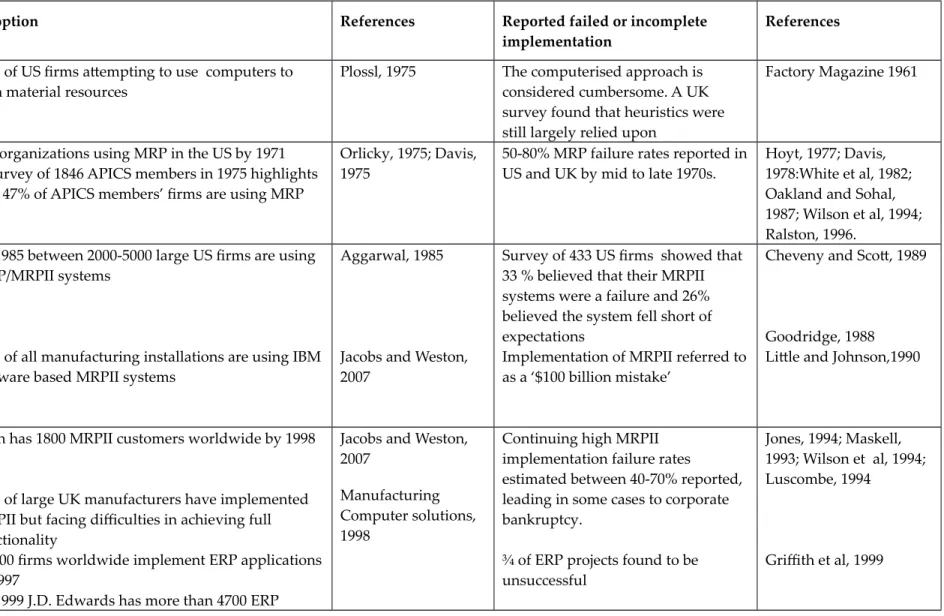
actions and process contributing to the evolution of RP. This analysis (see Table 1) captured
the key actors involved in the evolution and diffusion of RP, locating their actions in time
and space. In Table 2 we also offer an indicative overview of approximate diffusion and
implementation failure rates across the decades which, combined with our event based
narrative analysis, form the basis of our case study description presented next.
The Case of RP Innovation
RP is an innovation in management practice as it involves changing practices by
systematically integrating the information flows of different business processes so as to
improve planning and control1. Originally, this integration took place within a
manufacturing environment and focused on integrating information about purchasing,
inventory and production schedules (Wight, 1987). Subsequently, the focus of RP’s
integrating effect shifted to wider cross-functional and multi-site organizational processes
(Wilson et al, 1994) and, later, enterprise-wide (Robey et al, 2002).
1 MRP – “provides a logical approach to planning and scheduling” The objectives are to
reduce inventory costs, improve customer service and maximise efficiency (Wilson et al., 1994, Wight, 1987).
MRPII – “ a company – wide closed loop manufacturing control system which integrates all aspects of manufacturing…. It is designed to help
managers control complex manufacturing and business environments ….when
companies are able to exercise effective systems management , substantial benefits of integration are claimed “ (Wilson et al, 1994)
As outlined in Table 1, RP originated with a small group of US manufacturing firms in the
post WWII period as an innovation that challenged traditional Economic Order Quantity
approaches. Managers worked independently to develop MRP with support from three
consultants (Wight, Plossl or Orlicky). Wight was responsible for naming this approach
‘Materials Requirements Planning (MRP)’. From 1967, this group, who were closely linked
to IBM, and to the newly formed professional association for production control – APICS –
began to work together developing MRP reports and a certification programme for APICS.
They also supported the development of IBM software to standardise, computerised
approaches to MRP (Lummus, 2007).
INSERT TABLE 1 HERE
MRP offered benefits over a manual approach, but still struggled to establish itself, largely
as a result of dissatisfaction with the accuracy of the production schedules it generated.
Problems were attributed to the ‘sensitivities’ of the technical system to outside influences
(Fortuin, 1977). MRP systems were only as good as the data submitted by production
controllers who often input data based more on their own heuristics rather than actual sales
forecasts (Swan and Clark, 1992).
A watershed in MRP diffusion, however, came with APICS endorsement which was the
outcome of a stormy meeting of the annual conference in 1971 (Orlicky and Burlinghame,
1971), whereby the professional body was practically mobilized in support of the MRP
concept. Plossl stated; ‘In the early 1970s we organized the APICS MRP Crusade, using the
resources of the Society and the knowledge of a few ‘Crusaders’ to spread the word on MRP
among APICS members and others interested.’ (Plossl, 1989: ii). Following the launch,
adoption rates soared during the 1970s, but so too did accounts of implementation failures
as shown in Table 2. Here we should note that ‘failure’, like ‘success’, in the context of an
innovation is a very broad term, open to a range of interpretations and attributions (a point
to which we return later). But even as a simple description of implementation outcomes it
stands out as an important strand in contemporary accounts of RP’s spread.
It is difficult to quantify the level of implementation failure (reports vary), but it was clearly
high across the whole cycle of RP’s evolution (see Appendix A). While early MRP systems
experience was already mixed, with some success rates put as low as 5% (Belt, 1979; Wight,
1974).
INSERT TABLE 2 HERE
Wight, now considered a world expert in manufacturing management (Ralston, 1996),
endorsed the need to integrate production with the planning and control of other resources
such as finance and distribution (Lilly and Smith, 2001). Wight referred to this expanded
approach as ‘Manufacturing Resource Planning’ and ‘MRP II’, to distinguish it from MRP
(Wight, 1982; Mabert, 2007). MRPII was based on the same ‘push’ philosophy as MRP, but it
also enabled other capacity constraints to be taken into account. Because this approach
demanded even greater integration across functions, it encouraged software vendors to
develop applications and specialist consultants to support implementation. These suppliers
promoted the benefits of MRPII in relation to strategic business concerns, particularly in
light of what was seen as the emerging ‘threat’ of competition from Japanese manufacturers
(Wight, 1982, 1983). By the mid-1980s, several thousand large US firms were using MRPII
systems.
Again experience of implementation was mixed and many companies felt they were not
getting the expected benefits (Miller, 1981, Table 2, Appendix A). MRPII suppliers had
claimed that the MRP ‘problems’ organizations had experienced could be solved by
computerizing and integrating the planning of financial and human resources with materials
and production. However, because of its increased scope and greater level of organizational
integration, MRPII actually generated further problems. By the 1980s, problems around the
technical aspects of the system and the accuracy of sales forecasts were largely resolved.
Continued implementation failures were therefore attributed to poor implementation
methods and management of change. Managers struggled to integrate the output from MRP
systems with other organizational information, which was often still maintained manually
(Wilson et. al, 1994). Implementation, it was argued, required a better ‘fit’ between the
technology and the organization, which could be accomplished by adapting the system
locally to match business requirements (Schroeder et al, 1981 – see Appendix A). Problems
To address these problems, consultants began to develop implementation methodologies,
the archetype of which was the ‘Proven Path’, developed by the Wight Consultancy.
Training courses were offered to help adopters implement this methodology and a Class ‘A’
to ‘D’ checklist was developed against which adopters could be audited. This made a virtue
out of the challenges of RP implementation by celebrating the ‘world class’ minority who
achieved Class ‘A’ full implementation status. These efforts were accompanied by intense
professional support, with APICS promoting a certification programme that emphasised
MRPII as the best practice (Swan et al, 1999a). Yet user experience across the US and Europe
continued to be mixed, with reported success rates in achieving full integration varying
from around 50% to as low as 8-12% (Brauch, 1988; Wilson et al, 1994; Appendix A).
During the 1990s, these ongoing implementation problems, together with further
developments in RP knowledge and hardware led a number of software vendors to
undertake what was termed a ‘structural migration’ of the MRPII approach into systems
which were no longer confined to manufacturing applications, but that could also be used in
the service sector and across a broader range of business functions (Kalakota and Robinson,
2001; Schonsleben, 2000). In 1990, the Gartner Group coined the term ‘Enterprise Resource
Planning’ (ERP) to denote the new, enterprise-wide scope of the RP innovation, providing
adopters with the means to business plan across their entire supply chains (Wylie, 1990).
Software vendors and management consultancies presented these systems as ‘complete
business solutions’. This broadening of scope meant that the RP innovation was capable of
planning and scheduling both internal and external resources (within the supply chain)
according to dynamic customer demands (Shaul and Tauber, 2013). High failure rates
continued to be attributed to problems of implementation (such as political factors, user
resistance etc. – see Appendix A) but, because ERP was a complex ‘whole system approach’
users were advised to select the most appropriate software vendor for their industry sector
and, with the support of specialist consultants, make their organization fit in terms of
changes to internal processes, rather than take a ‘piecemeal’ approach to implementation.
Work turned to the improvement of a comprehensive set of ‘critical success factors’ required
to manage the organizational transformation more effectively (Appendix A).
A small group of RP vendors led by SAP now began to dominate. Because ERP required the
were able to argue that it made a virtue out of the replacement of all legacy systems within
firms. As Umble et al (2003) noted; ‘For managers who have struggled…with incompatible
information systems and inconsistent operating practices, the promise of a quasi
‘off-the-shelf’ solution to the problem of business integration is enticing’ (p243). This was further
reinforced by the global spread of the ‘millennium bug’ discourse (Themistocleous et al,
2001), with vendors stressing that it was imperative that firms invest in ERP before the year
2000 (Scott and Kaindl, 2000, Adam and Sammon, 2004; Jacobs and Weston, 2007). As a
Deloitte (2012) report notes: ‘Organizations were forced to invest in ERP solutions that could
cater for eight-digit dates, because of the threat that their existing solutions would fall apart
at midnight on 31st December 1999 and that their business would be left in total disarray’. These factors prompted a major increase in revenues and adopters. By 2006, SAP alone had
96,400 installations across 25 industry sectors, and 12 million users (Jacobs and Weston,
2007).
However, the continuing challenges of implementing ERP to work in local contexts
prompted vendors to make major investments in on-line communities that could link
developers with users and business experts. Even so, the ERP period saw some very high
profile and costly implementation failures, including Fox Meyer and Dell Computers,
(Adam and Sammon, 2004). Recent surveys and reviews (see Appendix A) continue to
highlight high levels of dissatisfaction with ERP, with a recent 2014 report based on 192
respondents finding that 66 per cent of organizations believed that they had received less
than 50 per cent of the benefits they anticipated from ERP (Panorama, 2014). It is worth
noting however that organizational issues, rather than software continue to be seen as the
major cause of implementation problems.
Analysis: Explaining the Evolution of RP Innovation
The evolution of RP innovation and its widespread, global diffusion described above was
clearly the result of multiple factors including the complex interactions between field-level
actors and the organizations implementing this innovation. In this section, our analysis is
structured according to the key processes enabling such interactions, as indicated by our
earlier review of the literature.
The discursive framing of the RP innovation involved a shifting array of organizational and
field-level actors. Initially, in the MRP era, the audience for this discursive framing was
production and inventory control managers. Through the involvement of a nascent APICS
in its framing, working closely with the ‘Group of 3’ consultants (Lummus, 2007), MRP was
more fully theorized and legitimized (c.f. Greenwood et al., 2002). This not only served to
justify its adoption in preference to traditional methods (Mabert, 2007), but also served the
interests of the professional group who were seeking to ‘colonize’ this emerging field
(Abbott, 1988). The importance of this link between the innovation and the interests of
field-level actors is made clear by the impact of the ‘coup’ at the 1971 conference. As a result of
APICS’ commitment to the ‘MRP Crusade’, both MRP’s spread and APICS membership
increased dramatically (Greene 1987).
The RP innovation’s subsequent development was characterized by successive re-framings in
which new labels were applied to variants that demanded progressively greater
organizational integration. Thus MRP was initially modified to incorporate feedback loops
which it allowed it to be framed as a ‘closed loop’ system, rather than as an ‘open loop’
system that could spiral out of control. The subsequent development and increased
functionality of MRPII, led by Oliver Wight (with IBM) advocated the integration of
production and inventory control with the planning and control of other internal resources
such as finance, accounting and human resources.
A further progression in scope and functionality accompanied the development of ERP,
which extended the innovation’s reach and market potential across a range of sectors,
national contexts and different-sized firms (Shaul and Tauber, 2013). Each re-framing was
triggered by further objectification – via software and implementation methods - of RP
knowledge, aiding both its cross-functional and industry sector spread. In each case,
field-level groups such as management gurus, professional bodies and software vendors, sought
to justify the expanded scope (and costs) of the RP innovation by highlighting its substantial
benefits to a widening audience of senior managers. The innovation was also linked to high
level business concerns. MRPII was linked to the ‘Japanese threat’ to US manufacturing
(Newell et al, 1993), while ERP was considered to be the answer to the problems of business
these re-framings by field-level actors, not only emphasized the performance benefits of each
new variant, but also directly engaged with the problematic vicarious experience of its
predecessor. In effect, the framing of each succeeding variant provided a narrative to
distance it from failed implementations in the past. Moreover, as can be seen in Appendix A,
the ongoing and high failure rates with all variants of this RP innovation were framed as
problems of management that could be resolved by attending to well-defined critical success
factors, and not as failures of the innovation itself. This continued to be portrayed by
field-level actors (who had a vested interest in downplaying the problems of implementation) as
promising substantial business benefits.
Organizational enactment and adaptation
In the MRP period, manufacturing managers used their in-house expertise to tailor RP
systems to meet their own organizational problems. The increased involvement of field-level
actors - professional associations, consultancies and software vendors - however, led to the
progressive codification and ‘blackboxing’ of RP knowledge as standardised software and
methods. This helped promote RP’s diffusion by enabling market-based relationships
between vendors and users. Thus, the advent of MRPII saw a new group of software
suppliers enter this market, followed, in the ERP era by consolidation and domination of a
small group of suppliers led by SAP.
While these developments enabled much wider diffusion, the need to objectify RP
knowledge into more generic forms also created a greater challenge for its adaptation to
specific organizational contexts. Effective implementation thus required significant
adaptation efforts to integrate distributed organizational practices and the software itself
(Waterlow and Monniot, 1986; Wilson et al, 1994). While such adaptation efforts initially
entailed in-house customisation of the systems (Swan et al, 1999c), with the ever expanding
scope and complexity of the software, it increasingly entailed significant organizational
change to accommodate complex software packages. Implementing organizations relied
increasingly on the skills of consultants and software suppliers, with an associated reduction
in their in-house RP systems expertise (Wilson et al, 1994).
Our analysis above shows that, with successive variants of RP, the interpretive flexibility of
the innovation was progressively reduced. Increasingly over time, organizations had to
‘work around’ the standardised software packages, thereby demanding investments in
software, implementation methodologies, consultancy support and training that far
exceeded software costs (Benders et al, 2006; Dechow and Mouritsen, 2005). There is a shift
between adapting the innovation to suit the context and then later, occasioned by more
complex systems, adapting the organization to suit the innovation. This was supported by
vendors’ claims that ‘vanilla’ implementations – that is, minimizing changes to the software
and adapting organizational practices instead – would secure ‘world class’ performance
(Wagner and Newell, 2004). The Year 2K ‘problem’, and software offerings tailored to very
specific sectors exerted further pressure not to ‘drift’ from the standard ERP solutions on
offer.
As it became more difficult to adapt the software, there was a greater impetus to adapt and
standardize organizational practices (Benders et al., 2006), with work now focussing on the
systematic identification of ‘Critical Success Factors’ – centred on management and
organization – required to implement ERP (see Appendix A). Coupled with the increasing
cross-functional scope of the innovation, however, the reduction in interpretive flexibility
greatly increased the risks of implementation, because organizations continued to focus on
software costs and to allocate insufficient budget to organizational change management,
both of which are required to fully realise the business benefits of highly tailored ERP
solutions (Panorama, 2014).
Vicarious experience of the RP innovation
As a result of these high levels of implementation failure, vicarious experience of the RP
innovation was mixed. As outlined in Table 2 and in Appendix A, at each stage in its
evolution there were numerous academic and practitioner reports of failure or
disappointing outcomes. As RP evolved, access to this vicarious experience became possible,
through practitioner media, professional association events, and user groups. As noted, this
accumulation of vicarious experience helped to trigger and promote the discursive
re-framing of the innovation at field level. Here, as with the ‘Proven Path’ methodology for
variant through an underlying narrative that attributed implementation ‘failure’ to failures
of management, allowing the ‘success’ of the RP innovation in terms of its technical core and
potential business benefits to remain intact. The emphasis on ‘Critical Success Factors’ is
indicative of this underlying narrative that, if the management of change were properly
supported, then the RP innovation would be successful.
In summary, by adopting a multi-level analysis we have been able to explore the complex
inter-relationship between the field-level diffusion of the innovation, and its adaptation at
organization level. Our analysis suggests a novel model of the evolution of this management
innovation which builds on, and extends previous theory. This is depicted in Figure 1 which
relates our conceptual analysis to the RP variants and their diffusion over time.
INSERT FIGURE 1 HERE
This model responds to our third research question by conceptualizing the spread of
innovations in terms of a recursive relationship between the field-level discursive
(re)framing of the RP innovation and its adaptation within particular organizational settings.
It develops the processual view by depicting diffusion as the product of a temporally
situated interplay between discursive framing, innovation affordances, organizational
adaptation and vicarious experience.
Concluding Discussion
Our analysis of RP’s spread represents a theory development case study and as such we
need to be cautious about over-generalizing (cf. Abrahamson and Eisenman, 2008).
However, it is clear that our case reinforces questioning of the institutional model of
diffusion (Lounsbury, 2002) by showing, not only the critical importance of agency in the
spread of a management innovation, but also the variability of what was spread. The role of
agency is seen with field-level groups who are engaged in a continuing quest to (re)frame
the innovation discursively, and with organization-level actors who are interpretively
provides a processual perspective in which ‘carriers and hosts co-construct management
practices diffusing into new settings’ (Ansari et al., 2010: 86). Thus, the initial development
of the innovation is closely intertwined with the growth of professional groups who were
able to anchor and legitimize RP practice (Perkmann and Spicer, 2008; Nicolini, 2010). Over
time, as RP knowledge became further elaborated and objectified, the legitimizing role of the
profession was superseded by the marketing efforts of software vendors and consultancy
groups, promoting particular variants.
Our findings complement existing work on institutional entrepreneurship by highlighting
both the embedded agency of particular actors (e.g. the ‘Group of 3’ who aligned their work
closely with that of APICS) but also the important role of field configuring events, such as
the APICs conference, in mobilizing commitment (cf. Oliver and Montgomery, 2008; Hardy
and Maguire, 2010). In addition, our processual model pays close attention to the innovation
itself and its adaptation in context, thereby responding to calls for institutional
entrepreneurship scholars to ‘gain greater insight by considering the role of technology and
its materiality in shaping the innovation trajectory in organizations’ (Henfridsson and Yoo,
2013: 948).
Here the comparison between TQM and RP is instructive. Both management innovations
experienced high levels of failure, but RP achieved enduring global diffusion, while TQM
succumbed to the boom and bust cycle of management fashions. Our study suggests that
this contrast can be explained by considering, firstly, the effect of an innovation’s
affordances on its enactment and adaptation, and secondly, the role of vicarious experience
in the discursive framing and spread of an innovation (i.e. our first two research questions).
In terms of affordances, as TQM was largely grounded in rhetorical, symbolic practices
(Zbaracki, 1998), it offered far greater interpretive flexibility than RP (Ansari et al., 2010).
This supported diffusion by enabling a wider range of non-specialist suppliers to claim
relevant TQM competence and to spread it through a ‘superficial’ implementation approach
that could secure ‘ceremonial’ benefits for adopting organizations (David and Strang, 2006).
This resulted in both large scale adoption of TQM, and wide variability in the adaptation of
the concept. The tendency towards superficial implementation of TQM, however
of ‘failure’ rather than ‘success’ stories fed through into a negative discursive framing by
field-level actors, and this contributed to the downswing in the TQM diffusion cycle (Strang
and Macy, 2001).
In contrast, the RP innovation was developed by a small circle of professional groups,
specialist consultants and software vendors. This limited its interpretive flexibility from the
outset, and even more so when RP knowledge became increasingly objectified as software
and methods in subsequent variants. Moreover, the RP innovation, unlike TQM, was
materialized in a technical core, amid on-going pressures on organizations to better manage
their resources. It was possible, then, for field level actors to highlight the proven success of
the technical artefact – i.e. the RP knowledge embodied in operating rules, and later
software – in handling the computational aspects of RP. Success here could thus be
differentiated as a performance outcome from the many, frequently unsuccessful, efforts to
adapt the innovation to particular organizational contexts.
This interpretive distinction between the innovation and its organizational adaptation is a
recurrent theme in RP’s evolution. It can be seen as helping to sustain the relations between
the field level actors who have an interest in ‘selling’ the RP concept for their own benefit
-and the managers who are faced with the challenge of enacting the innovation within their
own organizational context. Importantly, the distinction enabled field-level actors, such as
professional groups and consultants, to re-cast adaptation problems as partial
implementations on a ‘proven path’ to success; an overarching discourse of ‘progress’ which
distanced the potential of the new from the failures of the old (Abrahamson, 1991). This
field-level framing thus served to insulate RP innovation from the growing vicarious
experience of widespread adaptation failures. At the same time, and reinforcing the
narrative of progress, the innovation was successively re-labelled; from MRP to MRPII to
ERP. This re-labelling was not cosmetic, but helped to renew legitimacy by elaborating the
original concept (Lawrence and Suddaby, 2006). RP was thus able escape the boom and bust
cycle which has affected other management innovations such as TQM.
Relating these insights to our first research question highlights our study’s contribution to
theory regarding the impact of affordances on innovation diffusion. Here our study has
innovation’s enactment and adaptation within adopting organizations. In addition, our
work further suggests that this affordance may influence the interpretation of performance
outcomes from such adaptations, and particularly the causal attribution of success and
failure. As we found that these attributions often distinguished between RP’s technical core
and its local implementation, we can link them to the widespread societal tendency towards
viewing technology as a progressive force (Winner, 1977) and a tendency for managers, in
particular, to justify change as technologically-based (Markus, 2004; Leonardi, 2008). In
essence, our study suggests that where the implementation of innovation encounters
problems, these may often be attributed to the innovation’s social and organizational
aspects, rather than to its technical features. This ‘partitioning of the blame’ in actors’
accounts is afforded by the innovation (in this case, that it has a technical core), and provides
one explanation as to why an innovation can continue to diffuse even in the face of ongoing
problems with implementation. We should note that we see this explanation as
complementary to, and not replacing, arguments as to the ‘actual’ technical efficiency of an
innovation, which was not the theoretical focus of our study. However, it does suggest a
need for further work to consider how attributions of success and failure to different aspects
of the same management innovation can shape its propensity to diffuse or die.
By relating the interpretive efforts of organization-level managers to the framing of an
innovation by field-level actors, our study highlights the need to address sense-making at
multiple levels of analysis in accounting for the spread of innovations. This might
encompass, for example, the importance of the labels supplied by field-level actors in
guiding sense-making at the organization level (Weick, 1995), and the role of adopting
organizations in acting as exemplars or ‘sense-givers’ for other organizations (Fiss and Zajac,
2006; Swanson and Ramiller, 1997).
A further and related contribution centres on our second research question and our finding
that vicarious experience may not operate as an objective force upon diffusion but may be
re-framed discursively by field-level actors. This suggests that the distinction made in
previous literature between ‘success’ and ‘failure’ in adoption outcomes is too broadly
defined. Future research could usefully focus on how these notions are discursively
constructed even for more technologically-based innovations. For example, a recent study
(Barrett at al., 2013). Further work on this question could deepen our understanding of the
role of ‘success’ and ‘failure’ in the sense-making and sense-giving of different groups,
which, as Fincham highlights, stand as ‘conjoined narratives…implicated in forms of change
and innovation’ (2002, p.1).
Finally, our study also adds to the processual perspective by demonstrating how the above
questions need to be considered within the context of the wider evolution of an innovation.
The construction of success/failure reflects not only the discursive framing of field-level
actors, but also the degree of interpretive flexibility pertaining to an innovation and its
organizational adaptation. It follows that greater explanatory power for diffusion cycles and
levels of diffusion might be achieved by considering the evolving inter-relationship between
the affordances of the innovation, its adaptation by organizations, and its framing by
References
Abrahamson, E. (1991). 'Managerial fads and fashions: The diffusion and rejection of innovations' , Academy of Management Review, 16, pp. 586-612.
Abrahamson, E. (1996). 'Management fashion', Academy of Management Review, 21, pp. 254-285.
Abrahamson, E. and M. Eisenman (2008). 'Employee-management techniques: transient fads or trending fashions?', Administrative Science Quarterly, 53, pp. 719-744.
Adam, F. and D. Sammon (2004).The Enterprise Resource Planning Decade: Lessons Learned and Issues for the Future. London: Idea Group.
Aggarwal, S. (1985). ‘MRP, JIT, OPT or FMS?’, Harvard Business Review, 63, pp. 8-16.
Anderson, J. C. and R. G. Schroeder (1984). 'Getting results from your MRP system', Business Horizons, 27, pp. 57-64.
Anon (2000) ‘What place MRPII in 2000? With Y2K over, manufacturers in the mid-market will need to capitalise on their manufacturing IT. But is MRPII up to the challenges of e-business?’, Manufacturing Computing Solutions (2000), 6, pp. 14-19.
Ansari, S. M., P. C. Fiss and E. J. Zajac (2010). 'Made to fit: How practices vary as they diffuse', Academy of Management Review, 35, pp. 67-92.
Ansari S., J. Reinecke and A. Span (2014). ‘How are practices made to vary? Managing practice adaptation in a multinational corporation’, Organization Studies, 35, pp. 1245-1264
ASUG (2013). Americas SAP User Group at http://www.asug.com/membership (accessed 14th August 2013).
Barrett, M., L. Heracleous and G. Walsham (2013). 'A rhetorical approach to IT diffusion: reconceptualizing the ideology-framing relationship in computerization movements', MIS Quarterly, 37, pp. 201-220.
Basoglu, N., T. Daim and O. Kerimoglu (2007). 'Organizational adoption of enterprise resource planning systems: A conceptual framework', The Journal of High Technology Management Research, 18, pp. 73-97.
Battilana, J., B. Leca and E. Boxenbaum (2009). ‘How actors change institutions: Towards a theory of institutional entrepreneurship’, Academy of Management Annals, 3, pp. 65-107.
Beatty, C. (1992). ’Implementing advanced manufacturing technologies: Rules of the road’, Sloan Management Review, 33, pp. 49-60.
Belt, B. (1979). ‘Men, spindles and materials requirements planning: enhancing implementation’, Production and Inventory Management, 20, pp. 54-65
Benders, J. and K. van Veen (2001). 'What's in a fashion? interpretative viability and management fashions', Organization, 8, pp. 33-53.
Birkinshaw, J., G. Hamel and M. Mol (2008). 'Management innovation', Academy of Management Review, 33, pp. 825-845.
Bradley, J. (2008). 'Management based critical success factors in the implementation of Enterprise Resource Planning systems', International Journal of Accounting Information Systems, 9, pp. 175-200.
Brauch, K. (1988). ‘Apprenticeships and MRPII’, Computing Canada, 14, pp. 28-29.
Brown, A. D. (1993). 'Understanding technological change: the case of MRPII', International Journal of Operations and Production Management, 13, pp. 25-35.
Cadili, S. and E. Whitley (2005). 'On the interpretative flexibility of hosted ERP systems', The Journal of Strategic Information Systems, 14, pp. 167-195.
Callerman, T. E. and J. E. Heyl (1986). 'A model for material requirements planning
implementation', International Journal of Operations and Production Management, 6, pp. 30-37.
Cerveny, R. P. and L. W. Scott (1989). 'A survey of MRP implementation', Production and Inventory Management Journal, 30, pp. 31-34.
Clark, P., S. Newell P. Burcher, D. Bennett, S. Sharifi, and J. Swan (1992). ‘The decision-episode framework and computer aided production management (CAPM)’. International Studies of Management and Organization, 22, pp. 69-80.
Cole, R. E. (1999). Managing Quality Fads. Oxford: Oxford University Press.
Cooper, R. B. and R. W. Zmud (1990). 'Information Technology Implementation Research - a Technological Diffusion Approach', Management Science, 36, pp. 123-139.
Cotteleer, M. (2002). ’ ERP: Payoffs and Pitfalls’. Harvard Business School Working Knowledge. http://hbsk.hbs.edu/item.jhtml?id=3141@t=operations.
Dacin, M., J., Goodstein and W.Scott, (2002). 'Institutional theory and institutional change: Introduction to the special research forum' , Academy of Management Journal, 45, pp. 45-56.
Damanpour, F. (1987). 'The adoption of technological, administrative and ancillary innovations: Impact of organizational factors' , Journal of Management, 13, pp. 675-688.
Damanpour, F. (2010). ‘An Integration of Research Findings of Effects of Firm Size and Market Competition on Product and Process Innovations’, British Journal of Management, 221, pp. 996–1010.
David, R. and D. Strang (2006). 'When fashion is fleeting: Transitory collective beliefs and the dynamics of TQM consulting' , Academy of Management Journal, 49, pp. 215-233.
Davis, E. (1978). ‘Studies in Materials Requirements Planning: A Collection of Company Case Studies’. Falls Church, VA: APICS.
Dechow, N. and J. Mouritsen (2005). 'Enterprise resource planning systems, management control and the quest for integraton’, Accounting, Organizations and Society, 30, pp. 691-733.
Deloitte (2012). 'ERP Investment Decisions'. Johannesburg: Deloitte.
Dezdar, S. and A. Sulaiman (2009). 'Successful enterprise resource planning implementation: taxonomy of critical factors', Industrial Management and Data Systems, 109, pp. 1037-1052.
Dimaggio, P. J. and W.Powell (1983). 'The Iron Cage Revisited - Institutional Isomorphism and Collective Rationality in Organizational Fields', American Sociological Review, 48, pp. 147-160.
Dorado, S. (2005). ‘Institutional entrepreneurship, partaking, and convening’, Organization Studies, 26, pp. 385-414.
Ehie, I. C. and M. Madsen (2005). 'Identifying critical issues in enterprise resource planning (ERP) implementation', Computers in Industry, 56, pp. 545-557.
El Amrani, R., F. Rowe and B. Geffroy-Maronnat (2006). ‘The effects of enterprise resource planning implementation strategy on cross-functionality’, Information Systems Journal, 16, pp. 79-104.
Ferlie, E., L. Fitzgerald, M. Wood and C. Hawkins (2005). 'The Nonspread of Innovations: The Mediating Role of Professionals', Academy of Management Journal, 48, pp. 117-134.
Finney, S. and M. Corbett (2007). 'ERP implementation: a compilation and analysis of critical success factors', Business Process Management Journal, 13, pp. 329-347.
Fiss, P. C. and E. J. Zajac (2006). 'The symbolic management of strategic change: Sensegiving via framing and decoupling', Academy of Management Journal, 49, pp. 1173-1193.
Fitzgerald, L., E. Ferlie, M. Wood and C. Hawkins (2002). 'Interlocking interactions, the diffusion of innovations in health care', Human Relations, 55, pp. 1429-1449.
Fortuin, L. (1977). 'A survey of literature on reordering of stock items for production inventories', The International Journal of Production Research, 15, pp. 87-105.
Françoise, O., M. Bourgault and R. Pellerin (2009). 'ERP implementation through critical success factors' management', Business Process Management Journal, 15, pp. 371-394.
Garud, R., S. Jain and A. Kumaraswamy (2002). ‘Institutional entrepreneurship in the sponsorship of common technological standards: The case of Sun Microsystems and Java’. Academy of Management Journal, 45, pp. 196-214.
Ghosh, S. and M. J. Skibniewski (2010). 'Enterprise resource planning systems
implementation as a complex project: a conceptual framework', Journal of Business Economics and Management, 11, pp. 533-549.
Goodhue, D. and R. Thompson (1995). ‘Task technology fit and individual performance’, MIS Quarterly, 19, pp. 213-236.
Goodridge, M. (1988). ‘Managing operations: Into the 1990s’, Management Decision, 26, pp.5-10.
Grabski, S. V., S. A. Leech and P. J. Schmidt (2011). 'A review of ERP research: A future agenda for accounting information systems', Journal of Information Systems, 25, pp. 37-78.
Greene, J. (1987). Production and Inventory Control Handbook (2nd Ed). New York: McGraw Hill.
Greenwood, R., R. Suddaby and C. Hinings (2002). 'Theorizing change: The role of professional associations in the transformation of institutionalized fields', Academy of Management Journal, 45, pp. 58-80.
Guler, I., M. F. Guillén and J. M. Macpherson (2002). 'Global competition, institutions, and the diffusion of organizational practices: The international spread of ISO 9000 quality certificates', Administrative Science Quarterly, 47, pp. 207-232.
Hald, K. S. and J. Mouritsen (2013). 'ERP operations and management', International Journal of Operations and Production Management, 33, pp. 1075-1104.
Hardy, C., and S. Maguire (2010). ‘Discourse, field-configuring events, and change in organizations and institutional fields: Narratives of DDT and the Stockholm
Convention’. Academy of Management Journal, 53, pp. 1365-1392.
Hargadon, A., and Y. Douglas, Y. (2001). ‘When innovations meet institutions: Edison and the design of the electric light’, Administrative Science Quarterly, 46, pp. 476-501.
Henfridsson, O. and Y. Yoo (2013). ‘The liminality of trajectory shifts in institutional entrepreneurship’, Organization Science, 25, pp. 932-950.
Hong, K.-K. and Y.-G. Kim (2002). 'The critical success factors for ERP implementation: an organizational fit perspective', Information and Management, 40, pp. 25-40.
Hoyt, G. (1977). ‘Successes and failures in MRP user involvement’. Proceedings of the APICS 20th Annual International Conference, Cleveland, USA, pp. 204-209.
Hutchby, I. (2001). 'Technologies, texts and affordances', Sociology, 35, pp. 441-456.
Jacobs, F. and F. Weston, F. (2007). ‘Enterprise Resource Planning(ERP) – a brief history’. Journal of Operations Management, 25, pp. 357-363.
Jacobson, S., S. Shepherd, M. D’Aquila and K. Carter (2007). ‘The ERP Market Sizing Report, 2006–2011’, AMR Consulting. http://www.gtm.sap.com/uk/solutions/business-suite/erp/pdf/ AMR_ERP_Market_Sizing_2006-2011.pdf (accessed 20th July, 2013).
Jones, C. (1994). ‘Scheduling: Industry’s enthusiasm for finite capacity scheduling tools has been dampened by the disillusionment with existing MRPII based planning tools,’
Engineering Computers: Hardware, Software and Commonsense, 13, pp. 12-15.
Kalakota, R. and M. Robinson (2001). E-business 2.0: Roadmap for Success. New Jersey: Addison Wesley.
Karmarkar, U. (1989). ‘Getting control of Just-in-Time’, Harvard Business Review, September-October, pp.122-131.
Kennedy, M. and P. Fiss (2009). 'Institutionalization, framing, and diffusion: The logic of TQM adoption and implementation decisions among US hospitals', Academy of Management Journal, 52, pp. 897-918.
King, S. F. and T. F. Burgess (2006). 'Beyond critical success factors: A dynamic model of enterprise system innovation', International Journal of Information Management, 26, pp. 59-69.
Krupp, J. (1984). 'Why MRP systems fail: Traps to avoid', Production and Inventory Management, 25, pp. 48-53.
Lawrence. B. 1984. ‘Historical perspective: Using the past to study the present’, Academy of Management Review, 9, pp. 307-312.
Lawrence, T. and R. Suddaby (2006). ‘Institutions and institutional work’. In S. Clegg, C.Hardy, T.Lawrence, and W. Nord (eds), The Sage Handbook of Organization Studies, pp. 215-254. London:Sage.
Leblebici, H., G. Salancik, A. Copay and T. King, (1991). ‘Institutional change and the transformation of inter-organizational fields: An organizational history of the U.S. radio broadcasting industry’, Administrative Science Quarterly, 36, pp.333-363.
Leonardi, P. M. (2008). 'Indeterminacy and the discourse of inevitability in international technology management', Academy of Management Review, 33, pp. 975-984.
Lilly, R., and F. Smith (2001). The Road to Manufacturing Success: Common sense Throughput Solutions for Small Business. Boca Raton: St.Lucie Press.
Little, D. and S. Johnson (1990). ’Survey of UK manufacturing control practice’, BPICS Control, April/May, pp. 31-1.
Lounsbury, M. (2002). 'Institutional Transformation And Status Mobility: The
Professionalization Of The Field Of Finance', Academy of Management Journal, 45, pp. 255-266.
Lounsbury, M. (2007). 'A tale of two cities: competing logics and practice variation in the professionalizing of mutual funds', Academy of Management Journal, 50, pp. 289-307.
Lummus, R. (2007). ‘The role of APICS in professionalising operations management’. Journal of Operations Management, 25, pp. 336-345.
Luscombe, M. (1994). ’Of course I’m committed to MRP but….’, Management Services, 38, pp. 12.
Mabert, V. (2007). ‘The early road to materials requirements planning’, Journal of Operations Management, 25, pp. 346-356.
Maguire, S. and C.Hardy (2009), 'Discourse and deinstitutionalization: The decline of DDT', Academy of Management Journal, 52, pp. 148-178.
Maguire, S., C. Hardy, and T.B. Lawrence (2004). ‘Institutional entrepreneurship in emerging fields: HIV/AIDS treatment advocacy in Canada’. Academy of Management Journal, 47, pp. 657-679.
Mamman, A. (2002). 'The adoption and modification of management ideas in organizations: towards an analytical framework', Strategic Change, 11, pp. 379-389.
Marcello B. and P. Alberto (1999). ‘Shortcomings and benefits associated with the
implementation of MRP packages: a survey research’, Logistics Information Management, 12, pp. 428-438.