Research and Support for Developing a UK Strategy for
Managing Contaminated Sediments (ME 1104)
Task 2: Exploring Liability and the Polluter Pays
Principle
Contents
Page
Executive Summary 4
1. Introduction 7
1.1 Introduction to the Project 7
1.2 Introduction to Task 2 Report 12
2. The Background Context 19
2.1 The Polluter Pays Principle 19
2.2 Regulatory Controls on Dredging and Disposal 23
2.3 Sources of Contamination 26
2.4 The Nature of Costs and Liabilities for CMS 28
2.5 Establishing Liability 33
3. Historic CMS Case Studies 34
3.1 Development of Historic CMS Case Studies 34
3.2 Case Study A 36
3.3 Case Study B 38
3.4 Case Study C 40
3.5 Case Study D 41
3.6 Case Study E 42
3.7 General Issues from the Case Study Scenarios 43
3.8 Use of Case Studies 45
4. Legal Liability Regimes 46
4.1 Overview of Liability Regimes 46
4.2 Private Law Liability Regimes 49
4.3 Statutory Liability Regimes 56
4.4 General Issues and Remedies 61
4.5 Environmental Liability Directive 67
4.6 Application of Liability Regimes to CMS Case Studies 75
5. Novel CMS Management Methods: Liability Issues 86
5.1 Development of Hypotheticals 86
5.2 Hypothetical 1 (Geobags & Offshore Disposal) 87
5.3 Hypothetical 2 (Confined Aquatic Disposal in Seabed Pits) 91
5.4 Hypothetical 3 (Maritime Structures) 93
6. Ownership Issues 96
6.1 Land Ownership 96
6.2 Ownership of CMS sites 98
6.3 Ownership of Disposal Sites 100
7. Managing Liabilities from CMS 101
7.1 Indemnities 102
7.2 Financial Guarantees/Bonds 107
7.3 Special Purpose Vehicles 108
7.4 Insurance 109
7.6 Conclusion - Strategies for Managing Liabilities 111
Executive Summary
This report comprises the output of Task 2 Exploring Liability and the Polluter Pays Principle of Project ME 1104: Research and Support for Developing a UK Strategy for Managing Contaminated Sediments.
Section 2 of the report provides a contextual analysis of the issues surrounding liability for CMS. This includes a brief discussion of the meaning and relevance of the Polluter Pays Principle; consideration of sources of contamination; and general principles relevant to establishing liability. An important conceptual distinction is drawn in this section whereby liabilities relating to historically Contaminated Marine Sediments (‘CMS’) can be grouped within two categories:
“Operational Management” liability (reflecting the increased costs of managing, moving and disposing of CMS); and
“Contingent Liabilities” (arising from such operational management). This distinction forms the basis for much of the analysis in the remainder of the Report.
Section 3 presents an outline of a number of Case Studies, provided by Project members and stakeholders, which provide the factual contexts within which to discuss the application of liability for CMS.
Section 4 provides an outline of the most relevant liability systems for allocating and apportioning costs and liabilities associated with the management and disposal of historic CMS. This includes particular consideration of the applicability of the Environmental Liability Directive (‘ELD’). The main finding is that in the context of historically Contaminated Marine Sediment, the liability regimes generally may be relevant to the Contingent Liabilities which arise in relation to the undertaking of Operational Management activities, but are of limited use in relation to recovering the costs of those Operational Management activities. The potential application of the ELD is almost wholly restricted to Contingent Liabilities.
Section 6 considers briefly some ownership issues relating to liability for CMS.
Section 7 discusses the issues surrounding the management of liabilities from CMS. This includes methods of structuring liabilities and other options for legal risk management.
Section 8 draws out the Key Findings from the Task/Report. The application of liability regimes, and the different variables, to particular fact patterns found in the CMS Case Studies suggests that there are no general answers to questions relating to the recovery and transfer of costs and liabilities incurred as a result of operational dredging activities to those who were responsible for historic
contamination. Each set of facts will give rise to different considerations. It is possible, however, to identify some general points raised by the application of the polluter pays principle (‘PPP’) in the context of liability for the management, movement and disposal of historic CMS:
A Costs and liabilities cannot be transferred or recovered unless there is some specific legal mechanism which allows them to be transferred or recovered.
B The application of liability regimes and principles to CMS Case Studies suggests that liability on the part of ‘historic polluters’ will not be imposed in most cases of ‘Operational Management’ liabilities
C Whilst liability for remedial works required to address CMS in situ might be more readily established, such cases are generally outside the scope of the project
D Even where the requirements for establishing liability in law can be met, there may be significant legal and practical obstacles to actually securing money or actions from other parties
F Consideration of the ‘Hypotheticals’ relating to novel operational
management techniques suggests that the nature of Contingent Liabilities which might arise can be complex
G Ownership of CMS sites, and disposal sites, is important as it can result in liability, but will not usually do so where remedial works are not required
H The identity of the ‘polluter’ can be considered from different
perspectives, including that of the person creating environmental risks, so that there are justifications for applying the PPP to those undertaking CMS Operational Management activities
1. Introduction
1.1 Introduction to the Project
1.1.1 Contaminated Sediment and Dredge Material
It is Government policy to promote the use of the sea for the transport of goods around the UK and also to encourage a modal shift from road to water1. As
the global and UK economy continue to grow there is an increasing demand for port capacity and the UK’s success in the global market place depends, in part, upon the ability of ports to adapt and operate efficiently as gateways to international trade2. There is, therefore, a fundamental need to ensure ports continue to
operate and their activities are sustainable and not detrimental to the environment.
Whilst the majority of sediments in many inshore areas around the UK coast are relatively clean or only mildly contaminated, due to dominantly historic
pollution within the industrialised estuaries of the UK, the seabed sediments in many of these areas are contaminated with a variety of chemical species. These include heavy metals, organo-metal complexes (e.g. TBT), and various organic congenors e.g. PCBs. The contaminants in sediment are often persistent (i.e. they do not readily break down) and this creates a significant sediment quality issue, where there are potential risks to both aquatic life and to human health.
Significant issues arise when – for largely economic reasons – these sedimentsneed to be dredged. The disturbance to the contamination which arises during dredging, and during subsequent management of the dredged material, may result in
unacceptable contaminant loss, dispersal and pollution within the biosphere. The key issue is to develop a management approach to dredging and disposal of contaminated seabed sediments in port regions in which the economic objectives are achieved but in which there is minimal risk to the environment.
There is currently little in the way of a management framework for dredged marine sediment in the UK, and contaminated dredged material is usually either disposed of at sea (in open sea disposal sites subject to chemical and biological
1 The Department for Transport has estimated that about 95% of goods either consumed or produced in
the UK are either imported or exported by sea (http://www.dft.gov.uk/pgr/shippingports/).
2 Department for Transport, 2007. Ports Policy Review. http://www.dft.gov.uk/pgr/shippingports/ports/
screening criteria) or when contaminant levels are too high transported and dumped in a land fill. To date, there has been limited investigation into the treatment, disposal or beneficial use of contaminated dredged sediment in the UK, and other than the OSPAR and London Protocol Guidelines there is no formal sediment management framework that details the procedures for the treatment, disposal or beneficial use of contaminated marine sediment.
1.1.2 Background to Project
In 2006, Defra’s Marine Consents and Environment Branch (MCEB) completed an internal review of the current situation regarding contaminated marine
sediments. It identified that there is a lack of information on the extent of contaminated marine sediments in UK waters, and clarity was required regarding the current industry options for dredging and disposal and associated factors such as liability and legislation. Currently there is no consistent guidance in place to help industry address the issue and furthermore, the information known is largely unavailable through a common portal.
In May 2006, as part of a Defra initiative, a Contaminated Marine Sediment Steering Group was set up, comprising representatives from CEFAS, Natural
England, the Welsh assembly, the Scottish Executive, The Crown Estate, representatives from industry including port authorities (ABP, BPA, PoLA), conservation agencies and green NGO’s (e.g. CCW, JNCC, MCS). The aim of this group was to discuss and formulate a programme of research work to underpin provide a comprehensive guidance document (‘strategy’) for managing
contaminated marine sediments in the UK. The specific Terms of Reference (TOR) for this group was;
‘to assist and facilitate the development of the UK strategy for handling and managing contaminated material to be dredged from UK marine waters, and to support and advise on the practical implementation of the strategy’.
contaminated areas where dredging was likely to occur or be necessary in the future.
1.1.3 Scope of Project
This project was conceived within several highly specific terms-of-reference. These are:
that the sediment is contaminated (although the severity of contamination is not known); and
that a decision to dredge has already been made;
that minor revisions to existing legislative statues can be entertained; that all UK waters and thus potentially out to 200 miles (and inland as far as
tidal limits) are considered.
These terms are important because they dictate at what point within a decision hierarchy the results of this research will be invoked. For example, this project is not intended to underpin or provide a framework for evaluating, permitting and controlling the dredging of CDMS.
1.1.4 Project Objectives
The aims of the project were set out under ‘Background and Overview’ in the original project specification, and these are as follows:
The research will underpin development of a UK strategy for managing contaminated marine sediments that need to be dredged which will:
Aid in the transparent and objective assessment of all dredged material disposal options through the Best Practicable Environmental Option (BPEO) assessment process, taking into consideration the principles of sustainable development (including the polluter pays principle and the precautionary principle) on a case by case basis.
Act as a focus for existing work, draw together best practice and ensure work is not duplicated elsewhere e.g. The London and Oslo Paris (OSPAR) Conventions, Navigation Ports & Waterways (PIANC), Central Dredging Association (CEDA) etc.
Produce a simultaneous and inclusive consultation process to replace the current methodology of approaching one regulator at a time in order to make disposal solution decisions.
Identify where regulations are preventing the BPEO from being used and reflect the associated risks to the marine environment these represent. Examples where flexibility in regulations allows the common sense approach to prevail will be highlighted.
Define the nationwide scale of the problem and disposal solutions at sea as well as beneficial use, identify current sea disposal sites receiving contaminated, but acceptable, material and suggest guidance for their use, identify remedial measures for material deemed acceptable for sea disposal and establish guidelines for preventing further contamination.
1.1.5 Project Tasks
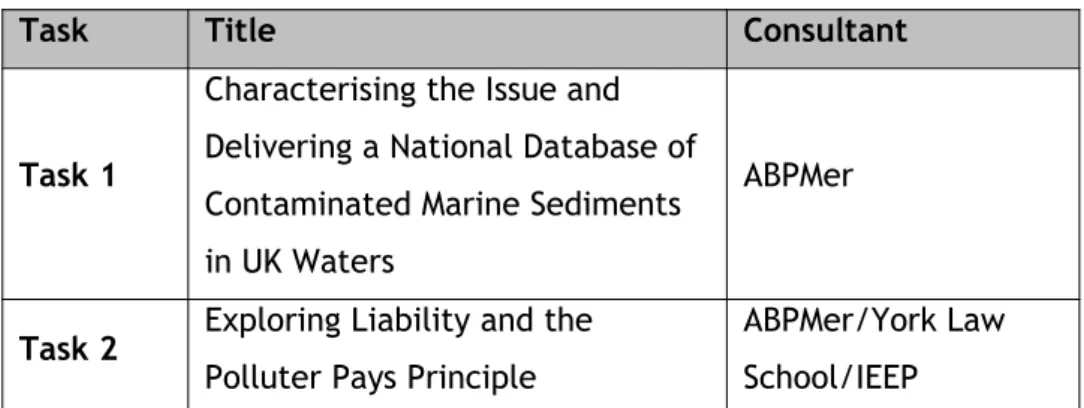
The research was delivered through a series of six commissioned work packages, or Tasks. These were let through a competitive tendering process. The project co-ordination was also let via the same process and was awarded to Partrac Ltd (Glasgow). Table 1 summarises the six tasks.
Table 1: Summary of the six commissioned work packages within the project
Task Title Consultant
Task 1
Characterising the Issue and Delivering a National Database of Contaminated Marine Sediments in UK Waters
ABPMer
Task 2 Exploring Liability and the
Polluter Pays Principle
Task 3
Identifying Existing Relevant Legislative and Regulatory Barriers, and Guidelines and Protocols, with Respect to CDMS
ABPMer
Task 4
Establishing best practice for the prevention of pollution arising from CDMS
ABPMer
Task 5
Establishing Best Practice for Current Disposal and Treatment Options for CDMS
Entec
Task 6
Identify relevant marine sediment research and development
relevant to the management of CDMS
1.2 Introduction to Task 2 Report
1.2.1 Background
The legacy of historic pollution and contamination within and around ports and harbours around the UK presents significant challenges in terms of managing the environmental and social risks associated with contaminated marine sediments (CMS).3 These challenges are becoming ever more urgent as the amount of
management, treatment and disposal of CMS is increasing to support the growth in maritime transport and other port-related developments. This growth, coupled with tighter regulatory requirements, means that the options for dealing with CMS are narrowing whilst costs continue to rise.
All historic contamination poses difficult problems of allocating and apportioning the costs of any work undertaken to minmise the risk of harm. In many cases the activities which produced contaminants ceased many years ago and the ‘original polluter’ may have ceased to ‘exist’ or may not be able to pay for the works. Land based contamination has complex regulatory systems to allocate and apportion the costs and liabilities associated with dealing with any work necessary to minimise the risk of harm. The marine environment is very different and
presents unique problems which may not be addressed either directly or indirectly in the usual land-based statutory frameworks.
As the challenges and costs facing those dealing with CMS increase, so there is a greater focus on allocating and apportioning those costs to the people who have caused the conditions for the CMS to be created in the first place – in other words what might be termed ‘the original polluters’. The general approach that the ‘polluter should pay’ as enshrined in the polluter pays principle might seem to suggest that there are clear mechanisms for transferring such costs. Given the historic nature of much polluting activity, establishing such liability may often not be possible and so other means of funding those costs have to be identified.
3 The Term ‘Contaminated Marine Sediments’ (or ‘CMS’) is used in this report to include both
Contaminated Sediments in situ (which other reports may refer to as ‘CMS’) and dredged contaminated sediments (which other reports may refer to as ‘Contaminated Dredged Marine Sediments’, or
Awareness of the costs of dealing with contaminated sediments and the liabilities which may accrue presents a need for guidance on managing such liabilities.
ABPmer in association with York Law School, University of York was
commissioned by the Department for Environment Food and Rural Affairs to provide assistance with an examination of the allocation and apportionment of the costs of managing, treating and disposing of historic CMS via the application of the polluter pays principle.
This report has been compiled in consultation with, and the assistance of, various key stakeholders including the Marine and Fisheries Agency who have assisted with the identification and preparation of suitable Historic CMS Case Studies which provide a context for common areas of uncertainty in terms of liability for managing, treating and disposing of CMS.
1.2.2 Objectives and scope
This report comprises one element of the project Research and Support for Developing a UK Strategy for Managing Contaminated Sediments (ME 1104). The overall objective of the project was to develop a framework with guidelines for the management of contaminated marine sediments in UK waters
This report sets out the findings of the work undertaken in relation to Task 2 of that project: Exploring Liability and the Polluter Pays Principle. It examines the issue of who pays for dealing with any legal liabilities arising from historic contamination where those liabilities are directly caused by the lawful
management, treatment or disposal of CMS.
The purpose of this report is to explore the compatibility of historical legacy issues with the ‘polluter pays principle’. Three specific issues were identified in relation to this overall purpose:
Use appropriate case studies to provide a paper identifying generic issues
Assess the implications of the Environmental Liability Directive.
This report should be read in conjunction with the reports in relation to the other tasks on the project. In particular there are significant overlaps between the issues covered in this report and the report of Task 3 – Identifying existing relevant legislative and regulatory barriers with respect to CMS. That task has identified the existing relevant legislation both nationally and internationally that governs the management, movement and disposal of CMS. There are clear links between existing legislative regimes and the liabilities associated with historic
contamination.
These overlaps between different tasks have also had an impact upon the scope of the issues considered within this report. Whilst there is a clear overlap between existing legislative and regulatory frameworks controlling the
management, movement and disposal of CMS and costs and liabilities incurred as a result of doing so, the distinctive factors between Task 2 and 3 are the links between liabilities/costs and historic contamination and the transferability and recoverability of those costs/liabilities from those who were responsible for that contamination.
Thus the scope of this report was restricted to the extent to which any costs and liabilities associated with managing, moving and disposing of historic CMS can be passed on to the original parties responsible for the historic contamination. The quantum of any costs/liabilities, the range of available disposal options or any other constraint imposed by extant or incoming regulatory requirements is determined by the factors considered by Task 3. The difficulties in establishing liability on the part of ‘original polluters’ and broader interests of stakeholders have, however, resulted in a wider approach being taken, so that the report considers some general liability issues relevant to those managing CMS.
Furthermore this report considers liability principles under existing
legislation and does not consider or propose any legislative reforms.4 It attempts to
identify the relevant issues which need to be explored when considering the nature of the recovery and/or transfer of any costs and/or liabilities associated with managing, moving or disposing of historic CMS. In this way the ‘polluter pays principle’ provides a backdrop for the transfer or recovery of possible
costs/liabilities incurred by those undertaking operational activities to those who may be termed the ‘original polluters’.
Finally, in addition to focusing on historic contamination, this report only considers the liabilities arising as a result of managing, moving and disposing of CMS. Accordingly there is limited consideration of requirements for restorative or remedial operations arising from the presence of contaminants within CMS. In other words, there is an assumption that the existence of CMS in situ does not, unless otherwise indicated, give rise to any liabilities.5 It is the act of operational
dredging and its consequences that is the main focus of the analysis here.
The geographical scope of this report is largely focused on English
territorial waters out to the 12 nautical mile (nm) limit. Whilst there are general similarities in the liability regimes which apply to the management, movement and disposal of CMS in English, Welsh, Scottish and Northern Irish territorial waters, the legal systems are not uniform and a detailed consideration of the distinctive features in each jurisdiction lies outside the scope of the report. Some examples of these differences, which result in part from devolved legislative and administrative powers, are:
Acts of Parliament common to more than one jurisdiction may have differences in the applicable provisions;6
In some areas, different legislative measures apply;7
4 There is an outline of the possible implications of the Marine Licensing system under the Marine Bill. 5 Of course, CMS may require remedial works as a result of harm caused whilst in situ, but this is
beyond the scope of this Task/Report in general.
6 For example, the definition of ‘harm’ in Part 2A of the Environmental Protection Act 1990 differs
between Scotland and England & Wales (see Section 4.6.3, below).
7 For example, only a limited number of sections of the Environmental Protection Act 1990 apply to
Regulations transposing and implementing European Directives may differ in the various jurisdictions;8 and
Common law provisions, which include important private law liability regimes, sometimes differ across the jurisdictions.9
In terms of scoping the content of this report, one of the main challenges was the identification of key definitions and concepts which define the parameters of the Task. Many of the significant terms have contested meanings. For example, the nature of ‘contamination’, ‘pollution’, the ‘original polluter’ and
‘responsibility’ all have a range of meanings both generally and specifically within the marine context.
Accordingly, the allocation and apportionment of legal liability for the management, movement and disposal of CMS involves a series of temporal, spatial and evidential questions in addition to establishing the applicable legal and
regulatory frameworks.
In other words answering questions as to the appropriate legal obligations arising from managing, moving and disposing of CMS is dependent upon knowing (amongst other things):
What activities were/are involved in causing the contamination
The identity of parties who might be ‘responsible’ for the activities/events which caused the contamination
When those activities/events occurred
Whether those activities/events took place in compliance with or in breach of regulatory requirements
Where those activities/events took place and the proximity to the place where the contamination can be found
8 For example, the regulations transposing the Environmental Liability Directive are different for
England, Wales, Scotland and Northern Ireland (see Section 4.5, below).
9 For example, the common law torts of ‘Nuisance’ and ‘Negligence’ (see Sections 4.2.1 and 4.2.3,
The extent to which these previous issues can be determined to any degree of certainty as required to establish legal liability
It is in the context of these very general and open-ended questions that the Historic CMSCase Studies acted as a clear point of definition which restricted the scope and nature of the investigation to those situations which gave answers to those questions, notwithstanding the fact that some of the answers lacked sufficient clarity to produce clear findings.
This last point reflects one of the more challenging aspects of setting the scope and meeting the objectives set in the report. The allocation and
apportionment of costs and liability for historic contamination is entirely
contingent on context. That context is often dependent upon scientific proof and other factors which are difficult to determine without significant (and costly) investigations. Thus the scope of the report is largely restricted by the extent to which that information was available.
1.2.3 Structure of Report
This Report has been divided into seven further sections as follows:
Section 2 provides a contextual analysis of the issues surrounding liability for CMS. This includes a brief discussion of the meaning and relevance of the polluter pays principle; consideration of sources of contamination; and general principles relevant to establishing liability
Section 3 presents an outline of a number of case studies which provide the factual contexts within which to discuss the application of liability for CMS
Section 4 provides an outline of the most relevant liability systems for allocating and apportioning costs and liabilities associated with the
Section 5 presents an outline of a number of hypothetical scenarios involving novel CMS management methods and application of liability principles to these
Section 6 considers briefly some ownership issues relating to liability for CMS
Section 7 discusses the issues surrounding the management of liabilities from CMS. This includes methods of structuring liabilities and other options for legal risk management
2. The Background Context
2.1 The Polluter Pays Principle
International obligations require that polluters should, in principle, bear the costs of pollution.10 Accordingly, there is a desire to identify and examine legal
regimes whereby ‘polluters’ may be made liable for the costs of managing, treating and disposing of CMS.
Identifying sources of pollution and the parties responsible for that pollution can be very complicated when the acts giving rise to the pollution are historic and disparate. Because of this complexity and the uncertainties inherent in all
litigation, there is often a cost/benefit equation which means that unless the effects of the pollution are relatively severe and/or the consequent
costs/liabilities high, the consequences of the pollution are entirely externalised because it is simply not cost effective to try to allocate and apportion those liabilities.
Liabilities relating to CDMS have become an increasing concern over recent years, as the financial consequences resulting from their management, movement and disposal have increased. This has reflected increasing awareness of the environmental risks which are presented. In cases of ‘uncontaminated’ marine sediment, the dredged material has been put to a variety of other beneficial uses, largely involving land-based construction projects, habitat creation, coastal protection, beach nourishment and land drainage works.11
The presence of contamination within sediments provides some difficult management, and disposal challenges mainly because the available options may be severely reduced or associated costs increased.12 In most cases the main
alternative to at-sea disposal or other beneficial use is final disposal in landfill. Restrictions on the classes of waste going to landfill means that this is no longer a viable option for some types of CDMS.
10 See 2.1.1 below
Thus, increased knowledge as to the risks presented by disposal of
contaminated material in the marine environment has resulted in the imposition of higher standards for disposal through developments in international and domestic law and policy. Those standards have limited the range of management and disposal options for some contaminated sediments and increased the associated costs significantly.
As costs have increased and are likely to go on increasing significantly in the future, more focus has fallen upon the question of who should be responsible for paying for these costs as well as who should bear the risks consequent to and associated with the dredging of CMS.
When the costs of dealing with historic pollution are raised, there is
inevitably discussion of the polluter pays principle as a justification for transferring those costs and any associated liabilities to those ‘responsible’ for making the situation arise in the first place.
The title of this report makes reference to one of the leitmotifs of national and international environmental law and policy namely the ‘polluter pays principle’ (PPP). The underlying assumption is that the principle has an accepted meaning. In the context of historic contamination the PPP would suggest a simplistic link between those who have ‘caused’ the contamination in the first place and the costs of having to ‘clean up’ the contamination. Unfortunately this interpretation is not as clear as it might first seem and there is little consensus as to what the PPP means in a practical context.
The concept of the ‘Polluter Pays Principle’ is used by different people in different ways in different contexts. The origins of the principle can be traced back to the OECD in the early 1970s.13 In its earliest form, the principle was used as
shorthand for approaches which made the producer of goods or other items
responsible for the costs of preventing or dealing with any pollution caused by the production process.
More recently the principle has been defined in broader terms to encompass a general economic approach to allocating the so-called externalities of pollution
to those who cause the pollution. In this sense, the internalisation of the costs of pollution occurs when the polluter pays for all costs associated with the pollution. In the absence of such an allocation, costs are shifted to others including the community and those who suffer the consequences of dealing with the effects of the pollution.
More specifically, in the context of the management, movement and disposal of CMS, the increased costs and liabilities associated with operational activities are externalised to those responsible for those activities in the absence of other internalising recovery or transfer mechanisms.
Although expressed as a single principle, it does not have any single coherent application although it is often used as a justification for imposing new environmental liability schemes. There are a number of different functions which the principle can serve:
remediation of damage (restorative) compensation for damage (redistributive)
prevention of pollution/damage, with market correction through the internalisation of the ‘external’ consequences of polluting activities (preventative)
as a deterrent (punitive)
As well as the imposition of liability, the Principle can be implemented through other mechanisms such as taxation or regulation (to prohibit activities, prevent or reduce impacts, etc).
2.1.1 The Polluter Pays Principle in CMS Relevant Legislation
The Polluter Pays Principle is enshrined within various pieces of legislation relevant to the management of CMS. These include:
The OSPAR Convention
The London Dumping Convention
Article 3.2 of 1996 Protocol providing that: “Taking into account the approach that the polluter should, in principle, bear the cost of pollution, each
Contracting Party shall endeavour to promote practices whereby those it has authorized to engage in dumping or incineration at sea bear the cost of meeting the pollution prevention and control requirements for the authorized activities, having due regard to the public interest.”
The Waste Framework Directive
Article 15 of Directive 2006/12/EC requiring that “In accordance with the "polluter pays" principle, the cost of disposing of waste must be borne by: (a) the holder who has waste handled by a waste collector or by an undertaking as referred to in Article 9; and/or (b) the previous holders or the producer of the product from which the waste came.”14
The Environmental Liability Directive
Recital (2) of Directive providing that: “The prevention and remedying of environmental damage should be implemented through the furtherance of the "polluter pays" principle, as indicated in the Treaty and in line with the
principle of sustainable development. The fundamental principle of this Directive should therefore be that an operator whose activity has caused the environmental damage or the imminent threat of such damage is to be held financially liable, in order to induce operators to adopt measures and develop practices to minimise the risks of environmental damage so that their exposure to financial liabilities is reduced.”
2.2 Regulatory Controls on Dredging and Disposal 15
The costs and liabilities associated with the management, movement and disposal of CMS are largely linked to dredging activities in ports and harbours and around the coast of the UK. Almost all ports in the UK are required to undertake dredging (and subsequent disposal) of sediments for a variety of reasons, which can be categorised as ‘maintenance’16, ‘capital’17, ‘aggregate’18 works.
Operational dredging is subject to a variety of statutory regimes. Consent for dredging activities is controlled under a mosaic of statutory schemes including local powers19 or more generally under the Coast Protection Act 1949.20
Licences are also required to dispose of dredged (waste) sediment at sea or for other beneficial use under the Food and Environment Protection Act 1985. 2122
Under section 5 of the 1985 Act, a licence from the Department for Environment, Food and Rural Affairs is required for the deposit of substances or articles in the sea or under the sea-bed from a vessel, vehicle, aircraft, hovercraft or marine structure, from a floating container, or from a structure on land intended for depositing solids in the sea. This applies to all vessels in United Kingdom territorial waters or within the limits the continental shelf. Section 6 requires a licence for the incineration of substances on vessels or marine structures within the same limits. The loading of vessels in the United Kingdom for dumping or incineration
15 This section is in outline only. More detailed coverage of the regulatory control over dredging
activities can be found in the Report compiled under Task 3.
16 Maintenance dredging removes sediments from existing channels and berths to maintain safe
navigation. It involves removal of sediments arising from an area for which there is evidence that dredging has been undertaken to that level (or lower) during that period.
17 Capital dredging deepens existing or creates new channels and berths to provide additional
infrastructure to enable construction projects or access for larger vessels. It involves removal of sediments from the seabed, generally for fresh navigation or construction purposes in an area not previously dredged for the previous 10 years.
18 Aggregates dredging covers the removal of sediments for the purpose of the supply of sands and
gravel for construction and other related projects.
19 E.g. under Harbour Authorities local powers in relation to maintenance works carried out within
harbour limits or where special Acts of Parliament apply e.g. Port of London Act 1968, s.73
20 Coastal Protection Act 1949, ss.18, 34.
21 The Food and Environment Protection Act 1985, Part II, originally replaced the Dumping at Sea Act
1974 and has been amended subsequently by the Environmental Protection Act 1990, s 146. The Act originally implemented international commitments under the Oslo Convention and the London Convention. These have now been replaced or superseded by the OSPAR Convention and the 1996 Protocol to the London Convention.
22 see s.8. Applications for sea disposal licences for dredged material must also consider whether there
anywhere is also licensed under these sections, and UK vessels anywhere in the world require a FEPA licence for disposal at sea.
A number of operations are exempted from the need for a licence by the Deposits in the Sea (Exemptions) Order 1985.23 These mainly involve deposits that
are incidental to lawful operations24 or are subject to another regulatory system.25
FEPA licensing of deposits at sea is currently the subject of proposals to introduce a new, broader regulatory system of marine licences introduced by Part 4 of the Marine and Coastal Access Bill.
In addition to the direct licensing of dredging and the deposit of waste materials under FEPA there are further indirect consequences of licensing which play a role in controlling the management and treatment of CMS. Some of the main provisions are set out in Table 2.26
Table 2:
Environmental Legislation relevant to the management of CDMS
Water Framework Directive27
Environmental Liability Directive28
Habitats and Wild Birds Directives29
Countryside and Rights of Way Act 200030
23 S.I. 1985/1699 (as amended).
24eg navigation, fishing, dredging for aggregates, see Sch. 1 paras 9, 12 and 17 respectively. 25 eg pollution by oil or garbage, see Sch. 1 paras 1 and 2.
26 For a more detailed schedule, see the report from Task 3.
27 Directive 2000/60/EC. The Directive and implementing regulations (the Water Environment (Water
Framework Directive) (England and Wales) Regulations 2003 (S.I. 2003/3242)) provide for
designations of all surface waters as water bodies and the achievement of ‘good ecological status’ by 2015, monitored and implemented through the River Basin Management Plans which are directly relevant to applications for dredging consents and disposal licences covering activities within WFD waters.
28 Directive 2004/35/EC, covered in detail in section 4.5 (below).
29 The Conservation (Natural Habitats, &c.) Regulations 1994 S.I. 1994/2716 transpose the
requirements of the Habitats Directive (92/43/EC) and the Wild Birds Directive (79/409/EC). They apply to capital dredging and maintenance dredging. In the latter case there is a Protocol which provides a ‘Baseline Document’ which draws on existing information describing current and historic patterns of dredging and is used as a foundation for obtaining the necessary consents under the Regulations. See Maintenance Dredging & the Habitats Regulations 1994 (DEFRA, 2007).
Environmental Assessment & Strategic Environmental Assessment Directives31
Waste Framework Directive32
Marine Strategy Framework Directive33
Bathing Waters and Shellfish Waters Directives34
Dangerous Substances35 and Daughter Directives
Landfill Directive36
31 Directives 85/337/EEC and 2001/42/EC.
32 Directive 2006/12/EC (repealed and replaced by Directive 2008/98/EC from 12 December 2010). 33 Directive 2008/56/EC.
34 Directive 76/160/EEC (repealed and replaced by Directive 2006/7/EC), and Directive 2006/113/EC. 35 Directive 76/464/EEC.
2.3 Sources of Contamination
Detailed consideration of the challenges posed by the presence of CDMS is provided in the reports produced by Tasks 3 & 5. Information regarding the nature and presence of contaminants in CDMS is included in the work undertaken by Task 1. The way in which these may increase management, movement or disposal costs through regulatory control are explored in the report produced by Task 3.
Identifying the source of contamination goes to the heart of identifying who might be responsible for ‘causing’ the presence of the contamination and therefore who might be a candidate for allocating costs and liabilities under the polluter pays principle.
There are a number of relevant factors when considering the link between the sources and types of contamination and the allocation and apportionment of liabilities associated with the management, movement and disposal of CMS.
Contamination of CMS has taken place over many years
Activities which have produced contaminating substances may have ceased, or be ongoing (in which case they may still be producing the substances)
Even if activities are no longer being undertaken or producing substances, migration from the site on which they were may still be on-going.
CMS is made up of many different types of contaminants. There is no ‘typical’ CMS. Moreover, whilst not all ‘contaminating’ substances will influence the way in which CMS is managed or disposed of (with the consequential impact upon risks and costs), there is a wide range of substances which will do so
management and disposal requirements, with a correspondingly broad range of sources for those substances
Even where those management decisions are affected by a single contaminant, or a small number of contaminants, there may still be a variety of sources for the contaminant(s)
Whilst many contaminants may be the result of human activity, there may be natural sources of the same substances, or of other substances which also influence decision as to how to handle CMS
The means by which contaminants have reached sediments
(‘pathways’) are also varied and might include direct discharge on-site (from works carried out in a berth, for example), movement of substances from dredging activities in the area, migration from (more distant) off-site locations, including industrial activities up-river, and through geological formations (such as aquifers)
Contaminants may have resulted from ‘one-off’ or relatively short-term activities, or may result from smaller scale discharges over a longer period of time
2.4 The nature of costs and liabilities for CMS
The terms ‘costs’ and ‘liabilities’ are used widely in this report. In general terms, a legal ‘liability’ is payable in any situation in which a person is directly financially and legally responsible for something. For a liability to have any legal significance it must be created and be enforceable by law.
In this paper a distinction is drawn between costs which are a foreseeable consequence of the lawful management, movement and disposal of CMS and liabilities which may arise as a consequence of that management, movement or disposal.
Costs may arise as a result of the need to dispose of or treat CMS in new and more expensive methods after legislative changes. Liabilities may arise in relation to the costs of cleaning up or restoring environmental damage (e.g. in relation to biodiversity damage) or for compensating those who have suffered loss as a result of an interference with private rights (e.g. in relation to trespass or nuisance), such as the presence of contaminating substances.
The reason for the distinction is that the mere existence of increased costs (for example arising from the disposal of CMS) does not, in and of itself, create a liability unless there are mechanisms to allocate and apportion that liability under law. To put it another way, in most cases the cost of complying with tighter regulatory requirements falls upon the operator unless there are specific statutory mechanisms which provide for the recovery or transferability of those costs from or to other parties.
In relation to the first ‘original pollution’ stage the key definition is a temporal consideration – i.e. when did the activity which led to the presence of the contamination take place? The central aim of this report is to consider ‘historical legacy issues’ and so consideration is focused upon historic
contamination and the recoverability and/or transferability of any associated costs/liability arising from operational activities.
In this context historic contamination includes contamination caused by activities/events which ceased before the ‘trigger’ date for the liability/cost being incurred where such events/activities are not covered under current regulatory regimes. These events/activities may have been lawful or in breach of some historic regulatory requirement.
This is in contrast to extant or ongoing contamination which is caused by activities/events which are contemporaneous to the trigger date for the
cost/liability. Given the development of regulatory controls over recent years, it is likely that such continuing contamination will generally result from
events/activities which are unauthorised.37
The second stage may then be described as the ‘operational management’ stage involving activities to manage, move and/or dispose of the CMS as a result of operational and/or statutory requirements. Such activities are generally regulated and licensed under regulatory regimes (mainly FEPA for disposal at sea and
Environmental Permitting for managing and disposing of waste CDMS on land).38
Accordingly, our consideration of the transfer and recovery of any cost and liability for environmental damage and/or interference with private rights
generally relates to costs/liabilities associated with operational activities carried out within existing regulatory frameworks. The consequences of failing to comply with such requirements are, however, referred to.
As a result, two types of liabilities are considered in this report:
The increased operational costs of managing, moving and disposing of CMS
Namely the recoverability and/or transferability of any costs associated with the management, movement and disposal of historically contaminated dredged material. These costs have risen (or are anticipated to rise) as a result of increasing regulation and other prohibitions placed upon the disposal of CMS. Thus consideration of whether such increased costs can be passed on to those who were responsible for or who had otherwise ‘caused’ the historic
contamination is relevant. In this report, this type of liability is referred to as “Operational Management” liability.
Contingent liabilities which relate to subsequent disposal
Namely the recoverability and transferability of any cost/liability associated with the disposal of historic CMS. This would cover any potential liability for interference with a private right (e.g. ownership) associated with the licensed disposal of CMS. These liabilities are distinguishable from increased
operational costs associated with disposal as they are largely contingent and dependent upon the exact nature of the interference. In this report, this type of liability is referred to as “Contingent Liability”.
2.4.1 Operational Management Costs
Operational Management costs typically reflect some form of ‘physical’ damage to property. Determining whether property (e.g. land) has been ‘damaged’ in the legal sense is not always straightforward. Establishing whether this is the case can be very important, however, as certain liability regimes will not allow financial losses to be recovered unless there is some form of physical ‘damage’.
of loss may be incurred where the rising costs of Operational Management inhibit or prevent proposed development, rather than existing uses.
2.4.2 Contingent Liabilities
Whilst the costs of undertaking Operational Management activities may involve different types of legal ‘losses’, the liabilities which might arise from the undertaking of those activities are much broader. These include further financial costs, in the sense of undertaking further management actions where initial actions have not been fully effective.
Importantly, they also include liabilities relating to effects on others. These can include the impacts on other (neighbouring) landowners and, importantly, natural resource damage. Thus the risks of damage to other ‘legal persons’ and their property, and also to the unowned environment may have to be included when considering contingent liabilities which may materialise from Operational Management activities.
Examples of the types of liability which might arise include damage in the form of physical deposit of material on other land, with related financial damage, and biodiversity impacts in the form of adverse effects on species or habitats.39
A related type of liability are the contingent liabilities which may arise post-Operational Management, i.e. the risk of future damage arising after the completion of Operational Management activities. An example of how these may arise is where disposal (at sea) results in the need for further action at some point in the future. This might be as where damage of some kind, or the threat of this, results from the presence of the material.40
Whilst the main approach of this report has been to assume that
Operational Management activities are ‘regulatory compliant’ when undertaken, this may not always be the case, and so the potential liabilities which may arise in relation to such unlawfulness have to be recognised. Similarly, activities may be
39 Where the Environmental Damage (Prevention and Remediation) Regulations 2009 may apply, see
below Section 4.5.
40 Again, the Environmental Damage (Prevention and Remediation) Regulations 2009 may be relevant
undertaken negligently, or in breach of contract, which may also form the basis for liability.
Those undertaking Operational Management activities will want to avoid, minimise, or otherwise ‘manage’ these Contingent Liabilities before and/or during their undertaking of them, as will those commissioning such activities.
2.4.3 Remedial Liability
Whilst the scope of this report is limited to Operational Management activities,41 so that dredging operations or other actions undertaken to address the
effects of CMS in situ are not considered in depth, as we have seen, such ‘Remedial’ liability might be included in the Contingent Liabilities which result from undertaking those activities.
In some cases, the need to dredge CMS for Operational Management purposes may coincide with the presence of contaminants at levels and in circumstances where remedial liability may be enforceable through regulatory requirements. In such cases, it may be that legislative provisions can be used to require certain actions which form part (or even all of) the Operational
Management activities. Whilst these coincidences of actions may be very limited, they suggest that consideration should be given to the possible application of liability regimes such as Part III of the Water Resources Act 1991 and Part 2A of the Environmental Protection Act 1990.42
As identified above, such regulatory regimes will need to be taken into account when considering potential Contingent Liabilities. As with private law liability regimes, the precise scope and requirements which determine the availability of remedies under these regimes vary, with each having specific regulatory agencies, powers and responsibilities.
2.5 Establishing Liability
The existence of increased Operational Management Costs and Contingent Liabilities when dealing with CMS do not, of themselves, establish a basic right to allocate and apportion those costs and liabilities to others. In order to establish a set of circumstances where such costs and liabilities can be established various factors must also be established.
3. Historic CMS Case Studies
3.1 Development of Historic CMS Case Studies
The Case Studies set out below were provided by other consultants and stakeholders in the project. Most of them were provided by, or through, the Marine & Fisheries Agency.43 Following initial analysis of the legal issues arising from this
range, a smaller number of Case Studies were identified which represented certain ‘typologies’ in the factual and legal issues presented by them.
Confirmation of our understanding of the factual and legal issues was assisted by a telephone interview conducted with the Head of Marine Development Control at the MFA.44 This provided the opportunity to explore other issues raised
by the Case Studies, as well as those relating to the management of CMS more generally.
The Case Studies set out below provide ‘typical’ factual matrices providing the context for CMS liability issues. Those contexts cover a range of factual
circumstances, but are limited in some respects in that they are restricted to cases:
Within the jurisdiction of England & Wales; Concerning commercial facilities; and Which are ‘Coastal’.
Other contexts where CMS liability issues could arise, but for which Case Studies were not available include smaller facilities (such as small marinas), offshore facilities, and facilities in other jurisdictions (e.g. Scotland or Northern Ireland). The information received has suggested, however, that these Case Studies are appropriate for analysis of the liability issues covered by this report, in that they include the most significant liability issues and a broad range of the factual circumstances in which they might arise.
43 The help provided by consultants and stakeholders is acknowledged. We are particularly grateful for
the support provided by Carly Brooks of the MFA.
The Case Studies have been used to develop our understanding of CMS liability issues and the way in which they are presented in real world scenarios. They have also been used for the application of legal principles to explore how they might work in those scenarios. Finally, they have been used to identify and explore potential options for dealing with CMS liability issues.
From the Case Studies provided, five were selected for analysis in this report: Case Studies A to E.45
45 These Case Studies have been made ‘semi-anonymous’ by removing the names of the ports,
3.2 Case Study A
Between 1990 and 1992 a wharf had been leased by the Harbour
Commission to a company which used subcontractors to carry out shipbreaking of number of Russian submarines and other naval vessels. During these operations transformers in the vessels, which used PCB liquids as coolants, were broken up. Those liquids, together with normal oils, escaped from the vessels into the dock area and subsequently required clean up. Some oil and PCBs became incorporated into the sediment of the dock and adjacent area at significant levels.
PCB contaminated sediment extended outside the dock into the area of the harbour used as a turning circle for vessels that used the harbour and this would have restricted the use of the harbour if it had not been removed. The source of the sediment contamination was very clear: it being possible to ‘fingerprint’ and match the contaminants with a specific source. The timescale over which
contamination had taken place was also very short, which made the case quite unusual. As the contamination resulted from a short-scale release, contamination of that type was unlikely to recur.
The company to which the site had been leased was in liquidation, and so establishing liability would be of little benefit, as the potentially liable party could not be pursued to recover costs, etc. Whilst an insurance policy had been required, that did not cover the risks which materialised and so could not used to fund remedial works.
The County Council led a project to clean up the wharf as part of
regeneration of the landward side of the wharf. This involved a ‘one-off’ capital dredge, including the contaminated material. The sediment was dredged and put through a sediment washing plant to separate the highly contaminated fines from the rest of the relatively clean material.
3.3 Case Study B
The River X is heavily contaminated with a number of substances. Zinc is thought to be present from the underlying geology and mining history. Zinc levels are also thought to be elevated through the painting of on one (or more) of the bridges over the River X for cathodic protection. TBT is present as a result of ship building. A wide range of contaminants have been introduced by industry along the river banks. Dredging operations include regular maintenance works and ‘one-off’ capital dredging activities.
The sources for specific contaminants are unclear, given the variety of sources and high natural levels. Contamination has taken place over a long period of time. Given the ‘migration’ which often takes place, there can also be very long ‘gaps’ between contaminating activities and the identification of contamination problems.
The wharves at the Port are owned by four local authorities. Businesses rent from these councils, or other businesses which sub-let them. A number of
businesses currently based on the River X require ocean-going berths. There are plans for further investment, including the use of significantly contaminated berths for ocean-going vessels.
The disposal of dredged sediments from these berths will be extremely costly as disposal of dredged materials to sea is unlikely to be licensed.
Accordingly, they will require alternative disposal routes with a consequent
increase in overall development costs. The result of this has been a ‘Capping Trial’, which includes the removal of approximately 60,000m3 of CMS.
The CMS was removed using dredging techniques to ensure that it is
retained in an undisturbed, discrete and consolidated form. It is then disposed at a disposal ground in the North Sea using techniques to ensure that material remained in a consolidated form during descent to the sea-bed, with minimal loss of
In the short term, the businesses involved, along with the regional
Government Office, the local authorities, the Environment Agency and the Regional Development Agency are considering encapsulating contaminated material and depositing it within sealed dry docks.46
The limited number of dry docks available means that other options need to be explored. Various bodies are therefore funding a research programme to better understand the source, extent and nature of the contamination within the river and estuary.47
46 The first phase of this Capping Trial has now been completed, with future monitoring of the site
under consideration by stakeholders.
3.4 Case Study C
The Harbour has had severe historical contamination problems, centred around a canal area. Contaminants include heavy metals, organo-tins and
hydrocarbons. PAHs are the main contaminants, with some TBT problems as well. Whilst PAHs cannot be matched conclusively with specific sources by
‘fingerprinting’, some identifying features can be established. The canal area is itself highly contaminated, and is a likely source of contamination for the whole of the Harbour region.
The canal is in the immediate vicinity of an old Gasworks site, which is considered the overriding source of the PAH contamination in the canal and river system. The Gasworks were demolished some years ago, with the contamination leaching into the aquifer. This has resulted in elevated levels of contaminants appearing at sea, re-surfacing after transport via a geological syncline. This
situation is likely to remain unchanged for many years to come. Pollution from the Gasworks site was investigated by the local authority and Environment Agency, following notification of the problem. These focused on the CMS and wider problems, rather than the condition of the aquifer itself. As the PAH levels in monitoring dropped, investigations of the Gasworks were scaled down.
3.5 Case Study D
Historically, this region has been subjected to high inputs of metals from the mining and extraction industry. Industry along the River Y has produced
industrial chemicals including and PCBs and PAHs. There are also elevated levels of metals, with Zinc, Arsenic and Copper all being notably high. The geology is igneous which contributes to contaminants in the river basin.
An area of the marina contains high levels of copper and mercury and so dredged material from there is unsuitable for disposal to sea. There is also TBT contamination at levels preventing sea disposal. Dredging for the harbour area is undertaken regularly. As the main problem is from the (historic) TBT inputs, it is considered unlikely that problems will recur.
As a result of the contamination and the associated costs of non-sea disposal, a number of FEPA licence applications have been withdrawn and
alternative Operational Management methods considered. An alternative means of disposal was trialled, with confined disposal of material from within the marina in a two-stage process.
3.6 Case Study E
The overall quantity of material to be removed for the port was relatively small, but it was significantly contaminated with heavy metals. Contamination levels were high for Cadmium, Copper, Mercury, Nickel, Lead, Zinc and Arsenic. Arsenic and Copper were significantly in excess of the levels suitable for sea disposal and Cadmium, Mercury and Zinc were present at levels which caused concern about their impact on the marine environment.
Although background levels of heavy metal concentrations were not available for the River Z, they were available for a nearby harbour, which was considered to be comparable. Those indicated significantly lower concentrations of heavy metals, which suggested that the contamination concentrations at the port were significantly above naturally occurring background levels. Dredging takes place less regularly than in some of the other Case Studies. Contamination problems are thought likely to recur in the future.
3.7 General Issues from the Case Study Scenarios
Before outlining and applying the liability regimes which may be relevant to the Case Studies in the section, some general issues can be identified. Whilst the factual circumstances identify some common themes, they are also sufficiently diverse as to allow some clear distinctive features to be drawn which are pertinent to liability issues.
All of the Case Studies involve the impacts of sediment contamination on Operational Management activities. They involve 10s or 100s of thousands of tonnes of material. All of the cases also involve the partial or complete prohibition on disposal of sediments at sea under a FEPA licence.
As identified in Section 2 above, legal liability for the management,
movement and disposal of CMS involves a series of temporal, spatial and evidential questions in addition to establishing the applicable legal and regulatory
frameworks. In other words answering questions as to the appropriate legal
obligations arising from managing, moving and disposing of CMS is dependent upon knowing (amongst other things):
What activities were/are involved in causing the contamination
o What sources of contamination can be identified?
o How clearly can specific sources of contamination be identified? o How clearly can sources be identified with specific actions/activities
(including ‘pathways’ for contamination of sediments)?
Who is/was ‘responsible’ for actions/activities which caused the contamination?
o When did those actions/activities take place?
o Can the person ‘responsible’ still be identified (and are they traceable/solvent)?
Whether those activities/events took place in compliance with or in breach of regulatory requirements
o What (if any) enforcement powers might be used in relation to the CMS?
What kinds of impacts have resulted from the presence of contaminants?
o Increased Operational Management costs (actual or prospective) o (Potential) restriction of port etc use
o (Potential) restriction of port etc development
o Remedial Liability (Nature conservation damage/other environmental impacts)
o Likelihood of recurrence
Whether the Operational Management activities regarding CMS present particular issues regarding Contingent Liabilities
3.8 Use of Case Studies
Having identified some Case Study scenarios and identified some of the features of these relevant to the consideration of legal liability, section 4 of this report uses those scenarios as the basis for assessing the potential application of liability regimes.
Table 3:
CMS Case Study Features Contamination
Sources Responsible Parties Regulatory Controls Impacts
Case Study A
Main Source: Very Clear - Single Contaminant & Identifiable Source.
Very Clear – single activity/operator & short period. Solvency/tracing not clear. Possible. Powers considered but not used (successfully).
Actual: Operational Management Costs. Potential: Harbour Use & Development restrictions.
Recurrence not likely.
Case Study B
Very unclear - Multiple contaminants & sources; Human & natural inputs; Long history of inputs.
Research Project to identify sources.
Very unclear - Multiple activities; contribution to CMS levels unclear; Long period; Solvency/tracing issues.
Possible variety - range of
sources/activities; Difficulty of identifying specific sources & powers in place at relevant times. Powers not used.
Actual: Operational Management Costs. Potential: Harbour Use & Development restrictions.
Contingent liabilities (Capping Trial). Recurrence very likely.
Case Study C
Main source: Fairly Clear – Single contaminant & identifiable source. Other sources – unclear.
Fairly clear – Single activity, but ownership & operators not clear; Long period; Solvency/tracing issues. Probable - Regulated activity. Difficulty of identifying specific sources & powers in place at relevant times. Powers not used.
Actual:
Restrictions on area of Harbour dredged. Recurrence likely.
Case Study D
Unclear - Multiple contaminants & sources; Human & natural inputs; Long history of inputs.
(a) Contaminant presence: Very unclear -
Multiple activities; contribution to CMS levels unclear; Long period; Solvency/tracing issues.
(b) Contingent Liability: very clear - Single activity & short time period.
(a) Contaminant presence: Possible - Difficulty of identifying specific sources & powers in place at relevant times. Powers not used. (b) Contingent Liability – powers in place & used.
Actual: Operational Management Costs; Contingent liabilities (Criminal)
Potential: Harbour Use & Development restrictions. Main Contaminant: Recurrence not likely.
Case Study E
Very unclear - Multiple contaminants & sources; Human & natural inputs; Long history of inputs.
Very unclear - Multiple activities; contribution to CMS levels unclear; Long period; Solvency/tracing issues.
Possible variety - range of
sources/activities; Difficulty of identifying specific sources & powers in place at relevant times. Powers not used.
Actual: Operational Management Costs; Likely: Harbour Use & Development
4. Legal Liability Regimes
4.1 Overview of Liability Regimes
Liability for environmental damage and/or interference with private rights only exists within legally enforceable liability regimes. These regimes impose different ‘heads’ of liability and provide mechanisms which can implement the Polluter Pays Principle by allocating and apportioning liability to different parties.
An important point to make at the outset is that establishing legal liability is rarely easy, and this is certainly the case with historic contamination of
sediments. A combination of limitations on legal liability and practical hurdles to establishing this suggest that imposing liability will be very difficult in the main.
In relation to liability for historic contamination, there are three main types of liability regimes which may be relevant:
4.1.1 Private Law Regimes
Private law liability regimes attempt to allocate largely compensatory liabilities for interference with private interests, such as interference with ownership rights. For example the ‘torts’ of nuisance & trespass might provide compensation and other remedies for the deposit of CMS on land without consent or where there has been an unreasonable interference with those ownership rights. In addition the law of contract and tort of negligence may give rise to liabilities for breach of private obligations. These may be of particular relevance to Contingent Liabilities arising from the Operational Management of CMS.
4.1.2 Statutory Regimes