Transactions of the 17th International Conference on Structural Mechanics in Reactor Technology (SMiRT 17)
Prague, Czech Republic, August 17 –22, 2003
Paper # K13-1
A New Method for Essential Reduction of Seismic and External Loads on NPP’s
Structures, Systems and Components
Victor Kostarev, Andrei Petrenko, Peter Vasilyev
CKTI-Vibroseism, Co. Ltd., St. Petersburg, Russian Federation, e-mail: [email protected]
ABSTRACT
A new method of essential decreasing of floor response spectra is proposed in the paper. The design considers interconnection of main structures inside NPP containment by High Viscous Dampers. In result within the same ZPGA level of a reference earthquake or the same intensity of other than seismic external loads the acceleration range of floor response spectra could be dropped in factor 2 to 3 or even more depending on a number of installed damping devices. That way an essential decreasing of dynamic loads on structures, components and systems (SSC) could be achieved. Another important advantage of the actual proposal consists of eliminating of possible interactions and collisions in the gaps between building structures that wears potential threat of building failure. In-depth dynamic analysis of the Reactor Building System with proposed design decision was undertaken and presented in the paper. Both a simplified stick model and accurate 3D Finite Element Model of PWR Reactor Building were investigated and comparative analysis results for the systems without dampers and with dampers were obtained.
The proposed decision could be relatively simply implemented in design of a new Nuclear Plants as well as for existing one and upgrade its seismic, wind, blast and other kind of external event capacities.
KEY WORDS: floor response spectra decreasing, reactor building, structures, systems and components, high-viscous damper, seismic, wind and blast loads
INTRODUCTION
It is well known that seismic, wind, tornado, blast and other kinds of external event design brings essential increasing of primary cost of the Nuclear Power Plant. According to investigations of John D. Stevenson the overall cost of external event design and upgrading measures could reach 15% of initial cost of a plant for a high intensity seismic zones. For the typical 1000 MWt PWR Unit the total cost of external event upgrading starts approximately from $50 millions for ZPGA level of 0.1 g to $150 millions for ZPGA 0.35 and higher. This additional cost is mainly connected with the engineering efforts and especially with reinforcement and fixing of thousands of safety related systems, equipment and components rather than with building structures of a plant which number is usually no more than 10 [1].
The proposed idea consists of using of special aseismic devises, namely High-Viscous Dampers (HVD), not for fixing each system, component, piping inside containment but for initial decreasing of seismic input and external event hazard for all elements of reactor building. This approach could bring essential cost benefit in comparison with rigorous efforts for providing necessary dynamic capacity of each safety related SSC.
HIGH-VISCOUS DAMPER TECHNOLOGY
The HVD has some principal advantages in comparison with other widely spread seismic and dynamic protection devices that can be formulated as follows:
• universal high damping ability for any dynamic impact (vibration, shock, seismic, etc);
• long service life without repairing;
• radioactive and thermal resistance;
• negligible reaction force to piping or system under thermal expansions;
• lack of time delay under dynamic load;
• ability to overloading without loosing functionality and integrity;
• ability for regulation of individual optimal damping for the current system;
• low primary and negligible inspection and maintenance cost.
RESPONSE SPECTRA DROP ON EXAMPLE OF TYPICAL PWR REACTOR BUILDING
Dynamic seismic analysis for calculation of in-structure response spectra (RS) was carried out for the reactor building of the existing PWR nuclear power plant (NPP) of VVER-1000 type. General view of such an NPP is presented in Fig 1. Using the finite element approach (FEA) with the help of modeler FEMAP (EDS, USA) detailed model of the considered reactor building was developed. Principal view of the model section is given in Fig.2.
Fig. 1. NPP VVER-1000 Fig. 2. General view of the reactor building model section
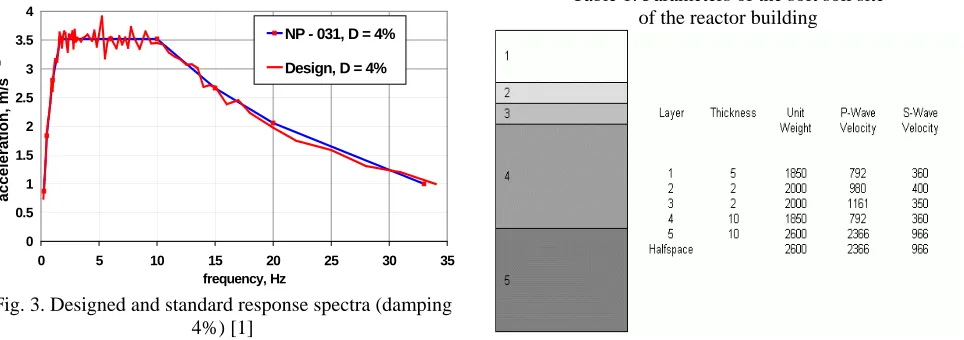
With the help of THSpec Software (Stevenson & Co, Romania) [5] single component artificial ground time history acceleration (TH) was synthesized on a basis of standard generalized ground spectra from Guideline NP-031 [1]. This acceleration has duration of 25 s, time step of 0.01 s, maximal value of 0.1 g and meets requirements of [1, 2, 4]. Designed response spectrum from developed TH and standard one are represented in Fig 3. Dynamic analysis was undertaken using FEA solver SOLVIA-99.0 (SOLVIA Engineering AB, Sweden) by time history direct integration procedure.
Two types of soil base were considered. The first one was rock base and the second one was soft soil base. The parameters of the second one are given in Table 1. They correspond to the site of one of existing NPP of VVER-1000 type.
0 0.5 1 1.5 2 2.5 3 3.5 4
0 5 10 15 20 25 30 35
frequency, Hz
accel
er
at
ion,
m/
s
2
NP - 031, D = 4%
Design, D = 4%
Fig. 3. Designed and standard response spectra (damping 4%) [1]
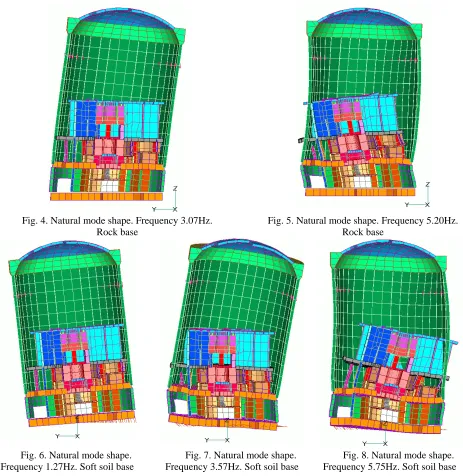
largest participation factors for global Y-direction are represented in Fig. 4-8. For global X direction natural mode shapes keep the same character as for Y direction, but corresponding eigenvalues are 3.11Hz and 5.04 Hz for rock base and 1.27 Hz, 3.57 Hz и 5.45 Hz for soft soil base.
Fig. 4. Natural mode shape. Frequency 3.07Hz. Rock base
Fig. 5. Natural mode shape. Frequency 5.20Hz. Rock base
Fig. 6. Natural mode shape. Frequency 1.27Hz. Soft soil base
Fig. 7. Natural mode shape. Frequency 3.57Hz. Soft soil base
Fig. 8. Natural mode shape. Frequency 5.75Hz. Soft soil base
The reactor building structure consists of three main parts: foundation structure, containment and internal structure – nuclear island. The two last ones are parallel independent systems located on the common foundation structure. Mass relations for the considered parts are given in the Table 2.
Table 2. Masses of the main structural parts of the reactor building
REACTOR BUILDING STRUCTURES
MASS, kg
Containment 3.6e+7 Internal Structures 3.3e+7
Foundation structure 4.1e+7 Total Building 1.1e+8
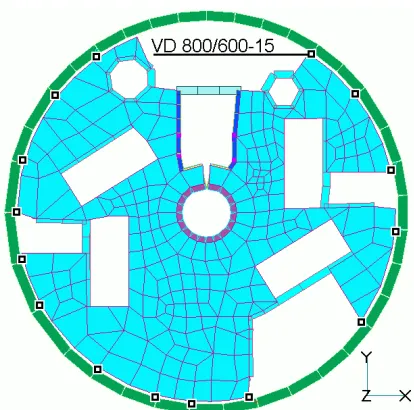
Fig. 9. Distribution of dampers at the upper deck of Reactor Island (horizontal plane)
Fig. 10. Distribution of dampers at the upper deck of
Reactor Island (vertical plane) Fig. 11. Sketch of dampers’ installation
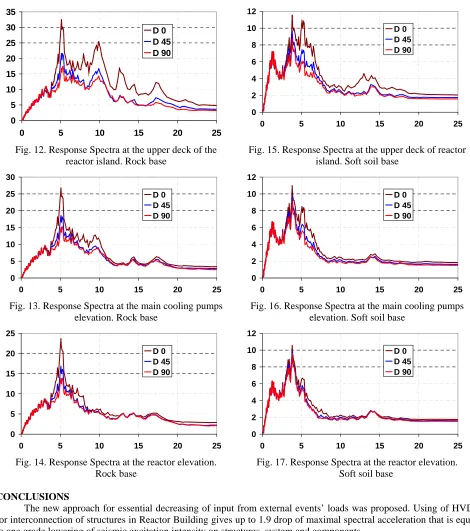
The rock base analysis results without dampers (D = 0) and with 45 (D = 45) and 90 (D = 90) units of HVD are shown in Fig. 12-14.
Fig. 12 presents spectra at the upper deck of the Reactor Island. In result of dampers installation the maximal spectral acceleration dropped from 32.5 m/s2 to 17.4 or 1.9 times on the characteristic frequency 5.0 Hz and 1.8 times on the frequency 10.0 Hz. For the Primary Pump elevation the maximal spectral acceleration dropped 1.8 times on the characteristic frequency 5.0 Hz. For the reactor supports elevation the maximal spectral acceleration dropped 1.7 times on the characteristic frequency 5.0 Hz.
Thus installation of HVDs on the upper deck of RB brings essential decreasing of seismic acceleration input on systems and components as well as on structures itself located on a rock or stiff enough soils. The drop of acceleration is approximately equal to one level of MSK-64 seismic intensity scale and influence totally on whole reactor building system.
0 5 10 15 20 25 30 35
0 5 10 15 20 25
D 0 D 45 D 90 0 2 4 6 8 10 12
0 5 10 15 20 25
D 0 D 45 D 90
Fig. 12. Response Spectra at the upper deck of the reactor island. Rock base
Fig. 15. Response Spectra at the upper deck of reactor island. Soft soil base
0 5 10 15 20 25 30
0 5 10 15 20 25
D 0 D 45 D 90 0 2 4 6 8 10 12
0 5 10 15 20 25
D 0 D 45 D 90
Fig. 13. Response Spectra at the main cooling pumps elevation. Rock base
Fig. 16. Response Spectra at the main cooling pumps elevation. Soft soil base
0 5 10 15 20 25
0 5 10 15 20 25
D 0 D 45 D 90 0 2 4 6 8 10 12
0 5 10 15 20 25
D 0 D 45 D 90
Fig. 14. Response Spectra at the reactor elevation. Rock base
Fig. 17. Response Spectra at the reactor elevation. Soft soil base
CONCLUSIONS
The new approach for essential decreasing of input from external events’ loads was proposed. Using of HVDs for interconnection of structures in Reactor Building gives up to 1.9 drop of maximal spectral acceleration that is equal to one grade lowering of seismic excitation intensity on structures, system and components.
REFERENCES
1 Stevenson J D Course Notes Regional training course on assessment and upgrading of nuclear power plants in relation to external hazards Istanbul 1995
2 GOSATOMNADZOR OF RUSSIA, NP-031-01- Norms for Seismic-Resistant Design of Nuclear Plants (2002) 3 AMERICAN SOCIETY OF CIVIL ENGINEERS, ASCE 4-98 STANDARD. Seismic Analysis of Safety Related
Nuclear Structures and Commentary. Approved 1998
4 INTERNATIONAL ATOMIC ENERGY AGENCY, IAEA SAFETY SERIES No 50-SG-D15. Seismic Design and Qualification for Nuclear Power Plants. A Safety Guide, Vienna (1992)
5 U.S. NUCLEAR REGULATORY COMMISSION, NUREG-0800, Standard Review Plan, Section 3.7.2. Seismic System Analysis (1989)