Asian Journal of Pharmaceutical Research and Development
(An International Peer-Reviewed Journal of Pharmaceutical Research and Development)www.ajprd.com
ISSN 2320-4850
Research Article
FORMULATION & EVALUATION OF SUSTAINED RELEASE
MATRIX TABLET OF CARBAMAZEPINE
Kumar Ashish, Jain C.P., Arora Saurabh, Raj Vinit, Singh Satyjeet , Riyaz Mohd.
Roorkee College of Pharmacy, 09 milestones Roorkee-Dehradun Highway, Haridwar, Uttarakhand, India
Received: 24 February 2013, Revised and Accepted: 03 March 2013
ABSTRACT
Monolithic matrix tablets of carbamazepine were formulated as sustained release tablet employing HPMC polymer and the sustained release behavior of the fabricated tablet was investigated. Sustained matrix tablet contain 200 mg of carbamazepine were developed using different grade of HPMC alone or in combination. Tablets were prepared by direct compression. Formulation was optimized on the basis of acceptable tablet properties and in-vitro drug release. The resulting formulation produced robust tablets with optimum hardness, consistence weight uniformity and low friability. The result of dissolution study indicated that formulation C07 the most successful of the study, exhibited drug release pattern very close to USP data for carbamazepine extended release tablet. A decrease in release kinetic of drug was observed on increasing polymer ratio.
Keywords: Carbamazepine , sustained release matrix tablet, epilepsy and HPMC.
INTRODUCTION
arbamazepine is an anticonvulsant drug used in the treatment of epilepsy. Carbamazepine is related chemically to tricyclic antidepressant. This is derivative of iminostilbin with a carbamil group at 5th position, this moiety is essential for antiseizure activity. It is chemically described as 5H-Dibenz[b,f] azepine-5-carboxamide[1-5].Sustain release formulation of carbamazepine present the formulator with significant chalanges due to its physical propertie s(like polymorphism)[6], due to its increase metabolism (autoinduction by repeated dosing),
pronounced daily fluctuation in serum
concentration of carbamazepine[7], and limited water solubility.
Corresponding address: Ashish Kumar
Roorkee College of Pharmacy Haridwar, Uttarakhand, India
Because there is a correlation between peak concentration of carbamazepine and CNS side effects especially in patient receiving polytherapy (elilepsia)[8]. It is of great clinical importance to assure a steady level of carbamazepine during 24 hr carbamazepine delivery.
MATERIALS AND METHODS
Carbamazepine, Colloidal Silicon Dioxide and magnesium stearate, was obtained from Arbro Pharmaceuticals Ltd, New Delhi.Various grades of Hydroxy propyl methyl cellulose were purchased from colorcon, India. All other chemicals used were of analytical grade.
Preparation of matrix tablets:
Different tablet formulations were prepared by direct compression method by mixing required amount of the drug, the polymer, diluents and
to weighing based on theoretical weight of each tablet, the filling capacity of the lower punch was adjusted and tablets were compressed at 7-10 kg/cm2 hardness using a 16 station rotary tablet-punching machine.
Evaluation of Uncoated Sustained Release Matrix Tablets
Weight Variation Test
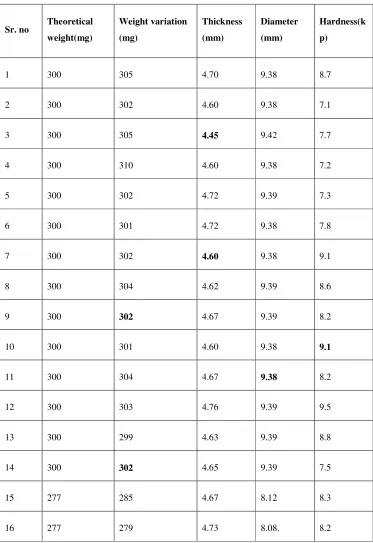
Twenty tablets were randomly selected and weighed to determine the average weight and were compared with individual tablet weight. The percentage weight variation was calculated. The results are given in table III.
Friability Test
20 dedusted tablets were subjected to rotating drum of friability test apparatus. The drum was rotated at a speed of 25 rpm. The apparatus was operated for 4 minutes and the tablets were weighed. Friability was calculated by the following formula. − = W W W
F 100 0 F = Friability, W = Final
weight, Wo = Initial weight
The results are given in table III.
Hardness Test
The hardness of tablet was determined by using Monsanto type hardness tester. The hardness of the tablet kg / cm² was measured. The result are given in table no. III.
Thickness & diameter
The dimensional specifications were measured using digital micrometer calipers. The thickness of the tablet is mostly related to the tablet hardness can be used as initial control parameter. The result is given in Table no. III.
Assay (carried by UV)
Preparation of test solution:
Crushed 20 tablets and weighed equivalent to 100 mg(approx 151 mg of powered drug) of Carbamazepine and dissolved in 100 ml distilled
water (Solution – A) 10 ml of the solution – A was further diluted to 100 ml with distilled water. (Solution – B). From solution B, 10 ml of solution was again diluted to 100 ml (Solution – C) and recorded the absorbance at 284 nm with the help of UV spectrophotometer.
Preparation of standard solution
Weighed 100 mg of standard Carbamazepine powder and diluted to 100 ml distilled water. Further 10 ml of this solution diluted to 100 ml. from this solution 10 ml diluted to 100 ml with distilled water and read the absorbance at 284 nm with the help of UV spectrophotomete.
ASSAY (BY HPLC)[9]
Assay was performed as per USP 2004. 20 Tablets were weighed and powdered. High performance liquid chromatography was carried out, using the following solutions
Chromatographic conditions
• Mobile phase: A mixture of water, methanol,
methylene chloride in ratio
(500:450:45 )
• Column used: Lichrosphere C-18
• Wavelength :284nm
• Flow rate: 2.0ml/min
• Injection vol.: 20µL
Preparation of standard solution:
Weighed 50mg of standard Carbamazepine powder and diluted to 50ml with methanol.and sonicated for 10 min. Further 2 ml of this solution diluted to 25 ml with mobile phase
Prepration of test solution
Weighed tablet powder equvivalent to 50 mg carbamazepine drug and dissolved in 50 ml volumetric flask with few ml of methanol .Volume made up to 50 ml with methanol.and sonicated for 10 min. Further 2ml of this solution diluted to 25 ml with mobile phase.
IR spectra of drug, drug and polymers were obtained using Jasco FTIR-410 to establish the compatibility of ingredients. Physical mixture of the drug and the polymer [1:1] were mixed with 400 mg of Potassium Bromide. About 100 mg of the mixture was taken and compressed to form a trasnsparent pellet in a hydraulic press at 15 tonnes pressure. The samples were scanned from 4000 to 400 cm-1 in a FTIR spectrophotometer. Similar, the IR spectra of the individual drug and the polymers were also recorded .Changes if any in the spectra were observed to assess any physical or chemical interaction.
Formulation development
Various factors that may influence the drug release profile such as tablet shape, dissolution medium, apparatus, combination of polymers and their proportions, viscosity of polymers are studied.
The composition and tablet weight (theoretical weight) for the formulations prepared are listed in Table: IA &IB
In-vitro Drug release kinetics
Dissolution data was fitted kinetic model mentioned in introduction and regression analysis was carried out. The criteria for selecting the most appropriate model was based on best goodness of fit and smallest standardize residuals.
Gel layer dynamics
The tablets were clamped between two glass slides and placed in cobalt (II) thiocynate solution and allowed to hydrate for 12 hours. The hydrated matrices were photographed.
Gel Layer Dynamics and Front Visualization
When hydrophilic matrix former matrices were hydrated in cobalt (II) thiocynate solution (6.8 gm cobalt chloride and 4.3 gm ammonium thiocynate in 100 mL water) is permeated into the tablet along with water. Cobalt (II) thiocynate gives a pink
colour when diluted and forms a blue complex with compounds containing amino groups. Thus a blue colour was developed in the hydrated region of the tablet containing carbamazepine while drug free hydrated region appeared pink due to cobalt (II) thiocynate. The un-hydrated glassy core of the matrix retained it’s off- white colour. The junction of these regions mark the different fronts observed in a hydrating matrix and are marked in figure.
Figure 1: Hydrophilic matrix containing drug after
hydration for 8 hours in cobalt (II) thiocynate solution. The white region is the unhydrated core, blue region is the hydrated region-containing drug and pink region is the drug free hydrated polymer
RESULT AND DISCUSSION
Selection of Target Release Profile
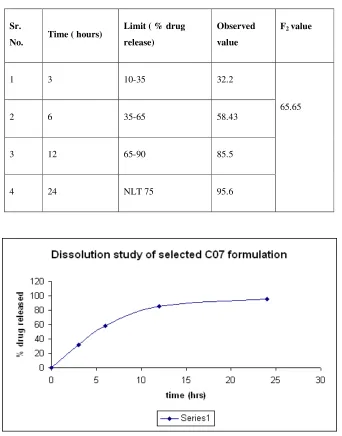
The primary aim of the project was to develop a generic equivalent which has release profile in range as specified in USP(2004). Hereby physical properties of the tablets of all batches were found satisfactory but the parent drug release and dissolution profile were not satisfactory in batch C01 to C16 except C07 that having f2value 65.65
Table-IA : Tablet Weight and Composition of Prototype Formulation Prepared (C01-08)
S.NO. Ingredients B. No.
C01
(%w/w)
B. No.
C02
(%w/w)
B. No.
C03
(%w/w)
B. No.
C04
(%w/w)
B. No.
C05
(%w/w)
B. No.
C06
(%w/w)
B. No.
C07
(%w/w)
B. No.
C08
(%w/w)
1.
Cbz 66.66 66.66 66.66 66.66 66.66 66.66 66.66 66.66
2.
HM11 14.66 - - 23.33 7.33 7.33 7.33 13.93
3.
HM12 - 14.66 - - - -
4.
HM13 - - 14.66 - - - 7.33 -
5.
HM2 - - - - 7.33 - - -
6. HM3 - - - 7.33 - -
7. D1 16.66 16.66 16.66 8.00 16.66 16.66 16.66 16.66
8. MS 1 1 1 1 1 1 1 1
9. CSD 1 1 1 1 1 1 1 1
10. ISM - - - 0.73
11. D2 - - - -
12. PVP - - - -
13. SLS - - - -
14. HM10 - - - -
15. Tablet Wt. 300 300 300 300 300 300 300 300
Cbz- Carbamazepine,MS- Magnessium stearate,CSD-Colloidal silicone dioxide,HM-Hydrophilic matrix former
Table I B: Tablet Weight and Composition of Prototype Formulation Prepared (C09-16)
S.NO. Ingredients B. No. C09 (%w/w)
B. No. C10 (%w/w)
B. No. C11 (%w/w)
B. No. C12 (%w/w)
B. No. C13 (%w/w)
B. No. C14 (%w/w)
B. No. C15 (%w/w)
B. No. C16 (%w/w)
1. Cbz 66.66 66.66 66.66 66.66 66.66 65.35 72.20 72.20
2. HM11 13.2 31.33 23.33 14.66 14.66 22.87 - -
3. HM12 - - - -
4. HM13 - - - -
5. HM2 - - - -
6. HM3 - - - -
7. D1 16.66 - - - 15.66 6.53 - -
8. MS 1 1 1 1 1 1 1 1
9. CSD 1 1 1 1 1 1 1 1
10. ISM 1.466 - - - -
11. D2 - - 8.00 16.66 - - - -
12. PVP - - - 3.26 - -
13. SLS - - - 1
14. HM10 - - - 25.79 24.79
15. Tablet Wt. 300 300 300 300 300 300 270 270
Cbz- Carbamazepine,MS- Magnessium stearate,CSD-Colloidal silicone dioxide,HM-Hydrophilic matrix former
Table II: showing limit and observed value for the % drug release
Sr.
No. Time ( hours)
Limit ( % drug release)
Observed value
F2 value
1 3 10-35 32.2
65.65
2 6 35-65 58.43
3 12 65-90 85.5
4 24 NLT 75 95.6
Figure 2: Dissolution study of selected formulation
Formulation development
Evaluation of tablet formulation (Physical characteristics of fabricated tablets)
The tablet is evaluated for the following parameters as given below in table.
1.Weight variation test was conducted as per
specifications.
2. Thickness and length using a vernier caliper.
3. Hardness test was performed using a
Monsanto hardness tester.
4. Friability test was performed using a Roche friability testing machine.
5. Drug content (Assay) by HPLC and UV
Table III: Weight variation test of uncoated sustained release Carbamazepine matrix tablets
Sr. no Theoretical weight(mg)
Weight variation (mg)
Thickness (mm)
Diameter (mm)
Hardness(k p)
1 300 305 4.70 9.38 8.7
2 300 302 4.60 9.38 7.1
3 300 305 4.45 9.42 7.7
4 300 310 4.60 9.38 7.2
5 300 302 4.72 9.39 7.3
6 300 301 4.72 9.38 7.8
7 300 302 4.60 9.38 9.1
8 300 304 4.62 9.39 8.6
9 300 302 4.67 9.39 8.2
10 300 301 4.60 9.38 9.1
11 300 304 4.67 9.38 8.2
12 300 303 4.76 9.39 9.5
13 300 299 4.63 9.39 8.8
14 300 302 4.65 9.39 7.5
15 277 285 4.67 8.12 8.3
16 277 279 4.73 8.08. 8.2
Drug –Excipient compatibility studies
The interaction was verified and found
carbamazepine did not interact with excipient used. From the FTIR spectra shown in figures
Figure 3: IR Spectrum of Carbamazepine drug and Standard Carbamazepine drug
Figure 4: IR Spectrum of HPMC (Hydroxy Propyl methyl Cellulose)
Release kinetics
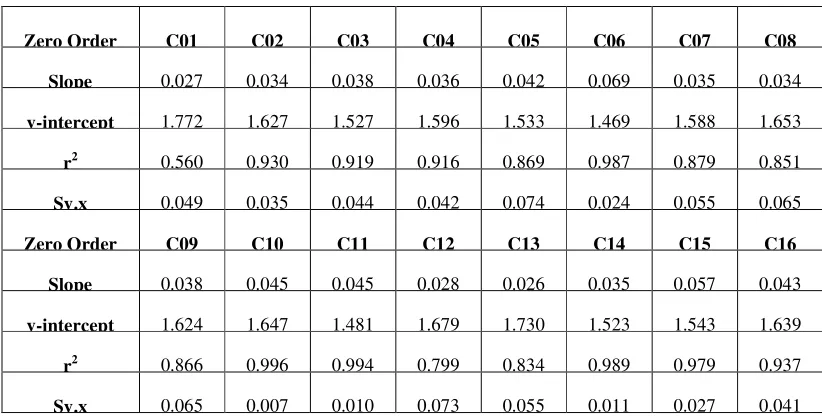
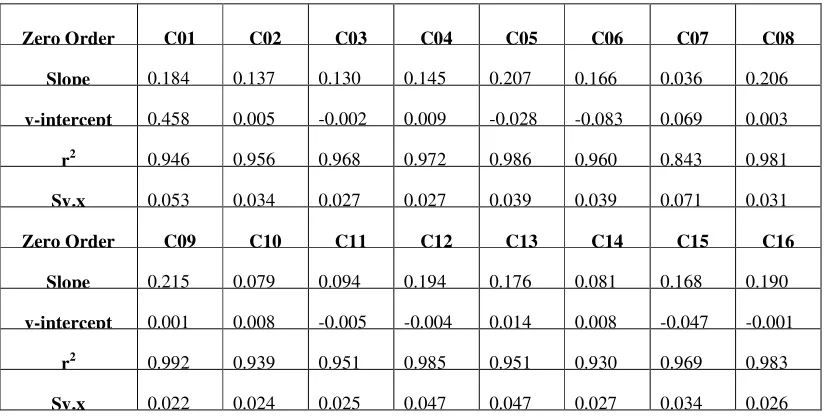
Dissolution data of each formulation was fitted to various models using the equations mentioned in section. By regression analysis of curves, slopes,
intercepts, correlation coefficient ® and
standardized residuals were calculated. The data
are summarized in table IV. In cases where the correlation coefficients were high for more than one model best fit model was selected based on minimum value for standardized residuals.
Table IV: Kinetical study of dissolution datas of various formulations Zero Order Table
Zero Order C01 C02 C03 C04 C05 C06 C07 C08 Slope 0.374 0.031 0.309 0.032 0.508 0.055 0.159 0.045
y-intercept 0.108 0.073 0.057 0.070 0.522 0.036 0.001 0.080
r2 0.769 0.822 0.850 0.834 0.889 0.964 0.973 0.843
Sy.x 0.11 0.695 0.587 0.067 0.074 0.037 0.029 0.090
Zero Order C09 C10 C11 C12 C13 C14 C15 C16 Slope 0.049 0.019 0.023 0.044 0.036 0.077 0.049 0.046
y-intercept 0.072 0.046 0.047 0.085 0.099 0.055 0.050 0.074
r2 0.870 0.828 0.858 0.791 0.782 0.785 0.934 0.882
Sy.x 0.082 0.041 0.043 0.106 0.100 0.048 0.049 0.071
First Order Table
Zero Order C01 C02 C03 C04 C05 C06 C07 C08 Slope 0.027 0.034 0.038 0.036 0.042 0.069 0.035 0.034
y-intercept 1.772 1.627 1.527 1.596 1.533 1.469 1.588 1.653
r2 0.560 0.930 0.919 0.916 0.869 0.987 0.879 0.851
Sy.x 0.049 0.035 0.044 0.042 0.074 0.024 0.055 0.065
Zero Order C09 C10 C11 C12 C13 C14 C15 C16 Slope 0.038 0.045 0.045 0.028 0.026 0.035 0.057 0.043
y-intercept 1.624 1.647 1.481 1.679 1.730 1.523 1.543 1.639
r2 0.866 0.996 0.994 0.799 0.834 0.989 0.979 0.937
Higuchi Table
Zero Order C01 C02 C03 C04 C05 C06 C07 C08 Slope 0.184 0.137 0.130 0.145 0.207 0.166 0.036 0.206
y-intercept 0.458 0.005 -0.002 0.009 -0.028 -0.083 0.069 0.003
r2 0.946 0.956 0.968 0.972 0.986 0.960 0.843 0.981
Sy.x 0.053 0.034 0.027 0.027 0.039 0.039 0.071 0.031
Zero Order C09 C10 C11 C12 C13 C14 C15 C16 Slope 0.215 0.079 0.094 0.194 0.176 0.081 0.168 0.190
y-intercept 0.001 0.008 -0.005 -0.004 0.014 0.008 -0.047 -0.001
r2 0.992 0.939 0.951 0.985 0.951 0.930 0.969 0.983
Sy.x 0.022 0.024 0.025 0.047 0.047 0.027 0.034 0.026
Hixson Table
Zero Order C01 C02 C03 C04 C05 C06 C07 C08 Slope 0.017 -0.046 -0.045 -0.047 -0.058 -0.056 -0.049 -0.058
y-intercept 0.300 0.315 0.321 0.319 0.320 0.332 0.317 0.312
r2 0.037 0.090 0.100 0.085 0.034 0.049 0.075 0.030
Sy.x 0.262 0.274 0.280 0.277 0.279 0.289 0.276 0.272
Zero Order C09 C10 C11 C12 C13 C14 C15 C16 Slope -0.058 -0.038 -0.040 -0.055 -0.057 -0.037 -0.054 -0.054
y-intercept 0.314 0.327 0.326 0.304 0.303 0.323 0.326 0.316
r2 0.030 0.146 0.130 0.035 0.050 0.15 0.054 0.069
Sy.x 0.272 0.284 0.284 0.266 0.264 0.281 0.284 0.274
Stability studies
Drug release studies of final formulation C07 were conducted as per the planned scheduled as above.
1. Storage condition at 400C ± 20C / 75% ± 5%RH:
Table V(1): comparison of color of stability samples at accelerated condition
Test Observation Inference
Description (color change)
No changed of color Complies with the stability
Result : Best fit Model
C01 Higuchi
C02 Higuchi
C03 Higuchi
C04 Higuchi
C05 Higuchi
C06 First
C07 Zero
C08 Higuchi
C09 Higuchi
C10 First
C11 First
C12 Higuchi
C13 Higuchi
C14 First
C15 First
Table V (2): comparison of dissolution data of stability samples at accelerated condition.
Time
(Hr)
Initial
(0 days)
15 days
(UV)
30 days
(UV)
90 days
(UV
0.5 10.28 10.26 10.24 10.25
1 15.26 14.28 14.23 14.18
2 24.55 25.55 25.5 26.5
3 32.2 31.3 31.2 31.45
4 41.2 40.2 41.2 40.5
5 48.95 48.65 48.85 48.23
6 58.43 58.45 59.65 59.62
8 70.8 70.5 70.32 69.95
12 85.5 88.5 88.4 88.23
24 95.6 97.8 96.9 97.4
2) Room Temperature (250C ± 20C / 60% RH ± 5%):
TableVI (1): comparison of color of stability samples at accelerated condition
Test Observation Inference
Description (color change)
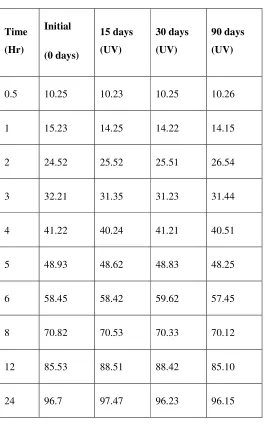
Table VI (2): comparison of dissolution data of stability samples at Room temperature
Time
(Hr)
Initial
(0 days)
15 days
(UV)
30 days
(UV)
90 days
(UV)
0.5 10.25 10.23 10.25 10.26
1 15.23 14.25 14.22 14.15
2 24.52 25.52 25.51 26.54
3 32.21 31.35 31.23 31.44
4 41.22 40.24 41.21 40.51
5 48.93 48.62 48.83 48.25
6 58.45 58.42 59.62 57.45
8 70.82 70.53 70.33 70.12
12 85.53 88.51 88.42 85.10
24 96.7 97.47 96.23 96.15
SUMMARY & CONCLUSION
In present work attempts have been made to formulate sustained release matrix tablet of Carbamazepine by using hydrophilic polymer, which is preferably used as an anticonvulsant agent in various types of seizures. Matrix tablets were prepared using different polymers, by direct compression technique. Carbamazepine meets all the ideal characteristics to formulate in the form of sustained release drug delivery system. Under Preformulation study, the organoleptic properties were complied with the USP specification. The compatibility evaluations were performed by FTIR spectroscopy. Both studies imply that the drug and polymers are compatible with each other. There
basis of pharmacopoeial specification. Shapes of the tablets were rounding biconcave. The physical parameters like diameter and thickness, hardness, friability and weight variation is carried out.
Assay were carried out for finally selected formulation and the result were found to be 100.91% (by HPLC) and 98.6% (by UV)
Stability studies were carried out by keeping the tablets at room temperature (250 C ± 20C / 60% ± 5% RH) and at accelerated temperature (400 C ± 20C / 75% ± 5% RH) in Stability chamber for 90 days. The result of stability studies conducted on C07 reveled no change in physical appearance and
in-vitro dissolution profiles, hence C07
anomalous release and erosion of the swollen matrix due to less solubility of the drug. In all formulation C01 to C16 except C07 that % drug
release is out of the specified range in USP. In
the present study attempts were made to formulate 200mg sustained release once daily formulation which can provide effective drug release for 24 hours.
SR matrix tablets of Carbamazepine were prepared by direct compression. In vitro study showed formulation C07 were well suited to be extended release formulation.
Final selected formulation gives release profile in range as specified in USP and drug release governed by anomalous release and erosion of the swollen matrix.
From the results obtained, it can be concluded that formulation C07 has achieved the objective of sustained drug release, patient convenience and cost effectiveness as a single daily dose of the drug and appears to be assessed further by conducting bioavailability studies in human volunteers and long term stability testing.
ACKNOWLEDGEMENTS
The authors would like to express their gratitude to Mohan Lal Sukhadia University, Udaipur for providing the research facilities. One of the authors (Ashish kumar) is also thankful to Department of pharmacy MLSU Udaipur, Rajasthan, India for providing these facilities.
REFERENCES
1. Goodman and Gillman, The pharmacological basis of therapeutics, 10thed.New Delhi: Mc-Graw Hill Comp. Medical Publishing Division; 2001; 521-547.
2. www.rxlist.com
3. Tripathi KD, Essentials of Medical Pharmacology, 5thed.
NewDelhi: Jaypee Brothers Medical Publishers(p) Ltd..1999; 246-250.
4. Klaus F., Analytical profile of drug substances, published by Elsevier 2005:9,87-106
5. The Indian Pharmacopoeia , Dehli: Published by the controller of publications, Ministry of Health &Family Welfare ;1996;136
6. Pergamon NY., Thermomicroscopy in the analysis of pharmaceuticals 1971; 227
7. Weaver DF., Fraser Al., Massive carbamazepine overdose clinical & pharmacologic observations in five episodes, Europ.J.Clin.Pharmacol 1975; 8:91-96.
8. Lidwien GJ., Alpherts CJ., Cognitive effects of a new pyrrolidine derivative (levetriracetam) in patients with epilepsy, Epilepsia 1987;28:507-514