R E S E A R C H
Open Access
Particle swarm optimization for pilot tones
design in MIMO-OFDM systems
Muhammet Nuri Seyman
1*and Necmi Ta
ş
pinar
2Abstract
Channel estimation is an essential task in MIMO-OFDM systems for coherent demodulation and data detection. Also designing pilot tones that affect the channel estimation performance is an important issue for these systems. For this reason, in this article we propose particle swarm optimization (PSO) to optimize placement and power of the comb-type pilot tones that are used for least square (LS) channel estimation in MIMO-OFDM systems. To optimize the pilot tones, upper bound of MSE is used as the objective function of PSO. The effects of Doppler shifts on designing pilot tones are also investigated. According to the simulation results, PSO is an effective solution for designing pilot tones.
Keywords:MIMO-OFDM, channel estimation, particle swarm optimization
Introduction
Recently, to meet the demand on high data rate transmis-sion in communication systems, orthogonal frequency division multiplexing (OFDM) is applied as a modulation scheme. OFDM is a multicarrier modulation technique that operates with specific orthogonality constraints between subcarriers. The orthogonality results a wave-form which uses available bandwidth with a high band-width efficiency [1]. Also OFDM can be combined with multiple transmit and receive antennas known as multi-input multi-output (MIMO) architecture to improve system capacity and quality of service [2].
However, at the receiver MIMO-OFDM systems require channel state information (CSI) for coherent demodulation and data detection. In order to obtain CSI, blind and training symbol (pilot tones)-based chan-nel estimation techniques are applied. In blind chanchan-nel estimation technique, CSI is estimated by channel statis-tics without any knowledge of the transmitted data. But it can suffer from slow convergence in mobile wireless systems because of the time varying nature of channels [3]. In training symbol technique, training sequences that are also called as pilots are inserted into all of sub-carriers of OFDM symbols with specific period or
inserted into each OFDM symbol [4]. Compared with blind technique, pilot-based channel estimation techni-ques provide better resistance to fast fading and time varying channels [4-6]. However, designing of pilot tones directly affect the performance of channel esti-mation algorithms. Hence, optimal design for training symbols based on minimizing Cramer Rao lower bound [7], minimizing mean square error (MSE) of estimation [8-10], and maximizing lower bound capa-city [11] has been considered in literature. By minimiz-ing Cramer Rao Bound on MSE of channel, the optimal placement of pilot symbols has been consid-ered in [7]. In [8], the number and the placement of pilot symbols and the power allocation between pilot and information symbols have been optimized in OFDM systems by minimizing error probability. Opti-mal pilot sequences and optiOpti-mal uniformly placed pilot tones have been derived with the regard to MSE of LS estimation scheme in MIMO-OFDM systems in [9]. Also in [10], optimal training design for MIMO-OFDM systems with non-uniform placement of pilot tones has been addressed.
Also by utilizing from advantages of the heuristic opti-mization techniques, the particle swarm optiopti-mization (PSO) that is a kind of heuristic optimization technique has been used to solve some problems in communication systems. In [12], blind channel estimation technique based on PSO for power-line communication has been proposed
* Correspondence: [email protected]
1
Department of Electronic Communication, Vocational High School, Kirikkale University, 71100 Kirikkale, Turkey
Full list of author information is available at the end of the article
using tracking features of PSO. In [13], continuous and discrete PSO has been used for joint channel and data esti-mation based on maximum likelihood principle. In [14], to decrease the effect of noise, angle domain PSO-LS algo-rithm which exploits most significant taps technique using a suitable threshold for MIMO-OFDM systems has been presented. In [15], genetic algorithm (GA) and PSO-based adaptive channel estimation methodology in space time block coded (STBC) OFDM system are investigated to get optimal solution of MMSE algorithm. In this article, LS channel estimation algorithm for MIMO-OFDM systems based on comb-type pilot tones is described briefly. Then optimization of these pilot tones whose design is very cru-cial for LS channel estimation performance is proposed using PSO. And by optimizing both placement and power of pilot tones, the performance of LS channel estimation algorithm is increased.
This article is organized as follows: the MIMO-OFDM system model and MSE of LS channel estimation method are presented in next section followed by parti-cle swarm optimization, objective function of partiparti-cle swarm optimization, simulation results and discussion. Finally, this article concludes with the conclusions.
MIMO-OFDM system model
The block diagram of MIMO-OFDM system that has Nt
transmit antennas,Nr receive antennas is presented in Figure 1. At transmitter side, data symbols are mapped by considering modulation type. Pilot symbols are inserted to estimate channels and IFFT is taken at each transmitter antenna. Then cyclic prefix is inserted to prevent inter symbol interference. The transmitted sym-bol at the pth transmitter antenna includes pilot tones, Bp(k), and data symbols. At theqth receiver antenna, after removing cyclic prefix and taking FFT, the received pilot tone vectors expressed as
Yq(n) = Nt
p=1
Bdiagp (n)Fhq,p+Wq(n) (1)
where Yq(n) = [Yq(n1),... Yq(nM)]T and Bp(n) = [Bp
(n1),... Bp(nM)]T are vectors with the lengthM. hq,pis
L×1 vector frompth transmit antenna to qth receive
antenna.L is maximum length of channel. F denotes
(1/√K) times the K×Kunitary DFT matrix, Wq(n) =
[Wq(n1),... Wq(nM)]T is M×1 additive white Gaussian
noise vector, K is number of sub carriers and (.)T is
transpose operation. Then hq,p is estimated in
chan-nel estimation block and the signal is demodulated [9,10].
Least squares (LS) channel estimation
In order to estimate channel state information (CSI), LS is derived as follows:
Assuming training overg consecutive OFDM symbol,
the sequence (1) can be written as
Yq=Ahq+Wq (2)
where Yq=
YqT(0),. . .,YqT(g−1)T and
A=
⎡ ⎢ ⎣
Bdiag1 (0)F . . . BdiagNt (0)F . . . . . . . . . Bdiag1 (g−1)F. . .BdiagNt (g−1)F
⎤ ⎥
⎦ (3)
hq=
h1T
q ,. . .,hNt T q
T
(4)
channel impulse responsehq can be estimated by LS
algorithm:
ˆ
hq=AtYq=hq+AtWq (5)
where At = (AH A)-1 AH. It is assumed that pilot
sequences are designed such that the gK ×LNt sized
matrixAis of full column rankLNtwhich requiresgK≥
LNt. Also M =LNt must be estimated for minimum
number of pilot tones.
IFFT IFFT IFFT FFT FFT FFT
Mapping demapping
1 Nt 1 Nr Channel Estimation input
Data Output Data
From Equation 5, MSE of LS channel estimation can be obtained as follows
MSE = 1
LNt E
∧hq−hq
2
= 1
LNt
EAtWq2
= 1
LNt
trAtEW
qWqH
AtH
(6)
If we assume zero mean white noise we have
E
WqWqH
=σ2IM. In this case, the MSE can be
writ-ten as
MSE = σ
2
LNt
tr(AAH)−1 (7)
According to (2), minimum MSE of LS channel
esti-mate can be achieved if AAH=PILNt then minimum
MSE can be given by
MSE =σ
2
P (8)
wherePis a fixed power for the pilot tone,s2is noise variance, (.)H is hermitian matrix, (.)tis matrix pseudo inverse, tr(.) is trace,E(.) is expectation [9,10].
Particle swarm optimization
The particle swarm optimization (PSO) is an evolution-ary optimization algorithm whose mechanics are inspired by collaborative behavior of biological popula-tions such as birds flocking and fish schooling to guide particles to search for globally optimal solutions. The advantages of the PSO are its simple implementation and it’s quickly convergence ability. In PSO, simple soft-ware agent called as particles that represent as potential solutions are placed in the search space of function and evaluate the objective function at their current location. Each particle searches for better position in the search space by changing velocity according to rules that is mentioned as follows
Each particleihas xi= (x1i,x2i,. . .,xDi ) position vector
and vi= (v1i,vi2,. . .,vDi ) velocity vector, where D is dimension of solution space. Initially, velocity and posi-tion of particles are generated randomly in search space. At each iteration, the velocity and the position of
parti-cleion dimentiondare updated as shown below
vd
i(t+ 1) =wvdi(t) +c1ri1(t)
pbestdi(t)−xdi(t)
+c2r2
i(t)
gbestd−xd i(t)
(9)
xdi(t+ 1) =xdi(t) +vdi(t+ 1) (10)
where pbestdi = (p1i,p2i,. . .,pDi ) is the previous best position of particle i, gbestd = (p1, p2,...,pD) is the best position among all particles, ri1 and r2i are uniformly distrubuted numbers in the interval [1, 0], c1andc2 are
cognitive and social parameters andwis inertia weights that are used to maintain momentum of particle [16-19]. The inertia weight wis employed to control the impact of the previous history of velocities on the cur-rent velocity, thereby influencing the trade off between global and local exploration abilities of the flying points. A large inertia weight (w) facilitates a global search, while a small inertia weight facilitates a local search. Suitable selection of the inertia weights provides a bal-ance between global and local exploration abilities and thus requires less iteration on the average to find the optimum [17]. In our article, inertia weightwis linearly decreased fromwmaxtowminaccording to
w=wmax−
wmax−wmin
iterationmax ×
iteration (11)
The PSO algorithm steps have been applied as illu-strated in Figure 2. As it can be seen from the Figure 2; at first, the particles that represent pilot positions are initialized at random values between 0 and 127 for the system which has 128 subcarriers, and 0 and 63 for the system which has 64 subcarriers. All the possible combi-nations of particle positions are tested using fitness
function that is Rmax
P (discussed in the“Particle swarm
optimization objective function” section). If the fitness of particle’s current position is better than its previous best position, the velocity and position of particle are updated using Equations 9 and 10. These processes are repeated till the stopping criteria are carried out that are 3000 iterations and 1000 iterations for the systems which have 128 subcarriers and 64 subcarriers, respec-tively. After the fixed number of iterations, best global particles are chosen as pilot tones positions. Besides, the powers of pilot tones are optimized as mentioned above. However for this purpose, the particles called as power of pilot tones are initialized at random values between 0 and 1.
Particle swarm optimization objective function
and real. According to the theorem, upper bound of MSE which will be used as objective function of PSO can be found as
tr
(AAH)−1
= L i=1 1 λi ≤
⎧ ⎨ ⎩
L P−Rmax
+∞
, P>Rmax , P≤Rmax (12)
where li(I= 1,...,L) is Eigen values,P bii= (i= 1,...L) is diagonal elements of matrix (AAH)and Rmax= max(Ri)
is the maximum radius of the Gerschgorin disc defined as
Ri= L
j=1,j=i
bij (13)
According to the analysis in Equation 12, we can use
Rmax
P as objective function for PSO.
Simulation results
The simulation parameters for the MIMO-OFDM sys-tem with two transmit antennas and two receive
anten-nas are given in Tables 1 and 2. L = 8 tap channel
whose taps are independent, identically distributed and correlated in time with a correlation function according to Jakes model rhh(τ) =σh2J0(2πfdτ)[21,22] is chosen by assuming there are fd= 5 and fd= 10 Hz. Doppler
fre-quency shifts. In simulations, we evaluate the perfor-mance of various pilot tones:
(a) Equipowered random placed pilot tones
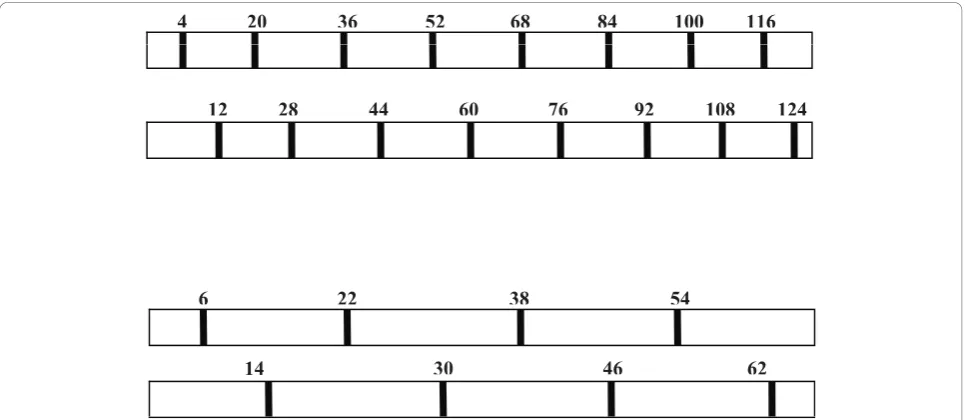
(b) Equipowered and equispaced orthogonal pilot tones that are in Figure 3
(c) Equipowered and optimized location of pilot tones using PSO that is in Figure 4
(d) Optimized both power and location of pilot tones using PSO.
The parameters of particle swarm optimization that has been used for the optimization of location and (or) power of pilot tones are given as follows: swarm size = 20 for 128 subcarriers and swarm size = 10 for 64 sub-carriers, maximum velocity = 20, inertia factor = 0.9 (start), 0.4 (end), learning factorc1and c2 = 2.
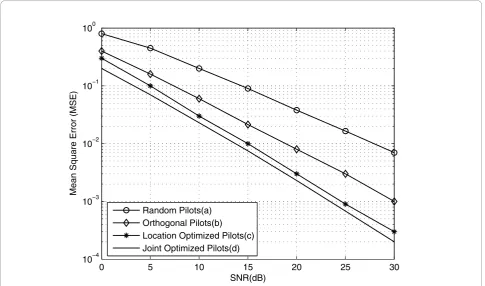
In Figures 5 and 6, mean square error (MSE) versus SNR(dB) and bit error rate (BER) versus SNR(dB) of dif-ferent pilot tones for 128 subcarriers over channels with
Doppler frequency shift fd = 5 Hz are shown,
respec-tively. From Figure 5, it can be seen that in case of pla-cing pilot tones randomly, the system has poor performance comparing to other methods because of channel estimation errors. The difference of MSE between random pilots and orthogonal pilots is approxi-mately 10-1at 30 dB SNR. By locating pilot tones uni-formly as such in orthogonal pilot tones, instead of placing them randomly, the estimator performance will be increased. As it is seen from Figure 6, orthogonal pilots require 5 dB less SNR than random pilots at BER value of 10-3. However, when pilot tones placement is optimized using PSO unlike orthogonal pilots; we can achieve a 10-1BER gain at increasing SNR values. Also Begin
Initialize particles with random position and velocities
Calculate the fitness of each particle’s position (p)
If fitness (p) better than fitness (pbest) then pbest=p
Set best of pBests as gBest
Update the position and velocity of particle
If the max iteration or end condition appears
End: giving gBest (optimal) YES
NO
Figure 2PSO algorithm flow diagram.
Table 1 MIMO-OFDM simulation parameters for 128 subcarrier
Parameter Value
FFT size 128
Number of subcarrier 128
Cyclic prefix size FFT/4 = 32
Number of pilot tones 16
Modulation type QPSK
at 30 dB SNR, BER difference between location opti-mized pilot tones and random pilot tones is more than 10-1. Besides not only optimizing placement of pilot tones but also optimizing power of them, the estimation performance will be increased much.
The MSE versus SNR(dB) and BER versus SNR(dB) of pilot tones by assuming Doppler shift isfd= 40 Hz are
shown in Figures 7 and 8, respectively. According to these figures, when Doppler shifts increase channel esti-mation errors also increase. However, optimizing pilot tones makes the system robust. Also to show the effect of number of subcarrier on system performance, BER and MSE of the systems which have 64 subcarriers are simu-lated in Figures 9, 10, 11, and 12. According to these fig-ures, system performance is decreased with the reduction of the subcarrier number. Because a greater number of subcarriers can offer a better protection against multi-path delay spread. For instance, when we consider to Fig-ures 6 and 10, at 25 dB SNR value the BER difference of optimized pilot tones is approximately 10-1.
In addition to the performance advantages of PSO which can be seen from above figures, PSO also avoids
exhaustive searches to optimize pilot tones location. For each antenna, exhaustive search of pilot position as in orthogonal pilots needs C16128≈2.26041×1028 searches
for 128 subcarriers and 16 pilot tones; and
C864≈4.426×10⁶ searches for 64 subcarrier and 8 pilot tones; conversely the number of search in PSO is just 3000 × 20 = 6 × 10⁴ for 3000 iteration and 20 parti-cle sizes.
Here, we investigate the rough computational com-plexity of orthogonal and optimal placement of pilot tones in terms of Nt(number of transmitter antenna),
Nr (number of receiver antennas),Niteration(number of
iteration in PSO), n(swarm size), and M (number of
pilot tones). Placing of the pilot tones orthogonally as presented in [9] requires NtNrM4 multiplications; also
this process has to compute the MSE in Equation 8 for objective function. However, computing this equa-tion is required matrix inversion, as a results M3 addi-tions and multiplicaaddi-tions are needed additionally[23].
In contrast, using Rmax
P instead of using MSE in
Equa-tion 8 as the objective funcEqua-tion, we avoid to compute this matrix inversion to optimize the pilot tones based
on PSO. The proposed PSO algorithm needs (NtNr)n
multiplication for the fitness of the each position inn sized population at first stage. Velocity and position update in PSO requiresµadditional multiplications per iteration. After all iterations, PSO needs Niteration(NtNr)
n multiplications. As it can be seen from the above
complexity analysis, optimizing location of pilot tones based on PSO has computational complexity advantage over orthogonal placement of pilot tones. The
Table 2 MIMO-OFDM simulation parameters for 64 subcarrier
Parameter Value
FFT size 64
Number of subcarrier 64
Cyclic prefix size FFT/4 = 16
Number of pilot tones 8
Modulation type QPSK
OFDM symbol duration (τs) 565 µs
complexity of orthogonal placement of pilot tones becomes quite high when the number of subcarrier is increased. Because increasing number of subcarrier also increase the number of pilot tones in MIMO-OFDM systems.
Conclusion
In this article, we have proposed particle swarm optimi-zation (PSO) to optimize both placement and power of pilot tones which are used in LS channel estimation algorithm based on comb-type pilot tones in
MIMO-4 17 31 48 64 82 99 117
14 29 41 53 74 97 110 126
14 29 41 53 74 97 110 126
9 27 43 58
16 33 47 63
Figure 4The placement of optimized pilot tones for (a) 128 subcarrier and 2 transmit antennas and (b) 64 subcarrier and 2 transmit antennas.
0 5 10 15 20 25 30
10−4 10−3 10−2 10−1 100
SNR(dB)
Mean Square Error (MSE)
Random Pilots(a) Orthogonal Pilots(b) Location Optimized Pilots(c) Joint Optimized Pilots(d)
0 5 10 15 20 25 30 10−5
10−4 10−3 10−2 10−1 100
SNR(dB)
Bit Error Rate (BER)
Random Pilots(a) Orthogonal Pilots(b) Location Optimized Pilots(c) Joint Optimized Pilots(d)
Figure 6BER versus SNR for various pilot tones with 128 subcarriers (fd= 5 Hz).
0 5 10 15 20 25 30
10−4 10−3 10−2 10−1 100
SNR(dB)
Mean Square Error (MSE)
Random Pilots(a) Orthogonal Pilots(b) Location Optimized Pilots(c) Joint Optimized Pilots(d)
0 5 10 15 20 25 30 10−5
10−4 10−3 10−2 10−1 100
SNR(dB)
Bit Error Rate (BER)
Random Pilots(a) Orthogonal Pilots(b) Location Optimized Pilots(c) Joint Optimized Pilots(d)
Figure 8BER versus SNR for various pilot tones with 128 subcarriers (fd= 40 Hz).
0 5 10 15 20 25 30
10−3 10−2 10−1 100
SNR(dB)
Mean Square Error (MSE)
Random Pilots(a) Orthogonal Pilots(b) Location Optimized Pilots(c) Joint Optimized Pilots(d)
0 5 10 15 20 25 30 10−4
10−3 10−2 10−1 100
SNR(dB)
Bit Error Rate (BER)
Random Pilots(a) Orthogonal Pilots(b) Location Optimized Pilots(c) Joint Optimized Pilots(d)
Figure 10BER versus SNR for various pilot tones with 64 subcarriers (fd= 5 Hz).
0 5 10 15 20 25 30
10−3 10−2 10−1 100
SNR(dB)
Mean Square Error (MSE)
Random Pilots(a) Orthogonal Pilots(b) Location Optimized Pilots(c) Joint Optimized Pilots(d)
OFDM systems. From the simulation results, we can see that optimized pilot tones derived by particle swarm optimization outperforms the orthogonal and random pilot tones significantly in terms of MSE and BER. In order to show the effect of Doppler shifts on various pilot tones performance, simulations are carried out over channels with different Doppler shifts values. Furthermore, in objective function of PSO there is no need of computing matrix inversion which is needed to compute MSE values. For this reason this approach has less computational complexity.
Abbreviations
BER: bit error rate; CSI: channel state information; GA: genetic algorithm; LS: least square; MIMO: multi-input multi-output; MSE: mean square error; OFDM: orthogonal frequency division multiplexing; PSO: particle swarm optimization; STBC: space time block coded.
Author details 1
Department of Electronic Communication, Vocational High School, Kirikkale University, 71100 Kirikkale, Turkey2Department of Electrical and Electronic
Engineering, Erciyes University, 38039 Kayseri, Turkey
Competing interests
The authors declare that they have no competing interests.
Received: 26 November 2010 Accepted: 8 June 2011 Published: 8 June 2011
References
1. LJ Cimini Jr, Analysis and simulation of digital mobile channel using orthogonal frequency division multiplexing. IEEE Trans Commun. 3(7):665–675 (1985)
2. H Sampath, S Talwar, A fourth-generation MIMO-OFDM broadband wireless systems: design performance and trial results. IEEE Commun Mag. 40(9):143–149 (2002). doi:10.1109/MCOM.2002.1031841
3. BL Saux, M Helard, Iterative channel estimation based on linear regression for MIMO OFDM system.Wireless and Mobile Computing, Networking and Comm Conference. (Canada, Montreal, 2006), pp. 356–361
4. S Coleri, M Ergen, A Puri, A Bahai, Channel estimation techniques based on pilot arrangement in OFDM systems. IEEE Trans Broadcast.48(3):223–229 (2002). doi:10.1109/TBC.2002.804034
5. O Edfors, JJ Van de Beek, M Sandell, SK Wilson, PO Börjesson, OFDM channel estimation by singular value decomposition. IEEE Trans Commun. 46, 931–939 (1998). doi:10.1109/26.701321
6. R Negi, J Cioffi, Pilot tone selection for channel estimation in a mobile OFDM system. IEEE Trans Consum Electron.44(3):1122–1128 (1998). doi:10.1109/30.713244
7. M Dong, L Tong, Optimal design and placement of pilot symbols for channel estimation. IEEE Trans Signal Process.50(12):3055–3068 (2002). doi:10.1109/TSP.2002.805504
8. X Cai, GB Giannakis, Error probability minimizing pilots for OFDM with M-PSK modulation over Rayleigh fading channels. IEEE Trans Veh Technol. 53(1):146–155 (2004). doi:10.1109/TVT.2003.819624
9. I Barhumi, G Leus, M Moonen, Optimal training design for MIMO OFDM systems in mobile wireless channels. IEEE Trans Signal Process. 51(6):1615–1623 (2003). doi:10.1109/TSP.2003.811243
0 5 10 15 20 25 30
10−4 10−3 10−2 10−1 100
SNR(dB)
Bit Error Rate (BER)
Random Pilots(a) Orthogonal Pilots(b)
Location Optimized Pilots(c) Joint Optimized Pilots(d)
10. D Hu, L Yang, L He, Y Shi, Optimal pilot sequence design for multiple input multiple output OFDM systems.IEEE Global Telecom Conference
(GLOBECOM’05). (Saint Louis, USA, 2005), pp. 2260–2264
11. S Adireddy, L Tong, H Viswanathan, Optimal placement of training for frequency selective block fading channels. IEEE Trans Inform Theory.48, 1338–1353 (2002)
12. GA Laguna-Sanchez, R Barron-Fernandez, Blind channel estimation for powerline communications by a PSO-inspired algorithm.IEEE Latin Conf on Commun (LATINCOM 09). (Medellin, Colombia, 2009), pp. 1–6
13. M Zubair, MAS Choudhry, A Naveed, IM Qureshi, Joint channel and data estimation using particle swarm optimization. IEICE Trans Commun. E91-B(9):3033–3036 (2008). doi:10.1093/ietcom/e91-b.9.3033
14. P Xu, J Wang, F Qi, Pilot-based angle domain channnel estimation for MIMO-OFDM systems.Proceedings of the Inernational Conference on Communities and Mobile Computing. (Yunnan, China, 2009), pp. 47–50 15. L D’Orazio, C Sacchi, M Donelli, Adaptive channel estimation for
STBC-OFDM systems based on nature-inspired optimization strategies. Proceedings of the 3rd International Workshop of Multiple Access Communications (MACOM 2010). (Barcelona, Spain, 2010), pp. 188–198 16. J Kennedy, R Eberhart, Particle swarm optimization.IEEE International
Conference on Neural Networks IV. (Perth, Australia, 1995), pp. 1942–1948 17. YH Shi, RC Eberhart, A modified particle swarm optimizer.Proceedings of
1998 IEEE International Conference on Evolutionary Computation. (Anchorage, USA, 1998), pp. 69–73
18. RC Eberhart, Y Shi, Comparision between genetic algorithms and particle swarm optimization. Lecture notes in computer science.1447, 611–616 (1998). doi:10.1007/BFb0040812
19. ZH Zhan, J Zhang, Y Li, H Shu-Hung, Adaptive particle swarm optimization. IEEE Trans Syst Man Cybernet.39(6):1362–1381 (2009)
20. RA Horn, CR Jonhson, Cambridge University Press, Cambridge. Matrix Analysis. (1985)
21. WC Jakes, (Microwave Mobile Communications, Wiley, New York, 1975) 22. P Dent, GE Bottomley, T Croft, Jakes fading model revisited. Electron Lett.
29(13):1162–1163 (1993). doi:10.1049/el:19930777
23. GH Golub, CFV Loan, (Matrix Computations, Hopkins University Press, Baltimore, 1996)
doi:10.1186/1687-6180-2011-10
Cite this article as:Seyman and Taşpinar:Particle swarm optimization for pilot tones design in MIMO-OFDM systems.EURASIP Journal on Advances in Signal Processing20112011:10.
Submit your manuscript to a
journal and benefi t from:
7 Convenient online submission
7 Rigorous peer review
7 Immediate publication on acceptance
7 Open access: articles freely available online
7 High visibility within the fi eld
7 Retaining the copyright to your article