Faculty of Behavioural Sciences
University of Twente
Why an MBA?
Tomoka Iwasaki
Mentor: Dr. Bob Witziers
Second reader: Dr. A.A.M. (Ida) Wognum
External mentor: Dr. Padmakumar Nair
This thesis is dedicated to all the children in the world
who suffer from reasons beyond their control.
Contents
Index of Figures ...vii
Index of Tables ...vii
Acknowledgements...viii
Summary ...ix
Chapter1 Introduction ... 1
1.1. Introduction...1
1.2. History and evolution of MBA...2
1.3. Expectations of MBA seekers...4
1.4. MBA today: relevance in the business world?...4
1.5. Still, why an MBA?...6
Chapter 2 Conceptual Framework and Research Questions... 8
2.1. Introduction...8
2.2. Research Questions... 11
2.3. Hypotheses...12
2.3.1. Financial benefit...12
2.3.2. Employability...13
2.3.3. Job satisfaction...14
2.3.4. Confidence in knowledge and skill...15
2.3.5. Career growth...16
2.3.6. Status...18
Chapter 3 Research Method... 19
3.1. Introduction...19
3.2. Research Methodology...19
3.2.1. Control variables...19
3.2.2. Scales...21
3.3. Description of the Sample...22
3.4. Data collection...26
3.5. Measurement...27
3.6. Limitations...29
Chapter 4 Results ... 31
4.1. Introduction...31
4.2. Results...31
4.3. Perspectives of superiors on differences between MBA holders and people without MBA...37
4.3.1. Difference between perceptions of superiors in Japan and in the US...39
Chapter 5 Conclusion and Recommendations ... 41
5.1. Conclusion...41
5.3. Recommendations and Future Study...42
APPENDICES ... 53
Appendix A.1 For MBA holders in English...55
Appendix A.2 For people without MBA in English...62
Appendix A.3 For superiors in English...66
Appendix A.4 For MBA holders in Japanese...69
Appendix A.5 For people without MBA in Japanese...75
Appendix A.6 For superiors in Japanese...78
Appendix B.1 MBA holders working in Japan and people without MBA working in Japan…….75
Appendix B.2 MBA holders working in the US and people without MBA working in the US……88
Appendix B.3 MBA and people without MBA: The whole sample………101
Index of Figures
Figure 2.1. Characteristics of the individual, program and business school………..9
Figure 2.2. Potential benefits for the stakeholders: Individuals, employers and business school………..9
Figure 2.3. Model showing the relationship between MBA intervention, intermediate outcomes and final outcomes … … … . . 11
Figure 2.4. Simplified cause model………12
Index of Tables
Table 3.1.A. Sample description of MBA and No MBA: Country of work place……….22Table 3.1.B. Sample description of MBA and No MBA: Gender………..23
Table 3.1.C. Sample description of MBA and No MBA: Age………23
Table 3.1.D. Sample description of MBA and No MBA: Number of years of work experience………...23
Table 3.1.E. Sample description of MBA and No MBA: Educational background………...24
Table 3.1.F. Sample description of MBA and No MBA: Previous business education……….24
Table 3.1.G. Sample description of MBA and No MBA: Current position………24
Table 3.1.H. Sample description of MBA and No MBA: Current work hour………..25
Table 3.1.I. Sample description of MBA and No MBA: Current organizational size………25
Table 3.1.J. Sample description of MBA and No MBA: MBA brand………25
Table 3.1.K. Sample description of superiors: Country of work place………...26
Table 3.1.L. Sample description of superiors: Position………26
Table 3.1.M. Sample description of superiors: Size of the organization………26
Table 3.1.N. Sample description of superiors: Number of MBA holders……….26
Table 3.2. Factor analysis: MBA holders and people without MBA……….28
Table 3.3. Reliability: MBA holders and people without MBA……….29
Table 4.1. Descriptive statistics: MBA working in Japan and No MBA working in Japan………32
Table 4.2. Results of linear regression analysis: MBA working in Japan and No MBA working in Japan………..32
Table 4.3. Descriptive statistics: MBA working in the US and No MBA working in the US………34
Table 4.4. Results of linear regression analysis: MBA working in the US and No MBA working in the US………...34
Table 4.5 Descriptive statistics: The whole sample MBA and No MBA………...35
Table 4.6. Results of linear regression analysis: The whole sample MBA and No MBA………..36
Table 4.7. Superiors’ perspective on difference between MBA holders and people without MBA………..………..38
Table 4.8 T-test results: Superiors’ perspective..………39
Acknowledgements
This study was carried out as a part of Master’s program in Human Resource Development of the faculty of Behavioral Science and Technology at the University of Twente in the Netherlands. This study was conducted in collaboration with the Minori Management Research Institute in Japan and also with the School of Management of the University of Texas at Dallas in the USA. I would like to sincerely thank all the people who supported me in various ways while working on this project.
My sincere thanks and appreciation are due to all the people who contributed to this study by the way of finding participants for the questionnaire survey and giving me moral support and encouragement. In this respect I am particularly indebted to Mr. Kenichiro Akiyama, Mr. Hideki Kondo and Ms. Eiko Saito [Minori Management Research Institute, Tokyo, Japan], Mr. Jeffery Hicks [IBM, USA], Mr. Ilayaraja Singaram [UTD, USA] and Ms. Roberta Dante [Wall Street Institute, Italy]. I gratefully acknowledge the time, work, ideas and thoughtful encouragement they provided me for data collection. I would also like to convey my sincere appreciation to Dr. Fumiko Yasuno [National Institute for Educational Policy Research of Japan, Tokyo], who helped me solve many of my statistical data analysis problems and also provided me with support in many other areas. I am also indebted to Dr. Nirup Menon [UTD, USA] for helping me with the initial stage of data analysis.
Secondly I would like to thank each and every one of my family members and all my friends who encouraged me when I was going through difficulties during my studies here. Among the friends who contributed to this study, I especially would like to thank Ms. Maho Okamoto [FedEx, the Philippines] and Ms. Tianle (Annika) Jiang [Shell, the Netherlands], who also helped us with data collection, and Dr. Takahisa Iida [SANYO Electric Co., Ltd, Japan], who helped this project by participating in our pilot study and providing me with useful feedback on Japanese translations.
Finally I would like to express my warmest gratitude toward my mentors Dr. Bob Witziers of the University of Twente, who always provided me with prompt feedback and meaningful advice and guided me to the right direction throughout this project, and Dr. Padmakumar Nair of the University of Texas at Dallas, who helped me find this project and often struggled to cope up with my extreme inflexibility and have always inspired and supported me with a lot of time, patience and energy.
Without the guidance, support, patience, understanding, love and care of these people, it would have been impossible for me to finish this Master’s program at the University of Twente.
My very special and heart felt thanks are due to all the children of the world. They inspire me and make me work hard to achieve one of my future goals of helping disadvantaged children.
Tomoka Iwasaki
Summary
In this study we have mainly investigated the effectiveness of Master of Business Administration (MBA) on job related income in Japan and compared it with that of the US. In addition, we have also examined impact of MBA intervention on other job outcomes such as employability, job satisfaction, confidence in knowledge and skills, career growth and status. We have collected and used a total of 86 survey questionnaire responses (36 MBA holders and 50 people without MBA) from Japan, the US and some other countries. In addition, we have collected responses from 22 people in supervisory roles at work about their view on differences in performance between MBA holders and people without MBA at work. They provided us with their perspectives on financial benefit, business related knowledge and career growth.
Our interest in the effectiveness of MBA stems from the fact that despite many severe criticisms on its quality and ability to prepare individuals for a successful career, it has kept attracting people worldwide. In the past 30 years, many researchers have studied the impact of MBA on financial benefit with positive empirical evidence in the US and Europe, but there were very few studies conducted in the Japanese business context. In addition to financial benefit, employability and career growth were also focus of many other studies. However, very few studies were conducted to measure the impact of MBA on other job related outcomes such as job satisfaction, confidence in knowledge and skills, and status related decision making autonomy and therefore, in addition to financial benefit, we have also decided to focus on those too.
We started with the hypotheses that MBA has positive impact on all the job related outcome variables discussed above. After statistically controlling for the influence of other independent variables such as brand of MBA, gender, country, work experience, previous education and previous business education, results from the linear regression analysis showed that MBA had negative impact on employability and only MBA from the top 100 business school had positive impact on financial benefit and employability in Japan. Moreover, in the US only top 100 MBA positively influenced financial benefit and employability. In addition to financial benefit and employability, top 100 MBA had positive impact on status for the total sample including Japan and the US. Questionnaire responses from the superiors were qualitatively analyzed and they supported MBA’s impact on financial benefit and showed MBA’s minimal impact on business related knowledge or career growth.
Summary in Japanese
要旨
経営学修士号(MBA: Master of Business Administration)に対して批判と支持が交錯しているにもかか わらず世界中では多くの人々が経営学修士号を目指している。この経営学修士号の賛否を明らかにす るために、アメリカとヨーロッパでは経営学修士号の仕事に齎す効果についての研究が多く存在して いる。その結果、これらの地域においては一般に個人の収入に利益を齎すということが分かった。 一 方、日本における経営学修士号の効果を検証した研究の数は少ない。また、その研究対象の多くは、 雇用能力やキャリア成長であり、実際に注目されるべき職業に対する満足度、知識や能力に対する自 信や地位における経営学修士号の効果について検証した研究は殆ど存在しない。
このような背景から、本プロジェクトにおいては日本社会における経営学修士号の収入への効果を研 究し、アメリカにおけるその効果との違いを検証した。 さらに、従来の雇用能力やキャリア成長に関 してだけではなく、職業に対する満足度、知識と能力に対する自信や、地位における経営学修士号の 効果を日本、アメリカとその他の国を対象に検証した。ここでは、合計86名(経営学修士号保持者: 36名、経営学修士号非保持者:50名)から調査票を回収し、さらに、上司として職業に従事する 22名からの調査票についても回収した。これにより、収入、ビジネスに関する知識、そしてキャリ ア成長における経営学修士号保持者と経営学修士号非保持者間の相違について客観的意見を求めた。
ここで、経営学修士号が個人の仕事による収入、雇用能力、職業に対する満足度、知識と能力に対す る自信、キャリア成長、そして地位に対して利益を齎すと仮定し、日本、アメリカおよび全体の標本 について重回帰分析を行った。 独立変数としては、経営学修士号を取得した大学、性別、就業してい る国、職歴、学歴、そして過去においての経営学履修経験を考慮にいれた分析を行った。日本では経 営学修士号は雇用能力に対して負の影響があり、世界ランキングで100以上の経営学修士号には収 入と雇用能力に対して正の影響があることが分かった。さらにアメリカでは、トップ100の経営学 修士号だけが明らかに収入と雇用能力に正の影響与えていることがわかった。また、経営学修士号保 持者には、どこの国でも収入と雇用能力だけでなく地位に対しても正の影響があることも分かった。 経営学修士号保持者の上司へのアンケートの分析の結果、上司は経営学修士号保持者の収入への正の 影響をサポートし,業務の知識やキャリアの成長に対しては影響がないということを示した。
本プロジェクトでは標本数の問題から結果の信憑性と研究手段の信頼性において制限があった。将来 の研究では、個人の性格の相違に焦点を当て、経営学修士号と仕事における個人の利益との因果関係 を調べる。その際には、本研究の制限を最小限に留めるため、個人の利益を表すための従属変数や独 立変数の決定に十分な注意を払うことと、アンケート項目数を増やし内容の十分な吟味を行う。また、 標本の規模を拡大することで結果の信憑性を高めていきたい。
Chapter1 Introduction
1.1. Introduction
MBA (Master of Business Administration), after its introduction in 1900s, has been one of the fastest growing and popular streams of study. There are ongoing discussions in the popular press and in scholarly journals about its usefulness and value to students, business and society. The main reason for this interest comes from the fact that today more than 200,000 MBA degrees are awarded world wide every year (Lorenzi, 2004), and only in the US alone, about 121,000 MBAs were awarded in 2002 (Ewers, 2005). Moreover, MBA represented 24 percent of all master’s degrees awarded in the USA in 1998 (Lorenzi, 2004) and now it has become one of the most popular graduate degrees in the world (Lorenzi, 2004). Many of business and political leaders, both successful and ineffective, are the products of business schools. For example, Jeff Immelt, the ninth CEO of GE, Frank Lorenzo, CEO of Continental Airlines, James Robbinson, CEO of American Express and George W. Bush, the current President of the United States hold MBA degrees from reputed business schools and their effectiveness in their roles is not only affecting the organizations they are in but also the society as a whole.
In a 2003 report, Ministry of Education, Culture, Sports, Science and Technology of Japan noted that in 1999, 456,984 master’s degrees were awarded in the US, in that, 164,373 were for Law, Business some other combined, 47,467 were in Liberal Arts including Literatures and Humanities and Fine Arts, 14,451 in Science, and 45,490 in Engineering. MBA is not an inexpensive program of study. In the US students spend anywhere between $78,000 at Harvard or Dartmouth to less than $15,000 for a two year MBA program, this includes only the tuition and fees (Business Week, 2005). In the UK, for a two-year MBA program, students spend between £27,000 and £41,400 this includes program tuition, fees and living expense (Coomber, 2005). When we add one’s opportunity cost to the above amounts, it will turnout to be a significant investment.
employability and career growth because we think they were also important job outcomes which could be influenced by MBA.
1.2. History and evolution of MBA
On January 19th 1900, Dartmouth College Trustees authorized establishment of the Amos Tuck School of Administration and Finance. This was the beginning of graduate education in business (Friga, Bettis & Sullivan, 2003). At Amos Tuck School, initially the graduate degree was called MCS (Master of Commercial Science) and in 1953 its name was changed to MBA. An undergraduate business school was established even before Amos Tuck School at Dartmouth. In 1881 University of Pennsylvania founded the Wharton School for undergraduates, world's first collegiate business school. Harvard University started its business school only during 1908 and it is the first programme called which called the degree MBA (Mintzberg, 2005). These pioneering schools and their followers modelled their MBA curriculum after the standard American two-year graduate program and most students enrolled straight after a first degree. Some had work experience and some did not. This model was rapidly accepted and adopted quickly throughout the US and other countries. In the first 50 years of MBA education, most professors in business schools were practicing or retired managers from nearby corporations and their focus in the class was mainly on sharing their experience from the workplace and programs were highly practice oriented (Friga, Bettis, & Sullivan, 2003). During this time, students in the US generally attended a business school close to their home and workplace (Schlossman, Sedlac, & Wechsler, 1998) and studying and understanding local business issues were a priority.
MBA education went well till early 1950s until several reports on graduate education criticized it for lack research focus and academic rigor (Schlossman, Sedlac, & Wechsler, 1998). Two critical reports, by the Carnegie and Ford Foundations, were published during this period condemning American graduate business education as little more than trade schools filled with second-rate students taught by second-rate professors who did not have any theoretical or research background in the fields in which they were teaching (Leavitt, 2004). By 1958, business schools responded quickly by changing their curriculum and emphasizing faculty research in line with engineering and science schools (Schlossman, Sedlac, & Wechsler, 1998). This move resulted in raising student admission and faculty hiring standards.
approach (Friga, Bettis, & Sullivan, 2003). Business school ranking systems was introduced by the media in 1988 (Schmotter, 1998; Segev, Raveh, & Farjoun, 1999). It pushed business schools to make more changes and make difference from other business schools (Friga, Bettis, & Sullivan, 2003). Also due to extensive media coverage the popularity of MBA rose in the US during 1980s, this has also triggered business schools’ efforts to look for new markets in outside the US (Friga, Bettis, & Sullivan, 2003). The overall result of these changes is now famous sought after US style MBA program that is being increasingly adopted worldwide.
According to the Association to Advance Collegiate Schools of Business1 (AACSB), within the past 100 years, hundreds of universities worldwide started offering MBA degrees, in the US alone there are about 450 AACSB accredited business schools. Countries like Japan and Germany are relatively latecomers to the field. All over the world, the population of MBA candidates grew in a great deal. By the fall 2000, in the USA alone, out of 1400 accredited colleges and universities, there are 900 universities offering a master’s degree in business (Leonhardt, 2000). According to a report published in Economist (2004), in the past 10 to 15 years, business education boomed in Europe, a places where it hardly existed before 1980s, though some of the top-ranked business schools such as London Business School in the UK and INSEAD in France and Singapore started MBA already in 1960s. Business education has widely spread in the UK, throughout Asia and continental Europe from the early 1980s to late 1990s (Pfeffer & Fong, 2002). In the UK, enrolment on MBA courses grew by 35% between 1995 and 2000 (Pfeffer & Fong, 2002). According to Prof. Sugita of Konan University, Japan, China started MBA education in 1991 with 9 universities and the number of university providing MBA became 65 in 2002. He reported that the number of application for MBA in China grew from 23,000 in 1992 to more than 50,000 in 2002 while it was possible to admit only 8,000 of them. Among these universities, about 20 have MBA programs with American partners, and more than 40 run by Chinese universities alone (Roberts & Li, 2002; Economist, 2004). In Russia and central and Eastern Europe, more than 1,000 new business schools were started from 1990 to 1997 (Bollag, 1997). Even though MBA was popular among Japanese business circles, the government allowed Japanese universities to have accredited business schools only in April, 2000 (MBA MART, 2005). There are about 10 to 15 accredited business schools in Japan and some foreign universities also provide MBA programs, which are not accredited by the Japanese government.
Regular full time MBA programs are one of the many graduate level programs offered by business schools. Many schools offer part-time MBA programs, online MBA programs and executive MBA programs, mostly offered in the weekends. The entrance requirements vary with the type of program and the prestige of the school. The ones offering executive education to experienced managers are some times willing to consider candidates without the typical academic prerequisites.
1 A not-for-profit corporation of educational institutions, corporations and other organizations devoted to the promotion and
MBA has become overly popular in the last four decades and applications were piling up in college admission’s offices in the US (Byrne, 1993). Taking it for granted, business schools routinely increased tuition and fees and those universities which did not have an MBA program, even created one for the extra revenue (Byrne, 1993). While, according to William Broesamle, president of the Graduate Management Admissions Council (GMAC), the number of people who want to enter a business school and are willing to take Graduate Management Admission Test2 (GMAT) has been falling since 1991 and there would be 20% decline in interest in MBA programs in a two-year period, and it is said that the promise of a business school education has relevance today as ever. Although the MBA growth was slow in 1990s, it still remains as modern-day symbol of business success (Byrne, 1993).
1.3. Expectations of MBA seekers
GMAC found in their study in 2003 that the major motivation to enter a business school is to remain competitive in the business world. They want to develop management knowledge and technical skills, improve long-term income and get financial stability and gain the professional credentials needed for career advancement. The research also shows that people who apply for a business school generally believe that a MBA is what they need to achieve their career goals, and that they are able to finance a degree or will reap a return on their investment even if financing the degree is difficult. People who apply for MBA program have a tendency to be confident, realistic and ready for a challenge. It also reports that when students feel increase in earning power, preparation to get a good job, personal improvement, earning of the credentials they wanted, and development of management knowledge and skill, they will rate the value of their MBA high.
1.4. MBA today: relevance in the business world?
While it is controversial whether it is worthwhile to attend a business school, a large number of MBA graduates from top universities in the USA describe studying for an MBA as very useful (Byrne, 1993). They will meet new people, share experiences, and discover new horizons and careers they never knew existed. MBA also gives them confidence and maturity they never had before (Byrne, 1993). According to Robert K. Jaedicke, a former dean of Stanford University’s Business School, MBA has been seen as a passport to be successful in the business world in the USA (Byrne, 1993). It made many of those who did not have an MBA feel disadvantaged at work and feel they needed some business education to be successful in the business world. However, this “passport” has also become frustrating dead end for many people because they put too much hope, expectations and dreams on a piece of certificate. On one hand, MBA is required for advancement in many business positions (Senechal, 2004). For example, investment banking and management firms hire a large number of MBA graduates every year to put them into “associate” level. Those without an MBA, in this case, will not easily get promoted. Senechal (2004), an editor of Vault Career Library, writes that “at major
2 Standardized assessment test that helps business schools assess the qualifications of applicants for advanced study in
consumer products companies like Procter & Gamble, Kraft and Colgate Palmolive, MBA graduates are hired as ‘assistant brand managers’ into the brand management department; those without an MBA are generally not eligible for the department.” On the other hand, Arnoud De Meyer (2002), the associate dean of the MBA program at INSEAD, the European Institute of Business Administration in Fontainebleau in France, says that “The MBA is not a magic want that transforms inexperienced and immature undergraduates into licensed managers” and continues that “I have never met a company recruiter who hired MBAs. They hire people with high potential” (Mintzberg, 2005). Moreover, there is such argument that there have been fewer job opportunities for business school graduates recent years and their declining salaries (Connolly, 2003). Pfeffer and Fong (2002) say that “When we examine the actual effects of business schools on the two outcomes of most relevance and importance, the careers of their graduates and the knowledge they produce, the picture is reasonably bleak. There is little evidence that mastery of the knowledge acquired in business schools enhances people’s careers, or that even attaining the MBA credential itself has much effect on graduates’ salaries or career attainment.” The purpose of earning an MBA degree itself has come into question.
Back in 1960s, Peter Drucker observed that the corporation was the first social institution to learn how to bring together a diversity of knowledge in a common effort to pursue a coordinated series of goals (Porter & McKibbin, 1988). After four decades since the statement was made, we are facing this perspective to be growing bigger and bigger. All kinds of business require employees to have both deep knowledge in business expertise and practical skills in order to apply these knowledge to satisfy the demands of the fast growing society (Porter & McKibbin, 1988).
It is important to mention that what business schools have been doing was not wrong, but it is no longer enough (Tyson, 2005). They must move their focus toward furnishing students with skills and attributes to become future executives. MBA education must become more action-oriented, and at the same time it must find ways to nurture integrity, judgment, intuition, and other essential leadership attributes (Tyson, 2005). Above all, business schools must train their students the power to think, decide, and act efficiently and innovatively in an unpredictable global business environment while the reality of workplace is now much more diverse than ever (Tyson, 2005). In this situation, they emphasize increasing focus on helping students learn how to learn and there is significantly more utilization of team problem solving in business schools. The beauty of what is happening in business schools today is that they are trying to clearly reflect what is going on in today’s real business world and put much greater emphasis on team problem solving (Lewicki, 2005), which can be crucial to any business issues.
1.5. Still, why an MBA?
We have scanned the scientific and popular literature on business education to get a convincing answer to the above question, why an MBA? We were also interested to find answers to many more related questions such as whether MBA is equally effective in other countries and cultures other than the US. In Japan, it is popular and prestigious to obtain an MBA degree from a famous US or European business school and most Japanese MBA students are sponsored by companies and used as a formal training program for their high potential employees. Although there is much research on effectiveness of MBA programs based on salary increase and career development after obtaining an MBA in the US, the UK and Europe, there is very little research available in Japanese business context (Baruch & Leeming, 2001; Baruch, Bell & Gray, 2005; Pfeffer & Fong, 2002; Connolly, 2003).
Most previous research on the effectiveness of MBA is about financial benefit (Connolly, 2003). Most of these publications argue based on empirical evidence that people earn more job related income after completing an MBA degree (Connolly, 2003). None of this research is successful in unequivocally proving the causal connection between MBA and financial benefit. This is mainly because of methodological difficulties and also difficulties in separating effects like in general only highly motivated people pursue higher education. Highly motivated people could end up in high job related income even without an MBA (Pfeffer & Fong, 2002). Considering the preliminary nature of our study, we did not have the resources to overcome this methodological difficulty to clearly study the causal relationship between MBA and financial benefit. Instead we have studied financial benefit as the main dependent variable in the conventional way.
Most researchers studying effectiveness of MBA focused on, other than financial benefits, employability, potential for career growth and business related knowledge and skills (Baruch & Leeming, 2001; Baruch, Bell & Gray, 2005; Pfeffer & Fong, 2002). None of these studies attempted to compare job related outcomes between MBA holders and people without MBA in Japan and the US. Also no studies dealt with impact of MBA on important job related outcomes like job satisfaction, decision making autonomy and feeling of independence at work (Baruch & Leeming, 2001; Baruch, Bell & Gray, 2005; Pfeffer & Fong, 2002). In a very recent paper, Wolniak and Pascarella (2005) showed the importance of college major on job satisfaction. Also very few studies have investigated the relationship between MBA and confidence in business related knowledge and skills at work (Baruch & Leeming, 2001; Baruch, Bell & Gray, 2005; Pfeffer & Fong, 2002).
Chapter 2 Conceptual Framework and Research Questions
2.1. Introduction
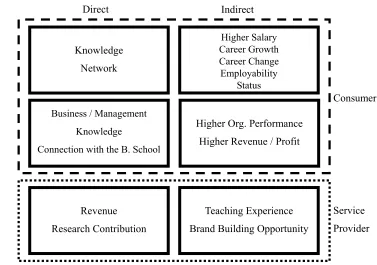
In chapter 1 we have introduced the history and evolution of MBA education. Based on the available literature, we have shown in chapter 1 that MBA has become one of the most popular fields of study. It is important to note that potential MBA degree seekers could have a wide variety of backgrounds with respect to age, education, duration and type of work experience, gender, ethnicity and academic/scholarly orientation (knowledge). Also there are many different types MBA programs such as full-time, part-time, executive, distance learning etc. Above all the different universities and business schools offer programs with differences in content and the way it is taught. Fig.2.1 summarizes general attributes of MBA seekers, MBA programs and MBA providers. In Fig.2.1, the attributes listed under tangible are the ones easily amenable measurement and quantification. The ones listed under intangible are difficult to quantify and measure. From Fig.2.1, it is also clear that there could be several permutations and combinations with respect to the background of MBA seekers, types of MBA programs and the attributes of MBA providers. In other words, practically, MBA graduates would rarely represent a homogeneous population. Likewise their expectations from an MBA degree could also be very much different from one another. Fig.2.2 lists potential benefits for different stakeholders involved in MBA intervention. Please note that, for the sake of simplicity, we have not included government and other social actors in our stakeholder list. Among the stakeholders, MBA seekers and organizations employing MBA graduates are considered consumers of MBA programs and the business schools, program providers, are considered as the service providers.
Figure 2.1 Characteristics of Individual (MBA-seeker), Program (MBA-program) and the Business School (MBA-provider)
Figure 2.2 Potential Benefits for the Stakeholders: Individuals (MBA-seeker), Employers (MBA-user) and Business Schools (MBA-provider)
Individual
Program
Business School
Individual Difference Knowledge Experience Motivation Age
Education Gender Experience (Duration) Experience (position/responsibility)
Experience (industry type) Ethnicity / Nationality
Full-time Part-time Executive In-company Distance Learning
Global (geographically distributed) Specializations
Brand Size
Age Faculty Expertise
Location
Curriculum Structure Teaching Style
Tangible Intangible
Employers
Higher Salary Career Growth Career Change Employability
Status Knowledge
Network
Business / Management Knowledge
Connection with the B. School
Teaching Experience Brand Building Opportunity Revenue
Research Contribution
Direct Indirect
Individual
Business School
Higher Org. Performance Higher Revenue / Profit
Consumer
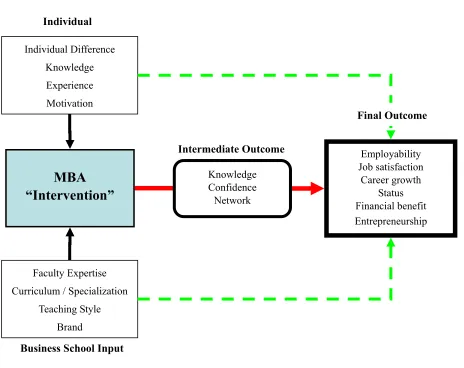
Figure 2.3 Model showing the relationship between MBA intervention, intermediate outcome and final outcome
2.2. Research Questions
The key research questions of this study are:
How does an MBA degree impact one’s job related income in Japan? Is it different from that of the US?
In addition, what influence an MBA degree has on one’s career with respect to employability, job satisfaction, confidence in business related knowledge and skills, career growth and status?
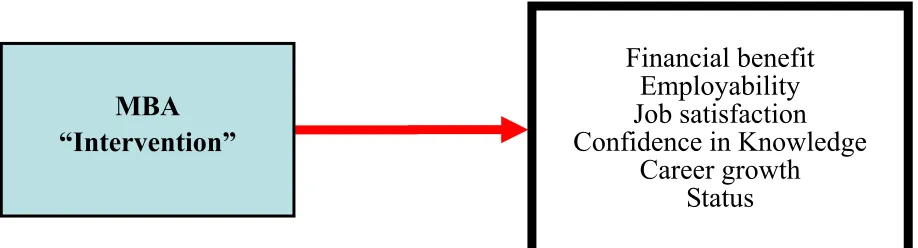
Based on our research question we have decided to trim down our model (given in Fig.2.3) to a simple one representing our research question. It is shown in Fig.2.4.
Knowledge Confidence Network
Employability Job satisfaction
Career growth Status Financial benefit Entrepreneurship
Faculty Expertise Curriculum / Specialization
Teaching Style Brand Individual Difference
Knowledge Experience Motivation
MBA
“Intervention”
Intermediate Outcome
Final Outcome Individual
Figure 2.4 Simplified causal model
2.3. Hypotheses
Based on the model given in Fig.2.4, we have developed hypotheses on the effectiveness of MBA for the selected variables such as financial benefit, employability, job satisfaction, confidence in knowledge and skills, career growth and status.
2.3.1. Financial benefit
According to the Corporate Recruiters Survey by GMAC (2005), the estimated average starting annual salary for MBA graduates in 2005 is US $78,040 in the USA and the estimated starting annual salary for MBA graduates in 2002 was US $72,021, US $73,859 in 2003, US $77,066 in 2004.
The survey reports that in 2005 the estimated total compensation package for a MBA recruit is US $96,657 including annual salary and additional compensation. 84% of the respondents companies offer a benefit package as a part of their additional compensation, 61% of the companies offer a moving allowance and 56% offer a performance based bonus.
The estimated starting salary for MBA differs significantly depending on the size of organizations. In 2005, it estimated as US $73,191 in organizations with fewer than 500 employees, US $79,546 in organizations with 500-9,999 employees and US $80,499 in organizations with more than 10,000 employees. The report notes that the effective salary difference between small and large organizations may not be significant when the total compensation is considered.
According to the U.S. News & World Report issued in April 2005, the actual average starting salary of MBA graduates is US $77,000 in the US and people at pre-business school stage earn US $50,000 (Ewers, 2005). It shows US $27,000 difference between MBA graduates and people without MBA in their starting salaries. We can see that the actual amount is almost similar to the estimated average starting annual salary stated above, which shows relevancy between the estimation and the actual situation. In addition, Business Week (2002) found salary improvements of MBA graduates after they
Financial benefit
Employability
Job satisfaction
Confidence in Knowledge
Career growth
Status
complete an MBA program (Baruch, Bell & Gray, 2005). In addition, many other research findings also support the fact that MBA intervention increases salary of the graduates. (Business Week, 2002; Hegarty, 1996; Schofield, 1996). MBA not only helps improve income of those graduated from the leading US business schools but also gives significant income improvement on graduates from lower prestige business schools (Baruch & Peiperl, 2000). Forrester (1986) research, using data from London Business School graduates, showed clear increase in income between post-MBA and pre-MBA in the ranging of 24 to 45%. In summary, there is enough evidence to support that MBA graduates from a number of business schools improve their income after the program (Business Week, 2002; Hegarty, 1996; Judge et al., 1995: Schofield, 1996).
There are several research findings in the areas of vocational behavior, economics and education showing the direct relationship between higher education and financial benefit (Grubb, 1992; Rumberger & Thomas, 1993; Thomas, 2000 & 2003). Some other studies directly point to the relevance of majoring in quantitative subjects like business and engineering in gaining higher income jobs (Rumberger & Thomas, 1993; Thomas, 2000, 2003).
There are also other research findings indicating the irrelevance of MBA intervention on salaries. A study, conducted with the graduates of University of California, Berkeley and schools in the Midwest in the US, found very little relationship between MBA and current salaries for people from upper middle class or higher socioeconomic backgrounds (Dreher, Dougherty, & Whitely, 1985; Pfeffer, 1977). At the same time Pfeffer (1977) found a positive relationship between starting salary and MBA intervention irrespective of socioeconomic origin. But noted a positive relationship was found with current salary only in the case of those who are not coming from upper-middle and upper class backgrounds (Pfeffer, 1977). Dreher, Thomas & Whitely (1985) tested the generalizability of findings reported by Pfeffer (1977) and found that MBA graduates receive higher starting salary irrespective of socioecomonic origin (Dreher, Thomas & Whitely, 1985).
Hypothesis 1 - Financial benefit:
MBA degree will help graduates earn higher salary compared to people without an MBA.
2.3.2. Employability
A degree in any subject is a signal to the prospective employer that the holder can perform a certain job better than others who do not posses a similar qualification. In fact one could argue that a degree is only a noisy signal to the prospective employers because the ability of an individual to perform depends, in addition to the education, on many other moderating factors such as intelligence, self-efficacy, etc. However, it is a general belief that a degree will improve the employability of graduates holding that degree.
rapidly growing in the last 20 years, the demand for MBA graduates are falling (Pfeffer & Fong, 2002). The Economist (1996) reported that “In Britain, the demand for MBA graduates has fallen by a fifth since 1991.” An article published in the Economist (1996) also mentioned that more MBA graduates and about the same or lower demand would minimize the advantage MBA graduates enjoyed with respect to ease of finding a job. Furthermore jobs in business management are not restricted to only those who graduated from business schools unlike other professions such as law, medicine, accounting, architecture and some types of engineering (Pfeffer & Fong, 2002). Anybody who wishes to work, for example, as a business consultant to enter the profession even without any business credentials (Pfeffer & Fong, 2002). Moreover there are a large number of successful companies in the world without many MBA graduates working for them (Ewers, 2005).
However, many researchers argue that better job opportunity is one of most important reasons why people go for an MBA degree (Baruch, Bell & Gray, 2005). Hawksley states that “the most recognized reason to pursue an MBA is to improve job opportunities” (Hawksley, 1996). A survey conducted in the US and the UK in the late 1990s concluded that there was a significant improvement in MBA graduates’ ability to have better career growth and higher position in the corporate hierarchy (Baruch & Peiperl, 2000; Dreher & Chargois, 1998; Judge et al., 1995: Schofield, 1996).
Hypothesis 2– Employability:
It is easier for MBA graduates to find a suitable job or to change their employer than those who do not have an MBA.
2.3.3. Job satisfaction
Another component of job satisfaction is the person-job fit (Erdogan & Bauer, 2005). Many researchers have noted that personality and education will play a major role in it (Elton & Smart, 1988; Fricko & Beehr, 1992; Smart, Elton, & McLaughlin, 1986). These researchers have used Holland’s theory of vocational behaviour to relate education to vocational preferences (Elton & Smart, 1988; Fricko & Beehr, 1992; Smart, Elton, & McLaughlin, 1986; Holland, 1985 & 1997). Many researchers have also noted that over time consistent educational and work experience would lead to favourable job related outcomes (Barak & Rabbi, 1982; Gottfredson, 1977; Nafziger, Holland, Helms, & McPartland, 1974; Oleski & Subich, 1996). Overall, MBA education will lead to higher levels of job satisfaction due to higher income and higher degree of person-job fit.
Hypothesis 3– Job satisfaction:
MBA holders are more satisfied with their jobs in terms of position, income and job as a whole than people without MBA.
2.3.4. Confidence in knowledge and skill
In general one would gain confidence in ones own knowledge and skills through formal education, self-learning and on the job experiential learning. Confidence is also improved when one sees positive results of his own actions. Education in general and MBA education particular is one way of achieving business related knowledge and skills. Management literature is full of discussions on how effective MBA intervention in improving knowledge and skills of graduates (Gordon & Howell, 1959; Pfeffer & Fong, 2002; Mintzberg, 2005). According to Gordon and Howell, one of the major problems of American business schools in the 1950s was that they did not emphasize problem-solving skills and students were "trained" for their first jobs rather than "educated" for their whole career (Gordon & Howell, 1959). Prompted by these criticisms business schools in the US had initiated a strong move towards research based curriculum and were successful in doing so by heavily investing in research and faculty training through doctoral education. This research based tradition is still continuing for the last 30 to 40 years. However, many scholars now feel that the business schools have moved too far to the other extreme of the continuum and now slowly loosing its relevancy to the business world (Mintzberg, 2005, Pfeffer & Fong, 2002). According to Charan and Colvin MBA gives people more confidence to make decisions but does not really give people the competence to deal with the messy reality in which decisions are executed (Charan & Colvin, 1999). Mintzberg and Lample noted that business schools tend to give students the confidence to make decisions, but not the competence to deal with the messy reality in which decisions are executed (Mintzberg & Lample, 2001).
organization (Bailey & Ford, 1996). According to Byrne, MBA education not only prepares graduates for challenging business jobs but also it will prepare them for entrepreneurial ventures (Byrne, 1993). Business schools have been successful to teach business as they recognize that the world is becoming more diverse, dynamic, and complex and they are able to teach business to students based on these timely issues (Lorenzi, 2004).
Tyson, the dean of London Business School in the UK, in a recent paper, comment on the educational value of MBA (Tyson, 2005). According to her, “skills are practiced ability and they can be acquired through the repeated application of knowledge” (Tyson, 2005). She is pointing to the fact that the knowledge gained during the MBA intervention combined with actually using it in the business world will help graduates develop necessary business related skills. Tyson also noted that "business has always been action-oriented, and skills have always been fundamental to effective management". In addition she notes that "knowledge is executive base camp".
Jerry Jurgensen, chief executive officer of nationwide has said the following in a recent interview on Mintzberg's Managers Not MBAs book (Mintzberg, 2005): "I admit I have a bias. I have an MBA, and I believe that it helped me. It gave me the opportunity to look at a lot of cases, to determine what I believe, and to argue my point of view with others. That was extremely useful. There was great value in the process of studying the successes and failures of past businesses. Finally, it was most helpful to have faculty test and probe the quality of my analysis and reasoning" (Lewicki, 2005).
In order to respond to the rapid changes in the world from 1960s up to 2000s, business schools began to strengthen their strategies by changing programs beyond traditional methods of MBA education. Tyson notes, most business schools now offer advanced courses on, in addition to the basic functional subjects, organizational psychology (Tyson, 2005). It allows students to have opportunities to learn more about employees and organizational environment issues (Tyson, 2005). Going through such MBA programs, students can prepare themselves and increase their confidence in knowledge and skills for the actual business world (Baruch, Bell, & Gray, 2005).
Hypothesis 4 – Confidence in knowledge and skills:
The knowledge and skills people gain from MBA program give them more confidence at work than those who do not have an MBA degree.
2.3.5. Career growth
revolutionary concepts like boundaryless careers (Sulliva, 1999; Arnold, 2001). It is a well established fact that education in general and graduate and professional education in particular will help people with upward or lateral mobility (Baruch, Bell, & Gray, 2005). Business education is no exception (Baruch, Bell, & Gray, 2005). In the past many people attended an MBA program at a top ranked business schools and experienced positive impact on their careers (Baruch, Bell, & Gray, 2005). Even today, many graduates from a variety of MBA programs have been experiencing positive impact at work (Altman & Simpson, 2002; Baruch & Peiperl, 2000; Dreher & Chargois, 1998). However, recently many scholars started questioning the extent of correlation between graduate business education and career success (Pfeffer & Fong, 2002).
According to GMAC survey in 2004, part-time and executive program students are so called “career enhancers”. They earn MBA degree to cultivate their current career (GMAC, 2005). Full-time students tend to be “career switchers” and earn MBA degree to change their career directions. The survey shows that the career switchers expect more benefits from gaining MBA degree, and career enhancers experience benefit from gaining MBA degree sooner. In terms of career change comparing to pre-MBA and post-MBA, 54% of the respondents of GMAC survey are changing industries and 46% are remaining in their current industry. In a GMAC report the following five reasons were given as the most important motivators for potential MBA seekers (GMAC, 2005):
1. to enhance their career by increasing chances of promotion where they currently work and also by allowing them to remain competitive
2. to use MBA to help them switch from their current operational area to a specific new one, 3. to pursue the goal of starting their own business
3. to make a transition from a non-business undergraduate degree 4. to prepare to seek international employment
Even though the above motivators may be applicable to all MBA seekers, the relative importance may vary amongst full-time students, part-time and executive students. For example, full-time students give more importance to a changing career direction (GMAC, 2005)
MBA is not a passport to the CEO’s office straight from the business school (Lewicki, 2005). Lewicki stresses the importance of enriching MBA education with on the job experiential learning in attaining higher position and career growth. Thorough multiple jobs and assignments, one can contextualizes the theoretical learning from the business school in the business (Lewicki, 2005).
Hypothesis 5 – Career growth:
2.3.6. Status
The term status means different things to different people. In this study we define status as one’s ability within his/her organization to be independent and participate in the decision making process. MBA degree is a signal, to the organization and to the supervisors and managers using MBA graduates, indicating the capability of an individual to effectively perform business related tasks. There are not many reports in the literature looking at the influence of MBA intervention on status in general and decision making autonomy in particular.
Also status could be influenced by the position of the employee in the social network. Research by Dreher and others note that MBA intervention will give an excellent opportunity to increase social capital through networking (Dreher, Dougherty & Whitely, 1985). Social capital will help job seekers get obtain jobs with higher degree of freedom and independence. Also it has been noted that MBA graduates in general show a high need for achievement and autonomy and also organizations show a willingness to hire MBAs into jobs needing high degrees of autonomy and independence (Harrell & Alpert, 1979). Another interesting aspect of authority and independence comes from the fact that a majority of MBAs work for large corporations and they will provide ample opportunities to MBAs to be roles of autonomy (Harrell & Alpert, 1979). Autonomy and opportunity to participate in decision making will give employees a feeling of self-worth and higher status. Following this line of thinking we have postulated the following hypothesis:
Chapter 3 Research Method
3.1. Introduction
The purpose of this study is to understand the effectiveness of MBA “intervention” with respect to its tangible and intangible benefits to people who had undergone an MBA study program compared to people without an MBA degree. One could define a number of qualitative and quantitative measures to study the effectiveness of an educational intervention like that of an MBA. Therefore our approach is, this study being preliminary in nature, to keep the scope, initially, of this study as broad as possible. In this chapter we will describe the characteristics of the sample and our research approach.
3.2. Research Methodology
Effectiveness of MBA intervention on financial benefit and other MBA outcomes such as employability, job satisfaction, confidence in knowledge and skills, career growth and status was evaluated using questionnaires specifically developed for this purpose. The questionnaires were sent out to three groups of subjects. These are a group consisting of people with MBA, a group consisting of people without an MBA and the third group consisting of supervisors who could tell us their opinion about the performance of employees with and without an MBA degree.
3.2.1. Control variables
As explained in chapter 2 that there are several factors which will influence job related outcomes other than MBA intervention. Therefore in addition to the main independent variable, MBA, we have included other independent variables such as country of work, gender, year of work experience, educational background, previous business education, current position, current work hour, and current organizational size as control variables in this study. In a recent study, on the impact of HRD programs on job related outcomes, it was noted that independent variables such as gender, family background, age, work experience, level of initial education, variables relating to career motivation, economic sector and level of competencies acquired through education influence job related outcomes (Witziers, 2003). Even though all the above factors might be important to be considered in this study, lack of time and resources forced us to limit the control variables to gender, country of work place, educational background, size of the organization and total work experience.
Educational background and previous business education are also included as control variables for the following reasons. The relationship, for example, between college major and job satisfaction has been explicitly examined in some studies such as the ones by Elton & Smart (1988), Fricko & Beehr (1992), and Smart, Elton & McLaughlin (1986). There are also several findings pointing to the fact that good education and stable work experience would lead to positive vocational outcomes (Barak & Rabbi, 1982; Gottfredson, 1977; Nafziger, Holland, Helms, & McPartland,1974; Oleski & Subich, 1996). In a recent study Witziers (2003) emphasized the relationship between job related outcomes and competencies acquired through education.
Factors such as current position, total years of work experience and size of the organization are also included as control variables. Recent studies show that current position and total years of work experience influence job outcomes such as income (Witziers, 2001 & 2003). Some other studies pointed to the relationship between the size of the organization and job related income (e.g. Meesters, 1992). Gabbay (1999) showed clearly the positive relationship between work experience and job related income for Dutch managers working in large corporations. All these findings clearly lead to the strong influence of work experience on job related income. According to human capital theory (Mincer, 1974), workers gain knowledge and skills through on the job experience and because of that age or tenure could be an indicator of skill level (Brown, 1989; Acemoglu & Pischke, 1998 & 1999). These studies also indicated the positive relationship between worker’s experience and productivity, thus higher job related income (Brown, 1989; Acemoglu & Pischke, 1998 & 1999).
We have also considered country of work place as one of the necessary control variables because we did not restrict respondents from a single country or region and it was important for us to know the country or region of respondents’ work place to eliminate the influence of country of work on the impact of MBA intervention. In addition, we were also interested in generalizing our findings by using respondents from various countries and regions. Another reason was that one of our initial research objectives was to compare effectiveness of MBA intervention between countries or regions to have further insights into the impact of MBA intervention. Age is not included as a control variable since age and total years of work experience have strong correlation (r = .947, p < .001), making it redundant as a control variable.
and the US. According to a GMAC survey (2005), reputation of a business school was an important consideration in student’s decision in selecting the business school. According to Byrne (1993), brand of the business school can affect graduates ability to find jobs in big corporations. Also we know from other studies (Meesters, 1992; Witziers, 2003) that big corporations pay higher than smaller ones. Pfeffer and Fong (2002) also noted the importance of school brand in obtaining high paying jobs.
It should be noted that there are other factors, such as individual difference, motivation to learn and perform and position in the social network, which would influence job related outcomes. In this study we have not included them due to lack of time and resources. It is planned to incorporate them in future studies.
3.2.2. Scales
The independent (and control) variables are categorized and coded to the followings: MBA: 1 = MBA holder, 0 = People without MBA
MBA brand: 1=MBA from the top 100 business schools, 0= MBA from other business schools and people without MBA
Country: 1 = Japan, 2 = the US, 3 = Other Gender: 1 = Male, 2 = Female
Educational background: 1 = Bachelor’s degree, 2 = Master’s degree, 3 = Doctor’s degree Previous business education: 1 = Business, 0 = others
Current work hour: 1 = Full-time, 0 = Part-time
Position: 1 = Regular Employee, 2 = Manager, 3 = Junior Manager, 4 = Senior Manager 5 = General Manager, 6 = Director, 7 = Vice President, 8 = CEO
Year of work experience (years): 1 = 1-5, 2 = 6-10, 3 = 11-15, 4 = Above 15
Organizational size (number of staff): 1 = 1-10, 2 = 11-100, 3 = 101-1,000, 4 = 1,001-10,000 5 Above 10,000
A five-point Likert scale ranging from 1 to 5, 1 being strongly disagree to 5 being strongly agree was employed to examine employability, job satisfaction, confidence in knowledge and skills, career growth and status. Current annual gross income represents financial benefit. Financial benefit was coded as shown follows:
1 = Under 400, 2 = 400-699, 3 = 700-999, 4 = 1,000-1,199
5 = 1,200-1,399, 6= 1,400-1,599, 7 = 1,600-1,799, 8 = More than 1,800 (x100 US$)
3.3. Description of the Sample
We have collected self reported questionnaire responses from two different sample groups. They are namely, working people with MBA degree and people without MBA degree. The sample consists of individuals with 1 to 25 years of work experience and most of them are either working in Japan or in the US. We have also collected data from people with or without MBA degree but in a supervisory role. This group was asked about their impression on the performance of people with and without an MBA degree. Questionnaires were randomly distributed to all three groups, people with MBA, without MBA and people in supervisory roles in organizations. We have contacted about 100 people in Japan, 600 in the US and 50 people in other countries, in total approximately 750 including all the three groups. The questionnaires were sent out by email and were asked to send the completed responses back to a specific email address. In the email that we had sent out, it was clearly mentioned that no information related to the personal identity of the respondents will neither be extracted from the email response nor be kept in our computer after this study. Data was gathered in a period of about 3 months starting from the beginning of July to early October, 2005. 108 completed responses were returned; 36 from MBA holders, 50 from people without MBA, and 22 from superiors. The response rate was approximately 15 %. Descriptions of the respondents for MBA holders and people without MBA are explained below with the Tables from 3.1.A to 3.1.J and for superiors are explained with the Table 3.1.K to 3.1.N.
MBA holders and people without MBA Country of work place
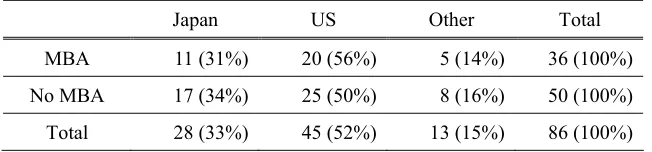
Majority of the respondents are working either in Japan or the US. As far as the rest, 2 responses in the MBA category (MBA) are from Germany, one from Italy, one from UAE and one from India. In the group of people without MBA (No MBA), number of respondents from China, Brazil and the UK were 5, 2 and 1 respectively. The country of work place does not represent the nationality of the respondents. The details are in Table 3.1.A.
Table 3.1.A
Japan US Other Total
MBA 11 (31%) 20 (56%) 5 (14%) 36 (100%) No MBA 17 (34%) 25 (50%) 8 (16%) 50 (100%) Total 28 (33%) 45 (52%) 13 (15%) 86 (100%)
Gender
Table 3.1.B
Male Female Total
MBA holder 24 (67%) 12 (33%) 36 (100%) No MBA 24 (48%) 26 (52%) 50 (100%) Total 48 (56%) 38 (44%) 86 (100%)
Age
The average age of MBA holders is 34.4 and that of people without MBA is 29.4. The total average age of all the respondents is 31.5. There are respondents in their late 40s and 50s, however respondents they are included under the category of "Above 40" because above 45 years of age are relatively few. The details are in Table 3.1.C.
Table 3.1.C
21-25 26-30 31-35 36-40 Above 40 Total
MBA 1 (3%) 11 (31%) 9 (25%) 8 (22%) 7 (19%) 36 (100%) No MBA 13 (27%) 23 (47%) 7 (14%) 2 (4%) 4 (8%) 49 (100%) Total 14 (16%) 35 (41%) 15 (18%) 11 (13%) 10 (12%) 85 (100%)
Number of years of total work experience
The average number of years of work experience of MBA holders is 10.0 and that of people without MBA is 6.3. The average year of total work experience of all the respondents is 7.8. The details are in Table 3.1.D.
Table 3.1.D
1-5 6-10 11-15 Above 15 Total
MBA 9 (26%) 10 (29%) 11 (31%) 5 (14%) 35 (100%) No MBA 28 (56%) 14 (28%) 5 (10%) 3 (6%) 50 (100)
Total 17 (20) 28 (33) 14 (16) 8 (8) 86 (100)
Educational background
Table 3.1.E
Bachelor Master Doctor Total
MBA 31 (86) 4 (11) 1 (3) 36 (100) No MBA 41 (82) 7 (14) 2 (4) 50 (100) Total 72 (84) 11 (13) 3 (3) 86 (100)
Previous Business education
In the case of people without MBA, previous business education is defined as any formal business degree received and in the case of MBA holders any other formal business degree other than MBA. In both the groups, more than half the respondents majored in a subject other than Business. The details are in Table 3.1.F.
Table 3.1.F
Business Other Total
MBA 10 (28) 26 (72) 36 (100) No MBA 17 (34) 33 (66) 50 (100) Total 27 (31) 59 (69) 86 (100)
Current position
While 60% of respondents with MBA have stated their position as regular employee, 87% of people without MBA reported their current position as regular employee. The highest position reported by people without MBA is senior manager and that for people with MBA is chief executive officer (CEO) although it is highly possible that positions are called differently in each organization. The details are in Table 3.1.G.
Table 3.1.G Regular
employee Manager
Junior manager Senior manager General manager Director Vice
president CEO Total
MBA 21 (60%) 8 (23%) 2 (6%) 1 (3%) 2 (6%) 0 (0%) 0 (0%) 1 (3%) 35 (100%) No MBA 40 (87%) 5 (11%) 0 (0%) 1 (2%) 0 (0%) 0 (0%) 0 (0%) 0 (0%) 46 (100%)
Current work hour
Full-time is defined as more than 40 hours work per week and part-time is defined as less than 40 hours per week. 92% of both MBA and people without MBA are working full-time and 8% in the both groups are working part-time. The details are in Table 3.1.H.
Table 3.1.H
Full-time Part-time Total
MBA 33 (92%) 3 (8%) 36 (100%) No MBA 46 (92%) 4 (8%) 50 (100%) Total 79 (92%) 7 (8%) 86 (100%)
Current organizational size
The answers were self reported by the respondents. Respondents were asked to select a size range where the respondents are currently working. The details are in Table 3.1.I.
Table 3.1.I
1-10 11-100 101-1,000 1,001-10,000 Above
10,000 Total
MBA 5 (14%) 3 (8%) 7 (19%) 9 (25%) 12 (33%) 36 (100%) No MBA 6 (12%) 5 (10%) 14 (28%) 8 (16%) 17 (34%) 50 (100%) Total 11 (13%) 8 (9%) 21 (24%) 17 (20%) 29 (34%) 86 (100%)
MBA brand
Among the 36 MBA holders, 16 (46%) of them completed MBA from the top 100 full-time global MBA programs and 19 (54%) of them had MBA from other business school. There is one missing answer. The details are in Table 3.1.J.
Table 3.1.J
Top 100 MBA Other MBA Total
16 (46%) 19 (54%) 35 (100%)
Superiors
Country of work place
Table 3.1.K
Japan US Other Total
13 (59%) 7 (32%) 2 (9%) 22 (100%)
Organizational size
The answers were self reported by the respondents. Respondents were asked to select a size range where the respondents are currently working. The details are in Table 3.1.K.
Table 3.1.L
1-10 11-100 101-1,000 1,001-10,000 Above 10,000 Total
0 (0%) 5 (23%) 2 (9%) 11 (50%) 4 (18%) 22 (100%)
Position
Half of the superiors are in managers and many are positioned in other roles than ones mentioned in our category. The details are in Table 3.1.L.
Table 3.1.M
Manager Junior
manager Director
Vice
president CEO Other Total
12 (55%) 1 (5%) 0 (0%) 0 (0%) 1 (5%) 8 (36%) 22 (100%)
Number of MBA graduates
81% of superiors had from 1 to 10 MBA holders in the last 10 years, and 1 person answered 20 and another person answered 30. The average number of MBA holders is worked with them is 7. The details are in Table 3.1.M.
Table 3.1.N
1-5 6-10 11-15 Above 15 Total
10 (45%) 8 (36%) 2 (9%) 2 (9%) 22 (100%)
3.4. Data collection
respondents. A brief description of this study including the purpose, organizations involved in this study, anonymity issue and return email address were stated at the beginning of the questionnaire sheets.
In early September, 2005, in addition to some earlier contacts in the US, we have distributed the questionnaires to current part-time MBA students of a large south western state university in the US. We have expected most of the part-time MBA students would be in the sample group of people without MBA since most of them were working full-time and had at least a Bachelor’s degree. Since we asked many of our contacts to distribute the survey, we were not able to count the exact number of people who have received the questionnaires.
3.5. Measurement
We have used self reporting survey based questionnaires and prepared in such a way that it could be completed in 5 to 10 minutes. Although response rate can often be very low for surveys, carefully prepared questionnaires have been widely acknowledged as an effective research method in the area of behavioral sciences (Baruch & Leeming, 2001).
As mentioned earlier, we had three different groups of respondents. People with MBA, people without MBA and a group consists of superiors who would be able tell there opinion about MBAs and people without MBA. In the questionnaires used for the superiors’ group, we asked about superior’s perception on the differences between MBA holders and people without MBA in relation to job related performance. Typically these superiors who completed the questionnaire had 1-30 people with MBA worked for them in the last 10 years. The educational background of the superiors was also included in the questionnaire because it might be possible that their view of people with MBA might be influenced by their educational background. However, we realized this issue in the last phase of data collection and out of the total 22 responses we could get only 6 responses with educational background included in their answers. Therefore, educational background of superiors is not considered in this study due to insufficient information.
MBA holders and people without MBA
when translating the questionnaires into Japanese to avoid any mistranslation which might change the original meanings. Before finalizing the items in the questioner, we have tested the questionnaire with several individuals. We have also conducted a small pilot study to see the clarity and meaningfulness of the items from the point of view of potential respondents. A five-point Likert scale ranging from 1 to 5 was used, 1 being strongly disagree to 5 being strongly agree.
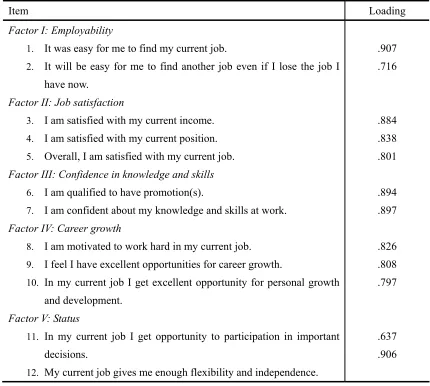
After collecting more than 80 responses, we have conducted exploratory factor analysis of the 17 items using Principle Component Analysis as the extraction technique with Varimax rotation technique. Analyses using 3 to 8 pre-fixed factors were tried and 5 factors yielded the best result after rejecting 5 items out the total 17 items. Only factors with loading more than .60 were included. Table 3.2 gives the item descriptions and factor loading of the 5 selected factors.
Table 3.2 Factor analysis: MBA holders and people without MBA
Item Loading Factor I: Employability
1. It was easy for me to find my current job.
2. It will be easy for me to find another job even if I lose the job I have now.
.907 .716
Factor II: Job satisfaction
3. I am satisfied with my current income. 4. I am satisfied with my current position. 5. Overall, I am satisfied with my current job.
.884 .838 .801 Factor III: Confidence in knowledge and skills
6. I am qualified to have promotion(s).
7. I am confident about my knowledge and skills at work.
.894 .897 Factor IV: Career growth
8. I am motivated to work hard in my current job. 9. I feel I have excellent opportunities for career growth.
10. In my current job I get excellent opportunity for personal growth and development.
.826 .808 .797
Factor V: Status
11. In my current job I get opportunity to participation in important decisions.
12. My current job gives me enough flexibility and independence.
.637 .906
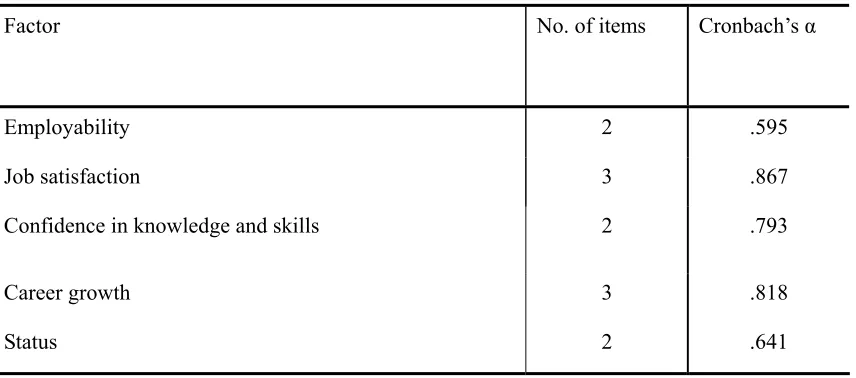
given in Table 3.3 For the analysis, missing answers were replaced with the average value of the answers belonging to each item.
Table 3.3 Reliability: MBA holders and people without MBA
Factor No. of items Cronbach’s α
Employability 2 .595
Job satisfaction 3 .867
Confidence in knowledge and skills 2 .793
Career growth 3 .818
Status 2 .641
Superiors
There were 14 items asked supervisors to compare job related performance between MBA holders and people without MBA. This questionnaire was developed also based on Handbook of Training Evaluation and Measurement Methods (third edition) (Phillips, 1997) and both English and Japanese questionnaires were used. Same as what we did for MBA and people without MBA, we paid special care for the language translations since the original questionnaire was in English and tested the questionnaire with some individuals to make sure the clarity and meaningfulness of the items. They were also asked about country of work place, size of the organization, job position and the number of MBA graduates who are currently working with them (or worked for them in the past 10 years). Due to the small number of total respondents, we do not distinguish these variables for analysis. The details are given in Tables from 3.1.J to 3.1.M. Data was collected using a five-point Likert scale ranging from 1 to 5, 1 being strongly disagree to 5 being strongly agree. We qualitatively analyzed the data collected from superiors by looking at what percentage of respondents agre