Privacy-Preserving Matchmaking via Threshold PSI
Yongjun Zhao and Sherman S.M. Chow Department of Information Engineering The Chinese University of Hong Kong, Hong Kong
{zy113, sherman}@ie.cuhk.edu.hk
Abstract. Private set-intersection (PSI) allows a client to only learn the intersection between his/her set C and the set S of another party, while this latter party learns nothing. We aim to enhance PSI in different dimensions, motivated by the use cases of increasingly popular online matchmaking — Meeting “the one” who possessesall desired qualities andfree from anyundesirable attributes may be a bit idealistic. In this paper, we realizeover-(resp.below-) threshold PSI, such that the client learns the intersection (or other auxiliary private data) only when|C∩ S| > t (resp. ≤ t). The threshold corresponds to tunable criteria for (mis)matching, without marking all possible attributes as desired or not. In other words, the matching criteria are in a succinct form and the matching computation does not exhaust the whole universe of attributes. To the best of our knowledge, our constructions are the very first solution for these two open problems posed by Bradleyet al.(SCN ’16) and Zhao and Chow (PoPETS ’17), without resorting to the asymptotically less efficient generic approach from garbled circuits.
Moreover, we consider an “outsourced” setting with a service provider coordinating the PSI execution, instead of having two strangers to be online simultaneously for running a highly-interactive PSI directly with each other. Outsourcing our protocols are arguably optimal — the two users performO(|C|)andO(1)decryptions, for unlocking the private set Cand the outcome of matching.
1 Introduction
to compute the intersection of their respective private sets. For example, two companies can learn their common customers without sharing their databases. Yet, apart from hiding elements not in the set of the counter-party, PSI offers no more control. For example, if two companies do not share a high number of common customers, they may not bother to discuss any joint campaign, not to say revealing common customers to each other.
Recently, Zhao and Chow [45] initiated the study of PSI with access struc-ture,i.e., the client gets to know the intersection set only if its private set satisfies some policy specified by the server. As a special case, they consider threshold PSI which only reveals the intersection if its size is greater than a threshold agreed upon by both parties. While the vision of incorporating a sharing strategy to a vanilla PSI is great, the actual protocols realized by Zhao and Chow are a bit unsatisfactory. Without resorting to non-standard cryptographic assumptions, their designalways leakshow many elements “contribute” to the satisfaction of the policy. Specifically, for threshold policy, they only achieved a weaker vari-ant under the name ofthreshold private set-intersection cardinality(t-PSI-CA), which always leaks the size of the intersection to the client, regardless of whet-her it is greater than the threshold or not. They argue that this level of privacy protection is enough for applications such as online dating, where the matching criteria are sensitive, and revealing the degree of overlapping even in a misma-tch is a nice feature. Nevertheless, threshold PSI protocol based on standard cryptographic assumptions remains open [45].
From the perspective of finding common interests, the “over threshold” policy discussed above appears to be a natural choice. Yet, considering matchmaking or access control in general, it is equally interesting to realize the complementary notion ofbelow-threshold private set-intersection. To unify the notion, we rename the two functionalities above as t≥-PSI[45] andt≤-PSI[9] respectively.
The benefits of supporting both kinds of policy are apparent. For the da-ting application, using t≥-PSI alone only allows the search for desired quality. Users probably also want to match with others who do not possess a certain set of undesired attributes (e.g., smoking, over-gregarious). Witht≤-PSI, users can simply make sure that their number of occurrence is below an acceptable thres-hold instead of specifying every possible negated attribute (e.g., non-smoking). Unfortunately,t≤-PSIis also posed as an open question [9].
1.1 Technical Overview
In this work, we unify the design of both protocols. We take an innovative approach to realize both kinds of threshold PSI protocol, without the deficiency of leaking the intersection size. To better understand the difficulty of hiding the intersection size, we briefly go over the design of the protocol of Zhao and Chow [45]. Roughly, it works by generating “secret shares” to the participant. With enough shares, the intersection set can be “unlocked”. The difficulty faced by Zhao and Chow in hiding the size of the intersection appears to be the following. On one hand, there should be a way to quickly identify what shares can be used to reconstruct the unlocking key; for otherwise one needs to exhaust an exponential number of possible combinations among the shares. On the other hand, it reveals the number of matches,i.e., the size of the intersection, via the counts of how many individual shares are potentially useful.
Interestingly, we got inspiration from an apparently even more restrictive variant of PSI proposed by Carpentet al.[11], which is known as existential PSI (orPSI-Xin short).PSI-Xonly outputs a single bit instead of a set. The output denotes whether the two private sets have any overlapping. As minimal as it may seem, we “upgrade” our own design ofPSI-Xprotocol (ΠX, see Appendix B
for more details) to encode more information. Specifically, we build a protocol ΠePSI-CA which we callencrypted private set-intersection cardinality (ePSI-CA).
In this design, cardinality is no longer an unintended leakage but intentionally encrypted. This provides a basis useful for realizing the threshold functionality. WithePSI-CA, we obtain at≥-PSIprotocol by a simple modification of our t≤-PSIprotocolΠt≤-PSI. Underlying both designs is a technique for computation
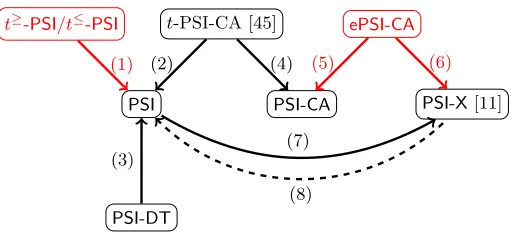
over encrypted data realized byoblivious polynomial evaluation (OPE) [24]. Appendix C summarizes the relations between the PSI variants.
1.2 Merits of Our Constructions
Our proposed protocols are of both practical and theoretical interest. From the efficiency perspective, the complexities of our constructions are linear in the set sizen. This beats the classical garbled circuit approach that uses sort-compare-shuffle network with O(nlogn) complexity [30], as well as recent advancement that achieves almost linear (namelyω(n)) complexity [43].
From the design perspective, we demonstrate how to use old techniques in the PSI literature in a novel way to realize PSI functionalities for which no efficient solutions are known. Specifically, many PSI protocols use OPE to encode the private set [13,24,27,28,37,45]. Another idea of realizing PSI, which uses Bloom filter related techniques, was first brought by Donget al.[20] and has a shorter history [16, 17, 45]. To the best of our knowledge, for the first time, we combine these two techniques in a non-trivial way. It also suggests a new avenue for addressing other open problems such as private set projection (PSI-P) [11] with linear computational complexity. See Appendices A and B for more details.
Lastly, our protocols remain conceptually simple and modular. Both deside-rata greatly simplify the security analysis. Future more efficientFePSI-CA
1.3 Outsourced Threshold PSI Protocols
Although our protocols are asymptotically efficient, they still rely on public-key techniques, which are difficult to avoid and are not as efficient as symmetric-key primitives (say, hash functions or blockciphers) which often fail to provide algebraic structure for fancy functionalities. PSI protocols are also often highly interactive. For our motivating applications of matchmaking, the interactive na-ture and the heavy use of public key cryptography hinder the practical usage of PSI.
Our final contribution lies in outsourcing the heavy computations in our protocols to an oblivious cloud. Beyond simply following the trend of leveraging cloud service, we believe that most of the popular mobile applications nowadays, no matter privacy-preserving or not, are often executed with the help of some central servers operated by the service provider. As such, outsourcing PSI not only leads to better efficiency, but also better matches the business model and the usage habits of mobile applications. In the context of using threshold PSI for matchmaking, the user who is a potential match may respond to notification of the smartphone from time to time but would not permanently stay online. It is thus desirable to have the service provider which arbitrates between two users instead of having two users interact with each other directly.
While there is a server which mediates requests between clients, the privacy guarantees of PSI still carry over. In other words, with our outsourced extensions, not only we can enjoy the richer functionalities on top of the privacy provided by our PSI protocols, but also a more deployable protocol which is closer to the real-world model from the perspective of both users and the service provider.
1.4 Related Work
Freedmanet al.[24] first proposed a PSI protocol based on oblivious polynomial evaluation. Dong et al. [20] proposed PSI protocol using oblivious transfer ex-tension. Subsequently, more efficient PSI protocols using similar technique are proposed [38, 39, 42, 44].
A branch of work aims to restrict the output or the leakage of PSI. PSI-CA/PSU-CA reveals only the (approximate) cardinality of the intersection/union but not the set itself [3, 6, 15, 16, 18, 21–24, 29, 37]. Some [3, 15, 18, 22] also use Bloom filter, but none of them can be directly adapted toΠePSI-CA(see Sec. 4).
Atenieseet al.[4] and D’Arcoet al.[14] proposed (input-)size-hiding PSI. Brad-leyet al.[9] further enable imposing an upper bound on the input set size.
PSI is also considered in the outsourced setting [1, 33–35]. These works do not support advanced threshold set operations.
Concurrent Work.Recently, Hallgrenet al.[26] also study over-threshold private set-intersection with application in ride sharing. They also consider se-curity in the semi-honest model, but the complexity of their protocol is of or-der O(n2), which is worse than the garbled circuit approach. A very recent
off(C∩S)for arbitrary functionf. Our protocols are specific protocols which are more efficient (O(n)vs.O(n2)). Also, our design naturally allows the revelation
of some auxiliary data (e.g., a session keyK encrypting the contact information for matchmaking) when the threshold policy is satisfied. Extending their two-party computation approach [12] in a straightforward way to also support this feature requires a more complicated functionf.
Pinkas et al. [43] introduce new variants of Cuckoo hashing technique to reduce the number of gates from O(nlogn) to ω(n) in garbled-circuit based PSI protocol. It is possible to adapt their solution to compute threshold PSI by adding an additional circuit. Therefore, the overall complexity will be at least ω(n).
2 Preliminary
For a finite set S, |S| denotes its size and s ←−$ S denotes picking an element uniformly at random from S. We denote [i] = {1, . . . , i}. We write {si}n as a shorthand for the setS={s1, . . . , sn}ofnelements. We drop the subscriptnif it
is clear from context. We useFρto denote an ideal functionality that implements the protocolρ, and useΠρ to denote a concrete construction of the protocolρ.
A probability ensemble indexed byI is a sequence of random variables in-dexed by a countable index set I, namely, X ={Xi}i∈I where Xi is a random
variable. Two distribution ensembles X ={Xn} andY ={Yn} are computati-onally indistinguishable, denoted by X ≡c Y, if for every PPT algorithm D, there exists a negligible functionnegl(·)such that for every n∈N,
|Pr[D(Xn,1n) = 1]−Pr[D(Yn,1n) = 1]| ≤negl(n).
2.1 Additive Homomorphic Encryption and Oblivious Polynomial Evaluation
We will use CPA-secure additive homomorphic encryption (AHE)(KeyGen,Enc, Dec) such as Paillier encryption [41]. Given two ciphertexts Enc(pk, m0) and Enc(pk, m1), one can efficiently compute their addition Enc(pk, m0 +m1) =
Enc(pk, m0)⊕Enc(pk, m1)without using private keysk. For a constantc, given one ciphertextEnc(pk, m), one can easily computeEnc(pk, c·m) =c⊙Enc(pk, m). To build an OPE protocol, a polynomial p(x) can be hidden by encryp-ting its coefficients a0, . . . , ak. With these encrypted coefficients, denoted by
Enc(pk, p(·)), anyone holding a plaintext s can compute an encryption of p(s)
as Enc(pk, a0)⊕(Enc(pk, a1)⊙ s)⊕ · · · ⊕(Enc(pk, ak)⊙sk)using addition and
constant-multiplication.
2.2 Bloom Filters
All bits in the array are initialized to0. To insert an element x ∈ S, x is hashed by the k hash functions to get k index numbers. All the bits at these indexes in the array are set to 1, regardless of its original value. To check if an item y is in S, y is hashed by the k hash functions to get k indexes. If any of the bits at these indexes is 0, we conclude that y is certainly not in S (no false negative). Otherwise, y is probably in S. So it incurs only a small fraction of false positives. The upper bound of the false positive probability [8] is:ϵ=pk
(
1 +O (
k p
√
lnm−klnp m
))
wherep= 1−(1−m1)kn.
If we set the false positive rate to be less than a thresholdϵ0, it can be shown
that the length of the bit array sizemshould be at leastm≥nlog2e·log21/ϵ0,
where e is the base of the natural logarithm. Equality is achieved when k = (m/n)·ln 2 = log21/ϵ0. We will stick with these optimal values as follows: the
false positive probability isϵ = 2−ω(logλ) so that ϵ is negligible in the security
parameterλ. As a result, k=ω(logλ)andm=k·nlog2e.
2.3 Secure Two-Party Computation
We use the simulation-based security definition for two-party computation (2PC). More details can be referred to [25]. A 2PC protocolπcomputes a function that maps a pair of inputs to a pair of outputsf :{0,1}∗×{0,1}∗→ {0,1}∗×{0,1}∗, where f = (f1, f2). For every pair of inputsx, y ∈ {0,1}∗, the output-pair is a
random variable (f1(x, y), f2(x, y)). The first party obtains f1(x, y)and the
se-cond party obtains f2(x, y). When fi(x, y) = ⊥, it means party i’s output is
empty.
We first considerstatic semi-honestadversaries, which can control one of the two parties and assumed to follow the protocol specification exactly. However, it may try to learn more information about the input of the other party.
In the semi-honest model, a protocolπis secure if whatever can be computed by a party in the protocol can be obtained from its input and output only. This is formalized by the simulation paradigm. We require the view of a party in a protocol execution to be simulatable given only its input and output. The view of the partyiduring an execution ofπon input(x, y)is denoted byViewπ
i(x, y) = (w, ri, mi1, . . . , mit), wherew∈(x, y) is the input ofi,ri isi’s internal random coin tosses, andmij denotes thej-th message that it received.
Definition 1 (Semi-honest Model). Protocol π is said to securely compute a deterministic function f = (f1, f2) in the presence of static semi-honest ad-versaries if there exists PPT algorithmsSim1,Sim2 such that
{Sim1(x, f1(x, y))}x,y c
≡ {Viewπ
1(x, y)}x,y,
{Sim2(y, f2(x, y))}x,y ≡ {c Viewπ
2(x, y)}x,y.
parties interact with each other and use trusted help. When constructing a pro-tocolπwhich uses a sub-protocol that securely computes some functionalityF, we consider that the parties run π and use “ideal calls” to a trusted party for computingF. Upon receiving the inputs from the parties, the trusted party com-putes F and sends all parties the corresponding output. After receiving these outputs back from the trusted party, the protocolπcontinues. By the composi-tion theorem [10], any protocol that securely implementsF can replace the ideal calls toF.
3 PSI with Threshold Policy
3.1 Definitions
We begin with the formal definitions of two private set-intersection with thres-hold policy functionalities in the literature. We remark that for the second party P2 (often referred to as “server” in the literature), its output is always ⊥: it
never knows whether the threshold policy is satisfied or not. For the first party P1(often referred to as “client” in the literature), if its output is not⊥, it knows
that the threshold policy is satisfied; however, when its output is ⊥, it cannot distinguish whether that is due toC∩S=ϕ, or|C∩S|not meeting the policy. Here, the input of the parties includes the size of the input set of the counter-party. This is the standard practice in the multi-party computation literature, when the protocol considered is not “input-size hiding” [40]. We leave “input-size hiding” variants of threshold PSI as a future work.
Definition 2 (Below-Threshold Private Set-Intersection (t≤-PSI) [9]).
Let S andC be subsets of a predetermined domain, the functionality Ft≤-PSI is:
((C,|S|),(S,|C|))7→
{
(C∩S,⊥) if|C∩S| ≤t
(⊥,⊥) otherwise
Definition 3 (Over-Threshold Private Set-Intersection (t≥-PSI) [26,45]).
Let S andC be subsets of a predetermined domain, the functionality Ft≥-PSI is:
((C,|S|),(S,|C|))7→
{
(C∩S,⊥) if|C∩S| ≥t
(⊥,⊥) otherwise
To realize bothFt≤-PSI andFt≥-PSI, our key insight is to leverage a primitive
calledencryptedPSIcardinality(ePSI-CA) functionality in a novel way. This new functionality is formally defined below.
Definition 4 (Encrypted PSICardinality (ePSI-CA)). LetS andC be sub-sets of a predetermined domain. Let (pk1,sk1)be a public / secret key pair of a homomorphic encryption scheme. The functionalityFePSI-CAis:
We choose to single outFePSI-CAnot only for a more compact presentation of
Πt≤-PSIandΠt≥-PSI, but also because we believe thatFePSI-CAitself is an
interes-ting primitive. In Appendix B, we use it to construct the most efficientexistential private set-intersection protocol (PSI-X) andprivate set projection [11] to date. Motivations and applications of these two protocols can also be found in Appen-dix B. and [11].
3.2 Intuition
We describe ourΠt≤-PSI andΠt≥-PSIconstructions in the(FePSI-CA,FPSI)-hybrid
model, while the concrete instantiation forFePSI-CAis deferred to Sec. 4. In what
follows, we use t≤-PSI as an example to showcase how it is readily achievable withFePSI-CAas a building block. The crux of our novel combination ofePSI-CA
and oblivious polynomial evaluation (OPE) is that we use OPE to transform Enc(pk1,|C∩S|)(namely, the output ofFePSI-CA) to an encryption of a session
key K if and only if |C∩S| ∈ [0, t]. If|C∩S|∈/ [0, t], the evaluation result is random and contains no information aboutK.
In more details, P2 re-randomizes the encrypted cardinality obtained from FePSI-CA by a random number r as Enc(pk1,|C∩S|+r) such that P1 knows
nothing about |C ∩ S| after decrypting Enc(pk1, |C ∩ S| + r), but can obliviously evaluate a polynomial at |C∩S|+r. To be more specific, P2 first
prepares a polynomial p(·) whose roots are r, r+ 1, . . . , r+t, and chooses a random symmetric key K. P2 then sends encrypted coefficients of polynomial
p′(·) =r′·p(·) +Kunder its own public keypk2. In this way, whenP1obliviously
evaluates p′(·)at|C∩S|+rvia additive homomorphism (See Section 2.1), the result will be an encryption of K if and only if |C∩S| ≤ t; otherwise it will be encrypting a random number that reveals no information aboutK (because r′·p(·)serves as a one-time pad encryptingK, whileP2 only usedr′ once).
To retrieve the value ofp′(·)at|C∩S|+r(which is either the correct session keyK or a random value) in plaintext from the previous OPE (which produces Enc(pk2, p′(|C∩S|+r)),P1randomizes this ciphertext (denoted byEnc(pk2, K′)
in Step (4) in Fig. 1) simply by further blinding it with a random numberr′′and asksP2for decryption. WhatP1eventually obtains is a valueK′which equals to
Kif and only if|C∩S| ≤t. ThisK′ serves as a token showing if the intersection
|C∩S| is below the threshold. The final step is to have P1 and P2 engage in
a normalΠPSI, in which P1 andP2 uses CK
′
={ci||K′} and SK ={si||K} as
input respectively. HenceP1can recover the intersection if it possesses the same
keyK′=K.
3.3 t≤-PSI Protocol:Πt≤-PSI
We describe our t≤-PSIprotocolΠt≤-PSI in the(FePSI-CA,FPSI)-hybrid model in
viewed as the result of double encryption: firstly encrypt|C∩S|using a one-time padr, and then further encrypt under pk1.
In Step (3), the polynomialp′(·)andp(·)are both degree(t+ 1), so the number of coefficients to be encrypted and transmitted is(t+ 2)∈O(|C|+|S|). Also, note that these coefficients are independent of the set S. Looking ahead, such independence allows outsourcing computation to a cloud server.
In Step (4),P1needs to blind the evaluation of polynomial by a one-time padr′′
similar to whatP2 does in Step (2). This is because ifP2 seesK′ in plaintext,
it can check ifK =K′ and learn a single bit of informationb = (|C∩S|> t), violating the requirement of Ft≤-PSI. Recall that in Definition 2, the output of
P2is always⊥.
In Step (6), the session key K′ serves as a token that allows P1 to obtain the
intersection when the threshold policy is satisfied viaFPSI on transformed sets.
Yet, when the output of FPSI is ⊥, P1 does not know whether it is due to
C∩S = ϕ, or the threshold policy is not met. Meanwhile, P2 learns nothing
fromFPSI, thus satisfying the requirement of Ft≤-PSI.
Πt≤-PSI Input:P1’s input is (C,|S|).P2’s input is (S,|C|).
1. [invoke FePSI-CA] P1 sends his AHE public keypk1 toP2. Next, they invoke an ideal execution ofFePSI-CA where the input ofP1 is(C,|S|,(pk1,sk1))and the input ofP2 is(S,|C|,pk1)).P2 then getsEnc(pk1,|C∩S|)).
2. [P2 masks encrypted|C∩S|]P2randomly choosesrand homomorphically computesEnc(pk1,|C∩S|+r).
3. [P2prepares encrypted polynomials]P2prepares a polynomialp(·)whose roots arer, r+ 1, . . . , r+t.P2also chooses a random numberr′ and a random symmetric keyK. Finally, P2 sends encrypted coefficients of the polynomial p′(·) =r′·p(·) +Kunderpk2, as well asEnc(pk1,|C∩S|+r).
4. [P1 evaluates polynomial]P1 decrypts the received ciphertext to get|C∩ S|+r, and obliviously evaluatesp′(·)at point|C∩S|+r. Denote the result byEnc(pk2, K′).P1 blinds it with randomnessr′′into Enc(pk2, K′+r′′) and asksP2 for decryption.
5. [P2 decrypts]P2 decryptsEnc(pk2, K′+r′′)and returnsK′+r′′toP1, who recoversK′.
6. [invokeFPSI]P1andP2 invoke an ideal execution ofFPSIwhere the input of P1 is(CK
′
,|S|)and the input of P2 is(SK,|C|), whereCK ′
={ci||K′}and
SK={si||K}.
7. [output]P1outputs whatever it receives in the previous step (stripping away the trailing keyK′ if the output is non-empty).
3.4 Analysis
By the correctness of FePSI-CA functionality, P2 obtains Enc(pk1,|C ∩S|) in
Step (1). If the size of intersection|C∩S| ≤t, then in Step (3) the polynomial p(·)will be evaluated to0, and hence the evaluation ofp′(·)will beK′ =K. On the other hand, if|C∩S|> t, the evaluation ofp′(·) will beK′ ̸=K. Then by the correctness of FPSI,P1 obtainsC∩S if and only if|C∩S| ≤t.
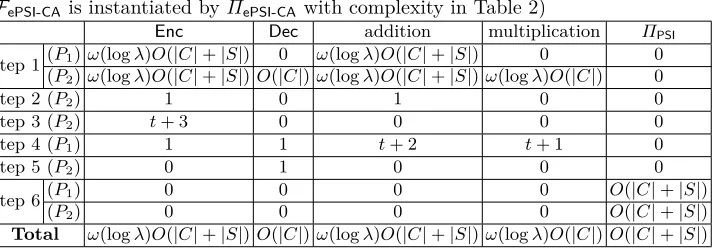
For efficiency, since public-key operations are much slower than symmetric-key ones, we only count the total number of public-symmetric-key operations, including encryption, decryption, and homomorphic operations (addition and multiplica-tion by a constant). We assume usingΠePSI-CAto instantiateFePSI-CAin Step (1).
The number of public-key operations of ΠePSI-CA will be presented in Table 2.
We also assume an efficient ΠPSI construction. Note that the state-of-the-art
ΠPSI protocols [38, 42, 44] under the semi-honest model require linear
compu-tation and communication complexities. Table 1 summarizes the overall result, showing that theΠt≤-PSI protocol features linear computational complexity.
Table 1: Computational Efficiency ofΠt≤-PSI
(FePSI-CAis instantiated byΠePSI-CA with complexity in Table 2)
Enc Dec addition multiplication ΠPSI
Step 1(P1) ω(logλ)O(|C|+|S|) 0 ω(logλ)O(|C|+|S|) 0 0 (P2) ω(logλ)O(|C|+|S|)O(|C|)ω(logλ)O(|C|+|S|)ω(logλ)O(|C|) 0
Step 2 (P2) 1 0 1 0 0
Step 3 (P2) t+ 3 0 0 0 0
Step 4 (P1) 1 1 t+ 2 t+ 1 0
Step 5 (P2) 0 1 0 0 0
Step 6(P1) 0 0 0 0 O(|C|+|S|)
(P2) 0 0 0 0 O(|C|+|S|)
Total ω(logλ)O(|C|+|S|)O(|C|)ω(logλ)O(|C|+|S|)ω(logλ)O(|C|)O(|C|+|S|)
Theorem 1. Assuming the existence of CPA-secure additive homomorphic en-cryption scheme(KeyGen,Enc,Dec), whose plaintext space is super polynomial in the security parameter; then the protocol Πt≤-PSI in Fig. 1 securely implements the functionality Ft≤-PSI in Def. 2 in the presence of semi-honest adversaries under the (FePSI-CA,FPSI)-hybrid model.
Proof. Simulating the view of P1 using Simt
≤-PSI
1 .The view of P1 contains
the messages sent byP2: Enc(pk1,|C∩S|+r),pk2,Enc(pk2, p′(·))(encryptions
of coefficients of the polynomialp′(·)),(K′+r′′), the fixed empty output⊥from
FePSI-CA, as well as the output from FPSI.
LetAbe a probabilistic polynomial time (PPT) adversary corrupting party P1. We design a PPT simulator Simt
≤-PSI
1 that invokesAby playing the role of
the honest partyP2andSimt
≤-PSI
FPSI. The simulator will generate a view indistinguishable from a hybrid one. Simt≤-PSI
1 has different simulation strategies for different outputs ofP1. We
con-sider two disjoint cases. (1) the output is ⊥:
1. Given input((C,|S|, t),⊥),Simt≤-PSI
1 invokesA on input(C,|S|, t), and
re-ceivesA’s first messagepk1. 2. Simt≤-PSI
1 plays as the trusted party and emulates the ideal calls toFePSI-CA.
3. Simt≤-PSI
1 generates a random public/private key pair (pk2,sk2), a random
symmetric keyK, just as whatP2 will do, and continues the protocol
emu-lation by sending encryptions of0 underpk2 (representing an all-zero poly-nomial) instead of encryption of coefficients of the polynomial p(·). It also encrypts a random numberR1 under pk1 to emulate the intended message
Enc(pk1,|C∩S|+r).
4. WhenAobliviously evaluates the zero-polynomial at pointRin Step (4), the result will be an encryption of 0 under pk2. A randomizes this encryption of 0 into an encryption of r′′ and asks Simt≤-PSI
1 for decryption. Sim t≤-PSI 1
returns yet another random valueR2.
5. Finally,Awill computeK′ =R2−r′′(̸=Kwith overwhelming probability).
ThenAuses(C′={ci||K′},|S|)as input to theFPSI functionality emulated
bySimt≤-PSI
1 , who will return⊥as intended.
We argue that this simulated view is indistinguishable from the real one. First, notice that the simulated messages Enc(pk1, R1)and R2, are identically
distributed as the real onesEnc(pk1,|C∩S|+r)and K′+r′′. It is because, in the real protocol,ris selected byP2 uniformly at random andK′ is distributed
uniformly at random when|C∩S|> tthanks to the randomnessr′ in Step (3). Second, notice that the other simulated messages are encryptions underpk2. Any
distinguisher of these two views can be transformed to an adversary breaking CPA-security of the encryption scheme.
(2) the output is a subset Cˆ⊆C whose size |Cˆ| is less than t:
Simt1≤-PSIworks as the previous case, except in Step (4) it decrypts the ciphertext
to getr′′. In Step (5) it computesK′=R2−r′′, converts the setCˆ intoCˆK
′ by appendingK′ to each element inCˆ. Finally, it usesCˆK′ to emulate the output
ofFPSI forA.
This simulated view is indistinguishable from the real view because every-thing is the same as the other case with the only exception being the output ofFPSI.
Simulating the view of P2 using Sim t≤-PSI
2 .
This part is easy becauseP2’s view contains onlyEnc(pk1,|C∩S|)fromFePSI-CA, ⊥fromFPSI andEnc(pk2, K′+r′′). The third element is an encryption of a truly
random value (because r′′ is chosen by P1 uniformly at random), which can
reduction shows that any distinguisher who can distinguishEnc(pk1,|C∩S|)from Enc(pk1,0)can be used to break the CPA-security of the encryption scheme.
3.5 t≥-PSI Construction and Generalizations
To constructΠt≥-PSI, we modifyΠt≤-PSIin Fig. 1. The modification is simple and
straightforward: in Step (3),P2prepares a polynomial whose roots arer+t, r+ (t+ 1), . . . , r+ min(|S|,|C|), where the function min(x, y) returns the smaller value ofxandy. The rest of the protocol remains exactly the same. Note that the degree of this polynomial ismin(|S|,|C|)−t+1, which remains to beO(|S|+|C|), and hence the efficiency analysis in Table 1 also holds forΠt≥-PSI.
In general,P2 can specify the roots of the polynomial at will. For example,
the roots could be integers within a certain interval{r+a, r+ (a+ 1), . . . , r+b}. It means P1 only learns the intersection if|C∩S| falls within the range [a, b].
Further generalizing, we can change the criteria to be|C∩S| ∈ {m1, m2, . . . , mq}, i.e., an arbitrary set of numbers (a subset of even numbers, a subset of prime numbers, etc.) instead of consecutive numbers.
Proving the security of Πt≥-PSI (and its generalizations) just takes a very
straightforward adaption of Theorem 1 and thus we omit the repetitive details.
4 Encrypted PSI-Cardinality
Both ourΠt≤-PSI andΠt≥-PSI protocol heavily rely onFePSI-CA, which is a novel
variant ofPSIandPSI-CAprotocol in the literature. It is tempting to instantiate
FePSI-CAfromFPSI-CAby just adding encryption:P1andP2executeFPSI-CA, and
P1encrypts the output|C∩S|under its public keypk1, forwards the ciphertext
to P2. Yet, this approach leaks |C∩S| to P1 and hence does not satisfy our
Definition 4, namely,P1should output nothing but⊥.
One may instead wonder if some trivial extensions ofΠPSI-CAcan do. Yet, all
ΠPSI-CAprotocols that we are aware of proceed by transforming elements in the
two parties’ respective set via some one-way transformation, and let P1 count
the number of common elements in the transformed domain. If one follows this paradigm, it seems impossible to hide the number|C∩S|fromP1. After all, in FPSI-CA andFPSI, it is P1 who has non-trivial output while in FePSI-CA, it is P2
instead. Such inherent inconsistency suggests that new techniques are required to designePSI-CA.
4.1 ePSI-CA Protocol: ΠePSI-CA
Our construction is inspired by theexistential private set-intersection (denoted byFX) protocol by Carpentet al. [11]. We observe that the core of their pro-tocol is implementing an encrypted private membership test propro-tocol, a special case ofFePSI-CAwhereP1’s input set consists of a single element. Unfortunately,
Bloom filter. Here we only highlight our design principle. A detailed discussion ofFX is deferred to Appendix B.
Recall that a Bloom filterBFS encoding a setSsupports efficient
members-hip test by hashing the test elementxintoklocations usingkhash functions. If the value ofBFS at those locations areall“1”, we conclude thatx∈S. Namely,
the predicate “x∈S or not” is transformed to determining the number of “1”s.
P(x, BFS) =
{
1 x∈S
0 x /∈S
=
{
1 exactlyk “1”s in {BFS[h1(x)], . . . , BFS[hk(x)]} 0 less thank “1”s in{BFS[h1(x)], . . . , BFS[hk(x)]}
Suppose thatP2’s Bloom filter BFS is encrypted under its public-key pk2,
thenP1 can obliviously compute an encryption of the number of “1”s underpk2
by adding the ciphertexts of those k locations for element x. Let nX be such
number of “1”s, andenX be its encryption underpk2. Our task becomes how to
transformenX to an encryption of0ifnX∈[0, k−1]; or to an encryption of1if
nX =k. This task is similar to what we have in Sec. 3, in which we transform an
encryption of|C∩S|to an encryption of0if|C∩S| ∈[0, t]; or to an encryption of a non-zero number otherwise.
Fig. 2 gives the full details ofΠePSI-CA. Two notes are in order. In Step (1),
k = ω(logλ) and N = ω(logλ)|S|log2e, which are optimal values for a false positive rate ofϵthat is negligible in the security parameterλ(see Sec. 2.2). In Step (4),P1 can precompute or outsource this step since the polynomials pi(·)
is independent of the private setC.
4.2 Analysis
Regarding the correctness, in Step (3), the resulting ciphertext is encrypting an integer nˆi ∈ {ri, . . . , ri+k} because the sum consists of a random ri and
k encrypted numbers in {0,1}. For any element ci ∈/ S, P1 can only collect
less than k encryptions of “1” in Step (3) (otherwise a false positive of Bloom filter has occurred). Therefore, the polynomials pi( ˆni)will be evaluated to 0in the ciphertext domain in Step (5). On the other hand, for cj ∈ S, then the
polynomial evaluationpj( ˆnj) =k×(k−1)× · · · ×1 =k!. After normalizing by a factor of(k!)−1, the protocol output is an encryption of|C∩S|.
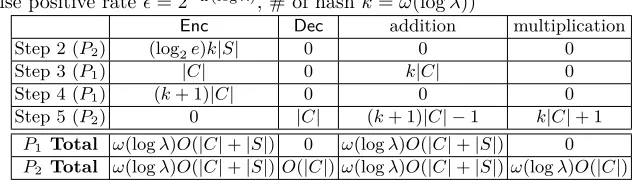
Next, we analyze the efficiency by counting the total number of public-key operations from Step (2) to Step (5). We assume that the false positive rate of Bloom filter is set to be ϵ = 2−ω(logλ), so k =ω(logλ). The other parameters
of Bloom filter are set to the optimal values accordingly. Moreover, we assume that Horner’s rule is applied in the evaluation ofpi(·)in Step (5), which requires
kadditions andkmultiplications for evaluating a degree-kpolynomial. Table 2 summarizes the result, which shows that the complexity of our construction is only linear in the set size.
ΠePSI-CA
Input:P1’s input isC,|S|, and an AHE key pair(pk1,sk1). P2’s input isS,|C|, and an AHE key pair(pk2,sk2).
1. [setup] The parties perform a secure coin-tossing sub-protocol to choose random seeds for Bloom filter hash functionsh1, . . . , hk:{0,1}∗→[N].
2. [P2 encrypts its Bloom filter] P2 builds an N-bit Bloom filter of his set Susingh1, . . . , hk, encrypts the bits of the Bloom filter underpk2, and sends the resulting encrypted bitse1, e2, . . . , eN toP1.
3. [P1 masks the query results] For each elementci∈C,P1 hashesciusing
thosek hash functions to obtain k indicesh1(ci), h2(ci), . . . , hk(ci). P1 cre-ates a ciphertextenˆi to be sent toP2 by homomorphically summing up all
ciphertexts at those indices (eh1(ci), . . . , ehk(ci)) and another ciphertext of a
randomly chosen numberri.
4. [P1 prepares encrypted polynomials]For alli,P1 encrypts underpk1 the coefficients of a degree-kpolynomialpi(x) = (x−ri)(x−ri−1)· · ·(x−ri−k+1).
P1 sends the encrypted coefficients ofpi(·)andenˆi toP2.
5. [output]P2decryptsenˆito getnˆi.P2obliviously evaluates(k!)−
1·
(∑ipi( ˆni))
via additive homomorphism. Outputs this encrypted result.
Fig. 2: EncryptedPSICardinality (ΠePSI-CA)
Table 2: Computational Complexity ofΠePSI-CA
(false positive rateϵ= 2−ω(logλ),# of hashk=ω(logλ))
Enc Dec addition multiplication
Step 2 (P2) (log2e)k|S| 0 0 0
Step 3 (P1) |C| 0 k|C| 0
Step 4 (P1) (k+ 1)|C| 0 0 0
Step 5 (P2) 0 |C| (k+ 1)|C| −1 k|C|+ 1
Theorem 2. Assuming the existence of a CPA-secure additive homomorphic encryption scheme(KeyGen,Enc,Dec), whose plaintext space is super-polynomial in the security parameter; then the protocolΠePSI-CAin Fig. 2 securely implements the functionalityFePSI-CAunder the semi-honest model.
Proof. We consider two corruption cases. Simulating the view of P1 using Sim
ePSI-CA
1 .The view of P1 only contains
its view in the coin-tossing protocol Viewcoin
1 , pk2, and (e1, . . . , eN)
(encrypti-ons of binary numbers under pk2). SimePSI-CA
1 can generate the first two using
theSimcoin
1 ,KeyGenalgorithm, while the third one can be simulated by
encryp-tions of zero due to the CPA-security of the encryption scheme. Assume for contradiction that there exists a distinguisherDfor the simulated view and the real view. One can build a distinguisher D′ breaking the CPA-security of the
encryption scheme. In the CPA-security game, D′ is given a public-key pk. D′
submits two vectors of plaintexts m0,m1 where m0 is an all-zero bit vector
as constructed in the simulated view, andm1 is the Bloom filter as in the real
execution.D′ receives a vector of ciphertextccorresponding to an encryption of either m0 or m1, and directly forwards (pk,c)to D. Finally, D′ outputs what
Doutputs. It is easy to see that the advantages ofDandD′ are the same.
Simulating the view of P2 using SimePSI2 -CA. The view of P2 can also be
simulated in an analogous way. In particular, the view ofP2 containsViewcoin2 ,
P1’s public-key pk1, encryptions of random numbers nˆi = ri +ni under pk2,
where ni is a number in[0, k], encryptions of coefficients of a polynomials pi(·)
whose roots areri, ri+ 1, . . . , ri+k−1underpk1. The first two elements can be
simulated using Simcoin
2 and KeyGen. Encryptions under pk2 can be generated
by encrypting random numbers, while encryptions under pk1 can be emulated
by encryptions of 0. By a similar argument as above, the simulation will be indistinguishable from the real view.
4.3 Reducing Communication Cost
We can reduce the communication cost of Step (2) (sendingN encryptions) and Step (4) (sendingk|C|encryptions) viaprivate information retrieval(PIR) and oblivious transfer (OT) respectively.
In Step (2), instead of transferring the whole encrypted Bloom filtere1, e2, . . . , eN
from P2 to P1, it suffices to obliviously transfer only a subset of those
cipher-texts which will be used byP1in Step (3). The exact number of such ciphertexts
depends onP1’s set size|C|and the number hash functionsk, and can be
upper-bounded byk|C|. In more detail, Steps (2) and (3) are replaced by the following steps: Firstly, P1 constructs a Bloom filter for its private set C according to
the hash functions specified in Step (1). ThenP1 records the indices of non-zero
bits of the Bloom filter, and uses these indices as input to k|C| instances of a single-server PIR protocol, in which P2 plays the role of the server holding a
LetPIR(N)be the communication cost of a single server PIR scheme whose database size is N. The overall communication cost of the above approach can be bounded by k|C| ×PIR(N). Since the state-of-the-art scheme [19] gives
PIR(N) ∈ O(log log(N)), the above approach incurs O(k|C|log log(N)) com-munication cost instead of O(N). The improvement can be significant when
|C| ∈o(log log(|S||S|)), namelyP2’s set size is much larger thanP1’s. Such an
unba-lanced set size setting is considered in the literature [36] recently.
The security of this optimization can be easily understood as follows: (1) With PIR optimization, P1 obtains fewer ciphertexts, so it will not harm the
security ofP2. (2)PIRalso guarantees thatP2does not know which ciphertexts
P1 has queried, just like the case without optimization in which P2 sends all
ciphertexts and lets P1 locally decides which of them are useful.
Conceptually, Steps (4) and (5) are executing|C| instances of the following variant of1-out-of-(k+1)OT. Namely,P2is holding an indexnˆiandP1is holding
a numberri and an array of(k+ 1)ciphertexts, the firstkbeingEnc(pk1,0)and
the last one beingEnc(pk1,1). In the end,P2obtains the( ˆni−ri)-th ciphertext.
A concrete instantiation of the above protocol using log(k+ 1) instances of1 -out-of-2 OT was given by Jarrous and Pinkas [31] as a part of theirbinHDOT protocol (Fig. 1 in [31]). After applying this technique, the communication cost of Step (4) is reduced from sending(k+1)|C|ciphertexts to executing|C|×log(k+1) 1-out-of-2 OT.
The benefits of reduced bandwidth using these two techniques come with a price. On one hand, the use of PIR significantly increases P2’s computational
cost. On the other hand, we will discuss how to outsource heavy computations of ΠePSI-CA to an untrusted cloud in the next section. Unfortunately, these two
optimizations do not seem to be compatible with our outsourcing techniques. Therefore, we choose to present ΠePSI-CA as in Fig. 2. The complexity analysis
ofΠePSI-CA is computed according to the protocol in Fig. 2, without taking the
above techniques into consideration.
5 Outsourcing Threshold PSI
Heavy computations in our protocols can be outsourced to an oblivious cloud. As discussed in Sec. 1.4, there are quite a few outsourcedPSIprotocols [1,2,33–35]. However, they only implement the basic PSI protocol with different degrees of outsourceability. None of them supports flexible control as ourt≤-PSIandt≥-PSI do. We extend thePSImodel by introducing an additional cloud server, denoted by CSP. This party serves as an oblivious helper in our ePSI-CA, t≤-PSI, and t≥-PSIprotocols: it helps P1 andP2 to perform some heavy computations but
remains oblivious to both P1 and P2’s inputs, and the protocol outcome. CSP
may share information withP1orP2(whenP2orP1is an adversary respectively)
5.1 OutsourcingΠePSI-CA
As the major building block of the bigger protocolsΠt≤-PSIandΠt≥-PSI, we first
discuss the outsourceability of each step ofΠePSI-CA.
Step 1 P1andP2run a coin-tossing protocol per execution to obtain the random
seed for hash functions. The seed should remain hidden fromCSP. Step 2 P2bitwise-encrypts its Bloom filter. Note that a Bloom filter is always a
binary string. As a result,P2 can prepare a set of ciphertext encrypting
“0”s and “1”s under pk2offlinebefore any protocol execution.
Recall that P2 uses anN-bit Bloom filter to represent its set. Hence it
suffices to let CSP prepare N0= 1+δ2 ×N encryptions of “0”s and the
same number N1 = N0 for “1”s. (δ is a small constant and N is the
same as that in Sec. 4.1). P2 permutes these ciphertexts according to a
pseudorandom permutation generated from a secret random seed, and uploads the(N0+N1)ciphertexts to theCSP.
These ciphertexts can be reused for different protocol executions as fol-lows: after obtaining the random seeds for the hash functions in Step (1), P2 locally generates its plaintext Bloom filter. For each bit BF[i], P2
randomly selects one of theN0(orN1) ciphertexts stored inCSP.P2
in-formsCSPits choice by sendingNindices in total, so thatCSP can pre-pare anencryptedBloom filter forP2. Note that onlyP2knows whether
these ciphertexts are “0”s or “1”s. HenceCSP remains totally oblivious to the content of the Bloom filter.
Step 3 P1hashes its elements according to the hash functions agreed in Step (1),
and obtainskindices for each element. P1 sends these locations toCSP
so thatCSP can homomorphically calculate the sum of these ciphertexts forP1. SinceCSP does not know the random seeds for the hash functions
generated in Step (1), these indices are completely random numbers from CSP’s point of view. Moreover, the random numberriis independent of
its corresponding elementci, soCSP can chooseri on behalf ofP1.
Step 4 The coefficients of the polynomialpi(x) = (x−ri)· · ·(x−ri−k+ 1)are
completely determined byri, which are now selected byCSP in Step (3).
Hence CSP can perform the whole Step (4).
Step 5 The polynomial evaluation step homomorphically computes encryption of ak·nˆik+· · ·+a1·nˆi1+a0 in the ciphertext domain using nˆi from
decryption. Note that we cannot revealnˆi=ni+ritoCSP becauseCSP
knows ri. The knowledge ofni leaks whether thei-th element is in the
intersection or not. Still, P2 can locally compute ciphertexts of aj·nˆij
for all j ∈[0, k], and then ask CSP to add them together (which saves some computation). In this way, P2 can still outsource (k+ 1)|C| −1
homomorphic additions toCSP.
Putting these together, Fig. 3 presents the outsourced ΠePSI-CA protocol.
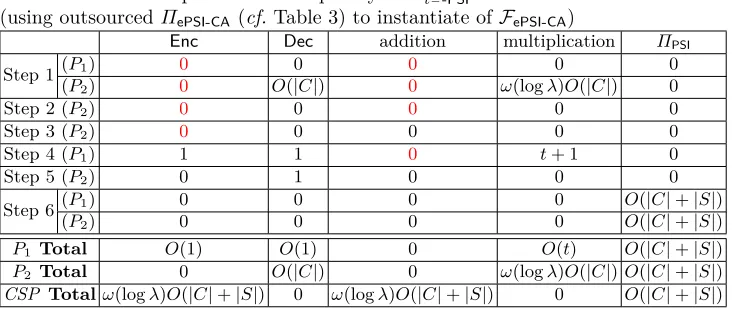
Table 3 shows its online computational complexity, with the saving highlighted in red. In short,P1can outsourceall public key operations to theCSP whileP2
Table 3: Online Computational Complexity of OutsourcedΠePSI-CA
(false positive rateϵ= 2−ω(logλ),# of hashk=ω(logλ))
Enc Dec addition constant-multiplication
Step 2 (P2) 0 0 0 0
Step 3 (P1) 0 0 0 0
Step 4 (P1) 0 0 0 0
Step 5 (P2) 0 |C| 0 k|C|+ 1
P1 Total 0 0 0 0
P2 Total 0 O(|C|) 0 ω(logλ)O(|C|)
CSP Totalω(logλ)O(|C|+|S|) 0 ω(logλ)O(|C|+|S|) 0
OutsourcingΠePSI-CA
Input:P1’s input isC,|S|, and an AHE key pair(pk1,sk1).
P2’s input isS,|C|, and an AHE key pair(pk2,sk2).CSP has no input. Offline Phase:
– P2 encrypts N0 zeros and N1 ones underpk2.P2 randomly permutes these ciphertexts according to some pseudorandom permutationπbefore uploading these(N0+N1)ciphertexts(˜e1, . . . ,˜eN0+N1)toCSP.
Online Phase:
1. [setup]P1andP2perform a secure coin-tossing sub-protocol to choose seeds for random Bloom filter hash functionsh1, . . . , hk:{0,1}∗→[N].
2. [P2 builds encrypted Bloom filter at CSP] P2 builds an N-bit Bloom filterBFS withk hash functions on its setS.P2 sends an ordered list ofN indices(idx1, . . . ,idxN) to CSP such that Dec(sk2,˜eidxi) =BFS[i]. TheseN
ciphertexts are denoted bye1, . . . , eN.
3. [P1 sends the query toCSP]For each elementci∈C,P1 hashesciusing
thosekhash functions to obtaink indicesh1(ci), h2(ci), . . . , hk(ci).P1 sends these indices toCSP.
4. [CSP forms encrypted queries] For each i, CSP creates a cipher-text enˆi by homomorphically summing up all ciphertexts at those indices
(eh1(ci), . . . , ehk(ci)) and another ciphertext of a random numberri.
5. [CSP prepares encrypted polynomials]For alli,CSPprepares encrypted coefficients of a degree-kpolynomialpi(x) = (x−ri)(x−ri−1)· · ·(x−ri−
k+ 1)underpk1. For alli,CSP sends the set of encrypted coefficients ofpi(·)
(e.g.,ak,i, . . . , a0,i) andenˆi toP2.
6. [P2 partially evaluates pi(·)] For each i, P2 decrypts enˆi to get nˆi, and
computes ciphertexts ofaj,i·nˆij for allj∈[0, k].P2 sends these ciphertexts toCSP.
7. [output]CSP homomorphically adds these ciphertexts intoeΣ.CSP
homo-morphically multiplieseΣwith the constant(k!)−1.CSP sends this encrypted
result toP2, who outputs it directly.
5.2 OutsourcingΠt≤-PSI
We use Πt≤-PSI as a showcase. It is very straightforward to apply the same
technique to Πt≥-PSI and its generalizations. Basically, most of the public key
operations (except decryption) can be outsourced.
Step 1 Invoking ofFePSI-CA. This can be (partially) outsourced as in Sec. 5.1.
Step 2 The blinding factor r is independent of P2’s private input. Hence the
computation of Enc(pk1,|C∩S|+r)can be delegated to the cloud. Step 3 The coefficients of the polynomialp′(·), like those in Step (4) of Fig. 2,
are again independent ofP2’s private input. Therefore the encryption of
coefficients can be outsourced to CSP, who will choose r′, K on behalf ofP2.
Step 4 Since only P1 knows sk1, CSP cannot decrypt Enc(pk1,|C ∩S|+r).
Moreover, the decryption result |C∩S|+rcannot be revealed toCSP because CSP knows r in Step (2). As a result, the evaluation of p′(·)
cannot be fully outsourced to CSP, but still P1 can locally compute
encryptions ofaj·(|C∩S|+r)j forj∈[0, t], as well asEnc(pk2, r′′), and
then ask CSP to homomorphically add them together. Step 5 Decryption cannot be outsourced.
Step 6 Intuitively outsourcingΠPSI requires outsourceable PSI. There are quite
a few potential solutions with different levels of outsourceability in the literature [1, 2, 33–35]. We refer readers to these papers for more details.
Putting these pieces together, Fig. 4 presents the outsourced below-threshold private set-intersection protocol. Table 4 gives the online computational complex-ity of outsourcedΠt≤-PSI.
Table 4: Online Computational Complexity ofΠt≤-PSI
(using outsourcedΠePSI-CA (cf.Table 3) to instantiate ofFePSI-CA)
Enc Dec addition multiplication ΠPSI
Step 1(P1) 0 0 0 0 0
(P2) 0 O(|C|) 0 ω(logλ)O(|C|) 0
Step 2 (P2) 0 0 0 0 0
Step 3 (P2) 0 0 0 0 0
Step 4 (P1) 1 1 0 t+ 1 0
Step 5 (P2) 0 1 0 0 0
Step 6(P1) 0 0 0 0 O(|C|+|S|)
(P2) 0 0 0 0 O(|C|+|S|)
P1 Total O(1) O(1) 0 O(t) O(|C|+|S|) P2 Total 0 O(|C|) 0 ω(logλ)O(|C|)O(|C|+|S|)
OutsourcingΠt≤-PSI Input:P1’s input is (C,|S|).P2’s input is (S,|C|). (CSP has no input.)
Offline Phase:
– Execute the offline phase of outsourcedΠePSI-CAand outsourcedΠPSI.
Online Phase:
1. [execute outsourcedΠePSI-CA]P1generates an AHE public/private key pair (pk1,sk1), sendspk1 toP2. NextP1,P2, andCSP engage in an execution of outsourcedΠePSI-CA where the input ofP1 is(C,|S|,(pk1,sk1))and the input ofP2 is(pk1, S,|C|).
2. [CSP masks encrypted |C ∩ S|] P2 sends the encrypted cardinality
Enc(pk1,|C∩S|)toCSP, who blinds it by a random numberrasEnc(pk1,|C∩ S|+r).
3. [CSP prepares encrypted polynomials]CSP prepares a polynomialp(·) whose roots arer, r+ 1, . . . , r+t.CSP also chooses a random numberr′ and a random symmetric keyK. Finally,CSP sends encrypted coefficients of the polynomialp′(·) =r′·p(·) +Kunderpk2, as well asEnc(pk1,|C∩S|+r) to P1.
4. [P1 partially evaluates polynomial] Let the decryption of Enc(pk1,|C∩ S|+r) bex.P1 homomorphically computes encryption of aj·xj underpk2 for each polynomial coefficientaj.P1 sends these ciphertexts toCSP. 5. [CSP completes polynomial evaluation]CSP homomorphically adds all
received ciphertexts fromP1. Denote the result byEnc(pk2, K′).CSP blinds it with randomnessr′′intoEnc(pk2, K′+r′′)and asksP2for decryption.CSP sendsr′′toP1 in plaintext.
6. [P2 decrypts]P2 decryptsEnc(pk2, K′+r′′)and returnsK′+r′′toP1, who recoversK′.
7. [execute outsourcedΠPSI]P1,P2, andCSP engage in an execution of out-sourcedΠPSI where the input ofP1 is(CK
′
={ci||K′},|S|)and the input of
P2 is(SK={si||K},|C|).
8. [output]P1outputs whatever it receives in the previous step (stripping away the trailing keyK′ if the output is non-empty).
6 Evaluation
For examining the performance of our proposed protocolsΠePSI-CAandΠt≤-PSI,
we conducted our experiment on a desktop machine running Windows 8.1, with 2 Intel(R) Core(TM) i5-4590 3.30GHz CPUs, and8GB RAM. We fix the size of the sets to be 100 and the thresholdt to be half of the set size, namely 50. as they should be sufficient for private-matching application in reality. Note that a dating site eHarmony recently only uses a couple questions that can be finished within 10 minutes to build up a model called “29 dimensions” to build up a user profile. The Bloom filter uses 30hash functions instantiated by SHA-256, implemented by the OpenSSL library1. This number of hash functions reflects a false negative rateϵ= 2−30and Bloom filter size4500bits. We note that one can
achieve better performance at the cost of a larger false negative rate by reducing the number of hash functions, which will lead to a smaller Bloom filter. We use existing Paillier encryption implementation2, and set the key length to be2048. Experiments were measured in seconds via wall clock runtime, and the reported runtimes are the average of100 trials.
We report the computation time of each step of ΠePSI-CA and Πt≤-PSI in
Table 5 and 6 respectively. The last column represents the online computation time forP1andP2in the outsourced setting. We do not include the running time
of the last step of Πt≤-PSI, because it relies on existing efficient ΠPSI protocol
(and its outsourced version), which is not part of the contribution of this paper. From the tables, we see that the outsourced version achieves a significant reduction in computation time for both P1 and P2. There are several ways to
further reduce it forP2. First, note that our protocols are easily parallelizable,
which means significant improvement can be achieved via multi-threading. Se-cond, recently Jost et al. [32] reported optimizations on Paillier cryptosystem that improves naïve implementation by a factor of over 150. Taking these into consideration, our constructions can finish within1s.
Table 5: Execution time ofΠePSI-CA(without the optimization of [32])
time (s) online (s) Step 2 (P2)
create Bloom filter 0.001 0
encrypt Bloom filter 60.404 0
Step 3 (P1) query Bloom filter 2.685 0.001
Step 4 (P1) encrypt polynomial 81.268 0
Step 5 (P2)
decryptions 1.322 1.322
evaluate polynomials 76.627 76.562
P1 Total 83.953 0.001
P2 Total 138.353 77.884
Table 6: Execution time ofΠt≤-PSI,t= 50(without the optimization of [32])
time (s) online (s) Step 1 (ΠePSI-CA)
P1 83.953 0.001
P2 138.353 77.884
Step 2 (P2) 0.026 0
Step 3 (P2) 1.363 0
Step 4 (P1) 1.325 1.324
Step 5 (P2) 0.013 0.013
P1 Total 85.278 1.325
P2 Total 139.755 77.897
7 Private Matchmaking
We discuss how to utilize our (outsourceable) protocols in our motivating sce-nario. The matchmaking application is set up as follows. The service provider acts asCSP. When each user joins the system, apart from generating a public key pair for AHE, they randomly pick a symmetric keyKand use it to encrypt their profile such as photos and contact. The system suggests a set of attributes (e.g., highly-educated, smoking). The user can mark a subset of attributes to be desired, and mark another disjoint subset to be undesired. The unmarked ones will be considered as “don’t care”, and they will not be part of the proto-col input. The user also picks two thresholds: to which is for the least number
of desired attributes, another one is tb which is for the maximum number of
undesired attributes.
A user Alice is considered to be matched with another user Bob if and only if she possesses of more thantodesired attributes specified by Bob, and possess
less thantb undesired ones. If matched, Alice should obtain the symmetric key
Kthat can decrypt the profile of Bob. We uset≤-PSIandt≥-PSIsimultaneously to implement the above functionality as follows: Bob splits the symmetric keyK into two parts by a simple(2,2)secret sharing based on XOR. Specifically, Bob picks a keyKo which is as long asK, and outputs bothKoandKb=K⊕Ko.
Bob puts all the undesired (resp. desired) attributes as the private set input of t≤-PSI(resp.t≥-PSI).
Users who joined the service can either be passively matched by others or actively request for matching. Here we discuss a typical protocol run from the perspective of an active user Alice. The service provider will pick a potential user, called a passive user Bob, and execute the PSI protocols on behalf. In other words, that is where the outsourced feature of our protocols comes into the play. Suppose the number of undesired attributes of this passive user Bob is below the thresholdtbafter runningt≤-PSI, and the number of desired attributes
If our protocols are used directly, the active user Alice will get the intersection of either kind of attributes. This may not be the most privacy-preserving way for doing matchmaking since Bob has no way to control about whether revealing any secret information (such as the profile) or not. Luckily, the intersection result can be easily removed from our protocols by removing the last step of performing the (keyed-)PSI. As a result, even Bob passed the matching criteria, Alice only obtains a secret key generated by Bob (from the second last step of the protocol). Here, we utilize the idea of secret transfer with access structure from Zhao and Chow [45]. This key will serve as a proof of criteria satisfaction. Upon the presentation of the aforementioned secret key, the user can decide to revealKb
(resp.Ko) or not. Such a decision can be done after the service provider executes
the PSI protocols on behalf of this passive user. If the interest is mutual,i.e., the requesting user also satisfies the search criteria of the “passive” user, the passive user can finally reveal the encrypted profile.
Two remarks are in order. First, note that even with the help of the service provider who mediates the requests between two users, the outsourced PSI pro-tocols are not entirely non-interactive. For this, the service provider still needs to relay messages between the users. However, it matches with the workflow used by non-private matchmaking apps nowadays which the user cannot connect to another user until there are mutual interests. Second, some user may expect to assign different weightings to different attributes. A trivial approach is to repli-cate the attribute multiple times. Devising cleverer solutions which maintain a similar level of efficiency requires further twisting of our PSI protocols (perhaps by borrowing techniques from Zhao and Chow [45]). We left it as future work.
8 Conclusion
We propose efficient protocols for three important extensions of PSI, namely, en-crypted private set-intersection cardinality, over threshold private set-intersection, and below threshold private set-intersection. The last two provide affirmative answers to two open problems posed recently in the literature. All of our con-structions achieve linear computational complexity by utilizing and extending existing building blocks in a novel way. We prove that our constructions are se-cure against semi-honest adversaries. Our constructions provide useful building blocks to realize privacy-preserving online matchmaking.
Acknowledgement
We thank anonymous reviewers for suggesting the use of the technique in [31] to reduce communication cost.

![Table 5: Execution time of ΠePSI-CA (without the optimization of [32])time (s) online (s)](https://thumb-us.123doks.com/thumbv2/123dok_us/7985667.1324960/21.612.160.424.520.634/table-execution-time-pepsi-ca-optimization-time-online.webp)