Copyright to IJIRSET DOI:10.15680/IJIRSET.2015.0409150 9314
The Moulds, for Euclidean
Geometry
Quantization , and Relativity .
Markos Georgallides
Larnaca (Expelled from Famagusta town occupied by the Barbaric TurksAug-1974), Cyprus Civil-Structural Engineer (NATUA) , Athens
Email address:
[email protected]To cite this article:
Markos Georgallides. The Moulds of geometry and Relativity ,The Parallel Theoremand Physical World . Article [45] .
Abstract: The Quantization of Euclidean Geometry becomes
, In monad →through Mould of Space –Anti-space
in itself which is the material dipole in inner monad Structure as the Electromagnetic Cycloidal field
, Linearly
→ through Mould of Parallel Theorem , In Plane→ through Mould of Squaring the circle , and In Space (volume)→ through Mould of the Duplication of the Cube as analytically explained .Because of Geometers scarcity, I was instigated to republish this article and to locate the weakness of prooving this Axiom. Weakness createdthe Non-Euclid geometries which deviated GR in Space-time confinement, so ,not conceiving the beyond Planck`s existence, not explaining the WHY speed of light is constant, and thus the whole universe. In the manuscript is prooved that parallel postulate is onlyin Plane (three points only and not a Spherical triangle)based on the fourPostulatesfor Constructions, and now is proved to be a Theorem , where all properties ofEuclidean geometry compactly exist as theExtrema Quantizationonpoints, lines, planes, circlesand spheres. Projective, Hyperbolic and Elliptic geometry is proved to be an Extrema (deviations) in Euclidean geometry where on them Einstein's theory of general relativity is implicated approximately to the properties of physical space.The universally outstandingdenial perception thatProofby geometric logic only is inaccessible, is now contradicted. Furthermore consists the first order of conceiving the Geometric logic and knowledge , for the relative extended Physical world as in criticism. In Conclutions (9) is referred the Geometrical mechanism of composing the Spaces and the way of Quantization of Euclidean geometry to its constitutes i.e. from point , Segment , Plane , to Volume, as the Physical world elements , through Extrema Principle.It was attributedalso, by means of pure geometry alone → The Extrema in{[7.1] →Zeno`s Paradox , [7.2] → Dichotomy Paradox , [7..3] → Arrow Paradox , [7.4] → Algebraic numbers , [7.5] → Natural numbers}, and in{[7.6] →the Regular Polygons was measured the side of Heptagon , [7.8] → Trisection of angle by reducing the problem in monad Extrema type , even if the problem is not Plane ,[7.6.1] → the Doubling of the Cube , [7.8.2 ] →the special problem of Squaring the circle,giving number π andare shown the Moulds andthe Meters of Quantization of Euclidean geometryto the Physical world, and to Physics , based on the Geometrical logic alone , which is according to Pythagoras, → Unit is a Point without position while a Point is a Unit having position. [43] . It is a provocation to all scarce today Geometers and Mathematicians to conceive the scientific depth of this article.
Keywords: Parallel Postulate, Euclid Geometry and Relativity, Geometry and Physics
CONTENTS :
1.. Abstract : Page 01 11.. The Polygons Reward :Page 24
2.. Introduction : Page 02 12.. The doubling of the Cube: Page 25 – 34 3.. E-E Definitions – The Method : Page 02 13.. Extrema examples and Perspectivity : Page 26 4.. Types of Geometry : Page 0414.. The STPL Line-Cylinder : Page 33
5.. Respective Figures : Page 06 15.. The Trisection of any Angle : Page 35 6.. The Self Quantization of E-G : Page 13 16.. The Euclid Elements : Page 41
1. Introduction
Euclid‘s elements consist of assuming a small set of intuitively appealing axioms and from them, proving many other propositions (theorems). Although many of Euclid‘s results have been stated by earlier Greek mathematicians, Euclid was the first to show how these propositions could be fit together into a comprehensive deductive and logical system self consistent. Because nobody until now succeeded to prove the parallel postulate by means of pure geometric logic and under the restrictions imposed to seek the solution, many self consistent non-Euclidean geometries have been discovered based on Definitions, Axioms or Postulates, in order that non of them contradicts any of the other postulates of what actually are or mean.In the manuscript is proved that parallel postulate is only in Plane (three points only) andis based on the four Postulates for Constructions, where all properties of Euclidean geometry compactly exist as Extrema on points, lines, planes, circles and spheres. Projective, Hyperbolic and Elliptic geometry is proved to be an Extrema (deviations) [16] in Euclidean geometry where on them Einstein's theory of general relativity is implicated and calls a segment as line and the disk as plane in physical space.
It have been shown thatthe only Space-Energy geometry is the Euclidean, on primary and on any vector unit AB,(AB = The Quantization of points and of Energy on AB vector) on the contrary to the general relativity of Space-time which is based on the rays of the non-Euclidean geometries and to the limited velocity of light. Euclidean geometry describes Space-Energy beyond Plank´s length level as monas in Space and also in its deviations which are described as Space-time in Plank´s length level. Quantization is holding only on points and Energy [Space-Energy] ,where Time is vanished [PNS], and not on points and Time [Space-time] which is the deviationof Euclidean geometry. [21]
2. Euclid Elements fora Proof ofthe
Parallel Postulate (Axiom)
Axiom or Postulate is a statement checked if it is true and is ascertained with logic (the experiences of nature as objective reality).
Theorem or Proposition is a non-main statement requiring a proof based on earlier determined logical properties.
Definition is an initial notion without any sensible definition given to other notions.
Definitions, Propositions or Postulates createdEuclidgeometry using the geometrical logic which is that of nature, the logic of the objective reality.
Using the same elements it is possible to create many other geometries but the true uniting element is the before refereed. 2.1. The First Definitions (D) of Terms in Geometry
D1:Apoint is that which has no part (Position)
D2: A line is a breathless length (for straight line, the whole is equal to the parts)
D3: The extremities of lines are points (equation). D4: A straight line lies equally with respect to the points
on itself (identity).
D: A midpoint C divides a segment AB (of a straight line) in two. CA = CB any point C divides all straight lines through this in two.
D: A straight line AB divides all planes through this in two. D: A plane ABC divides all spaces through this in two 2.2. Common Notions (Cn)
Cn1: Things which equal the same thing also equal one another.
Cn2: If equals are added to equals, then the wholes are equal.
Cn3: If equals are subtracted from equals, then the remainders are equal.
Cn4: Things which coincide with one another, equal one another.
Cn5: The whole is greater than the part. 2.3.The Five Postulates (P) for Construction
P1.To draw a straight line from any point A to any other point B.
P2.To produce a finite straight line AB continuously in a straight line.
P3.To describe a circle with any centre and distance. P1,P2 are unique.
P4.That, all right angles are equal to each other.
P5.That, if a straight line falling on two straight lines make the interior angles on the same side less than two right angles, if produced indefinitely, meet on that side on which are the angles less than the two right angles, or (for three points on a plane)
5a. The same is plane‘s postulate which states that, from any point M, not on a straight line AB, only one line MM΄ can be drawn parallel to AB.
Since a straight line passes through two points only and because point M is the third then the parallel postulate it is valid on a plane (three points only).
3. The Method
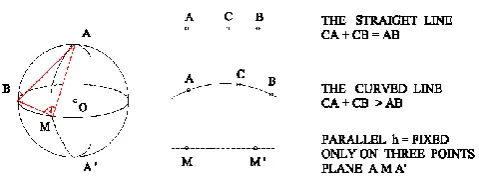
AB is a straight line through points A, B, AB is also the measurable line segment of line AB , and M any other point. When MA+MB > AB then point M is not on lineAB.(differently if MA+MB = AB , then this answers the question of why any line contains at least two points ) ,
Copyright to IJIRSET DOI:10.15680/IJIRSET.2015.0409150 9316 To prove the above Axiom is necessary to show:
a.
The parallel to AB is the locus of all points at a constant distance h from the line AB, and for pointMisMA1,b.
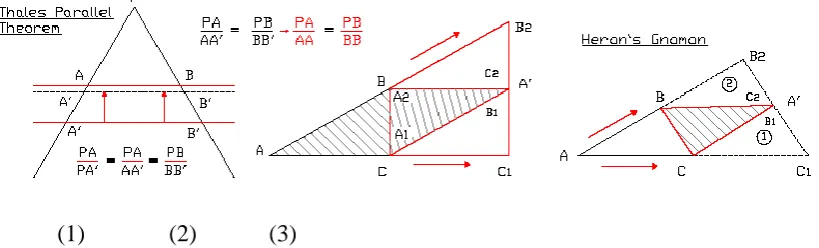
The locus of all these points is a straight line.Figure2. The Method – (3) Step 1
Draw the circle (M, MA) be joined meeting line AB in C.Since MA = MC, point M is on mid-perpendicular of AC. Let A1 be the midpoint of AC, (it is A1A+A1C = AC because A1 is on the straight line AC. Triangles MAA1, MCA1 areequal because the three sides are equal, therefore angle < MA1A = MA1C (CN1) and since the sum of the two angles < MA1A+MA1C = 180°(CN2, 6D)then angle < MA1A = MA1C = 90 °.(P4) so, MA1 is the minimum fixed distance h
of point M to AC. Step 2
Let B1 be the midpoint of CB,(it is B1C+B1B = CB because B1 is on the straight line CB) and draw B1M΄ = h equal to A1M on the mid-perpendicular from point B1 to CB. Draw the circle (M΄, M΄B = M΄C) intersecting the circle (M, MA = MC) at point D.(P3) Since M΄C = M΄B, point M΄ lies on mid-perpendicular of CB. (CN1)
Since M΄C = M΄D, point M΄ lies on mid-perpendicular of CD. (CN1)SinceMC = MD, point M lies on mid-perpendicular of CD. (CN1) Because points M and M΄ lie on the same mid-perpendicular (This mid-perpendicular is drawn from point C΄ to CD and it is the midpoint of CD) and because only one line MM΄ passes through points M, M ΄ then line MM΄ coincides with this mid-perpendicular (CN4)
Step 3
Draw the perpendicular of CD at point C΄. (P3, P1) a. Because MA1 ┴ AC and also MC΄ ┴ CD then angle <
A1MC΄ = A1 CC΄. (Cn 2,Cn3,E.I.15)Because M΄B1 ┴ CB and also M΄C΄┴ CD then angle < B1M΄C΄ = B1CC΄. (Cn2, Cn3, E.I.15)
b. The sum of angles A1CC΄ + B1CC΄ = 180▫ = A1MC΄ + B1M΄C΄.(6.D), and since Point C΄ lies on straight line MM΄, therefore the sum of angles in shape A1B1M΄M are < MA1B1 + A1B1M ΄ + [ B1M΄ M + M΄MA1 ] = 90▫ + 90▫ + 180▫ = 360▫ (Cn2), i.e.The sum of angles in a Quadrilateral is 360▫ and in Rectangle all equal to 90 ▫.(m)
c. The right-angled triangles MA1B1, M΄B1A1 are equal because A1M = B1M΄ and A1B1common, therefore side A1M΄ = B1M (Cn1). Triangles A1MM΄,B1M΄M are equal because have the three sides equal each
other,therefore angle < A1MM΄ = B1M΄M, and since their sum is 180▫ as before (6D), so angle < A1MM΄ = B1M΄M = 90▫ (Cn2).
d. Since angle < A1MM΄ = A1CC΄ and also angle < B1M΄M = B1CC΄ (P4),therefore quadrilateralsA1CC΄M, B1CC΄M΄, A1B1M΄M are Rectangles (CN3). From the above three rectangles and because all points (M, M΄ and C΄) equidistant from AB, this means that C΄C is also the minimum equal distance of point C΄ to line AB or, h = MA1 = M΄ B1 = CD / 2 = C΄C (Cn1) Namely, line MM΄ is perpendicular to segment CD at point C΄ and this line coincides with the mid-perpendicular of CD at this point C΄ and points M, M΄,C΄ are on line MM΄. Point C΄ equidistant,h, from line AB, as it is for points M,M΄, so the locus of the three points is the straight line MM΄, so the two demands are satisfied, (h = C΄C = MA1 = M΄B1 and also C΄C ┴ AB, MA1 ┴ AB, M΄B1 ┴ AB).(ο.ε.δ.)
e. The right-angle triangles A1CM, MCC΄ are equal because side MA1= C΄C and MC common so angle <A1CM = C΄MC, and the Sum of angles C΄MC + MCB1 = A1CM + MCB1 = 180▫
3.1.The SuccessionofProofs
1. Draw the circle (M, MA) be joined meeting line AB in C and letA1, B 1 be the midpoint of CA, CB.
2. On mid-perpendicular B1M΄ find point M΄ such that M΄B1 = MA1 and draw the circle (M΄, M΄B = M΄C) intersecting the circle (M, MA = MC) at point D. 3. Draw mid-perpendicular of CD at point C΄.
4. To show that line MM΄ is a straight line passing through point C ΄ and it is such that MA1 = M΄B1 = C΄C = h, i.e. a constant distance h from line AB or, alsoThe Sum of angles C΄MC + MCB1 = A1CM + MCB1 = 180 ▫ 3.2.Proofed Succession
1. The mid-perpendicular of CD passes through points M, M ΄.
2. Angle < A1MC΄ = A1 MM΄ = A1CC΄, Angle < B1M΄C΄ = B1M΄M = B1CC΄<A1MC΄ =A1CC΄ because their sides are perpendicular among them i.e.
MA1┴CA,MC΄┴CC΄.
a. In case < A1MM΄ +A1CC΄=180▫ and B1M΄M +B1CC΄ = 180▫ then < A1MM΄ = 180▫- A1CC΄, B1M΄M = 180▫ - B1CC΄, and by summation < A1MM΄ + B1M΄M = 360▫ - A1CC΄- B1CC΄ orSum of angles <A1MM΄ + B1M΄M = 360 - (A1CC΄ + B1CC΄) = 360-180▫ = 180▫
3. The sum of angles A1MM΄ + B1M΄M = 180▫ because the equal sum of angles A1CC΄ + B1CC΄ = 180▫, so the sum of angles in quadrilateral MA1B1 M΄ is equal to 360▫.
5. Since angle A1CC΄ =B1CC΄ = 90▫, then quadrilaterals A1CC΄M, B1CC΄M΄ are rectangles and for the three rectangles MA1CC΄, CB1M΄C΄, MA1B1M΄ exists MA1 = M΄B1 = C΄C
6. The right-angled triangles MCA1, MCC΄ are equal, so angle < A1CM = C΄MC and since the sum of angles < A1CM + MCB1 = 180 ▫ then alsoC΄MC + MCB1 = 180 ▫→which is the second to show, as this problem has been set at first by Euclid.
All above is a Proof of the Parallel postulate due to the fact that the parallel postulate is dependent of the other four axioms (now is proved as a theorem from the other four).Since line segment AB is common to ∞ Planes and only one Plane is passing through point M (Plane ABM from the three points A, B, M, then the Parallel Postulate is valid for all Spaces which have this common Plane, as Spherical, n-dimensional geometry Spaces. It was proved that it is a necessary logical consequence of the others axioms, agree also with the Properties of physical objects, d + 0 = d, d * 0 = 0, now is possible to decide through mathematical reasoning,that the geometry of the physical universe is Euclidean.Since the essential difference between Euclidean geometry and the two non-Euclidean geometries , Spherical and hyperbolic geometry, is the nature of parallel line, i.e. the parallel postulate so,<<The consistent System of the - non-Euclidean geometry - have to decide the direction of the existing mathematicallogic>>.
The above consistency proof is applicable to any line Segment AB on line AB,(segment AB is the first dimensional unit, as AB = 0 → ∞), from any point M not on line AB, [ MA + MB > AB for three points only which consist the Plane. For any point M between points A, B is holding MA+MB = AB i.e. from two points M, A or M, B passes the only one line AB. A line is also continuous (P1) with points and discontinuous with segment AB [14],which is the metric defined by non- Euclidean geometries ,and it is the answer to the cry about the < crisis in the foundations of Euclid geometry >(F.2)
3.3.ALine Contains at Least Two Points, is Not an Axiom Because is Proved as Theorem
Definition D2 states that for any point M on lineAB is holding MA+MB = AB which is equal to < segment MA + segment MB is equal to segment AB > i.e. the two lines MA,MB coincide on lineABand thus this postulate is proved also from the other axioms, thus D2is not an axiom, which form a system self consistentwith its intrinsic real-world meaning.F.a→ F.2.
4.
The Types of Geometry
The structure of Euclidean geometry
Any single point A constitutes a Unit without any Position and dimension (non-dimensional= Empty Space) simultaneously zero, finite and infinite. The unit meter of Point is equal to0.
Any single point B, not coinciding with A, constitutes another one Unit which has also dimension zero. Only one Straight line (i.e. the Whole is equal to the Parts) passes throughpoints A and B,which consists another un-dimensional Unitsince is consisted of infinite points with dimension zero. A line Segment AB between points A and B (either points A and B are near zero or are extended to the infinite), consists the first Unit with one dimensional, the length AB, beginning from Unit A and a regression ending in Unit B.Line segment AB = 0 → ∞, is the one-dimensional Space. The unit meter of AB is m = 2.(AB/2) = AB because only one middle point exists on AB and since also is composed of infinite points which are filling line, then nature of line is that of Point (the all is one for Lines and Points).
Adding a third point C, outside the straight line AB, (CA+CB >AB), then is constituted a new Unit (the Plane) without position, since is consisted of infinite points, without any position. Shape ABC enclosed between parts AB, AC, BC is of two dimensional, the enclosed area ABC, and since is composed of infinite Straight lines which are filling Plane, then, nature of Plane is that of Line and that of Points (the all is one for Planes, Lines and Points). Following harmony of unit meter AB=AC=BC, then Area ABC = 0 → ∞, is the two-dimensional Space with unit meter equal to m = 2.(π.AB/√2)² = π.AB ², i.e. one square equal to the area of the unit circle.
Four points A,B,C,D (....) not coinciding, consist a new Unit (the Space or Space Layer)without position also, which is extended between the four Planes and all included, forming Volume ABCD and since is composed of infinite Planes which are filling Space, then, nature of Space is that of Plane and that of Points (the all is one for Spaces, Planes, Lines and Points). Following the same harmony of the first Unit, shape ABCD is the Regular Tetrahedron with volume ABCD = 0 → ∞, and it is the three-dimensional Space. Thedimension of Volume is 4 - 1 = 3. The unit measure of volume is the side X of cube X³twice the volume of another random cube of side a = AB such as X³ = 2.a³ and X = ³√2.a.Geometry measures Volumes with side X related to the problem of doubling of the cube.In case that point D is on a lower Space Layer, then all Properties of Space, or Space Layerare transferred to the lower corresponding Unit, i.e.an inverse quantization from volume to Plane ,from Plane the Straight line , andthen to the Point, which is the quantization of units in E-Geometry. This Concentrated(Compact) Logic of geometry[CLG ] exists for all Space – Layers and is very useful in many geometrical and physical problems. (exists, Quality = Quantity, since all the new Units are produced from the same, the first one, dimensional Unit AB).
Copyright to IJIRSET DOI:10.15680/IJIRSET.2015.0409150 9318 Proceeding inversely with roots of any unit AB = 0 → ∞
(i.e. the Sub-Spaces are theroots ofAB, ²√AB, ³√AB,.. ⁿ√ AB then it is ⁿ√ AB = 1as n → ∞), and since all roots of unit AB are the vertices of the Regular Solids in Spheres then this n Space Layer is limiting to 0 as n→∞The dimensionality of the physical universe is unbounded (∞) but simultaneously equal to (1)as the two types of Spaces and Sub-Spaces show.
Because the unit-meters of the N-1 dimensional Space Layers coincide with the vertices of thenth-roots of the first dimensional unit segment AB as AB = ∞ → 0,which is point,(the vertices of the n-sided Regular Solids), therefore the two Spaces are coinciding (the Space Layers and the Sub-Space Layers are in superposition on the samemonads).[F.5]
That is to say, Any point on the Nth Space or Space-Layer, of any unit AB = 0 →∞, jointly exists partly or whole, with all Subspaces of higher than N Spaces, N = (N+1) -1 = (N+2) -2 =(N+N)-N...= (N+∞) - ∞, where (N+1),…(N+∞) are the higher than N Spaces, and with all Spaces of lower than N Subspaces, N = (N-1) +1 = (N-2)+2 = (N-N)+N = (N -∞) +∞, where (N-1),(N-2), (N-N),(N-∞) are the lower than N Spaces.The boundaries of N points, corresponding to the Space, have their unit meter of the Space and is a Tensor of N dimension (i.e. the unit meters of the N roots of unity AB), simultaneously, because belonging to the Sub-Space of the Unit Segments > N, have also the unit meter of all spaces.[ F.5 ]
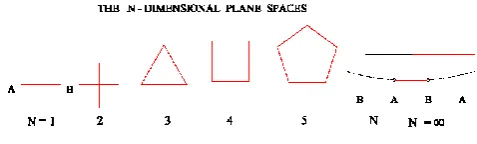
1. The Space Layers: (or the Regular Solids) with sides equal to line-segment AB = 0 → ∞The Increasing Plane Spaces with the same Unit. (F.3)
Figure 4. The Increasing Space Layers –(4)
The Sub-Space Layers : (or the Regular Solids on AB) as Roots of AB = 0 → ∞. The Decreasing Plane Spaces with the same Unit. (F.4)
Figure5.The decreasing (Sub-Spaces) Layers – (4)
2. The superposition of Plane Space Layers and Sub-Space Layers: (F.6) The simultaneously co-existence of Spaces and Sub-Spaces of any Unit AB = 0 → ∞ , i.e.
Euclidean, Elliptic, Spherical, Parabolic, Hyperbolic, Geodesics, metric and non-metricgeometries have Unit AB as common. The Interconnection of Homogeneous
and Heterogeneous Spaces, and Subspaces of the Universe.[F.6]. In the same monad AB , coexist the ± Spaces Layers and the ± Sub-Spaces and thus forming the united Unit , which is the monad or quaternion or any other complex magnitude .
Figure 6. The Superposition of Spaces – (4)
3. A linear shape is the shape with N points on a Plane bounded with straight lines. A circle is the shape on a Plane with all points equally distance from a fix point O. A curved line is the shape on a Plane with points not equallydistance from a fix point O. Curved shapes are those on a Plane bounded with curved lines.Rotating the above axial-centrifugally (machine AB ┴ AC) is obtained Flat Space, Conics, Sphere, Curved Space, multi Curvature Spaces, Curved Hyperspace etc.The fact that curvature changes from point to point, is not a property of one Space only butthat of the common area of more than two Spaces, namely the result of the Position of Points.Euclidean manifold (Point, sectors, lines, Planes, all Spaces etc) and the one dimentional Unit AB is prooved to be the same thing (according to Euclid έν ηο πάν). [F.5]
Since Riemannian metric and curvature is on the great circles of a Sphere which consist a Plane, say AMA΄, while the Parallel Postulate is consistent with three points only, therefore the great circles are not lines (this is because it is MA + MA΄ > AA΄) and the curvature of Space is that of the circle in this Plane, i.e. that of the circle (O, OA), which are more than three points. Because Parallel Axiom is for three points only, which consist a Plane, then the curvature of < empty space > is equal to 0,( Points have not any metric or intrinsic curvature). [F.6]
The physical laws are correlated with the geometry of Spaces and can be seen, using CLG, in Plane Space as it is shown in figures F3 - F5 and also in regular polygons which are Algebraic equations of any degree. A Presentation of the method is seen on Dr Geo-Machine Macro-constructions.
Today has been shown that this common horizon is the common circle of Space, Anti-space equilibrium, which creates breakages and by collision all particles ,dark matter and dark energy exist in these Inertial systems, STPL lines .
Gravity field is one of the finest existing Space and Anti-space quantization, which is restrained by gravity force.[41]
Hyperbolicgeometry and straight lines:
Figure7. The Euclidean straight line and the others – (4)
The parallel axiom (the postulate) on any line Segment AB in empty Space is experimentally verifiable, and in this way it is dependent of the other Axioms and is logically consistent, and since this is true then is accepted and so the Parallel Postulate as has been shown is a Parallel Axiom,soall Nature (the Universe as objective reality) is working according to the Principles (the patterns),the Properties and the dialectic logic of the Euclidean geometry. [17]
Hyperbolic and Projective geometry transfers the Parallel Axiom to problem of a point M and a Plane AB-C instead of problem of three points only,a Plane, whichsuch it is.(F.6)
Vast (the empty space) is simultaneously ∞ and 0 for every unit AB, as this is for numbers. Uniformity (P4 = Homogenous Plane) of Empty Space creates, all the one dimensional units, the Laws of conservation for Total Impulse, and moment of Inertia in Mechanics, independently of the Position of Space and regardless the state of motion of other sources. (Isotropic Spaces)Uniformity (Homogenous) of Empty Time creates, the Laws of conservation of the Total Energy regardless of the state of motion (Time is not existing here, since Timing is always the same as zero ) and Time Intervals are not existing.[17]. It was shown in [38] that Time is the conversion factor between the conventional units (second) and length units (meter).
In Special Relativity events from the origin are determined by a velocity and a given unit of time, and the position of an observer is related with that velocity afterthe temporal unit.
Since all Spaces and Subspaces co-exist, then Past, Present and Future simultaneously exist on different Space Layer. Odd and Even Spaces have common and also opposite Properties,( the regular Odd andEven regular Polygons on any dimensional Unit ) so for Gravity belonging to different Layers as that of particles, is also valid in atom Layers. Euclidean geometry with straight lines is extended beyond Standard Model ( AB < 10 - 33m) from that of general relativity where Spaces may be simultaneously Flat or Curved or multi-Curved,and according to the Concentrated,(Compact) Logic of the Space, are below Plank's length Level, so thechanging curvature from point to point is possible in the different magnitudes of particles. In
Planck length level and Standard Model, upper speed is that of light, while beyond Planck length a new type of light is needed to see what is happening.[43]
5. Respective Figures
5.1.Rational Figured Numbers or Figures
This document is related to the definition of ― Heron ‖ that gnomon is as that which, when added to anything, a number or figure, makes the whole similar to that to which it is added. In general the successive gnomonic numbers for any polygonal number, say, of n sides have n-2 for their common difference. The odd numbers successively added were called gnomons. See Archimedes (Heiberg 1881, page 142,ε΄.)
The Euclidean dialectic logic of an axiom is that which is true in itself.
This logic exists in nature (objective logic) and is reflected to our minds as dialectic logic of mind. Shortly for ancient Greeks was,(μηδέν εν ηη νοήζει ειμή ππόηεπον εν ηoί αιζθήζοι) i.e. there is nothing in our mind unless it passes through.our senses.Since the first dimentional Unit is any line Segment AB, it is obvious that all Rational Segments are multiples of AB potentially the first polygonal number of any form, and the first is 2AB = AB +AB, which shows that multiplication and Summation is the same action with the same common base, the Segment AB.To Prove in F8:
Figure 8. The Rational figures – (5.1)
The triangle with sides AC1,AB2,C1B2 twice the length of initial segments AC,AB,CB preserves the same angles < A = BAC, B = ABC, C = ACB of the triangle.Proof :
a. Remove triangle ABC on line AC such that point A coincides with point C (A1). Triangles CB1C1, ABC are equal, so CA΄ = AB, C1A΄ = CB
b. Remove triangle ABC on line AB such that point A coincides with point B (A2). Triangles BB2C2, ABC are equal, so BC2 = AC, B2C2 = BC
c. The two circles (C,CB1 = AB) and (B,BC2 = AC) determine by their intersection point A΄, so triangles CBA΄, CBA are equal, and also equal to the triangles CC1B1, BB2C2, andthis proposition states that sides CB1 = CA΄, BC2 = BA΄. Point A΄ must simultaneously lie on circles (C1, C1 B1),(B2, B2C2), which is not possible unless point A΄ coincideswith points B1 and C2. d. This logic exists in Mechanics as follows :The linear
Copyright to IJIRSET DOI:10.15680/IJIRSET.2015.0409150 9320 freedom of the System should not be satisfied therefore
points B1, C2, A΄ coincide.
e. Since circles (C1,C1B1 = C1A΄= CB),(B2, B2C2 = B2A΄= CB) pass through one point A΄, then C1A΄B2 is a straight line, this because C1A΄+A΄B2 = C1B2, and A΄ is the midpoint of segment B2C1.
f. By reasoning similar to what has just been given, it follows that the area of a triangle with sides twice the initials, is four times the area of the triangle.
g. Since the sum of angles < C1A΄C + CA΄B + BA΄B2 = 180▫ (6D) and equal to the sum of angles CBA + CAB + ACB then the Sum of angles of any triangle ABC is 180▫, which is not depended on the Parallel theorem or else-where.
This proof is a self consistent logical system . Verification :
Let be the sidesa=5, b=4, c =3 of a given triangle and from the known formulas of area S = (a + b + c) / 2 = 6, Area = √ 6.1.2.3 = 6For a=10, b=8, c=6 then S = 24/2 = 12 and Area = √ 12.2.4.6.= 24 = 4 x 6 (four times as it is)
5.2. A given Point P and Any Circle(O, OA)
Figure9. A point and a circle – (5.2)
1.. Point P is outside the circle. 2.. Point P on circle.
3.. Point P in circle. To Prove :
The locus of midpoints M of segments PA, is a circle with center O΄ at the middle of PO
and radius O΄M = OA / 2where,Pis any point on a Plane Ais any point on circle (O, OA) M is mid point of segment PA,Proof :
Let O΄ and M be the midpoints of PO, PA. According to the previous given for Gnomon, the sides of triangle POA are twice the size of PO΄M, or PO = 2.PO΄ and PA = 2.PM therefore as before, OA = 2.O΄M, or O΄M = OA/2.
Assuming M found, and Since O΄ is a fixed point, and O΄M is constant, then (O΄, O΄M = OA/2) is a circle. For point P on the circle :The locus of the midpoint M of chord PA is the circle (O΄,O΄M = PO / 2) and it follows that triangles OMP, OMA are equal which means that angle < OMP = OMA = 90 ▫, i.e. the right angle < PMO = 90▫ and exists on diameter PO (on arc PO), and since the sum of the other two angles < MPO + MOP exist on the same arc PO = PM + MO, it follows that the sum of angles in a rectangle triangle is 90 + 90 = 180 ▫.(q.e.d)
5.3. The two Angles Problem
Any two angles α =AOB, β = A΄O΄B΄ with perpendicular, sides are equal.
Figure 10.The two perpendicular angles – (5.3) O = O ΄O = O ΄O # O΄
angle α ≤ 90 ▫ angle α > 90 ▫ any angle Rotation of α=βRotating of α=βDisplacing of α = β Let AOB = a be any given angle and angle A΄O΄B΄ = bsuch thatAO ┴ O΄A΄, OB ┴ O΄B΄.
To proof that angle b is equal to a. Proof :
CENTREO΄ = O, α ≤ 90▫
Angle< AOA΄ = 90▫ = AOB + BOA΄ = α + x(1)
Angle< BOB ΄ = 90▫ = BOA΄ + A΄OB΄ = x + β(2), subtracting (1), (2) → angle β = α
CENTREO΄ = Ο, 90▫ < α < 180▫
Angle< AOA΄ = 90▫ = AOB΄ - B΄OA΄ = α - x(1)
Angle< BOB ΄ = 90▫ = A΄OB - A΄OB΄ = β - x(2), subtracting (1), (2) → angle β = α
CENTREO΄ # O.
Draw circle (M, MO = MO΄) with OO΄ as diameter intersecting OA,O΄B΄ produced to points A1,B1.
Since the only perpendicular from point O to O΄A΄ and from point O΄ to OB is on circle (M, MO)
then, points A1, B1 are on the circle and angles O΄A1O, O΄B1O are equal to 90▫.
The vertically opposite angles a = a1 + a2, b = b1 + b2 where O΄C ┴ OO΄.
Since MO= MA1 then angle < MOA1 = MA1O = a1. Since MA1 = MO ΄ then angle < MA1O΄ = MO΄A1 = x Since MO΄ = MB1 then angle < MO΄B1 = MB1O΄ = z Angle MO΄C = 90▫ = x + b1 = z + b2.
Angle O΄A1O = 90▫ = x + a1 = x + b1→a1 = b1 Angle O΄B1O = 90▫ = z + a2 = z + b2. →a2 = b2
By summation a1 + a2 = b1 + b2 orb = a (ο.ε.δ)i.e. any two angles a, b, having their sides perpendicular among them are equal.
From upper proof is easy to derive the Parallel axiom, and more easy from the Sum of angleson a right-angled triangle. 5.4.Any Two Angles Having their Sides
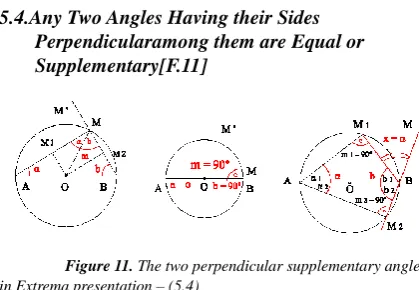
Perpendicularamong them are Equal or Supplementary[F.11]
Figure 11. The two perpendicular supplementary angles in Extrema presentation – (5.4)
Let be AB = DiameterM → B, AB ┴ BM΄, AM1┴BM1,
Let also angle < M1AM 2 = a and angle < M1BM 2 = b, which have sideAM1 ┴ BM1 and the sideAM 2 ,
AM 2 ┴ BM 2 ┴ BM Show :
1. Angle < M1AM2 = M1BM = a
2. Angle < M1AM2 + M1BM2 = a + b = 180▫.
3. The Sum of angles in Quadrilateral AM1BM2 is 360▫. 4. The Sum of angles in Any triangle AM1M2is 180▫. Proof :
1. In figure 10.3, since AM1 ┴ BM1 and AM2 ┴ BM2 or the same AM2 ┴ BM, then according to prior proof, AB is the diameter of the circle passing through points M1, M2, and existsa1 +b1 = m1 = 90▫, a2 +b2 = m2 = 90▫ and by summation (a1 +b1) + (a2 + b2) = 180▫ or(a1 + a2) + (b1+ b2) = a + b = 180▫, and since also x + b = 180▫ therefore angle < x = a
2. Since the Sum of angles M1BM2 + M1BM = 180▫ then a + b = 180 ▫
3. The sum of angles in quadrilateral AM1BM2 is a + b + 90 +90 = 180 + 180 = 360 ▫
4. Since any diameter AB in Quadrilateral divides this in two triangles, it is very easy to show that diamesus M1M2 form triangles AM1M2, BM1M2 equal to 180▫ each.
so, Any angle between the diameter AB of a circle is right angle (90▫).
1. Two angles with vertices the points A, B of a diameter AB, have perpendicular sides
2. and are equal or supplementary.
3. Equal angles exist on equal arcs, and central angles are twice the inscribed angles.
4. The Sum of angles of any triangle is equal to two right angles.(ο.ε.δ)
i.e two Opposite angles having their sides perpendicular between them, are Equal or Supplementary between them. This property has been used in proofs of Parallel Postulateand is also a key to many others .[20]
Many theorems in classical geometry are easily proved by this simple logic.
Conclutions, and how useful is this invention is left to the reader. Unfortunately not any reaction is noticed .
5.5. APoint M on any Circle
5.5.1. A PointM on a Circle of any DiameterAB = 0 → ∞
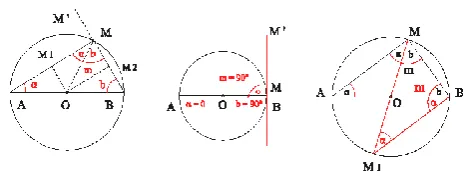
Figure 12. An angle on a circle with Extrema cases - (5.5.1)
AB = Diameter M → B, AB ┴ BM΄Δ [ AMB = MBM1 ]
LetMbe any point on circle (O,OM = OA = OB),andM
┴ BA at point B(angle AMM΄ = 90 ▫).
In third figureMM1is a diameter of the circle. Show :
1. Angle < AMB = MAB + MBA = a + b = m
2. Triangles MBM1, MBA are always equal and angle < MBM1 = AMB = 90 ▫
3. The Sum of angles on triangle MAB are < AMB + MAB + MBA = 180▫.
Proof:
1. Since OA = OM and M1A = M1M and OM1 common, then triangles OM1A, OM1M are equal and angle < OAM = OMA = BAM = a → (a)Since OM = OB and M2B = M2M and OM2 common, then triangles OM2B, OM2Mare equal and angle < OBM = OMB = ABM = b → (b)By summation (a),(b) BAM + ABM = (OMA + OMB) = AMB = a + b = m..(c)i.e. When a Point M lies on the circle of diameter AB, then the sum of the two angles at pointsA, B is constantly equal to the other angle at M. Concentrated logic of geometry exists at point B,because as on segment AB of a straight line AB,which is the one dimensional Space, springs thelaw of Equality, the equation AB = OA + OB i.e. The whole is equal to the parts, so the same isvalid for angles of all points on the circumference of the circle (O,OM), [ as Plane ABM and allangles there exist in the two dimensional Space ], and it is m = a + b.
2. In figure (11), when point M approaches to B, the Side BM΄ of angle < ABM tends to the perpendicular on BA and when point M coincides with point B, then angle < ABM = 90▫ and < OAM = BAM = 0, therefore angle < AMB = 90▫ and equation (c) becomes : BAM + ABM = AMB → 0 + 90▫ = AMB → AMB = 90▫,(i.e. AM ┴ BM) and the sum of angles is (BAM + ABM) + AMB = 90▫ + 90 ▫ = 180▫, or BAM + ABM + AMB = 180▫
3. Triangles MBA, MBM1 are equal because they have diameter MM1 = AB, MB commonand angle < OBM = OMB = b (from isosceles triangle OMB).Since Triangles MBA, MBM1 are equal therefore angle < MM1B = MAB = a,and from the isosceles triangle OM1B, angle < OBM 1 = OM1B = aThe angle at point B is equal to MBM 1 = MBA + ABM 1 = b + a = m = AMB . Rotating diameter MM1 through centre O so that pointsM, M1 coincides withB, Athen angle < MBM1 = MBA + ABM1 = BBA + ABA = 90▫ + 0 = 90▫ and equal to AMBi.e. The required connection for angle MBM1 = AMB = m = a + b = 90 ▫. (ο.ε.δ)
Copyright to IJIRSET DOI:10.15680/IJIRSET.2015.0409150 9322 ▫(ο.ε.δ),(q.e.d)
2a. To show, the Sum of anglesa + b = constant = 90▫ = m.F.12-3,Mis any point on the circle andMM1 is the diameter. Triangles MBA,MBM1 are equal and by rotating diameter MM1through centreO, the triangles remain equal.
Proof :
a. Triangles MBA, MBM1 are equal because they have MM1 = AB, MB commonand angle < OBM = OMB = b (from isosceles triangle OMB) soMA = BM1.
b. Since TrianglesMBA, MBM1 are equal therefore angle < MM1B = MAB = a,and from isosceles triangle OM1B, angle< ABM1 = OBM 1 = OM1B = a
c. The angle at point B is always equal toMBM1 = MBO + OBM 1 =b + a = m = AMBRotating triangleMBM1 so that pointsM,B coincide then MBM1 = ABB +ABA = 90+0 = m .Since angle AMB = a + b = m and is equal to angle <MBM1, of the rotating unaltered triangleMBM1 and which at point Bhas anglem = 90 ▫, then is valid angle <AMB = MBM1 = 90 ▫ i.e. the required connection for angleAMB = m = a + b = 90 ▫.(ο.ε.δ),(q.e.d) - 22 / 4 /2010.
2b. When point M moves on the circle, Euclidean logic is as follows :
Accepting angle ABM΄ = bat pointB, automatically point M is on the straight line BM΄and the equation at pointBis for (a = 0, b = 90▫, m= 90▫) → 0 + 90▫ = m and alsoequal to, 0 + b – b + 90▫ = m or the same →b + (90▫ - b) = m…..(B)
In order that pointMbe on the circle of diameter AB, is necessary → m = b + a...(M)where, a, is an angle such that straight lineAM(the direction AM) cutsBM΄, and isb + (90▫ - b) = m = b + a or → 90▫ - b = a and → a + b = 90▫ = constant,i.e. the demand that the two angles , a, b, satisfy equation (M) is that their summust be constant and equal to90 ▫.(ο.ε.δ)-(q.e.d)
3. In figure F12-3,according to prior proof, triangles MBA,MBM1 are equal.Triangles AM1B,AMBare equal because AB is common, MA = BM1 and angle < MAB = ABM1, so AM1 = MB. Triangles ABM1, ABM are equal because AB is common MB = AM1 and AM = BM1therefore angle < BAM1 = ABM = b and so, angle MAM1 = a + b = MBM1.
Since angle AMB = AM1B = 90▫ then AM ┴ BM and AM1 ┴ BM1.
Triangles OAM1, OBM are equal because side OA = OB, OM = OM1 and angle< MOB = AOM1, therefore segment M1A = MB.
Rotating diameter MM1 through O to a new position Mx, M1x any new segment isMxB = M1xA and the angle < MxBM1x = MxBA + ABM1x and segment BMx = AM1x.
Simultaneously rotating triangle MxBM1x through B such that BMx ┴ AB then angle< MxBM1x = BBA + ABA = 90▫ + 0 = 90▫,i.e. in any position Mx of point M angle < AMxB = MxBM1x = 90▫
i.e. two Equal or Supplementary between them opposite
angles, have their sidesperpendicular between them.(the opposite to that proved) .
Followings the proofs, then any angle between the diameter of a circle is right angle (90 ▫), central angles are twice the inscribed angles, angles in the same segments are equal to one another and then applying this logic on the circumscribed circle of any triangle ABM, then is proofed that the Sumof angles of any triangle is equal to two right angles or < BAM + ABM + AMB = 180▫
5.5.2. The motion of a PointMon a Circle ofany DiameterAB = 0 → ∞ F.13
Figure13. All angles on a diameter of a circle are 90▫- (5.5.2)
To show that angle < AMB = m = 90 ▫ BB΄ ┴ BA(angle ABB ΄ = 90 ▫) and MM ― ┴ AB
F.13.1 : It has been proved that triangles AMB, MBM1 are equal and angle <AMB = MBM1 = mfor all positions of M on the circle. Since triangles OMB, OAM1 are equal then chordBM = AM1 and arcBM = AM1.
F.13.2 : The rotation of diameter MM1 through centre O is equivalent to the new positionMx of point M and simultaneously is the rotation of angle < M΄MxBM1 = M΄BM1through pointB, and this because arcBM = AM1, BMx = AM1x,i.e. when pointM moves with BMM΄ to a new positionMx on the circle, diameter MOM1 = MxOM1xis rotated throughO, the points M,M1are sliding on sidesBMM΄, BM1 because point M1 to the new position M1x is such thatAM1x = BMx and angle < M΄BM1 is then rotated throughB.(analytically as below)
F.13.3 : When diameter MM1 is rotated through O, point M lies on arc MB = AM1 and angle < M΄BM1 is not altered (this again because MB = AM1) and when point M is at B,point M1 is at point A, because again arc BM = AM1 = 0, and angle a = BM1M = 0, orangle < M1BM = M1BM΄ = ABM΄ = 90▫ = m = a + b
Conclusion 1.
Since angle < AMB is always equal to MBM1 = M΄BM1 and angle M΄BM1 = 90▫ thereforeangle< AMB = a + b = m = 90▫
Conclusion 2.
Since angle < ABB΄ = 90▫ = ABM + MBB΄ = b + a, therefore angle MBB΄ = a,i.e. the two angles < BAM, MBB΄ which haveAM ┴ BMand alsoAB ┴ BB΄ are equal between them.
Conclusion 3.
Conclusion 4.
Drawing the perpendicular MM ‖ on AB, then angle BMM ‖ = MAB = MBB ΄, because they have their sides perpendicular between them, i.e. since the two lines BB΄, MM ‖ are parallel and are cut by the transversalMBthen the alternate interior anglesMBB΄, BMM ‖ are equal.
Conclusion 5.
In Mechanics, the motion of point M is equivalent to, a curved one on the circle, two Rotations through points O, B,and one rectilinear in the orthogonal systemM΄BM1 = MBM1.
5.5.3.A PointMon a Circle of any DiameterAB = 0 → ∞
Figure14. An angle on any circle - (5.5.3)
Show that angleMBM1 is unaltered when plane MBM1 is rotated through B to anew position MxBM1x
Let Plane (MBM1),(F14) be rotated through B, to a new position B1BM1x such that:
1. Line BM → BB1 intersects circle (O,OB) at pointMx and the circle (B,BM = BB1), at point B1.
2. Line BM1 → BM1x extended intersects circle (O,OB) at the new point M1x.
3. Angle < M1BM1x = MBB1 = MBMx, is angle of rotation.
Proof:
Since angle < M1BM1x = MBMx, therefore angle < M1BM is unaltered by rotation→ i.e. Angle < M1BM = M1xBMxand diameterMM1is sliding uniformly on their sides.
Data + Remarks.
1. Diameter MM1 is sliding in angle M1BM which means that points M1, M lie on the circle(O,OB) and on lines BM1, BM respectively, and also sliding to the other sides BM1x, BMxof the equal angle < M1xBMx. Any line segment M1xMw= MM1 is also diameter of the circle.
2. Only point Mx is simultaneously on circle (O,OB) and on line BB1.
3. The circle with point M1x as centre and radius M1xMw = MM1 intersect circle (O, OB) at only one unique point Mw.
4. Since angle < M1xBB1= M1BM and since segment M1xMw = MM1 then chord M1xMw must be also on sides of angles M1xBB1, M1BM, i.e. Point Mw must be on line BB1
5. Ascertain 2 and 4 contradict because this property
belongs to point Mx, unless this unique point Mw coincides with Mx and chord MxM1x is diameter of circle (O,OB).
Point Mx is simultaneously on circle (O, OB), on angle < M1xBB1 = M1xBMx and is sliding on line BB1. We know also that the unique point Mw has the same properties as point Mx, i.e. point Mw must be also on circle (O, OB) and on line BB1, and the diameter M1xMw is sliding also on sides of the equal angles M1xBB1, M1xBMx, M1BM.
Since point Mw is always a unique point on circle (O,OB) and also sliding on sides of angle M1BM = M1xBMx and since point Mx is common to circle (O,OB) and to line BB1 = BMx, therefore, points Mw, Mx coincide and chord MxM1x is diameter on the circle (O,OB), i.e. The Rotation of diameter MM1 through O, to a new position MxM1x, is equivalent to the Rotation of Plane (MBM1) through B and exists angle < MBM1 = MxBM1x, so angle < MBM1 = MxBM1x = AMB = 90▫ = m = a + b ……… ο.ε.δ
Since angle < MBMx = M1BM1x is the angle of rotation, and since also arc MMx = M1M1x (this because triangles OMMx, OM1M1x are equal)then:Equal inscribed angles exist on equal arcs.
6. General Remarks
6.1.Axiom not Satisfied by Hyperbolic or other Geometry It has been proved that quadrilateral MA1CC΄ is Rectangle (F2) and from equality of triangles MA1C, MC΄C then angle < C΄MC = MCA1. Since the sum of angles < MCA1 + MCB = 180 ▫, also, the sum of angles < C΄MC + MCB = 180 ▫which answers to Postulate P5, as this has been set (F1.e). Hyperbolic geometry, Lobachevski, non-Euclidean geometry, in Wikipedia the free encyclopedia, states that there are TWO or more lines parallel to a given line AB through a given point M not on AB. If this is true, for second angle C2MC, exists also the sum of angles < C2MC + MCB = 180▫, which is Identity (C2MC = C΄MC), i.e. all (the called parallels) lines coincide with the only one parallel line MM΄, and so again the right is to Euclid geometry.
Copyright to IJIRSET DOI:10.15680/IJIRSET.2015.0409150 9324 6.2. Hyperbolic Geometry Satisfies the Same4Axioms as
Euclidean Geometry, and the Error if Any in Euclidean Derivation of the 5th Axiom
An analytical trial is done to answer this question.
Postulate 1: States that ―Let it have been postulated to draw a straight-line from any point to any point‖. As this can be done by placing the Ruler on any point A to any point B, then this is not in doubt by any geometry. The world ―line‖ in Euclid geometry is straight line (the whole is equal to the parts, where lines on parts coincide) and axioms require that line to be as this is (Black color is Black and White color is White). ForancientGreeks< Εςθεία γπαμμή έζηιν, ήηιρ εξ΄ ίζος ηοίρ εαςηήρζημείοιρ κείηαι. >
Postulate 2: states that, ― And to produce a finite straight-line ‖ Marking points A, B which are a straight-line segment AB, and by using a Ruler then can produce AB in both sides continuously, not in doubt by any geometry.
Postulate 3: states that, ―And to draw a circle with any center and radius‖ Placing the sting of a Compass at any point A (center) and the edge of pencil at position B and (as in definition 15 for the circle) Radiating all equal straight lines AB, is then obtained the figure of the circle (the circumference and the inside), not in doubt by any geometry.
Postulate 4: states that, ― And all right angles are equal to one another ‖In definition D8 is referred as Plane Angle, to be the inclination of two lines in a plane meeting one another, and are not laid down straight-on with respect to one another, i.e. the angle at one part of a straight line. In definition D9 is stated ―And when the lines containing the angle are straight then the angle is called rectilinear ‖ and this because straight lines divide the plane, and as plane by definition is 360▫then the angles on a straight line are equal to 180▫In definition D10 is stated that a perpendicular straight line stood upon (another) straight-line makesadjacent angles (which are) equal to one another, each of the equal angles is a right-angle and this because as the two adjacent angles are equal and since their sum is 180 ▫, then the two right-angles are 90 ▫each and since this happen to any two perpendicular straight-lines, then all right angles are equal to one another, not in doubt by any geometry.
Postulate 5: This postulate is referred to the Sum of the two internal angles on the same side of a straight- linefalling across two (other) straight lines, being produced to infinity, and be equal to 180▫.Because this postulate, beside all attempts to prove it, was standing for centuries, mathematicians created new geometries to step aside this obstruction. In my proposed article the followings have been geometrically proved:
From any point M to any line AB (the three points consist a Plane) is constructed by using the prior four Postulates, a system of three rectangles MA1CC΄, C΄CB1M΄, MA1B1M΄ which solve the problem.(3.d)
The Sum of angles C΄MC and MCB is < C΄MC + MCB = 180 ▫, which satisfies initial postulate P5of Euclid geometry, and as this is now proved from the other four postulates, then it is an axiom.
The extended Structure of Euclidean-geometry to all Spaces (Spaces and Sub-spaces)resettles truth to this geometry, and by the proposed solution which is applicable to any point M, not on line AB, answers to the temporary settled age-old question for this problem.
Mathematical interpretation and all the relative Philosophical reflections based on the non-Euclid geometry theories must be properly revised and resettled in the truth one. For conceiving alterations from Point to sectors, discrete, lines , plane and volume is needed Extrema knowledge where there happen the inner transformations on geometry and the external transformations of Physical world .
6.3. The sum of Angles on Any Triangle is 180▫
Since the two dimensional Spaces exists on Space and Subspace (F.11) then this problem of angles must be on the boundaries of the two Spaces i.e. on the circumference of the circle and on any tangent of the circle and also to that point where Concentrated Logic of geometry exists for all units, as straight lines etc. It was proved at first that, the triangle with hypotenuse the diameter of the circle is a right angled triangle and then the triangle of the Plane of the three vertices and that of the closed area of the circle (the Subspace), measured on the circumference is 180 ▫.
6.4.Angles with Perpendicular Sides areEqualor Supplementary
In Proofed Succession (5.4-5), is referred that two angles with perpendicular sides are equal (or supplementary). To avoid any pretext, a clear proof is given to this presupposition showing that,any angle between the diameter AB of a circle is right angle (90▫).
Any two angles with vertices the points A, B of a diameter AB, have perpendicular sides and are also equal or supplementary.
Equal angles exist on equal arcs, and central angles are twice the inscribed angles.
The Sum of angles of any triangle is equal to two right angles. So, there is not any error in argument of proofs.
The 5th Postulate is Depended on (derived from)the prior four axioms.
6.5. Questions and Answers onthefifth Postulate .
Question 1 :Which axiom is not satisfied by Hyperbolic or other geometry ? 15 / 4 / 2010
It has been proved that quadrilateral MA1CC΄ is Rectangle and from equality of triangles MA1C , MC΄C then angle < C΄MC = MCA1 .
Since the sum of angles < MCA1 + MCB = 180▫ , also , the sum of angles < C΄MC + MCB = 180 ▫which answers to Postulate P5 , as this has been set .
If this is true , for second angle C2MC , exists also the sum of angles < C2MC + MCB = 180▫ , which is Identity as ( C2MC = C΄MC ) , i.e. all ( the called parallels ) lines coincide with the only one parallel line MM΄ , and so again the right is to Euclid geometry .
Definitions , Axioms or Postulates create a geometry, but in order this geometry to be right must follow the logic of Nature , which is the meter of all logics , and has been found to be in the first dimensional Unit AB = 0 → ∞ (figure 7) i.e. the quantization of points as monads is the reflected Model of the Universe agreeing with E-Geometry
Lobachevsky‘s and Rieman‘s Postulate may seem to be good attempts to prove Euclid‘s Fifth Postulate by contradiction , and recently by ― compromising the opposites “ in the Smarandache geometries .
Non of them contradicts any of the other Postulates of what actually are or mean .
From any point M on a straight line AB , springs the logic of the equation ( the whole line-segment AB is equal to the parts MA , MB ) , which is rightly followed ( intrinsically) in Euclidean geometry only , in contradiction to the others which are based on a confused and muddled false notion (the great circle or segment is line, disk as planes and others) so all non-Euclidean geometries contradict to the second ( D2 )definition and to the first ( P1) Euclidean Postulate.
Question 2 : Is it possible to show that the sum of angles on any triangle is 180▫ ? 1 / 5 / 2010
Yes by Using Euclidean Spaces and Subspaces .
Since the two dimensional Spaces exists on Space and Subspace then this problem of angles must be on the boundaries of the two Spaces i.e. on the circumference of the circle and on any tangent of the circle and also to that point where Concentrated Logic of geometry exists for all units , as straight lines etc. . It was proofed at first that, the triangle with hypotenuse the diameter of the circle is a right angled triangle and then the triangle of the Plane of the three vertices and that of the closed area of the circle ( the Subspace ) , measured on the circumference is 180 ▫ .
Question 3 :Why Hyperbolic geometry satisfies the same 4 axioms as Euclidean geometry , and the error in my Euclidean derivation of the 5th axiom . 24 / 4 / 2010 An analytical trial is done to answer this question .
Postulate 1 : states that , ― Let it have been postulated to draw a straight-line from any point to any point ‖ . As this can be done by placing the Ruler on any point A to any point B , then this is not in doubt by any geometry . The world ― line‖ in Euclid geometry is straight line (and as was shown → the whole is equal to the parts )and axioms require that line to be as this is defined ( as in colors , Black color is Black and White color is White ) .
InancientGreek< Εςθεία γπαμμή έζηιν , ήηιρ εξ΄ ίζος ηοίρ εαςηήρ ζημείοιρ κείηαι > .
Postulate 2 : states that ,
― And to produce a finite straight-line ‖
Marking points A , B which are a line segment AB , and by using a Ruler then can produce AB line in both sides continuously , not in doubt by any geometry .
Postulate 3 : states that ,
― And to draw a circle with any center and radius ‖ Placing the sting of a Compass at any point A ( center ) and the edge of pencil at position B and (as in definition 15 for the circle) Radiating all equal straight lines AB , is then obtained the figure of the circle (the circumference and the inside) , not in doubt by any geometry .
Postulate 4 : states that ,
― And all right angles are equal to one another ‖
In definition D8 is referred as Plane Angle , to be the inclination of two lines in a plane meeting one another , and are not laid down straight-on with respect to one another , i.e. the angle at one part of a straight line .
In definition D9 is stated ― And when the linescontaining the angle are straight then the angle is called rectilinear ‖ and this because straight lines divide the plane , and as plane by definition is 360▫ then the angles on a straight line are equal to 180 ▫
In definition D10 is stated that a perpendicular straight line stood upon ( another) straight-line makes adjacent angles ( which are ) equal to one another ,each of the equal angles
is a right-angle ,and this because as the two adjacent angles are equal and since their sum is 180▫ , then the two right-angles are 90▫ each and since this also happen to any two perpendicular straight-lines , then all right angles are equal to one another , not in doubt by any geometry .
Postulate 5 :
This postulate is referredto the Sum of the two internal angles on the same side of a straight- linefalling across two ( other ) straight lines , being produced to infinity , and be equal to 180▫ .
Because this postulate , beside all attempts to prove it , was standing for centuries , mathematicians created new geometries to step aside this obstruction .
In my proposed article the followings have been geometrically proved :
1 . From any point M to any line AB ( the three points consist a Plane ) is constructed by using the prior four Postulates , a system of three rectangles MA1CC΄ , C΄CB1M΄ , MA1B1M΄ .
2 . The Sum of angles C΄MC and MCB is < C΄MC + MCB = 180▫ , which satisfies postulate P5 of Euclid geometry, and as this is now proved , then it is a theorem . 3 . The extended Structure of Euclidean-geometry to all Spaces ( Spaces and Sub-spaces) resettles truth to this geometry , and by the proposed solution which is applicable to any point M , not on line AB , answers to the temporary settled age-old question for this problem .
Copyright to IJIRSET DOI:10.15680/IJIRSET.2015.0409150 9326 my dear professor (xxxxxxxxxx) , after giving you all these
explanations you asked , I was waiting from you to promote my article contained in your Publication Org .That`s OK. Nevertheless I still believe that Relativity is a theory which has not elucidated the base of its Physical-content andhas adopted the wrong base of the Non-Euclid geometries and is implicated and calls a circlesegment as line segment ,and the spherical disk as plane in physical space, Spherical angle as Plane angle ,for which I am quietly opposed .
I repeat again what is referredbetween us at the beginning of our understanding , that this today Workshould be done in Euclidean-Geometry after Euler-Lagrange equations ,
forExtrema of functionals , and not after two hundred and more years since then .
Meanwhile , Mechanics and Physics have been developed and experimentally confirmed onthe right basis of Euler-Lagrange and Hamilton works, in contradiction to Physics,
General Relativity ofEinstein`s theory of gravity which ties ,Time, with space which is an enormous fault, which was based on the wrong Non-Euclid geometries and resulting to the confinement of Space and Energy (velocity) in Planck`s length and in light velocity without any scientific proof .[41]
Geometryin its Moulds , andpresent
contributionofthis Article to the
Special problemsof geometry.
7.1. Zeno`s Paradox and the nature of Points
.The world quantization has to do with the discrete continuity, which describes the Physical reality through the Euclidean conceptual ,for Points Straight lines,Planes , the Monads in Universe and the Dual Nature of Spaces as discreteand
continuous.Euclidean Geometry is proved to be the Model of Spaces since it is Quantized asComplex numbers are so. 7.1.1. Achilles and the Tortoise :
The Problem :
(0m) → (100 m) (110 m )
A ---C--- B → --- D D-7.1 <In a race , the Quickest runner can never overtake the Slowest , since the Pursuer must first reach the point whence the Pursued started , so that the Slower must always hold a lead >
This problem was devised by Zeno of Elea to support Parmenides΄s doctrine that <all is one in Euclidean Absolute Space> , contrary to the evidence of our senses for plurality and change and to others arguing the opposite . Zenο΄s arguments are as proof by contradiction or (reduction ad absurdum ) which is a philosophical dialectic method . Achilles allows the Tortoise a head start 100 m and each racer starts running at some constant speed , one very fast and one very slow , the Tortoise say has further 10 m.
7.1.2The proposed Euclidean solution
Straight line AB is continuous in Points between A and B [ i.e. all points between line segment AB are the elements
which fillAB , which Points are also , Nothing , or
Everything else and are Anywhere as in Diagram (D-7.1)] , and Achilles in order to run the 100 m has to pass the infinite points between A and B. A point C is on line AB only when exists CA+ CB = AB ( or the whole AB is equal to the parts CA , CB , and it is equation, i.e. an equality) . In case CA + CB > AB then point C is not on line AB , and this is the main difference between Euclidean and the Non-Euclidean geometries .On this is based the Philosophy of Parallel fifth Postulate which is proofed to be a Theorem. Definition 2 ( a line AB is breathless length) is altered as →for any point C on line AB exists CA + CB = AB i.e. it is the equation . [9-10]
Since points have not any dimensionand since only AB has dimension (the length AB and for AC the length AC) and since onAB exist infinite line segments AC → AB , which have infinite Spaces , Anti-Spaces and Sub-Spaces [ Fig.6] , then is impossible in--bringing Achilles to the Tortoise΄s starting point B and also for Tortoise΄s to 110 m , because as follows ,
Straight line AB is not continuous unless a Common Dimensional Unit AC > 0 or AC = ds → AB is accepted and since in this way,
1.a. Straight line AB is continuous with points as filling ( Infinitively divisible ).
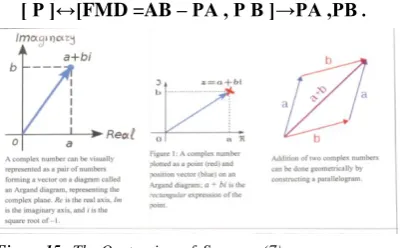
1.b. Straight line AB is discontinuous (discrete) with dimensional Units , ds, as filling (that is made up of finite indivisible parts the Monads ds → AB /n ,where n=1,2,→∞) 1.c. Straight line AB is discontinuous (discrete) with dimensional Units ds , and also continuous in ds with points as filling ,Space ,Anti-space ,Sub-space ,where , ds = quantum= AB / n (where n = 1,2,3 → ∞ , = [ a+b.i] /n = complex number and Infinitively divisible which is keeping the conservation of Properties at End Points A , B ) as filling ,and continuous with points as filling( for n = ∞ then ds = 0 i.e. the point in ds ). i.e
Monads ds = 0 → ∞ are simultaneously ( actual infinity ) and ( potential infinity ) in Complex number form ,and this defines , infinity exists between all points which are not coinciding , and because ds comprises any two edge points with imaginary part then this property differs between the infinite points .This is the Vector relation of Monads , ds , ( or , as Complex Numbers in their general form w = a + b. i ) , which is the Dual Nature of lines ( discrete and continuous ) .
7.1.3. The proposed Physicalsolution
Following Euclidean geometry logic , short definitions and elucidations are made clear, and which are proceed . What is a Point and what is a segment? [10-14]
![Figure 16 . yTheUnit circle of the Polygons – (7) B= [ 2 . R ]](https://thumb-us.123doks.com/thumbv2/123dok_us/1665524.1209252/18.595.48.456.199.504/figure-ytheunit-circle-polygons-b-r.webp)