Copyright1999 by the Genetics Society of America
Meiotic Drive of Chromosomal Knobs Reshaped the Maize Genome
Edward S. Buckler IV,* Tara L. Phelps-Durr,
†Carlyn S. Keith Buckler,
†R. Kelly Dawe,
‡John F. Doebley
§and Timothy P. Holtsford
†*USDA-ARS, Department of Genetics, North Carolina State University, Raleigh, North Carolina 27695-7614,†Division of Biological Science, University of Missouri, Columbia, Missouri 65211,‡Department of Botany and Genetics, University of Georgia, Athens, Georgia 30602 and
§Department of Plant Biology, University of Minnesota, St. Paul, Minnesota 55108
Manuscript received July 6, 1998 Accepted for publication May 13, 1999
ABSTRACT
Meiotic drive is the subversion of meiosis so that particular genes are preferentially transmitted to the progeny. Meiotic drive generally causes the preferential segregation of small regions of the genome; however, in maize we propose that meiotic drive is responsible for the evolution of large repetitive DNA arrays on all chromosomes. A maize meiotic drive locus found on an uncommon form of chromosome 10 [abnormal 10 (Ab10)] may be largely responsible for the evolution of heterochromatic chromosomal knobs, which can confer meiotic drive potential to every maize chromosome. Simulations were used to illustrate the dynamics of this meiotic drive model and suggest knobs might be deleterious in the absence of Ab10. Chromosomal knob data from maize’s wild relatives (Zea mays ssp. parviglumis and mexicana) and phylogenetic comparisons demonstrated that the evolution of knob size, frequency, and chromosomal position agreed with the meiotic drive hypothesis. Knob chromosomal position was incompatible with the hypothesis that knob repetitive DNA is neutral or slightly deleterious to the genome. We also show that environmental factors and transposition may play a role in the evolution of knobs. Because knobs occur at multiple locations on all maize chromosomes, the combined effects of meiotic drive and genetic linkage may have reshaped genetic diversity throughout the maize genome in response to the presence of Ab10. Meiotic drive may be a major force of genome evolution, allowing revolutionary changes in genome structure and diversity over short evolutionary periods.
M
EIOTIC drive is found in many taxa, where it of maize and teosinte (Kato 1976; Figure 1). Knobsordinarily causes the preferential segregation of consist of thousands to millions of tandem 180- and 350-small regions of the genome (Lyttle 1991). Meiotic bp repeats, and they may account for as much as 8% drive is normally portrayed as arising either from the of the genome (Peacock et al. 1981; Ananiev et al. evolution of a drive locus and linked modifiers or from 1998b). Most genetic and evolutionary data on knobs “a direct consequence of intrinsic chromosome struc- were collected with light microscopes, and a small knob ture” (Lyttle 1991). Maize meiotic drive does not as defined by this methodology may have roughly 20,000 readily fall into either category. Our analysis of existing repeats (Peacocket al. 1981). Most 180-bp repeats are data suggests that meiotic drive is the result of rapid found in visible knobs; however, some 180-bp repeats and extensive evolution of drive loci on the Abnormal 10 are distributed and isolated among all chromosomes chromosome (Ab10) and multiple unlinked cytological (at least 100 per chromosome; Ananiev et al. 1998a). features known as knobs. Instead of viewing knobs as This research focuses on the evolution of visible knobs an intrinsic structure of the genome, we test the view (.20,000 repeats) rather than the evolution of isolated that knobs are the products of a genome evolving in knob repeats, as these visible knobs form the functional
response to meiotic drive. neocentromeres necessary for meiotic drive.
Meiotic drive in maize results from an interaction The 180-bp knob sequence has one 68-bp region with between Ab10 and knobs (Rhoades 1942). Chromo- similarity to sequences mapping to maize centromeres somal knobs are large blocks of cytologically visible het- (Burret al. 1992;AlfenitoandBirchler1993). The erochromatin (McClintock1929), which can be found 350-bp repeat has two short segments (,30 bp) with at 34 distinct locations spread across all 10 chromosomes homology to the 180-bp sequence (Ananiev et al. 1998b). Neocentromeric activity is observed only when Ab10 is present and thousands of these repeats form a
knob (Rhoades 1952; Dawe and Cande 1996). The
This manuscript is dedicated to Eleanore Small Buckler (1943–
1998), who introduced her sons and thousands of Virginia school origin and original function of the knob sequences is children to the wonders of science.
unclear. Centromeric origin of knobs is suggested
be-Corresponding author: Edward S. Buckler IV, USDA-ARS, Department
cause they contain one 68-bp motif characteristic of
of Genetics, North Carolina State University, Raleigh, NC 27695-7614.
E-mail: [email protected] maize sequences that map to centromeres. However,
knob, 59% (Kikudome1959). Additionally, when a lo-cus is heterozygous for knobs of different sizes, the larger knob will exhibit preferential segregation over the smaller knob (Kikudome1959). For example, when chromosome 9S is heterozygous for a small knob and a medium knob, the medium knob is preferentially seg-regated 65–70% of the time (Kikudome1959).
On the basis of observations from a few maize races, it appears that races with Ab10 may have more knobs (Longley1945) and that maize knobs are nonrandomly located along chromosomal arms (Longley 1939). These observations suggest that selection might play an important role in knob evolution. We hypothesize that chromosomal knobs are the result of meiotic drive and suggest the following model: (1) A rearrangement in chromosome 10 resulted in complete linkage between repetitive knob DNA and factors that ensure the segre-gation of the knob to the distal megaspores of the mei-otic tetrad, creating a meimei-otic drive system that favored Figure 1.—Chromosomal knob positions in Z. mays ssp.
its own segregation (Ab10). (2) Ab10’s frequency was
parviglumis and ssp. mexicana (Kato 1976). The area of the
determined by the balance between preferential
segre-circle is proportional to the size and frequency of the knob
(knob index). The black internal knobs are unique to popula- gation and the fitness of the permanently linked genes
tions of Z. mays ssp. parviglumis, mexicana, and/or mays, while in Ab10’s rearrangement (Rhoades and Dempsey the gray terminal (telomeric) knobs are found in all Zea spe- 1985). (3) In populations where Ab10 reached modest cies. Ab10’s chromosomal knob is larger than representation
frequencies, strong selection would favor knobs on
mul-in this figure would allow.
tiple chromosomes. Because larger knobs outcompete smaller knobs for preferential segregation (Kikudome 1959), meiotic drive would favor ever larger knobs. (4) subtelomeric origin is supported phylogenetically,
be-cause at least three consecutive outgroups to maize have Knobs should also develop at chromosomal positions that allow high frequencies of preferential segregation. visible knobs only at their telomeres (Randolph1955;
Kato1976;KatoandLopez1990). Two competing constraints could affect knob position.
Recombination between the knob and the centromere Abnormal 10 is an uncommon version of chromosome
10 that has an extended, rearranged long arm, a large is necessary to produce the heteromorphic dyad, which sets the stage for meiotic drive. This process favors knobs knob, and tightly linked factors that cause segregation
distortion (Rhoades and Dempsey 1985; Dawe and in telomeric positions. Counterbalancing this, microtu-bule interactions of centromeres with the knob neocen-Cande 1996). When Ab10 is present, meiotic drive is
observed in megasporogenesis for Ab10 and for any tromeres must be coordinated so that both regions are pulled toward the same pole, a constraint that may favor other chromosome heterozygous for a knob (Rhoades
1942). The average knobbed chromosome of the het- knobs closer to the centromere (Yuet al. 1997; discussed below). (5) Once an efficient and functional knob devel-erozygous pair preferentially segregates to 70% of the
viable megaspores instead of the expected 50% oped on a chromosomal arm, it would be unlikely that
another knob will develop on the same chromosomal (Rhoades1942), although preferential segregation
var-ies from 59 to 82% for different knob sizes and loci arm. (6) Knobs must be slightly deleterious, which pre-vents them from being fixed in most populations. (Longley1945). Preferential segregation occurs when
crossing over between the knob and centromere pro- This hypothesis conflicts with evidence that suggests most repetitive DNA is either neutral or slightly deleteri-duces a heteromorphic dyad (Rhoades 1952). The
chromatids bearing the knobs are pulled toward the ous (Charlesworth et al. 1994). A balance between amplification mechanisms and losses through deletion, spindle poles in meiosis I and eventually toward the
outermost megaspores (Rhoades 1952; Dawe and drift, and unequal crossing over dominates the popula-tion dynamics of most repetitive DNA. The permissive Cande1996), which results in the two outermost
mega-spores having the knobbed chromosomes. The chalazal hypothesis posits that selection is not responsible for the accumulation of repetitive DNA; rather, repetitive (basal) megaspore will become the gametophyte and
produce gametes (BedingerandRussell1994). The and junk DNA accumulate in regions of low recombina-tion as long as the fitness costs of replicating repetitive degree of preferential segregation is positively
associ-ated with the size of the knob; e.g., the knobs on 9S DNA are low. The permissive hypothesis therefore pre-dicts that repetitive DNA should be prevalent in chromo-exhibit the following levels of preferential segregation:
popula-417 Meiotic Drive of Chromosomal Knobs
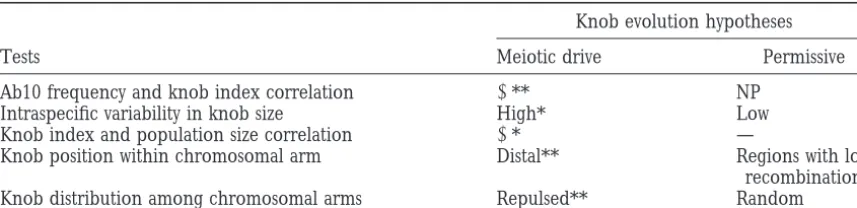
TABLE 1
Predictions and tests of the meiotic drive and permissive hypotheses for knob evolution
Knob evolution hypotheses
Tests Meiotic drive Permissive
Ab10 frequency and knob index correlation 1** NP
Intraspecific variability in knob size High* Low
Knob index and population size correlation 1* —
Knob position within chromosomal arm Distal** Regions with low
recombination
Knob distribution among chromosomal arms Repulsed** Random
NP, the hypothesis makes no prediction for the test.
* Predictions consistent with observations from Z. m. ssp. parviglumis and mexicana. ** Predictions with statistical support (P,0.05).
METHODS
tions with small sizes (Charlesworth et al. 1986;
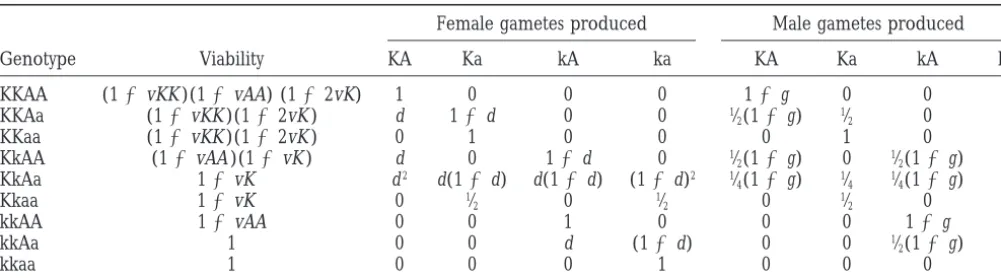
Stephan1987). The permissive hypothesis of knob evo- Model of meiotic drive hypothesis:We used two models of lution suggests that chromosomal knobs are the prod- meiotic drive to illustrate the interactions between Ab10 and
knobs. Viability selection, meiotic drive, recombination, and
ucts of repetitive DNA dynamics without the positive
gametic selection are modeled without drift; mutation,
un-selection of meiotic drive.
equal crossing over, and transposition were not modeled.
Mul-The fitness cost of repetitive DNA is an important
tiple starting allele frequencies were tested to avoid local
min-consideration for either of these hypotheses. The mei- ima or maxima, and recursions of the model were continued otic drive hypothesis provides a positive selection regime until allele frequencies changed,131026per generation. (Ab10) that could favor knob DNA even if knob DNA Model 1 describes the meiotic drive of Ab10 in female
ga-mete production, the meiotic drive effects on an unlinked
were normally deleterious. The permissive hypothesis
knob, and the gametic selection against Ab10 in male pollen
suggests repetitive DNA is either neutral or only slightly
(Table 2). KA is a gamete with a knob and Ab10, while ka is
deleterious. Experimentally evaluating selection on a gamete with no knob and normal 10. vKK is viability reduc-maize knobs, while controlling for closely linked genes, tion of knob homozygotes, vAA is the viability reduction of will require high-resolution maps of maize chromo- Ab10 homozygotes, vA is the viability reduction of individual Ab10 chromosomes, and vK is the viability reduction of
indi-somes and knobs. These resources will only become
vidual knobbed chromosomes. d is the meiotic-drive-based
available over the next 3 to 5 years. Instead, this study
segregation distortion of knobbed chromosomes in the
pres-models how knob fitness reduction and meiotic drive ence of Ab10 (d5 0.5 is Mendelian segregation); g is the could balance to produce knob polymorphisms. We also gametic selection against Ab10 in pollen.
consider how the environment may modify knob and Model 2 describes the competition of two linked chromo-somal knobs (Table 3), where the chromochromo-somal order is
cen-Ab10 fitness and may explain the prevalent
knob-envi-tromere, small knob, and then large knob. When both a large
ronment correlations (Poggioet al. 1998).
and a small knob are on the same heteromorphic dyad, only
We examine the chromosomal evidence in light of the large knob exhibits meiotic drive. The model assumes a both the meiotic drive and the permissive hypotheses constant frequency of Ab10 in the population. Table 3 only (Table 1). The meiotic drive hypothesis predicts that describes megasporogenesis when Ab10 is present, while megasporogenesis without Ab10 and microsporogenesis
fol-increases in Ab10 frequency should result in more
fre-low Mendelian segregation. vLL is viability reduction against
quent and larger knobs, Ab10 frequency will be affected
large-knobbed homozygotes, vL is the viability reduction of
by the environment, knobs should be in optimal chro- individual large-knobbed chromosomes, vSS is viability reduc-mosomal positions for meiotic drive, and knobs should tion against small-knobbed homozygotes, vS is the viability have a repulsed distribution caused by competition be- reduction of individual small-knobbed chromosomes, r1is the recombination distance between the centromere and the
tween knobs. The permissive hypothesis predicts that
small knob, r2is the recombination distance between the small knob repetitive DNA will proliferate in regions with little
knob and the large knob, and m is the probability that a given
recombination and in small populations. With chromo- heteromorphic dyad will result in the knobbed chromosome somal data from the maize’s sister taxa, Zea mays ssp. ending up in the polar megaspore. The double-stranded cross-parviglumis and mexicana, we used phylogenetic compari- overs resulting from single crossovers in r1and r2were mod-eled, but double crossovers within r1or r2were not modeled sons to show that changes in Ab10 frequency are
proba-because of the minor effects on the total model and proba-because
bly the most important determinant of knob frequency
chromosomal interference would reduce the likelihood of
and size, although environment may affect knob
evolu-such a situation.
tion. The cytological distribution of knobs supports the Sampling:Fifty-one populations of Z. mays ssp. parviglumis conclusion that knobs are the products of meiotic drive and mexicana were scored for Ab10, knobs, B chromosomes,
and altitude byKato(1976) using light microscopy. Knobs
TABLE 2
Model for Ab10 and an unlinked chromosomal knob
Female gametes produced Male gametes produced
Genotype Viability KA Ka kA ka KA Ka kA ka
KKAA (12vKK )(12vAA) (122vK) 1 0 0 0 12g 0 0 0
KKAa (12vKK )(122vK ) d 12d 0 0 1⁄
2(12g) 1⁄2 0 0
KKaa (12vKK )(122vK ) 0 1 0 0 0 1 0 0
KkAA (12vAA )(12vK ) d 0 12d 0 1⁄
2(12g) 0 1⁄2(12g) 0
KkAa 12vK d2 d(12d) d(12d) (12d)2 1⁄
4(12g) 1⁄4 1⁄4(12g) 1⁄4
Kkaa 12vK 0 1⁄
2 0 1⁄2 0 1⁄2 0 1⁄2
kkAA 12vAA 0 0 1 0 0 0 12g 0
kkAa 1 0 0 d (12d) 0 0 1⁄
2(12g) 1⁄2
kkaa 1 0 0 0 1 0 0 0 1
Entries in the table are the relative fitness for various gametes and plant genotypes.
in telomeric positions are classified as terminal, while all the Balsas [13], Zmp-East Central Balsas [5]), (Zmp-South Balsas [5], (Zmmx-Nobogame [2], (Zmmx-Chalco [14], Zmmx-Cen-other interstitial knobs are classified as internal. Because the
two cytologically differentiable types of Ab10 (I and II) both tral Plateau [12])))] was based on analyses of isozyme and ribosomal data (Doebleyet al. 1984;BucklerandHoltsford produce meiotic drive, their frequencies were combined in
this analysis (RhoadesandDempsey1985). Type I is found 1996). Zmp is ssp. parviglumis, and Zmmx is ssp. mexicana, while [5] indicates that five accessions were sampled in that in maize, while Types I and II are found in Z. mays ssp.
parvig-lumis and mexicana. A knob index was calculated to reflect the region. The branch lengths were assumed to be unknown. Within each of the six regions, a polytomy (a node with more average number of knob repeats index at each of the 34
chromosomal positions in each population (Brettinget al. than two descendants) was assumed between accessions, be-cause gene flow has probably occurred between the multiple 1987). Knobs were cytologically scored as absent, small,
me-geographically close accessions. Eleven contrasts (one for each dium, or large and given weightings of 0,1⁄
3,2⁄3, and 1,
respec-of the ancestral nodes) were calculated for each respec-of the 34 tively. The knob index for a population is the sum over all
knob loci. Because the contrasts were not normally distributed, size classes of the knob frequency in a population times the
Wilcoxon’s signed-rank test was used to evaluate the associa-weighting for the size of the knobs.
tions between the contrasts (SokalandRohlf1995). Sample The environment may be related to repetitive DNA fitness
sizes were sometimes small for individual accessions or individ-(Poggioet al. 1998). Plants at high altitudes have short
grow-ual knobs; therefore the overall strength of the Ab10-knob ing seasons, rapid developmental rates, and take fewer days
correlation was estimated by averaging the individual contrasts to flower. Days to flowering and altitude have been measured
for all knob positions and by excluding the six within-region for 15 central Mexican populations (Wilkes1967), and
regres-comparisons, where phylogenetic independence was dubious sion between altitude and time to flowering explained much
due to hybridization. of the variation (r2562%, P,0.001). For the 49 populations
For comparison purposes, we also examined these correla-found in central Mexico, altitude is closely related to the
tions without accounting for phylogeny. This might be an length of the growing season; two populations in northern
acceptable model, because many of the populations probably Mexico (Nobogame) are outliers in this regression, which is
diverged from one another at approximately the same time. otherwise based on central Mexican populations. To account
Spearman’s coefficient of rank correlation was used because for latitudinal effects on time to flowering, we used the
regres-some of the variables were not normally distributed (Sokal sion equation and data on Nobogame population time to
andRohlf1995). flowering (Wilkes1967) to derive a central Mexican altitude
proportional to their flowering time and environment (alti-tude is 3487 m).
RESULTS AND DISCUSSION
Phylogenetic contrasts:The population frequencies of Ab10 and knobs should not be directly correlated, because the
num-Ab10 and knobs in teosintes:Ab10 is found in 37% of
ber of independent comparisons depends on the populations’
the populations of Z. mays ssp. parviglumis and mexicana.
shared evolutionary history (Felsenstein 1985). By using a
phylogenetic tree and by calculating the differences in knob Within those populations, Ab10 ranges in frequency up
and Ab10 frequencies between the immediate descendants of to 50% with an average frequency of 14%. Knobs were an ancestor, we can compare the changes in knob and Ab10 highly variable in frequency and size in all populations. frequencies that occurred during these periods of
indepen-The knob index ranged from 0.03 to 0.25 with an
aver-dent evolution. Phylogenetic indepenaver-dent contrasts (Purvis
age of 0.15. For a scale of reference, a knob index of
and Rambaut1995) were used to evaluate correlations
be-tween Ab10, altitude, and knob indexes. This hierarchical 0.15 is equivalent to being homozygous for small knobs
phylogenetic approach is appropriate for these wild Z. mays at 15 of the 34 knob positions.
populations because analysis of isozyme data suggested dis- Why is Ab10 uncommon despite meiotic drive? De-persal, rather than subsequent hybridization, was most
impor-spite strong meiotic drive, Ab10 is uncommon in
popu-tant in determining the population structure of ssp. parviglumis
lations perhaps because of gametic selection against
and mexicana (E. S. Buckler, T. P. HoltsfordandJ. F.
419
Meiotic
Drive
of
Chromosomal
Knobs
TABLE 3
Model of two linked chromosomal knobs during female meiosis with Ab10 present
Female gametes produced
Genotype Viability sL Sl sL sl
SSLL (12vLL)(12vSS)(122vL)(122vS) 1 0 0 0
SSLl (12vSS)(12vL)(122vS) r1(12r2)m r1(12r2)(12m) 0 0
1(12r1)r2m 1(12r1)r2(12m)
11⁄
4r1r2(112m) 11⁄4r1r2(322m)
11⁄
2(12r1)(12r2) 11⁄2(12r1)(12r2)
SSll (12vSS)(122vS) 0 1 0 0
SsLL (12vLL)(122vL)(12vS) 1⁄
2 0 1⁄2 0
SL/sl (12vL)(12vS) r1(12r2)m 1⁄2(12r1)r2(12m) 1⁄2(12r1)r2m r1(12r2)(12m)
11⁄
2(12r1)r2m 11⁄4r1r2 11⁄8r1r2(112m) 11⁄2(r1r2)12m)
11⁄
8r1r2(112m) 11⁄2(r1r2)(12m)
11⁄
2(12r1)(12r2) 11⁄2(12r1)(12r2)
Sl/sL (12vL)(12vS) 1⁄
2r2(12r1)m r1(12r2)m r1(12r2)m 1⁄2r2(12r1)(12m)
11⁄
8r1r2(112m) 11⁄2r2(12r1)(12m) 11⁄2r2(12r1)m 11⁄2r1r2(12m)
11⁄
4r1r2 11⁄8r1r2(112m)
11⁄
2(12r1)(12r2) 11⁄2(12r1)(12r2)
Ssll (12vS) 0 r1(12r2)m 0 r1(12r2)(12m)
11⁄
2(12r1)r2 11⁄2(12r1)r2
1r1r2m 1r1r2(12m)
11⁄
2(12r1)(12r2) 11⁄2(12r1)(12r2)
ssLL (12vLL)(122vL) 0 0 1 0
ssLl (12vL) 0 0 r1(12r2)m r1(12r2)(12m)
1r2(12r1)m 1r2(12r1)(12m)
11⁄
4r1r2(112m) 11⁄4r1r2(322m)
11⁄
2(12r1)(12r2) 11⁄2(12r1)(12r2)
ss11 1 0 0 0 1
Figure2.—Simulation results of Ab10 and an unlinked knob (model 1, Table 2). Frequency of the Ab10 or the knob is noted by shading. (A) Ab10 frequency with various meiotic drive (d) and gametic selection (g) values and no homozygous viability reduction; vAA50. (B) Ab10 frequency with various meiotic drive (d) and gametic selection (g) values and homozygous viability reduction; vAA50.10. (C) Unlinked knob frequency for various intensities of viability reduction by knob homozygotes (vKK ) and viability reduction from individual knobbed chromosomes (vK ); d50.70, g50.37, vAA50.10.
the interaction between meiotic drive, gametic selec- Although individual knob loci exhibited high varia-tion in response to Ab10, the phylogenetic contrasts for tion, and viability reduction. Ab10 meiotic drive and
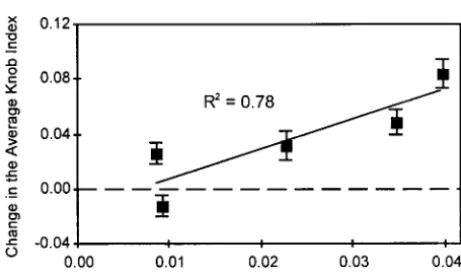
gametic selection can result in an evolutionary stable the 34 loci showed a strong positive association between the knob index and Ab10 frequency (Table 4). The polymorphism of Ab10 (Figure 2A). If Ab10
homozygos-ity reduces viabilhomozygos-ity, then an even wider range of meiotic change in the genome-wide knob index was strongly correlated with the change in Ab10 frequency (Figure drive and gametic selection values can produce a stable
Ab10 polymorphism (Figure 2B). 3). The nonphylogenetic approach also indicated a
sig-nificant correlation (Table 4). Hence, these sigsig-nificant Ab10 meiotic drive varies depending on genetic
back-ground and growth conditions (d 5 0.50 to 0.75; associations and correlations between Ab10 frequency and the knob index supported the meiotic drive hypoth-Rhoades 1942;Kikudome1959). The theoretical
esti-mates of male gametic selection fall near the range of esis.
Genetic experiments suggest multiple B (accessory) field observations for Ab10 type I (g 5 0.09 to 0.27;
Rhoades 1942); however, the cytologically different chromosomes can cause the loss of knobbed chromo-somes (RhoadesandDempsey1972); therefore, we also type II version of Ab10 has full male gametic fitness in
the one maize background tested (RhoadesandDemp- considered whether B chromosomes had a confounding evolutionary effect on knobs. B chromosomes have no sey 1988). We have no estimate of viability reduction
by homozygous Ab10, but it is likely that the rearranged significant association with the knob index or Ab10 (Ta-ble 4), and therefore B chromosomes probably do not end on chromosome 10 carries fixed deleterious
reces-sive alleles. These empirical estimates of Ab10 meiotic have a large influence on knob frequency or size over evolutionary time. The lack of correlation between B drive (s) and gametic selection (g) are in rough
agree-ment with the values that produce polymorphic popula- chromosomes and Ab10 was expected; all B chromo-somes have the same knob, and therefore heteromor-tions for Ab10 as predicted by Model 1 (Figure 2, A and
B). This persistence of meiotic drive in maize sets the phic dyads are impossible.
Are knobs slightly deleterious?The simulation of
mei-stage for knobs to develop on all chromosomes.
Is Ab10’s meiotic drive responsible for the frequency otic drive model 1 indicates that knobs will rapidly go
to fixation in Ab10 populations unless the knobs slightly
and size of knobs inZ. mays?When Ab10 is present in
a population, model 1 (Table 2) simulations indicate reduce plant viability (Figure 2C). Viability reduction (vK or vKK ) on the order of 0.03 is sufficient to maintain unlinked chromosomal knobs will obtain very high
fre-quencies (Figure 2C). Over evolutionary time, the mei- polymorphism when d50.70; however, lower levels of viability reduction (vK 5 0.01) would be required to otic drive hypothesis suggests populations with high
fre-quencies of Ab10 should develop higher frefre-quencies of maintain polymorphism for small knobs exhibiting less drive (d50.59;Kikudome1959). Twelve of the 34 knob larger knobs. The best approach to evaluate this
predic-tion of knobs and Ab10 evolupredic-tion is to compare popula- loci are found to be fixed in some populations of Z. mays ssp. parviglumis or mexicana, but most knobs are tions that have been separated long enough for
differ-ences in knob and Ab10 frequencies to have evolved. not fixed within populations. Therefore, if the meiotic drive hypothesis is correct, the knobs of many loci must Maize’s closest relatives (Z. mays ssp. parviglumis and ssp.
mexicana) were used for the phylogenetic comparisons, be slightly deleterious to prevent their fixation. The permissive hypothesis also suggests that large regions of because their populations have probably migrated and
hybridized less than domesticated maize. The maize repetitive DNA might be slightly deleterious.
In the absence of Ab10, knobs may be deleterious knob constitution is a subset of the variability found
421 Meiotic Drive of Chromosomal Knobs
TABLE 4
Correlations between the knob index, Ab10, B chromosomes, and altitude
Phylogenetic independent contrasts
Nonphylogenetic Signed-rank test
Pearson correlation of associationa Spearman correlation
Knob index w/ R P (N55) Direction P (N5374) R P (N552)
Ab10 Freq. 0.896 ,0.05 1 2.631027 0.366 ,0.01
B Freq. 0.051 NS 1 0.520 20.132 NS
Altitude 20.796 NS 2 2.931024 0.247 NS
Ab10 Freq. w/ R P (N55) Direction P (N511) R P (N552)
B Freq. 0.386 NS 1 NS 20.166 NS
Altitude 20.919 ,0.05 2 NS 20.114 NS
NS, not significant.
aContrasts in which there was no difference between the independent variables were excluded from this
test of association.
chromosomal knobs in maize (Pryor et al. 1980). There are several avenues by which knob loci could be slightly deleterious, but this will remain unproven Higher frequencies of multiple bridges have been found
in plants with large numbers of chromosomal knobs until experiments on natural populations examine knob fitness and control for linked loci.
(FluminhanandKameya1997), and these bridges were
especially common in plants that were germinated from Does the environment determine the distribution of
chromosomal knobs?According to a recent review by
seeds maintained in wild-like conditions (18 mo at 258).
Most of the chromosomal breaks appeared to occur Poggioet al. (1998), most studies have found negative correlations between genome size and altitude, between adjacent to or proximal to chromosomal knobs. This
could create somaclonal variants and inviable seedlings, knobs and altitude, and between knobs and latitude. This suggests knobs might be more deleterious in cer-which could directly reduce viability. These mitotic
ab-normalities may be related to the late replication of tain environments. However, these studies have not con-sidered Ab10 frequency or the phylogenetic history of knob heterochromation relative to all other chromatin
(Pryoret al. 1980;LeeandPhillips1988;Fluminhan the samples. Altitude and latitude are both related to the developmental rate of maize and teosinte. This selec-andKameya1997). Alternatively, individual knob loci
may also be slightly deleterious because of their position tion for rapid mitotic cycles might favor smaller genome sizes and selection against repetitive DNA, while slower relative to other genes. Knobs may be in linkage
disequi-librium with deleterious neighboring genes and/or the development would permit larger genome sizes. Evi-dence supporting this hypothesis has been found in heterochromatin of knobs might deleteriously affect the
expression of neighboring genes. animals (PagelandJohnstone1992). In plants there
is far more intraspecific variation in genome size, and the proximate causes of associations between genome size, the environment, and development are unclear (Bennett 1985; Laurie and Bennett 1985; Porter and Rayburn 1990; Reeves et al. 1998). In addition, some of the claims for plant intraspecific genome size variation are being questioned (Greilhuber 1998).
To examine the connection between the environ-ment and knobs, altitude and the knob index were cor-related (Table 2). There was a significant negative rank association between altitude and the knob index but no significant linear correlation (Table 2). This suggests that there is a possible connection between the knobs and the environment. Alternatively, altitude may modify Figure3.—Regression between the phylogenetic indepen- Ab10’s distribution, and in turn, the Ab10 distribution
dent contrasts of knob indexes averaged over all loci and Ab10 is responsible for the correlation between altitude and frequency indicate the increases in Ab10 may have caused
the knob index. Ab10 frequency was significantly
nega-increases in knob frequency and size. The regression line is
tively correlated with altitude in one but not all the
significant at P,0.05; error bars indicate the standard error
between altitude and knob size and frequency may result from selection on knobs or on Ab10.
The distribution of knobs and/or Ab10 appears to vary with environment. The environmental connection could be explained by at least two alternatives: selection on knobs themselves or on loci linked to Ab10’s re-arrangement.
1. Knob DNA replicates very late relative to euchroma-tin and most heterochromaeuchroma-tin, and it is likely that
knobs lengthen the S phase (Pryoret al. 1980). This Figure4.—The chromosomal position of knobs relative to slow replication could slow cell division and plant the centromere. Distances from the centromere are approxi-mate positions measured byKato(1976) during the
pachy-development, selecting against knobs at high
alti-tene stage. Frequencies of knobs were based on the knob
tudes or latitudes. This effect could be even more
index averaged for all populations of Z. mays ssp. parviglumis
substantial for Ab10, which has 1 million knob
re-and mexicana. Terminal knobs are found at the telomeres,
peats (Peacock et al. 1981). while internal knobs are interstitial. The frequency of internal
2. The associations between Ab10 and altitude could plus terminal knobs sums to one. The random expectation
is the expected distribution of knobs if they were randomly
also be directly produced by the fitness consequences
distributed along chromosomal arms.
of the many genes permanently linked to the knob and meiotic drive factor through Ab10’s rear-rangement. One gene that is probably in Ab10’s
re-sis suggests knobs should be favored most effectively arrangement is a maize quantitative trait locus (QTL)
when drift is small relative to the selection of meiotic for flowering time (Koester et al. 1993). Further
drive; i.e., in large populations. Genetic diversity deter-research is needed to refine this QTL’s exact
posi-mined from isozymes is the best available estimate of tion. This QTL is probably in other Zea taxa, because
effective population size for these taxa (Doebleyet al. an orthologous QTL is also present in Sorghum (Lin
1984). Only 12 populations have both isozyme estimates et al. 1995).
of genetic diversity and knob estimates. For those popu-lations, there is a nonsignificant positive correlation be-Observations from domesticated maize suggest
Ab10’s environmentally related distribution, rather tween the knob index and genetic diversity (Spearman r 5 0.447, n 5 12, P . 0.10). At a higher taxonomic than developmental selection, produces the associations
between knob frequency and altitude. Ab10 is found level, the internal knobs are prevalent in the high diver-sity (large population size) taxa of Z. mays ssp. parvig-extensively throughout maize races of Mexico, and these
populations have the greatest numbers of knobs lumis (HT 5 0.311) and mexicana (HT 5 0.287), while
they are nonexistent in the low diversity (small popula-(McClintocket al. 1981). In contrast, many equatorial
races have lower knob and Ab10 frequencies (McClin- tion size) taxa of Z. mays ssp. huehuetenangensis (HT 5 0.173) and Z. luxurians (HT 5 0.155). Both of these tocket al. 1981). The lowland-Mexican maize race
Zapa-lote Chico has the largest measured genome size and a observations are more consistent with the predictions of the meiotic drive hypothesis rather than the permissive rapid developmental rate, which argues against genome
size being directly related to development (Well- hypothesis.
Does the permissive hypothesis predict the
chromo-hausenet al. 1952;LaurieandBennett1985).
Zapa-lote Chico also has an extremely high knob index (0.25) somal position of knobs? Originally the nonrandom distribution of knobs was thought to result from certain and very high Ab10 frequencies (Ab10 frequency 5
0.25;McClintocket al. 1981). This suggests that Ab10, chromosomal regions being able to efficiently “collect knob material” (Longley1939). We now know knobs rather than developmental rate, is more important for
the evolution of internal knobs. are heritable blocks of repetitive DNA. The
chromo-somal distribution of knobs was studied by plotting the Environmental conditions are related to the
distribu-tion of knobs, which suggests knob fitness is somehow proportion of knobs at various distances from the cen-tromere (Figure 4). The proportion of knobs was based related to the environment. We cannot rule out that
selection on repetitive copy number may produce this on the knob index for each locus relative to the total knob index for all loci averaged for all 51 populations. pattern, but a more likely possibility is that Ab10’s fitness
is directly related to the environment, and the knob Distances from the centromere are approximate posi-tions measured by Kato(1976) during the pachytene association is indirect.
Does population size predict the knob index? The stage and were scaled to the average length of 1L (46.32
mm) measured by Longley (1939). These data allow permissive hypothesis predicts that repetitive DNA
should be most prevalent in small populations where us to compare the different predictions of the meiotic drive and permissive hypotheses for the optimal location drift is more important than selection against repetitive
423 Meiotic Drive of Chromosomal Knobs
Cytologically visible knob positions appear to have somal position of knobs? The positions of knobs in dramatically changed during the evolution of Zea. Most maize, ssp. mexicana and parviglumis contradict the per-Zea species and the sister genus Tripsacum have exclu- missive hypothesis, but do they agree with the meiotic sively telomeric knobs on almost every chromosome drive hypothesis? The meiotic drive hypothesis predicts arm, but they have no Ab10 (Kato 1976; Kato and that knobs will form in positions that maximize their Lopez1990). However, the taxa with Ab10 (maize, ssp. chances of being transmitted to progeny through mei-mexicana and parviglumis) have 28 of their 34 knob posi- otic drive. First, crossovers must occur between the knob tions in distal, but not telomeric, positions. Phylogenetic and centromere to produce the heteromorphic dyad analysis with Zea taxa and Tripsacum indicated that necessary for preferential segregation (Rhoades and these 28 internal knob positions in maize and Z. mays Dempsey1966). One crossover is necessary between the ssp. parviglumis and mexicana represent the derived or centromere and knob; however, a large proportion of advanced state. Z. diploperennis is an exception because higher order crossovers will also produce heteromor-it has only terminal knobs and populations have been phic dyads. Assuming the location of crossovers is bino-identified with Ab10 (KatoandLopez1990); however, mially distributed, a knob would end up in a
heteromor-the Type I Ab10 in Z. diploperennis might result from phic dyad 40% of the time at 30 cM from the
the extensive recent introgressions that occur between centromere, 59% at 70 cM, and 66% at an infinite dis-Z. diploperennis and Type I Ab10 containing maize lines tance. The optimal efficiency for this preferential segre-(Buckler andHoltsford1996). gation system could be 83%, if heteromorphic dyads Unequal crossing over can produce variation in repet- can be formed 66% of the time and the knobbed chro-itive DNA array size, such that drift or selection can mosomes experience 100% preferential segregation easily eliminate neutral or slightly deleterious repetitive (m51.0) and homomorphic dyads exhibit normal seg-DNA in regions with high levels of recombination regation [(1.030.66)1(0.530.33)50.83]. There-(Charlesworthet al. 1986). The permissive hypothesis fore, the meiotic drive hypothesis predicts that knobs predicts that most repetitive DNA should be in regions will be preferentially found on the distal halves of chro-of low recombination and little unequal crossing over mosomes (Figure 4). Second, it has been suggested that such as telomeres and centromeres. The positions of Zea during chromosome alignment, neocentromeres must telomeric knobs agree with this permissive hypothesis apply tension to linked centromeres to ensure the coor-prediction. In addition, the absence of frequent
un-ientation of the two structures at metaphase (Yuet al. equal crossing over should result in repetitive DNA
1997). The effect of a poleward-moving neocentromere arrays that exhibit little intraspecific size variation
on the orientation of a linked centromere would be (Charlesworthet al. 1994). However, the 28 internal
most pronounced when the neocentromere and centro-knob positions are unlikely to be the product of the
mere were in close proximity. Our expectation is that permissive process, as two points suggest there is no
coorientation is under strong selection. In the absence general reduction in levels of recombination.
of coorientation, the dicentric (centric-neocentric) 1. Genetic experiments using flanking markers indicate chromosomes would be subject to chromosome
bridg-that knobs affect recombination, but they can either ing, breakage, and loss (e.g.,McClintock1943). decrease or increase recombination depending on The idea that there is an optimum knob position for the position of the knob, the size of the knob, and meiotic drive is supported by a reevaluation of experi-heterozygosity or homozygosity (Kikudome 1959; mental data for the 3L knob (Rhoades and Dempsey Rhoades and Dempsey 1966). The knobs can in- 1966).RhoadesandDempsey’s (1966) work used inver-crease recombination by 36% or reduce it by 63% sions on chromosome 3L to examine preferential segre-depending on the exact case (Kikudome 1959; gation. The normal knob is at a physical position of Rhoades and Dempsey 1966). There does not ap- 0.6 on 3L. Inversion In3a results in the knob being pear to be any general pattern of suppression of positioned distally at 0.75, and inversion In3b moves the recombination by knobs themselves; however, Ab10 knob proximally to 0.45. We compared the frequency of does consistently increase recombination proximal preferential segregation among testcrosses with knobs
to knobs (see below). at these three positions, while Ab10 and 3L knobs were
2. The tremendous within-population variation in knob heterozygous. Preferential segregation of the 3L knob size (Kato 1976) suggests recombination and un- is most efficient near its present position (recovered in equal crossing over is frequent within knobs, al- 71% of testcross progeny; crosses 4, 5, and 11). Inversion though direct molecular evidence of recombination 3a brings the 3L knob to a more distal position and within a knob is not available. Thus, there is no gen- strongly reduced preferential segregation (62% in cross eral evidence of recombination suppression by 20; compared to normal, test of independence indicated knobs, which could support the permissive
hypoth-G557.6, d.f.51, P53310214). In contrast, inversion esis.
3b brings the 3L knob to a more proximal position and also slightly reduces preferential segregation (67% in
chromo-cross 14; compared to normal, G5 12.0, d.f.51, P5 0.0005).
This balance between selection for increased recom-bination and for coorientation of knobs and centro-meres should result in knobs being clumped at an opti-mal distance if meiotic drive is responsible for their evolution. To test whether knob chromosomal position within the arms was nonrandom, we compared the ob-served distribution of 34 knob positions to a distribution that assumed knobs should be uniformly distributed
Figure 5.—Simulation results of linked large and small
across the length of all the chromosomal arms using a
knobs (model 2, Table 3) for various levels of viability
reduc-Kolmogorov-Smirnov test for goodness of fit (Sokal tion against the large knob (vL) and the small knob (vS). andRohlf 1995). Knob positions were not uniformly Only in the black region did both the large and small knobs
segregate together in the same population, otherwise either
distributed along the chromosomal arms
(Kolmogorov-one or both of the knobs became extinct. The fixed
parame-Smirnov test; D50.468, n534, P,0.001). To
deter-ters are as follows: r150.3, r250.3, vLL5vSS50.02, m5 mine whether the knobs were segregated to telomeric
0.9, freq(Ab10)50.12.
or centromeric ends of the chromosomal arm, we com-pared the positions of the 34 knobs to the mean
chromo-somal distance from the centromere with a t -test (Sokal erochromatin (e.g., Robertson 1968; Rhoades and Dempsey1970;Nel1973). This magnification of recom-andRohlf1995). Half of the genome is within 14mm
of the centromere, but the knobs were significantly dis- bination by Ab10 permits high frequency heteromor-phic dyad formation even for the internal knobs. tal to this midpoint (based on Student’s t -test; t510.26,
n534, P55.9310212), with a distinct modal distance Do chromosomal knobs compete within a
chromo-somal arm? Meiotic drive predicts that chromosomal
of z25mm from the centromere (Figure 3). The six
terminal knob positions were found only on short chro- knobs may compete against one another on the same chromosomal arm, because only the largest knob is pref-mosomal arms with lengths ,28 mm (Figure 1). The
inversions on 3L suggested physical boundaries between erentially segregated (Kikudome1959). Simulations of model 2 (Table 3) indicate that only if the viability which high levels of preferential segregation were found
(In3a knob ≈31mm from the centromere; In3b knob reductions of both knobs are carefully balanced do they allow for multiple knobs segregating per chromosomal
≈19mm). Only 28% of the genome is between 19 and
31mm from the centromere; however, 82% of the knob arm (Figure 5). This occurs because the smaller knob reduces viability constantly; however, the smaller knob index and 71% of the knob sites fall between these
boundaries. Knob sites were significantly overrepre- experiences meiotic drive only in the uncommon situa-tion when the large knob is absent. If the small knob sented in this physical region, with high preferential
segregation potential (G 525.97, d.f. 5 1, P5 3.4 3 were closer to the large knob (e.g., r15 0.5, r2 50.1), then the parameter space of both knobs segregating 1027). These observations agree with the meiotic drive
hypothesis. One alternative to explain this positional slightly increases. Even when two knobs are segregating on a single arm, the smaller knob increasing in size bias is that centromeric heterochromatin obscures the
cytological identification of the knobs near the centro- could quickly result in only one knob present on the arm.
mere. This possibility is refuted by in situ hybridization
experiments that demonstrate the vast majority of knob Thus the first functional knob to develop on a chro-mosome in a favorable position is likely to outcompete repeats are restricted to the cytologically observed
posi-tions (Peacock et al. 1981; R. K. Dawe, unpublished other linked knobs. Therefore, knobs should have a uniform or repulsed distribution among arms. The ob-results).
Unfortunately, the genetic positions of most knobs served distribution indicates there is generally one fre-quent position per arm (Figure 1), while only the short-are unknown, but we can make minimum estimates
for the terminal knobs and rough estimates for a few est chromosomal arms have no knobs. To test whether knobs were repulsed from each other, we calculated a internal knobs based on translocation breakpoints
(Maize genome database, www.agron.missouri.edu). coefficient of dispersion (CD) for the number of knob positions per arm (Sokal and Rohlf 1995). The sig-The six terminal knobs average 68 cM from the
centro-mere; the internal knobs (1L1, 1S2, 2S1, 3L1) have a nificance of the CD was evaluated by randomly placing 34 knobs on 20 arms with a uniform probability per minimum distance of 37 cM and a rough average of 55
cM. In addition, Ab10 encodes a function that strongly arm (1000 randomizations). The actual distribution of knobs was significantly repulsed relative to the random increases recombination up to twofold in the regions
proximal to the knobs (Kikudome1959;Rhoadesand distribution according to the CD (CD5 0.50, n5 34, P50.039). Only chromosome 6 violates this pattern. 6L Dempsey 1966), which may partially result from
425 Meiotic Drive of Chromosomal Knobs
organizing region that appears to preclude knobs or that can rapidly and extensively modify the genome and knob repeats from this arm (Kato1976;Peacocket al. even create novel genomic structures. Genome-wide 1981). The knobs are spread out on 6L, which may have meiotic drive can develop rapidly; for example, cytologi-allowed more knobs to evolve; however, repulsion still cally visible internal knobs have evolved subsequent to appeared to occur between these knobs. We used phylo- the Z. mays divergences within the last 100,000 years. genetic independent contrasts between the knobs to Meiotic drive may be an ephemeral system, which rap-test for repulsion. Knob 6L1 is negatively associated with idly results in either fixation or extinction of the “driver” knob 6L2 (Wilcoxon’s signed-rank test Ts5 0, n 5 7, genes. However, while meiotic drive persists, strong se-two-tailed P50.016), while the neighboring knobs 6L2 lection for ever better knobs (larger knobs with better and 6L3 do not show a consistent association. The mei- positions) has probably affected thousands of knob-otic drive hypothesis predicts this consistent pattern of linked loci. The combination of selection and linkage repulsion, while neutral theories might expect a more disequilibrium between knobs and tightly linked genes
random distribution. may have caused linked genes to lose diversity. Future
Other genetically untested theories could also con- large-scale diversity surveys will allow this prediction to tribute to knob competition. First, the knob closest to be tested. The powerful effect of Ab10 on knobs calls the centromere could dominate the coorientation of into question the phylogenetic utility of knobs for exam-the centromere, and this could favor internal knobs. ining the divergence patterns of maize races, as the Second, depending on the timing of crossovers and the spread of knobs would depend tremendously on Ab10. microtubule attachment to knobs, multiple knobs on The presence of the knob heterochromatin throughout an arm could result in a chromosomal arm being pulled the genome may also modify the expression of genes
apart. neighboring knobs. Furthermore, meiotic drive may
Transposition of knob sequences:Internal knobs ap- have retarded selection from effectively evaluating the
pear to be a derived state, so how did the knobs get to organismal-level fitness of the knob-linked genes. In these internal positions? Translocations are probably deep time, meiotic drive systems that interact with the not responsible for the movement of knobs, because cytoskeleton may be very important in creating genomic chromosome structure and linkage relationships are structures such as centromeres and dispersed tandem similar among Zea species (Randolph 1955; Kato arrays (satellite DNA); i.e., satellite DNA may be the 1976). Transposition of individual repeats or large tan- remnant of ancient episodes of meiotic drive.
dem arrays seems most likely, and they have been char- Conclusions:The existence, frequency, size, and posi-acterized as megatransposons (Ananiev et al. 1998b). tion of knobs agree with the theory that Ab10 is responsi-Knobs have several transposon-like characteristics. In- ble for their evolution (Table 1). The permissive theory verted 350-bp repeats have been found, which could of repetitive DNA evolution cannot explain the rapid form fold-back DNA elements (Ananievet al. 1998b). evolution or the position of the 28 cytologically visible Full-length retroposons have been found interspersed internal knob positions. The environment may affect within chromosomal knobs (Ananievet al. 1998a).
Ad-the evolution of knobs but it is unclear wheAd-ther this ditionally, we discovered that individual 180-bp repeats
occurs through selection against knobs or through selec-can form highly stable fold-back-like structures that are
tion on Ab10. Knobs are also an important example of significantly more stable than random sequences with
repetitive DNA being favored by selection. Meiotic drive the same composition (E. S. Buckler,unpublished
re-appears to have played an important role in structuring sults).
the maize genome. These fold-back characteristics of knob repeats may
We thank J. Birchler, J. Kermicle, and S. Muse for critically
dis-have facilitated the transposition of knob repeats
cussing these ideas. We also appreciate the input by O. Hoekenga,
throughout the genome. Additionally the associated
ret-E. Kaszas, M. Wanous, A. Clark, and an anonymous reviewer. This
roposons may have moved knob repeats throughout the research was supported by a University of Missouri Maize Training genome. The initial movement of knob repeats probably Program fellowship (a unit of the DOE/NSF/USDA Collaborative has little to do with meiotic drive, but it established Research in Plant Biology Program) and a National Institutes of Health
postdoctoral fellowship to E.S.B.
knob repeats throughout the genome for meiotic drive to work upon. After transposition, an increase of knob repeats in favorable chromosomal positions could be
accomplished via unequal crossing over or in situ ampli- LITERATURE CITED
fication, eventually giving rise to a cytologically visible
Alfenito, M. R.,andJ. A. Birchler,1993 Molecular
characteriza-knob with thousands of repeats. Although size variability tion of a maize B chromosome centric sequence. Genetics 135: normally leads to stochastic loss of repeats, the combina- 589–597.
Ananiev, E. V., R. L. PhillipsandH. W. Rines,1998a Complex
tion of size variability with positive selection from
mei-structure of knob DNA on maize chromosome 9: retrotransposon
otic drive can lead to larger arrays of repetitive DNA.
invasion into heterochromatin. Genetics 149: 2025–2037.
Genomic implications of knob evolution: Chromo- Ananiev, E. V., R. L. PhillipsandH. W. Rines,1998b A
knob-associated tandem repeat in maize capable of forming fold-back
DNA segments: are chromosome knobs megatransposons? Proc. Nel, P. M.,1973 The modification of crossing over in maize by extraneous chromosomal elements. Theor. Appl. Genet. 43: 196– Natl. Acad. Sci. USA 95: 10785–10790.
Bedinger, P.,andS. D. Russell,1994 Gametogenesis in maize, pp. 202.
Pagel, M.,andR. A. Johnstone,1992 Variation across species in 48–61 in The Maize Handbook, edited byM. Freeling and V.
Walbot.Springer-Verlag, New York. the size of the nuclear genome supports the junk dna explanation for the c-value paradox. Proc. R. Soc. Lond. Ser. B Biol. Sci. 249:
Bennett, M. D.,1985 Intraspecific variation in DNA amount and
the nucleotypic dimension in plant genetics, pp. 283–302 in Plant 119–124.
Peacock, W. J., E. S. Dennis, M. M. RhoadesandA. J. Pryor,1981
Genetics, edited byM. Freeling.Alan R. Liss, New York.
Bretting, P. K., M. M. GoodmanandC. W. Stuber,1987 Karyologi- Highly repeated DNA sequence limited to knob heterochomatin in maize. Proc. Natl. Acad. Sci. USA 78: 4490–4494.
cal and isozyme variation in West Indian and allied American
mainland races of maize. Am. J. Bot. 74: 1601–1613. Poggio, L., M. Rosato, A. M. ChiavarinoandC. A. Naranjo,1998 Genome size and environmental correlations in maize (Zea mays
Buckler, E. S., IV, andT. P. Holtsford, 1996 Zea systematics:
ribosomal ITS evidence. Mol. Biol. Evol. 13: 612–622. ssp. mays, Poaceae). Ann. Bot. 82: 107–115.
Porter, H. L.,andK. L. Rayburn,1990 B-chromosome and c-band
Burr, B., F. A. Burr, E. C. MatzandS. J. Romero,1992 Pinning
down loose ends mapping telomeres and factors affecting their heterochromatin variation in Arizona maize populations adapted to different altitudes. Genome 33: 659–662.
length. Plant Cell 4: 953–960.
Charlesworth, B., C. H. Langleyand W. Stephan,1986 The Pryor, A., K. Faulkner, M. M. RhoadesandW. J. Peacock,1980 Asynchronous replication of heterochromatin of maize. Proc. evolution of restricted recombination and the accumulation of
repeated DNA sequences. Genetics 112: 947–962. Natl. Acad. Sci. USA 77: 6705–6709.
Purvis, A.,andA. Rambaut,1995 Comparative analysis by
indepen-Charlesworth, B., P. SniegowskiandW. Stephan,1994 The
evo-lutionary dynamics of repetitive DNA in eukaryotes. Nature 371: dent contrasts (CAIC): an Apple Macintosh application for analys-ing comparative data. Comput. Appl. Biosci. 11: 247–251. 215–220.
Dawe, R. K.,andW. Z. Cande,1996 Induction of centromeric activ- Randolph, L. F.,1955 Cytogenetic aspects of the origin and evolu-tionary history of corn, pp. 16–61 in Corn and Corn Improvement, ity in maize by suppressor of meiotic drive 1. Proc. Natl. Acad. Sci.
USA 93: 8512–8517. edited byG. F. Sprague.Academic Press, New York.
Reeves, G., D. Francis, M. S. Davies, H. J. RogersandT. R. Hodkin-Doebley, J. F., M. M. GoodmanandC. W. Stuber,1984
Isoenzy-matic variation in Zea (Gramineae). Syst. Bot. 9: 203–218. son,1998 Genome size is negatively correlated with altitude in natural populations of Dactylis glomerata. Ann. Bot. 82: 99–105.
Felsenstein, J., 1985 Phylogenies and the comparative method.
Am. Nat. 125: 1–15. Rhoades, M. M.,1942 Preferential segregation in maize. Genetics
27:395–407.
Fluminhan, A.,andT. Kameya,1997 Involvement of knob
hetero-chromatin in mitotic abnormalities in germinating aged seeds Rhoades, M. M.,1952 Preferential segregation in maize, pp. 66–80 in Heterosis: A Record of Researches Directed Toward Explaining and of maize. Genome 40: 91–98.
Greilhuber, J.,1998 Intraspecific variation in genome size: a critical Utilizing the Vigor of Hybrids, edited byJ. W. Gowen.Hafner Publish-ing Co., New York.
reassessment. Ann. Bot. 82: 27–35.
Rhoades, M. M.,andE. Dempsey,1966 The effect of abnormal 10
Kato Y., T. A.,1976 Cytological studies of maize (Zea mays L.) and
on preferential segregation and crossing over in maize. Genetics teosinte (Zea mexicana Schrader Kuntze) in relation to their origin
53:989–1020. and evolution. Mass. Agric. Exp. Stn. Bull. 635: 1–185.
Rhoades, M. M.,andE. Dempsey,1970 Crossing over and
preferen-Kato Y., T. A.,andA. R. Lopez,1990 Chromosome knobs of the
tial segregation in chromosome 10 induced by abnormal 10. perennial teosintes. Maydica 35: 125–141.
Maize Genet. Coop. Newsl. 44: 57.
Kikudome, G. Y.,1959 Studies on the phenomenon of preferential
Rhoades, M. M.,andE. Dempsey,1972 On the mechanism of chro-segregation in maize. Genetics 44: 815–831.
matin loss induced by the B chromosome of maize. Genetics 71:
Koester, R. P., P. H. SiscoandC. W. Stuber,1993 Identification
73–96. of quantitative trait loci controlling days to flowering and plant
Rhoades, M. M.,andE. Dempsey,1985 Structural heterogeneity of height in two near isogenic lines of maize. Crop Sci. 33: 1209–
chromosome 10 in races of maize and teosinte, pp. 1–18 in Plant 1216.
Genetics, edited byM. Freeling.Alan R. Liss, New York.
Laurie, D. A., and M. D. Bennett,1985 Nuclear DNA content
Rhoades, M. M.,andE. Dempsey,1988 Structure of K10-II chromo-in the genera Zea and Sorghum. Intergeneric, chromo-interspecific and
some and comparison with K10-I. Maize Genet. Coop. Newsl. 62: intraspecific variation. Heredity 55: 307–313.
33.
Lee, M.,andR. L. Phillips,1988 The chromosomal basis of
so-Robertson, D. S.,1968 Increased crossing over in chromosome 5 maclonal variation. Annu. Rev. Plant Physiol. Plant Mol. Biol. 39:
in the presence of abnormal 10. Maize Genet. Coop. Newsl. 42: 413–437.
89.
Lin, Y. R., K. F. SchertzandA. H. Paterson,1995 Comparative
Sokal, R. R.,andF. J. Rohlf,1995 Biometry. W. H. Freeman, New
analysis of QTLs affecting plant height and maturity across the
York. Poaceae, in reference to an interspecific sorghum population.
Stephan, W., 1986 Recombination and the evolution of satellite Genetics 141: 391–411.
DNA. Genet. Res. 47: 167–174.
Longley, A. E.,1939 Knob position on corn chromosomes. J. Agric.
Stephan, W.,1987 Quantitative variation and chromosomal loca-Res. 59: 475–490. tion of satellite dnas. Genet. Res. 50: 41–52.
Longley, A. E.,1945 Abnormal segregation during megasporogen- Wellhausen, E. J., L. M. Roberts, E. Hernandez X. and P. C. esis in maize. Genetics 30: 100–113. Mangelsdorf,1952 Races of Maize in Mexico: Their Origin,
Char-Lyttle, T. W.,1991 Segregation distorters. Annu. Rev. Genet. 25: acteristics and Distribution. Bussey Institution of Harvard University,
511–557. Boston.
McClintock, B.,1929 Chromosome morphology in Zea mays. Sci- Wilkes, H. G.,1967 Teosinte: the Closest Relative of Maize. Bussey Insti-ence 69: 629. tution of Harvard University, Cambridge, MA.
McClintock, B.,1943 Maize Genetics. Yearb. Carnegie Inst. Wash. Yu, H. G., E. N. Hiatt, A. Chan, M. SweeneyandR. K. Dawe,1997
42:148–152. Neocentromere-mediated chromosome movement in maize. J.
McClintock, B., T. A. Kato Y.andA. Blumenschein,1981 Chromo- Cell Biol. 139: 831–840. some Constitution of Races of Maize. Colegio de Postgraduados,