Perspective on Human Resources as a Result of
Economic Changes
ARSIM GJINOVCI European University of Tirana
Tirana, Albania
Abstract:
In organizations which operate in our market, management is faced with problems of economic and non-economic nature, which are a result of the long transition period. As a result of changes, economic elements were defined and clarified even more as to the role and importance of human resources in the new organizational mentality. From that time and until now human resources have been and are the focus of many researchers.
The economic development is not satisfactory, but that influenced in the creation of new jobs and this influenced in the changing role and perspectives of the human resources in organizations. These changes are driven by the challenges facing managers today in modern organizations. In order to maximize revenue managers should pay great attention to the professional management of human resources, seeking and exploring the factors that influence motivation and de-motivation to work in human resources. In this paper, we have done the research in the field of human resource management, performance evaluation system application of human resources, the effect of performance and motivation in the development of the organization. Relying on specification of this research there have been utilized quantitative research methods, which has helped to collect different types of data in public organizations.
comparing research results and identifying a new perspective of human resources in organizations.
Key words: management, performance evaluation, motivation, organizations, perspective of human resource management.
1. Introduction
Rapid changes that have occurred at the end of the last century and early in this century have contributed to create new perspectives, new models respectively, as to the human resources governance. Human resource management now is increasingly playing an important role in the adaptation and structuring of human resources in the organization, through: recruitment, selection, continuous education, evaluation, motivation and advancement.
New ways of organizing human resources is undergoing a rapid change, modern enterprises operating in a district that requires a new structure. Enterprise models today are oriented towards new methods and mentality which require a greater commitment, determination and new knowledge. That is why more and more enterprises are oriented towards human resources and the asset factor of importance in the development of organizations. So, more and more companies are leaving their traditional organization pyramid shape which forms lead to the bureaucratic obstacles, namely hierarchic organization is losing its meaning adapting traditional free market. The new role of human resources occurs as a result of market competition, globalization and through the application of the system of evaluation of performance, motivation and their impact on the development and growth of the organization.
Post of Kosovo,1 and GSM Val for the first time, start to be
applied after the '99-ies,2 is a topic that needs further
exploration in the light of its importance in the organization
and beyond. Applying performance assessment in
organizations, with the aim of developing the organization on a longer term as well as promoting development and innovation among the employed is a priority.
1.1 Review of the literature
1.1.1 The meaning and role of human resource management
Organizations in Kosovo today are facing challenges that have been and are the focus of research; these researches have been limited both in public and in private organizations.
Human resource management has gone through a long process, going through several stages until it has reached the status and function that it has today.3 One of the main roles of
human resources is their action as a factor of change, transformation and organizational culture change; the changing nature of human resources work creates itself and seeks new challenges, asking an increased mental activity of expression in a request for new information, ideas, innovations, which are achieved through learning, continuing education as to the demand and necessity of the new economy.
Learning is a relatively permanent change that affects the mode of behaviour that occurs as a result of practice and experience.4 We must relate learning to the development of new
knowledge or knowledge that has the potential to influence the
1 http://www.postaekosoves.net/ (date 26.07.2013). 2 http://www.valamobile.com/ (date 26.07.2013).
3 Koli Z. Dhe Llaci Sh. 2005. “Managing of humane resource.” Universitet of Tirana, II publication, pp-24-25.
behaviour of employees in the organization.5 Managers
continually work to improve and adapt to changes in human resources management according to the circumstances and needs, adapting the new economy to globalization. The term "new economy”, is used for the first time in the late 90s, to suggest globalization or innovation in information technology, which has changed the way the work of the world economy functions.6
Human resources are defined as human capital, human factor in the organization, as it presents as a combination of intelligence, skills and experience that gives the organization its own special character. Human elements of the organization are those resources that relate to learning, changing, bringing innovation and distributing creativity to motivation that can provide long-term survival of the organization.7
The development of human capital is done through knowledge, talent development through effective training, the development of effective interconnecting and motivated teams
and creating an environment that promotes global
intercommunication and exchange of knowledge.8 Since the
satisfactory performance is not achieved automatically, a performance evaluation system that is based on realistic objectives and possibly achievable or measurable is necessary. Performance evaluation system consists of the identification of the process proficiency, encouragement, support, measurement and reward improvement through
5 Mabey, C and Salaman, G. 1995. Strategic Human Resource Management. Oxford: Blackwell Business.
6 Deardorff, A.V. 2001. “Deardorff's Glossary of International Economics.” 7 Bontis, N, Dragonetti, N C, Jacobsen, K and Roos, G. 1999. “The knowledge toolbox: a review of the tools available to measure and manage intangible resources.” European Management Journal, 17(4): 391–402.
performance evaluation of employees.9 Employees should be
evaluated for their contribution and is regarded as a valuable asset organization.10 Assessment of performance is defined as a
strategic and integrated approach to the success and sustainability of the organization by improving the performance of people who work in it and developing the skills of teams and individual contributors.11 During the process of evaluation of
employees, supervisors not only give judgment against them, but also help them to improve themselves in terms of professional development, and also in changing their behaviours as to the work results and beyond. The concept of performance is related to an approach of creating vision and common purpose in the organization, helping each employee to understand and recognize their part to contribute to them and thereby increasing performance of each other, for the benefit of the individual and of the organization.12 Managers should
suggest alternative ways of improving behaviour by providing development opportunities, training courses, in order and in a way to help employees improve and encourage them to work efficiently, as we identify and assess their needs for development and advancement. Assessment criteria and the rewards are linked to the strategic objectives of the organization as they are tools that support the realization of the strategy of the organization.13
Since the satisfactory performance is not achieved automatically, a performance evaluation system that is based
9 Kniggendorf, Fred. 1998. Performance Management and Appraisal, “Helping Supervisors Define Standards of Performance”, HR Focus, 380.
10 Robbins, S.P., and T.A. Judge. 2007. Organizational Behavior. Twelfth edition. New Jersey: Prentice Hall.
11 Armstrong, M. and A. Baron. 1998. Performance Management: The new realities. London: CIPD.
12 Fletcher, C. 1993. Appraisal: Routes to improved performance. London: Institute of Personnel Management.
13
De Waal, A. A. 2007. Strategic performance management: A managerial and
on realistic objectives and possibly achievable or measurable, is necessary.
Performance evaluation system is successful if companies see the processes of change, therefore continually working to improve and adapt changes according to the circumstances and needs of the organization, departments or organizational units that adjust to the economic activity and market competition.
2. Aim of the study
In this paper, we have done the research in the field of human resource management, performance evaluation system application of human resources, the effect of performance and motivation in the development of the organization.
Relying on specification of this research we have utilized quantitative research methods, which has helped to collect different types of data in public organizations and public operator Vala.
The purpose of this paper is:
• Analysis of the application of the system of evaluation of the performance of human resources,
• Assessment of material and motivational factors and their impact on the employees of public organizations in Kosovo Post and GSM Vala, and
• Making recommendations on the challenges
employees face.
So, the purpose of the study is the research and analysis of data for evaluation of performance and motivation in the organization, presenting and comparing research results and identifying a new perspective on human resources.
For the preparation of this research we have exploited the literature in the field of human resource management and performance evaluation of human resources, in particular with an emphasis on exploiting research in this field as well as the exploitation of materialistic collected from documents, the distribution of questionnaires or respondents in the field.
Sample selection is based on the following criteria: a) To be public organization.
b) Organization is in the official evidence of registered businesses.
c) To have more than 50 employees in the organization / business.
For the preparation of the questionnaire we have used literature and previous experience in research and consultation with specialists in the area of research.
Based on prepared questionnaires, we have assessed responses required in the implementation of performance evaluation and its impact, the impact of motivation martial and nonmaterial employees in the organizations surveyed. The research was quantitative, including all employees regardless of their position or level in the survey, including public organization such as Post of Kosovo and the public operator GSM Vala 900.
4. Results and analysis of research
The questionnaire included four research questionnaires for every respondent:
a) The first questionnaire, assessment performance of HR, b) The second questionnaire, no martial motivation employees, c) The third questionnaire, material motivation employees, and d) The fourth questionnaire, motivating factors.
The data used in this paper are: performance management, performance assessment, motivation material and not material, including level of education and age. Assessment of the performance of human resources in the organization and post wave of Kosovo, for the first time began to apply in 2007 and it is a topic that needs further exploration in the light of its importance in the organization and beyond. Questionnaires have addressed employees regardless of their position and function in the organization.
In chart one, it is presented the gender composition of the candidates who were interviewed in public operator Vala 900, of whom 70% were male and 30% were women. Also in chart one, it is presented gender composition of candidates who were interviewed in Kosovo post public organization of which 54% were male and 46% were women.
employees have various other backgrounds: high school and other specialties needed for the workplace.
Also in second chart we presented the respondents on the basis of their professional background. Based on data collected in the field, it turns out that the professional background of the employees was different, out of 50 officers participating in the survey, 74% of them having superior training: Bachelor, Faculty, Master and Doctorate, while 26% of employees have various training: high school and other specialties needed for the workplace.
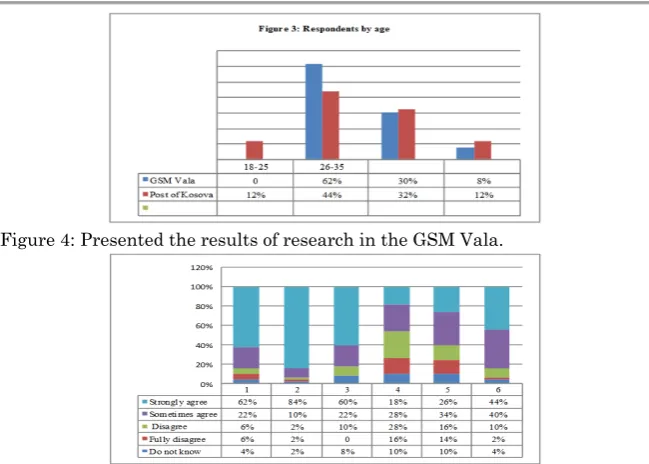
In the third chart, we presented data lists of the participants by age in the organization GSM Vala:
a) age of 18-25 - 0,
b) age of 26-35 - 62% employees c) age of 36-45 - 30% of workers, and d)> 46 - 8% of the employees.
Similarly, in the third charter, we presented data listed by age of the participants in the organization Post of Kosovo:
a) age of 18-25 - 12%,
Figure 4: Presented the results of research in the GSM Vala.
Of 100% of participants in the research, as to the first question 62% of respondents strongly agree to receive a copy of the evaluation of their performance. In the second question 84% strongly agree that goals are specified in an agreement with the manager. In the third question 60% of respondents in research strongly agree that the increased performance affects on-going training and 22% of them sometimes disagree. According to the fourth question, 18% strongly agree that they have taken into account the probable outcome of performance evaluation in the training and promotion of employees, 28% sometimes agree, 28% disagreed, 16% fully disagree and 10% do not know, whether to account the probable performance in training and promotion of employees in the organization. In the fifth question, 26% strongly agree that assessment is done in the correct manner and it helps identify potential employees, 34% sometimes agree, 16% disagree, 14% fully disagreed, while 10% do not know. In the sixth question 44% fully agree that through performance evaluation we identify staff training and
professional development, 40% sometimes agree, 10%
research, we understand that management performance organization has its advantages but also its deficiencies, especially on the part of the visibility of performance evaluation results during the training and advancement of employees in the organization. The fifth graph presents the results of research in public organization Post of Kosovo.
Of 100% participants in the research in the first question 64% of respondents strongly agree receiving a copy of the evaluation of their performance. In the second question 58% strongly agree that goals are specified in an agreement with the manager, 27% sometimes agree, 11% disagree, 3% strongly disagree and 1% does not know. In the third question, 53% in research strongly agree that increased performances affect on-going training and 32% of them sometimes disagree. According to the fourth question, 22% strongly agree that they have taken into account the probable outcome of performance evaluation in the training and promotion of employees, 31% sometimes agreed, 28% disagreed, 11% fully disagree and 8% do not know. In the fifth question, 37% fully agree that assessment is done in the correct manner and it can identify potential employees, 27% sometimes agree, 25% disagree, 5% fully disagreed, and 6% do not know. In the sixth question 53% strongly agree that through performance evaluation one can identify staff training and professional development, 26% sometimes agree, 13% disagreed, 2% fully disagree and 4% do not know.
performance evaluation results during the training and advancement of employees in the research public organizations.
Figure 6, presents the results of martial and non-martial motivation, for the importance and impact for their employees, in the public operator GSM Vala.
Research results show that the base fee as well as monetary compensation as bonuses etc, are not factors of motivation for employees in this company. What motivates more employees are not material motivation factors, such as working conditions, professional development, etc. Relying on the responses of the questionnaires, in the first question 62% of employees consider basic income as a motivating factor, 32% sometimes agree that the basic income is a motivating factor, 4% disagree partially and 2% fully disagree. According to the second question, the opportunity to expand knowledge and
develop professionally motivates 86% of employees
of the surveyed participants strongly agree and 12% sometimes agree.
The analysis of research in the field concludes that the employees in the organization are more motivated by non-material factors than the non-material ones.
In the graph 7: Results of the survey consider the impact of the factors - material and non-material motivation for the importance and impact of their employees in the public organization Post of Kosovo.
sometimes and 4% totally disagree. In sixth question, support career development: certain specializations are considered as a significant motivation and 65% of the surveyed participants agree fully, 16% sometimes agree, 7% percent disagree, 6% fully disagree and 6% do not know.
The analysis of research in the field concludes that the employees in the organization are more motivated by non-material motivating factors than by the non-material ones.
5. Conclusions and recommendations
This study has provided some useful insights into the role and perspective of human resources practices in concrete public organizations through the application of performance evaluation, as well as the impact of motivational factors of employees in the public operator Vala and Post of Kosovo. It is understood that the study comprising the total value of surveyed organizations helps to enrich the benefit of knowledge management needs and helps in better management of human resources in the organization.
important: the opportunity to expand your knowledge and
develop professionally motivates 86% of employees
participating in the research, working conditions motivate 90% of employees receiving job results by motivating manager 86% of employees, based on the work. Enhancement and experience motivate 94% of employees who consider independence to work as a motivating factor - 86% of respondents totally agree, while only 62% of basic income employees consider this as a motivating factor. But even for the public organization Post of Kosovo non-material factors encourage and motivate the highest percentage of employees in their working.
Based on the survey, for the organizations in the management of human resources, performance evaluation has advantages and disadvantages, especially on the part of the visibility of the results of performance evaluation during the training and advancement of employees, where 18% of respondents in GSM Vala completely agree that they have taken into account the probable outcome of performance evaluation in the training and promotion of employees, while the opposite opinion is supported by 28% of respondents. Also in Post of Kosovo, 22% of employees strongly agree that they have taken into account the probable outcome of performance evaluation in the training and promotion of employees, 31% sometimes agree, 28% disagree, 11% completely disagree and 8% do not know.
Considering the capabilities and economic strength of Kosovo Post and especially of the GSM public operator, Vala:
- Organization managers should be given a very special attention as well as management system assessment of human resources performance in the organization,
- A commitment to professional study and adoption of non material factors,
In this study we have taken as a case study the GSM Wave and Post of Kosovo. For further research, researchers may use other organizations to explore the role and perspective of human resource management through performance and identify problems associated with the evaluation and motivation of the employees for the purpose of development and economic growth of the organization.
BIBLIOGRAPHY:
Armstrong, M. and Baron, A. 1998. Performance Management: The new realities. London: CIPD.
Bass, B M and Vaughan, J A. 1966. Training in Industry: The management of learning. London: Tailstocks.
Bontis, N, Dragonetti, N C, Jacobsen, K and Roos, G. 1999. “The knowledge toolbox: a review of the tools available to measure and manage intangible resources.” European Management Journal 17(4): 391–402.
Deardorff, A.V. 2001. Deardorff's Glossary of International Economics.
De Waal, A. A. 2007. Strategic performance
management: A managerial and Behavioural approach. New York: Palgrave Macmillan.
Fletcher, C. 1993. Appraisal: Routes to improved performance. Institute of Personnel Management. London.
Kniggendorf Fred. 1998. “Helping Supervisors Define Standards of Performance.” In Performance Management and Appraisal. HR Focus.
Koli Z. and Dhe Llaci Sh. 2005. Managing of human resource. Section II: 24-25. University of Tirana.
Mabey, C and Salaman, G. 1995. Strategic Human Resource Management. Oxford: Blackwell Business.
Ulrich, D. 1997. Human Resource Champions. Boston: Harvard Business School Press,
Vasilika K. , Mustafa N. and Krasniqi E. 2012. Leadership, theory, concept and practice. The Institute for Economic Research – Globus. Prishtine.