Saroj H. Gatkal*, Priti R. Mhatre, Vitthal V. Chopade, Prvin D. Choudhari
Department of Quality Assurance Techniques, Modern College of Pharmacy Nigdi, Pune-411044, Maharashtra, India. *Corresponding author’s E-mail:[email protected]
Accepted on: 14-03-2013; Finalized on: 30-04-2013. ABSTRACT
The objective of the current study was to develop simple, precise and accurate stability indicating by Gradient RP-HPLC assay method and validated for determination of Mesalamine in solid pharmaceutical dosage forms. Gradient RP-HPLC separation was achieved on an analytical C18 R column (250 mm × 4.6 mm i.d., 5 µm particle size) using mobile phase of Water: Methanol (80:20 v/v) at a UV detector. The drug was subjected to acid degradation, alkaline degradation, oxidation, photolysis and heat to apply stress condition. The method was validated for specificity, linearity, precision, accuracy, robustness and solution stability. The method was linear in the drug concentration range of 10-60 µg/ml with a correlation coefficient 0.999. The method was also found to be robust as indicated by the % RSD values which are less than 2%. The stress degradation studies showed that Mesalamine undergoes degradation in acid, base, oxidation, dry heat (2.1%, 1.86%, 1.60%, 1.33% respectively). Degradation products produced as a result of stress studies did not interfere with detection Mesalamine and the assay can thus be considered stability indicating.
Keywords: Mesalamine, Stability indicating assay validation, RP-HPLC, chromatographic analysis.
INTRODUCTION
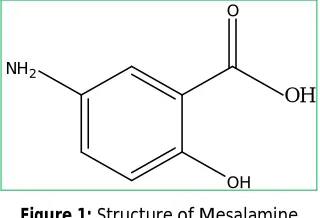
esalamine is chemically (5-amino-2hydroxybenzoic acid) is an anti‐inflammatory agent, structurally related to the salicylates, which is active in inflammatory bowel disease and active ulcerative colitis. It is a tan to pink crystalline powder, relatively insoluble in chloroform, ether, n‐hexane and ethyl acetate and freely soluble in dil. HCl and alkali hydroxides, Mesalamine is available in tablet dosage forms and is an official drug of USP. ( figure 1).
NH2
OH O
OH
Figure 1: Structure of Mesalamine
The mechanism of action of this drug remains uncertain. 5-ASA has been shown to be a potent scavenger of reactive oxygen species that play a significant role in the pathogenesis of inflammatory bowel disease, inhibition of natural killer cell activity, inhibition of antibody synthesis, inhibition of cyclo-oxygenase and lipoxygenase pathways and impairment of neutrophil function1-2.
MATERIALS AND METHODS
Mesalamine sample was obtained from Lupin pharmaceuticals. Mesalamine tablet was purchased from local market. The solvent used Water (HPLC grade), Methanol (AR grade), NaOH (AR grade), HCl (AR grade), H2O2 (HPLC grade), OPA (HPLC grade). These chemicals
were purchased from Merck Chemicals (Mumbai, India).
Selection of mobile phase and chromatographic conditions
Chromatographic separation studies were carried out on a C-18, column on the working standard solution of Mesalamine (40µg/ml). Initially, trials were carried out using Water and Methanol in various proportions along with varying pH, to obtain the desired system suitability parameters. After several trials, Water: Methanol (pH adjusted to 3.8 with Ortho Phosphoric acid) (80: 20 v/v), was chosen as the mobile phase, which gave good resolution and acceptable peak parameters. 3-8
Preparation of Standard stock solution
10mg of Mesalamine reference standard was weighed accurately and transferred in 100ml volumetric flask. Drug was dissolve in Water: Methanol (80: 20 v/v) and volume was made up to 100ml with same solvent. So as to get the concentration 100µg/ml. 4ml standard stock solution of Mesalamine was then diluted in 10ml Water: Methanol (80: 20 v/v) to get working standard solution 40µg/ml. Preparation of mobile phase
Mobile phase was prepared by mixing Water:Methanol (pH adjusted to 3.8 with Ortho Phosphoric acid) (80: 20 v/v), filtered through 0.45µ membrane filter paper and then sonicated on ultra sonic water bath for 30min.
Selection of Detection Wavelength
From the standard stock solution further dilutions were done using Water: Methanol (80: 20 v/v) and scanned over the range of 200 - 400nm and the spectra was obtained. It was observed that Mesalamine showed considerable absorbance at 330 nm (Figure 2).
Development and Validation of Stability Indicating HPLC Assay Method for
Determination of Mesalamine in Bulk Drug and Tablet Formulation
M
Figure 2: UV spectrum of Mesalamine (40µg/ml) in Water: Methanol (80: 20 v/v)
Chromatogram of Mesalamine
The column was saturated with the mobile phase (indicated by constant back pressure at desired flow rate). Standard solution of Mesalamine was injected to get the chromatogram. The retention time for Mesalamine was found to be 5.92 ± 0.02 min. Chromatogram of Mesalamine is shown in (Figure 3)
Figure 3: Representative Chromatogram of Mesalamine (40µg/ml, RT = 5.92)
Degradation Studies
The International Conformance on Harmonization (ICH) guidelines entitled stability testing of new drug substance and products requires that stress testing be carried out to elucidate the inherent stability characteristics of the active substance. The aim of this work was to perform the stress degradation studies of the Mesalamine using the proposed method8-12.
Acidic hydrolysis
4ml of working standard solution was mixed with 2ml of 2N HCl and kept for 3 hours. After 3hours solution was neutralized with NaOH then solution was diluted to 10ml with Water: Methanol (80:20) and injected in stabilized chromatographic conditions. Under this condition, degradation was observed (RT = 4.12) (table 1 & figure 4).
Alkaline hydrolysis
4ml of working standard solution was mixed with 2ml of 1.6N NaOH and kept for 3 hours. After 3 hours solution was neutralized with HCl then solution was diluted to 10ml with Water: methanol (80:20) and injected &
Figure 4: Chromatogram of Mesalamine (40µg/ml) after acidic hydrolysis induced degradation with degradation product at RT 4.12
Figure 5: Chromatogram of Mesalamine (40µg/ml) after alkali hydrolysis induced degradation with degradation product at RT 3.87
Oxidation
4ml of working standard solution was mixed with 3ml 6% solution of H2O2. The solution was diluted to 10ml with
Water: Methanol (80:20 v/v) and refluxed for 3 hours. The solution was injected in stabilized chromatographic conditions. (RT =6.72) (Table 1 & Figure 6).
Figure 6: Chromatogram of Mesalamine (40µg/ml) after oxidative degradation with degradation product at RT 6.72
Degradation under dry heat
Methanol (80:20v/v) to get conc. of 100µg/ml. 4ml standard stock solution of Mesalamine was then diluted in 10ml Water: Methanol (80:20v/v) to get working standard solution 40µg/ml. The solution then injected in stabilized chromatographic conditions. (table 1 & figure7).
Figure 7: Chromatogram of Mesalamine (40µg/ml) after dry heat degradation with degradation product at RT 3.85 Photo-degradation studies
Long UV-Degradation at 366nm
The photochemical stability of the drug was studied by exposing the drug sample to long UV (366nm) light for 48 hour 10mg after exposure, accurately weighed 10mg of drug in 100ml of methanol to get concentration 100µg/ml. 4ml standard stock solution of Mesalamine was then diluted in 10 ml Water: Methanol (80:20 v/v) to get working standard solution 40µg/ml and was then injected in stabilized chromatographic conditions No degradation peaks were obtained.
Short UV-Degradation at 256nm
The photochemical stability of the drug was studied by exposing the drug sample to short UV (256nm) light for 48 hour 10mg after exposure, accurately weighed 10mg of drug in 100ml of methanol to get concentration 100µg/ml. 4ml standard stock solution of Mesalamine was then diluted in 10ml methanol to get working standard solution 40µg/ml and was then injected in stabilized chromatographic conditions. No degradation peaks were obtained.
Validation of Analytical methods
The validation for HPLC method development was performed using parameters like Linearity, Precision, Accuracy, Limit of detection (LOD), Limit of quantification (LOQ) and Robustness.
Linearity
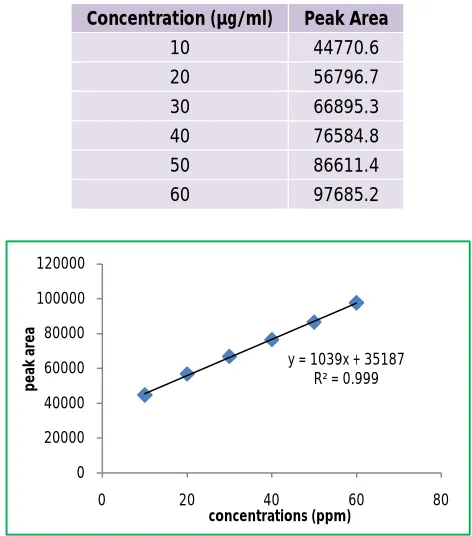
The standard stock solution containing 100µg/ml of Mesalamine to prepare range of standard solutions containing six different concentrations of analyte. The linearity of the relationship between peak area and concentration was determined by analyzing six standard solutions over the concentration range 10-60µg/ml. The results obtained are shown in (table 2&7). The peak areas
were plotted against the corresponding concentrations to obtain the calibration curve (figure 8).
Table 2: Linearity studies of Mesalamine
Concentration (µg/ml) Peak Area
10 44770.6
20 56796.7
30 66895.3
40 76584.8
50 86611.4
60 97685.2
Figure 8: Calibration curve for Mesalamine
Precision
The precision of the method was demonstrated by intra-day and inter-intra-day variation studies. In the inter intra-day studies, 3 different concentrations 30, 40 and 50µg/ml were injected in stabilized chromatographic conditions and were analyzed in triplicate. The percentage RSD was calculated. The result obtained for intraday variations are shown in (table 3 & 7). In the inter day variation studies, 30, 40 and 50µg/ml were injected in stabilized chromatographic conditions and were analyzed. This procedure was repeated once a day for three consecutive days. The percentage RSD was calculated. The result obtained for interday variations are shown in (table 4& 7). Accuracy
To check accuracy of the method, recovery studies were carried out by mixing standard drug solution to pre-analyzed sample solution at three different levels 80, 100 and 120%. Basic concentration of sample chosen was 30 µg/ml of Mesalamine bulk drug solution to which 24, 30 and 36 µg/ml of Mesalamine tablet solution was added. These solutions were injected in stabilized chromatographic conditions in triplicate to obtain the chromatograms. The drug concentrations of Mesalamine were calculated by using linearity equation. The results obtained are shown in (table 5 & 7).
y = 1039x + 35187 R² = 0.999
0 20000 40000 60000 80000 100000 120000
0 20 40 60 80
p
e
ak
a
re
a
Table 1: Summary of stress degradation studies of Mesalamine bulk drug
Stress deg. Parameter Peak Area Percent Degradation RT of deg. Product
Initial 76584.8 - -
Acid (2N HCl Kept for 3 hrs) 74984.1 2.1% 4.12 Alkali (1.6N NaOH Kept For 3 hrs) 75566.2 1.86% 3.87 6% H2O2 Kept For 3 hrs 75364.3 1.60% 6.72
Dry Heat at (50⁰C for 3 hrs) 75890.7 1.33% 3.85
Long UV 366 nm 76581.7 - -
Short UV 254 nm 76587.3 - -
Table 3: Intra-day precision studies for Mesalamine
Table 4: Inter-day precision studies for Mesalamine
Table 5: Recovery Studies of Mesalamine
Level Std Sample Conc. (µg/ml) Area Mean Recovered Conc. % Recovery
80 30 + 24
90871.3
90875.72 53.598 99.25 90768.1
90987.8
100 30 + 30
97285.5
97238.73 59.722 99.53 97139.1
97291.6
120 30 + 36
104329.3
104010.1 66.239 100.36 105224.8
102476.2
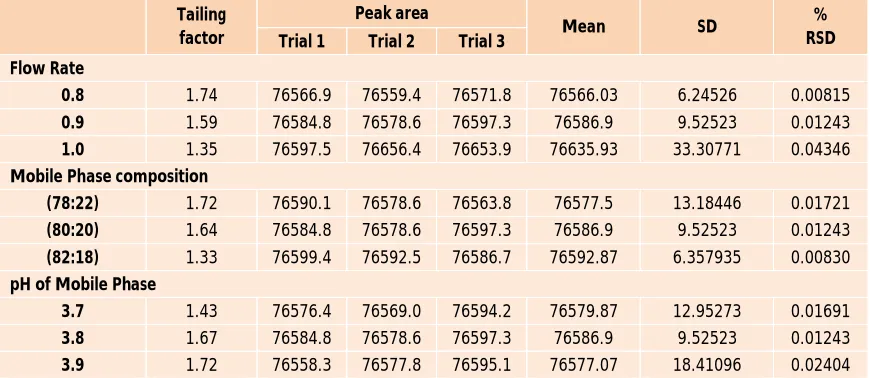
Table 6: Robustness Studies of Mesalamine
Tailing factor
Peak area
Mean SD %
RSD Trial 1 Trial 2 Trial 3
Flow Rate
0.8 1.74 76566.9 76559.4 76571.8 76566.03 6.24526 0.00815 0.9 1.59 76584.8 76578.6 76597.3 76586.9 9.52523 0.01243 1.0 1.35 76597.5 76656.4 76653.9 76635.93 33.30771 0.04346 Mobile Phase composition
(78:22) 1.72 76590.1 76578.6 76563.8 76577.5 13.18446 0.01721 (80:20) 1.64 76584.8 76578.6 76597.3 76586.9 9.52523 0.01243 (82:18) 1.33 76599.4 76592.5 76586.7 76592.87 6.357935 0.00830 pH of Mobile Phase
3.7 1.43 76576.4 76569.0 76594.2 76579.87 12.95273 0.01691 3.8 1.67 76584.8 76578.6 76597.3 76586.9 9.52523 0.01243 3.9 1.72 76558.3 76577.8 76595.1 76577.07 18.41096 0.02404 Concentration
(µg/ml)
Peak area
Mean SD % RSD
Trial 1 Trial 2 Trial 3
30 66895.3 66882.6 66876.5 66884.8 9.591142 0.01434 40 76584.8 76578.6 76597.3 76586.9 9.52523 0.01243 50 86611.4 86656.7 86632.5 86633.53 22.66767 0.02616
Concentration (µg/ml)
Peak area
Mean SD % RSD
Day 1 Day 2 Day 3
Limit of Detection (LOD)
LOD is calculated from the formula: 3.3 σ
DL = S Where,
σ = standard deviation of response for the lowest conc. in the range
S = slope of the calibration curve. LOD =Mesalamine: 0.0302 µg/ml
Limit of Quantification (LOQ)
The quantitation limit (QL) may be expressed as: 10 σ
QL =
S LOQ = Mesalamine: 0.0916µg /ml.
Range
Mesalamine: 10-60µg/ml
Robustness
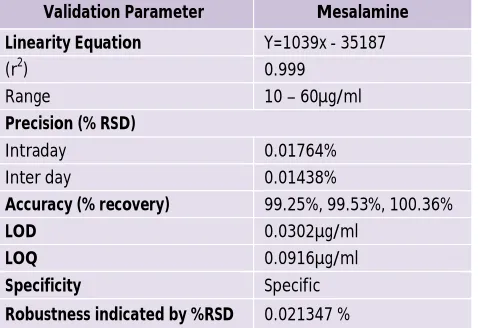
Robustness was performed by injecting the Mesalamine standard solution in to the HPLC by altering the flow rate, changing the pH and changing the composition of the organic solvent from the normal chromatographic conditions. The results are tabulated in (table 6 & 7). Table 7: Summary of validation parameters of Mesalamine
Validation Parameter Mesalamine Linearity Equation Y=1039x - 35187
(r2) 0.999
Range 10 – 60µg/ml
Precision (% RSD)
Intraday 0.01764%
Inter day 0.01438%
Accuracy (% recovery) 99.25%, 99.53%, 100.36%
LOD 0.0302µg/ml
LOQ 0.0916µg/ml
Specificity Specific
Robustness indicated by %RSD 0.021347 %
RESULTS AND DISCUSSION
The developed method was found to be precise as the %RSD values for intraday and inter-day were found to be less than 2%. Good recoveries (99.25% to 100.36%) of the drug were obtained at each added concentration,
indicating that the method was accurate. The method was also found to be specific indicated by the % recoveries ranging from 99.25% to 100.36%. The LOD and LOQ were found to be 0.0302µg/ml and 0.0916µg/ml indicating the sensitivity of the method. The method was also found to be robust as indicated by the % RSD values which are less than 2%. The summary of validation parameters of proposed spectrophotometric method is shown in Table 7. The stress degradation studies showed that Mesalamine undergoes degradation in acid, base, oxidation, dry heat (2.1%, 1.86%, 1.60%, and 1.33% respectively). Summary of the results of stress degradation studies of Mesalamine are shown in the Table 1.
CONCLUSION
All the above factors lead to the conclusion that the proposed method as accurate, precise, simple, sensitive, robust and cost effective and can be applied successfully for the estimation of Mesalamine bulk and pharmaceutical formulation and percentage degradation. The proposed method is also useful for determination of Mesalamine stability in sample of pharmaceutical dosage forms.
REFERENCES
1. Tripathi KD: Essentials of Medical Pharmacology. Jaypee Brothers Medical Publishers (P) Ltd. Sixth Edition, 2010, 787-788.
2. Yadav AV and Yadav VB: Improvement of physicochemical properties of mesalamine with hydrophilic carriers by solid dispersion method. Research J. Pharma and Tech, 1, 2008, 324-328 3. Dunge A, Sharda N, Singh B and Singh S, Establishment of inherent stability of Stavudine and development of a validated stability-indicating HPLC assay method, Journal of Pharmaceutical and Biomedical Analysis, 37, 2005, 1115–1119.
4. Kumar R., Rao G. and Naidu P., Stability Indicating RP-LC Method for Determination of RasagilineMesylate in Bulk and Pharmaceutical Dosage Forms, International Journal of Applied Biology and Pharmaceutical Technology, 2, 2002, 247-259. 5. Dunge A, Sharda N, Singh B, Singh S, Validated specific HPLC
method for determination of Zidovudine during stability studies, Journal of Pharmaceutical and Biomedical Analysis, 37, 2005, 1109-1114.
6. Trabelsi H, Bouabdallah S, Bouzouita K andSafta F,Determination and degradation study of Haloperidol by high performance liquid chromatography, Journal of Pharmaceutical and Biomedical Analysis, 29, 2002, 649-657.
7. Vignaduzzo S., Castellano P. and Kaufman T., Method development and validation for the simultaneous determination of Meloxicam and Pridinolmesylate using RP-HPLC and its application in drug formulations, Journal of Pharmaceutical Biomedical Analysis., 46, 2008, 219-25.
8. Chopade V., Tembhurkar N., JadhavS. and Chaudhari P., Development And Validation of A Stability Indicating Assay Method of Mefloquine HCl By Using Different Stress Degradation Conditions, Journal Of Pharmacy Research, 5, 2012, 2631-2635.