Article
A Fast K-prototypes Algorithm Using Partial
Distance Computation
Byoungwook Kim
Creative Informatics & Computing Institute, Korea University, Seoul 02841; [email protected]; Tel.: +82-2-3290-1674
Abstract: The k-means is one of the most popular and widely used clustering algorithm, however, it is limited to only numeric data. The k-prototypes algorithm is one of the famous algorithms for dealing with both numeric and categorical data. However, there have been no studies to accelerate k-prototypes algorithm. In this paper, we propose a new fast k-prototypes algorithm that gives the same answer as original k-prototypes. The proposed algorithm avoids distance computations using partial distance computation. Our k-prototypes algorithm finds minimum distance without distance computations of all attributes between an object and a cluster center, which allows it to reduce time complexity. A partial distance computation uses a fact that a value of the maximum difference between two categorical attributes is 1 during distance computations. If data objects have m categorical attributes, maximum difference of categorical attributes between an object and a cluster center is m. Our algorithm first computes distance with only numeric attributes. If a difference of the minimum distance and the second smallest with numeric attributes is higher than m, we can find minimum distance between an object and a cluster center without distance computations of categorical attributes. The experimental shows proposed k-prototypes algorithm improves computational performance than original k-prototypes algorithm in our dataset.
Keywords: clustering algorithm; k-prototypes algorithm, partial distance computation
1. Introduction
K-means algorithm is one of the simplest clustering algorithm as unsupervised learning, so that is very widely used [1]. As it is a partitioning-based clustering methods in cluster analysis, a dataset are partitioned into several groups according to a similarity measure as a distance to average of a group. K-means algorithm minimizes the objective function known as squared error function iteratively by finding a new set of cluster centers. In each iteration, the value of the objective function become lowers. In k-means algorithm, the objective function is defined by the sum of square distances between an object and a cluster center.
The purpose of using k-means is to find clusters which minimized the sum of square distances between each cluster center and all objects in each cluster. Even though the number of cluster is small, the problem of finding optimal solution of means algorithm is NP-hard [2,3]. For this reason, k-means algorithm adapts heuristics and finds local minimum as approximate optimal solutions. The time complexity of k-means algorithm is O(i*k*n*d) where i iterations, k centers, and n points in d dimensions.
K-means algorithm spends a lot of processing time for computing the distances between each of the k cluster centers and the n objects. So far, many researchers have developed on accelerating k-means algorithm by avoiding unnecessary distance computations between an object and cluster centers. Because objects usually remain in the same clusters after a certain number of iterations, much of repetitive distance computation are unnecessary. So far, the number of researches on accelerating k-means algorithm to avoid unnecessary distance calculations have been carried out [4-7].
K-means algorithm is efficient for clustering large datasets, but it only works on numerical data. But the real-world data is a mixture of both numeric and categorical features, so k-means algorithm has a limitation of applying cluster analysis. To overcome this problem, several algorithms have been
developed to cluster large datasets that contain both numeric and categorical values, and a well-known algorithm is k-prototypes algorithm by Huang [8]. The time complexity of k-prototypes algorithm is O(i*k*n*d) as the one of k-means. In case of large data sets, time cost of distance calculation between all data objects and the centers is high. To the best of our knowledge, however, there have been no studies that reduce time complexity of k-prototypes algorithm.
In this paper, we propose a fast k-prototypes algorithm for mixed data (FKPT). The FKPT reduces distance calculation using partial distance computation. The contributions of this study are summarized as follows.
1. Reduction: reducing computational cost without additional data structure and memory spaces.
2. Simplicity: it is simple to implement, because it does not require complex data structure. 3. Convergence: being able to apply to other fast k-means algorithms to compute distance between
each of cluster center and an object for numeric attributes.
4. Speed: it is faster than the conventional k-prototype.
This study presents a new method of accelerating k-prototypes algorithm using partial distance computation by avoiding unnecessary distance computations between an object and cluster centers. As a result, we believe the algorithm proposed in this paper will become the algorithm of choice for fast k-prototypes clustering.
The organization of the rest of this paper is as follows. In Section 2, various methods of accelerating means and traditional prototypes algorithm are described, for the proposed k-prototypes are defined. A fast k-k-prototypes algorithm proposed in this paper is explained and its time complexity is analyzed in Section 3. In Section 4, experimental results on (five) real data sets demonstrate the scalability and effectiveness of the FKPT using partial distance computation by comparison with traditional k-prototypes algorithm. Section 5 concludes the paper.
2. Related works
In this section, we briefly describe various methods of accelerating means and traditional k-prototypes algorithm.
2.1. k-means
The k-means is one of the most popular clustering algorithm due to its simplicity and scalability for large data sets. The k-means algorithm is to partition n data objects into k clusters while minimizing the Euclidean distance between each data object and the cluster center it belongs to [9]. The fundamental concept of k-means clustering is as follows.
1. It chooses k cluster centers in some manner. The final result of the algorithm is sensitive to the initial selection of k initial centers, and many efficient initialization methods have been proposed to calculate better final k centers.
2. The k-means repeats the process of assigning individual objects to their nearest centers and updating each of k centers as the average of a value of object’s vector assigned to the centers until no further changes occur on the k centers.
K-means algorithm spend most of the time computing distance between an object and current cluster centers. However, much of these distance computations are unnecessary, because objects usually remain in the same clusters after a few iterations [6]. Thus, k-means is popular and easy to implement, but it is wasting processing time on redundant and unnecessary distance computations.
The reason why the k-means are inefficient is because in each iteration all objects must identify the closest center. In one iteration, all nk distance computations is needed between the n objects and the k centers. After the end of one iteration, the centers are changed and the nk distance computations occur again in next iteration.
2.2. k-prototypes
world are mixed type objects. Assume a set n objects, = , , ⋯ , . = , , ⋯ , is consisted of attributes ( is numerical attributes, is categorical attributes, = + ). The goal of clustering is to partition n objects into k disjoint clusters = , , ⋯ , , where is a i-th cluster center. The distance , between and can be calculated as follows:
, = , + , , (1)
where , is the distance between numerical attributes, ( , ) is the distance between categorical attributes and is a weight for categorical attributes.
, = − (2)
, = , (3)
, = 0, when1, when =≠ (4)
In Equation (2), , is the squared Euclidean distance measure between cluster centers and an object on the numeric attributes. , is the simple matching dissimilarity measure on the categorical attributes, where , =0 for = and , =1 for ≠ . and ,
1 ≤ ≤ , are values of numeric attributes, whereas and , + 1 ≤ ≤ are values of categorical attributes for object i and the cluster center j. is the numbers of numeric attributes and
− is the numbers of categorical attributes.
3. K-prototypes using Partial Distance Computation
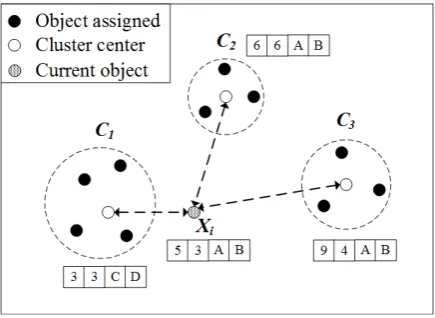
The existing k-prototypes algorithm allocates objects to the cluster with the smallest distance by calculating the distance between each cluster center and a new object to be allocated to the cluster. Distance is calculated by comparing all attributes of an object with all attributes of each cluster center using Brute-Force method. Figure 1 illustrates how k-prototypes algorithm organizes clusters with a target object. In this figure, an object consists of two numerical attributes and two categorical attributes. The entire dataset is divided into three clusters, = , , . The center of each cluster is = (3,3, , ), = (6,6, , ) and = (9,4, , )The traditional k-prototypes algorithm calculates distance with each cluster center to find the cluster to which = (5, 3, A, B) is assigned. The distance about numeric attribute of and , , is (3 − 5) + (3 − 3) = 4, (6 − 5) +
(6 − 3) = 10, (9 − 5) + (4 − 3) = 17 respectively. The distance about categorical attribute of 와 , , is 1 + 1 = 2 ∵ C ≠ A, ≠ B, 0 + 0 = 0 ∵ A = A, B = B, respectively. The total distance of and , ,, and is 6, 10, and 17, respectively, and the cluster closest to is . Thus, the traditional k-prototypes algorithm computes the distance as a brute force method that compares both numerical and categorical properties.
about numeric attribute of and , , is (3 − ) + (3 − ) = x, (6 − ) + (6 − ) = x,
(9 − ) + (4 − ) = x respectively.
Figure 1. A process of assigning an object Xi to a cluster of which the center is most closest to the objects.
This paper studies a method to find the closest center to an object without comparison for all attributes in a distance computation. We prove that the closest center to an object can be found without comparison for all attributes. For a proof, we define a Computable Max Difference Value as follows.
Definition 1. Computable Max Difference Value. The computable max difference value means the max difference value can be calculated in distance measure between an object and cluster centers for one attribute.
According to the Equation (4), the distance for a single categorical attribute between cluster centers and an object is either 0 or 1. Therefore, a computable max difference value for a categorical attribute becomes 1 by Definition 1 without taking the value of the attribute into account. If an object in dataset consists of m categorical attributes, then a computable max difference value between a cluster and object is m. A computable max difference value of a numeric attribute is a difference of a max value and a min value of the attribute. Thus, to know a computable max difference value of a numeric attribute, we have to scan full datasets so that a max and min value are obtained.
The proposed k-prototypes algorithm finds minimum distance without distance computations of all attributes between an object and a cluster center using computable max difference value of the object. The k-prototypes algorithm updates a cluster center after an object is assigned to the cluster of the closest center by distance measure. By Equation 1, the distance , between an object and a cluster center is computed by adding the distance of numeric attributes and the distance of categorical attributes. If a difference of the first and the second minimum distance on numeric attributes is higher than m, we can find minimum distance between an object and a cluster center only using distance computation of numeric attributes without distance computations of categorical attributes.
Lemma 1. For a set of objects with m categorical attribute, if ( , ) − ( , ) > then ( , ) > ( , ).
Proof. ( , ) − ( , ) >
( , ) > + − ( , ).
By Equation (2) ( , ) = ( , ) + ( , )
( , ) = ( , ) + ( , )
( , ) − ( , ) > + ( , ) − ( , ).
By definition (1), categorical distance between an object and a cluster center with m categorical attributes can be 0 ≤ ( , ) ≤ and 0 ≤ ( , ) ≤ . ( , ) ≥ ( , ) − ( , ) >
+ ( , ) − ( , ) ≥ ( , ). ∴ ( , ) > ( , )
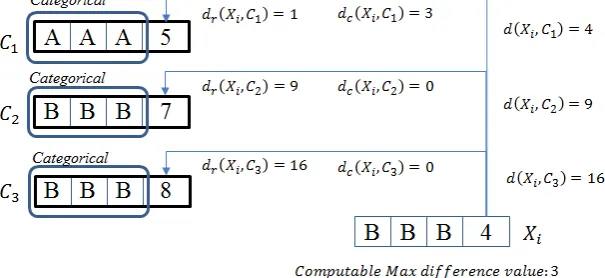
Example 1. We assume that k=3. The each current cluster center are = ( , , , 5), =
( , , , 7), and = ( , , , 8). As shown by Fig. 1, we have to compute the distance between =
( , , , 4) and each of cluster centers ( , , and ) for assigning to the cluster of the closest center. Firstly, we compute the distance of numeric attributes, , is 1, 9, and 16, respectively. is the closest to only with numeric attributes. In this example, objects consisted of 3 categorical attributes, and the min value of possible distance is 0, the max value is 3. The difference of numeric distance between ( , ) and ( , ) is 8. Thus, the fact that is the closest to is unchanged even if ( , ) is calculated by 3 as computable max difference value.
Figure 2. Finding the closest cluster center without computing categorical attributes.
3.2. Proposed algorithm
In this section, we describe our proposed algorithm. Algorithm 1: proposed k-prototype
Input: n: the number of objects, k: the number of cluster, p: the number of numeric attribute, q: the number of categorical attribute
Output: k cluster
01: INITIALIZE // Randomly choosing k object, and assigning it to . 02: While not converged do
03: for i = 1 to n do
04: dist_n[] = DIST-COMPUTE-NUM( , C, k, p) // distance computation only numeric attributes 05: first_min = DIST-COMPUTE.first_min // first minimum value among ,
06: second_min = DIST-COMPUTE.second_min // second minimum value among , 07: if ( second_min – first_min < m) then
08: dist[] = dist_n[] + DIST-COMPUTE-CATE( , C, k) 09: else
10: dist[] = dist_n[] 11: num = argmin [ ]
12: is assigned to
13: UPDATE-CENTER( )
The proposed k-prototypes algorithm in this paper is similar to traditional k-prototypes. The difference between proposed k-prototypes and traditional k-prototypes is that the distance between an object and cluster centers on the numeric attributes, , , is calculated firstly.
In Line 4, firstly, you calculate the distance for a numerical attribute. You obtain the closest distance and the second closest distance value while calculating the distance. Using these two values and the number of the categorical attributes, m, the discriminant is performed. If the result of the discriminant is true, the distance to the categorical property is calculated, and then the result of the final distance is derived by adding the distance of the numerical property. If the result of the discriminant is false, the final distance is measured by the numerical attribute result only. Including
Definition 1 is a function that determines whether to compare the categorical attribute with the algorithm that implements it. Returns the true value if the difference between the second smallest distance and the first smallest distance is less than to m in the distance measured only by numerical property comparison between an object and cluster center. If a true value is returned, Algorithm 1 calls a function that compares the distance of the categorical attribute to calculate the final distance. If a false value is returned, the distance measured by only the numerical property comparison is set as the final results value without comparing the categorical property. The larger the difference between the two distances, the greater the number of categorical attributes that need not be compared.
Algorithm 2: DIST-COMPUTE- NUM()
Input: : an object vector, C: a set of cluster center vectors, k: the number of clusters, p: the number of numeric attribute
Output: dist_n[], first_min, second_min
01: for i = 1 to k do 02: for j = 1 to p do
03: dist_n[j] = ( [ ] − [ ]) 04: first_min = dist_n[0]
05: second_min = dist_n[0] 06: for i = 0 to k-1 do
07: if( dist_n[i] < first_min ) then 08: second_min = first_min 09: first_min = dist_n[i]
10: else if( dist_n[i] < second_min) then 11: second_min = dist_n[i]
12: Return dist_n[]
In Algorithm 2, DIST-COMPUTE-NUM() calculates a distance between an object and cluster centers for numerical attributes and returns all distances for each cluster. In this algorithm, first_min and second_min is calculated to determine whether calculation of categorical data in a distance computation.
Algorithm 3: DIST-COMPUTE- CATE()
Input: : an object vector, C: cluster center vectors, k: the number of clusters, p: the number of numeric attribute
Output: dist_c[]
01: for i = 1 to k do
02: for j = p +1 to m do 03: if( [ ] = [ ] ) then 04: dist_c[i] += 0 05: else
06: dist_c[i] += 1 07: Return dist_c[]
In Algorithm 3, a distance between an object and cluster centers is calculated for categorical attributes of each cluster.
01: foreach o ∈ do 02: for j = 1 to p do 03: sum[j] += o[j] 04: for j = 1 to p do 05: C[j] = sum[j] / | | 06: for j = p +1 to m do
07: C[j] = argmax COUNT(o[j])
In Algorithm 4, the center vector of a cluster is assigned to new center vector. The center vectors consisted of two part which are numeric and categorical attributes. The numeric part of center vector is calculated by an average value of each numeric attributes and the categorical part of center vector is calculated by the value of the highest frequency in each categorical attribute.
3.3. Time complexity
The time complexity of traditional k-prototypes is ( ∗ ∗ ∗ ), where I is the number of iterations, k is the number of clusters, n is the number of data objects and m is the number of attributes. The best-case complexity of the proposed k-prototypes has a lower bound of ( ∗ ∗ ∗
), where p is the number of numeric attributes and p < m. The best-case is that the difference of the first and the second minimum distance between an object and cluster centers for all object in given dataset on numeric attributes is less than m. The worst-case complexity has an upper bound of ( ∗
∗ ∗ ). The worst-case is that the difference of the first and the second minimum distance between an object and cluster centers for all object in given dataset on numeric attributes is higher than m.
4. Experimental results
All experiments are conducted on an Intel(R) Pentium(R) 3558U 1.70 GHz, 4GB RAM. All programs are written in Java. We generate several independent, uniform distribution mix typed datasets. A distribution of numerical attributes is from 0 to 100, and one of categorical attributes is from alphabet A to Z.
4.1. Effect of cardinality
We set |X| (number of objects)={500000, 800000, 1000000}, numerical attributes=2, categorical attributes=16 and k=3. Figure 3 shows the CPU time versus cardinality in different datasets. In the figure, there are two lines. In general, the CPU time increases linearly when the cardinality increases linearly. The experimental shows proposed k-prototypes algorithm improves computational performance than original k-prototypes algorithm in our dataset.
500k 800k 1000k
4.4 4.5 4.6 4.7 4.8 4.9 5.0 5.1 5.2 5.3 5.4 5.5 5.6 5.7 5.8 5.9 6.0
Ti
m
e (seco
nd)
cardinalrity
Figure 3. Effect of cardinality. FKPT (fast k-prototypes) is the result of our propose k-prototype algorithm and TKPT (traditional k-prototypes) is the result of original k-prototypes algorithm.
5. Conclusion
In this paper, we have proposed a fast k-prototypes algorithm for clustering mixed data sets. Experimental results show that our algorithm is fast than original algorithm. Previous fast k-means algorithm focused on reducing candidate objects for computing distance to cluster centers. Our k-prototypes algorithm reduces unnecessary distance computation using partial distance computation without distance computations of all attributes between an object and a cluster center, which allows it to reduce time complexity. The experimental shows proposed k-prototypes algorithm improves computational performance than original k-prototypes algorithm in our dataset.
However, our k-prototypes algorithm does not guarantee that computational performance will be improved in all cases. If the difference of the first and the second minimum distance between an object and cluster centers for all object in given dataset on numeric attributes is less than m, then the performance of our k-prototypes is same to the original k-prototype. Our k-prototypes algorithm is influenced by variance of the numeric data values. The larger variance of the numeric data values, the higher probability that the difference of the first and the second minimum distance between an object and cluster centers is large.
The k-prototypes algorithm proposed in this paper simply reduces the computational cost without using additional data structures and memories. Our algorithm is faster than original k-prototypes algorithm. The goal of the existing k-means acceleration algorithm is to reduce the number of dimensions to be compared when calculating the distance between center and object, in order to reduce the number of objects compared with the center of the cluster. K-Means, which deals only with numeric data, is the most widely used algorithm among clustering algorithms. Various acceleration algorithms have been developed to improve the speed of processing large data. However, real-world data is mostly a mixture of numeric data and categorical data. In this paper, we propose a method to speed up the k-prototypes algorithm for clustering mixed data. The method proposed in this paper is a method of reducing the number of objects compared with the center of existing clusters, and is not exclusive, and the existing methods and the methods proposed in this paper can be integrated with each other.
Author Contributions: Byoungwook Kim: Research for the related works, doing the experiments, writing the
paper, acquisition of data, analysis of data, interpretation of the related works, and design of the complete model.
Conflicts of Interest: The authors declare no conflict of interest.
References
1. MacQueen, J. B. Some methods for classification and analysis of multivariate observations, in Proc. 5th Symp. Mathematical Statistics and Probability, Berkeley, CA, 1967, pp. 281-297.
2. Aloise, D.; Deshpande, A.; Hansen, P.; Popat, P. (2009). NP-hardness of Euclidean sum-of-squares clustering. Machine Learning, 75: 245–249. doi:10.1007/s10994-009-5103-0.
3. Dasgupta, S. and Freund, Y. (July 2009). Random Projection Trees for Vector Quantization. IEEE Transactions on Information Theory, 55: 3229–3242. arXiv:0805.1390. doi:10.1109/TIT.2009.2021326. 4. Drake, J., Hamerly, G. (2012) Accelerated k-means with adaptive distance bounds. In: 5th NIPS workshop
on optimization for machine learning
5. Elkan, C. Using the triangle inequality to accelerate k-means. In Tom Fawcett and Nina Mishra, editors, ICML, pages 147–153. AAAI Press, 2003.
6. Hamerly, G. 2010. Making k-means even faster. Proc. SDM. pp. 130-140.
7. Pelleg, D. and Moore, A. W. 1999. Accelerating exact k-means algorithms with geometric reasoning. In KDD, pages 277–281.
8. Huang, Z. 1997. Clustering large data sets with mixed numeric and categorical values. Proceedings of the First Pacific Asia Knowledge Discovery and Data Mining Conference, Singapore: World Scientific, pp. 21–34. 9. MacQueen, J. B. Some methods for classification and analysis of multivariate observations, in Proc. 5th