
1078
UV-VISIBLE ABSORPTION STUDY OF SOME PEROVSKITE LAYER
COMPOUNDS
J. Aazza
University Moulay Ismail, Laboratory of Materials and Modelisation, Department of Physics, Zitoune, Meknes, Morocco
K. Elmebrouki
University Moulay Ismail, Laboratory of Materials and Modelisation, Department of Physics, Zitoune, Meknes, Morocco
M. Ettakni
University Moulay Ismail, Laboratory of Materials and Modelisation, Department of Physics, Zitoune, Meknes, Morocco
M. Khechoubi
University Moulay Ismail, Laboratory of Materials and Modelisation, Department of Physics, Zitoune, Meknes, Morocco
A. Khmou
University Moulay Ismail, Laboratory of Materials and Modelisation, Department of Physics, Zitoune, Meknes, Morocco
ABSTRACT
Perovskite Layer compounds with the general formula (CnH2n+1NH3)2MX4 (CnMX4 for short) or
[NH3-(CH2)n-NH3] MX4 (Short notation 2CnMX4) where M is a divalent metal atom and X an halogen (M = Cu, Mn, Zn, Co, Cd…) (X = Cl, Br…) are lamellar type structures and typical “Sandwich” system because of the regular alternation of inorganic and hydrocarbon regions that consist of long chain alkylammonium groups ionically bonded to an inorganic support. Perovskite
Layer compounds are Phase Change Material which have solid-solid transitions and thermal
properties good for Thermal Energy Storage. UV-Visible absorption measurements was taken for
six samples synthesized in our lab, from the spectrums we defined a charge transfer transitions
and try to find the influence of the organic chain and the nature of metal on these transitions.
Intra-atomic d-d transition was expected for cupric compounds.
Keywords:
Perovskite layer, UV-Vis, charge transfer transitions, d-d transitionJournal of Asian Scientific Research
1079
1.
INTRODUCTION
The organic–inorganic perovskites are one of the most extensively studied crystalline families
of nanaohybrids which offers an important opportunity to combine useful properties from two chemical realms, organic and inorganic compounds, within a single molecular scale composite (Elmebrouki et al., 2011). Among these compounds, the perovskite layers organometalics with the
general formula [NH3-(CH2)n-NH3] MX4 (Short notation 2CnMX4) where M is a divalent metal atom and X an halogen (M = Cu, Mn, Zn, Co, Cd…) (X = Cl, Br…). These compounds are lamellar type structures in which the sheets of corner-shared MX6octahedra are sandwiched between a pair of layer of n-alkylammonium chains. The cavities between the octahedra are occupied by the NH3 groups which are attracted to the MX6 by hydrogen bonds N-H….X. So, the Perovskite Layers are typical “Sandwich” system because of the regular alternation of inorganic and hydrocarbon regions that consist of long chain alkylammonium groups ionically bonded to an
inorganic support (Tamsamani et al., 2011).
These compounds are the origin of a number of useful and peculiar properties due to the organic layer or to the inorganic one or to the organic inorganic hybrids (Elmebrouki et al., 2011).
In fact the studies have shown that these Perovskite Layers are among the Phase Change Material (PCM) good for Thermal Energy Storage (TES) because of the solid-solid transition (Tamsamani et
al., 2011). In addition, these materials have a distinct set of advantages, including good electric mobility, tunable band gap property, magnetic property, but only few studies have been done to the electrical behaviour and the magnetic properties for this kind of perovskite layers when the same
studies were already known for layer compounds (Balamurugan et al., 2009);(Wei Ning et al., 2009a);(Wei Ning et al., 2009b).
We have synthesized several compounds with two different organic chains and some different metals where the halogen was always Chlorine. In this work, by means of UV-Visible absorption spectrum, we try to study transitions in these compounds and their origin and the influence of the
organic chain or the metal on these transitions.
Fig.1. Organic inorganic layers in a Perovskite layer
[NH3-(CH2)n-NH3] MX4
1080
1.1.
Synthesis of the Compounds
In our synthesis, we used two organic chains (C8 and C10) and four Metals (M: Cu, Mn, Ni and
Zn)
The first step in the synthesis is adding gazeaosHCl to the organic chain
(gaseous HCl is obtained by adding drop by drop H2SO4 acid to solid NaCl)
Next, we complete the synthesis of the complexes by mixing stoechiometric quantities of the products of the first reaction and aqueous solution of MCl2.
The acquired solution is clear, homogeneous and uncolored. It is left in dark at room
temperature several days to obtain single crystals (Elmebrouki et al., 2011), (Emebrouki et al., 2013).
We have studied the UV-Visible absorption spectrums of some of synthesized complexes in
order to determine the transitions and the influence of organic chain and nature of metals on it. The studied complexes are: 2C8CuCl4, 2C8ZnCl4, 2C8MnCl4, 2C10CuCl4, 2C10ZnCl4, 2C10NiCl4.
1.2.
Absorption UV-Vis
Fig 3 Fig 4
Fig 5 Fig 6
NH2-R-NH2 +HCl (NH2-R-NH2, 2HCl)
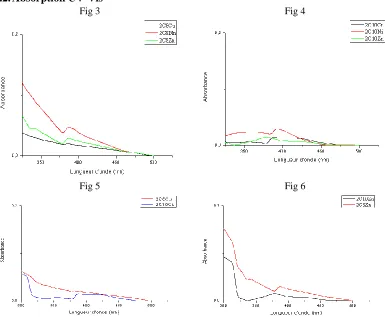
1081 UV-Visible absorption measurements were taken in the range of 200 – 500 nm for the six
samples. All spectra shows o peak at 385nm with different intensities of absorption. This
absorption band is known to correspond to charge-transfer transitions (Edward, 2006),(Anne, 2006), (Mokhtaria Rosa, 2012).
1.3.
Charge-transfer Transitions
Indeed, at still higher energy (UV-Vis), electrons are exited from the filled ligand-centred
orbitals to the half-occupied d orbital, producing ligand to metal charge transfer transitions (Edward, 2006). As said before, organic and inorganic groups are attracted by hydrogen bonds N-H....Cl. This bonding is reducing the electronic density around the chlorine ion and cause the
charge transfer metal-to-ligand Cu---Cl.
The charge transfer transitions are key to understanding the nature of ligand-metal bonds
because high covalency is associated with low energy (Edward, 2006). The intensities of these transitions are proportional to the overlap of the donor and acceptor orbitals involved in the charge transfer process (Edward, 2006).
We have grouped the spectrums in a way to determine the influence of the metal ion and the organic chain on the charge transfer process and the covalency of the hydrogen bonds.
Fig 3 and 4 shows the absorption spectra of three different metal ions for a same organic chain. The intensity of absorption for compounds with Zinc ion is higher than compounds with copper ion.
Fig 5 and 6 shows the absorption spectra of two different organic chains with a same metal ion. For both, we see taht more the length of the organic chain is higher, more the intensity of
absorption is lower; and so the contribution in the charge transfer process is lower, and more the hydrogen bond is weaker.
1.4.
Intra-atomic d-d Transition
On the other hand, other transition is expected for some of these compounds. For exemple, on the
2C8CuCl4, 2C10CuCl4 compounds, cupric ion is placed in an octahedral ligand field, the five d orbitals split into t2g and eg sets. Placing nine electrons into these ligand field split orbitals gives one in the eg set and thus unstable to Jahn-Teller distortion. This splitting allows a d-d transition.
Those samples was active to ESR and their spectrum have been studied in another work, so, we expect an absorption band between λ=750nm and λ=1800nm relative to intra-atomic d-d transition (Anne, 2006); (Mokhtaria Rosa, 2012).
REFERENCES
Anne, L.N., 2006. Corrélation structure – proprieties d’absorption UV-Vis-IR associée
aux états de valenc du cuivre dans les oxides à base de zinc de type spinelle et
wurtzite.
Balamurugan, K., N. Harish Kumar, J. Arout Chelvane and P.N. Santhosh, 2009. Room
temperature ferromagnetism in Fe-doped BsSnO
3. J. Alloys and Comounds,
1082
![3 (4 Methylphenyl) 4 [(thiosemicarbazono)methyl] 1,2,3 oxadiazol 3 ium 5 olate 1,4 dioxane hemisolvate](data:image/gif;base64,R0lGODlhAQABAIAAAP///wAAACH5BAEAAAAALAAAAAABAAEAAAICRAEAOw==)