
Experimental Analysis and Modelling of an
Information Embedded Power System
A Thesis
SUBMITTED IN FULFILMENT OF THE REQUIREMENTS FOR THE DEGREE OF
DOCTOR OF PHILOSOPY
By
Amanullah Maung Than Oo
To
School of Electrical Engineering
Faculty of Health, Engineering and Science
Declaration of Originality
I, Amanullah Maung Than Oo, declare that the PhD thesis entitled ―Experimental Analysis and Modelling of an Information Embedded Power System‖ is no more than 100,000 words in length, exclusive of tables, figures, appendices and references. This thesis contains no material that has been submitted previously, in whole or in part, for the award of any other academic degree or diploma. Except where otherwise indicated, this thesis is my own work.
To my wonderful wife Habibah Begum
and
ABSTRACT
As power industry enters the new century, powerful driving forces, uncertainties and new functions are compelling electric utilities to make dramatic changes in their information communication infrastructure. Expanding network services such as real time measurement and monitoring are also driving the need for more bandwidth in the communication network and reliable communication infrastructure. These needs will grow further as new remote real-time protection and control applications become more feasible and pervasive. Information embedded power system via wide area network (IEPS-W) is the solution to accommodate the growing demand of wide area monitoring, protection and control. IEPS-W is an extension of traditional power systems with added monitoring, control and telecommunications facilities.
Various power system communication protocols are being used within IEPS-W to transmit critical data in real time along with decades old Supervisory Control and Data Acquisition System (SCADA). Most of the protocol in used are not originally developed to use in wide area computer network (WACN) environment. However, protocol developers upgrade their protocols and use it in WACN. This requires experimental investigation of various power system communication protocols before employing it on the power grid.
Victoria) in order to experimentally analyse the performance characteristic of Distributed Network Protocol (DNP3) over wide area network (WAN). In this experiment, real time data were sent from Intelligent Electronic Devices to utility control center using WAN.
ACKNOWLEDGEMENTS
First and foremost, I would like to express my special appreciation to my supervisor Professor Akhtar Kalam for his guidance, assistance and encouragement during this research. The opportunities and learning experiences he has given me are deeply appreciated. My experience at Victoria University is especially rewarding and helpful in my future career because of his supports not only in the research work but also in many other aspects. I would also like to show my appreciation to my co-supervisor for his timely advice and support throughout this research.
I would like to thank SP AusNet PTY LTD for providing all the hardware and software required for this project. In particular, I would like to thank Kevin Whelan, Andrew Roberts and Doug Peddler for their cooperation and assistant. I also would like to thank my colleagues at the School of Electrical Engineering for their valuable support. In particular, I would like to thank Dr. Cagil Ozansoy, Hassan AL-Khalidi, Abdulrahman Hadbah, David Fitrio, Adnand Mohan, Jaideep Chandran, Nikhil Joglekar and other friends in room D706 and G218, School of Electrical Engineering. I would also like to thank my parents, parents-in-law and other family members including Shafiqur Rahman, Dr. Faridur Rahman and Aksa Jamila for their support and encouragement.
LIST OF ABBREVIATIONS
ACSI Abstract Communication Service Interface AGC Automatic Generation Control
ALP Application Layer Protocol ATM Asynchronous Transfer Mode
CASM Common Application Service Models
CORBA Common Object Request Broker Architecture CRC Cyclic Redundancy Code
CSMA/CD Carrier Sense Multiple Access/Collision Detection DA Destination Address
DCOM Distributed Component Object Model DES Data Encryption Standard
DMS Distributed Management System DNP3 Distributed Network Protocol version 3 DPU Data Processing Unit
DTS Dispatcher Training Simulator EMS Energy Management Systems EPRI Electric Power Research Institute FACTS Flexible AC Transmission System
GOMSFE Generic Object Models for Substation and Feeder Equipment GOOSE Generic Object-Oriented Substation Events
ICCP Inter-control Centre Communications Protocol ICV Integrity Check Value
IEC International Electrotechnical Commission IEDs Intelligent Electronic Devices
IEEE Institute of Electrical and Electronics Engineers
IEPS-W Information Embedded Power System over Wide Area Network IETF Internet Engineering Task Force
IIN Internal Indications IKE Internet Key Exchange IP Internet Protocol
IPSec Internet Protocol Security IT Information Technology
LAN Local Area Network LPDU Link Protocol Data Unit LSDU Link Service Data Unit
MMS Manufacturing Message Specification MTU Master Terminal Units
NIS Network Integrated System NTP Network Time Protocol
OO Object Oriented
PKI Public Key Infrastructure
PLC
Power Line Carrier
PSTN Public Switched Telephone Networks PVC Permanent Virtual Circuit
RTS Richmond Terminal Station RTU Remote Terminal Unit SA Substation Automation
SCADA Supervisory Control and Data Acquisition System SCSM Specific Communication Service Mapping
SDU Service Data Unit
SEL Schweitzer Engineering Laboratories SNMP Simple Network Management Protocol SONET Synchronous Optical Network
SSL/TLS Secure Sockets Layer / Transport Layer Security SVC Switched Virtual Circuit
TCP/IP Transmission Control Protocol/Internet Protocol TH Transport layer Header
TPCI Transport Protocol Control Information TPDU Transport Protocol Data Unit
TSDU Transport Service Data Unit
UCA Utility Communication Architecture UDP User Datagram Protocol
VHF/UHF Very High Frequency / Ultra High Frequency VNSC Victoria Network Switching Centre
VOIP Voice Over Internet Protocol VON Virtual Overlay Network
VPN Virtual Private Network WAN Wide Area Network
WACN Wide Area Computer Network
TABLE OF CONTENTS
ABSTRACT ii
ACKNOWLEDGEMENTS iv
LIST OF ABBREVIATIONS v
TABLE OF CONTENTS ix
LIST OF FIGURES xiv
LIST OF TABLES xvii
LIST OF PUBLICATIONS xviii
CHAPTER 1 THESIS OVERVIEW 1.0 Introduction 1
1.1 Motivation 4
1.2 Research methodologies and techniques 6
1.3 Organization of the Thesis 9
1.4 Originality of the Thesis 11
CHAPTER 2 LITERATURE REVIEW 2.0 Introduction 13
2.1 Wide area power system monitoring, protection and control 15
2.1.1 Impact of the information technology on power system 16
2.1.2 Obstacles to technology 21
2.1.3 Possible solutions to technology obstacles 27
2.2.1 Importance of real time information in power system 41
2.2.2 Future power system information needs 44
2.3 Current power system data communication media 45
2.4 Power system communication protocols 48
2.5 SCADA system design for electric utilities 53
2.6 Conclusion 56
CHAPTER 3 AN OVERVIEW OF MODERN INFORMATION EMBEDDED POWER SYSTEMS 3.0 Introduction 58
3.1 Information embedded power system 59
3.1.1 Measurement system 59
3.1.2 Communication system 62
3.1.3 Energy control centre 64
3.2 Power system communication protocols 68
3.2.1 Distributed Network Protocol (DNP3) 68
3.2.2 IEC 61850 76
3.2.3 Other commonly used power system communication protocols 79 3.3 Conclusion 82
4.2 Experimental procedures 89 4.3 Experimental results 93 4.4 Conclusion 101
CHAPTER 5 MODELLING OF DNP3 PROTOCOL FOR AN IEPS-W
5.0 Introduction 102
5.1 Brief overview of OPNET modeller 103 5.2 Development and modelling of DNP3 protocol using OPNET modeller 104
5.2.1 Implementation of DNP3 data link layer 107 5.2.2 Implementation of DNP3 transport layer 110 5.3 Development and implementation of DNP3 Application Layer 116
5.3.1 Message structure 118
5.3.2 Fragment rules 125
5.3.3 Classes 128
5.3.4 Time synchronisation 129
5.3.5 Level 1 Implementation 130
5.3.6 Implementation of DNP3 application layer 136 5.3.7 Master solicited response reception state 148
5.4 Conclusion 153
CHAPTER 6 MODELLING OF AN EFFICIENT INFORMATION EMBEDDED POWER
SYSTEM
6.1 Importance of time critical communication infrastructure 156
for power system 6.2 Development and modelling of efficient IEPS – W 157
6.2.1 Implementation of unsolicited response for IEPS-W 158
6.2.2 Master unsolicited response reception state table 178
6.3 Conclusion 184
CHAPTER 7 MODELLING OF SECURE INFORMATION EMBEDDED POWER SYSTEM 7.0 Introduction 185
7.1 Secure communication system for utilities 185
7.1.1 Threats analysis of DNP3 protocol 187
7.1.2 SCADA securities issues 191
7.1.3 Approaches to enhance IEPS – W security 192
7.2 Development and implementation of DNPSec for IEPS – W 201
7.2.1 DNP3 security framework 201
7.2.2 Key management 206
7.2.3 Analysis of the approach 208
7.2.4 SCADA/DNP3 over IP 210
7.2.5 Implementation of DNPSec in IEPS – W 212
8.1 Introduction 221 8.2 Summary and achievements of the research 223
8.3 Future work 226
REFERENCES 229
APPENDIX
A. Experimental data for DNP3 251
LIST OF FIGURES
Figure 1.1: Information embedded power system over WAN (IEPS-W) 1
Figure 2 .1: Substation communication protocols [38] 26
Figure 2.2: SCIMS - base architecture [46] 33
Figure 2.3: Computer network controlling the electric network 36
with a tree topology [49] Figure 2.4: Integrated WAN communication network [50] 38
Figure 2.5: The circle of measurement, information and decision making 42
Figure 2.6: Future power system information needs 45
Figure 2.7: The OSI reference model 50
Figure 2.8: The Ethernet network concept [80] 51
Figure 2.9: TCP/IP protocols and functional layers [26] 52
Figure 2.10: RTU components [91] 55
Figure 3.1: Energy control centre [103] 65
Figure 3.2: DNP3 common system architecture [105] 70
Figure 3.3: Client and server relationship [105] 71
Figure 3.4: DNP3 frame 72
Figure 3.5: DNP3 protocol stack [105] 75
Figure 3.6: Network topology [105] 76
Figure 4.2: Control room (master) and slaves (RTUs) setting 89
Figure 4.3: Time interval setting 90
Figure 4.4: Time setting up to milliseconds 90
Figure 4.5: DNP3 classes 91
Figure 4.6: ASE2000 communication test set: TCP as transport mode 92 Figure 4.7: Activity timeline for DNP3-LAN/WAN (TCP/IP) 92
Figure 4.8: Propagation delay with 10% data traffic in DNP3-WAN (TCP/IP) 94 Figure 4.9: Propagation delay in DNP3-WAN (TCP/IP) with 20% traffic increase 96
Figure 4.10: Propagation delay in DNP3-WAN (TCP/IP) with 40 % traffic increase 97 Figure 4.11: Propagation delay in DNP3-WAN (TCP/IP) with 60 % traffic increase 98 Figure 4.12: Propagation delay in DNP3-WAN (TCP/IP) with 80 % traffic increase 99 Figure 4.13: Mean propagation delay for DNP3-WAN (TCP/IP) 100
Figure 5.1: DNP3 protocol stack [105] 104
Figure 5.2: Control centre and IED in OPNET platform 105 Figure 5.3: DNP3 protocol stack in OPNET environment 106 Figure 5.4: DNP3 data link layer in OPNET environment 110 Figure 5.5: Transport layer message layout 113
Figure 5.6: TH Bit definitions 113
Figure 5.7: Transmission of a single frame message 115 Figure 5.8: DNP3 transport lawyer in OPNET platform 115
Figure 5.9: DNP3 device interface 116
Figure 5.10: Message sequence 117
Figure 5.12: Application response header 119 Figure 5.13 Application control fields 119 Figure 5.14: Outstation fragment state diagram 146 Figure 5.15: Outstation fragment state diagram in OPNET environment 147 Figure 5.16: Master solicited response reception diagram 152 Figure 5.17: Master solicited response reception diagram in OPNET 153
Figure 6.1: Unsolicited timing diagram 159
Figure 6.2: Ideal mixed unsolicited and solicited communications 169 Figure 6.3: Unsolicited response or confirmation not received 170 Figure 6.4: Read request received in region A 172 Figure 6.5: Read request received in region A (2) 174 Figure 6.6: Read request received in period B (1) 176 Figure 6.7: Read request received in period B (2) 177 Figure 6.8: Master unsolicited response reception diagram 179 Figure 6.9: Master unsolicited response in OPNET platform 181
Figure 6.10 IEPS-W in OPNET environment 182
Figure 6.11: Mean propagation delay of efficient IEPS-W 183
Figure 7.1: Planning the attack 189
Figure 7.2 DNPSec protocol structure 203
LIST OF TABLES
Table 4.1: Summary of experimental features and characteristics 85 involved in DNP3-WAN (TCP/IP) experiment
Table 4.2: Propagation delay with 10% data traffic 94 Table 4.3: Propagation delay with 20% increased data traffic 95 Table 4.4: Propagation delay with 40% increased data traffic 96 Table 4.5: Propagation delay with 60 % increased data traffic 97 Table 4.6: Propagation delay with 80 % increased data traffic 99 Table 4.7: Summary of experimental results in different network traffic 100
Table 5.1: Function code table 120
Table 5.2: Level 1 Implementation (DNP-L1) 133 Table 5.3: Outstation fragment state table 138 Table 5.4: Master reception state table, solicited responses 150 Table 6.1: Master reception state table, unsolicited responses 180 Table 7.1: Dynamic behaviour and relative performance characteristics of 209
large scale VPN environments
Table 7.2: Advantages and disadvantages of DNPSec 210 (proposed solution), DNP3/IPSec and DNP3/SSL/TLS architectures
LIST OF PUBLICATIONS
Journals
1. Amanullah M.T.O, Kalam A. and Zayegh A., ―Information Embedded Power System: The effects of 'larger switched computer network' on the controllability of power system,‖ Journal of the Australian Institute of Energy, March 2005, Australia
2. Amanullah M.T.O, Kalam A. and Zayegh A., ―Wide area power system monitoring, protection and control,‖ Association for the Advancement of Modelling and Simulation Techniques in Enterprises (AMSE), France, 2006
3. Amanullah M.T.O, Kalam A. and Zayegh A., ―The effects of computer network on the controllability of an information embedded power system,‖ Journal of Information and Communication Technology, Vol. 1, No. 1, (Summer 2005) pp: 29-35, TECNOLOGICS
Conference papers
1. Amanullah M.T.O, Kalam A. and Zayegh A., ―Information embedded power system: the effective communication system of the 21st century power system industry,” AUPEC 04, September 26-29, Brisbane, Australia.
2. Amanullah M.T.O, Kalam A. and Zayegh A., ―Effective power system communication requirements for deregulated power industry,‖ APCCAS 04, December 6-9, Tainan, Taiwan.
3. Mahajan M.M, Amanullah M.T.O and Kalam A., ―Renewable hydrogen based distributed power generation systems,‖ ICECE 04, December 28-30, Dhaka, Bangladesh.
4. Amanullah M.T.O, Kalam A. and Zayegh A., ―Network Security Vulnerabilities in SCADA and EMS,‖ IEEE/PES T&D 2005 Asia Pacific, August 14-18, 2005, Dalian, China.
6. Mahajan M.M, Amanullah M.T.O and Kalam A., ―Soft start and solid state speed control of a D.C. shunt drive,‖ ROVISP 2005: International Conference on Robotics, Vision, Information and Signal processing, 20-22 July 2005, Penang, Malaysia.
7. Amanullah M.T.O, Kalam A. and Zayegh A., ―Fiber Optic Network Infrastructure as next generation power system communications‖, The 6th
Jordanian International Electrical & Electronics Engineering Conference, JIEEEEC 2005, November 15-17, 2005,Amman, Jordan.
8. Amanullah M.T.O, Kalam A. and Zayegh A., ―Power system communication laboratory,” AUPEC 05, 25th - 28th September 2005, Hobart, Tasmania, Australia.
9. Amanullah M.T.O, Kalam A. and Zayegh A., ―Wide area power system monitoring, protection and control,‖ International Conference on Modelling and SimulationMarrakesh, Morocco,22- 24 November 2005.
11. Amanullah M.T.O, Kalam A. and Zayegh A., ―Intelligent control and protection of power system with IEPS-W,‖ 8th
International Conference on AC and DC power transmission, 28-31 March 2006, London, United Kingdom.
12. Amanullah M.T.O, Kalam A. and Zayegh A., ―Development of information embedded power system using OPNET,” AUPEC 06, 10-13 December 06, Melbourne, Australia.
13. M.T.O Amanullah, Md Mainuddin, H. Md Safayat, A. Kalam, A. Zayegh, ―Development of Real Life Power System Communication and Protection Laboratory At Victoria University,” AUPEC 06, 10-13 December 06, Melbourne, Australia.
14. Amanullah M.T.O, Kalam A. and Zayegh A., ―Experimental Investigations of DNP3 Protocol for an Information Embedded Power System,” IASTED, PES 2007, USA.
CHAPTER 1
THESIS OVERVIEW
1.0 Introduction
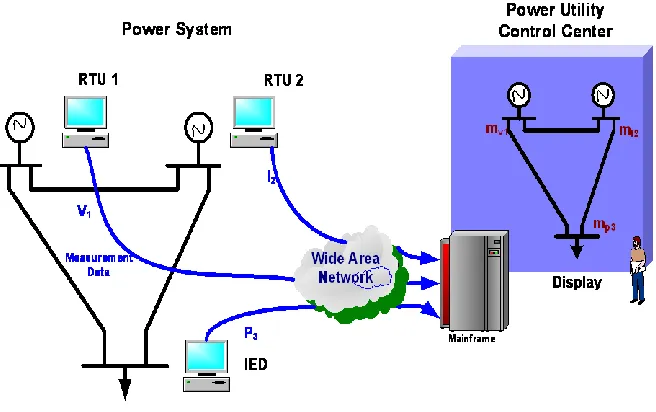
An Information Embedded Power System over wide area network (IEPS-W) is an extension of traditional power systems with added monitoring, control and telecommunication capabilities. In this thesis, information embedded power system refers to transmitting power system data from various Intelligent Electronic Devices (IEDs) or Remote Terminal Units (RTU) to the control centre using Distributed Network Protocol (DNP3) over Wide Area Network (WAN). A simplified illustration of an IEPS-W is shown in Figure 1.1.
As seen in the figure, IEPS-W consists of: i) power system hardware ii) the measurement system – which is represented by IEDs or RTUs iii) the communication system representing WAN and iv) the electric utility control centre. In this system, IEDs or RTUs record power system measurements and send them in real time over a wide area computer network to the power control centre using DNP3 protocol. Control centres also send control messages to various IEDs to perform control actions such as opening/closing breakers, relays actions, transformer tap changing and generation control. This thesis investigates the performance accuracy and characteristics of the DNP3 protocol over WAN when data are being sent from IEDs to control room.
Due to increasing demand of data by various utility, research efforts have begun to make power system communication infrastructure more efficient, reliable and secure. Further research has also been focused on how delays in computer control networks can introduce errors in measurements, when these measurements are sent across the wide area network. Carullo has done a thorough experimental study on measurement delay errors while power system employs local area network (LAN) to transmit power system data [13].
A Matlab simulation study was performed by Lian, Moyne and Tilbury [14] to determine key performance parameters of several types of common direct-link computer networks. These parameters included network utilization, magnitude of expected time delay and characteristics of time delays. Skeie, Johannessen and Brunner [15] investigated whether Ethernet has sufficient performance characteristics to meet real-time demands of substation automation. Luque, Escudero and Perez [16] also develop an analytical model of the relationship between measurement error and delay. They modelled the evolution of magnitudes in electric networks as a first order autoregressive process AR(1). This model assumes measurement error is a function of both the communications delay and the bandwidth of the evolution of the voltage magnitude.
1.1 Motivation
Information exchange is a vital component in the efficient operation, profitability and growth of a restructuring electric power industry. Commercial and regulatory needs today mandate a variety of advanced utility functions [13], including:
Real-time calculation/optimisation of total/available transmission and generation
Contingency assessment and response using live data to feed wide-area protection and islanding algorithms
Asset and workforce management with constantly updated databases
Spot market/power exchange energy pricing and delivery
Demand response, energy efficiency, and customer management through real time pricing, advanced metering and distributed generation
Outage management, auto-restoration and distribution network optimisation based on up-to-the-minute data from customer premises.
Integrated information systems and telecommunications networks capable of supporting these functions, as well as future capabilities, are critical in the changing utility environment.
and interoperable communications and control environment, standards must shape the architecture and accepted practices of the entire enterprise, especially when it is required to integrate different systems, vendors and technologies.
To improve the efficiency of a power system, it is necessary to develop power system monitoring devices and the system which can integrate and analyse the data from the devices. The system having the function to control the power system property is important, where the data collected with the device will be used as a control input. It is expected that there will be many of communication activities between the devices and the system. Thus designing the efficient communication protocol is very important. For this reason, it is vital that the performance of existing power system communication protocols is experimentally analysed. For example, the distribution of packet delivery times under different network traffic using different protocols may have a large effect on the real-time state estimation solvability or cause unacceptable error magnitudes. Random network traffic may cause delays in delivering metered data to the state estimator in the control centre, which may render many buses in a power system unobservable during one or more calculation intervals [14].
research has been done to analyse how random measurement delays due to WAN traffic can affect the accuracy of power system measurements. Hence, experimental investigation is required to systematically analyse performance characteristic of different power system communication protocols before adopting them into WAN environment.
1.2 Research methodologies and techniques
This research aims to experimentally study the performance of DNP3 protocol over WAN when data are sent from various IEDs to power control centre. The main aim is to develop an efficient power system communication protocol based on DNP3 for an information embedded power system to significantly reduce the propagation delay associated with DNP3. The experimentation was done using real life power system hardware, tools and software own by SP AusNet (a Australian Transmission and Distribution Organisation based in Victoria). Modelling, design, implementation, simulation and development was carried out using appropriate software development and network design tools called Optimized Network Engineering Tools (OPNET). The details of proposed methodology and techniques to achieve the requirements of this research project are as follows:
1.2.1 Analysis of the currently available systems / Literature review
systems in order to recognize the weaknesses of the present power system communications protocols which are used in the utility. This step of analysis and research showed that up until now, little research has been performed to experimentally investigate power system communication protocols such as DNP3 when power system data are sent via WAN for efficiently and reliably transmitting power system data for monitoring, control and protection purposes.
1.2.2 Setting-up experimental platform
An experimental platform was set up at Victorian Network Switching Centre owned by SP AusNet Pty LTD in order to experimentally analyse the performance characteristic of DNP3 protocol over WAN when data are sent from IEDs to utility control centre using WAN. More specifically, the experiment was setup to experimentally measure the propagation delay associated with DNP3 over WAN. The experimental platform consists of power system hardware, measurement system, embedded computer network communication system (WAN) and power system control centre as shown in Figure 1.1. After experimental platform had been set up, power system data were sent from IEDs to control center via WAN using DNP3 protocol and r the propagation delay recorded. The experimental platform utilises TEKRON precision clock to accommodate the precision timing.
The measurement delays associated with wide area network was very high as this type of network is much more complex due to the added complexities of routing and switching. Hence, based on the experimental data collected and carefully investigating the data, a more efficient and reliable protocol is developed based on DNP3 protocol using OPNET modeller. DNP3 link and transport layer was initially developed to analyse the protocol.
1.2.4 Design and implementation of DNP3 application layer modules
Application layer of DNP3 protocol is vital for critical data communication process. It describes the message format, service and procedures. The application layer responds to complete messages received (and passed up from the transport layer) and builds messages based on the need for or the availability of user data. Once messages are built, they are passed down to the pseudo-transport layer where they are segmented and passed to the data link layer and eventually communicated over the physical layer. After successfully developing the DNP3 link and transport layer, application layer was developed using OPNET technology to fully investigate and simulate the measurement delays involved in DNP3 over WAN.
1.2.5 Development of time efficient information embedded power system
DNP3 in OPNET environment, a more reliable and time efficient IEPS-W has been developed reducing the propagation delay involved in DNP3 over WAN. This allows provide power system to monitor, control and protect more efficiently.
1.2.6 Development of secure information embedded power system
Modern power utility faces significant security threat when they employ internet technology to transmit the power system critical and non-critical data. A more secure and reliable communication system is essential to avoid catastrophic disaster from major information attack. Hence, a more secure and reliable information embedded power system has been developed for the modern utility based on DNP3 protocol for IEPS-W.
1.3 Organization of the Thesis
This thesis contains eight chapters and is organized as follows:
Chapter 2 presents literature review of power system communications, recent developments and the use of protocols and future power system information needs. It further discusses the power system communication requirements in deregulated power industry highlighting the importance of efficient communication requirement in the deregulated power industry.
An overview of information embedded power system over wide area network has been presented in Chapter 3. It also details discussion on power system communication protocols and wide area computer network together with an overview of energy control centre. Chapter 4 presents detailed experimental analysis of DNP3 protocol over WAN for an IEPS-W. It includes detailed experimental set up and procedure carried out to investigate performance of DNP3. Experimental results and data have also been included.
1.4 Originality of the Thesis
This research will contribute to the knowledge in information embedded power system as it addresses major issues in efficient and reliable power system communication. The experimental analysis and development of IEPS-W is one of the pioneering attempts in power system communication.
This research will contribute to knowledge in the following specific areas:
(1) Contributes to the knowledge by identifying the requirement of performance analysis for different power system communication protocols. The proposed research will be immensely beneficial to power protection and control engineers since it further enhances the understanding of the different power system communications protocols.
(2) Contributes to the knowledge by conducting experiment to study the performance of DNP3 over WAN for an information embedded power system, identifying the critical issues behind the development and design of a specific communication service aimed at providing all sorts of communication mechanisms to DNP3 based applications running within power network.
(4) Contributes to knowledge since it develops a more reliable and efficient power system communication protocol based on DNP3 protocol.
CHAPTER 2
LITERATURE REVIEW
2.0 Introduction
The purpose of this chapter is to provide the necessary background required to understand the concepts that relate to power system communications, recent developments and the use of protocols for an information embedded power system.
Power supply is one of the most essential resources to the human society development. The cost of power outage is on the order of billions of dollars [17, 18]. In addition, power system can become vulnerable in the face of possible system abnormalities such as control, protection or communication system failures, disturbances and human operation errors. Therefore, to keep power supply stable and reliable is a very critical issue for future power system design.
clearly demonstrated the essential adoption of real time information coordination for the control system strategy design. Most communication technologies currently employed in the power system only allow local, narrowly focus, control actions [25] at the substation or line level due to lack of efficient, high speed, high bandwidth and reliable communication infrastructure.
As the electric power industry enters the new century, powerful driving forces, uncertainties and new services are compelling electric utilities to make dramatic changes in the power system information infrastructure design [26, 27]. The increasing incorporation of digital devices throughout the enterprise as well as the forces of deregulation is driving utility communications into new realms [28]. Expanding network services such as real time monitoring are also compelling the need for more increasing bandwidth in the communication network backbone. These needs will grow further as new remote real-time protection and control applications [29, 30] become more feasible and pervasive. Reliable communication capability with reliable communication protocol must exist both within a utility and with government emergency service respondent and other stakeholders to effect rapid recovery operations during a major disruption in the power system [31].
on power system. A broader literature review portion of this thesis is discussed in Section 2.1 which covers deregulated utility communications requirements. In this section, importance of real time information in power system along with future power system information needs has also been discussed. A detailed elaboration on current power system data communication media has been presented in Section 2.3. Section 2.4 discussed various power system communication protocols used by power utility. A more integral part of power system communication is discussed in Section 2.5 as SCADA system design for electric utilities. Conclusion remark is made in Section 2.6.
2.1 Wide area power system monitoring, protection
and control
The electric utility industry is going through significant changes caused by deregulation, distributed generation, increased competition and requirements for continuous improvement in the quality of power supplied to the users. At the same time, the use of the internet is growing, and more and more utilities are using WAN for their communications.
area power network [32]. Power system communication protocols such as DNP3 and International Electrotechnical Commission 61850 (IEC 61850) play significant role couple with SCADA ensuring the effective and reliable monitoring of modern power system network.
The prerequisite is an efficient communication link not only for SCADA and energy management systems (EMS) but also for providing the protection, maintenance and planning departments with direct access from remote to information from the substation primary and secondary equipment [33]. Thus, WAN based monitoring has become a very significant part of the power system monitoring, protection and control.
2.1.1 Impact of the information technology on power system
2.1.1.1 Data Acquisition
With computing power making its way into the primary equipment, more and more equipment internal data can be made available to the outside at virtually no extra cost. Interfaces to acquire such internal data were previously not provided for cost reasons. Data that will be accessible includes, but is not restricted to:
Switching counters
Thermal information
Switching currents
Manufacturing data
Original value of key performance criteria.
This kind of data can be the source of valuable condition information and exploited for building condition monitoring systems for those assets that exhibit the highest failure rates and/or cause unacceptable power interruption impact. Without doubt the transformers and circuit breakers are the prime candidates for these kinds of monitoring systems.
The second trend within the data acquisition falls into the category of IED, i.e. secondary equipment like protection terminals. Besides their primary functions, they host more and more additional functionality, which increase their attractiveness compared with dedicated single function units. Many of these additional functions provide a sound foundation for basic monitoring systems, cost-efficient and perfectly suited for medium and distribution voltage level IEDs for protection or control may comprise:
Disturbance recorders
Event recorders
Statistical value recording (peak current indicators, number of starts/trips, current at tripping, etc.)
General purpose programming capabilities that allow to write and run customer specific applications on the IEDs
Detective maintenance, i.e. to detect hidden failures by means of special functional checks and diagnostics.
The type of maintenance policy to select for specific equipment for transmission and distribution depends on reliability and on economic and customers‘ business related availability considerations, which take the consequences of failures into account [34].
2.1.1.2 Information Technology
There are three areas where advanced information technology (IT) applications can contribute significant benefits in terms of better power system performance and reduction of operating and maintenance costs:
1. Advanced power system management, which results in higher reliability of power supply
2. Intelligent substation automation which assures higher availability 3. On-line power system monitoring.
Mobility: In this context is the ability of a user of the system to access data without requiring physical configuration changes to the system to do so.
Simple Network Management Protocol (SNMP) Diagnostics: Remote diagnostics dealt primarily with the control and protection systems and not with the infrastructure that communicated the data. The SNMP protocol can be used to manage the complete network from Switches and Routers, Servers and Client PC‘s, Protection and Control devices to Printers. Using a network management system the health and performance of the network can be monitored in addition to allowing for the configuration of devices from a single point in the network. Bottlenecks in the system may be identified (where traffic is at its highest) and the routing or topology may be modified to alleviate any problems.
Scalability: Naturally the ability to add services must not adversely affect the existing system so hand in hand with this goes scalability. If an interface is too slow then simply add in or reconfigure the interface to a faster one. If fibre optic interfaces are used it is possible to scale from 100Mb to 1 or 10 Gb over the same fibres.
Video: In the same vein, the WAN can mediate video streams. These can be used for remote guidance in fault finding if site personnel are unfamiliar with the equipment or if the manufacturer needs to become involved. Web cams are cheap items and could be used freely. Specialist security/surveillance cameras can also be integrated into the system with facilities such as remote control and recording.
Remote Diagnostics: Performance data is collected and stored on each network devices and may be retrieved, stored and printed either using a diagnostic toolbox or by interrogation using SNMP. Remote diagnostics provide the ability to access this data from any point whilst not requiring any physical modification to the system. If any fault cannot be determined by local staff then external specialists can dial in to the system and perform more detailed analysis.
Tunnelling Protocols – Virtual Wire: Tunnelling allows a protocol to be transmitted as the data of another protocol. If serial protocol cannot be mediated over Ethernet and Transmission Control Protocol/Internet Protocol (TCP/IP) then it can be encapsulated as data in a protocol that can be. This offers reduced complexity and engineering and improves the overall diagnostics.
communications occur. Failure of a single switch or fiber would be detected and rectified within 500ms by internal reconfiguration of the topology.
(Extension) Scalability: Due to the evolving nature of electrical networks, control and monitoring systems need to be scalable in both network structure and bandwidth. Network based technologies allow the addition of independent networks (subnets) to their structure. Furthermore, they can later be integrated into corporate networks.
(End of equipment life) Multi-Source Kit: As TCP/IP and Ethernet are ubiquitous one is not forced to use a single source for software or hardware in the network. Application software can reuse the infrastructure if replaced, without penalty.
(Bandwidth Changes) Faster Kit: As new equipment becomes available it is possible to upgrade the infrastructure without hindrance to faster devices when required.
Time Synchronization: A fast WAN topology allows for more accurate time synchronization than in tradition serial topologies. Network Time Protocol (NTP) is an adaptive time synchronisation protocol that can adjust and choose between multiple time sources. Propagation delays over the network can be accommodated [35].
2.1.2. Obstacles to technology
development in the area of trusted networked computer systems. The vulnerability of any network computing system increases with the number of network access points enabled within that system [36]. Thus, a wide-area network for electric power monitoring, protection and control suffer from the same obstacles seen in creating wide-area trusted computing networks such as:
Lack of a wide-area based critical data communications infrastructure
Vulnerability of the internet technology
Lack of network quality of service guarantees
Immaturity, fragility and lack of interoperability in trust frameworks
The variety of control station and substation communications protocols and their lack of interoperability
Socio-economic and political resistance to regularity controls.
The reliability demands and time-critical nature of electric power systems place additional burdens on quality of service guarantees and high-speed authentication and trusted communications. Although it is assumed that the same technologies for mitigating risk and implementing interoperability in computer networks could be used for control and protection in electric power systems. The above-mentioned barriers have now been elaborated.
Birman in reference [37] states that in order to run mission-critical applications across wide spatial areas, there is a need to develop a Virtual Overlay Network (VON) separate from any next generation internet network that may evolve. In addition, Electric Power Research Institute (EPRI) has proposed the Inter-control Centre Communications Protocol (ICCP) as the base of an inter-regional communications infrastructure. The literal intent behind VON and ICCP is to segregate infrastructure related critical data communications (e.g., power system protection) from non-critical communications like e-commerce.
2.1.2.2. Vulnerability of Internet technology
create questions about their use in real-time applications. Therefore, internet access without any specialized protocol is unsuitable for real time protection; however it access is sufficient for casual observation and maintenance planning.
2.1.2.3. Lack of Network Quality of Service
There are a few mechanisms for ensuring the quality of service over a network such as packet prioritisation. Ethernet network prioritisation is still a research topic though packet prioritisation has been implemented on proprietary networks. Several companies and organisations have implemented Ethernet TCP packets over leased ATM. Fortunately, these two communication mechanisms do provide quality of service guarantees suitable for time critical applications. Unfortunately, the end-to-end TCP flow-control necessary for quality of service implementation can interfere with ATM and Frame-Relay packet construction, thereby causing an indeterminate degradation in service quality. Further work is needed to better define quality of service mechanisms within ATM and Frame-Relay packets.
2.1.2.4. Immature, Fragile Trust Frameworks
There are a few frameworks for establishing trusted interconnections between computing systems: Internet Protocol Security (IPSec) and Public Key Infrastructure (PKI). IPSec is an effort of the Internet Engineering Task Force (IETF) to add security mechanisms to the TCP/IP layers within the Ethernet protocol. PKI is an attempt to create a world-wide infrastructure for secure communications based on asymmetric public-key cryptography. As an alternative to PKI, the Pretty Good Privacy (PGP) group has implemented and advocates an informal ―web of trust‖ where trusted users vouch for and include others in formalised lists of who to trust. Other mechanism for establishing trust levels and trust frameworks are being explored, but all of these efforts are focused on e-commerce and are not sufficiently robust for electric power control systems.
2.1.2.5. Control and Substation Protocols with Minimal Interoperability
The diversity and lack of interoperability in these communication protocols create obstacles for anyone attempting to retrieve disturbance data (trip, near-trip, critical, or near-critical) from the station.
2.1.2.6 Socio-economic and political resistance to regularity controls
Despite the calls for centralized control structures and increased regulatory requirements, it is doubtful whether today‘s socio-economic and political climate would support such actions. The failed deregulation attempt in California have slowed but not stopped similar efforts in other parts of the world. Thus, it seems that the electric power industry will undergo the same deregulatory actions and influences experienced by U.S. telephone, railroad, and airline industries. It remains questionable, however, if a keystone critical infrastructure like the electric power grid should be stressed and jeopardised by deregulatory machinations.
2.1.3. Possible solutions to technology obstacles
After classifying the obstacles, new technologies now identified from computer networking and electric power system protection that might be used to overcome obstacles and foster development for such system:
Recognition for and the development of information infrastructures
Investigations into improved quality of service WAN parameters and service level agreements
Tunnelling utility protocols within Ethernet‘s TCP/IP layers
Research in trusted third-party infrastructures
Revisiting the issue of Deregulation
Next generation FACTS and IEDs.
2.1.3.1. The development of information infrastructures
stations and cutpoints. Advances in fiber-optics (e.g., Synchronous Optical Network (SONET)) make this type of network feasible today.
2.1.3.2. Improved WAN quality and service level agreements
There is a growing recognition of the need for quality of service parameters on the internet in general, and over time-critical WANs in particular. For example, Dixit and Ye [38] looked into quality of service implementations over TCP/IP stacks and concluded that the need for ultra-high speed data-centric networks was just around the corner. Advancements in robustness and quality of service over leased lines (e.g., ATM and Frame Relay) can already be witness. The Frame Relay Forum and the ATM Forum have combined to form a task group investigating mechanisms for increased interoperability and higher levels of service.
2.1.3.3. Tunnelling utility protocols within Ethernet’s TCP/IP layer
Analysis of those implementations with respect to IEC 834 standards for power systems‘ teleprotection show that for closed-LAN communications tunneling the UCA protocols under TCP are more than adequate to meet the time-critical needs for substation protection events [41]. Other efforts by SEL and various protective relay manufacturers are having success implementing utility protocols over TCP/IP and UDP/IP. Thus, it seems that Ethernet has provided us with a common protocol for most, if not all, LAN-based substation equipment data communication.
2.1.3.4. Improvements in hardware for authentication and secure tunnelling
Advances in hardware and cryptographic authentication devices have been well proven in large financial transactions and military applications and can be directly implemented in the electric power control and monitoring domain. Microcontrollers and Abstract Communication Service Interface (ASIC) for cryptographically secured communications are now available from a variety of commercial vendors. Intel, for instance, is now marketing a network interface card with an onboard crypto-chip that boasts 113 Mbps throughput while running a 168-bit Triple encryption algorithm on all I/O. Integration and automation engineers are starting to recognize the value of these turn-key commercial solutions.
Because of the boom in cyber-hacking activity targeted against e-commerce and military computer installations there has been much attention focused on developing trust levels and flexible trust frameworks within computer networks. For example, Vogt et al [42] suggest a framework for exchange protocols that increase in trust and expense as the importance of the exchange heightens.
Wichert, Ingham and Caughey [43] show how a non-repudiation scheme could be implemented in Common Object Request Broker Architecture (CORBA) middleware using an Extensible Markup Language (XML) document format based on the Internet Engineering Task Force‘s (IETF‘s) digital signature standard. When combined with hardware authentication devices like SmartCards, digital signatures may provide the extra layer of authentication and non-repudiation necessary for critical applications.
2.1.3.6. Revisiting the issue of deregulation
deregulation efforts were the impetus for adopting a centralized scheme for inter-regional load balancing and protection.
2.1.3.7. Next generation FACTS and intelligent electronic devices
2.2 Deregulated utility communications requirements
In recent times, interconnected power networks have become much more complex. As a result of this increasing complexity, maintaining the security of the power system has become more difficult. Deregulation has also served to further complicate the operation of power systems.
Figure 2.2: SCIMS - base architecture [46]
In the new deregulated environment, the pattern of power flows in the network is less predictable than it is in the vertically integrated systems, in view of the new possibilities
CB Protection & control Device PLC-based bay local control unit CB Protection & control device X Protection relay Y Protection relay Condition Minitoring equipment Multiple port serila to IP
converter
S C IM S C ell
S C IM S C ell
S C IM S C ell Propriety
Duplicated Operation
LAN
Other IEDs WAN
Operator workstation Router Switch Engineering Workstation Office & Engineering LAN PLC-based data acquisition Digital Communication Network
C on trol C en ter
B
C on trol C en ter
A
Asset info-based digital signalling
Process-based digital signalling SCADA-based digital signalling
TCP/IP info-based digital signalling Traditional input & output circuits
associated with open access and the operation of the transmission network under energy market rules [47]. The goal of modern power utilities, in the presence of new competitive markets, is to provide services to customers aiming at high reliability with the lowest cost. Before the days of deregulation, utilities performed both power network and marketing functions but were not motivated to use tools that required accurate real-time network models such as optimal power flows and available transfer capability determination. These practices are starting to change in the emerging competitive environment.
Modern power utilities are now starting to install more advanced SCADA systems and modern data communication networks in order to implement real-time network models, which allow for faster ―snapshots‖ (or sampling rate) of the states of the power system. Although reliability remains a central issue, the need for the real-time network models and faster telecommunication systems becomes more important than before due to new energy market related functions in EMS. These models are based on the results yielded by state estimation and are used in network applications such as optimal power flow, available transfer capability, voltage and transient stability [48].
such as modularity, centralization of control, integrated diagnostics, quick and easy maintenance and low cost. Many different computer networks types, with common bus architectures, have been promoted for use in power systems. There has been much effort over the last decade towards the standardisation of communication protocols used by electric power utilities.
The motivation for this standardization is to ease the integration process for inter-company data sharing. In 1990, EPRI launched a concept known as the UCA. The main purpose of the UCA was to identify a suite of existing communication protocols that could be easily mixed and matched, provide the foundation for the functionality required to solve the utility enterprise communication issues and be extensible for the future [48].
As mentioned earlier, worldwide electric utility deregulation is expanding and creating demands to integrate, consolidate and disseminate information quickly and accurately between and within utilities. Utilities spend an ever-increasing amount - estimated $ 2 billion to $ 5 billion dollars a year in the USA only-for voice and data communication. There are strong needs to find ways of reducing operating costs to improve utility earnings.
vision of electric network can be obtained. In a similar way, the information from the regional control centres can be transmitted to a national control centres in which one obtains a general vision of the network. This results in a hierarchy of control centres with several levels, from the RTU until the general (national) network control centre. In addition, information is frequently exchanged among control centres of the same hierarchical level or different levels as shown in Figure 2.3 [49].
RTU=Remote Terminal Unit, PROV = Provincial Control Centres
REG= Regional Control Centres, NAT=National Control Centres
Figure 2.3: Computer network controlling the electric network with a tree
topology [49]
The increasing incorporation of digital devices throughout the utility enterprise as well as the forces of deregulation are driving utility communication into new realms with new
RTU RTU RTU RTU RTU RTU RTU RTU
RTU RTU
PROV
PROV PROV PROV
REG
NAT
REG REG REG
NAT
communication of data and information throughout the utility enterprise. With the current advancement in IT, utility can meet the present data sharing in broader perspective. The time has come to fully employ WAN technology in the power system industry.
Conventional SCADA network designs rely on the predictable nature of connection-oriented services using fixed audio bandwidth links, analogue modems and specific protocols. Setting up and maintaining these networks require specialised skills. Reconfigurations involve hardware rewiring, are time consuming and costly. Bandwidth is limited to 3 kHz, which is adequate for current RTUs but potentially limiting business move towards the use of substation automation and remote management. As the world moves to digital communications, the support of analogue modems is becoming increasingly difficult.
monitoring, which are integrated with Network Integrated System (NIS), Energy Management System (EMS) and Human Machine Interface (HMI) as shown in Figure 2.4 [50].
Figure 2.4: Integrated WAN communication network [50]
Available Transmission Capacity
Available Transmission Capacity
Rate Schedules
Scheduling (especially inter-company)
Operating Constraints
Interruption Criteria.
Beyond data sharing, new mandates are being placed on the transmission and distribution utilities to minimise outage times, provide rate alternatives (for example, through Demand Side Management), maintain operating data archives, and in general, push more power through existing power lines. On the financial side, deregulation introduces the need for sharing of accounting data among utilities, metering firms, billing firms, and Independent Power Producers. Inter-utility billing must be correct and standardized. Standard accounting and record keeping topics to track include:
Revenues
Costs
Liabilities
Assets
Implementing this integration with different data models and communication protocols will add considerable time and money to the process. The possibility and inevitability of the need to perform this integration process should drive all utilities toward the standardization of data models and communication protocols.
2.2.1 Importance of real time information in power system
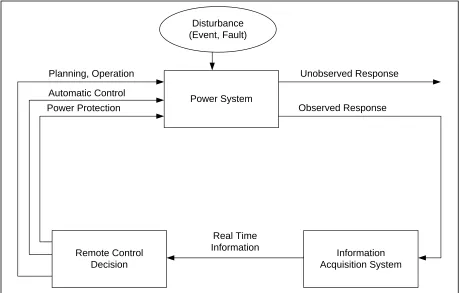
Real time data is highly important for automatic control to maintain system stability; it can also be used as a guide to immediate operating decisions in support of system recovery and for extensive analysis [51]. Research shows that major blackout that occurred during the last ten years could have been avoided. It demonstrates that wide-area, comprehensive and real-time information exchange is becoming a critical factor for the future power system reliability and stability. Figure 2.5 shows the illustration of the relationship between measurement, information and decision-making. The real time data applications range from very rapid control function to the very slow functions such as expansion planning. With high-speed real time measurement, proper protection and control actions could be taken to ensure the reliability of power system when event occurs.
Figure 2.5: The circle of measurement, information and decision making
It should have high bandwidth to support large volume power system monitoring and measurement information transmission
It should have low latency to support local area and wide area real time control and protection.
As discussed earlier, the future power system information exchange requirements have changed. Currently existing power system communication media [56] such as power
Power System
Remote Control Decision
Information Acquisition System Disturbance
(Event, Fault)
Planning, Operation
Automatic Control Power Protection
Unobserved Response
Observed Response
optic network will be the ultimate choice to meet power system real time control, protection and monitoring application requirements due to its high bandwidth, low latency, better security and QoS (Quality of Service) features. Furthermore, the time has come for inter-company communication and integration of data from various control centres, power plants and substations. SCADA systems are essential parts of the Distributed Management System (DMS) and EMS that employ a wide range of computer and communication technologies. However, existing SCADA information management systems [57] cannot fulfil the new challenges as more and faster information has now become desirable by many users and players. Advancement in IT with innovative networking devices available have made it possible to develop low cost real time communication system for accessing real time power system information over digital network. High performance fibre optic network brings great opportunities for the power system real time applications.
Power system frequency [58, 59] is one of the most critical parameters for understanding and controlling power system dynamics. However, frequency instability scenario can be initiated by a large mismatch between generation and load [60, 61]. Such a scenario can result in a cascaded loss of generation through under/or frequency related operation that would eventually lead to a blackout. However, recent technology advances in networking and communication as well as in power system design have opened the door for fast and accurate load shedding system design.
As illustrated in Figure 2.6, fast, real time and comprehensive information acquisition and transmission are the keys to the power system operation. The real time information can be used for power system control, protection, monitoring or even for the system maintenance. This section highlights some typical applications, which can be greatly improved by using real time information.
Figure 2.6: Future power system information needs
2.3 Current power system communication media
Power system communications have changed due to the deregulation of power industry. Wide area real time monitoring has become the norm. This requires high bandwidth network backbone to meet the real time data on demand. These needs will grow further as new remote real-time protection and control applications become more feasible and pervasive. Electric utilities often use several types of communication media [71-74] for different functions. With more and more bandwidth required by the power system data communication, fibre optic will be the ideal choice for the future power
Information Stream
Control Monitoring Protection Acquisition
system communication infrastructure. This section discusses some commonly used communication media in the power system.
Power Line Carrier (PLC)
PLC operates by transmitting radio band of frequency signals between 10 kHz to 490 kHz over the transmission lines. PLC with power output of order 150 W can be used up to 241 km. Normally, PLC carriers only one channel of 4 kHz bandwidth. The frequency range is limited by government regulations. However, it has some disadvantage such as bandwidth limit. It is subject to lightening, switching surges, and networks reconfiguration. This medium does not offer a reliable solution for wide area data transmission. Communication with remote sites cannot be maintained during a disturbance. Therefore, its effectiveness for wide area data transmission is limited.
Dedicated Links
Radio Systems
Different radio systems, such as conventional radio, trunked radio or spread spectrum are suitable for wide area data transmission [75]. They are based either on licensed channels or over non-licensed frequencies.
However, many countries suffer from a shortage of available frequencies in the Very High Frequency / Ultra High Frequency (VHF/UHF) bands. Besides, due to over-utilisation of these unlicensed frequencies by mass consumer applications, their reliability for commercial and industrial uses are questionable. It is important to note that using line protocols over radio results in unreliable communication and poor utilization of airtime.
Microwave
Wireless
Wireless is one of the modern methods of communication. Low orbit satellite communication system provides an existing option to transmit information covering a very large range. The delay is a problem, which depends on the distance. For example, the latency for low orbit satellite at 10 km above the earth is about 300 ms one-way. Another disadvantage is the cost of installation.
Fibre
Fibre is now considered the most reliable media of communication. Single fibre cable can carry up to 8000 channels. In addition to the capacity, the fibre has no interference with other electric systems. The only disadvantage is the cost of the cable and cost of the construction. Fibre optic communication has the smallest latency in all media of the communication.
2.4 Power system communication protocols
MODBUS: A popular master-slave protocol with industrial users, which has become popular in substations. It issues simple READ/WRITE commands to addresses inside an IED.
DNP: An increasingly popular master-slave protocol mainly used in North America. DNP can run over multiple media, such as RS-232 and RS-485 and can issue multiple types of READ/WRITE messages to an IED.
IEC-870-5-101: is considered as the European partner to DNP. It differentiates itself from DNP with its slightly different messaging structure and the ability to access object information from the IED.
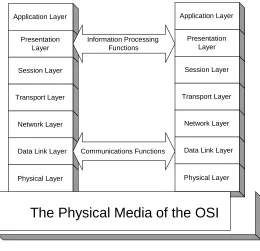
A protocol is basically a set of rules that must be obeyed for orderly communication between two or more communicating parties [77]. The International Standards Organisation (ISO) has divided the communication process into seven basic layers as shown in Figure 2.7, which is commonly referred to as the Open Systems Interconnection (OSI) model [77-79].
![Figure 2 .1: Substation communication protocols [38]](https://thumb-us.123doks.com/thumbv2/123dok_us/8026368.1335321/50.612.135.490.193.620/figure-substation-communication-protocols.webp)
![Figure 2.2: SCIMS - base architecture [46]](https://thumb-us.123doks.com/thumbv2/123dok_us/8026368.1335321/57.612.103.510.267.552/figure-scims-base-architecture.webp)
![Figure 2.4: Integrated WAN communication network [50]](https://thumb-us.123doks.com/thumbv2/123dok_us/8026368.1335321/62.612.127.484.192.437/figure-integrated-wan-communication-network.webp)
![Figure 2.10: RTU components [91]](https://thumb-us.123doks.com/thumbv2/123dok_us/8026368.1335321/79.612.90.523.82.288/figure-rtu-components.webp)
![Figure 3.3: Client and server relationship [105]](https://thumb-us.123doks.com/thumbv2/123dok_us/8026368.1335321/95.612.135.479.71.433/figure-client-and-server-relationship.webp)
![Figure 3.5: DNP3Protocol stack [105]](https://thumb-us.123doks.com/thumbv2/123dok_us/8026368.1335321/99.612.133.472.151.445/figure-dnp-protocol-stack.webp)
![Figure 3.6: Network Topology [105]](https://thumb-us.123doks.com/thumbv2/123dok_us/8026368.1335321/100.612.139.477.155.455/figure-network-topology.webp)
