University of South Carolina
Scholar Commons
Theses and Dissertations
2017
Investigating the Receptivity of Counseling
Students toward Receiving Counseling
Oluwatoyin Adeyemi University of South Carolina
Follow this and additional works at:https://scholarcommons.sc.edu/etd
Part of theCounselor Education Commons
This Open Access Dissertation is brought to you by Scholar Commons. It has been accepted for inclusion in Theses and Dissertations by an authorized administrator of Scholar Commons. For more information, please [email protected].
Recommended Citation
Investigating the Receptivity of Counseling Students toward Receiving Counseling
by
Oluwatoyin Adeyemi
Bachelor of Education University of Botswana, 2000
Master of Science
University of Wisconsin, Oshkosh, 2003
________________________________________________
Submitted in Partial Fulfillment of the Requirements
For the Degree of Doctor of Philosophy in
Counselor Education
College of Education
University of South Carolina
2017
Accepted by:
Joshua Gold, Major Professor
Ryan Carlson, Committee Member
Margaret Olson, Committee Member
Moody Crews, Committee Member
©Copyright by Oluwatoyin Adeyemi, 2017
DEDICATION
To my husband, Tonna Okei and our two wonderful children, Otitodilinna and Chetanna.
ACKNOWLEDGMENTS
The successful completion of this dissertation rests on the appreciated contributions of
many individuals. I thank Professor Joshua Gold who has guided me through this
journey. His patience, feedback and motivation resulted in the development of this
research paper.
I thank the other members of the dissertation committee, Dr Carlson, Dr Crews and Prof.
Peg Olson, for your suggestions.
I thank Dr. Lynda Nilges for giving me the opportunity to recruit students from her
department.
I thank all faculty and staff of the Counselor Education and Supervision Department.
I thank all the students that participated in the study.
I also thank my parents, Professor M.B. Adeyemi and Dr. Mrs. D.A Adeyemi. Thank you
very much for your encouragement and support both financially and emotionally. You
are the best parents in the World. I would not have been able to make it without you.
I appreciate God’s guidance and leading at every stage of the development of this work.
In addition, I thank my siblings, Kayode, Yemisi and Bukola. You have all contributed
ABSTRACT
This study investigated the perceptions of graduate students in counseling toward
seeking counseling as part of the efforts to promote the personal and professional
development. The main research question is: what are the perceptions of graduate
counseling students toward receiving counseling? The secondary questions are: What are
the reasons graduate students in counseling would be willing or reluctant to receive
counseling? What are the perceived benefits of counseling? And, finally, what are the
perceived drawbacks of counseling? The study is qualitative in nature applying a
phenomenological design. The participants were purposefully selected from the Ed.S.
program in Counselor Education. Six participants were involved in the study. Data was
collected through individual interviews which were analyzed through interpretation and
codification to derive themes as they pertained to content analysis. Overall, the results
indicated that the participants’ had a positive perception about seeking counseling.
However, the participants also shared hindrances that prevented them from seeking
counseling.
TABLE OF CONTENTS
DEDICATION ... iii
ACKNOWLEDGEMENTS ... iv
ABSTRACT ...v
CHAPTER 1: INTRODUCTION ...1
1.1 PROBLEM STATEMENT ...8
1.2 NATURE OF THE STUDY ...10
1.3 PURPOSE OF STUDY ...15
1.4 CONCEPTUAL FRAMEWORK ...16
1.5 OPERATIONAL DEFINITION ...19
1.6 ASSUMPTIONS ...19
1.7 LIMITATIONS ...20
1.8 SIGNIFICANCE OF STUDY ...21
1.9 SUMMARY ...24
CHAPTER 2: REVIEW OF RELATED RESEARCH AND LITERATURE ...26
INTRODUCTION ...26
2.1 RATIONALE FOR PERSONAL COUNSELING IN THE PERSONAL DEVELOPMENT OF COUNSELOR TRAINEES ...27
2.2 RESEARCH SUPPORTIVE OF PERSONAL COUNSELING ...27
2.3 WILLINGNESS/RELUCTANCE OF STUDENTS TOWARD COUNSELING ...30
2.5 COMPARISONS/CONTRASTS OF RESEARCH OUTCOMES ...42
2.5 SUMMARY ...44
CHAPTER 3: METHODOLOGY ...46
INTRODUCTION ...46
3.1 RESEARCH DESIGN AND APPROACH ...46
3.2 RESTATEMENT OF RESEARCH QUESTIONS ...47
3.3 THE ROLE OF THE RESEARCHER ...48
3.4 INSTRUMENTS ...49
3.5 CONTEXT FOR THE STUDY ...52
3.6 PARTICIPANTS ...53
3.7 DATA COLLECTION ...57
3.8 ANALYSIS AND INTERPRETATION OF DATA ...57
3.9 TRUSTWORTHINESS ...58
3.10 SUMMARY ...64
CHAPTER 4: RESULTS ...65
4.1 SAMPLE DEMOGRAPHICS ...65
4.2 DATA GATHERING PROCEDURES ...66
4.3 DATA TRACKING METHODOLOGY ...67
4.4 VALIDATION OF THEMES ...69
4.5 THEMES DISCOVERED ...72
4.6 DEVIANT PERSPECTIVES ...88
CHAPTER 5: IMPLICATIONS ...93
5.1 DISCUSSION OF THEMES ...94
5.2 ASSUMPTIONS ...98
5.3 SCOPE ...99
5.4 LIMITATIONS ...100
5.5 SIGNIFICANCE OF STUDY ...102
5.6 THEMES DISCOVERED FROM GRADUATE STUDENTS IN COUNSELING VERSUS UNDERGRADUATE STUDENTS ...104
5.7 PROBLEM STATEMENT ...110
5.8 PROFESSIONAL APPLICATION ...116
5.9 SUGGESTIONS FOR COUNSELOR EDUCATION PROGRAMS ...118
5.10 SOCIAL CHANGE ...121
5.11 SUGGESTIONS FOR FUTURE STUDIES ...122
5.12 RESEARCHER REFLECTIONS ...125
5.13 SUMMARY ...127
REFERENCES ...129
APPENDIX A– ATTITUDES TOWARD SEEKING PSYCHOLOGICAL HELP-SHORT FORM ...149
APPENDIX B – INVITATION MESSAGE ...152
APPENDIX C – INFORMED CONSENT ...154
CHAPTER 1
INTRODUCTION
The field of counselor education has evolved over the year of practice, more
recently guided by the accreditation standards created by CACREP (Council for
Accreditation of Counseling and Related Educational Programs). CACREP are those
standards of preparation for professional practice, the latest being dated 2016, that specify
the knowledge and skills needed to offer professional counseling. From these standards,
so far it has been observed that knowledge and skills comprise only two aspects of the
professional practice; the third aspect being the qualities of the provider of those
competencies, the professional counselor. This means that the self-of-the counselor is
vital to the success of counseling as well as the other two components, yet harder to
ascertain. Previous sources such as Corey & Corey (2003); Campbell & Christopher
(2012); & Neukrug (2012) have identified several personal characteristics that exemplify
an effective helper. However, the question could be raised as to how students respond to
the realization that they too, carry “baggage” that might interfere with their professional
duties and efficacy. Baggage in this situation is referred to as psychological baggage or
impairment.
According to De Vries, Valadez (2006), impairment was described as
“interference in professional functioning due to chemical dependency, mental illness, or
personal conflict” (p.78). Because client transparency and vulnerability are integral to the
curative nature of this therapeutic relationship and what might their perception of
accessing counseling be? In order for counselors in training to become effective
professionals, they must be aware of their own inadequacies and seek help when
necessary. It is impossible to help others if the student is unable to help herself or
himself. Loizos (2013) suggested that “work with the self sheds light on the characters
and personalities of those who are fit and those who are unfit for the profession, and
provides trainees with expertise and skills that are necessary to exercise counseling and
psychotherapy” (p.1).
The focus of this study is on the receptivity of graduate counseling students from
a CACREP Counselor Education and Supervision program toward seeking counseling.
Studies have been done to investigate the perceptions of students in the general university
population towards seeking counseling, but when it comes to seeking information about
how students in the counseling field perceive counseling themselves, as the main
advocates of counseling, there is inadequate information (De Vries & Valdez 2006). The
counseling field lacks adequate information about graduate students’ attitude in
comparison to undergraduates in the area. Haberstroh 2010; Hayes, Youn, Castonguay,
Lock, McAleavey and Norberg 2011, and Tse, Wantz andFirmin 2013; and Laxson 2014,
focused primarily on the help-seeking attitude of college age students alone. As a result
of the limited information or knowledge in this topic area for this specific population, the
researcher has chosen this area of study interest for its uniqueness, which has led to the
main research question for this study which is whether graduate counseling students are
To date, most literature reveals what we know about students’ willingness to seek
professional counseling but it does not provide insight into the reasoning of counseling
students who do or do not avail themselves of this opportunity. Studies of undergraduate
students’ revealed five psychological factors, in order of significance which are; social
support, self-disclosure, anticipated utility or anticipated risk of seeking help, social
stigma and social norm predicted attitude towards seeking counseling. This contributed to
or affected the intent to seek help (Vogel, Wester & Boysen 2005). Stigma came up
again as a factor associated with seeking counseling in the study done by Vogel, Wade
and Hackler (2006). Perceptions of public stigma were positively associated with
self-stigma, which in turn is negatively associated with attitudes individuals have toward
counseling. These attitudes are then positively associated with the willingness to seek
counseling. Self-stigma was described as “the internalized negative perceptions of
oneself if one were to seek help, whereas attitudes toward seeking counseling are the
positive or negative perceptions of counseling in general” (p.46). Gulliver, Grifiths and
Christensen (2012), in the study of barriers and facilitators to help seeking attitude, found
that participants rated stigma as the most dominant barrier, followed by lack of mental
health education, and then negative past experience. The reinforcements were
encouragement by others, established relationship with the counselor, positive previous
interactions with the counselor and positive attitude of others.
In Laxson’s (2014) study about help-seeking attitude, participants reported being
hesitant to seeking counseling when experiencing stress and in risking stigmatization.
Participants were not comfortable about seeking counseling. They were more willing to
severe stress or extreme mental health issue after one has exhausted all other support
systems or other coping techniques. Theproposed study intends to address this gap in
understanding by revealing the underlying factors that may support or impede the
attitudes of the students towards seeking counseling themselves. Currently, there is lack
of information regarding graduate counseling students, in regard to information about the
second research question which is; what are the perceptions of graduate counseling
students toward counseling? This question is open ended with the intent of allowing the
participants to elaborate on their thoughts extensively. Other questions about this research
study are developed to find out the perceived benefits of counseling, as well as the
drawbacks. The study will generate responses or answers that may lead to other themes
such as factors that may promote or hinder in order of significance. Therefore, the study
is relevant to the field of counseling and the process of counselor education in the
following ways:
First, the results of this study will provide information to the stakeholders
(faculty, department chairs, deans, and other professionals in counseling) to help explain
the reasons that may hinder or encourage the perception of the students towards seeking
counseling. Possible suggestions or recommendations can then be made to improve or
remedy unfavorable situations that may hinder the students in seeking counseling.
Through this investigation, counselor education programs and counseling staff will be
provided with the information on how to better support the students ‘personal
development, which will in turn have a positive impact on their professional
development. Hence, counselor education programs will be able to produce well-adjusted
The second reason is that the study will assist counselor education students to be
more proactive in seeking counseling by providing them with information about the
benefits of counseling and possible suggestions and recommendations. As a result,
improvements will be made regarding accessibility. This will enable students to feel more
comfortable with the idea of seeking counseling.
Again, in the training of students, counseling may be used as an instrument for
self-awareness by counseling educational programs (McCarthy 2008). Faculty in
counselor education programs are encouraged to give opportunities for self-growth as
standards of the counseling profession. CACREP (2016) & ACA (2014) ensures the
quality and continuous enrichment of counselor education programs through established
standards developed for students to practice and master knowledge and skills. The
standards encourage students to be involved in activities of self-growth and personal
development both personally and professionally. These standards have important
implications in admission, gatekeeping and endorsement processes for counselor
educators in evaluating students. All counseling students despite emphasis or track of
study are expected to possess the skills and practice necessary to address a wide variety
issues for their professional identity.
Also, the ACA Code of ethics, regarding student welfare, suggests that counselor
education programs describe requirements for self-growth experiences. Programs or
counselor educators may recommend self-growth experiences. Counseling may be
recommended or required to address any personal issues of the student that may affect
their competency (Code F.7.b., Self-Growth Experiences). Because counseling is
opportunities include personal counseling. This is a result of the realization that
counseling is an important element in the self-growth of students.
In line with the above position, Neukrug and Williams, (1993); Prosek, Holm, and
Daly (2013), outlined the benefits of counseling for counselors in training to include an
increased emotional health, a deeper understanding of intra and interpersonal functioning;
increased awareness; an increase in confidence about ability to work; and a decrease in
counselor acting out behavior; fewer psychological problems; decreased depressive
symptoms and anxiety symptoms. Furthermore, in order for persons to become effective
counselors, they must acknowledge their psychological issues and seek healing (Remen,
May, Young & Breland, 1985). Unaddressed psychological issues in counseling students
could become problematic for universities as a result of the potential for lawsuits due to
graduating ineffective therapists (Custer, 1994). Untreated mental health problems are
significant contributors to graduate student dropout. (Wilson, Mason & Ewing, 1997).
Another reason for this study is to draw attention to the advantages of counseling
for graduate counseling students. It is hoped that this study will support the idea of
personal counseling for graduate counseling students. De Vries, and Valadez (2006)
stated “ A by –product of such personal counseling might be that graduate counseling
students would be afforded first hand experiences of what it feels like to lie on the
proverbial couch, and would help them gain better insight into what counseling might
mean to their clients” (p.85). Downs (2000); Murphy (2005); and Norcross (2005)
suggested that counseling provides students with the opportunity for personal growth and
development which involves an increased understanding of what it feels like to be a
training and eventually in professional practice. Corey and Corey (2002) encouraged
counseling students in training to seek personal counseling, suggesting that it can assist in
improved understanding of motives in leading groups, examining biases, exploring
perceptions of group members and identifying ways to use members’ potentials. As a
researcher, there is a tendency for bias that may affect subjectivity. A bias on the part of
the researcher for this study is that the researcher is a counselor education student,
therefore, there is a tendency to promote the topic of personal counseling for students. As
a student in the field of counseling, there is a strong desire to help develop counseling
competencies in counseling. As a result of the above tendency, the researcher may desire
to contribute to the notion that supports counseling for the respondents. However, this
study will only rely on the self-report of the participants that will be analyzed and
interpreted using member check and peer review, thereby enhancing objectivity in order
to prevent personal views and misinterpretations. The researcher also will discuss the
nature of positionality and subjectivity so that participants are aware of and provided an
opportunity for checks and balances as it relates to the study. Hence, the researcher
affirms to desist from subjectivity to promote the validity of the study.
To explain the concepts of attitudes and perceptions, Lillios (2010), posits that the
association between attitudes and perception is that attitudes are developed from a
combination of various recurrent processes of sensation, perception and feelings. “An
attitude is the psychological response to people, society, objects, events, occurrences and
circumstances to life itself that generally influences our behaviors and actions. Attitudes
are either positive or negative.” (Life-success.secrets.com 2015). Attitudes are studied in
particular object or issue. Attitudes are studied in a particular setting or practical
situation. (Arul 2015). Hogg & Vaughan (2005) define attitude as “a relatively enduring
organization of beliefs, feelings, and behavioral tendencies towards significant objects,
groups, events or symbols” (p.150). I define the concept of attitude as what an individual
believes about a specific idea or object. Perceptions on the other hand is defined as “our
recognition and interpretation of sensory information (study.com 2015). Perception is
part of the components that formulate attitudes. According to Zanna & Rempel (1988)
attitude consists of both cognitive and affective aspects. Millar & Tesser (2015) further
reiterated that the cognitive aspect involves the encoding of attributes and beliefs about
the topic or object. If affect is more prominent than cognition, the attitude report will
reflect on feelings about the topic but if cognitions are more significant than the attitude,
the report will reflect beliefs about the topic. For this research study, it is expected that
participants discuss about perceptions based on their cognitive processes through
self-reporting. Concentration will be on the cognitive process or thoughts of the students
rather than on the feelings associated with the topic of study.
1.1 PROBLEM STATEMENT
Dearing, Maddux & Tagney (2005) indicated that more research is needed using
graduate counseling students as participants, and that most issues mainly focus on the
mental health aspect of the participants rather than on personal counseling as the main
concentration. De Vries, & Valdez (2006) stated that “only a few studies have
investigated the perceptions of counseling students toward counseling” (p.79). McCarthy
(2008) also suggested that there is insufficient information regarding studies done
impact it has on professional development of the students. Many studies have focused on
the help-seeking attitudes and utilization of counseling by undergraduate college students
such as those of Haberstroh (2010); Hayes, Youn, Castonguay, Lock, McAleavey and
Norberg (2011); Rickwood and Bradford (2012); Tse, Wantz and Firmin (2013); and
Laxson (2014). The few studies on help-seeking that involve graduate students, which
include those done by Bryne, and Shufelt (2014), Although, some of these studies
mentioned above are decades old, they however have been cited in recent studies due to
their relevance in the topic of the perceptions graduate counseling students towards
seeking counseling. Among the studies recently published and referenced or cited using
one or more of these studies include; McCarthy, Bruno and Sherman (2010) study that
explored the help-seeking attitudes of graduate students at higher education level; Loizos
(2013) study of personal therapy for future therapist; and Prosek, Holm & Daly (2013)
study of the benefits of required counseling for counseling students; The seasoned studies
serve as a foundation in research especially in retrieving information regarding graduate
counseling students perceptions towards seeking counseling. It is therefore
understandable that researchers of today, including I and possibly, future researcher will
continue to utilize the articles as they are vital resources to counselor education due to the
quality of information concerning the topic of my study.
With regard to the few studies done on perceptions of graduate counseling
students towards counseling, there seems to be a plethora of information regarding the
knowledge and skills of graduate counselor trainees but not on perceptions. A search of
counselor education and supervision using the Psych Info search engine based at a
counseling students yielded 20,577 articles. Still, most of these articles are information
on the skills and knowledge of the students. Little is known about the topic on the
perceptions of the students in seeking counseling. Most of the information obtained was
on multicultural issues, counseling skills, skills competency, rehabilitation, child centered
therapy, assessment, grief counseling, clinical supervision and so on. This study therefore
is an attempt to fill the gap of information on the topic because of the advantages to the
population of students and to the cause of professional development, skills and
knowledge in the area of counselor education.
1.2 NATURE OF THE STUDY
This study will investigate the receptivity of graduate counseling students towards
counseling. The researcher has chosen to use a qualified approach in order to obtain
in-depth or robust information for the study. Heppner and Heppner (2003) suggested that
through qualitative research rich descriptions of phenomena are analyzed to represent
individual lived experiences through writing and interpretations. Different methods
enable this kind of study to enhance rigor, breadth and depth. Focus is on individual
perspectives through multiple strategies. Hovart (2013) affirmed that qualitative research
is appropriate to describe and understand processes or problems. It also shows how
respondents make sense of their world in relation to a specific context. Therefore,
qualitative study is very apt for this study as the researcher is interested in this particular
study with the target population being graduate counseling students at a university
location. This will provide the researcher the opportunity to develop individual
responses, provide understanding and description of personal individual experiences and
meanings, and identify contextual factors as it relates to the study.
The following are the reasons why the qualitative designs are more suited for this
study:
First, the researcher will use an interpretative paradigm as a framework to guide
this study. The general framework for the study is to explore a phenomenon. The
phenomenon is to investigate the receptivity of graduate counseling students towards
receiving counseling themselves. Heppner and Heppner (2003) stated “Phenomenological
researchers need to design their studies to be ideally suited to understand the
phenomenon under investigation” (p.168). The participants are expected to discuss the
meaning of their experiences on the topic. Thus, this method will allow the researcher to
develop, bring together and convey the participants’ meanings. Furthermore, Turner
(2010) suggested that the main advantage of qualitative designs or approach is to provide
information regarding the “human” aspect of an issue which involves the attitudes,
beliefs, emotions, opinions and relationship of individuals. These ideas support the
suitability of using an interpretative paradigm as the best approach to carry out this social
science study.
Secondly, through the use of individual interviews in the collection of data, the
researcher will be able to obtain in-depth information from the participants. The
interview process allows for flexibility in regards to the ability to ask open ended
questions, develop and modify follow up questions to derive the optimal amount of
opportunity to obtain specific information that will attempt to answer the research
questions. Open ended questions will allow the participants to express themselves further,
thereby increasing the depth of information. According to Mack, Woodsong, MacQueen,
Guest & Namey (2005), open ended questions and probing allows participants to answer
questions in their own words rather than to force them to select from fixed responses like
in quantitative research methods. They stated that “open ended questions have the ability
to evoke responses that are meaningful and culturally salient to the participants,
unanticipated by the researcher, rich and explanatory in nature” (p.4). Another advantage
of using open ended questions is that it allows the researcher to be flexible in the process
of probing previous responses made by participants. The researcher is able to ask “why”
or “how”. In the current study, the researcher intends to make use of open ended
questions as well as follow up questions for flexibility in order to derive extensive,
comprehensive and thorough amount of responses from participants.
Also, individual interviews promote the issue of confidentiality in research.
Givens (2008), advocated for researchers to protect the privacy of the research
participants. This means that researchers must not disclose information that can in any
way identify a participant. This is done to prevent harm or stigma. For the current study
the researcher intends to conduct individual interviews at a secure location rather than
conduct a focus group interview where participants will be expected to discuss at once as
a group. Individual interview will provide more privacy on the topic of study which
involves sharing personal information about experiences concerning “counseling”. The
topic of my research is very sensitive in nature as participants will be expected to share
Purposive sampling will be used to obtain data. According to Tongco (2007),
purposive sampling provides a researcher with dependable and robust data. It is used in a
natural social science setting. It is a process of finding participants intentionally, and then
selecting them randomly within the purposive sample. For the current study, the
researcher selects a specific population which is graduate counseling students in a
counseling program. The reasons are that this specific population or sample possess the
knowledge of the research topic and may be more willing to participate in the research.
Thus they are more likely to contribute appropriate data in application and depth.
RESEARCH QUESTIONS
The questions of this study are developed and modified from the ATSPPH
(Attitude Towards Seeking Professional Psychological Help, Fischer & Farina,
1995)-Short Form. The ATSPPH form contains ten questions about attitudes toward seeking
professional psychological help. According to Vogel, Wade and Ascheman (2009), the
ATSSPH-SF was developed to measure attitudes towards seeking psychological help
which is to be tested by researchers and clinicians. Alheimer and Hansen (2012), it is also
used to understand how individuals view counseling. The test correlates with the use of
professional help for a problem. The internal consistency is reported to be .84 in college
sample study (Fischer and Farina, 1995). The items on the test ranges from 0 (disagree)
to 4 (agree). Since this study is qualitative, the questions are modified into open ended
questions in order for the researcher to obtain more specific details to correspond with the
The main research question that guides this study is:
1. What are the perceptions of graduate counseling students towards counseling?
Other related questions are:
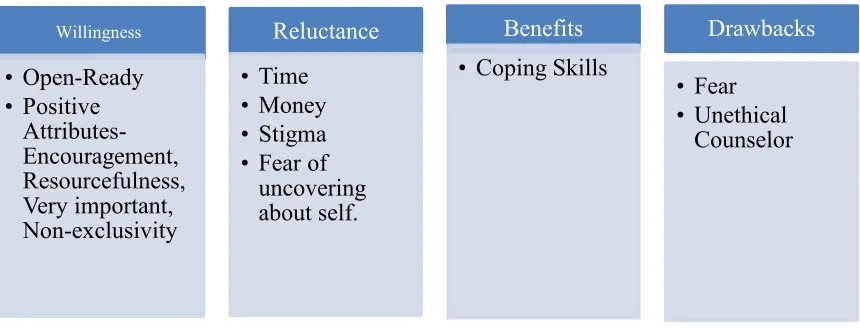
2. What are the reasons graduate counseling students would be willing to or
reluctant to seek counseling?
3. What are the perceived benefits of graduate counseling students in receiving
counseling?
4. What are the perceived drawbacks of graduate counseling students in receiving
counseling?
As the questions are developed for individual interviews, depending on the response
of the participants, follow up questions will be developed and expanded to derive more
responses. According to Turner (2010), it is necessary for qualitative researchers to ask
open ended questions which allow participants to explain their experiences. It is
particularly used to keep participants on focus with responses, to ensure and obtain
optimal responses from participants.
Among the questions developed for each of the research questions are the following:
Question regarding the students’ perceptions about counseling (Research Question 1).
1. What are your thoughts about a person who engages in counseling to cope with
psychological issues?
Question regarding students’ willingness or reluctance in seeking counseling (Research
2. What are your thoughts about your readiness in seeking counseling?
Question regarding the potential benefits from seeking counseling (Research Question 3)
3. What do you think are the benefits of engaging in counseling especially at the
university level?
Question regarding the potential drawbacks from seeking counseling (Research Question
4)
4. What may be the reasons for counseling not being an effective means to cope with
psychological problems?
These questions directly inquire about the participant’s idea about their attitude
towards counseling. The question provides an opportunity to answer in either a positive
or negative way. As the participant answers these questions, follow up questions about
the responses in order to seek more information about the participant’s stance on the topic
will be asked. Other questions tend to allow the participant to expand on their thought
processes in responses.
1.3 PURPOSE OF THE STUDY
The main purpose of this study is to investigate the perceptions of graduate
counseling students towards receiving counseling. In doing so, information regarding the
willingness or reluctance toward receiving counseling will be gathered. The study will
attempt to fill in the gap of information regarding this particular topic and the targeted
group towards seeking counseling. The other related purpose is to find the benefits
derivable from their readiness to seek counseling.
1.4 CONCEPTUAL FRAMEWORK
As already stated, this research is qualitative in nature. The study involves the use
of individual interviews, document review and analysis of data. Lacey (2010) suggested
that a conceptual framework identifies the researcher’s worldviews about a topic. It
describes assumptions and predeterminations for a study. Fulton and Krainovish-Miller
(2010) further described a framework as a map for a study, providing a rationale for
development of research questions. Lobiondon-Wood (2010) proposed that a framework
is the design for a study together with the research questions, purpose and literature
review. All should complement each other and help with the operationalization of the
research design. A framework assists the researcher in making sure that projects are
understood. It helps the researcher focus ideas of what the study is to achieve.
Robson (2002) believed that research studies need to have a definite story from
the beginning. Most beginning researchers find it helpful to use a conceptual framework
to guide and lay out a plan for study. It is then that conceptual framework is refined, as
data collection and analysis develops. Green (2014) believed that the use of a conceptual
framework was developed to fulfill the demands and expectations of research projects,
which are helpful in guaranteeing that information is presented in an organized manner
that is clearly communicated. Robson (2002), however, suggested that a framework is
This study is conceptualized as reflected in the diagram below:
Figure1.1 Diagrammatic Representation of the Conceptual Framework
In a nutshell, the study will investigate the perceptions of graduate counseling
students towards counseling. The willingness or reluctance of graduate counseling
students in seeking counseling is related to their perceptions toward counseling. It is
expected that in finding out this information, it will gradually lead to obtaining
information for the main research question. It is probable that the responses gathered
from the participants will be of a positive or negative response to the idea of seeking
counseling. Some of them may have challenges in seeking counseling help and some may
not. Despite the perception, there are benefits and drawbacks that may accrue from
seeking counseling. The information gathered from this study naturally leads to the
recommendations that are usable to the counseling programs, leading to personal and
professional development of the students which in turn will be beneficial to the Graduate
counseling students
Perceptions Willingness/
Reluctance
Challenges/
Benefits Solutions Suggestions
Personal/ Professional Devlopment
stakeholders. The stakeholders that this study may be of benefit to are curriculum
developers, counseling educators and the government.
Thus, whether negative or positive perceptions, some students may not
necessarily want or need counseling. This does not automatically suggest that the
students who seek counseling or decide to seek counseling are deficient in any way. The
response of the students in the research process will consequently lead to the direction or
pathway through the conceptual framework regarding their responses. Proseck, Holm &
Daly (2013), suggested that it is not every counseling student that may demonstrate
psychological concerns related to academics and relationships. De Vries & Valadez
(2006) in their study that involved the attitudes of counseling students toward counseling
showed that a negligible percentage of counseling students showed serious
psychopathological concerns. This statement shows that not all counseling students are in
need of seeking counseling.
Like a domino effect, effective counselors will be used to tackle the growing
number of psychological problems in college students as well as in the adult population
generally. The National Survey of College Counseling Centers (2014), reports that there
is an increase in students with severe psychological problems by 55%. This was an
increase to the reported 44% of the previous year. The National Institute of Mental
Health (NIHM 2015) reported that there is an increase 6% of adults who are affected by
mental illness. The government spends an estimated $300 billion dollars each year for
treatment of mental health services. Mental health costs for all Americans spent on
mental health treatment over a ten- year period were estimated at $57.5 billion. This
1.5 OPERATIONAL DEFINITIONS
Attitudes: A settled way of thinking or feeling, typically reflected in a person's
behavior.
Help-seeking: Assistance from professionals who have legitimate and recognized
professional role in providing relevant advice, support and/or treatment. (Rickwood
2012).
Internship Counseling Students: Students currently undergoing internship training
enrolled in the Educational Specialist degree program (Ed. Graduate Studies Bulletin
(2014-2015).
Perception: A way of regarding, understanding, or interpreting something; a
mental impression. Dictionary.com (2015).
Mental Health: A state of well-being in which the individual realizes his or her
own abilities, can cope with the normal stresses of life, can work productively and
fruitfully, and is able to make a contribution to his or her community www.cdc.gov/ment
(2011).
Receptivity: Having the quality of receiving, taking in, or admitting. Able or
quick to receive knowledge, ideas, etc.: a receptive mind. Willing or inclined to receive
suggestions, offers, etc., with favor: a receptive listener. Dictionary.com (2014).
1.6 ASSUMPTIONS
It is assumed that through the use of qualitative research design, the researcher
investigated through the use of individual interviews. Also, semi-structured interviews
will enhance positive interpersonal interaction between the researcher and the participants
in the process of social communication. Individual interviews will also provide the
participants with more privacy. Participants will be more comfortable sharing personal
information regarding the study in an individual setting than to share information in a
focus group setting.
1.7 LIMITATIONS
The following are the potential limitations of this qualitative study:
First, in this study, the sample size of the participants will relatively be small as
opposed to the use of hundreds of participants that could result from a quantitative study.
Madrigal and McClain (2012) suggested that the small size of participants is common in
qualitative studies. It is usual to conduct studies using between 6 to 12 participants.
However for this study, more details and information will be derived as a result of the use
of the research designs utilized in the process of collecting data in interviewing, probing,
and use of open ended questions as well as follow up questions.
Also, another limitation is that the researcher will rely use on the use of self-
report of the participants in the collection of data. As a result, there is a question of
validity or credibility for the study. Paulhus and Vazire (2007) pointed out that the data
from personal statements made by the participants may lack reality as seen by the
researcher and others. Participants may be deceptive for the purpose of self-enhancement,
consistency seeking and self-presentation. In this current study, the researcher will
to give participants the opportunity to reflect and communicate. The researcher will avoid
leading questions, listens to the participants with tolerance and acceptance. Other
techniques such as questioning (open ended), probing, and use of follow up questions in
interviewing will help to prevent bias and misinterpretations of the results since this
information is obtained directly from the participants themselves.
Since the individual interviews were a duration of one hour, information may not
be known about the number of participants who interviewed versus those that did not
agree to an interview or participate which may have to do with the level of interest for
this study.
1.8 SIGNIFICANCE OF STUDY
1.8.1 KNOWLEDGE GENERATION
The study is done to gather information about the orientations of graduate
counseling students towards seeking counseling or not. There are limited research studies
done on the perceptions or the willingness of graduate counseling students seeking
counseling services. When it comes to information about graduate counselor education
skills and knowledge, there is evidence of substantial information compared to
information on graduate student’s perceptions. Forest, Elman, Gizara and Vacha-Haase
(1999) offered a summary of ten previous studies from 1975, and noted that the studies
had very limited information. Most of the information done about student perceptions of
Counseling Services is done using the general student population. This study will bring
about more awareness about the receptivity of graduate counseling students towards
students will be disseminated to counselor education programs and serve as a way to
promote the field of counseling education by drawing attention will be given to this
particular topic in the area of counseling. Part of the motivation for this study is the
interest in doing research in Counselor Education. The findings emanating from this
study are capable of contributing to literature in the topic area. I find it rewarding to be
able to provide possible suggestions and also to do research in topic areas that have not
been done before or are rarely done. My work experience with students and colleagues in
counseling services especially at the higher education level has made me more interested
in and focused on embarking on this exceptional research topic.
Counseling is viewed as the start of a lifelong process of personal development
that impacts personal life in a positive way. It includes facing personal issues, deeper
understanding of self and self-awareness (Kumari 2011). Bryne and Shufelt (2014)
suggested that research focusing on counseling students’ perception on counseling has
both positive and negative effects. It is believed that there are still many unanswered
inquiries concerning the perspectives of counselor trainees towards personal counseling.
Counseling students who have never experienced counseling themselves may be
insincere to the profession as they are in a position of recommending services to clients
that they may not understand. This makes them unprepared as practitioners. The
counseling students may not be able to connect with the client’s outlook. The present
study will, however, attempt to add to the limited studies done on counseling seeking
attitudes of U.S counseling graduate students.
In embarking on this study, the perceptions of graduate counseling seeking
information on the themes that either support or discourage the willingness to seek
counseling. By so doing, factors that promote or hinder help-seeking attitudes will be
discussed. The perceptions of the students towards counseling would be addressed,
thereby recommending suggestions on how to improve the comfort level of those
students towards seeking help. Generally, counseling students are regarded as advocates
for the Counseling process and because of this, counseling students must have a positive
sense of self.
1.8.2 SOCIAL CHANGE
Curriculum developers can benefit from the findings of this study through
designing and regularly reviewing their curricula in the area of student’ s willingness and
reluctance as factors that may contribute or mar the effectiveness of counseling services
in higher educational institutions. This could be achieved by developing a sound
curriculum that addresses the overall development for counselors in training. This
development includes the promotion of personal growth by studying perceptions.
According to Patel, Hagedorn and Bai (2013), the main goal of counselor education is to
increase the growth of the counseling profession. Counselor educators are responsible for
instilling the skills, knowledge and practice that is best to promote client welfare as
mandated by the ACA code of Ethics. Part of the best practices involved in gatekeeping
is that counselor educators be informed of the current state of counseling profession and
hold a working knowledge of current and innovative practices in counseling. This will in
turn enhance training and educational processes.
Publishers of learning and teaching materials also may benefit from the findings
products for dissemination to the public. Bryne and Shufelt (2014) stated, “As the
research on this topic continues to emerge across the helping professions, it will remain
important for counselors to stay involved in efforts to better understand trainees issues,
such as developing an appreciation for the work we do, identifying with our clients’
experiences, and finding ways for training programs to best respond to the needs of the
students”. (p.188).
1.8.3 PROFESSIONAL APPLICATION
As opposed to other professionals, Counselors/Counselors in Training are held in
high regard when it comes to professionalism. According to the ACA (2014), code
“C.2.g”. “Counselors monitor themselves for signs of impairment from their own
physical, mental, or emotional problems and refrain from offering or providing
professional services when impaired. They seek assistance for problems that reach the
level of professional impairment, and if necessary, they limit, suspend, or terminate their
professional responsibility until it is determined that they may safely resume their work”.
(p.9).
1.9 SUMMARY
This qualitative research study is an investigation of the attitudes and perceptions
of graduate counseling students towards seeking counseling. The main research question
of the study is; what are the perceptions graduate counseling students towards receiving
counseling? The samples of participants are students graduate counseling students in
internship at a CACREP accredited Counselor Education program at a Southern
graduate counseling students towards counseling. In conducting this study, possible
challenges and benefits of seeking counseling as well as solutions could be developed for
the topic.
This chapter gives a general overview of the study. In the next chapter, there will
be discussion of previous research done in regards to the topic as well as the
contributions of this particular study. Chapter 3 will focus on methodology, which will
include information about study design, sample, and instruments. Chapter 4 will include
presentation of data, analysis and interpretation of data. Finally, chapter 5 will discuss
CHAPTER 2
REVIEW OF RELATED RESEARCH AND LITERATURE
INTRODUCTION
This literature review will discuss previous research done on the topic of my
study. The main research question of this study is what are the perceptions of graduate
counseling students towards receiving counseling? This will be done to gain a better
understanding of the attitudes and perceptions of graduate counseling students for
choosing to seek counseling or not. Counseling is viewed as a lifelong process of
personal development that influences life in a positive way. Perceptions about counseling
may either be positive or negative (Kumari 2011 and Bryne & Shufelt 2014). In obtaining
the resources or materials for this literature review, the search engines used were;
PsychINFO, PsycTESTS, Academic Search Complete, and Google Search. The key
words used in the searches were; Counseling Students, Counseling Students Attitudes,
Students Attitudes towards Counseling and Personal Counseling. The searches were done
using a university library website. The sources obtained were journal articles and
textbooks dated 1984 to 2015. In order to find answers to the research question, this
review will also discuss the issue of graduate counseling student awareness and
understanding of “self as a therapist” and possible counselor impairments. This literature
review will begin with the rationale for personal counseling. Information gathered has
been narrowed down to contain related literature reviews specific to or that include
2.1 RATIONALE FOR PERSONAL COUNSELING IN THE PERSONAL
DEVELOPMENT OF COUNSELOR TRAINEES.
Grimmer& Tribe (2001) , Kumari (2011), & Loizos (2013) concurred that two
roles necessary for personal counseling of counseling trainees that are paramount for
personal development and growth of future counselors are: 1) to develop knowledge and
skills for effective understanding of the counseling process and 2) to promote
self-awareness (p. 24). Dryden & Thorne (2008) suggested that the continuous experience of
self-awareness is beneficial for the counseling psychologists and the counseling process
as well. Counseling trainees must be aware of their beliefs, values and moral principles in
order to be able to identify their own feelings and reactions to different problematic
situations, which will eventually lead to self-actualization. In other words, the satisfaction
of personal needs will in turn enable counselor trainees to become better professionals in
the future.
2.2 RESEARCH SUPPORTIVE OF PERSONAL COUNSELING
In a qualitative study that involves the experience of counseling students towards
personal counseling during training, Murphy (2005) conducted the study that involved
the experience of students enrolled in a Master’s degree program towards required
personal counseling. The program required 40 hours of personal counseling for a course.
Interviews were done in a group setting and the outcome of the study revealed three
phases of themes from the respondents. The first phase was reflexivity. The awareness
that self-material (unresolved personal issues) can influence counseling practice. The
second phase describes empathy as an important part of self-awareness. The third phase
acceptable tool for practice. Lastly, the fourth phase, prolongation, respondents viewed
counseling in this phase as beneficial for long term and continuous professional
development. The study concluded that personal counseling is effective and has a
positive impact on both personal and professional development of students. A limitation
of the study is that only five participants were involved which made it small scale.
Although this study seems to have a small number of participants which is a common
feature of qualitative studies, the current study will attempt to utilize as many participants
as possible, even though it is also a small scale study. However, the current study will
gather deep information from the participants through intense individual interviews.
Also, Kumari (2011) conducted a qualitative study that involved the impact of
counseling on counseling trainees for personal and professional development. The aim of
the study was to explore trainee counseling psychologist’s experiences of personal
therapy as well as the impact of counseling on personal and professional development.
Eight trainee counseling psychologists participated in the study. The results of the study
showed that participants viewed counseling as a form of experiential learning that was
highly valued. Participants learned the importance of the therapeutic relationship as an
essential component of the counseling experience and the foundational basis of clinical
work. Participants also gained first-hand experience of the techniques of counseling,
experienced what it was to be a client. In personal development, participants viewed
counseling as a lifelong process that involves positive characteristics that involve the
ability to deal with personal challenges and develop a sense of self or insight. Limitations
of the study were that personal counseling was mandated as part of the requirement for
did not fully understand the reason counseling was a requirement for training. Also, a
small sample size was used for the study.
However, Kumari (2011) concluded that personal therapy improved counseling
trainees’ self-awareness that in turn created a positive impact on the personal lives and
professional development of the students. Kumari used a qualitative approach to find out
the impact of counseling on counseling trainees’ personal and professional development.
The current study is also qualitative in nature. The focus is on the attitudes and
perceptions of students towards counseling. A common word or term that is synonymous
with both studies is “Counseling”. Counseling is an important feature in both studies. The
impact of counseling on the students’ development is related to attitudes, which is why
this study is pertinent to the current study. The current study will attempt to find out the
attitudes of the students without having counseling as a mandated learning experience. It
is hoped that this will help to gather accurate data from the students without any fear of
disclosing socially undesirable information. Again, though this and current study are
small scale, the researcher intends to gather deep information or data from the
participants through individual interviews.
Similarly, Von-Haenisch (2011) carried out a study which explored the influence
of personal counseling on professional and personal development of counselor trainees in
a qualitative investigation. Personal and professional development was defined as “the
process of learning, experience and growth that happens as a consequence of personal
therapy, a compulsory component of many counselor training courses”. (p. 148). Six
participants were involved in the study. Personal counseling was a requirement for the
Interviews were conducted and data were analyzed using Interpretative
Phenomenological Analysis (IPA). Results indicated that participants viewed counseling
as an integral part of training that helped explore and promote issues of self-awareness
and self-acceptance. Personal counseling also helped to develop core and advanced skills
as well as establish suitable relationships with clients. Limitations of the study were that
the researcher lacked time and experience in research which might affect the analysis of
data.
2.3 WILLINGNESS/RELUCTANCE OF STUDENTS TOWARD COUNSELING
2.3.1 HELP SEEKING ATTITUDE
The approach used to examine a general model of help seeking was based on
Ajzen and Fishbein’s (1980) theory of reasoned action. According to this theory, one of
the determinants of the willingness to seek help is one’s attitude toward the counseling
process. Attitudes are formed through an evaluation of the expectations the individual has
about seeking psychological help. The premise is that the perceptions of stigma should
influence one’s attitudes, which then influence one’s willingness to seek help (Vogel,
Wade & Hackler 2007).
It is important to recognize the help-seeking process in the counseling profession
and as students in counselor training. There are many who could use assistance from
professional counseling services but do not utilize them. There are inadequate studies on
help-seeking that have included graduate students as participants. Most of the studies
done have focused on undergraduate students (McCarthy, Bruno & Sherman 2010). As a
result, there is more to learn when it comes to graduate student research. Furthermore, in
States, according to the NCES (National Center for Education Statistics, 2013). Despite
this significant number in the population, preceding research on help seeking attitudes
has mainly focused on undergraduate students (Patel, Hagedorn & Bai 2013).
McCarthy, Bruno & Sherman (2010) conducted an investigation to find out the
help-seeking attitudes of graduate students in the Northeastern U.S. The focus was to
explore the help-seeking attitudes of graduate students in order find out if graduate
students view stigma and cost of services as impediments to counseling and identify
factors that influence help-seeking attitudes. The total number of participants was 217.
The participants represented 10 academic programs namely; community counseling,
school counseling, business administration, criminology, adult and community education.
The Attitudes toward Seeking Professional Psychological Help-Scale, Shortened Form
(ATSPPH-SF, 1995) was used to gather information about help-seeking attitudes toward
seeking professional help. The overall results of the study indicated that the graduate
students reported a moderately favorable attitude toward seeking professional help
although time, cost and lack of insurance coverage were hindrances to the help-seeking
process. Among the factors that influenced help-seeking attitudes, discomfort with
self-disclosure, insurance status, prior counseling experience, membership in a graduate
counseling program and stigma were identified. However, stigma was not seen as a
significant problem. The limitations of this study were that inadequate data was collected
from graduate students in programs on the main campus which affected comparisons on
help seeking behavior. Also, the study had a smaller size of male participants. Lastly, a
convenient sample of participants was used, affecting external validity (McCarthy, Bruno
The next study focused on predictors of psychological help seeking in clinical and
counseling graduate students in a psychology program. Dearing, Maddux and Tagney
(2005), posit that past studies rarely focus on graduate student therapists-in-training.
Most of the researches done are geared towards mental health professionals. Emphasis
was placed on the importance of finding out why psychotherapy students-in-training
choose to seek or not to seek personal psychotherapy, as well as investigate variables
(perceived faculty attitudes about students in personal therapy). Questionnaires were
completed by 262 participants in the study. Most of the participants were seeking either a
PhD (48.5%) or a PsyD (26.7%) and the remaining were pursuing a Master’s degree.
Students rated 11 potential concerns in terms of the consideration to seek personal
therapy or not. General attitudes about seeking personal therapy, was measured using
ATSPPH; Fisher & Farina, 1995; Fisher and Turner, 1970). Participants were also
questioned about the perception of graduate program faculty’s view on therapy for
graduate students. Results showed that cost was the most rated factor, followed by time
and then confidentiality (Dearing et al, 2005). In the investigation of the perceptions
about seeking counseling, students reported a very favorable attitude towards counseling.
It was also reported that the students perceived faculty attitudes about students in
counseling as mildly positive. A limitation of this study was that it was a cross-sectional
design and was based on self-reporting.
De Vries and Valadez (2006) also conducted a study that involved counseling
students’ attitude toward counseling. The study assessed students in terms of attitude
toward counseling and psychopathology. Participants were 86 graduate counseling
personal Orientation Inventory (POI) which measured levels of self-actualization, the
Nature Man-Constructive (NC) which measured One’s Constructive view of nature of
Man, Acceptance Aggression (A) for measuring ability to accept one’s natural aggression
and the Attitude toward Seeking Professional Psychological Help Scale (ATSPPH).
Results indicated that a subset (7.1%) could possibly be impaired. Lack of recognition of
the usefulness of personal counseling was also reported by some participants (7%). The
researchers expressed concern for these results. It was suggested that these attitudes could
be projected unto clients in counseling sessions. It was also inferred that individuals with
a negative attitude may be less likely to seek therapy. Limitations of this study were that
the study had a low reliability score, it was suggested that future research need to use
more reliable instruments for better reliability.
The current study will however, use a qualitative approach rather than quantitative
study which will involve the development and use of specific questions to be able to
collect specific information regarding the study. Improvements will be made from the
previous study, in the process of using qualitative interview design to gather data. Turner
(2010), asserted that the interview aspect is the most significant area in qualitative
research design as it allows the researcher to obtain more data or responses from the
participants through an investigational perspective. The use of standardize open-ended
interviews allow participants to contribute as much information as desired. In turn more
information is obtained as participants explain, add and expand on their responses as they
fully express their perspectives. This results in more data which is coded, analyzed by the
prevent researcher bias than to request participants to select from specific categories in
questionnaires or surveys in quantitative research.
The above three studies involved the investigation of graduate counseling and/or
psychology students’ help seeking attitude towards personal counseling or
psychotherapy. Results indicated moderately favorable to very favorable responses
toward personal counseling. Counseling was seen as an integral part of training which
was further encouraged by positive faculty perception of counseling. The hindrances
reported in the help-seeking attitude of students were time, cost, lack of insurance
coverage and confidentiality. The studies directly relate to the topic area of this research
study which is aimed at investigating the attitudes of graduate counseling students toward
counseling.
2.3.2 SELF- CONCEALMENT/STIGMA
In a study done by Leech (2007), Cramer’s (1999) model of willingness to seek
counseling was tested on how well it fits with master’s level counseling students. The
ideas for this model were that; individuals who are high in self-concealment tend to be
low in social support. Low social support increased levels of distress. High distress
resulted in increased willingness to seek counseling. Individuals with high
concealment are likely to have high level of distress. Individuals with low
self-concealment tend to have a positive attitude toward counseling. Individuals with a
positive attitude toward counseling increased willingness to seek counseling. In the study,
there were 519 master’s level counseling students, mostly in schools of education in
counseling inventories were completed by the students. Three positive relations were
found in the model. The first is self-concealment and distress, then distress and
willingness to seek counseling and lastly, attitude toward counseling and willingness to
seek counseling. Results showed that self-concealment was positively related to distress,
signifying that counseling students with high self-concealment are likely to have a high
level of distress and counseling students with low self-concealment are likely to have low
levels of distress. Counseling students who experience high distress have tendency to
have an increase in willingness to seek counseling. Having a positive attitude toward
counseling have tendency to increase a counseling student’s willingness to seek
counseling. Counseling students with negative attitudes toward counseling tended to have
less willingness to seek counseling (Leech, 2007). The limitations of the study were that
the sampling method was used in recruiting faculty through a listerv in distribution of
surveys. Most of the faculties were not included in the sampling process and lastly, data
was collected by participants through self-report as a result, participants may not want to
disclose personal information about self. It was recommended that future studies examine
the relationship between willingness to seek counseling for counseling students and
benefit received in counseling which is part of the study that I will conduct.
The idea brought about by this study suggests that counseling students would be
more receptive to seeking counseling if there is a possibility of high concealment leading
to high state of distress. Positive attitude towards counseling increases a students’
willingness towards counseling. This is very much related to the current research of study
particularly to research question number one which states that “Are graduate counseling
2.3.3 PERCEPTIONS OF STUDENTS TOWARDS COUNSELING
Ordinarily, perception is defined as “the ability to see, hear or become aware of
something through the senses”. It can also be explained as a way of regarding,
understanding or interpreting something. When linked to counseling and psychology,
perception is explained as a process where we take in sensory information from our
environment. Through the perceptual process we gain information about the properties
and elements of the environment that are critical to our survival (psychologyabout.com
2015).
On the issue of Students’ Perceptions of Counseling, Cook, Park, Williams,
Webb, Nicholson, Schneider and Bassman (1984) conducted a study to find out the areas
of concern, conservative preferences for interventions, general favorable perceptions
about counseling, and sex differences. The problems identified by students in order of
significance were educational concern, anxiety, habits (breaking troublesome habits),
thoughts, emotions, life changes, career choices, dating, beliefs and values, physical
well-being, sexual relationships, friendship, self-control and multiple roles or responsibilities.
In the preferences for interventions, students preferred to rely on themselves to solve
problems. The assistance of friends and relatives were second preference. Self-reliance
was favored for problems of friendship, self-control, and physical well-being. Friends or
relatives’ help was preferred over self-reliance for problems of belief and values, life
changes, and career choices (Cook et al, 1984). Counselors represented the third most
preferred source of help, especially for career choice problems. Most of the participants
in the study had positive views about counseling. 83% of the students agreed that
willing to see a counselor only if they had serious problems. About a third of the
participants stated that they would be uncomfortable disclosing personal problems with a
stranger and they would not know where to go for counseling. However, a limitation of
the study was that there were inadequate preferences for students to select in reporting
different kind of problems depending on the severity. Thus, problems on the survey may
be seen as normal daily issues that do not require external or professional help (Cook et
al, 1984). It is also possible that the results have changed since it was a study done years
ago.
2.4 BENEFITS OF COUNSELING
This section discusses the benefits of counseling to students, faculty and
counselor education programs. In Leech’s (2007), study that tested how well Cramer’s
(1999) model of willingness to seek counseling was appropriate for master’s level
counseling students, result indicated that having a positive attitude toward counseling
tended to increase a counseling student’s willingness to seek counseling. The major
premise of this study was that possessing a positive attitude toward counseling tended to
increase a counseling student’s willingness to seek counseling. Trainees with negative
attitudes toward counseling tended to have less willingness to seek counseling.
Furthermore, McCarthy (2008), in his study that focused on helping counselor
trainees overcome barriers to seeking psychological help, McCarthy stressed the
importance of counseling as beneficial although there exists obstacles that discouraged
trainees from seeking help. One of the obstacles was the negative perceptions of
counseling. It was suggested that this factor was a contributor to negative perception