S. Werner (ed.),Proceedings of the 15th NODALIDA conference, Joensuu 2005, Ling@JoY 1, 2006, pp. 111–115
information retrieval
Jussi Karlgren
Swedish Institute of Computer Science
Box 1263, SE-164 29 Kista, Sweden
[email protected]
Abstract
Compounds, especially in languages where compounds are formed by con-catenation without intervening whites-pace between elements, pose chlenges to simple text retrieval al-gorithms. Search queries that in-clude compounds may not retrieve texts where elements of those com-pounds occur in uncompounded form; search queries that lack compounds will not retrieve texts where the salient elements are buried inside compounds. This study explores the distributional characteristics of com-pounds and their constituent elements using Swedish, a compounding lan-guage, as a test case. The com-pounds studied are taken from exper-imental search topics given for CLEF, the Cross-Language Evaluation Forum and their distributions are related to relevance assessments made on the collection under study and evaluated in terms of divergence from expected random distribution over documents. The observations made have direct ramifications on e.g. query analysis and term weighting approaches in in-formation retrieval system design.
1
What is a compound?
Compounding is one of the basic methods of word-formation in human language. Two or more base word elements which typically oc-cur independently as single words are juxta-posed to form a more complex entity. The com-pound elements can be concatenated without space, joined with a hyphen, or form an open
compound with white space in between: “class-room”, “cross-lingual”, “high school”. Com-pounding is a productive process: new com-pounds can be formed on the fly for ad-hoc pur-poses to treat topical elements in the discourse at hand. The semantics of a compound is typ-ically related to the constituent elements, and most often the former constituent modifies the latter. Compounding has been studied in detail although not always in terms of function by lin-guists, terminologists, grammarians, and lexi-cologists over the past years; there are excel-lent overviews available for most any language one might be interested in. Compounding pro-cesses may show great surface differences be-tween languages. Some languages use script systems that make no discernible difference be-tween compounds and happenstance or syn-tactically motivated juxtaposition – ideogram-based Asian scripts, such as Japanese or Chi-nese, e.g. Some languages show a prepon-derance of open compounds and are restric-tive in forming new closed compounds, such as the English language (see Quirk et al. (1985) for a comprehensive treatment of English com-pounding). Other languages again, such as Swedish, a near relation of English both in terms of cultural and linguistic history, tend towards closed compounds – with no white space between elements (see Noréen (1906) for a comprehensive treatment of Swedish com-pounding).
languages and then often lose their character as a composite term: “homicide” is only in some sense an English compound. Other types of derivation such as affixation also resembles compounding to the extent that it may be diffi-cult to draw a line. Is “eatable” a compound of “eat” and “able”? These types of process make compound analysis a demanding task for lan-guage engineering applications. When is it mo-tivated to segment a compound to make it un-derstandable and when should it be understood to be a lexical item in its own right?
2
Compounds in information
retrieval
In information retrieval the problem of match-ing compounds to its separate elements has sparked some recent interest. Since com-pounds are typically formed topically, the con-stituent elements are quite likely to have top-ical focus in the text at hand. In languages where compounding often results in closed compounds (a “compounding” language) this will pose a problem for typical string search based retrieval systems: the query terms may contain a crucial element buried inside a com-pound, or alternatively, the index entries for some document may lack crucial constituent el-ements if they occur only or mainly inside com-pounds. In the last few years of growing inter-est in cross-lingual and multi-lingual informa-tion retrieval, several recent research efforts have addressed aspects of compounding and decompounding for the purposes of information retrieval.
A retrieval system tailored to the require-ments of a compounding language would thus ideally split compounds both when indexing and when processing query terms. This has been tested by Braschler and Ripplinger (2004), who performed a set of information retrieval experiments on German text collec-tions using various approaches to morpholog-ical analysis including decompounding, and found, much as expected, that decompounding efforts improved retrieval results considerably. For indexing Swedish material splitting com-pounds at indexing time could be expected to improve recall by allowing queries to find ele-ments that otherwise would be hid inside com-pounds. In experiments, Ahlgren (2004) has found that splitting compounds and indexing
documents for both the entire compound and each constituent element separately yielded no significant effects, but in his experiments he did not attempt to decompound the query terms. In other experiments, Cöster et al. (2004) found that judicious splitting and expansion of query terms provided promising, if not entirely con-vincing results. Both index and query are likely to need decompounding to deliver practically useful results.
In a cross-lingual context, languages may have different compounding strategies. Trans-lating from Swedish – tending towards closed compounds – to English – tending towards open compounds allows the strategy of splitting com-pound query terms and then translated element by element to formulate an English query to re-trieve documents from an English index. Since most compounds in English are open, this strat-egy does not require any separate treatment of the index: the separate constituent elements are mostly reasonably elements of the query in terms of what the index contains. Hedlund (2003) has tested this strategy with productive and successful application to structured query construction, where the structure of the com-pounds can be translated into a structure of disjunctions and conjunctions of single term el-ements. It is evident that the structure of the compound itself carries information — which should not be discarded out of hand but instead be utilized in the analysis.
3
Experiment methodology
Terms may occur in texts for various reasons. Some occurrences are incidental and thus spu-rious for the purposes of topical retrieval; other occurrences are focussed, topical, and salient for topical retrieval systems. In this present study an arguably drastic simplified approxima-tion to topicality is employed: if a term occurs in a documentmore than once it is considered topical; if the term occurs only once it is con-sidered incidental. This is based on a three-parameter model of term distributions defined by Katz (1996): it postulates among others the parameterγ – the probability a term is topical or not. Katz’γis estimated by the observed rel-ative frequency of it appearing at least twice:
γ=N−n0−n1 N−n0
wheren0 is the number of documents without
the term, n1 is the number of documents with
the term exactly once, and N is the total num-ber of documents under consideration.
Katz’γestimate here constitutes an estimate of the bound of usefulness of terms for informa-tion access analysis. The assumpinforma-tion, following Katz, is that if a term tends to reoccur in a doc-ument, it will tend towards topical use. Topical use can then presumably be utilized by a search algorithm, if well crafted.
4
Data
The annual Cross-language Evaluation Forum (CLEF) conferences provide a stable test bench of document collections, queries (“topics”), and manually obtained relevance judgements which relate sets of documents to topics. Each topic thus has a set of relevance judgments to select which documents are judged topically relevant to it. Typically the number of topically relevant documents for a topic is on the order of a few dozen and the number of assessed documents around two hundred.
The document databases consisted of the CLEF collection of Swedish newsprint for the years 1994 and 1995, the sixty Swedish-language topics for the 2003 evaluation cycle (numbers 141-200; only the title and descrip-tion fields were used for this study, as in most experiments performed on the data), and the relevance judgements given for those topics. The document collection consists of some 140 000 documents of news articles in Swedish, most rather brief.
5
Occurrence statistics for
compounds
In Swedish running text between a tenth and a fifth of tokens are compounds: the material in the CLEF collection seems to tend towards the higher figure. Search queries can be assumed to be more topical than other types of textual material, and compounds can accordingly be expected to be more frequent in information need specifications. Statistics on CLEF top-ics bear out this assumption. Taking the sixty Swedish CLEF topics from 2003 we find about one thousand term token occurrences. Once morphological variants are conflated and stop words are taken out (including query specific terms such as “find” and “document”), we find that out of the somewhat less than four hun-dred individual terms used in the topics more than ninety are compounds, and that if dupli-cates are removed the numbers are even more striking: almost every second unique noun is a compound. (Compound analysis is always a question of judgments: some analyses are de-batable, other compounds are missed. Hand checking by several assessors indicates these errors cancel each other out for the purposes of this study.) As a comparison, the English ver-sions of these topics contain only two or three closed or hyphenated compounds. The statis-tics as shown in table 3 establishes beyond any doubt that for compounding languages such as Swedish queries should be understood to be compound dense. Any query analysis for a compounding language procedure should re-flect this fact.
6
Goal task
The following statistical observations are meant to guide the task of query generalization. Given that a query contains a set of terms, some of which are compoundsA+B, would the query be enhanced by adding further terms to it, e.g. constituent elements such asAorB?
7
Topical relevance and
compounds
Table 1: Occurrences of compounds in one year of Swedish CLEF topics. Tokens Two-place compounds Three-place compounds
All 392 78 14
Unique 333 77 14
general with about the same frequency that other documents in the collection, and the oc-currence of single terms and compounds is not dramatically different between relevant re-trieved and non-rere-trieved documents.
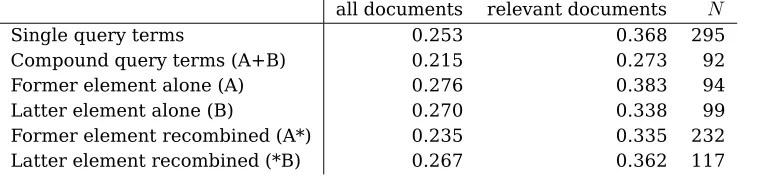
The constituent elements do not behave sym-metrically, however. As can be seen in table 7 former elements taken from a compound query term more often to be topically used in rele-vant documents than latter elements or new compounds based on either former or latter el-ements. This is consistent with arguments in the philological literature (Quirk et al., 1985; Noréen, 1906) where the former element of a compound is observed to be a focal component in an implicit predication.
These statistics show that on average it would seem to be advisable to add the for-mer element of the compound to the query: if the query contains term “diamantindustri” (dia-mond+industry) “diamant” is likely to be a use-ful query expansion, far more than other “in-dustri” would, and more than new compound terms such as “diamantring” (diamond ring), “oljeindustri” (oil industry), or “bilindustri” (au-tomobile industry).
8
Remaining questions to study
8.1 Distributional overlap
While the preceding set of statistics indicate that compounds can profitably be analyzed and elements treated individually, the overlap be-tween compounds and their elements remains a factor in determining the informational value of constituent elements vs entire compound: if the overlap is large, the marginal gain from in-troducing new terms can be assumed to be of low utility.
9
Principled prediction of topical
overlap
The above argument is based on the assump-tion that compounds follow a general pattern. The generalization may be useful and practi-cal but is likely to obscure underlying
system-atic differences between different types of com-pounding processes and different types of con-stituent element. The question is whether it is possible to predict the likely utility of adding constituent elements to a compound query term by observing the relative distributional statis-tics of the constituent elements and the com-pound in the collection without involving rele-vance assessments or human intervention.
The statistical treatment of compound ele-ments is a special case of the general question of terminological topical interdependence.
Questions that are being investigated in con-tinuing research efforts aim at the prediction of topical characteristics based on observed dis-tributional characteristics. They include ques-tions such as: Can we make a principled choice of elements to generalize from? Are elements in certain positions more valuable than others? Can we use characteristics of the bare elements to make that choice? Can we use total overlap to predict usefulness of constituent elements?
10
Discussion
The results of the present study are unequivo-cal on one level of analysis. As previous studies have shown, compounding languages should be treated as such. This study confirms that obser-vation.
Additionally, this study observes that com-pounds are not simple and happenstance jux-tapositions of equally salient elements. Com-pounding is a mechanism used by authors and speakers for a reason, and this can be usefully utilized in the analysis of e.g. information re-trieval queries. It would appear to be worth the trouble to select constituent elements by their distributional characteristics and by the struc-ture of the compound term rather than by their appearance as an unanalyzed compound in a query.
imple-Table 2: Katz’γfor compound term (AB) elements in the target collection. all documents relevant documents N
Single query terms 0.253 0.368 295
Compound query terms (A+B) 0.215 0.273 92
Former element alone (A) 0.276 0.383 94
Latter element alone (B) 0.270 0.338 99
Former element recombined (A*) 0.235 0.335 232
Latter element recombined (*B) 0.267 0.362 117
mentation in various systems rather than evalu-ation based on the quirks and characteristics of large scale information retrieval systems, how-ever competent and useful the systems are for the task they are built for.
References
Per Ahlgren. 2004. The Effects of Index-ing Strategy-Query Term Combination on Re-trieval Effectiveness in a Swedish Full Text Database. Ph.D. thesis, Department of Li-brary and Information Science, University College of Borås.
Martin Braschler and Bärbel Ripplinger. 2004. How effective is stemming and decompound-ing for German text retrieval? Information Retrieval, 7:291–306.
Rickard Cöster, Magnus Sahlgren, and Jussi Karlgren. 2004. Selective compound split-ting of Swedish queries for boolean combi-nations of truncated terms. In Carol Peters, Martin Braschler, Julio Gonzalo, and Mar-tin Kluck, editors, Fourth Workshop of the Cross–Language Evaluation Forum (CLEF 2003). Lecture Notes in Computer Science (LNCS), Springer, Heidelberg, Germany.
Turid Hedlund. 2003. Dictionary-Based Cross-Language Information Retrieval: Principles, System Design and Evaluation. Ph.D. thesis, Department of Information Science, Univer-sity of Tampere.
Slava Katz. 1996. Distribution of content words and phrases in text and language modelling. Natural Language Engineering, 2:15–60.
Adolf Noréen. 1906. Vårt språk, volume 7. CWK Gleerup, Lund, Sweden.
[image:5.595.75.460.100.191.2]