Putting Frames in Perspective
Nancy Chang, Srini Narayanan, and Miriam R.L. Petruck
International Computer Science Institute
1947 Center St., Suite 600, Berkeley, CA 94704
nchang,snarayan,miriamp
@icsi.berkeley.edu
Abstract
This paper attempts to bridge the gap between FrameNet frames and inference. We describe a computational formalism that captures structural re-lationships among participants in a dynamic sce-nario. This representation is used to describe the internal structure of FrameNet frames in terms of parameters for event simulations. We apply our for-malism to the commerce domain and show how it provides a flexible means of accounting for linguis-tic perspective and other inferential effects.
1
Introduction
FrameNet (Fillmore et al., 2001) is an online lex-ical resource1 designed according to the principles of frame semantics (Fillmore, 1985; Petruck, 1996). It thus takes as foundational the assumptions that (1) lexical items draw on rich conceptual structures, or frames, for their meaning and function; and (2) conceptually related lexical items may foreground different aspects of the same background frame. Verbs involved with commercial events serve as canonical examples:
(1) a. Chuck bought a car from Jerry for $1000. b. Jerry sold a car to Chuck for $1000. c. Chuck paid Jerry $1000 for a car. d. Jerry charged Chuck $1000 for a car. e. Chuck spent $1000 on a car.
The sentences in (1) might describe the same inter-action – in which one individual (Chuck) transfers money ($1000) to another (Jerry) in exchange for some goods (a car) – but differ in the perspective they impose on the scene.
The shared inferential structure of verbs like buy and sell is captured in FrameNet by the COMMERCE
frame, which is associated with a set of situational
1
http://www.icsi.berkeley.edu/framenet/
roles, or frame elements (FEs), corresponding to event participants and props. These FEs are used to annotate sentences like those in (1), yielding:
(2) a. [Chuck]Buyerbought [a car]Goods [from Jerry]Seller[for $1000]Payment.
b. [Jerry]Sellersold [a car]Goods [to Chuck]Buyer[for $1000]Payment.
FE tags act as a shorthand that allows diverse verbs to tap into a common subset of encyclopedic knowl-edge. Moreover, regularities in the set of FEs real-ized with specific lexical items can be taken as cor-related with their favored perspective.
A significant gap remains, however, between the unstructured and intuitively chosen tag sets used in FrameNet and a formal characterization of the inter-related actions and relations holding among them. An explicit representation of such frame-semantic information is needed to fully realize FrameNet’s potential use in text understanding and inference (Fillmore and Baker, 2001). In this paper we at-tempt to bridge the gap by defining a formalism that unpacks the shorthand of frames into structured event representations. These dynamic representa-tions allow annotated FrameNet data to parameter-ize event simulations (Narayanan, 1999b) that pro-duce fine-grained, context-sensitive inferences. We illustrate our formalism for the COMMERCE frame and show how it can account for some of the wide-ranging consequences of perspective-taking.
2
The FrameNet C
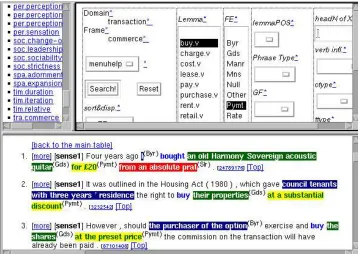
OMMERCEframeFigure 1: Results of a query on the FrameNet COMMERCEframe, showing annotated data for the verb buy.
wide variety of lexical items (or lemmas) and thus have the potential to allow corpus-based techniques to be applied to semantically oriented tasks.2
The current release of the FrameNet databases3
defines a COMMERCE frame with frame elements
including the familiar Buyer, Seller, Payment and
Goods, along with several other FEs needed to cover the data. The frame includes 10 verbs relevant to commercial transactions, for a total of 575 anno-tated sentences. Figure 1 shows a sampling of data annotated with respect to the COMMERCEframe.
Considerable research has been devoted to ex-plicating the connections among frames, perspec-tive, and argument structure; see Gawron (ms.) and Hudson (2002). But there has been relatively less work that addresses inferential issues related to per-spective. The COMMERCE frame, for example, is implicitly associated with a complex, dynamic net-work of interrelated events, actions and participants. Our proposal is that perspectival effects may be best understood in terms of subtle inferential effects on interpretation licensed by this network.
Our task, then, is to make this inferential structure
2
See (Gildea and Jurafsky, 2000) for some promising ini-tial work in applying statistical techniques to the FrameNet database to automatically label frame elements.
3We refer to data from FrameNet I; an interim release of FrameNet II is expected soon.
explicit. We take the original COMMERCE frame as our starting point and define the interrelation-ships present among its FEs. The additional struc-ture we impose on the COMMERCE frame allows us to distinguish a perspective-neutral description of a commercial transaction from the perspectivized situations described by particular verbs. The re-sulting event representation can be integrated with a simulation-based inference engine to account for differences in the interpretation of sentences like those in the annotated FrameNet data.
3
Structured event representations
In this section, we present a formal specification used for mapping the flat set of FEs in COM
-MERCE onto explicitly structured event
representa-tions based on the Embodied Construction Gram-mar (ECG) formalism. ECG is a constraint-based formalism similar in many respects to other unification-based linguistic formalisms, such as HPSG (Pollard and Sag, 1994).4 It differs from other lingustically motivated proposals in that it is
designed to support a model of language under-standing in which utterances evoke a complex net-work of conceptual schemas that are then mentally simulated in context to produce a rich set of infer-ences. It is thus ideally suited for our current goal of translating frames to conceptual representations.
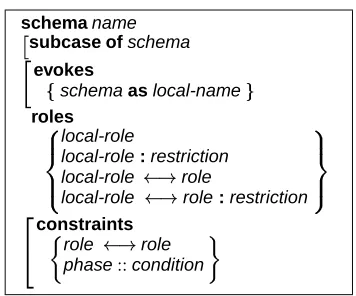
Figure 2 presents the ECG schema definition language. The indented block labeled roles lists and constrains the schema’s local roles, which are equivalent to features (or in this case, frame FEs). Roles are declared with a local name (local-role) and may be accompanied by type restrictions (indicated with ‘:’). Identification (or binding) constraints (in-dicated with ‘ ’) may appear in either theroles or theconstraintsblock; these cause roles and con-straints to be shared between its arguments, similar to unification or coindexation.5 The subcase
rela-tion defines a schema inheritance lattice, with the local schema inheriting all roles and constraints.
schema name
subcase of schema
evokes
schema as local-name
roles
local-role
local-role : restriction
local-role role
local-role role : restriction
constraints
role role
[image:3.612.94.272.316.464.2]phase::condition
Figure 2: Schema definition formalism. Keywords are shown in bold; a left square bracket ([) marks optional blocks; and curly braces ( ) enclose a set of optional statements. See text for details.
The formalism also has several novel features that we will exploit in representing commercial transac-tions. The most important of these are: (1) the abil-ity to flexibly evoke and relate multiple schemas, due mainly to the evokes relation; and (2) the abil-ity to assert dynamic conditions that apply to spe-cific event stages, through the use of simulation constraints. We will describe each of these briefly, deferring details to the example schemas below.
Schemas listed in the evokes block are instanti-ated locally (aslocal-name), but the relationship
be-5
Constraints may refer to locally declared roles, inherited roles, and evoked schemas, as well as any roles available through these structures. Standard slot-chain notation is used to refer to roleyof a structurexasx.y.
tween the defined schema and the evoked schema is underspecified. This underspecification allows one schema to be defined in terms of another schema without implying either full inheritance of the evoked schema’s roles or containment in either direction. In some cases, the evoked schema cor-responds to a subpart of the evoking schema; alter-natively, the evoked schema may serve as a back-ground schema against which the evoking schema is defined. We will see examples of each below.
Simulation constraints use the ‘::’ notation to as-sert someconditionon a particular phaseof simula-tion – either a relasimula-tion that must hold or an event or action that must take place during that phase. Simu-lation phases correspond to event stages; these con-straints serve as the bridging connection to previous work on modeling event structure and linguistic as-pect using active representations (Narayanan, 1997; Chang et al., 1998).
We now show how the ECG formalism can be used to define more complex schemas that provide the underlying structure we need to tackle the COM
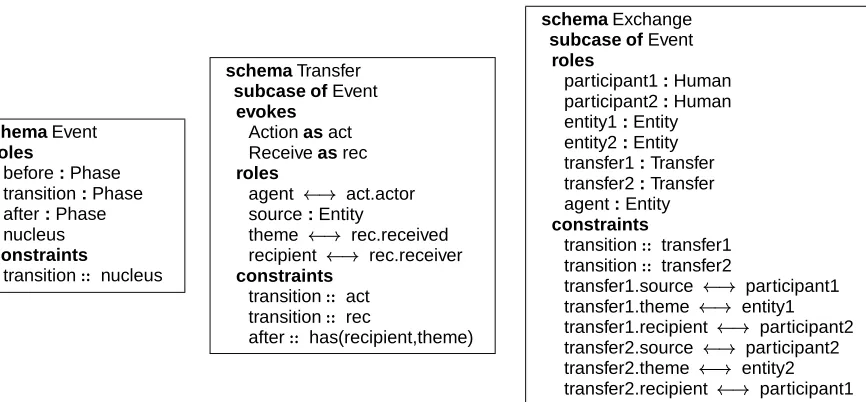
-MERCEframe; the key schemas for the current dis-cussion are shown in Figure 3.6
TheEventschema is of primary importance: it ap-pears directly or indirectly in the rest of the schema definitions, and it serves as the crucial link to simu-lation. The definition given here is not intended to capture the full complexity of the most generalized event, which may have complex internal structure (start and finish subevents, ongoing period, etc.). At a coarser granularity, however, it may also be viewed as a discrete temporal chunk that takes place between two time slices. The schema as shown re-flects this coarser view, which is sufficient for cur-rent purposes: its roles include before, after, and transition, all referring to simulation phases. An-other role, thenucleus, is constrained only to hold or take place during the transitionphase. Together these roles anchor the event to the passage of time.
The other schemas are more complex. The Trans-ferschema corresponds to an event in which anagent causes a theme to be transferred from the source to the recipient. It is defined as evoking two other schemas: anActionschema (with anactorrole) and a Receiveschema (in which areceivercomes into pos-session of thereceivedentity). (These are not shown, nor is the causal relation between them.) Note that bothact and recare conceptually distinct from the
schema Event roles
before : Phase transition : Phase after : Phase nucleus constraints
transition nucleus
schema Transfer subcase of Event
evokes Action as act Receive as rec roles
agent act.actor source : Entity
theme rec.received recipient rec.receiver constraints
transition act transition rec
after has(recipient,theme)
schema Exchange subcase of Event
roles
participant1 : Human participant2 : Human entity1 : Entity entity2 : Entity transfer1 : Transfer transfer2 : Transfer agent : Entity constraints
transition transfer1 transition transfer2
[image:4.612.92.525.69.270.2]transfer1.source participant1 transfer1.theme entity1 transfer1.recipient participant2 transfer2.source participant2 transfer2.theme entity2 transfer2.recipient participant1
Figure 3: TheEvent,TransferandExchangeschemas.
nucleus role inherited from Event, although all are constrained to take place during the event’s transi-tionphase. The agentrole is constrained to be the same entity as the actor of act. Importantly, the Transferevent schema makes no commitment as to whether its agent – the entity seen as causing the overall event – is thesource,recipientor eventheme. It is in this respect that the Transferschema can be considered neutral in perspective.
TheExchangeschema is structurally similar to the Transfer schema and provides most of the relevant constraints needed for commercial transactions. It includes two transfer events that occur during the transition phase and are parameterized straightfor-wardly in the constraints block by two human par-ticipants and two entities. An additional agentrole is not bound to any particular entity; this schema is thus also perspective-neutral, since either partici-pant (or both) might be viewed as active.
4
Commercial transaction schemas
We are now in a position to return to the commerce domain and put our inventory of domain-general schemas to use. We first define the Commercial-Transaction (CT) schema as a subcase of the Ex-changeschema with appropriate role identifications and an additional type restriction onentity1. The role names in this schema differ slightly from those in FrameNet’s COMMERCE, reflecting its perspective-neutral status. But given the obvious mapping to the FrameNet FEs, the CT schema fulfills part of our original objective: based on its inherited and evoked schemas and constraints, it concisely and
precisely states the conceptual underpinnings of the basic commercial transaction.
schema Commercial-Transaction subcase of Exchange
roles
customer participant1 vendor participant2 money entity1 : Money goods entity2
goods-transfer transfer1 money-transfer transfer2
Figure 4: TheCommercial-Transactionschema.
The CT schema provides the underlying in-frastructure against which various perspectivized schemas can be defined. As shown in Figure 5, we treatBuy,SellandPayas schemas thatevoketheCT schema and identify their roles with specific partic-ipants and event stages of the evoked CT schema. Note the use of the keywordself(which we treat as a special kind of role) to refer to the schema being defined:BuyandSellschemas each identifyselfwith thect.nucleusrole (that is, the nucleus of its evoked commercial transaction), and is thus constrained to take place during the evoked CT’s transitionphase. In contrast, sincePayidentifies itself with ct.money-transfer.nucleus, it refers specifically to a subpart of the overall commercial transaction, such that its ex-ecution does not necessarily entail the exex-ecution of thegoods-transferin the event (i.e., you don’t always get what you pay for).
schema Buy
subcase of Transitive-Action
evokes Commercial-Transaction as ct roles
self ct.nucleus
buyer actor ct.agent ct.customer goods undergoer ct.goods
schema Sell
subcase of Transitive-Action
evokes Commercial-Transaction as ct roles
self ct.nucleus
seller actor ct.agent ct.vendor goods undergoer ct.goods
schema Pay
subcase of Transitive-Action
evokes Commercial-Transaction as ct roles
self ct.money-transfer.nucleus payer actor ct.customer
ct.money-transfer.agent payment ct.money
payee ct.vendor
Figure 5: TheBuy,SellandPayschemas.
Transitive-Action (not shown), which corresponds to a prototypical situation in which an actorentity af-fects or manipulates an undergoer entity. The Buy and Sell schemas both identify the undergoer with ct.goods, and the actor with ct.agent. But the two schemas impose different views on the same situ-ation by virtue of a single additional constraint on this latter role (which corresponds to the active par-ticipant in the overall CT), binding it to either the ct.customer(Buy) or the ct.vendor (Sell). The bind-ings in the Pay schema assert that its actor is the ct.customer, as well as theagentof themoney-transfer.
Other schemas associated with the CT schema lend themselves to similar analyses, though they draw on additional schemas not defined here. For example, theSpendschema evokes a schema for re-source consumption (as in (Hudson, 2002));Charge involves the vendor’s communication of the price to the customer as a prerequisite to the overall ex-change of goods and money. In general, the CT schema explicitly specifies the internal event struc-ture of a commercial transaction but remains non-committal about which of its participants is seen as active. This flexibility in representation allows other schemas to effect the bindings that make appropri-ate commitments on an individual basis.
5
Simulation semantics
The structured event formalism we have described allows us to translate FrameNet descriptions into a representation suitable for simulative inference. Central to the representation is an event model called executing schemas (or x-schemas), moti-vated by research in both sensorimotor control and cognitive semantics (Narayanan, 1997). X-schemas are active structures that cleanly capture sequen-tiality, concurrency and event-based asynchronous control. They thus provide a cognitively moti-vated basis for modeling diverse linguistic phenom-ena, including aspectual inference (Chang et al., 1998), metaphoric inference (Narayanan, 1999a) and event-based reasoning in narrative understand-ing (Narayanan, 1999b). In this paper, we focus on the problem of frame-based inference and the atten-dent problem of modeling perspectival effects.
The event model is based on the Petri net, which in its basic form is a weighted, bipartite graph consisting of places (shown as circles) and
transi-tions (shown as rectangles) connected by directed
input and output arcs (Murata, 1989; Narayanan, 1997). Places may contain tokens (i.e., they may be marked), and they typically represent states, re-sources or conditions that apply. Transitions typi-cally represent actions or events. X-schemas extend the basic Petri net to include typed arcs, hierarchi-cal control, durative transitions, parameterization, typed (individual) tokens and stochasticity.
The most relevant property of the x-schema for this paper is its well-specified execution semantics: a transition is enabled when all its input places are marked, such that it can fire by moving tokens from input to output places. The active execution seman-tics serves as the engine of context-sensitive infer-ence in the simulation-based model of language un-derstanding mentioned earlier.
The ECG formalism is designed to allow con-straints on x-schema simulation to be expressed. In particular, the Event schema in Figure 3 has roles that refer to event phases; these correspond to x-schema places and transitions. Other schema roles specify schema parameters, which allow x-schemas to give rise to different execution traces through the network with different parameters.
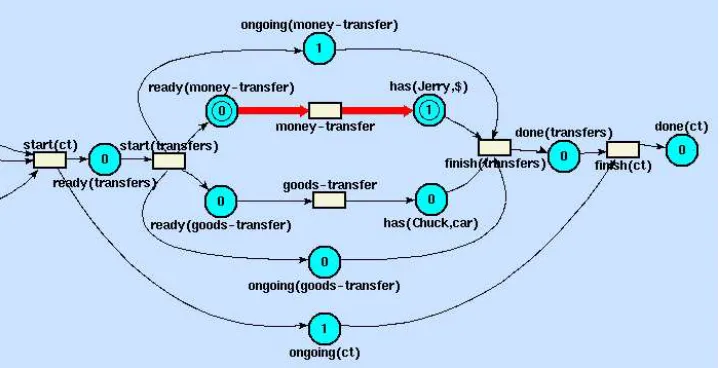
Figure 6: KarmaSIM simulation of theCommercial-Transactionschema. The highlighted execution is associ-ated with thePayschema, corresponding to themoney-transferevent.
fine-grained temporal structure of each event, cor-responding to the various control nodes in the net-work (ready, ongoing, finish, done, etc.); the transi-tionphase referenced in the schemas is expanded as thestart,ongoingandfinishnodes. As shown, execu-tion of the overallCTschema comprises the execu-tion of two subsidiary events, thegoods-transferand themoney-transfer. These need not be synchronized, but both must complete for the overall commercial transaction to complete (enforced by the arcs from ongoing(money-transfer)andongoing(goods-transfer)to finish(transfers)). All the frame-based inferences of theCTframe (e.g., the seller (buyer) has the goods (money) until the goods-transfer (money-transfer) is completed, and the seller (buyer) has the money (goods) when the money-transfer (goods-transfer) is completed) come from simulating theCTframe.
In the simulation framework, perspectival effects come in at least three flavors. First, the frame el-ement binding patterns may differ among perspec-tives, as illustrated by Figure 5, in which the lexi-cal itembuyidentifies theactorof thetransitive-action with both thecustomerof theCTand theagentof the money-transfer. This issue of binding has been the fo-cus of previous work (see Section 2); our approach is similar to construction-based proposals that ex-plicitly represent the binding constraints for differ-ent frame elemdiffer-ent binding patterns.
Second, some perspectives specify the specific subevents (or collection of subevents) to simulate while others require simulating the entire event frame. An example of this is shown in Figure 6,
where the highlighted money-transferportion of the network corresponds to a simulation of the Pay schema. The token inongoing(ct)shows that there is an ongoing transaction, but thefinish(transfers) tran-sition is not enabled. Technically, thedone(ct)place is not reachable (absent other information), since the simulation of Pay does not provide direct evi-dence for the occurrence of agoods-transfer.7In
con-trast, bothBuy and Sell involve simulating the en-tire transaction, include both transfers as well as the done(ct)node. (Thus, the entire network in Figure 6 can be considered an expansion of theCTschema’s transitionphase.)
A third, more subtle aspect of perspective is re-lated to the problem of linguistic focus. The per-spectival difference between Buy and Sell, for in-stance, is only partially captured by their different FE bindings to the CT frame. Another difference stems from the foregrounding of specific relations: buyforegrounds the interaction between the Buyer and theGoods(including the eventual possession of theGoods), whilesellforegrounds the interaction be-tween the Sellerand the Goods. Work in progress suggests that many foregrounding cases can be han-dled by simulating different parts of the event at varying degrees of detail. For example, the simu-lation forBuycould execute x-schemas in which the Buyerinteracts with the Goods– such as the goods-transferand its resulting possession (abbreviated as has(Chuck, car)in Figure 6) – at the default
larity, while other x-schemas are collapsed into less detailed simulations. (See (Narayanan, 1997) for a detailed model of simulation at multiple levels of granularity.) While the model is able to handle some of the issues pertaining to foregrounding and focus, a full account remains a topic of ongoing research.
6
Discussion and conclusions
FrameNet shows considerable promise for enabling qualitative breakthroughs on NLP applications re-quiring increased semantic and pragmatic sophis-tication, including information extraction, word-sense disambiguation, and question answering. FrameNet frames are intended to capture crucial generalizations not available in other lexical re-sources. WordNet (Fellebaum, 1998), for example, includes only simple taxonomic relations (buy and
sell are listed as hyponyms of get and give,
respec-tively, and as antonyms of each other). The Prop-Bank project (Kingsbury and Palmer, 2002) is, like FrameNet, geared toward the creation of a seman-tically annotated corpus (by adding general logical predicates to the Penn Treebank), though without any common background frame structures across lexical items.
While frames and FE tags are meaningful to hu-man interpreters, they are not yet suitable for use in natural language understanding. In this paper we have shown how FrameNet tags can be pre-cisely defined in terms of structured event repre-sentations, which can support parameterized simu-lations that license active inferences. The formal-ism appears expressive enough for the COMMERCE
frame, and uses methods of simulation semantics to handle frame-based inferences and associated per-spectival effects.
We are currently automating the process of map-ping frame definitions to simulation parameteriza-tions and extending the representation to cover the entire FrameNet II database.
Acknowledgments
Thanks to Chuck Fillmore, Jerry Feldman, the FrameNet and NTL groups, and the ScaNaLU workshop partici-pants for early feedback.
References
Collin F. Baker, Charles J. Fillmore, and John B. Lowe. 1998. The Berkeley FrameNet Project. In Proc.
COLING-ACL, Montreal, Canada.
Benjamin K. Bergen and Nancy C. Chang. 2002. Em-bodied Construction Grammar in simulation-based
language understanding. Technical Report TR-02-004, International Computer Science Institute. Nancy Chang, Daniel Gildea, and Srini Narayanan.
1998. A dynamic model of aspectual composition. In Proc. 20th Cognitive Science Society Conference, Madison, Wisconsin.
Nancy Chang, Jerome Feldman, Robert Porzel, and Keith Sanders. 2002. Scaling cognitive linguistics: Formalisms for language understanding. In Proc.
1st International Workshop on Scalable Natural Lan-guage Understanding, Heidelberg, Germany.
Christianne Fellebaum, editor. 1998. WordNet: An
Elec-tronic Database. MIT Press.
Charles J. Fillmore and Collin F. Baker. 2001. Frame semantics for text understanding. In Proc. WordNet
and Other Lexical Resources Workshop, Pittsburgh.
NAACL.
Charles J. Fillmore, Charles Wooters, and Collin Baker. 2001. Building a large lexical databank which pro-vides deep semantics. In Proc. Pacific Asian
Con-ference on Language, Information and Computation,
Hong Kong.
Charles J. Fillmore. 1985. Frames and the semantics of understanding. Quaderni di Semantica, IV(2). Jean Mark Gawron. 2002. Frames, modifiers, and
argu-ment structure. Ms., San Diego State University. Daniel Gildea and Daniel Jurafsky. 2000. Automatic
la-beling of semantic roles. In Proceedings of the 38th
Annual Meeting of the ACL, Hong Kong, October.
Richard Hudson. 2002. Buying and selling in Word Grammar. In press.
Paul Kingsbury and Martha Palmer. 2002. From Tree-bank to PropBank. In Proc. 3rd International
Confer-ence on Language Resources and Evaluation (LREC-2002).
Tadao Murata. 1989. Petri nets: Properties, analysis, and applications. In Proc. IEEE-89, volume 77, pages 541–576.
Srini Narayanan. 1997. Knowledge-based Action
Repre-sentations for Metaphor and Aspect (KARMA). Ph.D.
thesis, University of California at Berkeley.
Srini Narayanan. 1999a. Moving right along: A compu-tational model of metaphoric reasoning about events. In Proc. Sixteenth National Conference of Artificial
Intelligence (AAAI-99). AAAI Press, Menlo Park.
Srini Narayanan. 1999b. Reasoning about actions in nar-rative understanding. In Proc. Sixteenth International
Joint Conference on Artificial Intelligence (IJCAI-99).
Morgan Kaufmann Press.
Miriam R.L. Petruck. 1996. Frame semantics. In J. Ver-schueren, J. ¨Ostman, J. Blommaert, and C. Bulcaen, editors, Handbook of Pragmatics. John Benjamins, Philadelphia.
Carl Pollard and Ivan A. Sag. 1994. Head-Driven
Phrase Structure Grammar. University of Chicago