Quantifying Qualitative Data for Understanding Controversial Issues
Michael Wojatzki
†, Saif M. Mohammad
, Torsten Zesch
†, and Svetlana Kiritchenko
†Language Technology Lab, University of Duisburg-Essen
{michael.wojatzki,torsten.zesch}@uni-due.de National Research Council Canada
{saif.mohammad,svetlana.kiritchenko}@nrc-cnrc.gc.ca
Abstract
Understanding public opinion on complex controversial issues such as ‘Legalization of Marijuana’ and ‘Gun Rights’ is of considerable importance for a number of objectives such as identifying the most divisive facets of the issue, developing a consensus, and making informed policy decisions. However, an individual’s position on a controversial issue is often not just a binary support-or-oppose stance on the issue, but rather a conglomerate of nuanced opinions and beliefs on various aspects of the issue. These opinions and beliefs are often expressed qualitatively in free text in issue-focused surveys or on social media. However, quantifying vast amounts of qualitative information remains a significant challenge. The goal of this work is to provide a new approach for quantifying qualitative data for the understanding of controversial issues. First, we show how we can engage people directly through crowdsourcing to create a comprehensive dataset of assertions (claims, opinions, arguments, etc.) relevant to an issue. Next, the assertions are judged for agreement and strength of support or opposition, again by crowdsourcing. The collected Dataset of Nuanced Assertions on Controversial Issues (NAoCI dataset) consists of over 2,000 assertions on sixteen different controversial issues. It has over 100,000 judgments of whether people agree or disagree with the assertions, and of about 70,000 judgments indicating how strongly people support or oppose the assertions. This dataset allows for several useful analyses that help summarize public opinion. Across the sixteen issues, we find that when people judge a large set of assertions they often do not disagree with the individual assertions that the opposite side makes, but that they differently judge the relative importance of these assertions. We show how assertions that cause dissent or consensus can be identified by ranking the whole set of assertions based on the collected judgments. We also show how free-text assertions in social media can be analyzed in conjunction with the crowdsourced information to quantify and summarize public opinion on controversial issues. Keywords:controversial issues, judging assertions, crowdsourcing, stance detection, argument mining, sentiment analysis
1.
Introduction
Controversyis a state of sustained public debate on a topic or issue that evokes conflicting opinions, beliefs, claims, arguments, and points of view. In this paper, we will refer to utterances of opinion, belief, claim, argument, or point of view relevant to an issue as assertions. People make assertions on a controversy (or controversial issue) both in the physical world and on social media. Others might agree or disagree with these assertions. An individual’sposition on an issue is not simply a binary support-or-oppose stance on the issue, but rather a cumulative sum of many nuanced beliefs and opinions. Thus assertions are a useful means of capturing one’s position on a controversial issue. Examples of common controversial issues includethe legalization of marijuana, government policy on refugees,andgun rights. Examples of assertions include ‘Marijuana alleviates the suffering of chronically ill patients’ and ‘Expanding legal use of marijuana makes illegal use easier’.
Controversial issues are usually complex, not only be-cause of the many diverse and inter-related assertions they evoke, but also because they often subsume many inter-related sub-issues (e.g., ‘Should marijuana be legalized for medical purposes?’). An issue has manystake holders— people that are directly or indirectly affected by it—e.g., patients undergoing chemotherapy and parents of teenage children are just two of the many stakeholders affected by a possible legalization of marijuana. Given these complexi-ties, it is difficult to attain consensus, and people often tend to talk past each other without really listening to the mer-its of opposing arguments (amplifying existing echo cham-bers). Even decision making bodies, such as local and
na-tional governments, can make more informed choices if they have a comprehensive understanding of the controver-sial issue. Simply obtaining the percentage of people that support or oppose an issue is not sufficient. It is often more useful to obtain information about the different aspects of an issue, what aspects of an issue are considered more im-portant, what people’s beliefs and opinions on various as-pects are, who the main stakeholders are, what opposing groups agree and disagree on, etc.
A common approach to understanding complex contro-versial issues is to hire experts and conduct surveys. How-ever, such an approach has inherent limitations: the survey creators inadvertently bring in biases, often these surveys fail to cover all relevant aspects, and the process is time intensive and expensive. Further, such surveys often only make use of questions whose responses can be easily aggre-gated, e.g., multiple-choice questions and questions with a small set of possible responses. Quantifying qualitative re-sponses often requires manual interpretation and does not scale up to large surveys. In contrast, people naturally ex-press their nuanced positions on an issue through free-text utterances in the real world and in on-line social networks. Capturing and quantifying information in free-text asser-tions remains a significant challenge in understanding con-troversial issues.
as-sertions by both the degrees of agreement on them and by how strongly people support or oppose each of the asser-tions. We create this dataset by conducting crowdsourced surveys to: (1) collect about 150 unique assertions per is-sue, (2) determine agreement on these assertions by hun-dreds of respondents, and (3) rank the assertions based on how strongly people support or oppose them. For each of the sixteen issues we collect around 150 assertions (2,243 in total). For each of the assertions, we obtain 15 judg-ments on how strongly people support or oppose the asser-tions (67,290 in total) and about 45 judgments for agree-ment (101,133 in total). We will refer to this dataset as the dataset ofNuanced Assertions on Controversial Issues (NAoCI).
We propose several metrics that can be calculated from the data and used for grouping, ranking, and clustering as-sertions and participants. We show how these metrics can be used to identify agreement and support on assertions, to rank issues based on controversial assertions, and to de-termine the similarity of assertions, users and groups. An analysis of the distribution of judgments shows that for all of the controversial issues there are more assertions with which the majority of the people agree than assertions with which the majority of the people disagree or assertions with which some agree and some do not (controversial as-sertions). However, the controversial assertions are often the ones that are supported or opposed to the greatest de-gree. The new approach to understanding argumentation proposed here goes well beyond simple positive–negative– neutral classification or overall stance detection from text. The NAoCI dataset will help foster new research that tack-les difficult questions such as how people make arguments to support their stance on an issue, what is the distribution of assertions that people agree and disagree with across dif-ferent groups, and how the position on a controversial as-sertion impacts overall stance.
Our second goal is to improve theunderstanding of controversial issues using assertions made by people in social media. As a first step towards achieving this goal, we propose several new natural language processing tasks in this paper. These tasks include identifying assertions implicit in free-text posts on social media, determining a speaker’s position on various assertions, identifying the de-gree of ade-greement, support, and opposition for assertions by a large population of tweeters that post messages about a controversial issue, etc. These new natural language pro-cessing tasks are a way to summarize information about the controversial issues without necessarily having to do the crowdsourcing described above. However, the crowd-sourced data will serve as a source of reference (gold) labels for the evaluation of these NLP algorithms.
All the annotation tasks described in this paper were approved by the National Research Council Canada’s Insti-tutional Review Board, which reviewed the proposed meth-ods to ensure that they were ethical. All our data and crowd-sourcing questionnaires are made available on the project webpage.1
1
https://sites.google.com/view/you-on-issues
2.
Related Work
In recent years, a number of web-based applications have been developed that help users share their opinions and ex-plore public opinion on controversial issues. Specifically, Voting Advice Applications such asvotecompass.com, po-liticalcompass.org, andisidewith.comask visitors whether they agree or disagree with a set of pre-chosen assertions (Garzia and Marschall, 2012). The applications usually provide some form of visualization that depict which po-litical party or candidate is closest to the user’s own posi-tion. Voting Advice Applications have mainly been studied in political science, where researchers have examined ques-tions such as: whether these applicaques-tions have an effect on voting behavior (Ladner and Pianzola, 2010), what charac-teristics their users have (Wall et al., 2009), or how their de-sign affects their outcome (Louwerse and Rosema, 2014). In contrast, here we focus on creating a language resource containing crowdsourced judgments on a large number of user generated assertions.
Our second goal of understanding and summarizing public opinion from posts on social media is related to work on detecting sentiment (Pang and Lee, 2008; Liu, 2012; Mohammad, 2016; Mohammad et al., 2018) and stance (Mohammad et al., 2016; Xu et al., 2016; Taul´e et al., 2017), argumentation mining (Kwon et al., 2007; Walker et al., 2012; Rosenthal and McKeown, 2012; Stab and Gurevych, 2014; Peldszus and Stede, 2016; Habernal and Gurevych, 2016), and framing (Entman, 1993; Card et al., 2015; Tsur et al., 2015; Fulgoni et al., 2016; Johnson and Goldwasser, 2016). These approaches focus on identifying sentiment, stance, claims, premises, reasons, arguments, sentiment, etc. from individual utterances. In contrast, here we suggest quantifying information from a large number of social media utterances in order to gain the overall under-standing of a complex issue. There exists work on opin-ion summarizatopin-ion (Hu and Liu, 2004; Zhuang et al., 2006; Titov and McDonald, 2008; Titov and McDonald, 2008; Ganesan et al., 2010; Gerani et al., 2014) and on the cluster-ing of argumentative elements (Trabelsi and Zaıane, 2014; Misra et al., 2015; Boltuˇzi´c and ˇSnajder, 2015; Barker and Gaizauskas, 2016); however, these studies mainly explore the grouping of utterances into positive and negative clus-ters, or extracting opinion utterances and claims to create a summary. Here, we first establish a comprehensive rep-resentation of assertions for a controversial issue, and then propose discovering elements of this representation from free-text utterances in social media.
3.
Understanding Controversial Issues
Issue #
of
Assertions #of Agr
eement
Black Lives Matter 135 6,154 4,050
Climate Change 142 6,473 4,260
Creationism in school 129 5,747 3,870
Foreign Aid 150 6,866 4,500
Gender Equality 130 5,969 3,900
Gun Rights 145 6,423 4,350
Marijuana 138 6,200 4,140
Same-sex Marriage 148 6,899 4,440
Mandatory Vaccination 134 5,962 4,020
Media Bias 133 5,877 3,990
Obama Care 154 6,940 4,620
US Electoral System 175 7,695 5,250
US in the Middle East 138 6,280 4,140
US Immigration 130 5,950 3,900
Vegetarianism & Veganism 128 5,806 3,840
War on Terrorism 134 5,892 4,020
Total 2,243 101,133 67,290
Table 1: Issues, number of generated assertions, and num-ber of collected judgments.
including: ranking assertions based on how they were judged, clustering people and assertions by voting patterns, and ranking issues by degree of polarization. The sixteen controversial issues we explore are shown in Table 1. They were compiled from voting advice websites.
3.1.
Collecting Public Opinion
Generating Assertions: Given an issue (name and a brief description), we asked each participant to come up with five assertions relevant to the issue. To guide the process of cre-ating assertions, the participants were given the following directions. Participants had to formulate assertions in a way that a third person can agree or disagree with it. The asser-tions had to be self-contained and understandable. Hedged statements that included words such as ‘maybe’, ‘perhaps’, or ‘possibly’ were prohibited.
As a quality control measure, participants were also re-quired to answer test questions where they had to indicate whether the given assertions were applicable to the issue and whether they were in accordance with the rules. We discarded all responses from participants who incorrectly answered more than 10% of these questions.
We obtained 2,243 assertions from 69 participants for the sixteen issues. Duplicates and instances not in accor-dance with the guidelines were removed. Table 1 lists the number of remaining valid assertions for each issue.
Quantifying Agreement and Strength of Support and Opposition: Once the list of assertions was compiled, we obtained judgments on (a) whether people agree with the
assertion, and (b) how strongly they support or oppose the assertion. A participant may not be inclined to judge all as-sertions. However, if a large enough number of judgments are obtained from many participants, then meaningful in-ferences can be drawn. Thus, individual participants were free to judge as many assertions as they wished. For both kinds of judgments, the exact questionnaires along with the directions and examples are shown in the Appendix.
To obtain agreement judgments on the assertions, we simply asked the subjects to indicate to us whether they agree or disagree with the collected assertions. The av-erage number of agreement judgments per assertion was 45. Table 1 shows how many judgments we collected for each issue. From the agreement judgments, we created the agreement matrixAM, which contains one column per as-sertion, and one row per participant. Each celladp,ain this matrix has the judgment provided by participantpfor as-sertiona. Consequently,ad~ais the vector of all judgments provided for assertiona, andad~pis the vector of all judg-ments provided by participantp.
To obtain consistent and comparable fine-grained scores indicating the degree of support or opposition from multiple respondents, we used a technique known as Best– Worst Scaling (BWS) (Louviere et al., 2015b). BWS is an annotation scheme that addresses the limitations of tra-ditional rating scale methods, such as inter- and intra-annotator inconsistency, by employing comparative an-notations (Louviere, 1991; Louviere et al., 2015a; Kir-itchenko and Mohammad, 2016; KirKir-itchenko and Moham-mad, 2017). Annotators are given n items (an n-tuple, wheren >1and commonlyn= 4). They are asked which item is thebest(highest in terms of the property of inter-est) and which is theworst(lowest in terms of the property of interest). When working on4-tuples, best–worst annota-tions are particularly efficient because each best and worst annotation will reveal the order of five of the six item pairs. For example, for a 4-tuple with items A, B, C, and D, if A is the best, and D is the worst, then A >B, A>C, A> D, B>D, and C>D. Real-valued scores of association between the items and the property of interest can be cal-culated from the BWS annotations (Orme, 2009; Flynn and Marley, 2014).
We generated 4,486 4-tuples of assertions from our list of 2,243 assertions using the code provided by Kiritchenko and Mohammad (2016). Participants were presented with four assertions at a time and asked two questions:
1. which of the assertions they support the most (or op-pose the least),
2. which of the assertions they oppose the most (or sup-port the least).
Figure 1: Quantifying qualitative assertions for the issue ‘Legalization of Marijuana’. The agreement matrix has values
1for agreement and−1for disagreement. The support/oppose matrix contains integer values indicating how many times the participants have selected an assertion as the one they most support (resp. least oppose) and most oppose (resp. least support). The demographic matrix contains the responses to the demographic questions such as education, religion, and age.
Demographic Data: A key determiner of one’s beliefs and opinions is their personal experience, which in turn is often shaped by their demographic attributes. In order to determine the extent to which demographic attributes cor-relate with one’s judgments on assertions, we asked the participants to provide us with their demographic informa-tion: age, gender, political affiliation, education, family sta-tus, profession, race, religion, whether the participants have ties to overseas and whether they are US citizens. Partici-pants were free to not provide this demographic data if they wished.
Participants: Of the 230 subjects that participated in the quantitative phase, 85 (37%) submitted demographic infor-mation. This sample had a mean age of 34.9 years; 65% of the respondents were female. Just over 50% of the respon-dents had a bachelors or higher degree. With regard to po-litical affiliation, a broad mix could be observed. However, the group of people who identified themselves as democrats was the largest. About 50% of respondents indicated that they were employed. Most of the participants had ties to overseas (68%) and were US citizens (89%). With respect to religion, the majority of the participants were Christians (Roman Catholic 28%, Protestant 25%, Russian Orthodox 1%). About 29% were atheists. 69% of our participants identified themselves as white, 10% as Hispanic, 8% as black or African American, 8% as Asian, 2% as Ameri-can Indian or Alaskan native, and 3% as others. Further details of the demographic information can be found in the Appendix.
3.2.
Summarizing Public Opinion
The data gathered from crowdsourcing efforts can be used to summarize, visualize, and gain insights into public
opin-ion on controversial issues. In the subsectopin-ions below, we describe how we calculate various metrics from the data that can be used to summarize various aspects of public opinion on an issue.
3.2.1. Ranking Agreement and Support
Assertions expressed by participants provide key insights into why an issue is controversial, what aspects of the issue people are particularly passionate about, etc. Thus organiz-ing the assertions by amount of agreement (to quickly view the assertions with most and least agreement) and strength of support or opposition is particularly useful. We calculate theagreement score(ags) of an assertionaby simply sub-tracting the percentage of times the assertion was disagreed with from the percentage of times the assertion was agreed with:
ags(a) = %agree(a)−%disagree(a) (1)
alter-Agreement Score
Number of Asser
tions
−1.0 −0.5 0.0 0.5 1.0
0
50
100
150
200
(a) Distribution of Agreement Scores
Support−Oppose Score
Number of Asser
tions
−1.0 −0.5 0.0 0.5 1.0
0
50
100
150
(b) Distribution of Support–Oppose Scores
Figure 2: Distribution of agreement and support–oppose scores across all issues. We group the agreement and support– oppose scores into bins of size 0.05. For both the agreement and support–oppose scores, the colors encode how positive (green) or negative (red) the scores are.
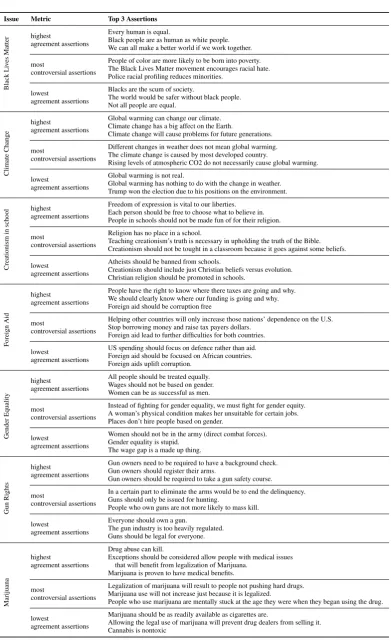
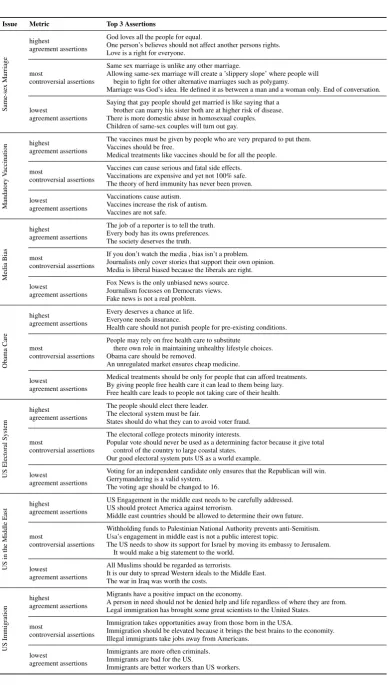
native marriages such as polygamy.’ is the most contro-versial. In the Appendix, we show the top three assertions according to these rankings for all issues.
We transform the comparative BWS judgments for sup-port and opposition into scores ranging from −1 (maxi-mum opposition) to1(maximum support) through a simple counting method proposed by Orme (2009). For an asser-tionawe calculate asupport–oppose score (sos) by sub-tracting the percentage of times an assertion was chosen as the most opposed from the percentage of times the assertion was chosen as the most supported:
sos(a) = %most support(a)−%most opposed(a) (2)
These scores can be used to rank assertions from most strongly supported (1) to most strongly opposed (−1). Se-lecting an assertion as ‘most opposed’ in the comparative annotations, may mean that one either most opposes or least supports the assertion. We can infer which of the two interpretations applies from the agreement judgments; i.e. ‘most oppose’ can be considered as ‘least support’ if a participant agrees to a statement and it remains ‘most oppose’ if the person disagrees with the assertion. Anal-ogously, ‘most support’ can be interpreted as ‘least oppose’ if one disagrees to the assertion and it can be interpreted as ‘most support’ if one agrees to the assertion. Thus, we additionally calculate asupport score(ranging from ‘least supported’ (0) to ‘most supported’ (1)) and anoppose score (ranging from ‘least opposed’(0) to ‘most opposed’ (1)). To calculate these scores, we reuse the formula shown in equa-tion 2. However, the percentages are now calculated only on the set of persons that have agreed to (support score) or disagreed with (oppose score) the assertion. These scores can be used to differentiate between assertions where a support–oppose scoreof about zero indicates that an asser-tion is both strongly supported and strongly opposed, and
assertions which have asupport–oppose scoreof about zero but that are rarely strongly supported or opposed. An ex-ample for the former is the assertion ‘Freedom of the press prevents the government or other third parties from control-ling the media.’ that has asupport–oppose scoreof0, but a fairly highsupport scoreof0.71, and a highoppose score of 1. An example for the latter is the assertion ‘Women’s rights have well found legal basis.’ that has a support– oppose score of −0.07 and both a lowoppose score (0) andsupport score(0.39).
Figure 2 shows histograms of the agreement and support–oppose scores. For the support–oppose scores, we observe that the scores have a normal distribution. This distribution can also be found when looking at the distri-butions per issue. For the agreement scores, we observe that the mass of the distribution is concentrated in the posi-tive range of possible values, indicating that the participants tend to agree with the assertions more often than they dis-agree. (We observe a similar distribution in each of the in-dividual issues as well.) This is consistent with the hypoth-esis that people often do not disagree with the individual assertions that the other side makes, however, they might disagree on the relative importance of that assertion among the various other assertions in terms of reaching an overall stance on the broader issue.
Examples of assertions with a particular highagreement score for the Legalization of Marijuana issue are ‘Drug abuse can kill.’, ‘Cannabis has legitimate medical effects.’, and ‘Exceptions should be considered allow people with medical issues that will benefit from legalization of Mari-juana.’.
3.2.2. Ranking Controversial Issues
0 0.1 0.2 0.3 0.4 0.5 0.6 0.7 0.8 0.9 1 US in the Middle East War on Terrorism
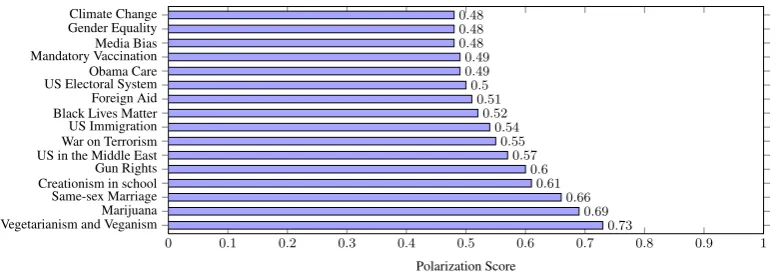
Figure 3: Issues ranked according to their polarization score.
them. One indicator of the degree of polarization is the ex-tent to which the assertions associated with the issue evoke opposing responses. If all the assertions for an issue have an agreement score of zero (the number of respondents that agree is equal to the number of respondents that disagree), then the issue is maximally polarizing. Hence, we calculate thepolarization score(ps) of an issue (a set of assertions)I by first calculating the average of the absolute value of the agreement score for each of the assertions, and then sub-tracting this value from one:
ps(I) = 1− 1 |I|
X
a∈I
|ags(a)| (3)
A polarization score of0indicates that participants consis-tently agree or disagree with all assertions representing an issue. A polarization score of1indicates that – on average – an equal number of participants agree and disagree with the assertions on an issue. Consequently, a polarization score of0.5describes an issue in which more and less polarizing assertions keep a balance.
The polarization scores for the sixteen issues are shown in Figure 3. Interestingly, many of the polarization scores for the issues are around 0.5. For the issues Climate Change,Gender Equality,Media Bias,Mandatory Vacci-nation, and Obama Care the scores are even below 0.5, which means that on average there is more consensus than dissent in judging the assertions on these issues. However, as shown by the issues Same-sex Marriage (0.66), Mar-ijuana (0.69) and Vegetarianism & Veganism (0.73), our data contains also more polarizing issues. In future work, we plan to examine whether linguistic properties of the as-sertions (e.g., whether they use superlatives) can be utilized to explain these differences. Also note that the score does not include external factors such as the social context in which a controversy takes place and should be used only as one (of the many possible ways) in which polarization can be measured.
3.2.3. Determining Similarity of Users and Assertions The crowdsourced data can be used to determine which users show a similar response behavior and which asser-tions have been similarly voted on. Voting similarity be-tween participants can be used to generate guesses about their judgments on assertions for which they have not voted.
We determine the voting similarity between pairs of partic-ipants by computing the cosine of the vectors that represent the rows in the agreement matrixAM(see Figure 1):
cos(p1, p2) =
~
adp1·ad~p2
|ad~p1| · |ad~p2|
(4)
Being able to judge similarity between assertions helps identify inter-related assertions. We determine the degree by which two assertions are judged similarly by computing the cosine of the column vectors of the agreement matrix AM(see Figure 1):
cos(a1, a2) =
~
ada1·ad~a2
|ad~a1| · |ad~a2|
(5)
The computed similarities between pairs of assertions are made public on the project’s website. We manually in-spected pairs of assertions with a particularly high or low judgment similarity. We found several reasons for high sim-ilarity between assertions (why people tend to agree with both assertions or they tend to disagree with both asser-tions): the two assertions are close paraphrases (e.g., ‘Own-ing a gun can deter criminals.’ and ‘Gun ownership de-ters crime.’), one assertion entails the other (e.g., ‘Oceans rise due to climate change.’ and ‘Climate change has a big effect on the Earth.’), underlying socio-cultural and po-litical factors cause people to vote similarly on two (some-times seemingly unrelated) assertions (e.g., ‘US should hire skilled immigrants.’ and ‘Inclusion should be facilitated for immigrants.’).
Reasons for low similarity between assertions (why people tend to agree with one assertion and disagree with the other) include: the two assertions are contradictory or contrasting (e.g., ‘It is safe to use vaccines.’ and ‘Vaccines cause autism.’), and underlying socio-cultural and political factors cause people to vote dissimilarly on two (sometimes seemingly unrelated) assertions (e.g., ‘Congress should im-mediately fund Trump’s wall.’ and ‘All immigrants should have the right to vote in the American elections.’).
(a) cosine>0.0 (b) cosine>0.1 (c) cosine>0.2 (d) cosine>0.3 (e) cosine>0.4
Figure 4: Similarity of participants visualized in an undirected graph for the issueBlack Lives Matter. In the sub figures, we draw edges between two persons if their voting similarity is above a certain threshold.
agreement scores. An example for this case are the follow-ing assertions:
‘Women should have the same rights than men.’ (ags= 0.84)
‘Women should have the same rights as men.’ (ags= 0.88)
‘Women should have the same right as men.’ (ags= 0.86)
Note that the first and third example are ungrammatical, which does not seem to significantly affect the rating.
However, there are also pairs with a high textual overlap and significantly different agreement scores. In these pairs, slight differences in wording have a marked influence on how the assertions are judged. Examples include:
‘Foreign aid budget should be more effective.’ (ags= 0.73)
‘The foreign aid budget should be made more ef-fective.’ (ags= 0.65)
as well as
‘Climate change is costing lives.’ (ags= 0.76) ‘Climate change is already costing lives.’ (ags= 0.52).
3.2.4. Clustering Participants With Similar Positions It is often useful to identify which groups of people have similar positions on a controversial issue. This allows for focused engagement with individual groups. The agree-ment judgagree-ments in our data can be used to cluster parti-cipants according to their judgments on assertions.
We use the voting similarity between participants (c.f. equation 4) to find groups of people with similar overall beliefs on an issue. The same methods described in sec-tion 3.2.1. to calculate the agreement and support–oppose scores for an assertion can be used to calculate agreement and support–oppose scores for individual groups (instead of for the whole population). Then separate ranked lists of as-sertions can be generated for each group. This ranking can then be used to summarize the judgments of the groups. We can also determine which assertions a group agrees the most with, which assertions receive similar judgments
across two groups, and which assertions the two groups dis-agree on.
When we cluster participants by judgment similarity, several scenarios are possible: a binary split into persons that support and oppose the overall issue (e.g., one clus-ter includes people in favour of legalizing marijuana and one cluster includes people that are against), several clus-ters that correspond to persons with more specific positions (e.g., being against legalizing marijuana for medical pur-poses or favoring the idea that marijuana is a gateway drug), or single cluster which expresses a mainstream of positions. To examine the distribution of similar participants, we create an undirected graph in which the nodes represent par-ticipants and edges are drawn if the person–person similar-ity exceeds a certain threshold. Next, we compare graphs with different thresholds. We find that it is not uncommon for an issue that at a low threshold almost all participants are connected; i.e. that all subjects have a certain similarity to each other. If we increase the threshold, we do not ob-serve the formation of several clusters, but of a single clus-ter and an increasing amount of single disconnected out-liers. This indicates that the majority of persons in our data belongs to a mainstream. We visualize this experiment for the issueBlack Lives Matterin Figure 4. We manually in-spect the judgments of disconnected persons and observe that these indeed tend to have rather radical positions (e.g., disagreeing with the assertion ‘Everyone is equal.’). Note that clustering using cosine similarity is just one of the sev-eral ways to identify groups of similar positions. In future work, we plan to examine other ways of determining simi-larity between vectors (e.g., by considering their overlap).
4.
Understanding Controversial Issues from
Assertions in Social Media
used as reference (gold) to evaluate these automatic meth-ods.
• Identifying explicit and implicit assertions relevant to an issue in social media posts (e.g. tweets).
• Identifying social media posts that express the same assertions in different ways; Identifying posts that ex-press contradictory or opposing assertions.
• Compiling a large list of assertions relevant to an is-sue from tweets; ranking them by an estimate of the degree of agreement; ranking them by an estimate of the support and oppose scores; automatically estimat-ing polarization scores for issues.
• Determining semantic similarity between pairs of as-sertions; Clustering tweeters by the similarity of the assertions they make (agree with); Clustering asser-tions by their similarity.
As a first step, we have begun collecting tweets pertinent to each of the sixteen issues (that are part of this project) through a small manually identified list of query terms.2 We have collected close to nine million tweets. The IDs of these tweets are available on the project webpage.
5.
Conclusion
We proposed a method to quantify qualitative information relevant to a controversial issue by engaging people di-rectly via crowdsourcing. This new approach to under-standing argumentation goes well beyond simple positive– negative–neutral classification or overall stance detection from text. We created a dataset containing a comprehensive and nuanced list of assertions relevant to an issue, and then ranked them by both the agreement and degree of support for each assertion. We applied the proposed method for sixteen different controversial issues and collected a total of over 2,000 assertions. We obtained over 100,000 judg-ments of whether people agree or disagree with the asser-tions and about 70,000 judgments indicating how strongly people support or oppose the assertions. We also proposed several metrics such as an agreement score for an assertion and a polarization score for an issue that can be calculated from the data and used for grouping, ranking, and cluster-ing issues, assertions and participants. Finally, we outlined a number of NLP tasks for the understanding of contro-versial issues through assertions made by people in social media. Our dataset, Nuanced Assertions on Controversial Issues (NAoCI), can be used as a source of reference la-bels in the evaluations of these tasks. We expect the NAoCI dataset and automatic algorithms produced as part of this project to be helpful—both to the lay person and expert— in making informed decisions about complex controversial issues.
6.
Acknowledgments
This work was supported by the Deutsche Forschungsge-meinschaft (DFG) under grant No. GRK 2167, Research Training Group “User-Centred Social Media”. We would also like to thank Tara Small for the helpful discussions.
2The full list of query terms is available on the project
web-page: https://sites.google.com/view/you-on-issues.
7.
Bibliographical References
Agirre, E., Diab, M., Cer, D., and Gonzalez-Agirre, A. (2012). Semeval-2012 task 6: A pilot on semantic tex-tual similarity. InProceedings of the Sixth International Workshop on Semantic Evaluation, pages 385–393. Barker, E. and Gaizauskas, R. (2016). Summarizing
multi-party argumentative conversations in reader comment on news. InProceedings of the 3rd Workshop on Argument Mining, pages 12–20, Berlin, Germany.
Boltuˇzi´c, F. and ˇSnajder, J. (2015). Identifying Prominent Arguments in Online Debates Using Semantic Textual Similarity. InProceedings of the 2nd Workshop on Ar-gumentation Mining, pages 110–115, Denver, USA. As-sociation for Computational Linguistics.
Card, D., Boydstun, A. E., Gross, J. H., Resnik, P., and Smith, N. A. (2015). The media frames corpus: An-notations of frames across issues. InProceedings of the 53rd Annual Meeting of the Association for Computa-tional Linguistics, pages 438–444, Beijing, China. Entman, R. M. (1993). Framing: Toward clarification
of a fractured paradigm. Journal of communication, 43(4):51–58.
Flynn, T. N. and Marley, A. A. J. (2014). Best-worst scal-ing: theory and methods. Handbook of Choice Mod-elling, pages 178–201.
Fulgoni, D., Carpenter, J., Ungar, L. H., and Preotiuc-Pietro, D. (2016). An Empirical Exploration of Moral Foundations Theory in Partisan News Sources. In Pro-ceedings of the Tenth International Conference on Lan-guage Resources and Evaluation (LREC 2016), pages 3730–3736, Portoroˇz, Slovenia.
Ganesan, K., Zhai, C., and Han, J. (2010). Opinosis: A Graph Based Approach to Abstractive Summarization of Highly Redundant Opinions. InProceedings of the 23rd International Conference on Computational Linguistics (Coling 2010), pages 340–348, Beijing, China.
Garzia, D. and Marschall, S. (2012). Voting advice appli-cations under review: the state of research. International Journal of Electronic Governance, 5(3-4):203–222. Gerani, S., Mehdad, Y., Carenini, G., Ng, R. T., and Nejat,
B. (2014). Abstractive Summarization of Product Re-views Using Discourse Structure. InProceedings of the 2014 Conference on Empirical Methods in Natural Lan-guage Processing (EMNLP), pages 1602–1613, Doha, Qatar.
Habernal, I. and Gurevych, I. (2016). Which argument is more convincing? analyzing and predicting convincing-ness of web arguments using bidirectional lstm. In Pro-ceedings of the 54th Annual Meeting of the Association for Computational Linguistics, pages 1589–1599. Hu, M. and Liu, B. (2004). Mining and summarizing
customer reviews. In Proceedings of the tenth ACM SIGKDD international conference on Knowledge discov-ery and data mining, pages 168–177, Seattle, USA. Johnson, K. and Goldwasser, D. (2016). Identifying stance
by analyzing political discourse on twitter. Proceedings of the First Workshop on NLP and Computational Social Science 2016, pages 66–75.
reliable fine-grained sentiment associations by crowd-sourcing and best–worst scaling. InProceedings of The 15th Annual Conference of the North American Chapter of the Association for Computational Linguistics: Hu-man Language Technologies (NAACL), San Diego, Cali-fornia.
Kiritchenko, S. and Mohammad, S. M. (2017). Best-worst scaling more reliable than rating scales: A case study on sentiment intensity annotation. InProceedings of The Annual Meeting of the Association for Computational Linguistics (ACL), Vancouver, Canada.
Kwon, N., Zhou, L., Hovy, E., and Shulman, S. W. (2007). Identifying and classifying subjective claims. In Pro-ceedings of the 8th annual international conference on Digital government research: bridging disciplines & domains, pages 76–81. Digital Government Society of North America.
Ladner, A. and Pianzola, J. (2010). Do voting advice ap-plications have an effect on electoral participation and voter turnout? Evidence from the 2007 Swiss Federal Elections. Electronic participation, pages 211–224. Liu, B. (2012). Sentiment analysis and opinion
min-ing.Synthesis lectures on human language technologies, 5(1):1–167.
Louviere, J. J., Flynn, T. N., and Marley, A. A. J. (2015a). Best-Worst Scaling: Theory, Methods and Applications. Cambridge University Press.
Louviere, J. J., Flynn, T. N., and Marley, A. A. (2015b). Best-worst scaling: Theory, methods and applications. Cambridge University Press.
Louviere, J. J. (1991). Best-worst scaling: A model for the largest difference judgments. Working Paper.
Louwerse, T. and Rosema, M. (2014). The design effects of voting advice applications: Comparing methods of calculating matches. Acta politica, 49(3):286–312. Lyon, C., Malcolm, J., and Dickerson, B. (2001).
Detect-ing short passages of similar text in large document col-lections. InProceedings of the 6th Conference on Empir-ical Methods in Natural Language Processing (EMNLP 2001), pages 118–125, Pittsburgh, USA.
Misra, A., Anand, P., Tree, J., and Walker, M. (2015). Us-ing summarization to discover argument facets in online idealogical dialog. InProceedings of the NAACL HLT, pages 430–440, Denver, USA.
Mohammad, S. M., Kiritchenko, S., Sobhani, P., Zhu, X., and Cherry, C. (2016). SemEval-2016 Task 6: De-tecting Stance in Tweets. InProceedings of the Inter-national Workshop on Semantic Evaluation 2016, San Diego, USA.
Mohammad, S. M., Bravo-Marquez, F., Salameh, M., and Kiritchenko, S. (2018). Semeval-2018 Task 1: Affect in tweets. InProceedings of International Workshop on Se-mantic Evaluation (SemEval-2018), New Orleans, LA, USA.
Mohammad, S. M. (2016). Sentiment analysis: Detecting valence, emotions, and other affectual states from text. Emotion Measurement, pages 201–238.
Orme, B. (2009). Maxdiff analysis: Simple counting, individual-level logit, and HB. Sawtooth Software.
Pang, B. and Lee, L. (2008). Opinion mining and senti-ment analysis. Foundations and TrendsR in Information Retrieval, 2(1–2):1–135.
Peldszus, A. and Stede, M. (2016). An annotated corpus of argumentative microtexts. InArgumentation and Rea-soned Action: Proceedings of the 1st European Confer-ence on Argumentation, Lisbon 2015 / Vol. 2, pages 801– 815, London, UK. College Publications.
Rosenthal, S. and McKeown, K. (2012). Detecting opin-ionated claims in online discussions. InSemantic Com-puting (ICSC), 2012 IEEE Sixth International Confer-ence on, pages 30–37. IEEE.
Stab, C. and Gurevych, I. (2014). Identifying argumen-tative discourse structures in persuasive essays. In Pro-ceedings of the Conference on Empirical Methods in Natural Language Processing (EMNLP 2014), pages 46–56. Association for Computational Linguistics. Taul´e, M., Martı, M. A., Rangel, F., Rosso, P., Bosco, C.,
and Patti, V. (2017). Overview of the task of stance and gender detection in tweets on catalan independence at ibereval 2017. In Notebook Papers of 2nd SEPLN Workshop on Evaluation of Human Language Technolo-gies for Iberian Languages (IBEREVAL), Murcia, Spain, September, volume 19.
Titov, I. and McDonald, R. (2008). A Joint Model of Text and Aspect Ratings for Sentiment Summarization. In Proceedings of ACL-08: HLT, pages 308–316, Colum-bus, USA.
Trabelsi, A. and Zaıane, O. R. (2014). Finding Arguing Expressions of Divergent Viewpoints in Online Debates. InProceedings of the 5th Workshop on Language Anal-ysis for Social Media (LASM)@ EACL, pages 35–43, Gothenburg, Sweden.
Tsur, O., Calacci, D., and Lazer, D. (2015). A Frame of Mind: Using Statistical Models for Detection of Fram-ing and Agenda SettFram-ing Campaigns. In Proceedings of the 53rd Annual Meeting of the Association for Compu-tational Linguistics, pages 1629–1638, Beijing, China. Walker, M. A., Tree, J. E. F., Anand, P., Abbott, R., and
King, J. (2012). A Corpus for Research on Deliberation and Debate. In Proceedings of the International Con-ference on Language Resources and Evaluation (LREC 2012), pages 812–817, Istanbul, Turkey.
Wall, M., Sudulich, M. L., Costello, R., and Leon, E. (2009). Picking your party online–an investigation of ireland’s first online voting advice application. Informa-tion Polity, 14(3):203–218.
Xu, R., Zhou, Y., Wu, D., Gui, L., Du, J., and Xue, Y. (2016). Overview of NLPCC Shared Task 4: Stance Detection in Chinese Microblogs. InInternational Con-ference on Computer Processing of Oriental Languages, pages 907–916, Kunming, China.
Appendix
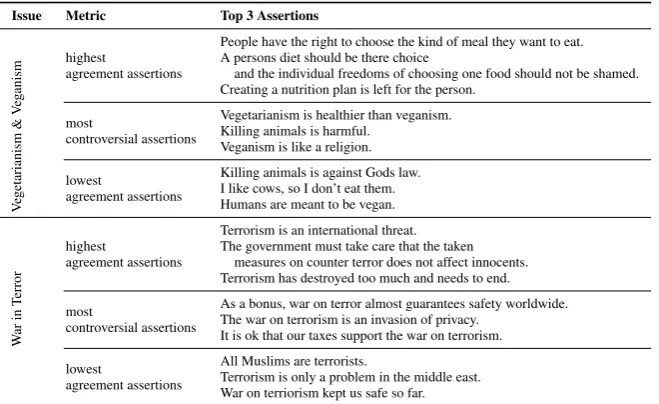
Table 2 summarizes the information provided by the partic-ipants in the demographic survey. Note that 85 (37%) of the total 230 participants submitted responses to the demo-graphic survey. For each of the sixteen issues explored in this study, Tables 3, 4 and 5 list assertions that most people agree with, assertions that most people disagree with, and assertions that are the most controversial. Below, we show an example questionnaire used for collecting assertions and an example questionnaire used for collecting judgments on the collected assertions:
QUESTIONNAIRE I: CREATING ASSERTIONS ON CON
-TROVERSIAL ISSUES
Provide at least five relevant assertions on the given controversial issue. The assertions must be expressions that one can agree or disagree with. They can be claims, beliefs, opinions, reasons, ar-guments, or any statement that can be used to inform or support one’s position on the issue. The assertions do not have to be reflec-tive of your own opinions. The assertions can be about a sub-issue or an aspect of the issue.
The assertions should:
• support a position that is relevant to the issue.
• cover a diverse set of positions on the issue. (Avoid claims that rephrase the same argument in slightly different ways.) • be formulated in a way that a third person can agree or
con-tradict the assertion.
• be self contained and understandable without additional con-text. (Do not use ’it’, ’she/her’ or ’he/him/his’ etc. to refer to an issue, a person or something else that is not directly mentioned in your assertion.)
• be precise. (Avoid vague formulations such as maybe, per-haps, presumably or possibly.)
The assertions should NOT:
• be a simple expression of agreeing/supporting or disagree-ing/rejecting the overall issue.
• contain multiple positions (e.g. migrants are friendly and hardworking).
• contain expressions of personal perspective (e.g. I don’t like immigrants).
• be the same as any of the provided examples; or simple nega-tions or other variants of a provided example.
Issue: Marijuana
Description: This issue is about legalization of cannabis. This includes the legalization for recre-ational or medical usage and other posi-tive or negaposi-tive consequences of legalizing cannabis.
Q1: True or False: This issue is about risks of consuming Cocaine.
( ) true
(X) false
Q2: Choose the assertion which meets the format requirements:
(X) The government should discourage any drug usage.
( ) Maybe, the government should discourage any drug usage.
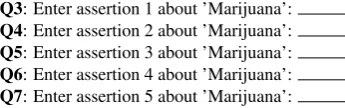
Q3: Enter assertion 1 about ’Marijuana’: Q4: Enter assertion 2 about ’Marijuana’: Q5: Enter assertion 3 about ’Marijuana’: Q6: Enter assertion 4 about ’Marijuana’: Q7: Enter assertion 5 about ’Marijuana’:
QUESTIONNAIREII:JUDGING ASSERTIONS ON CONTRO
-VERSIAL ISSUES
We want to better understand common controversial issues such as immigration and same-sex marriage. Therefore, we have col-lected a large amount of assertions relevant to these issues. Your task is to:
• Indicate whether you agree or disagree with these assertions. • Indicate how strongly you support or oppose these asser-tions. Since it is difficult to give a numerical score indicating the degree of support or degree of opposition, we will give you four assertions at a time, and ask you to indicate to us:
– Which of the assertions do you support the most (or oppose the least)?
– Which of the assertion do you oppose the most (or sup-port the least)?
– If you support two assertions equally strongly, then se-lect any one of them as the answer. The same applies for oppose.
Q1: Indicate whether you agree or disagree with the given asser-tions on the issue ’Black Lives Matter’.
• Every race has experienced racism.
( ) agree ( ) disagree
• There is racial discrimination in the U.S..
( ) agree ( ) disagree
• The Black lives matter movement is important.
( ) agree ( ) disagree
• Black Lives Matter encourages racial hate.
( ) agree ( ) disagree
Q2: Which of these assertions on the issue ’Black Lives Matter’ do you support the most (or oppose the least)?
( ) Every race has experienced racism. ( ) There is racial discrimination in the U.S.. ( ) The Black lives matter movement is important. ( ) Black Lives Matter encourages racial hate.
Q3: Which of these assertions on the issue ’Black Lives Matter’ do you oppose the most (or support the least)?
Variable Answers %
Education
Bachelor 39%
some college 15%
high school 12%
Master 12%
associate degree 11% vocational certification 9%
PhD 2%
Race
White 69%
Hispanic 10%
Black / African American 8%
Asian 8%
other 3%
American Indian 2%
Religion
Roman Catholic 28%
Atheist / Agnostic 25%
Protestant 19%
other 11%
Muslim 2%
Buddhist 2%
Jewish 1%
Russian Orthodox 1%
Af
filiation
Democrat 45%
independent 22%
none 16%
Republican 15%
other 1%
F
amily
Status
married 29%
single (living alone) 28% single (living with partner) 20% single (living with parents) 19%
other 4%
Profession
employee 49%
unemployed 14%
self-employed 13%
student 9%
other 6%
retired 6%
civil servant 2%
U.S.
Citizen
yes 89%
no 11%
T
ies
to
o
v
erseas
yes 73%
no 27%
Issue Metric Top 3 Assertions
Every human is equal.
Black people are as human as white people. We can all make a better world if we work together.
most
controversial assertions
People of color are more likely to be born into poverty. The Black Lives Matter movement encourages racial hate. Police racial profiling reduces minorities.
lowest
agreement assertions
Blacks are the scum of society.
The world would be safer without black people. Not all people are equal.
Climate
Change
highest
agreement assertions
Global warming can change our climate. Climate change has a big affect on the Earth.
Climate change will cause problems for future generations.
most
controversial assertions
Different changes in weather does not mean global warming. The climate change is caused by most developed country.
Rising levels of atmospheric CO2 do not necessarily cause global warming.
lowest
agreement assertions
Global warming is not real.
Global warming has nothing to do with the change in weather. Trump won the election due to his positions on the environment.
Creationism
in
school
highest
agreement assertions
Freedom of expression is vital to our liberties. Each person should be free to choose what to believe in. People in schools should not be made fun of for their religion.
most
controversial assertions
Religion has no place in a school.
Teaching creationism’s truth is necessary in upholding the truth of the Bible. Creationism should not be tought in a classroom because it goes against some beliefs.
lowest
agreement assertions
Atheists should be banned from schools.
Creationism should include just Christian beliefs versus evolution. Christian religion should be promoted in schools.
F
oreign
Aid
highest
agreement assertions
People have the right to know where there taxes are going and why. We should clearly know where our funding is going and why. Foreign aid should be corruption free
most
controversial assertions
Helping other countries will only increase those nations’ dependence on the U.S. Stop borrowing money and raise tax payers dollars.
Foreign aid lead to further difficulties for both countries.
lowest
agreement assertions
US spending should focus on defence rather than aid. Foreign aid should be focused on African countries. Foreign aids uplift corruption.
Gender
Equality
highest
agreement assertions
All people should be treated equally. Wages should not be based on gender. Women can be as successful as men.
most
controversial assertions
Instead of fighting for gender equality, we must fight for gender equity. A woman’s physical condition makes her unsuitable for certain jobs. Places don’t hire people based on gender.
lowest
agreement assertions
Women should not be in the army (direct combat forces). Gender equality is stupid.
The wage gap is a made up thing.
Gun
Rights
highest
agreement assertions
Gun owners need to be required to have a background check. Gun owners should register their arms.
Gun owners should be required to take a gun safety course.
most
controversial assertions
In a certain part to eliminate the arms would be to end the delinquency. Guns should only be issued for hunting.
People who own guns are not more likely to mass kill.
lowest
agreement assertions
Everyone should own a gun.
The gun industry is too heavily regulated. Guns should be legal for everyone.
Marijuana
highest
agreement assertions
Drug abuse can kill.
Exceptions should be considered allow people with medical issues that will benefit from legalization of Marijuana.
Marijuana is proven to have medical benefits.
most
controversial assertions
Legalization of marijuana will result to people not pushing hard drugs. Marijuana use will not increase just because it is legalized.
People who use marijuana are mentally stuck at the age they were when they began using the drug.
lowest
agreement assertions
Marijuana should be as readily available as cigarettes are.
Allowing the legal use of marijuana will prevent drug dealers from selling it. Cannabis is nontoxic
Issue Metric Top 3 Assertions
God loves all the people for equal.
One person’s believes should not affect another persons rights. Love is a right for everyone.
most
controversial assertions
Same sex marriage is unlike any other marriage.
Allowing same-sex marriage will create a ’slippery slope’ where people will begin to fight for other alternative marriages such as polygamy.
Marriage was God’s idea. He defined it as between a man and a woman only. End of conversation.
lowest
agreement assertions
Saying that gay people should get married is like saying that a brother can marry his sister both are at higher risk of disease. There is more domestic abuse in homosexual couples. Children of same-sex couples will turn out gay.
Mandatory
V
accination
highest
agreement assertions
The vaccines must be given by people who are very prepared to put them. Vaccines should be free.
Medical treatments like vaccines should be for all the people.
most
controversial assertions
Vaccines can cause serious and fatal side effects. Vaccinations are expensive and yet not 100% safe. The theory of herd immunity has never been proven.
lowest
agreement assertions
Vaccinations cause autism. Vaccines increase the risk of autism. Vaccines are not safe.
Media
Bias
highest
agreement assertions
The job of a reporter is to tell the truth. Every body has its owns preferences. The society deserves the truth.
most
controversial assertions
If you don’t watch the media , bias isn’t a problem. Journalists only cover stories that support their own opinion. Media is liberal biased because the liberals are right.
lowest
agreement assertions
Fox News is the only unbiased news source. Journalism focusses on Democrats views. Fake news is not a real problem.
Obama
Care
highest
agreement assertions
Every deserves a chance at life. Everyone needs insurance.
Health care should not punish people for pre-existing conditions.
most
controversial assertions
People may rely on free health care to substitute there own role in maintaining unhealthy lifestyle choices. Obama care should be removed.
An unregulated market ensures cheap medicine.
lowest
agreement assertions
Medical treatments should be only for people that can afford treatments. By giving people free health care it can lead to them being lazy. Free health care leads to people not taking care of their health.
US
Electoral
System
highest
agreement assertions
The people should elect there leader. The electoral system must be fair.
States should do what they can to avoid voter fraud.
most
controversial assertions
The electoral college protects minority interests.
Popular vote should never be used as a determining factor because it give total control of the country to large coastal states.
Our good electoral system puts US as a world example.
lowest
agreement assertions
Voting for an independent candidate only ensures that the Republican will win. Gerrymandering is a valid system.
The voting age should be changed to 16.
US
US Engagement in the middle east needs to be carefully addressed. US should protect America against terrorism.
Middle east countries should be allowed to determine their own future.
most
controversial assertions
Withholding funds to Palestinian National Authority prevents anti-Semitism. Usa’s engagement in middle east is not a public interest topic.
The US needs to show its support for Israel by moving its embassy to Jerusalem. It would make a big statement to the world.
lowest
agreement assertions
All Muslims should be regarded as terrorists.
It is our duty to spread Western ideals to the Middle East. The war in Iraq was worth the costs.
US
Immigration
highest
agreement assertions
Migrants have a positive impact on the economy.
A person in need should not be denied help and life regardless of where they are from. Legal immigration has brought some great scientists to the United States.
most
controversial assertions
Immigration takes opportunities away from those born in the USA.
Immigration should be elevated because it brings the best brains to the economity. Illegal immigrants take jobs away from Americans.
lowest
agreement assertions
Immigrants are more often criminals. Immigrants are bad for the US.
Immigrants are better workers than US workers.
Issue Metric Top 3 Assertions
V
egetarianism
&
V
eg
anism
highest
agreement assertions
People have the right to choose the kind of meal they want to eat. A persons diet should be there choice
and the individual freedoms of choosing one food should not be shamed. Creating a nutrition plan is left for the person.
most
controversial assertions
Vegetarianism is healthier than veganism. Killing animals is harmful.
Veganism is like a religion.
lowest
agreement assertions
Killing animals is against Gods law. I like cows, so I don’t eat them. Humans are meant to be vegan.
W
ar
in
T
error
highest
agreement assertions
Terrorism is an international threat. The government must take care that the taken
measures on counter terror does not affect innocents. Terrorism has destroyed too much and needs to end.
most
controversial assertions
As a bonus, war on terror almost guarantees safety worldwide. The war on terrorism is an invasion of privacy.
It is ok that our taxes support the war on terrorism.
lowest
agreement assertions
All Muslims are terrorists.
Terrorism is only a problem in the middle east. War on terriorism kept us safe so far.