Hindi Urdu Machine Transliteration using Finite-state Transducers
M G Abbas Malik
Christian Boitet
GTALP, Laboratoire d’Informatique Grenoble
Université Joseph Fourier, France
[email protected],
[email protected]
Pushpak Bhattacharyya
Dept. of Computer Science and Engineering,
IIT Bombay, India
[email protected]
Abstract
Finite-state Transducers (FST) can be very efficient to implement inter-dialectal transliteration. We illustrate this on the Hindi and Urdu language pair. FSTs can also be used for translation between sur-face-close languages. We introduce UIT (universal intermediate transcription) for the same pair on the basis of their com-mon phonetic repository in such a way that it can be extended to other languages like Arabic, Chinese, English, French, etc. We describe a transliteration model based on FST and UIT, and evaluate it on Hindi and Urdu corpora.
1
Introduction
Transliteration is mainly used to transcribe a word written in one language in the writing sys-tem of the other language, thereby keeping an approximate phonetic equivalence. It is useful for MT (to create possible equivalents of unknown words) (Knight and Stall, 1998; Paola and San-jeev, 2003), cross-lingual information retrieval (Pirkola et al, 2003), the development of multi-lingual resources (Yan et al, 2003) and multilin-gual text and speech processing. Inter-dialectal translation without lexical changes is quite useful and sometimes even necessary when the dialects in question use different scripts; it can be achieved by transliteration alone. That is the case of HUMT (Hindi-Urdu Machine Transliteration) where each word has to be transliterated from Hindi to Urdu and vice versa, irrespective of its
© 2008. Licensed under the Creative Commons Attri-bution-Noncommercial-Share Alike 3.0 Unported
license (http://creativecommons.org/licenses/by-nc-sa/3.0/). Some rights reserved.
type (noun, verb, etc. and not only proper noun or unknown word).
“One man’s Hindi is another man’s Urdu” (Rai, 2000). The major difference between Hindi and Urdu is that the former is written in Devana-gari script with a more Sanskritized vocabulary and the latter is written in Urdu script (derivation of Persio-Arabic script) with more vocabulary borrowed from Persian and Arabic. In contrast to the transcriptional difference, Hindi and Urdu share grammar, morphology, a huge vocabulary, history, classical literature, cultural heritage, etc. Hindi is the National language of India with 366 million native speakers. Urdu is the National and one of the state languages of Pakistan and India respectively with 60 million native speakers (Rahman, 2004). Table 1 gives an idea about the size of Hindi and Urdu.
Native Speakers 2
nd Language
Speakers Total
Hindi 366,000,000 487,000,000 853,000,000 Urdu 60,290,000 104,000,000 164,290,000 Total 426,290,000 591,000,000 1,017,000,000
Table 1: Hindi and Urdu speakers
Hindi and Urdu, being varieties of the same language, cover a huge proportion of world’s population. People from Hindi and Urdu com-munities can understand the verbal expressions of each other but not the written expressions. HUMT is an effort to bridge this scriptural divide between India and Pakistan.
Hindi and Urdu scripts are briefly introduced in section 2. Universal Intermediate Transcrip-tion (UIT) is described in secTranscrip-tion 3, and UIT mappings for Hindi and Urdu are given in sec-tion 4. Contextual HUMT rules are presented and discussed in section 5. An HUMT system im-plementation and its evaluation are provided in section 6 and 7. Section 8 is on future work and conclusion.
2
HUMT
There exist three languages at the border between India and Pakistan: Kashmiri, Punjabi and Sindhi. All of them are mainly written in two scripts, one being a derivation of the Persio-Arabic script and the other being Devanagari script. A person us-ing the Persio-Arabic script cannot understand the Devanagari script and vice versa. The same is true for Hindi and Urdu which are varieties or dialects of the same language, called Hindustani by Platts (1909).
PMT (Punjabi Machine Transliteration) (Ma-lik, 2006) was a first effort to bridge this scrip-tural divide between the two scripts of Punjabi namely Shahmukhi (a derivation of Perio-Arabic script) and Gurmukhi (a derivation of Landa, Shardha and Takri, old Indian scripts). HUMT is a logical extension of PMT. Our HUMT system is generic and flexible such that it will be extend-able to handle similar cases like Kashmiri, Pun-jabi, Sindhi, etc. HUMT is also a special type of machine transliteration like PMT.
A brief account of Hindi and Urdu is first giv-en for unacquainted readers.
2.1 Hindi
The Devanagari (literally “godly urban”) script, a simplified version of the alphabet used for San-skrit, is a left-to-right script. Each consonant symbol inherits by default the vowel sound [ə]. Two or more consonants may be combined to-gether to form a cluster called Conjunct that marks the absence of the inherited vowel [ə] be-tween two consonants (Kellogg, 1872; Montaut, 2004). A sentence illustrating Devanagari is giv-en below:
िहन्दी िहन्दुःतान की क़ौमी ज़ुबान है.
[hɪnḓi hɪnḓustɑn ki qɔmi zubɑn hæ] (Hindi is the national language of India)
2.2 Urdu
Urdu is written in an alphabet derived from the Persio-Arabic alphabet. It is a right-to-left script and the shape assumed by a character in a word is context-sensitive, i.e. the shape of a character is different depending on whether its position is at the beginning, in the middle or at the end of a word (Zia, 1999). A sentence illustrating Urdu is given below:
ÌÐ y636G¾6[6 zEegEZ F¯
Xì y6[6Ei Ìòâ
[ʊrḓu pɑkɪstɑn ki qɔmi zubɑn hæ] (Urdu is the National Language of Pakistan.)
3
Universal Intermediate Transcription
UIT (Universal Intermediate Transcription) is a scheme to transcribe texts in Hindi, Urdu, Punja-bi, etc. in an unambiguous way encoded in AS-CII range 32 – 126, since a text in this range is portable across computers and operating systems (James 1993; Wells, 1995). SAMPA (Speech Assessment Methods Phonetic Alphabet) is a widely accepted scheme for encoding the IPA (International Phonetic Alphabet) into ASCII. It was first developed for Danish, Dutch, French, German and Italian, and since then it has been extended to many languages like Arabic, Czech, English, Greek, Hebrew, Portuguese, Russian, Spanish, Swedish, Thai, Turkish, etc.
We define UIT as a logical extension of SAMPA. The UIT encoding for Hindi and Urdu is developed on the basis of rules and principles of SAMPA and X-SAMPA (Wells, 1995), that cover all symbols on the IPA chart. Phonemes are the most appropriate invariants to mediate between the scripts of Hindi, Punjabi, Urdu, etc., so that the encoding choice is logical and suitable.
4
Analysis of Scripts and UIT Mappings
For the analysis and comparison, scripts of Hindi and Urdu are divided into different groups on the basis of character types.
4.1 Consonants
These are grouped into two categories:
Aspirated Consonants: Hindi and Urdu both have 15 aspirated consonants. In Hindi, 11 aspi-rated consonants are represented by separate cha-racters e.g. ख [kʰ], भ [bʰ], etc. The remaining 4 consonants are represented by combining a sim-ple consonant to be aspirated and the conjunct form of HA ह[h], e.g.ल [l] + ◌् + ह [h] = ल्ह [lʰ].
In Urdu, all aspirated consonants are represented by a combination of a simple conso-nant to be aspirated and Heh Doachashmee (ه) [h], e.g.ﮎ [k] + ه [h] = ﻬﮐ [kʰ], ب [b] + ه [h] = ﻬﺑ [bʰ], ل [l] + ه [h] = ﻬﻟ [lʰ], etc.
The UIT mapping for aspirated consonants is given in Table 2.
Hindi Urdu UIT Hindi Urdu UIT
भ ﻬﺑ [bʰ] b_h हर् هر [rʰ] r_h
फ ﻬﭘ [pʰ] p_h ढ़ هڑ [ɽʰ] r`_h
थ ﻬﺗ [ṱʰ] t_d_h ख ﻬﮐ [kʰ] k_h
ठ ﻬﭨ [ʈʰ] t`_h घ ﻬﮔ [gʰ] g_h
छ ﻬﭼ [ʧʰ] t_S_h म्ह ﻬﻣ [mʰ] m_h
ध هد [ḓʰ] d_d_h न्ह ﻬﻧ [nʰ] n_h
[image:3.595.76.288.277.593.2]ढ هڈ [ɖʰ] d`_h
Table 2: Hindi Urdu aspirated consonants
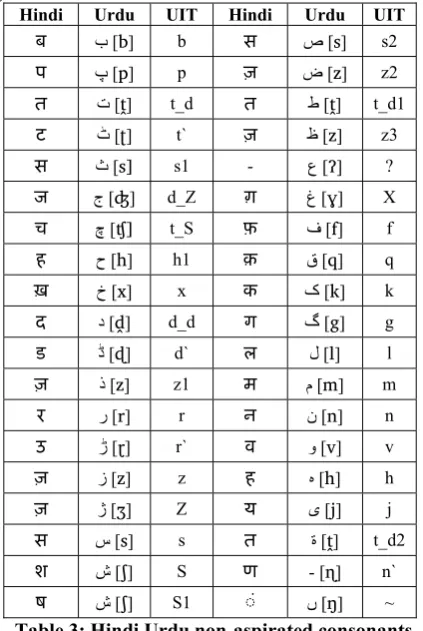
Non-aspirated Consonants: Hindi has 29
non-aspirated consonant symbols representing 28 consonant sounds as both SHA (श) and SSA (ष) represent the same sound [ʃ]. Similarly Urdu has 35 consonant symbols representing 27 sounds as multiple characters are used to represent the same sound e.g. Heh (ح) and Heh-Goal (ﮦ) represent the sound [h] and Theh (ث), Seen (س) and Sad (ص) represent the sound [s], etc.
UIT mapping for non-aspirated consonants is given in Table 3.
Hindi Urdu UIT Hindi Urdu UIT ब ب [b] b स ص [s] s2
प پ [p] p ज़ ض [z] z2
त ت [ṱ] t_d त ط [ṱ] t_d1
ट ٹ [ʈ] t` ज़ ظ [z] z3
स ث [s] s1 - ع [ʔ] ?
ज ج [ʤ] d_Z ग़ غ [ɣ] X
च چ [ʧ] t_S फ़ ف [f] f
ह ح [h] h1 क़ ق [q] q
ख़ خ [x] x क ﮎ [k] k
द د [ḓ] d_d ग گ [g] g
ड ڈ [ɖ] d` ल ل [l] l
ज़ ذ [z] z1 म م [m] m
र ر [r] r न ن [n] n
उ ڑ [ɽ] r` व و [v] v
ज़ ز [z] z ह ﮦ [h] h
ज़ ژ [ʒ] Z य ﯼ [j] j
स س [s] s त ة [ṱ] t_d2
श ش [ʃ] S ण - [ɳ] n`
[image:3.595.306.523.479.608.2]ष ش [ʃ] S1 ◌ं ں [ŋ] ~
Table 3: Hindi Urdu non-aspirated consonants
4.2 Vowels
Hindi has 11 vowels and 10 of them have nasa-lized forms. They are represented by 11 indepen-dent vowel symbols e.g. आ [ɑ], ऊ [u], औ [ɔ],
etc. and 10 dependent vowel symbols e.g. ◌ा [ɑ], ◌ू [u], ◌ौ [ɔ], etc. called maatraas. When a vowel comes at the start of a word or a syllable, the independent form is used; otherwise the de-pendent form is used (Kellogg, 1872; Montaut, 2004).
Urdu contains 10 vowels and 7 of them have nasalized forms (Hussain, 2004; Khan, 1997). Urdu vowels are represented using four long vo-wels (Alef Madda (ﺁ), Alef (ا), Vav (و) and Choti Yeh (ﯼ)) and three short vowels (Arabic Fatha – Zabar َ-, Arabic Damma – Pesh ُ- and Arabic Ka-sra – Zer ِ-). Vowel representation is context-sensitive in Urdu. Vav (و) and Choti Yeh (ﯼ) are also used as consonants.
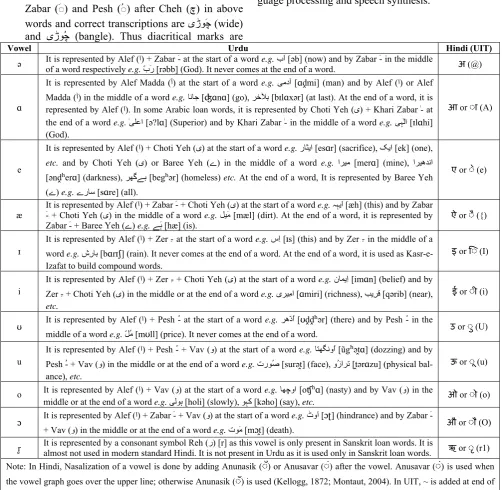
Hamza (ء) is a place holder between two suc-cessive vowel sounds, e.g. in ﯽﺋﺎﻤﮐ [kəmɑi] (earning), Hamza (ء) separates the two vowel sounds Alef (ا) [ɑ] and Choti Yeh (ﯼ) [i]. Noon-ghunna (ں) is used as nasalization marker. Anal-ysis and mapping of Hindi Urdu vowels is given in Table 5.
4.3 Diacritical Marks
Urdu contains 15 diacritical marks. They represent vowel sounds, except Hamza-e-Izafat ٔ- and Kasr-e-Izafat ِ- that are used to build com-pound words, e.g.ﺲﻨﺋﺎﺳ ٔﮦرادِا [ɪḓɑrəhɪsɑɪns] (In-stitute of Science), ﺶﺋاﺪﻴﭘ ِﺦﻳِرﺎﺗ [tɑrixɪpedɑɪʃ] (date of birth), etc. Shadda ّ- is used to geminate a consonant e.g. ّبر [rəbb] (God), ﺎﻬّﭼا [əʧʧʰɑ] (good), etc. Jazm -ْ is used to mark the absence of a vowel after the base consonant (Platts, 1909). In Hindi, the conjunct form is used to geminate a consonant. Urdu diacritical marks mapping is given in Table 4.
Hindi Urdu UIT Hindi Urdu UIT
- F◌ [ə] @ ◌ा G◌ [ɑ] A
ि◌ G◌ [ɪ] I न F◌ [ən] @n
◌ु E◌ [ʊ] U ◌ुन E◌ [ʊn] Un
◌ू E◌ [u] u ि◌न F◌ [ɪn] In
◌ी G◌ [i] i
Table 4: Diacritical Marks of Urdu
Diacritical marks are present in Urdu but spa-ringly used by people. They are very important for the correct pronunciation and understanding the meanings of a word. For example,
ﺖﮩﺑﮎﮍﺳہﻳ
ﯼڑﻮﭼ
۔ﮯﮨ
[je səɽək bʊhəṱʧɔɽi hæ] (This is a wide road.)
ﯼﺮﻴﻣ
ﯼڑﻮﭼ
۔ﮯﮨخﺮﺳ
pronounced as [ʧuɽi] (bangle). There should be Zabar (َ◌) and Pesh (ُ◌) after Cheh (چ) in above words and correct transcriptions are ﯼڑﻮَﭼ (wide) and ﯼڑﻮُﭼ (bangle). Thus diacritical marks are
essential for removing ambiguities, natural lan-guage processing and speech synthesis.
Vowel Urdu Hindi (UIT)
ə It is represented by Alef (of a word respectively ا) + Zabar َ- at the start of a word e.g.بَا [əb] (now) and by Zabar َ- in the middle
e.g.ّبَر [rəbb] (God). It never comes at the end of a word. अ (@)
ɑ
It is represented by Alef Madda (ﺁ) at the start of a word e.g.ﯽﻣدﺁ [ɑḓmi] (man) and by Alef (ا) or Alef Madda (ﺁ) in the middle of a word e.g.ﺎﻧﺎﺟ [ʤɑnɑ] (go), ﺮﺧﻶِﺑ [bɪlɑxər] (at last). At the end of a word, it is represented by Alef (ا). In some Arabic loan words, it is represented by Choti Yeh (ﯼ) + Khari Zabar ٰ- at the end of a word e.g.ٰﯽﻠﻋا [ə?lɑ] (Superior) and by Khari Zabar ٰ- in the middle of a word e.g.ﯽﮩٰﻟا [ɪlɑhi] (God).
आ or ◌ा (A)
e
It is represented by Alef (ا) + Choti Yeh (ﯼ) at the start of a word e.g.رﺎﺜﻳا [esɑr] (sacrifice), ﮏﻳا [ek] (one),
etc. and by Choti Yeh (ﯼ) or Baree Yeh (ے) in the middle of a word e.g. اﺮﻴﻣ [merɑ] (mine), اﺮﻴهﺪﻧا [ənḓʰerɑ] (darkness), ﺮﻬﮔﮯﺑ [begʰər] (homeless) etc. At the end of a word, It is represented by Baree Yeh (ے) e.g.ےرﺎﺳ [sɑre] (all).
ए or ◌े (e)
æ
It is represented by Alef (ا) + Zabar َ- + Choti Yeh (ﯼ) at the start of a word e.g.ہﮩﻳَا [æh] (this) and by Zabar َ
- + Choti Yeh (ﯼ) in the middle of a word e.g.ﻞﻴَﻣ [mæl] (dirt). At the end of a word, it is represented by Zabar َ- + Baree Yeh (ے) e.g.ﮯَﮨ [hæ] (is). ऐ
or ◌ै ({)
ɪ
It is represented by Alef (ا) + Zer ِ- at the start of a word e.g.سِا [ɪs] (this) and by Zer ِ- in the middle of a word e.g.شِرﺎﺑ [bɑrɪʃ] (rain). It never comes at the end of a word. At the end of a word, it is used as Kasr-e-Izafat to build compound words.
इ or ि◌ (I)
i
It is represented by Alef (ا) + Zer ِ- + Choti Yeh (ﯼ) at the start of a word e.g.نﺎﻤﻳِا [imɑn] (belief) and by Zer ِ- + Choti Yeh (ﯼ) in the middle or at the end of a word e.g.ﯼﺮﻴِﻣا [ɑmiri] (richness), ﺐﻳِﺮﻗ [qərib] (near), etc.
ई or ◌ी (i)
ʊ It is represented by Alef (middle of a word ا) + Pesh ُ- at the start of a word e.g.ﺮهّدُا [ʊḓḓʰər] (there) and by Pesh ُ- in the
e.g.ّﻞُﻣ [mʊll] (price). It never comes at the end of a word. उ or ◌ु (U)
u
It is represented by Alef (ا) + Pesh ُ- + Vav (و) at the start of a word e.g.ﺎﺘﻬﮕﻧوُا [ũgʰəṱɑ] (dozzing) and by Pesh ُ- + Vav (و) in the middle or at the end of a word e.g.ترﻮُﺻ [surəṱ] (face), وُزاﺮﺗ [ṱərɑzu] (physical bal-ance), etc.
ऊ or ◌ू (u)
o It is represented by Alef (ا) + Vav (و) at the start of a word e.g.ﺎﻬﭼوا [oʧʰɑ] (nasty) and by Vav (و) in the
middle or at the end of a word e.g.ﯽﻟﻮﮨ [holi] (slowly), ﻮﮩﮐ [kəho] (say), etc. ओ or ◌ो (o)
ɔ It is represented by Alef (+ Vav (و) in the middle or at the end of a word ا) + Zabar - + Vav (َ و) at the start of a word e.g.ٹوَا [ɔʈ] (hindrance) and by Zabar َ-
e.g.تﻮَﻣ [mɔṱ] (death). औ or ◌ौ (O)
r̥ It is represented by a consonant symbol Reh (almost not used in modern standard Hindi. It is not present in Urdu as it is used only in Sanskrit loan words. ر) [r] as this vowel is only present in Sanskrit loan words. It is ऋ or ◌ृ (r1)
[image:4.595.47.550.91.581.2]Note: In Hindi, Nasalization of a vowel is done by adding Anunasik (◌ँ) or Anusavar (◌ं) after the vowel. Anusavar (◌ं) is used when the vowel graph goes over the upper line; otherwise Anunasik (◌ँ) is used (Kellogg, 1872; Montaut, 2004). In UIT, ~ is added at end of UIT encoding for nasalization of all above vowels except the last one that do not have a nasalized form.
Table 5: Analysis and Mapping of Hindi Urdu Vowels
5
HUMT Rules
In this section, UIT mappings of Hindi Urdu al-phabets and contextual rules that are necessary for Hindi-Urdu transliteration are discussed.
5.1 UIT Mappings
UIT mappings for Hindi and Urdu alphabets and their vowels are given in Table 2 – 5. In Hindi, SHA (श) and SSA (ष) both represent the sound [ʃ] and have one equivalent symbol in Urdu, i.e.
Sheen (ش). To make distinction between SHA (श) and SSA (ष) in UIT, they are mapped on S and S1 respectively. Similarly in Urdu, Seh (ث), Seen (س) and Sad (ص) represent the sound [s] and have one equivalent symbol in Hindi, i.e. SA (स). To make distinction among them in UIT, they are mapped on s1, s and s2 respectively. All similar cases are shown in Table 6.
IPA Urdu (UIT) Hindi (UIT)
z ذ (z1), ز (z), ژ (Z), ض (z2), ظ (z3) ज़ (z)
ʃ ش (S) श (S), ष (S1)
[image:5.595.73.297.73.121.2]r ر (r) र (r), ऋ (r1)
Table 6: Multiple Characters for one IPA
Multi-equivalences are problematic for Hindi-Urdu transliteration.
UIT is extendable to other languages like Eng-lish, French, Kashmiri, Punjabi, Sindhi, etc. For example, Punjabi has one extra character than
Urdu i.e. Rnoon [ɳ] (ڻ), it is mapped on ‘n`’ in UIT. Similarly, UIT, a phonetic encoding scheme, can be extended to other languages.
All these mappings can be implemented by simple finite-state transducers using XEROX’s XFST (Beesley and Karttunen, 2003) language. A sample XFST code is given in Figure 1.
read regex [ب -> b, پ -> p, ج -> [d “_” Z] ]; read regex [[جه] -> [d “_” Z “_” h]]; read regex [و -> v, ﯼ -> j || .#. _ ]; read regex [و -> v, ﯼ -> j || _ [ﺁ | ا]]; read regex [ﯼ -> e || CONSONANTS _ ]; read regex [ ﯼ -> i || _ [ْ | .#.]];
…
read regex [ब -> b, प -> p, ज़ -> z, झ -> [d “_” Z“_” h]]; read regex [अ -> “@”, आ -> A, ई -> i || .#. _ ]
[image:5.595.77.291.292.411.2]…
Figure 1: Sample XFST code
Finite-state transducers are robust and time and space efficient (Mohri, 1997). They are a logical choice for Hindi-Urdu transliteration via UIT as this problem could also be seen as string matching and producing an analysis string as an output like finite-state morphological analysis.
5.2 Contextual HUMT Rules
UIT mappings need to be accompanied by neces-sary contextual HUMT rules for correct Hindi to Urdu transliteration and vice versa.
For example, Vav (و) and Choti Yeh (ﯼ) are used to represent vowels like [o], [ɔ], [i], [e], etc. but they are also used as consonants. Vav (و) and Choti Yeh (ﯼ) are consonants when they come at the beginning of a word or when they are fol-lowed by Alef mada (ﺁ) or Alef (ا). Also, Choti Yeh (ﯼ) represents the vowel [e] when it is pre-ceded by a consonant but when it comes at the end of a word and is preceded by a consonant then it represents the vowel [i]. These rules are shown in red colour in Figure 1.
Thus HUMT contextual rules are necessary for Hindi-Urdu transliteration and they can also be implemented as finite-state transducer using XFST. All these rules can’t be given here due to shortage of space.
6
HUMT System
The HUMT system exploits the simplicity, ro-bustness, power and time and space efficiency of finite-state transducers. Exactly the same trans-ducer that encodes a Hindi or Urdu text into UIT can be used in the reverse direction to generate Hindi or Urdu text from the UIT encoded text. This two-way power of the finite-state transducer (Mohri, 1997) has significantly reduced the amount of efforts to build the HUMT system. Another very important and powerful strength of finite-state transducers, they can be composed together to build a single transducer that can per-form the same task that could be done with help of two or more transducers when applied sequen-tially (Mohri, 1997), not only allows us to build a direct Hindi ↔ Urdu transducer, but also helps to divide difficult and complex problems into sim-ple ones, and has indeed simplified the process of building the HUMT system. A direct Hindi ↔
Urdu transducer can be used in applications where UIT encoding is not necessary like Hindi-Urdu MT system.
The HUMT system can be extended to per-form transliteration between two or more differ-ent scripts used for the same languages like Kashmiri, Kazakh, Malay, Punjabi, Sindhi, etc. or between language pairs like English–Hindi, English–Urdu, English–French, etc. by just in-troducing the respective transducers in the
Fi-nite-state Transducer Manager of
the HUMT system to build a multilingual ma-chine transliteration system.
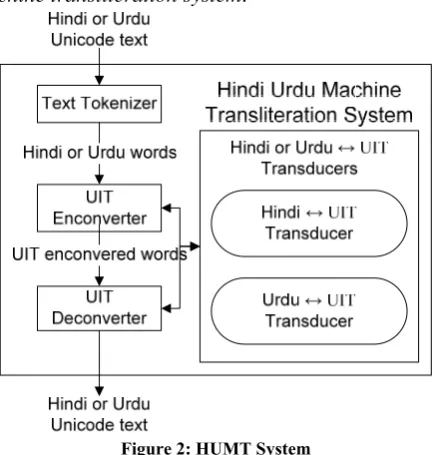
Figure 2: HUMT System
In the HUMT system, Text Tokenizer
[image:5.595.306.524.497.725.2]them to UIT Enconverter. The enconverter
enconverts Hindi or Urdu words into UIT words using the appropriate transducer from
Finite-state Transducers Manager, e.g. for
Hindi words, it uses the Hindi ↔ UIT transducer. It passes these UIT encoded words to UIT De-converter, which deconverts them into Hindi
or Urdu words using the appropriate transducer from Finite-state Transducers Man-ager in reverse and generates the target Hindi
or Urdu text.
6.1 Enconversion of Hindi-Urdu to UIT
Hindi ↔ UIT transducer is a composition of the mapping rules transducers and the contextual rules transducers. This is clearly shown in figure 3 with a sample XFST code.
clear stack
set char-encoding UTF-8
define CONSONANTS [क | ख | ग | घ | ङ | छ | ज]; read regex [◌् -> J, ◌ः -> h, ◌़ -> 0];
read regex [क -> k, ख -> [k “_” h], ग -> g, घ -> [g “_” h], ङ -> [n “@” g], च -> [t “_” S], छ -> [t “_” S “_” h]]; read regex [[क ◌् क] -> [k kّ], [क ◌् ख] -> [k k “_” h], [ग ◌् ग] -> [g gّ], [ग ◌् घ] -> [g g “_” h]];
…
read regex [[क ि◌] -> [k h], [न] -> [n A], [य ◌े] -> [j h], [व ◌े] -> [v h] || .#. _ .#.];
compose net
Figure 3: Sample code for Hindi ↔ UIT Transducer
How the HUMT system works is shown with the help of an example. Take the Hindi sentence:
फ़ाख़ता मुहबत और अमन का िनशान है [fɑxəṱɑ mʊhəbəṱɔr əmən kɑ nɪʃɑn hæ]
(Dove is symbol of love and peace) This sentence is received by the Text To-kenizer and is tokenized into Hindi words,
which are enconverted into UIT words using the mapping and the contextual rules of Hindi ↔
UIT transducer by the UIT Enconverter.
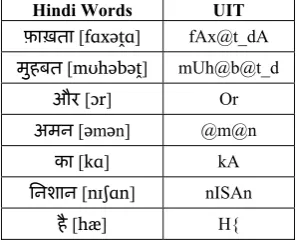
The Hindi Words and the UIT enconversions are given in Table 7.
Hindi Words UIT फ़ाख़ता [fɑxəṱɑ] fAx@t_dA
मुहबत [mʊhəbəṱ] mUh@b@t_d
और [ɔr] Or
अमन [əmən] @m@n
का [kɑ] kA
िनशान [nɪʃɑn] nISAn
[image:6.595.304.523.206.344.2]है [hæ] H{
Table 7: Hindi Words with UIT
6.2 Deconversion of UIT to Hindi-Urdu
For the deconversion, Hindi ↔ UIT or Urdu ↔
UIT transducer is applied in reverse on the UIT enconverted words to generate Hindi or Urdu words. To continue with the example in the pre-vious section, the UIT words are deconverted into the Urdu words by the UIT Deconver-ter using Urdu ↔ UIT transducer in reverse.
The Urdu words are given in table 8 with the Hindi and the UIT words.
Hindi UIT Urdu
फ़ाख़ता [fɑxəṱɑ] fAx@t_dA ﺎﺘﺧﺎﻓ
मुहबत [mʊhəbəṱ] mUh@b@t_d ﺖﺒﺤُﻣ
और [ɔr] Or روَا
अमन [əmən] @m@n ﻦﻣا
का [kɑ] kA ﺎﮐ
िनशान [nɪʃɑn] nISAn نﺎﺸِﻧ
है [hæ] H{ ﮯَﮨ
Table 8: Hindi, UIT and Urdu Words
Finally, the following Urdu sentence is gener-ated from Urdu words.
ﮯَﮨنﺎﺸِﻧﺎﮐﻦﻣاروَاﺖﺒﺤُﻣﺎﺘﺧﺎﻓ
Here the word फ़ाख़ता [fɑxəṱɑ] (Dove) is transliterated wrongly into ‘ﺎﺘﺧﺎﻓ’ because the vowel [ɑ] at the end of some Urdu words (bor-rowed from Persian language) is transcribed with help of Heh-gol [h] (ﮦ). This phenomenon is a problem for Hindi to Urdu transliteration but not for Urdu to Hindi transliteration.
7
Evaluation Experiments and Results
For evaluation purpose, we used a Hindi corpus, containing 374,150 words, and an Urdu corpus with 38,099 words. The Hindi corpus is extracted from the Hindi WordNet2 developed by the Re-source Center for Indian Language Technology Solutions, CSE Department, Indian Institute of Technology (IIT) Bombay, India and from the project CIFLI (GETALP-LIG3, University Jo-seph Fourier), a project for building resources and tools for network-based “linguistic survival” communication between French, English and Indian languages like Hindi, Tamil, etc. The Ur-du corpus was developed manually from a book titled “ﮦﺪﮐﺖﻤﻠُﻇ” [zʊlməṱ kədɑ]. The Hindi-Urdu corpus contains in total 412,249 words.
The HUMT system is an initial step to build Urdu resources and add Urdu to the languages of
2 http://www.cfilt.iitb.ac.in [image:6.595.107.256.635.755.2]
SurviTra-CIFLI (Survival Translation) (Boitet et al, 2007), a multilingual digital phrase-book to help tourists for communication and enquiries like restaurant, hotel reservation, flight enquiry, etc.
To reduce evaluation and testing efforts, unique words are extracted from the Hindi-Urdu corpus and are transliterated using the HUMT system. These unique words and their translitera-tions are checked for accuracy with the help of dictionaries (Platts, 1911; Feroz).
7.1 Urdu → Hindi Transliteration Results
While transliterating Urdu into Hindi, multiple problems occur like multi-equivalences, no equi-valence, missing diacritical marks in Urdu text. For example, Sheen [ʃ] (ش) can be transliterated in Hindi into SHA [ʃ] (श) or SSA [ʃ] (ष) that are present in 7,917 and 6,399 corpus words respec-tively. Sheen [ʃ] (ش) is transliterated into SHA [ʃ] (श) by default. Thus, 6,399 words containing SSA [ʃ] (ष) are wrongly transliterated into Hindi using HUMT. Urdu to Hindi multi-equivalences cases are given in Table 9 with their frequencies.
Urdu Hindi (corpus Frequency)
ش [ʃ] श (7917), ष (6399) ر [r] र (79,345), ऋ (199)
Table 9: Urdu → Hindi Multi-equivalences
Some Hindi characters do not have equivalent characters in Urdu, e.g. NNA [ɳ] (ण), retroflexed version of [n], has approximately mapped onto Noon [n] (ن). This creates a problem when a word actually containing NNA [ɳ] (ण) is transli-terated from Urdu to Hindi. No-equivalence cas-es are given in Table 10.
Urdu Hindi (corpus Frequency)
- ण (4744) - ङ (0) - ञ (532)
Table 10: Urdu → Hindi No-equivalences
Missing diacritical marks is the major problem when transliterating Urdu into Hindi. The impor-tance of diacritical marks has already been ex-plained in section 4.3. This work assumed that all necessary diacritical marks are present in Urdu text because they play a vital role in Urdu to Hindi transliterations. Results of Urdu to Hindi transliteration are given in Table 11.
Error Words Accuracy
Corpus 11,874 97.12%
Unique Words 123 98.54%
Table 11: Urdu → Hindi Transliteration Results
7.2 Hindi → Urdu Transliteration Results
Hindi → Urdu transliteration also have multi-equivalences and no-equivalence problems that are given in Table 12.
Hindi Urdu (corpus Frequency) त ت (41,751), ط (1312)
स س (53,289), ص (751), ث (86)
ह ﮦ (72,850), ح (1800)
ज़ ز (2551), ض (1489), ذ (228), ظ (215), ژ (2) - ع (2857)
Table 12: Hindi → Urdu Multi & No equivalences
Results of Hindi to Urdu transliteration are given in Table 13.
Error Words Accuracy
Corpus 8,740 97.88%
Unique Words 1400 83.41%
Table 13: Hindi → Urdu Transliteration Results
Interestingly, Hindi to Urdu conversion is 14.47% less accurate on the unique words as compared to its result on the corpus data that is a contrasting fact for the reverse conversion.
The HUMT system gives 97.12% accuracy for Urdu to Hindi and 97.88% accuracy for Hindi to Urdu. Thus, the HUMT system works with 97.50% accuracy.
8
Future Implications
Hindi-Urdu transliteration is one of the cases where one language is written in two or more mutually incomprehensible scripts like Kazakh, Kashmiri, Malay, Punjabi, Sindhi, etc. The HUMT system can be enhanced by extending UIT and introducing the respective finite-state transducers. It can similarly be enhanced to transliterate between language pairs, e.g. Eng-lish-Arabic, English-Hindi, English-Urdu, French-Hindi, etc. Thus, it can be enhanced to build a multilingual machine transliteration sys-tem that can be used for cross-scriptural transli-teration and MT.
We are intended to resolve the problems of multi-equivalences, no-equivalences and the most importantly the restoration of diacritical marks in Urdu text that are observed but left un-attended in the current work. Restoration of dia-critical marks in Urdu, Sindhi, Punjabi, Kashmi-ri, etc. texts is essential for word sense disambig-uation, natural language processing and speech synthesis of the said languages.
Hindi-Marathi, Hindi-Urdu, etc. Translation of the surface-close languages or inter-dialectal translation can be performed by using mainly transliteration and some lexical translations. Thus HUMT will also provide basis for Cross-Scriptural Transliteration, Cross-scriptural In-formation Retrieval, Cross-scriptural Applica-tion Development, inter-dialectal translation and translation of surface-close languages.
9
Conclusion
Finite-state transducers are very efficient, robust, and simple to use. Their simplicity and powerful features are exploited in the HUMT model to perform Hindi-Urdu transliteration using UIT that is a generic and flexible encoding scheme to uniquely encode natural languages into ASCII. The HUMT system gives 97.50% accuracy when it is applied on the Hindi-Urdu corpora contain-ing 412,249 words in total. It is an endeavor to bridge the scriptural, ethnical, cultural and geo-graphical division between 1,017 millions people around the globe.
Acknowledgement
This study is partially supported by the project CIFLI funded under ARCUS-INDIA program by Ministry of Foreign Affairs and Rhône-Alpes region.
References
Beesley, Kenneth R. and Karttunen, Lauri. 2003. Fi-nite State Morphology. CSLI Publications, USA.
Boitet, Christian. Bhattacharayya, Pushpak. Blanc, Etienne. Meena, Sanjay. Boudhh, Sangharsh. Fafiotte, Georges. Falaise, Achille. Vacchani, Vishal. 2007.
Building Hindi-French-English-UNL Resources for SurviTra-CIFLI, a linguistic survival system under construction. Proceedings of the Seventh Symposium
on NLP, 13 – 15 December, Chonburi, Thailand. Feroz ul Din. ودرُا تﺎﻐُﻠﻟاُزوﺮﻴﻓ Feroz Sons Publishers, Lahore, Pakistan.
Hussain, Sarmad. 2004. Letter to Sound Rules for Urdu Text to Speech System. Proceedings of
Work-shop on Computational Approaches to Arabic Script-based Languages, COLING 2004, Geneva, Switzer-land.
James, L. Hieronymus. 1993. ASCII Phonetic Symbols for the World’s Languages: Worldbet. AT&T Bell
Laboratories, Murray Hill, NJ 07974, USA.
Kellogg, Rev. S. H. 1872. A Grammar of Hindi Lan-guage. Delhi, Oriental Book Reprints.
Khan, Mehboob Alam. 1997. مﺎﻈﻧﯽﺗﻮﺻﺎﮐودرُا (Sound System in Urdu) National Language Authority, Pakis-tan.
Knight, K. and Graehl, J. 1998. Machine Translitera-tion. Computational Linguistics, 24(4).
Knight, K. and Stall, B G. 1998. Translating Names and Technical Terms in Arabic Tex. Proceedings of
the COLING/ACL Workshop on Computational Ap-proaches to Semitic Languages.
Malik, M. G. Abbas. 2006. Punjabi Machine Transli-teration. Proceedings of the 21st International
Confe-rence on Computational Linguistics and 44th Annual Meeting of the ACL, July 2006, Sydney.
Mohri, Mehryar. 1997. Finite-state Transducers in Language and Speech Processing. Computational
Linguistics, 23(2).
Montaut A. 2004. A Linguistic Grammar of Hindi.
Studies in Indo-European Linguistics Series, Mün-chen, Lincom Europa.
Paola, V. and Sanjeev, K. 2003. Transliteration of proper names in cross-language applications.
Pro-ceedings of the 26th annual International ACM SIGIR conference on research and development in informa-tion retrieval.
Pirkola, A. Toivonen, J. Keskustalo, H. Visala, K. and Järvelin, K. 2003. Fuzzy translation of cross-lingual spelling variants. Proceedings of the 26th Annual
international ACM SIGIR Conference on Research and Development in informaion Retrieval, Toronto, Canada.
Platts, John T. 1909. A Grammar of the Hindustani or Urdu Language. Crosby Lockwood and Son, 7
Sta-tioners Hall Court, Ludgate hill, London. E.C.
Platts, John T. 1911. A Dictionary of Urdu, Classical Hindi and English. Crosby Lockwood and Son, 7
Sta-tioners Hall Court, Ludgate hill, London, E.C. Rahman, Tariq. 2004. Language Policy and Localiza-tion in Pakistan: Proposal for a Paradigmatic Shift.
Crossing the Digital Divide, SCALLA Conference on Computational Linguistics.
Rai, Alok. 2000. Hindi Nationalism. Orient Longman
Private Limited, New Delhi.
Wells, J C. 1995. Computer-coding the IPA: A Pro-posed Extension of SAMPA. University College
Lon-don. http://www.phon.ucl.ac.uk/home/sampa/ipasam-x.pdf.
Yan Qu, Gregory Grefenstette, David A. Evans. 2003.
Automatic transliteration for Japanese-to-English text retrieval. Proceedings of the 26th annual interntional
ACM SIGIR conference on Research and develop-ment in information retrieval.
Zia, Khaver. 1999a. Standard Code Table for Urdu.