Proceedings of the 22nd International Conference on Computational Linguistics (Coling 2008),pages 401–408
Using Hidden Markov Random Fields to Combine Distributional and
Pattern-based Word Clustering
Nobuhiro Kaji and Masaru Kitsuregawa Institute of Industrial Science, University of Tokyo 4-6-1 Komaba, Meguro-ku, Tokyo 153-8505 Japan
{kaji,kitsure}@tkl.iis.u-tokyo.ac.jp
Abstract
Word clustering is a conventional and im-portant NLP task, and the literature has suggested two kinds of approaches to this problem. One is based on the distribu-tional similarity and the other relies on the co-occurrence of two words in lexico-syntactic patterns. Although the two meth-ods have been discussed separately, it is promising to combine them since they are complementary with each other. This pa-per proposes to integrate them using hid-den Markov random fields and demon-strates its effectiveness through experi-ments.
1 Introduction
Word clustering is a technique of grouping similar words together, and it is important for various NLP systems. Applications of word clustering include language modeling (Brown et al., 1992), text clas-sification (Baker and McCallum, 1998), thesaurus construction (Lin, 1998) and so on. Furthermore, recent studies revealed that word clustering is use-ful for semi-supervised learning in NLP (Miller et al., 2004; Li and McCallum, 2005; Kazama and Torisawa, 2008; Koo et al., 2008).
A well-known approach to grouping similar words is to use distribution of contexts in which target words appear. It is founded on the hypothe-sis that similar words tend to appear in similar con-texts (Harris, 1968). Based on this idea, some stud-ies proposed probabilistic models for word cluster-ing (Pereira et al., 1993; Li and Abe, 1998; Rooth
c
2008. Licensed under the Creative Commons
Attribution-Noncommercial-Share Alike 3.0 Unported
li-cense (http://creativecommons.org/licenses/by-nc-sa/3.0/). Some rights reserved.
et al., 1999; Torisawa, 2002). Others proposed distributional similarity measures between words (Hindle, 1990; Lin, 1998; Lee, 1999; Weeds et al., 2004). Once such similarity is defined, it is trivial to perform clustering.
On the other hand, some researchers utilized co-occurrence for word clustering. The idea be-hind it is that similar words tend to co-occur in certain patterns. Considerable efforts have been devoted to measure word similarity based on co-occurrence frequency of two words in a window (Church and Hanks, 1989; Turney, 2001; Terra and Clarke, 2003; Matsuo et al., 2006). In addition to the classical window-based technique, some stud-ies investigated the use of lexico-syntactic patterns (e.g., X or Y) to get more accurate co-occurrence statistics (Chilovski and Pantel, 2004; Bollegala et al., 2007).
These two approaches are complementary with each other, because they are founded on different hypotheses and utilize different corpus statistics. Consider to cluster a set of words based on the dis-tributional similarity. It is likely that some words are difficult to cluster due to the data sparseness or some other problems, while we can still expect that those words are correctly classified using patterns. This consideration leads us to combine distribu-tional and pattern-based word clustering. In this paper we propose to combine them using mixture models based on hidden Markov random fields. This model was originally proposed by (Basu et al., 2004) for supervised clustering. In semi-supervised clustering, the system is provided with supervision in the form of pair-wise constraints specifying data points that are likely to belong to the same cluster. These constraints are directly in-corporated into the clustering process as a prior knowledge. Our idea is to view the co-occurrence
of two words in lexico-syntactic patterns as con-straints, and incorporate them into distributional word clustering.
In summary, this paper discusses the problem of integrating multiple approaches for word clus-tering. We consider that the clustering results are improved if multiple approaches are successfully combined and if they are complementary with each other. Our contribution is to provide a proba-bilistic framework for this problem. Although our proposal aims at combining the distributional and pattern-based approaches, it is also applicable to combine other approaches like (Lin et al., 2003), as we will discuss in Section 5.4.
2 Distributional Clustering
This and next section describe distributional and pattern-based word clustering respectively. Sec-tion 4 will explain how to combine them.
2.1 Probabilistic model
In distributional word clustering, similarity be-tween words (= nouns) is measured by the distribu-tion of contexts in which they appear. As a context, verbs that appear in certain grammatical relations with the target nouns are typically used. Using the distribution of such verbs, we can express a noun nby a feature vectorφ(n):
φ(n) = (fnv1, fnv2, ...fnvV)
where fnvi denotes the frequency of noun-verb pair (n, vi), andV denotes the number of distinct verbs. The basic idea of using the distribution for clustering is to groupnandntogether ifφ(n)and
φ(n)are similar.
Let us consider a soft clustering model. We hy-pothesize that φ(n) is a mixture of multinomial, and the probability ofnis defined by1
p(n) = Z
z=1
p(z)p(φ(n)|z)
= Z
z=1
πzfn! vfnv!
v μfnv
vz
where Z is the number of mixture components, πz is the mixing coefficient (zπz = 1), fn =
vfnvis the total number of occurrence ofn, and
1We ignoredp(f
n)by assuming that it is independent of hidden variables. See (McCallum and Nigam, 1998) for detail discussion.
μvz is the parameter of the multinomial distribu-tion (vμvz = 1). In this model the hidden vari-ables can be interpreted as semantic class of nouns. Now consider a set of nouns n ={ni}Ni=1. Let z = {zi}Ni=1 be a set of hidden variables corre-sponding ton. Assuming that the hidden variables are independent andniis also independent of other nouns given the hidden variables, the probability of nis defined by
p(n) =
z
p(z)p(n|z)
where
p(z) = N
i=1 p(zi)
p(n|z) =
N
i=1
p(ni|zi).
Hereafter, we usep(n|z) instead ofp(φ(n)|z) to keep the notation simple.p(n|z)is the conditional distribution on all nouns given all the hidden vari-ables, andp(z)is the prior distribution on the hid-den variables. Computing the log-likelihood of the complete data(n,z), we found
logp(n,z) = N
i=1
logp(zi)p(ni|zi). (1)
2.2 Parameter estimation
The parameters can be estimated by the EM algo-rithm. In the E-step, p(zi|ni) is computed based on current parameters. It is computed by
p(zi =k|ni) = p(zi=k)p(ni|zi=k)
zp(z)p(ni|z)
= πk
vμfvkniv
zπzvμfvzniv .
In the M-step, the parameters are re-estimated by using the result of the E-step:
μγk = α+
ifniγp(zi=k|ni)
αV +vifnivp(zi=k|ni)
πk = α+
ip(zi=k|ni) αZ+zip(zi=z|ni)
where α is a smoothing factor.2 Both steps are repeated until a convergence criteria is satisfied. The important point to note is that the E-step can be computed using the above equation because the hidden variables are independent.
2α
X ya Y X mo Y mo X to Y to X, Y nado (X or Y) (X and Y) (X and Y) (X, Y etc.)
Table 1: Four lexico-syntactic patterns, where X and Y are extracted as co-occurring words. Note that ya, mo, and to are Japanese postpositions, and they correspond to or or and in English.
3 Pattern-based Clustering
A graph-based algorithm was employed in order to cluster words using patterns.
3.1 Graph Construction
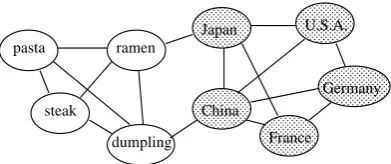
We first construct the graph in which vertices and edges correspond to words and their co-occurrences in patterns respectively (Figure 1). We employed four lexico-syntactic patterns (Table 1) to extract co-occurrence of two words from cor-pus. Note that we target Japanese in this paper al-though our proposal is independent of languages. The edges are weighted by the strength of co-occurrence that is computed by the Point-wise Mu-tual Information (PMI):
PMI(ni, nj) = logf(ni, nj)f(∗,∗) f(ni,∗)f(∗, nj)
where f(ni, nj) is the co-occurrence frequency of two nouns, and ‘∗’ means summation over all nouns. If PMI is less than zero, the edge is re-moved.
3.2 Graph Partitioning
Assuming that similar words tend to co-occur in the lexico-syntactic patterns, it is reasonable to consider that a dense subgraph is a good cluster (Figure 1). Following (Matsuo et al., 2006), we exploit the Newman clustering (Newman, 2004) to partition the graph into such dense subgraphs.
We start by describing Newman’s algorithm for unweighted graphs and we will generalize it to weighted graphs later. The Newman clustering is an algorithm that divides a graph into subgraphs based on connectivity. Roughly speaking, it di-vides a graph such that there are a lot of edges be-tween vertices in the same cluster. In the algorithm goodness of clustering is measured by scoreQ:
Q=
i
eii−a2i
ramen
dumpling pasta
steak
Japan U.S.A.
Germany China
France
Figure 1: An example of the graph consisting of two dense subgraphs.
where
eij = # of edges between two vertices in clusteriandj # of all edges
ai =
k eik.
The termeij is the fraction of edges between clus-ter iandj. ai is the sum ofeik over all clusters, anda2i represents the expected number of fraction of edges within the clusteriwhen edges are given at random. See (Newman, 2004) for the detail.
The Newman clustering optimizes Qin an ag-glomerative fashion. At the beginning of the algo-rithm every vertex forms a singleton cluster, and we repeatedly merge two clusters so that the join results in the largest increase inQ. The change in Qwhen clusteriandjare merged is given by
ΔQ=eij +eji−2aiaj = 2(eij −aiaj).
The above procedure is repeated until Q reaches local maximum.
The algorithm can be easily generalized to weighted graphs by substituting “sum of weights of edges” for “# of edges” in the definition ofeij. The other part of the algorithm remains the same.
4 Integration based on Hidden Markov Random Fields
This section represents how to integrate the distri-bution and pattern for word clustering.
4.1 Background and idea
framework, the clustering system is provided with a set of pair-wise constraints specifying data points that are likely to belong to the same cluster. These constraints are directly incorporated into the clus-tering process as a prior knowledge.
Our idea is to view the co-occurrence of two words in lexico-syntactic patterns as constraints, and incorporate them into the distributional clus-tering. The rest of this section describes how to ex-tend the distributional clustering so as to incorpo-rate the constraints, and how to geneincorpo-rate the con-straints using the patterns.
4.2 Probabilistic model
Let Cbe a set of pair-wise constraints, and con-sider to incorporate the constraints into the distri-butional clustering (Section 2). In what follows we assume each constraint i, j ∈ C represents that ziandzjare likely to have the same value, and it is associated with a weightwij(> 0) corresponding to a penalty for constraint violation.
It is easy to extend the distributional cluster-ing algorithm so as to incorporate the constraints. This is done by just changing the prior distribution on hidden variables p(z). Following (Basu et al., 2004), we construct the Markov random field on the hidden variables so as to incorporate the con-straints. The new prior distribution is defined as
p(z) =N
i=1
p(zi)×G1 exp{−
i,j∈C
δ(zi =zj)wij}
whereδ(·)is the delta function. δ(zi = zj)takes one if the constrainti, jis violated and otherwise zero. Gis the normalization factor of the Markov random field (the second term).
By examining the log-likelihood of the complete data, we can see how violation of constraints is pe-nalized. Using the new prior distribution, we get
logp(n,z) =
N
i=1
logp(zi)p(ni|zi)
−
i,j∈C
δ(zi =zj)wij
− logG.
The first term in the right-hand side is equal to the log-likelihood of the multinomial mixture, namely equation (1). The second term can be interpreted as the penalty for constraint violation. The last term is a constant.
It is worth pointing out that the resulting algo-rithm makes a soft assignment and polysemous words can belong to more than one clusters.
4.3 Parameter estimation
The parameters are estimated by the EM algo-rithm. The M-step is exactly the same as discussed in Section 2.2. The problem is that the hidden vari-ables are no longer independent and the E-step re-quires the calculation of
p(zi|n) =
z¬i
p(z¬i, zi|n)
∝
z¬i
p(z¬i, zi)p(n|z¬i, zi)
wherez¬i means all hidden variables butzi. The computation of the above equation is intractable because the summation in it requiresO(ZN−1) op-erations.
Instead of exactly computing p(zi|n), we ap-proximate it by using the mean field approximation (Lange et al., 2005). In the mean field approxima-tion,p(z|n)is approximated by a factorized distri-butionq(z), in which all hidden variables are inde-pendent:
q(z) =
N
i=1
qi(zi). (2)
Using q(z) instead ofp(z|n), computation of the E-step can be written as follows:
p(zi|n)
z¬i
q(z¬i, zi) =qi(zi). (3)
The parameters ofq(z)are determined such that the KL divergence between q(z) and p(z|n) is minimized. In other words, the approximate dis-tributionq(z)is determined by minimizing
z
q(z) log q(z)
p(z|n) (4)
under the condition that kqi(zi = k) = 1 for all i. This optimization problem can be re-solved by introducing Lagrange multipliers. Be-cause we cannot get the solution in closed form, an iterative method is employed. Taking the deriva-tive of equation (4) with respect to a parameter qik = qi(zi = k) and setting it to zero, we get the following updating formula:
q(t+1)ik ∝p(ni, k) exp{−
j∈Ni
whereNi ={j|i, j ∈C}andq(t)ik is the value of qik att-th iteration. The derivation of this formula is found in Appendix.
4.4 Generation of constraints
It is often pointed out that even small amounts of misspecified constraints significantly decrease the performance of semi-supervised clustering. This is because the error of misspecified constraints is propagated to the entire transitive neighborhoods of the constrained data (Nelson and Cohen, 2007). As an example, consider that we have two con-straintsi, jandj, k. If the former is misspeci-fied one, the error propagate tokthroughj.
To tackle this problem, we propose a technique to put an upper boundθon the size of the transitive neighborhoods. Our constraint generation process is as follows. To begin with, we modified the New-man clustering so that the maximum cluster size does not exceedθ. This can be done by prohibit-ing such merge that results in larger cluster than θ. Given the result of the modified Newman clus-tering, it is straightforward to generate constraints. Constraints are generated between two nouns in the same cluster if they co-occur in the lexico-syntactic patterns at least one time. The penalty for constraint violationwijwas set to PMI(ni, nj). This procedure obviously ensures that the size of the transitive neighborhoods is less thanθ.
5 Experiments
5.1 Data sets
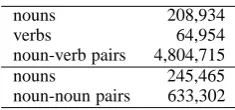
We parsed 15 years of news articles by KNP3 so as to obtain data sets for the distributional and pattern-based word clustering (Table 2). The num-ber of distinct nouns in total was 297,719. Note that, due to the computational efficiency, we re-moved such nouns that appeared less than 10 times with verbs and did not appear at all in the patterns. A test set was created using manually tailored Japanese thesaurus (Ikehara et al., 1997). We ran-domly selected 500 unambiguous nouns from 25 categories (20 words for each category).
5.2 Baselines
For comparison we implemented the following baseline systems.
• The multinomial mixture (Section 2).
• The Newman clustering (Newman, 2004).
3
http://nlp.kuee.kyoto-u.ac.jp/nl-resource/
nouns 208,934
verbs 64,954
noun-verb pairs 4,804,715
nouns 245,465
[image:5.595.356.474.69.124.2]noun-noun pairs 633,302
Table 2: Data sets statistics. The first and second row shows the number of distinct words (and word pairs) used for the distributional and pattern-based word clustering respectively.
• Three K-means algorithms using different distributional similarity or dissimilarity mea-sures: cosine, α-skew divergence (Lee, 1999)4, and Lin’s similarity (Lin, 1998).
• The CBC algorithm (Lin and Pantel, 2002; Pantel and Lin, 2002).
5.3 Evaluation procedure
All the nouns in the data set were clustered by the proposed and baseline systems.5 For the mixture models and K-means, the number of clusters was set to 1,000. The parameterθwas set to 100.
The result was assessed by precision and recall using the test data. The precision and recall were computed by the B-CUBED algorithm as follows (Bagga and Baldwin, 1998). For each nounni in the test data, precisioniand recalli are defined as
precisioni = |Si∩ Ti|
|Si|
recalli = |Si∩ Ti|
|Ti|
whereSi is the system generated cluster contain-ingniandTiis the goldstandard cluster containing ni. The precision and recall are defined as an av-erage of precisioni and recalli for all the nouns in the test data respectively. The result of soft clus-tering models cannot be directly evaluated by the precision and recall. In such cases, each noun is assigned to the cluster that maximizesp(z|n).
5.4 The result and discussion
Table 3 shows the experimental results. The best results for each statistic are shown in bold. For the mixture models and K-means, the precision and re-call are an average of 10 trials.
Table 3 demonstrates the impact of combining distribution and pattern. Our method outperformed
4α
= 0.99 in our experiment.
5Our implementation is available from
P R F1
proposed .383 .437 .408
multinomial mixture .360 .374 .367 Newman (2004) .318 .353 .334
cosine .603 .114 .192
[image:6.595.306.527.72.116.2]α-skew divergence (Lee, 1999) .730 .155 .255 Lin’s similarity (Lin, 1998) .691 .096 .169 CBC (Lin and Pantel, 2002) .981 .060 .114
Table 3: Precision, recall, and F-measure.
all the baseline systems. It was statistically signif-icantly better than the multinomial mixture (P < 0.01, Mann-Whitney U-test). Note that it is possi-ble to improve some baseline systems, especially CBC, by tuning the parameters. For CBC we sim-ply used the same parameter values as reported in (Lin and Pantel, 2002).
Compared with the multinomial mixture, one advantage of our method is that it has broad cov-erage. Our method can successfully handle
un-known words, which do not appear with verbs at
all (i.e., fn = 0andφ(n)is zero vector), if they co-occur with other words in the lexico-syntactic patterns. For unknown words, the hidden variables are determined based only onp(z)becausep(n|z) takes the same value for all hidden variables. This means that our method clusters unknown words using pair-wise constraints. On the other hand, the multinomial mixture assigns all the unknown words to the cluster that maximizesp(z).
The test set included 51 unknown words.6 We split the test set into two parts:fn= 0andfn= 0, and calculated precision and recall for each subset (Table 4). Although the improvement is especially significant for the unknown words, we can clearly confirm the improvement for both subsets. For the Newman clustering we can discuss similar things (Table 5). Different from the Newman clustering, our method can handle nouns that do not co-occur with other nouns if0< fn. In this case the test set included 64 unknown words.
It is interesting to point out that our framework can further incorporate lexico-syntactic patterns for dissimilar words (Lin et al., 2003). Namely, we can use patterns so as to prevent distribution-ally similar but semanticdistribution-ally different words (e.g., ally and supporter (Lin et al., 2003)) from being as-signed to the same cluster. This can be achieved by using cannot-link constraints, which specify data points that are likely to belong to different
clus-6The baseline systems assigned the unknown words to a
default cluster as the multinomial mixture does.
fn= 0 fn= 0
P R F1 P R F1
proposed .320 .632 .435 .412 .450 .430 multi. .099 1.000 .181 .402 .394 .398
Table 4: Detail comparison with the multinomial mixture.
f(ni,∗) = 0 f(ni,∗)= 0
P R F1 P R F1
proposed .600 .456 .518 .380 .479 .424 Newman .071 1.000 .133 .354 .412 .381
Table 5: Detail comparison with the Newman clus-tering.
ters (Basu et al., 2004). The remaining problem is which patterns to use so as to extract dissimilar words. Although this problem has already been discussed by (Lin et al., 2003), they mainly ad-dressed antonyms. We believe that a more exhaus-tive investigation is required. In addition, it is still unclear whether dissimilar words are really useful to improve clustering results.
One problem that we did not examine is how to determine optimal number of clusters. In the ex-periment, the number was decided with trial-and-error through our initial experiment. We leave it as our future work to test methods of automat-ically determining the cluster number (Pedersen and Kulkarni, 2006; Blei and Jordan, 2006).
6 Related work
As far as we know, the distributional and pattern-based word clustering have been discussed inde-pendently (e.g., (Pazienza et al., 2006)). One of the most relevant work is (Bollegala et al., 2007), which proposed to integrate various patterns in or-der to measure semantic similarity between words. Although they extensively discussed the use of pat-terns, they did not address the distributional ap-proach.
Mirkin (2006) pointed out the importance of integrating distributional similarity and lexico-syntactic patterns, and showed how to combine the two approaches for textual entailment acquisition. Although their work inspired our research, we dis-cussed word clustering, which is related to but dif-ferent from entailment acquisition.
words. As we have already discussed, the integra-tion of such patterns can also be formalized using similar probabilistic model to ours.
A variety of studies discussed determining po-larity of words. Because this problem is ternary (positive, negative, and neutral) classification of words, it can be seen as one kind of word clus-tering. The literature suggested two methods of determining polarity, and they are analogous to the distributional and co-occurrence-based approaches in word clustering (Takamura et al., 2005; Hi-gashiyama et al., 2008). We consider it is also promising to integrate them for polarity determi-nation.
7 Conclusion
The distributional and pattern-based word cluster-ing have long been discussed separately despite the potentiality for their integration. In this paper, we provided a probabilistic framework for com-bining the two approaches, and demonstrated that the clustering result is significantly improved.
Our important future work is to extend current framework so as to incorporate patterns for dissim-ilar words using cannot-link constraints. We con-sider such patterns further improve the clustering result.
Combining distribution and pattern is important for other NLP problems as well (e.g., entailment acquisition, polarity determination). Although this paper examined word clustering, we consider a part of our idea can be applied to other problems.
Acknowledgement
This work was supported by the Comprehensive
Development of e-Society Foundation Software
program of the Ministry of Education, Culture, Sports, Science and Technology, Japan.
References
Bagga, Amit and Breck Baldwin. 1998. Entity-based cross-document coreferencing using the vector space model. In Proceedings of ACL, pages 79–85.
Baker, L. Douglas and Andrew Kachites McCallum. 1998. Distributional clustering of words for text classification. In Proceedings of SIGIR, pages 96– 103.
Basu, Sugato, Mikhail Bilenko, and Raymond J. Mooney. 2004. A probabilistic framework for semi-supervised clustering. In Proceedings of SIGKDD, pages 59–68.
Blei, David M. and Michael I. Jordan. 2006. Vari-ational inference for Dirichlet process mixtures.
Bayesian Analysis, 1(1):121–144.
Bollegala, Danushka, Yutaka Matsuo, and Mitsuru Ishizuka. 2007. An integrated approach to mea-suring semantic similarity between words using in-formation available on the web. In Proceedings of
NAACL, pages 340–347.
Brown, Peter F., Vincent J. Della Pietra, Peter V. deS-ouza, Jenifer C. Lai, and Rober L. Mercer. 1992. Class-based n-gram models of natural language.
Computational Linguistics, 18(4):467–479.
Chilovski, Timothy and Patrick Pantel. 2004. VER -BOCEAN: Mining the web for fine-grained semantic verb relations. In Proceedings of EMNLP, pages 33– 40.
Church, Kenneth Ward and Patrick Hanks. 1989. Word association norms, mutual information, and lexicog-raphy. In Proceedings of ACL, pages 76–83.
Harris, Zellig. 1968. Mathematical Structure of
Lan-guage. New York: Wiley.
Higashiyama, Masahiko, Kentaro Inui, and Yuji Mat-sumoto. 2008. Learning polarity of nouns by se-lectional preferences of predicates (in Japanese). In
Proceedings of the Association for NLP, pages 584–
587.
Hindle, Donald. 1990. Noun classification from predicate-argument structure. In Proceedings of
ACL, pages 268–275.
Ikehara, Satoru, Masahiro Miyazaki, Satoshi Shirai, Akio Yokoo, Hiromi Nakaiwa, Kentarou Ogura, and Yoshifumi Oyama Yoshihiko Hayashi, editors. 1997. Japanese Lexicon. Iwanami Publishing.
Kazama, Jun’ichi and Kentaro Torisawa. 2008. Induc-ing gazetteers for named entity recognition by large-scale clustering of dependency relations. In
Pro-ceedings of ACL, pages 407–415.
Koo, Terry, Xavier Carreras, and Michael Collins. 2008. Simple semi-supervised dependency parsing. In Proceedings of ACL, pages 595–603.
Lange, Tilman, Martin H.C. Law, Anil K. Jain, and Joachim M. Buhmann. 2005. Learning with con-strained and unlabelled data. In Proceedings of
CVPR, pages 731–738.
Lee, Lillian. 1999. Measures of distributional similar-ity. In Proceedings of ACL, pages 25–32.
Li, Hang and Naoki Abe. 1998. Word clustering and disambiguation based on co-occurrence. In
Proceed-ings of ACL-COLING, pages 749–755.
Lin, Dekang and Patrick Pantel. 2002. Concept discov-ery from text. In Proceeodings of COLING, pages 577–583.
Lin, Dekang, Shaojun Zhao, Lijuan Qin, and Ming Zhou. 2003. Identifying synonyms among distri-butionally similar words. In Proceedings of IJCAI, pages 1492–1493.
Lin, Dekang. 1998. Automatic retrieval and clustering of similar words. In Proceedings of ACL-COLING, pages 768–774.
Matsuo, Yutaka, Takeshi Sakaki, Koki Uchiyama, and Mitsuru Ishizuka. 2006. Graph-based word cluster-ing uscluster-ing a web search engine. In Proceedcluster-ings of
EMNLP, pages 542–550.
McCallum, Andrew and Kamal Nigam. 1998. A com-parison of event models for naive Bayes text classifi-cation. In Proceedings of AAAI Workshop on
Learn-ing for Text Categorization, pages 41–48.
Miller, Scott, Jethran Guinness, and Alex Zamanian. 2004. Name tagging with word clusters and discrim-inative training. In Proceedings of NAACL, pages 579–586.
Mirkin, Shachar, Ido Dagan, and Maayan Geffet. 2006. Integrating pattern-based and distributional similar-ity methods for lexical entailment acquisition. In
Proceedings of COLING-ACL Poster Sessions, pages
579–586.
Nelson, Blaine and Ira Cohen. 2007. Revisiting prob-abilistic models for clustering with pair-wise con-straints. In Proceedings of ICML, pages 673–680.
Newman, Mark. 2004. Fast algorithm for detecting community structure in networks. In Phys. Rev. E
69.
Pantel, Patrick and Dekang Lin. 2002. Discovering word senses from text. In Proceedings of SIGKDD, pages 613–619.
Pazienza, Maria Teresa, Marco Pennacchiotti, and Fabio Massimo Zanzotto. 2006. Discovering verb relations in corpora: Distributional versus non-distributional approaches. In Proceedings of
IEA/AIE, pages 1042–1052.
Pedersen, Ted and Anagha Kulkarni. 2006. Automatic cluster stopping with criterion functions and the gap statistic. In Proceedings of HLT/NAACL,
Compan-ion Volume, pages 276–279.
Pereira, Fernando, Naftali Tishby, and Lillian Lee. 1993. Distributional clustering of english words. In
Proceedings of ACL, pages 183–190.
Rooth, Mats, Stefan Riezler, Detlef Prescher, Glenn Garrroll, and Franz Beil. 1999. Inducing a semanti-cally annotated lexicon via EM-based clustering. In
Proceedings of ACL, pages 104–111.
Takamura, Hiroya, Takashi Inui, and Manabu Oku-mura. 2005. Extracting semantic orientations of words using spin model. In Proceedings of ACL, pages 133–140.
Terra, Egidio and C.L.A. Clarke. 2003. Frequency es-timates for statistical word similarity measures. In
Proceedings of NAACL, pages 165–172.
Torisawa, Kentaro. 2002. An unsupervised learning method for associative relationships between verb phrases. In Proceedings of COLING, pages 1009– 1015.
Turney, Peter. 2001. Mining the web for synonyms: PMI-IR versus LSA on TOEFL. In Proceedings of
ECML, pages 491–502.
Weeds, Julie, David Weir, and Diana McCarthy. 2004. Characterising measures of lexical distributional similarity. In Proceedings of COLING, pages 1015– 1021.
Appendix. Derivation of the updating formula
We can rewrite equation (4) as follows:
(4) =
z
q(z) logq(z) (6)
−
z
q(z)N
i=1
logp(ni, zi) (7)
+
z
q(z)
i,j∈C
δ(zi =zj)wij (8)
+ const (9)
where we made use of the fact thatlogp(z|n) =
logp(n|z)p(z) +const. Taking the derivative of equation (6), (7), and (8) with respect to qik, we found
∂(6)
∂qik = logqik+const ∂(7)
∂qik = −logp(ni, k) +const ∂(8)
∂qik =
z¬i
q(z¬i)
j∈Ni
δ(zj =k)wij+const
=
j∈Ni
z¬i
q(z¬i)δ(zj =k)wij+const
=
j∈Ni
(1−qjk)wij +const