Tie-system calibration for the experimental setup of
large deployable reflectors
A. Cammarata1* , R. Sinatra1, R. Rigato2and P.D. Maddio1
1 University of Catania; [email protected]; [email protected]; [email protected]
2 Thales Alenia Space Italia; [email protected]
* Correspondence: [email protected]; Tel.: +39-095-738-2403
Version March 12, 2019 submitted to Preprints
Abstract:The tradeoff between the design phase and the experimental setup is crucial to satisfy the 1
accuracy requirement of Large Deployable Reflectors. Manufacturing errors and tolerances change 2
the RMS of the reflecting surface and require careful calibration of the tie rod system to be able 3
to fit into the initial design specifications. To give a possible solution to this problem, here two 4
calibration methods, respectively for rigid and flexible ring truss support, are described. Starting 5
from the acquired experimental data on the net nodal coordinates, the initial problem of satisfying 6
the static equilibrium at the measured configuration is described. Then, two constrained optimization 7
problems, for rigid and flexible ring truss support, are defined to meet RMS accuracy of the reflecting 8
surface modifying the tie lengths. Finally, a case study to demonstrate the validity of the proposed 9
methods is presented. 10
Keywords:large deployable reflector; tie adjustment; experimental setup 11
1. Introduction 12
In recent decades, satellite communications have been increasingly spread thanks to the possibility 13
of having high transmitting capacities at a relatively low cost compared to the establishment of a 14
terrestrial broadcasting network. The deployable reflectors represent the most widely used type of 15
structure because of their features such as large scale, high packaging efficiency, high accuracy and 16
lightweight. Typically, its architecture consists of a deployable ring truss support, two cable nets, facing 17
each other and linked by a series of tension ties, and an RF mesh attached to the backside of the front 18
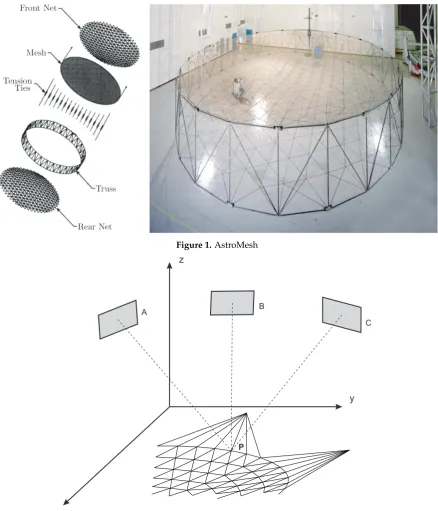
net. The most representative kind of this type of reflector is the AstroMesh [1], and its components are 19
shown in Fig.1. The electromagnetic performance of these antennas is closely related to the shape of 20
the reflector surface. In turn, this depends on the position of nodes located on the front net. Therefore, 21
it is clear how the measurement process of 3D node coordinates is to be made with extreme accuracy 22
so as to avoid invalidating the real root mean square (RMS) value. 23
In recent years several measurement systems have been developed depending on the application 24
area. Generally, they can be summarised in three categories: 25
• Photogrammetry 26
• Laser tracker 27
• Laser radar 28
The photogrammetry is a measurement technique that uses two-dimensional images of an object 29
to obtain its dimensions. As depicted in Fig.2the photogrammetry is based exclusively on angle 30
measurements: three-dimensional coordinates are calculated via optical triangulation (orintersection) 31
of two or more images taken from different positions. The object to be measured is identified by 32
targets mounted on it, usually made of reflective material so as to produce high contrast between the 33
target and the background [2]. Typically, a calibrated scale bar is integrated into the object in order 34
to reproduce it in true scale. At the end of measurements, a dedicated software calculates the 3D 35
coordinates into the chosen Cartesian coordinate system (x,y,z). 36
Figure 1.AstroMesh
B
C A
P
x
y z
Figure 2.Photogrammetry
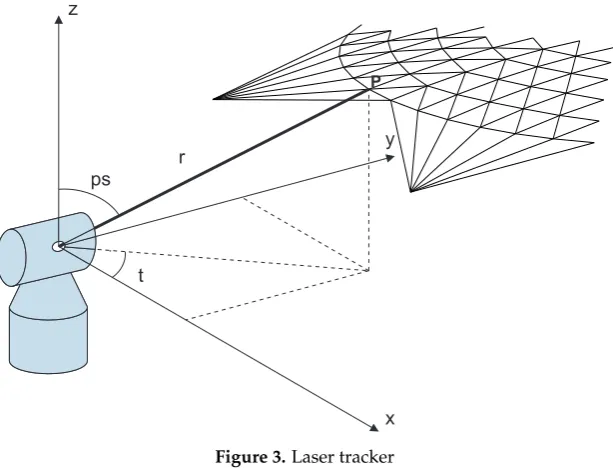
Laser tracker and laser radar, instead, are measurement systems based on the estimation of two 37
angles and one length, as shown in Fig.3. Two high-resolution encoders measure the azimuth (θ) and 38
elevation (ϕ) angles, whereas the radial coordinate (r) relative to the center of the target is measured 39
by means of optical interference [3]. Several types of target can be mounted, but the most widely used 40
is the spherically mounted retroreflector (SMR). Differently from laser tracker, laser radar does not 41
require a retroreflector. As a matter of fact, it is capable of measuring the surface of the object with just 42
1% of the reflected signal [4]. 43
Each of these measurement systems, however, has advantages and disadvantages, which need 44
to be assessed on the basis of various factors. Van Gestelet al. [4] identify the influencing factors to 45
P
x y z
t ps
r
Figure 3.Laser tracker
environmental restrictions. Regarding task requirements, the main element to be considered when 47
measuring the position of nodes is the accuracy, since the permissible RMS error on the reflecting 48
surface is less than 1 (mm). Whilst the laser tracker has errors on the order of 1µm, it is too costly due to 49
the high price of each SMR and given the number of nodes (at least a hundred). The photogrammetry 50
turns out to be the best choice [5,6], considering the affordable cost and accuracy of the measure. 51
Furthermore, the possibility of obtaining multiple images from different angles makes it possible to 52
overcome the lower accuracy of the angular encoders of laser trackers. 53
The acquisition of node coordinates is essential for the next calibration step in order to meet the 54
RMS design requirements of the reflecting surface. Generally, the main strategies followed by LDR 55
developers and designers is to use the tie system, connecting front and rear nets, to locally move 56
single nodes. This operation is long and delicate but allows to adjust different error sources such as 57
manufacturing errors [7–9], material definition errors, clearance [10,11], friction [12,13], hysteresis [14], 58
mechanical vibrations [15,16], not perfect behaviour of elastic properties of components. This paper 59
describes a method for the tie system calibration of LDRs with rigid or flexible ring truss. To our 60
knowledge this topic has not been deeply investigated in the literature and the adjustment phase is 61
entrusted with proprietary solutions of LDR companies. The outline of this paper is as follows. In 62
Section2the problem of correcting the parameters to satisfy the static equilibrium in the deployed 63
configuration is first addressed. Then, the method to find the necessary corrections to the tie-system 64
is discussed for the two cases of LDR with rigid and flexible ring truss. In Section3the method 65
is applied to a LDR with asymmetric ring truss developed by Thales Alenia Space. A simulated 66
error distribution is superimposed to the design configuration to represent a real experimental test. 67
Tie-system corrections, expressed in terms of length elongation or shortening, necessary to meet RMS 68
design requirement are obtained for both rigid and flexible ring truss cases. Finally, conclusions close 69
the paper. 70
2. Experimental setting for calibration 71
Once the antenna has been manufactured, it is necessary to carry out some experimental tests 72
in order to check for the RMS of the reflector in the deployed configuration. To do this, the first 73
operation consists of measuring the position of all nodes of the nets with respect to a reference system 74
through one of the methods described in the Introduction. Due to different sources of errors such as 75
manufacturing errors, assembly errors, the deployed configuration will be different from the design 76
operation of the nodes coordinates will be affected by errors. Laser trackers and photogrammetry have 78
errors on the order of 1µm; while laser radar reaches 0.1µm. Anyway, errors related to measurement 79
systems maintain significantly below the proceeding mechanical errors. In the following, two methods 80
for the experimental setting of the rigid and flexible ring truss support are described. 81
Several experimental methodologies [17–20] based on multibody approach have been developed 82
[21–29]. Recently, methods based on the Fuzzy logic [30–34], neural networks [35] and genetic 83
algorithm have been applied for the tensioning of space trusses [36,37]. The proposed methods 84
act on the tensioning system of the ties to fix the errors coming from the construction of the antenna. 85
2.1. Rigid ring truss support: construction length determination 86
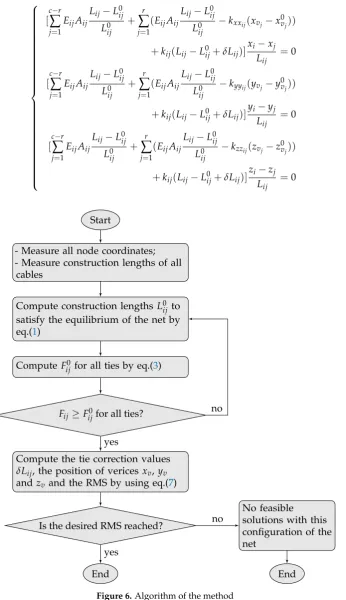
Tie cables regulation is usually independent from the actuators used for the LDA deployment [38–40] and from the control system [41–44]. Here, the method to regulate tie cables tension of an antenna with rigid ring truss support is first described. Once the deployment has been carried out and all node coordinates of the net have been measured the reflective surface deviated from the design configuration due to mechanical errors. As a consequence of this deviation, the system of equilibrium equation is not satisfied for the current configuration. Then, denoting withEij,Aij,Lij,L0ij the Young modulus, the cross-section area, the measured length, the construction length of cable/tieij, respectively and withkijthe spring constant of tieij, the system of nonlinear equations for each free nodei, withjadjacent nodes, is not satisfied:
∑ j
[EijAij Lij−L0
ij L0
ij
+kij(Lij−L0ij)] xi−xj
Lij 6=0
∑ j
[EijAijLij−L
0
ij L0
ij
+kij(Lij−L0ij)]yiL−yj
ij 6=0
∑ j
[EijAijLij−L
0
ij
L0ij +kij(Lij−L 0 ij)]
zi−zj Lij 6=0
(1)
wherexl,yl andzl are the measured Cartesian coordinates of thel-th node. It is noteworthy to remark 87
that the only measured parameters are the node coordinates; while themeasuredlength is derived 88
using the Euclidian norm. The remaining parameters of the previous system are design parameters 89
instead, each affected by different types of error. Here, we choose to gather all these errors inside the 90
construction lengthL0ijdefined as the distance between the centers of the eyeletsiandjbelonging to 91
the same cable, as shown in Fig.4. This choice is motivated by the fact that the construction length of 92
the cables is affected by two main sources of errors such as themanufacturing errors, generated during 93
the cutting operation of CNC machines [45], and theassembly errors, coming from a bad placement of 94
the eyelets necessary to connect two or more cables. In order to restore the equilibrium condition in 95
system (1) only the design parameters can be adjusted while the measured parameters describe the 96
real configuration of equilibrium: the measured configuration is already of equilibrium, thus system 97
(1) is to be satisfied in this configuration without changing node coordinates. 98
L
Figure 4.Layout of a cable: the construction lengthL0is affected bymanufacturing errors, generated
during the cutting operation andassembly errorscoming from a bad placement of the eyelets necessary to connect two or more cables
fmincon by giving a constant objective function and setting the eq.(1) as the nonlinear equality constraint, in addition to the linear inequality constraint Lij ≥ L0ij. The resulting constrained optimization problem is described below:
find L0
ij,∀cables and ties
min constant objective function
s.t. Lij≥L0ij
(2)
Hence, a first check is required. Because the springs used in tension ties require a prestress value, here denoted withF0, representing the minimum value necessary for their activation, the conditionFij≥Fij0 for each tension tie cable must be verified, where
Fij=kij(Lij−L0ij) (3)
is the spring force of tieij. If the condition is satisfied the next step can be conducted, otherwise the 99
spring belonging to the tie which has failed the test must be replaced and the algorithm starts again 100
calculating the arrayL0of all construction lengths. 101
2.2. Rear nodes determination 102
In the event that only the coordinates of the nodes of the front net are known by measurement, 103
before implementing the algorithm described above, the rear nodes coordinates have to be estimated. 104
Their coordinates are initialized with the design data and the system (1) for each free node of the front 105
and rear net is implemented. It can be noted the dualism between the two methods: in the former, the 106
unknowns are the construction lengths, in the latter the rear node coordinates. Then, the construction 107
lengths are obtained as a consequence using the Euclidian norm. We checked that both methods lead 108
to the same results, unless negligible errors, if the experimental configuration is not too distant from 109
the design one. 110
2.3. Rigid ring truss support: tie calibration 111
Once the configuration satisfying the static equilibrium has been found, the algorithm continues 112
with the estimation of the values of stretching or shortening for each tension tie cable that ensure that 113
the surface accuracy of the reflector can be met. The Figure5shows the screw adjustment system of a 114
tie. One fixed part is connected to a node of the front net while one mobile part, adjustable through a 115
screw, is connected to a node of the rear net. Now, the system of nonlinear equation of each free nodei 116
can be written as follows: 117
∑ j
[EijAijLij−L
0
ij
L0ij +kij(Lij−L 0
ij+δLij)] xi−xj
Lij =0
∑ j
[EijAij Lij−L0ij
L0
ij
+kij(Lij−L0ij+δLij)] yi−yj
Lij =0
∑ j
[EijAij Lij−L0
ij L0
ij
+kij(Lij−L0ij+δLij)] zi−zj
Lij =0
(4)
This system is similar to (1), used to determine the vectorL0, with the difference that, this time, the variables to be found are the stretching/shortening valuesδLijand the coordinates of the free nodes of the front and rear net. The valuesδLijcan be positive or negative: here we assume positive values for tie shortening and negative for tie stretching. Also this system is subject to some constraints. One condition for all net cables is thatL≥L0. For the tension tie cables, for which the valuesδLijare to be considered, the constraint condition is that the final forceFijmust be of traction:
L
maxk
L
minL
maxL
k
L
minL’=L- L
d
d
L
F
F
F’ = F + k
d
L
F = F + k
d
L
Figure 5.Screw adjustment tie system: (left) tie system before the adjustment; (right) tie system after the screw regulation.
Finally, the third constraint is related to the surface accuracy since the RMS error must be lower than 118
the desired design valueRMStarget. This is a typical constrained optimization problem largely used in 119
design optimization of complex systems [46–49] and mechanisms [50–52]. The optimization problem 120
can be summarised as follows: 121
find x1,y1,z1andδL
min constant objective function
s.t. Lij≥L0ij net cables
Lij+δLij≥L0ij tension tie cables
RMS≤RMStarget reflecting surface requirement
(6)
wherex1,y1andz1are the free node coordinates andδLis the array containing all correctionsδLij. 122
The RMS is calculated by measuring the minimum distance of the free nodes of the front net compared 123
to the ideal surface of the paraboloid (citazione primo articolo). The initial condition for the free nodes 124
is represented by their experimental measurement, while the guess value forδLis set equal to zero. 125
2.4. Flexible ring truss support 126
The truss support is generally manufactured in carbon fiber and is therefore reasonable to consider 127
the truss deformation under the effect of the tension of the cable net. 128
The elastodynamic model of the flexible ring truss support can be found using analytic techniques 129
combined with the Matrix Structural Analysis, [53–56], elliptic integrals [57,58], FEM models [59–61], 130
This implies the displacement of the nodes connected to the truss support, also called vertices, 132
when the net system is tensioned. By considering the stiffness of the structure, the nonlinear system (4) 133
described in the previous section becomes as follows: 134 [
c−r
∑
j=1
EijAijLij−L 0 ij L0ij +
r
∑
j=1
(EijAijLij−L 0 ij
L0ij −kxxij(xvj−x 0 vj))
+kij(Lij−L0ij+δLij)] xi−xj
Lij
=0
[
c−r
∑
j=1 EijAij
Lij−L0ij L0ij +
r
∑
j=1
(EijAij
Lij−L0ij
L0ij −kyyij(yvj−y 0 vj))
+kij(Lij−L0ij+δLij)]yi
−yj Lij =0
[
c−r
∑
j=1
EijAijLij−L 0 ij L0 ij + r
∑
j=1(EijAijLij−L 0 ij L0
ij
−kzzij(zvj−z0vj))
+kij(Lij−L0ij+δLij)] zi−zj
Lij
=0
(7)
Start
- Measure all node coordinates; - Measure construction lengths of all
cables
Compute construction lengths L0ij to satisfy the equilibrium of the net by eq.(1)
Compute Fij0 for all ties by eq.(3)
Fij≥Fij0for all ties?
Compute the tie correction values δLij, the position of vericesxv,yv and zvand the RMS by using eq.(7)
Is the desired RMS reached?
No feasible solutions with this configuration of the net End End no yes no yes
Figure 6.Algorithm of the method
135
wherecis the total number of cables connected to thei-th node;ris the number of rods,xv,yv 136
andzvare the unknown coordinates of thej-th vertex andx0
vertex itself. The stiffness of the truss support can be represented as a three-dimensional bushing, with 138
stiffnesseskxxij,kyyijandkzzij, connecting the rods to the vertex, as shown in Fig.7. The constrained 139
optimization (6) still applies to this flexible ring truss case and the overall algorithm is summarised in 140
the flowchart of Fig.6. 141
3. Results 142
In order to verify the validity of the proposed method, the case study of an asymmetric large 143
deployable reflector, designed by Thales Alenia Space [63], is described. Relevant parameters and 144
geometrical data are listed as follows: 145
• Focal length: 6 (m) 146
• Number of free nodes: 296 147
• Number of vertices: 14 148
• Number of total cables: 1044 149
• Cable section: 4 (mm)2 150
• Young modulus of cables: 8.3×10¹⁰(N/m)2 151
• Initial RMS error: 0.5872 (mm) 152
• Design value of the RMS faceting error: 0.21 (mm) 153
The value of spring constant in tie cables ranges from 2×10³N/m to 68×103N/m with radial 154
step of 11×103N/m starting from the centre (central node) to the outer ring cables. The initial RMS 155
error on the front net was simulated by introducing an additional value to each node proportionally to 156
k
a b
ring truss support
rods
vertex
Figure 7.Displacement of the vertex due to the deformation of the flexible ring truss support
3 4 6
24
62 1
02 04 06 08 m1 m2
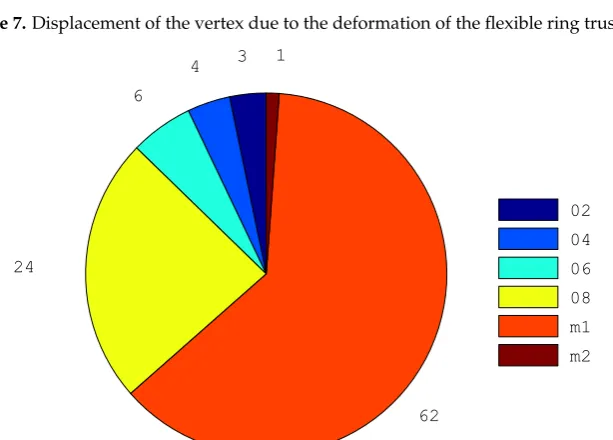
the length of the tie connected to it. By imposing the equilibrium in the system (1) we can determine the 157
construction lengths described in Section2. Nevertheless, from Fig.8it can be noted that the maximum 158
erroreL0obtained is about 1 (mm), representing only 1% of total cables; the largest percentage (86%) 159
showing an error between 0.6 (mm) and 1 (mm).
2000 3000 4000 5000 6000 7000 −2500
−2000 −1500 −1000 −500 0 500 1000 1500 2000 2500
0.5 0.55 0.6 0.65
Figure 9.Faceted RMS (mm) of the front tension truss in the initial configuration.
160
In Fig.9the local faceting error for the chosen initial configuration is shown. The local faceting 161
error is calculated considering the centroid of the triangular facets in which the surface can be 162
decomposed [64–67]. As it can be observed, the faceting error follows the shape of the asymmetric 163
reflector because the chosen error is proportional to the tie lengths. As a matter of fact, the central zone 164
is the one with the shortest cables and therefore with the lowest faceting error. On the contrary, the tie 165
lengths, and consequently the errors, grow moving from the centre to the outer perimeter of the net. 166
The optimization method described in the previous sections is first applied to the rigid ring truss 167
support. The Figure10shows the error of each free node of the front net with respect to the ideal 168
surface coupled with the stretching/shortening value necessary to reach the desired surface accuracy. 169
The reason why correction values are all positive is that the initial error is simulated by positioning all 170
nodes of the front net above the ideal surface, so there is the need to shorten the tie lengths to satisfy 171
the RMS design value. The bars are grouped by spring constant value. 172
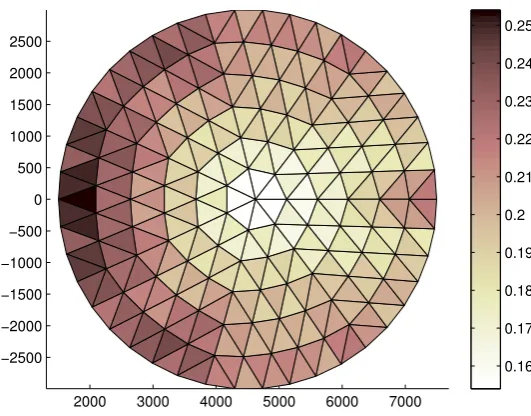
The corresponding faceting error is shown in Fig.11. As it can be observed the RMS of the faceting 173
error is lowered till the required value of 0.2036 (mm) furnished as specification. 174
Then, the same analysis has been performed for the flexible ring truss support. It can be noted that 175
in the Fig.12, the correction values are lower than the corresponding values with rigid truss support: 176
this is because the additional tensioning of ties further deforms the shape of the truss support resulting 177
in a closure of the support itself [68]. As a result, this causes a slight lowering of the front net thus 178
reducing the shortening action of tie lengths. Finally, the Fig.13shows the faceting error distribution 179
on the front net. Even in this case the final RMS faceting error reached 0.2045 (mm) representing 180
the design value of the RMS. Comparing the two Figs.11and13it can be observed that the faceting 181
error distribution is more uniform for the flexible ring truss support. This result can be explained 182
considering that the deformation of the truss support relaxes the front and rear tension truss systems 183
making the tension distribution more uniform. 184
Moreover, other simulations with different initial RMS errors revealed that, with the given design 185
−0.5 0 0.5
1 1.5
2 2.5
[mm]
Stretching/Shortening values Error
68 57 46 35 24 13 2
[N/mm]
Figure 10.Error and correction values (rigid case)
2000 3000 4000 5000 6000 7000
−2500 −2000 −1500 −1000 −500 0 500 1000 1500 2000 2500
0.17 0.18 0.19 0.2 0.21 0.22 0.23 0.24
Figure 11.Faceting error (mm) distribution on the front tension truss obtained for the rigid ring truss support
revision of design data is needed. This demonstrates the validity of the method only for small RMS 187
errors. 188
4. Conclusions 189
In this paper a method for the tie-system calibration of Large Deployable Reflectors (LDRs) is 190
provided. The LDRs are very sensitive to errors and usually require a careful experimental setup to 191
meet the design requirement of surface accuracy. Due to manufacturing errors, clearance, friction, not 192
perfect behaviour of materials the real configuration moves away from the design configuration and a 193
fine calibration is needed to improve the quality of the reflecting surface expressed in terms of closeness 194
to the ideal paraboloidal geometry. The proposed method follows two steps: the determination of the 195
−0.5 0 0.5
1 1.5
2 2.5
[N/mm]
[mm]
Stretching/Shortening values Error
68 57 46 35 24 13 2
Figure 12.Error and correction values (flexible case)
2000 3000 4000 5000 6000 7000
−2500 −2000 −1500 −1000 −500 0 500 1000 1500 2000 2500
0.16 0.17 0.18 0.19 0.2 0.21 0.22 0.23 0.24 0.25
Figure 13. Faceting error (mm) distribution on the front tension truss obtained for the flexible ring truss support
to meet RMS design requirements. For the first step a constrained optimization problem has been 197
proposed to find the cable construction lengths once all node coordinates have been measured. The 198
second step has been developed acting on the system of screw adjustable ties. A further constrained 199
optimization problem has been formulated to find the length corrections of each tie. Using the same 200
approach the cases of LDR with rigid and flexible tension truss have been studied. Finally, the method 201
has been applied to a LDR with asymmetrical ring truss designed by Thales Alenia Space. Considering 202
an initial RMS of 0.58 (mm) the results, not yet validated by experimental test, seemed comforting in 203
reaching the design RMS. The method convergency depends on the starting and desired RMS. Here, 204
the convergency has been insured up to the reasonable high initial RMS value of 1 (mm): beyond this 205
value the tie system is not able to reach the equilibrium and satisfy the constraints and a different 206
Author Contributions: This research paper was principally developed by the first and last author (A.C. and
208
P.D.M.). The other two authors (R.S. and R.R.) have dealt with the significant review activity.
209
Funding:“This research was funded by ESA grant number AO/1-7217/NL/CP - Innovative Scalable Large
210
Deployable Antenna Reflectors.”
211
Acknowledgments:This work has been partially financed by the University of Catania within the project “Piano
212
della Ricerca Dipartimentale 2016-2018” of the Department of Civil Engineering and Architecture.
213
Conflicts of Interest:“The authors declare no conflict of interest.”
214
Abbreviations 215
The following abbreviations are used in this manuscript:
216 217
MDPI Multidisciplinary Digital Publishing Institute DOAJ Directory of open access journals
TLA Three letter acronym
LD linear dichroism
218
References 219
1. Thomson, M. AstroMeshTMdeployable reflectors for ku and ka band commercial satellites. 20th AIAA 220
international communication satellite systems conference and exhibit, 2002, p. 2032.
221
2. Estler, W.T.; Edmundson, K.; Peggs, G.; Parker, D. Large-scale metrology–an update. CIRP
222
Annals-Manufacturing Technology2002,51, 587–609.
223
3. De Simone, M.C.; Guida, D. On the Development of a Low Cost Device for Retrofitting Tracked Vehicles
224
for Autonomous Navigation.Proceedings of the AIMETA2017.
225
4. Cuypers, W.; Van Gestel, N.; Voet, A.; Kruth, J.P.; Mingneau, J.; Bleys, P. Optical measurement techniques
226
for mobile and large-scale dimensional metrology. Optics and Lasers in Engineering2009,47, 292–300.
227
5. Dong, M.L.; Deng, W.Y.; Sun, Y.; Wang, Y. Photogrammetric Measurement of Deformation of Large
228
Deployable Mesh Microwave Antenna. Key Engineering Materials. Trans Tech Publ, 2008, Vol. 381, pp.
229
309–312.
230
6. Stegman, M.D.; Fedyk, M.; Kuehn, S. Solar thermal vacuum testing of deployable mesh reflector for model
231
correlation. Aerospace Conference, 2010 IEEE. IEEE, 2010, pp. 1–15.
232
7. Zhang, Y.; Li, Z.; Gao, J.; Hong, J.; Villecco, F.; Li, Y. A method for designing assembly tolerance networks
233
of mechanical assemblies. Mathematical Problems in Engineering2012,2012.
234
8. Villecco, F.; Pellegrino, A. Evaluation of uncertainties in the design process of complex mechanical systems.
235
Entropy2017,19, 475.
236
9. Villecco, F. On the evaluation of errors in the virtual design of mechanical systems. Machines2018,6, 36.
237
10. Cammarata, A.; Lacagnina, M.; Sinatra, R. Closed-form solutions for the inverse kinematics of the Agile
238
Eye with constraint errors on the revolute joint axes. Intelligent Robots and Systems (IROS), 2016 IEEE/RSJ
239
International Conference on. IEEE, 2016, pp. 317–322.
240
11. Cammarata, A. A novel method to determine position and orientation errors in clearance-affected
241
overconstrained mechanisms.Mechanism and Machine Theory2017,118, 247–264.
242
12. De Simone, M.; Guida, D. Dry friction influence on structure dynamics. Proceedings of the COMPDYN2015.
243
13. De Simone, M.C.; Guida, D. Modal Coupling in Presence of Dry Friction. Machines2018,6, 8.
244
14. Guida, D.; Pappalardo, C.M. Control design of an active suspension system for a quarter-car model with
245
hysteresis. JOURNAL OF VIBRATION ENGINEERING & TECHNOLOGIES2015,3, 277–299.
246
15. Pappalardo, C.M.; Guida, D. Adjoint-based optimization procedure for active vibration control of nonlinear
247
mechanical systems. Journal of Dynamic Systems, Measurement, and Control2017,139, 081010.
248
16. Pappalardo, C.M.; Guida, D. Control of nonlinear vibrations using the adjoint method.Meccanica2017,
249
52, 2503–2526.
250
17. Pappalardo, C.M.; Guida, D. A time-domain system identification numerical procedure for obtaining linear
251
dynamical models of multibody mechanical systems. Archive of Applied Mechanics2018,88, 1325–1347.
252
18. Pappalardo, C.M.; Guida, D. On the use of two-dimensional Euler parameters for the dynamic simulation
253
of planar rigid multibody systems. Archive of Applied Mechanics2017,87, 1647–1665.
19. Pappalardo, C.M.; Guida, D. System Identification Algorithm for Computing the Modal Parameters of
255
Linear Mechanical Systems. Machines2018,6, 12.
256
20. Pappalardo, C.M.; Guida, D. System Identification and Experimental Modal Analysis of a Frame Structure.
257
Engineering Letters2018,26.
258
21. Cavacece, M.; Pennestri, E.; Sinatra, R. Experiences in teaching multibody dynamics. Multibody System
259
Dynamics2005,13, 363–369.
260
22. Callegari, M.; Cammarata, A.; Gabrielli, A.; Sinatra, R. Kinematics and dynamics of a 3-CRU spherical
261
parallel robot. ASME 2007 International Design Engineering Technical Conferences and Computers and
262
Information in Engineering Conference. American Society of Mechanical Engineers, 2007, pp. 933–941.
263
23. Cammarata, A.; Angeles, J.; Sinatra, R. Kinetostatic and inertial conditioning of the McGill
264
Schönflies-motion generator. Advances in Mechanical Engineering2010,2, 186203.
265
24. Barbagallo, R.; Sequenzia, G.; Oliveri, S.; Cammarata, A. Dynamics of a high-performance motorcycle by
266
an advanced multibody/control co-simulation.Proceedings of the Institution of Mechanical Engineers, Part K:
267
Journal of Multi-body Dynamics2016,230, 207–221.
268
25. Barbagallo, R.; Sequenzia, G.; Cammarata, A.; Oliveri, S.; Fatuzzo, G. Redesign and multibody simulation
269
of a motorcycle rear suspension with eccentric mechanism. International Journal on Interactive Design and
270
Manufacturing (IJIDeM)2017, pp. 1–8.
271
26. De Simone, M.C.; Russo, S.; Rivera, Z.B.; Guida, D. Multibody model of a UAV in presence of wind fields.
272
Control, Artificial Intelligence, Robotics & Optimization (ICCAIRO), 2017 International Conference on.
273
IEEE, 2017, pp. 83–88.
274
27. Pappalardo, C.M.; Guida, D. Dynamic analysis of planar rigid multibody systems modeled using natural
275
absolute coordinates.Applied and Computational Mechanics2018,12.
276
28. Pappalardo, C.M.; Guida, D. On the Lagrange multipliers of the intrinsic constraint equations of rigid
277
multibody mechanical systems. Archive of Applied Mechanics2018,88, 419–451.
278
29. Pappalardo, C.M.; Guida, D. On the Computational Methods for Solving the Differential-Algebraic
279
Equations of Motion of Multibody Systems. Machines2018,6, 20.
280
30. Ghomshei, M.; Villecco, F.; Porkhial, S.; Pappalardo, M. Complexity in energy policy: A fuzzy logic
281
methodology. Fuzzy Systems and Knowledge Discovery, 2009. FSKD’09. Sixth International Conference
282
on. IEEE, 2009, Vol. 7, pp. 128–131.
283
31. Ghomshei, M.; Villecco, F. Energy metrics and Sustainability. International Conference on Computational
284
Science and Its Applications. Springer, 2009, pp. 693–698.
285
32. Sena, P.; Attianese, P.; Carbone, F.; Pellegrino, A.; Pinto, A.; Villecco, F. A fuzzy model to interpret data
286
of drive performances from patients with sleep deprivation. Computational and mathematical methods in
287
medicine2012,2012.
288
33. Sena, P.; d’Amore, M.; Pappalardo, M.; Pellegrino, A.; Fiorentino, A.; Villecco, F. Studying the influence of
289
cognitive load on driver’s performances by a Fuzzy analysis of Lane Keeping in a drive simulation. IFAC
290
Proceedings Volumes2013,46, 151–156.
291
34. Sena, P.; Attianese, P.; Pappalardo, M.; Villecco, F. FIDELITY: Fuzzy inferential diagnostic engine for on-line
292
support to physicians. 4th International Conference on Biomedical Engineering in Vietnam. Springer, 2013,
293
pp. 396–400.
294
35. Object Recognition by Using Neural Networks For Robotics Precision Agriculture Application, author=De
295
Simone, Marco Claudio and Guida, Domenico, journal=Engineering Letters, year=2018, publisher=under
296
review.
297
36. Salajegheh, E.; Salajegheh, J.; SEYEDPOUR, S.; Khatibinia, M. Optimal design of geometrically nonlinear
298
space trusses using an adaptive neuro-fuzzy inference system2009.
299
37. Finotto, V.C.; da Silva, W.R.; Valášek, M.; Štemberk, P. Hybrid fuzzy-genetic system for optimising
300
cabled-truss structures. Advances in Engineering Software2013,62, 85–96.
301
38. Pirrotta, S.; Sinatra, R.; Meschini, A. A novel simulation model for ring type ultrasonic motor.Meccanica
302
2007,42, 127–139.
303
39. De Simone, M.C.; Rivera, Z.B.; Guida, D. Obstacle Avoidance System for Unmanned Ground Vehicles by
304
Using Ultrasonic Sensors. Machines2018,6, 18.
305
40. Iannone, V.; De Simone, M.C. Modelling of a DC Gear Motor for Feed-Forward Control Law Design for
306
Unmanned Ground Vehicles.Actuators2018.
41. Zhai, Y.; Liu, L.; Lu, W.; Li, Y.; Yang, S.; Villecco, F. The application of disturbance observer to propulsion
308
control of sub-mini underwater robot. International Conference on Computational Science and Its
309
Applications. Springer, 2010, pp. 590–598.
310
42. De, S.; Rivera, Z.; Guida, D.; others. A new semi-active suspension system for racing vehicles. FME
311
Transactions2017,45, 578–584.
312
43. De Simone, M.C.; Guida, D. Identification and Control of a Unmanned Ground Vehicle By using Arduino.
313
UPB Sci. Bull. Ser. D2018,80, 141–154.
314
44. De, S.; Guida, D. Control design for an under-actuated UAV model.FME Transactions2018,46, 443–452.
315
45. Quatrano, A.; De, S.; Rivera, Z.; Guida, D. Development and implementation of a control system for a
316
retrofitted CNC machine by using Arduino.FME Transactions2017,45, 565–571.
317
46. Pellegrino, A.; Villecco, F. Design optimization of a natural gas substation with intensification of the energy
318
cycle. Mathematical Problems in Engineering2010,2010.
319
47. Formato, A.; Ianniello, D.; Villecco, F.; Lenza, T.L.L.; Guida, D. Design optimization of the plough working
320
surface by computerized mathematical model. Emirates Journal of Food and Agriculture2017, pp. 36–44.
321
48. Formato, A.; Guida, D.; Ianniello, D.; Villecco, F.; Lenza, T.; Pellegrino, A. Design of Delivery Valve for
322
Hydraulic Pumps. Machines2018,6, 44.
323
49. Muscat, M.; Cammarata, A.; Maddio, P.D.; Sinatra, R. Design and development of a towfish to monitor
324
marine pollution.Euro-Mediterranean Journal for Environmental Integration2018,3, 11.
325
50. Cammarata, A. Optimized design of a large-workspace 2-DOF parallel robot for solar tracking systems.
326
Mechanism and machine theory2015,83, 175–186.
327
51. Sequenzia, G.; Fatuzzo, G.; Oliveri, S.; Barbagallo, R. Interactive re-design of a novel variable geometry
328
bicycle saddle to prevent neurological pathologies. International Journal on Interactive Design and
329
Manufacturing (IJIDeM)2016,10, 165–172.
330
52. Barbagallo, R.; Sequenzia, G.; Cammarata, A.; Oliveri, S. An integrated approach to design an innovative
331
motorcycle rear suspension with eccentric mechanism. InAdvances on Mechanics, Design Engineering and
332
Manufacturing; Springer, 2017; pp. 609–619.
333
53. Cammarata, A.; Sinatra, R. On the elastostatics of spherical parallel machines with curved links. InRecent
334
Advances in Mechanism Design for Robotics; Springer, 2015; pp. 347–356.
335
54. Cammarata, A.; Caliò, I.; Greco, A.; Lacagnina, M.; Fichera, G.; others. Dynamic stiffness model of
336
spherical parallel robots. Journal of Sound and Vibration2016,384, 312–324.
337
55. Cammarata, A. Unified formulation for the stiffness analysis of spatial mechanisms. Mechanism and
338
Machine Theory2016,105, 272–284.
339
56. Cammarata, A.; Sinatra, R.; Maddio, P. A Two-Step Algorithm for the Dynamic Reduction of Flexible
340
Mechanisms. IFToMM Symposium on Mechanism Design for Robotics. Springer, 2018, pp. 25–32.
341
57. Cammarata, A.; Sequenzia, G.; Oliveri, S.M.; Fatuzzo, G. Modified chain algorithm to study planar
342
compliant mechanisms. International Journal on Interactive Design and Manufacturing (IJIDeM)2016,
343
10, 191–201.
344
58. Cammarata, A.; Lacagnina, M.; Sequenzia, G. Alternative elliptic integral solution to the beam deflection
345
equations for the design of compliant mechanisms. International Journal on Interactive Design and
346
Manufacturing (IJIDeM)2018, pp. 1–7.
347
59. De, S.M.C.; Rivera, Z.; Guida, D. Finite element analysis on squeal-noise in railway applications. FME
348
Transactions2018,46, 93–100.
349
60. Oliveri, S.; Sequenzia, G.; Calì, M. Flexible multibody model of desmodromic timing system.Mechanics
350
based design of structures and machines2009,37, 15–30.
351
61. Calì, M.; Oliveri, S.M.; Sequenzia, G. Geometric modeling and modal stress formulation for flexible
352
multi-body dynamic analysis of crankshaft. 25th Conference and Exposition on Structural Dynamics, 2007,
353
pp. 1–9.
354
62. Pappalardo, C.M. A natural absolute coordinate formulation for the kinematic and dynamic analysis of
355
rigid multibody systems. Nonlinear Dynamics2015,81, 1841–1869.
356
63. Maddio, P.; Meschini, A.; Sinatra, R.; Cammarata, A. An optimized form-finding method of an asymmetric
357
large deployable reflector. Engineering Structures2019,181, 27–34.
358
64. Agrawal, P.; Anderson, M.; Card, M. Preliminary design of large reflectors with flat facets.IEEE transactions
359
on antennas and propagation1981,29, 688–694.
65. Li, P.; Liu, C.; Tian, Q.; Hu, H.; Song, Y. Dynamics of a deployable mesh reflector of satellite antenna:
361
form-finding and modal analysis. Journal of Computational and Nonlinear Dynamics2016,11, 041017.
362
66. Yuan, S.; Yang, B.; Fang, H. Improvement of Surface Accuracy for Large Deployable Mesh Reflectors.
363
AIAA/AAS Astrodynamics Specialist Conference, 2016, p. 5571.
364
67. Morterolle, S.; Maurin, B.; Quirant, J.; Dupuy, C. Numerical form-finding of geotensoid tension truss for
365
mesh reflector.Acta Astronautica2012,76, 154–163.
366
68. Liu, W.; Li, D.X.; Yu, X.Z.; Jiang, J.P. Exact mesh shape design of large cable-network antenna reflectors
367
with flexible ring truss supports. Acta Mechanica Sinica2014,30, 198–205.