ISSN (Print) : 2320 – 3765 ISSN (Online): 2278 – 8875
I
nternational
J
ournal of
A
dvanced
R
esearch in
E
lectrical,
E
lectronics and
I
nstrumentation
E
ngineering
(An ISO 3297: 2007 Certified Organization)
Vol. 3, Issue 11, November 2014
10.15662/ijareeie.2014.0311024
Space Vector Pulse Width Modulation: A
Technique to Mitigate the Total Harmonic
Distortion
Himanshu Doraya1, Richa Parmar2, Mal Chand sharma3, Bipul Kumar4,
PG Student [Power System], Department of EEE, RIET, Jaipur, India1
Assistant Professor, Department of EE, RCEW, Jaipur, India2, 4
Assistant Professor, Department of EEE, RIET, Jaipur, India3
ABSTRACT: This Paper shows a technique named as Space Vector Pulsed Width Modulation and describes that total harmonic distortion can be reduced considerably using this technique. In this paper MATLAB/Simulink model has been designed and result is discussed.
KEYWORDS: SVPWM, Inverter
I. INTRODUCTION
In Power System applications one major problem in output is distortion. For mitigation of this different methodologies have been used. With advances in Solid-State Power Electronics Devices, various Pulse Width Modulation (PWM) techniques have been developed for Industrial applications.Shao-Liang An, Xiang-Dong Sun, Member, IEEE, Qi Zhang, Yan-Ru Zhong, and Bi-Ying Ren has been studied SVPWM Technique and this paper shows further study and talk about reduction of total harmonic distortion. PWM is a means of transmitting information in a series of pulses, where the data being transmitted is encoded in the width of the transmitted pulse. In the Space Vector Pulse Width Modulation technique, the duty cycles are computed rather than derived through comparison as in Sine Pulse Width Modulation. The SVPWM technique can improve the fundamental component by up to 27.39% than SPWM. This paper discusses the studies of Space Vector PWM technique (SVPWM). The simulation results show that the SVPWM technique has lower total harmonic distortion than the PWM technique.
II. SVPWM TECHNIQUE
In the Space Vector Pulse Width Modulation(SVPWM) technique, the duty cycles are computed rather than derived through comparison as in Sine Pulse Width Modulation. The main concept behind Space Vector Pulse Width Modulation is to divide the two Dimension-plane into six equal areas which is called sector.
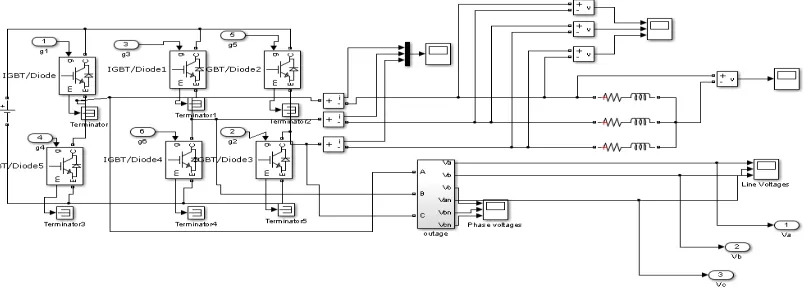
Figure 1: Three Phase bridge inverter
ISSN (Print) : 2320 – 3765 ISSN (Online): 2278 – 8875
I
nternational
J
ournal of
A
dvanced
R
esearch in
E
lectrical,
E
lectronics and
I
nstrumentation
E
ngineering
(An ISO 3297: 2007 Certified Organization)
Vol. 3, Issue 11, November 2014
The other two vectors V0 and V7 are called inactive vector, because all switches will be off or on. The basic principle of
SVPWM is based on the eight switch combinations of a three phase inverter. The switch combinations can be represented as binary codes that correspond to the top switches S1, S3 and S5 of the inverter as shown in fig. Each switching circuit generates three independent pole voltages , .[1][2]
The three phase inverter is therefore controlled by six switches and eight inverter configurations. The eight inverter states can be transformed into eight corresponding space vectors. In each configuration the vector identification uses a ‘0’ to represent the negative phase voltage level and a ‘1’ to represent the positive phase voltage level. The relationship between the space vector and the corresponding switching states is shown in figure. In addition, the switches in one inverter branch are in controlled in a complementary fashion (1 if the switch is on and 0 if it is off). [3][4]
Figure 2: Eight Switching Configuration
Here orthogonal coordinates used to represent the three phase two level in the phase diagram.There are eight possible inverter states that can generate eight space vectors. These are given by the complex vector expressions.[5]
III. SIMULATION
ISSN (Print) : 2320 – 3765 ISSN (Online): 2278 – 8875
I
nternational
J
ournal of
A
dvanced
R
esearch in
E
lectrical,
E
lectronics and
I
nstrumentation
E
ngineering
(An ISO 3297: 2007 Certified Organization)
Vol. 3, Issue 11, November 2014
10.15662/ijareeie.2014.0311024
3.2 Sector Implementation
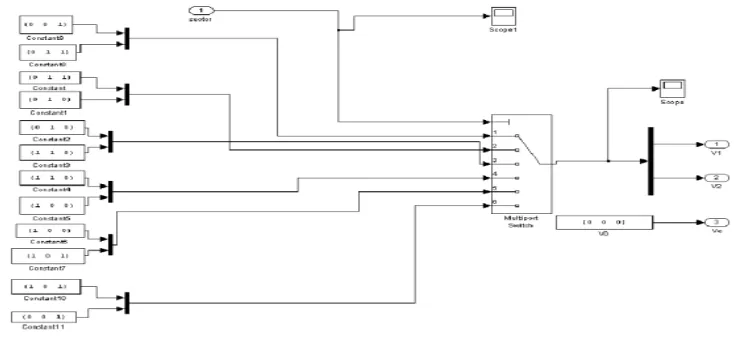
In Figure 4 Sector Implementation has been shown. As it can be seen that there is six sectors are formed .
Figure 4: Sector Implementation
3.3 Vector Implementation
In figure 5 Vector implementation is shown and output can be visualize on scope. Results of this is shown in section IV. This a model of Vector Implementation using MATLAB and output can be Visualized using Scope.
Figure 5: Vector Implementation
III. RESULT ANALYSIS
4.1 Simulation Results of Current of Space Vector Pulse Width Modulation Inverter
ISSN (Print) : 2320 – 3765 ISSN (Online): 2278 – 8875
I
nternational
J
ournal of
A
dvanced
R
esearch in
E
lectrical,
E
lectronics and
I
nstrumentation
E
ngineering
(An ISO 3297: 2007 Certified Organization)
Vol. 3, Issue 11, November 2014
Figure 6: Current Waveform for the time period from 0 to 0.2 seconds
4.2 Simulation Results of Line Voltage of Space Vector Pulse Width Modulation Inverter:
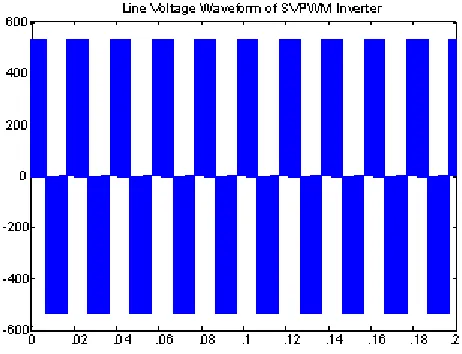
In the Figure 4.13 waveform of Line Voltage Vao, Vbo, Vco is Shown . It is also shown in figure that Peak to
Peak Voltage is 450 volt and it is shown on the Y axis and x axis represent the time period from 0 to .2 seconds.
Figure 7: Line Voltage Waveform for from the time period 0 to 0.2 seconds
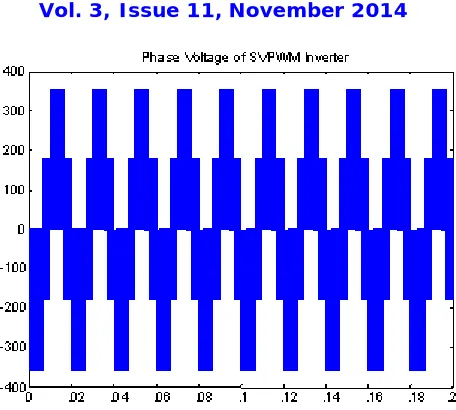
4.3 Simulation Results of Phase Voltage of Space Vector Pulse Width Modulation Inverter:
ISSN (Print) : 2320 – 3765 ISSN (Online): 2278 – 8875
I
nternational
J
ournal of
A
dvanced
R
esearch in
E
lectrical,
E
lectronics and
I
nstrumentation
E
ngineering
(An ISO 3297: 2007 Certified Organization)
Vol. 3, Issue 11, November 2014
10.15662/ijareeie.2014.0311024
Figure 8: Phase Voltage Waveform from the time period 0 to 0.2 seconds
4.4 FFT Result (Analysis) of Line Voltage of Space Vector PWM Inverter
In the figure 4.17 FFT analysis of Line Voltage of SVPWM inverter is shown from the analysis it is clear that total Harmonic distortion is 67.18.
Figure 9: FFT result analysis of Line Voltage waveform of Space Vector PWM Inverter
4.5 FFT Result (Analysis) of Phase Voltage of Space Vector PWM Inverter
ISSN (Print) : 2320 – 3765 ISSN (Online): 2278 – 8875
I
nternational
J
ournal of
A
dvanced
R
esearch in
E
lectrical,
E
lectronics and
I
nstrumentation
E
ngineering
(An ISO 3297: 2007 Certified Organization)
Vol. 3, Issue 11, November 2014
Figure 10: FFT result analysis of Phase Voltage waveform of Space Vector PWM Inverter
4.6 FFT Result (Analysis) of Current of Space Vector PWM Inverter
In the figure 4.21 FFT analysis of Current of SVPWM inverter is shown from the analysis it is clear that total Harmonic distortion is 4.11.
Figure 11: FFT result analysis of Current of SVPWM Inverter
V. CONCLUSION
ISSN (Print) : 2320 – 3765 ISSN (Online): 2278 – 8875
I
nternational
J
ournal of
A
dvanced
R
esearch in
E
lectrical,
E
lectronics and
I
nstrumentation
E
ngineering
(An ISO 3297: 2007 Certified Organization)
Vol. 3, Issue 11, November 2014
10.15662/ijareeie.2014.0311024
REFERENCES
[1] Shao-Liang An, Xiang-Dong Sun, Member, IEEE, Qi Zhang, Yan-Ru Zhong, and Bi-Ying Ren, “Study on the Novel Generalized Discontinuous SVPWM Strategies for Three-Phase Voltage Source Inverters”, IEEE Transactions on Ind. App., Page No. 781-789, May-2013. [2] Keliang Zhou and Danwei Wang, Member, IEEE,“Relationship Between Space-Vector Modulation and Three-Phase Carrier-Based PWM”,
IEEE Transactions on Ind. App. Vol. 49, No. 1, Page No. 186-196, FEBRUARY-2002.
[3] Atif Iqbal, Adoum Lamine, Imtiaz Ashraf Mohibullah, “MATLAB/SIMULINK Model of space vector pulse width modulation for three phase voltage source inverter”, Liverpool John Moores University, UK.
[4] B.Kumara Swamy, P.NageshwarRao, “Simulation Of A Space Vector PWM Controller For A Three-Level Voltage-Fed Inverter Motor Drive”, International Journal Of Advanced Trends In Computer Science And Engineering Vol.2 , No.1, Pages : 363 - 372 (2013) Special Issue of ICACSE 2013
[5] Mustafa A. Al-Refai “Matlab/Simulink Simulation Model for Direct Torque Control Based On Space Vector Modulation (DTC-SVM) of Induction Motor Drive”, International Journal of Electrical and Electronics Engineering (IJEEE), World Academy of Science, Engineering and Technology ,February-2013
[6] Y. vijayanandi, U.Sree Krishnakanth, Rajesh Kumarr & K. Laksmi Ganesh4 “New multilevel Cascaded PWM inverter topology for hybrid Electrical Vehicle Drive” International Journal of Electrical and Electronics Engineering (IJEEE) , May-2013
BIOGRAPHY
Mr. Himanshu Doraya is PG student [Power System] at the Department of Electrical & Electronics Engineering, RIET, Jaipur, India.
Miss. Richa Parmar is an Assistant Professor at the Department of Electrical Engineering, RCEW, Rajasthan Technical University, Jaipur, India.
Mr. Mal Chand Sharma is an Assistant Professor at the Department of Electrical & Electtronics
Engineering, RIET, Rajasthan Technical University, Jaipur, India.