Journal of
Volume 7 Number I January 1954RANGE
MANAGEMENT
Editorial
Boom and Bust
F great concern to livestock producers, and in no smaller degree to range managers, is the chaotic livestock market of recent months. In a period of less than two years market values have been cut in half and livestock owners have experienced a loss in inventory value of approximately seven bil- lion dollars. What is apt to be for- gotten is that in the preceding five years the inventory value of live- stock on farms had increased by a like amount.
A quick review of this boom period might yield a few clues leading to the current bust. Follow- ing the close of the shooting phase of World War II agriculture gener- ally found itself geared to a produc- tion rate 25 % in excess of domestic and normal export requirements. Immediate outlets were available for the excess in supplying the needs of the war-torn nations abroad but this was believed to be very tem- porary. Agricultural producers con- sequently began making adjust- ments toward a normal market situation.
Wartime experience indicated ’ that livestock products generally offered some opportunity for ex- pansion without serious disruption of the price structure. High labor and machinery costs caused many producers to turn to a livestock program with particular emphasis on the use of improved pastures. Simultaneously the reclamation of abandoned farm land throughout the Southeastern United States was making available for use mil- lions of acres of new pasturage. The
demand for stock cattle to utilize these new pasture acreages was an important factor in maintaining a stable livestock market in the early post-war years. With the outbreak in Korea the boom was on in earnest. Livestock intended by the original producer to go to slaughter found country buyers outbidding packers, slaughter was reduced, meat prices began to rise, livestock prices followed, and the inflation spiral grew until producers and markets appeared to lose sight of intrinsic values.
History tells that the cattle boom of the 1880’s was broken by drouth and two successive hard winters. Each succeeding cycle in the livestock population except that of 1937-1945 has been termi- nated by drouth or some similar situation where producers found themselves overstocked. Whenever such a situation existed over a considerable area, liquidation meant distressed prices, loss of confidence and a nation-wide demoralization of the agricultural economy.
The boom phase of the livestock cycle violates the basic concepts of sound range management. Failure to stock within sustained yield grazing capacities, to provide a seasonable balance in forage sup- plies, and to maintain adequate feed reserves will always lead to disaster sooner or later and this is the crux of the present situation.
In 1952 drouth conditions in the Southeast led to distress selling of poorly conditioned livestock ; at- tempts to import feed to maintain a nucleus of breeding stock dis-
rupted the feed situation in other areas. An intensification of the normal drouth condition of the Southwest triggered the real break in livestock prices. A considerable increase in the slaughter of the lower grades of meat animals weakened the price structure of all classes of dressed meats. Failure of retail outlets, including public eat- ing places, to adjust prices in step with those of livestock and of whole- sale dressed meat prevented the increased offering from moving into consumption until by January 1953 prices on all grades of livestock were steadily declining at an alarm- ing rate.
In the current year consumption has been increased and storage holdings of meat are now consider- ably below the recent normal. There is every indication that should weather conditions improve and a reasonable balance between pasture forage and livestock numbers be restored market conditions will quickly right themselves. However those who believe in weather cycles predict that drouth conditions may prevail through 1954. As long as forced liquidation continues any sustained strength in prices is unlikely.
How can individual producers meet the current situation?
1.
2.
3.
4.
If
Adjust livestock inventories to available feed.
Maintain quality in breeding stock.
2 EDITORIALS
might never have occurred. Uni- versal application of those prin- ciples might well prevent the future reoccurrence of the discouraging economic plight facing many opera- tors today and, what is more important, should avoid the ac- celerated damage to land resources which always accompanies over- stocking.
W
ITH this issue the Journal of Range Management takes on a “new look” in format, size and general appearance. In taking this step to the larger type page, the Journal is. following the trend in modern periodicals toward a more versatile medium of expres- sion. The ’ new larger 3-column format provides and combines effi- cient and economical use of space with a compact type page, read- ability and “eye-appeal” through diversity in arrangement of illus- trative materials, and improved facilities for the use of the Journal as an advertising medium. The adaptability of the new form allows for a wider selection in size of tables and illustrations. The large trim size increases by nearly 50% the text content per page as com- pared with the former Journal. Increased revenues through adver- tising are made possible by the provision of the standard page size for cuts and layouts used by most advertising concerns. Printing costs for journals of the two sizes do not differ greatly. The added advan- tages of versatility in make-up and the possibilities for increased reve- nue through advertising were prime factors in the selection of the newThe foregoing is a challenge to the American Society of Range Management. The Society has a responsibility to develop acceptable standards of Range Management and to speed up their adoption by range users. As individuals and as a unit there is an opportunity to render invaluable service in educa- tion which will terminate the
The New Journal
style by the Editorial Board and the Board of Directors.
We believe that the choice of the large-sized format represents a for- ward step for the Journal of Range Management in keeping with the progress made since its inception in 1948. The strong foundations laid by the previous editors, Harold H. Biswell, Robert S. Campbell and Joseph F. Pechanec and their co- workers are a tribute to their persevering work and a standard of excellence for the present editorial staff. With these mechanical changes in make-up, the Journal should be in a strengthened position for con- tinuing development in serving the interests of grazing land manage- ment.
To adequately fulfill its mission the Journal of Range Management should strive continually to broaden its scope and improve the quality of its contents. A growing journal is one which provides a maximum of reader satisfaction through its choice of pertinent, well-written articles of lasting value expressed in terms understandable by the technical and practical man alike.
Presentation of current news and viewpoints of members represents an integral function of a professional journal. Members of the Range
boom-and-bust system of economics in the livestock industry and in so doing will help posterity to some small degree by preventing per- manent damage to the basic re- sources of soil and water.-George E’. Weaver, Pinecroft Ranch, Liver- more, Colorado (formerly Produc- tion and Marketing Administration, U. S. Dept. of Agriculture.)
Society are encouraged to make the Journal a vehicle for news and comment on current items of in- terest. Personal news items such as transfers, promotions, and partici- pation in organizational activities are solicited for inclusion in the News and Notes Section. The Jour- nal should also provide a forum for the expression of viewpoints of the society members on matters of general interest. In subsequent issues opportunity will be provided for the publication of such comment and opinion in a Letters to the Editor Section.
2 EDITORIALS
might never have occurred. Uni- versal application of those prin- ciples might well prevent the future reoccurrence of the discouraging economic plight facing many opera- tors today and, what is more important, should avoid the ac- celerated damage to land resources which always accompanies over- stocking.
W
ITH this issue the Journal of Range Management takes on a “new look” in format, size and general appearance. In taking this step to the larger type page, the Journal is. following the trend in modern periodicals toward a more versatile medium of expres- sion. The ’ new larger 3-column format provides and combines effi- cient and economical use of space with a compact type page, read- ability and “eye-appeal” through diversity in arrangement of illus- trative materials, and improved facilities for the use of the Journal as an advertising medium. The adaptability of the new form allows for a wider selection in size of tables and illustrations. The large trim size increases by nearly 50% the text content per page as com- pared with the former Journal. Increased revenues through adver- tising are made possible by the provision of the standard page size for cuts and layouts used by most advertising concerns. Printing costs for journals of the two sizes do not differ greatly. The added advan- tages of versatility in make-up and the possibilities for increased reve- nue through advertising were prime factors in the selection of the newThe foregoing is a challenge to the American Society of Range Management. The Society has a responsibility to develop acceptable standards of Range Management and to speed up their adoption by range users. As individuals and as a unit there is an opportunity to render invaluable service in educa- tion which will terminate the
The New Journal
style by the Editorial Board and the Board of Directors.
We believe that the choice of the large-sized format represents a for- ward step for the Journal of Range Management in keeping with the progress made since its inception in 1948. The strong foundations laid by the previous editors, Harold H. Biswell, Robert S. Campbell and Joseph F. Pechanec and their co- workers are a tribute to their persevering work and a standard of excellence for the present editorial staff. With these mechanical changes in make-up, the Journal should be in a strengthened position for con- tinuing development in serving the interests of grazing land manage- ment.
To adequately fulfill its mission the Journal of Range Management should strive continually to broaden its scope and improve the quality of its contents. A growing journal is one which provides a maximum of reader satisfaction through its choice of pertinent, well-written articles of lasting value expressed in terms understandable by the technical and practical man alike.
Presentation of current news and viewpoints of members represents an integral function of a professional journal. Members of the Range
boom-and-bust system of economics in the livestock industry and in so doing will help posterity to some small degree by preventing per- manent damage to the basic re- sources of soil and water.-George E’. Weaver, Pinecroft Ranch, Liver- more, Colorado (formerly Produc- tion and Marketing Administration, U. S. Dept. of Agriculture.)
Society are encouraged to make the Journal a vehicle for news and comment on current items of in- terest. Personal news items such as transfers, promotions, and partici- pation in organizational activities are solicited for inclusion in the News and Notes Section. The Jour- nal should also provide a forum for the expression of viewpoints of the society members on matters of general interest. In subsequent issues opportunity will be provided for the publication of such comment and opinion in a Letters to the Editor Section.
Range Resources and Their Manage-
ment in British Columbia
E. W. TLSDALE,’ A. MCLEAN AND S. E. CLARKE Professor and Head, Range Management, College of Forestry, University of Idaho; Agrostologist in charge forage research, Canada Range Experiment Station, Kamloops, B. C.; and re- tired, formerly in charge pasture and forage crop studies, Canada Experiment Station, Swift Current, Saskatchewan.
T
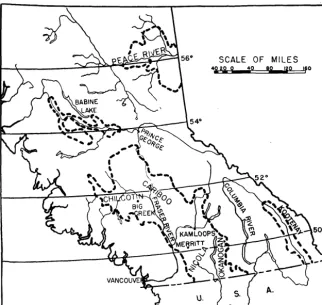
HE production of range live- stock is one of the important but lesser-known industries of Brit- ish Columbia, a province better known for such products as timber, minerals and fish. In the interior section of the province, ranching constitutes a major form of land use and permits stable settlement of large areas which cannot support more intensive forms of agriculture. The population of beef cattle and sheep, most of them on the range areas, was 272,000 and 106,000 respectively in 1952. This livestock population constitutes an important source of livestock products, but does not meet the total needs of the province, and considerable amounts are imported annually from the Canadian plains region.Description of the Area Most of the range lands of British Columbia are situated between the Rocky Mountain System on the east and the Coast Range on the west. The southern portion of this region, extending from the United States border about 250 miles north to the vicinity of Lat. 53” contains the bulk of the grazing lands, although an appreciable area occurs farther north and east in the Peace River section (Fig. 1). The grazing resource consists of about 3 million acres of native grasslands, and an area of forested range estimated at 10 to 12 million acres. The major grassland areas are found in the Chilcotin, Fraser,
1 Formerly oficer-in-charge, Range Ex- perimental Sub-Station, Kamloops, B. C., jrom 1936-41.
Thompson, Nicola and Okanagan Valleys. The timber ranges occur at higher elevations throughout the region. Smaller areas of alpine range occur on some of the interior mountains.
Topographically, the main range area is situated in the southern portion of .the Interior Plateau. This formation originally was com- parable to the Columbia Plateau of eastern Washington and Oregon. Subsequent uplift and erosion have produced a topography marked by a series of irregular plateaus sepa- rated by broad, deep valleys and interspersed in places by mountain ranges. The general plateau level varies from about 5,000 feet above sea level in the southern portion to 3,000 feet near the northern bound- ary of the range area. The valley bottoms range from 600 to slightly over 2,000 feet in elevation. Drain- age is mainly to the west, through the Fraser River and its tributaries.
The climate is determined to a large extent by the presence of a mountain barrier to the west and by the rugged topography of the region itself. The whole area is relatively dry because of the “rain shadow” effect of the Coast Moun- tains. In addition, local climate is strongly affected by differences in elevation and exposure. The valleys are dry and relatively warm considering their latitude, while at higher elevations there are marked increases in precipitation and de- creases in temperatures. About half the annual precipitation occurs in the late fall and winter months, while a second maximum occurs in
3
May and June. The frost-free season is relatively long in the valleys of the southern portion, but becomes a limiting factor in the more north- erly valleys and at higher elevations throughout the region. Climatic data for representative stations are presented in Table 1. The data give some idea of the variation of climatic conditions occurring within the region, but few records are available for the higher elevations.
The soils have been formed mainly from glacial materials, as the whole area was covered by the Pleistocene ice sheet. The soils commonly contain a high propor- tion of the native rock, and rock outcrops are common. Over most of the region, however, the soil mantle is relatively deep and well developed. Textures vary widely, with sandy loams most common. The grasslands soils fall into three main zonal groups, namely, Chernozems, Chestnut and Brown. These soil groups differ consider- ably in depth to the lime layer and in the organic matter content of the A horizon. The forest soils also include several zonal groups, but these have not been fully classified. The lightly-leached soils of the more open forests which support a vigorous undercover of herbaceous and shrubby species are most pro- ductive from the range standpoint. At’ high elevations in the spruce- fir openings and on the alpine ranges, the soils are of the “moun- tain meadow” type, high in humus.
Native Vegetation and Range Types Most of the vegetation can be classified into a few major zones which correspond to the soil zonal groups. Due to the rugged topog- raphy, much of the vegetation oc- curs in a series of elevational bands.
Grassland Ranges
4 TISDALE, MCLEAN AND CLARKE
FIGURE 1. Outline map showing location of major range areas (inside broken
line) in British Columbia.
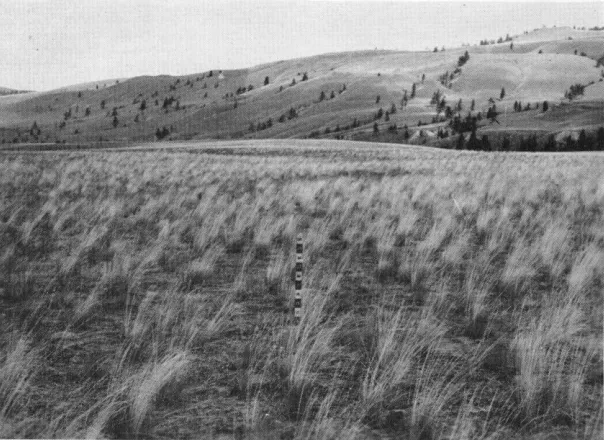
The grasslands belong to the bunch- grass type of the Pacific Northwest. Three distinct zones are recognized, differing in botanical composition, forage yield, season of use and reaction to grazing. Bluebunch wheatgrass (Agropyron spicatum), the principal grass of the region is a dominant in all three zones but the associated species differ con- siderably.
The wheatgrass-sagebrush (Lower Grassland) zone occurs in the val- leys at elevations up to 2,000 feet
approximately, and has the driest and warmest climate in the region. The brown soils support a rela- tively sparse vegetation of blue- bunch wheatgrass and other bunch- grasses and big sagebrush (Artemisia tridentata). This range type is well suited for early spring and late fall grazing, and where sufficient acre- age is available, for winter use as well. With overuse sagebrush in- creases at the expense of the bunch- grasses and grazing capacity de- clines greatly. In depleted areas,
Table 1. Climatic data for stations in interior British Columbia
Station Range
Type
McCulloch Spruce-fir 50 Knouff Lake Douglasfir 51 Big Creek Douglasfir 52 Merritt Grassland 50 Kamloops Grassland 51 Keremeos Grassland 49
Lat. Elev.
(degrees) (feet) 4100 3750 3100 1940 1260 1165
Av. Annual Precip.
Total 2;tT ___ _~
(inches) (inches) 26.1 11.4 14.8 7.7 12.0 7.1 8.9 3.6 10.2 5.5 9.8 4.9
Mean Temp.
Jan. July
(deg. F.) (days) 4
- 13 22 22 25
55 -
- -
60 51 64 121 70 170 71 184
sagebrush may comprise almost the entire cover, while destruction of this species by fire leads to domi- nance by cheatgrass (Bromus tec- torum). This introduced annual supplies spring range, but for a shorter season and less reliably than do the perennial grasses.
The wheatgrass-bluegrass zone occurs at elevations of about 2,000 to 2,700 feet, and is slightly cooler and moister than the wheatgrass- sagebrush type. The vegetation, where not altered by misuse, con- sists mainly of bluebunch wheat- grass, Sandberg bluegrass (Poa secunda) and a number of forbs. Sagebrush is absent or rare and the only common shrub is rubber rabbitbrush (Chrysothamnus nauseo- sus). This zone is suitable for spring-fall grazing. With heavy use, the wheatgrass is often replaced by needlegrass (Stipa comata). Con- tinued overgrazing results in a cover consisting mainly of cheat- grass and weedy forbs.
The wheatgrass-fescue (Upper Grassland) zone occurs at elevations of 2,700 to 3,300 feet or more and represents the most highly de- veloped and productive of the grass- land types. The principal climax species are bluebunch wheatgrass and rough fescue (Festuca scabella). In addition, there is an abundance of forbs including yarrow (Achilles), fleabane (Erigeron) , lupines (Lupi- nus) and balsamroot (Balsamor- hixa). This type is best used as late spring and early fall range.
The first change resulting from heavy use usually is replacement of wheatgrass and fescue by other perennial grasses, especially Co- lumbia needlegrass (Stipa colum- biana) and Kentucky bluegrass (Poa pratensis). Continued overuse results in a weedy cover dominated by unpalatable perennial forbs and a number of annuals including cheatgrass.
grassland types is contained in Table 2.
Forest Ranges
The forest grazing types occupy a much greater area than the grass- lands. In port,ions of t,he region the
livestock populations do not fully
utilize the available acreages of
forest range. The forest, ranges fall naturally into three zones, namely,
ponderosa pine, Douglasfir and
SplU%fir.
The pondeross pine xonc is
limit,ed in extent, occurring mainly as a fringe along thr lower edge of the forested lands. Often the transi-
tion between the ponderosa pine
and Douglasfir types is as extensive as the pine zone it,nelf. The rrell-
developed undercover veget,ation
resembles that of the grasslands.
The principal species include blue- hunch \vh&;Smss, .Jnnegruss (Kur- &a cristafn), rough fescue, nlbher
rabbit,brush a?d several perennial
forbs. This type is valuable for lat,e spring and fall use. It has a grazing rapscit,y, whey1 in good r”nditi(m, of about 2.5 acres per A.U.M. (animal unit month).
The esteA\e Douglasfir zone
supplies most “f the forest grazing. Soil moisture is usually adrquat,e
for growth throqhout, the summer
molths but, temperat,ures limit the
growing season t” 3 m”nt,hs or
less. The wil is R yellowish-hrovn p”:lAic t,ype, wither hi:ghly leached nor st,rongly arid.
The rlimas tree C”VFI’ consists
m%itrly of I1ouqlasfir (I’neudutu7qn
t&f&z) but, due to videsprrad fires, a large part of the zone is now
occupied by lodgepole pine (Pinus
conlorta var. lat<folia) and aspen
(Populus trrmuloidrs). Disturbance
hy fire has had a marked influence on grazing ralnrs. Areas dominated hy aspen usually possess a bctt,rr forage cover than thr)sr with con- fers, while sites “wupied by dense
young stands of either pine or
Douglasfir pro&Ire almost no for- age.
Over much of the zone the tree stand is relatively “pen, and there
is a well-dcveloprd underrover of
hrrbs and shrubs. The principal
grass is pinegrass (Calamagrostis
ruhescens), while many bmadleaved plants, including: vetch (Vi&),
peavine (Lathpus), aster (Ask),
wild rose (Kosa) and willow (S&z) provide valuable forage. Because “f the shortness of the frost,.free axson
and the rapid deterioration of
forage in t,he early fall, t,he season of use in this zone is from mid-
June to the end of September.
Grazing capnrit,y of good wndition range averages about 4 acres per A.17.M. With t,oo heavy use there
is a marked derline in the more
palatable species, esprrially among the forhs.
The third forest e”ne is the
SpW-fir, situated above the Douglasfir zone in a climate that is
~“1 and relatively moist with a
short, graving season. The spruce- fir t,ype is extensive hut grazing is
limited largely to meadow and
openings. The t,ree cover is relatiwly dense, and the soils are acid and
highly learhed. The undercover is
sparse and ronsists mainly “f low
shrubs swh as bhlrberr>~ (Vac-
cinium) along wit,h mosses and
lirhens. The prodwtion of forage
sprcies is usually too Ior\- to warrant
grazing use. In the meadow t,he
~WWL consists of sedges and, in t,he
drier openings, intermediate “at,-
grass (Dnnthonia in/ermedi,z). Herb-
nge production is high with an
average grazing rapacity estimnted at 1 8rre per A.IJ.M.
G TISDALE, McLEAX AND CLARKE
above G,500 feet and are vherar-
teriaed by an extremely short
growing season. The vegetation of
alpine grasses, sedges and forhs has received little detailed study. Graa- ing use is mainly by sheep during a short mummer period.
Nutritive Value and Palatability of the Range Forage
To date, evaluations of the
quality of range forage in Bridish
Columbia have been confined to
chemiral analyses. While surh meth- ods fall short, of revealing true nutritive value, they furnish rom- parative ratings for different species. Analyses of t,he prinripal species of the grassland ranges show a high nutrient ront,ent in the early growt,h
stages. The average for 6 major
grasses in the leaf stage w&s found to be 16 percent crude pro&in,
0.24 pa-tent phosphorus and 0.47
percent calcium. Marked changes
occur as the plants mat,ure, and
the (wed grass available for fall
and vinter use is low in protein
and phosphorus. In many pa& of
Interior British Columbia, phos-
phorus supplementation during the
winter months has proved hene-
ficial. There is some evidence that
deficiencies of vitamin A may also orcur in areas where cured forage is
the only feed available for long
periods.
On the forest ranges, the nutri- tional situation is strongly affect,ed by season of use. Since these ranges are grazed in the summer, t,he forage species are taken mainly in early growth &ages when nutrient ron- tent, is high. Grazing durirrg this period, ooupled with the orcurrence
of many high quality forb and
bro\vse species, offset the poor
quality of pinegrass forage. Pinc-
grass in this region averages 11
perrent crude protein and 30 percent crude fiber in the leaf stage.
No detailed data are available for the gains of livestock on the grass- lands, but weights of animals off grass indicate nutritive value com-
parable to that of Great Plains
ranges. On timber ranges, studies at
the Kamloops Experiment Station
from 1938 to 1940 show gains of 2 pounds per head per day for 2. year old steers and heifers during late June, duly and August. Gains dropped off sharply in September, \yith wring of the forage.
Although ratings of livestock
preferenrt? hare not, heen worked out
for all species, considerable informa- tion exists concerning the principal plants. On the grasslands, most of
the grasses including the wheat-
grasses, fescues and needlegrasses
are eaten readily, especially by
cattle. Sandberg bluegrass and
cheatgrass are highly palatable wheu young and green, hut uot when cured. Most of the forbs are low in palatability for rattle, but are used to a greater extent by sheep. Rubber
rabbitbrush is hrorsed lightly in
winter, while big sagebrush is eaten little at any time.
On the timber ranges, the highly-
preferred species are prinripally
forbs such as peavine, vetch and
asters. Several shrubs, including
rose and willow are also grazed readily. Piuegrass has only B moder- ate palatability rat,ing. Stock take this species in increasing amounts late in the grazing season, as the
supply of more palatable forage
becomes depleted.
The Ranching Industry History
The range livestork industry in
British Columbia owes it,s start to the disrovery of gold in the Cariboo area in 185% The demands of the miners ,x-we met first by trailing rat,& in from the Cuited States.
Soon ranrhes were established in
the area itself, and the livestork industry continued to dcvclop after gold mining artivity declined in the
late 18GO’s. Growth \vas further
stimulated by the completion of the
transcontinental railroad in the
early 1880’s. After heavy losses of
liycstock had occurred in severe
winters between 1879 and 1897,
the growing of wiuber feed hecame
general practice and helped to
stabilize the industry.
In the early years, the grasslands
alone provided abundant feed for
the livestock population, but by
1900 all readily available ranges
RANGE RESOURCES OF BRITISH COLUMBIA 7
virtually no use was made of the timber ranges. The effects of over- stocking and season-long grazing soon began to show in the form of lowered grazing capacity and in- crease of weedy species. Cheatgrass entered the region about 1915 and spread over large areas.
The shortage of grassland range has led to an increasing use and development of timber ranges for summer grazing in recent years.
Administration
A large portion of the open grass- land range is in private ownership or is held under renewable 21-year leases. The grazing leases are issued by the Lands Service of the De- partment of Lands and Forests. Some of the holdings are of large size, the largest being the approxi- mately 150,000 acres owned by the Douglas Lake Cattle Company. Most were acquired in the early days of settlement.
Some of the grassland and most of the forested ranges remain as unalienated Crown lands. These lands are administered by the Forest Service of the Department of Lands and Forests. Grazing use is on a permit basis. The area of these lands is divided into grazing districts for administrative purposes and further subdivided into stock ranges and grazing units. Permittees on each stork range are encouraged to form livestock associations which act in an advisory capacity on grazing use and problems. Actual administra- tion is in the hands of the District Foresters and their range manage- ment personnel. Grazing fees are based on a sliding scale in relation to livestock prices and take the form of a monthly charge per head of livestock. The rates for 1953 were 18 cents per head per month for cattle, 2235 cents for horses, and 3>i cents for sheep. Half of all grazing fees is used for range im- provements such as trails, fences, development of watering places and reseeding.
An extensive grazing survey is being carried on by the grazing staff of the Forest Service. Approxi- mately 600,000 acres are surveyed annually. Adjustments in rate of stocking and in livestock distribu- tion are made in accordance with the findings of these surveys.
Livestock Management and Grazing Practices
In the average ranch operation, the grasslands are grazed in spring and fall, the timber ranges in sum- mer and a combination of meadow and range grazing with supple- mentary feeding provides winter forage.
Spring turn-out time varies with local conditions. In the Kamloops district, the grazing season starts about mid-April when the lower ranges are ready for use. The ani- mals move upward into the higher grassland zones as the forage de- velops and usually reach the wheat- grass-fescue zone near the end of May. The timber range is ready for use by mid-June and supplies good forage until the end of September. Even on the forested ranges the grazing period varies with altitude, and the livestock are generally drifted up to higher elevations during the summer as the feed becomes dried out or depleted in the lower areas.
Cattle graze mainly in the Douglasfir zone and the meadows of the spruce-fir. Sheep are grazed on the open forest and meadows of the spruce-fir and alpine zones, reach- ing the latter about mid-July. All livestock are usually brought back to grassland ranges by late Septem- ber or early October because of danger from storms at the higher elevations, and the seasonal decline in quality of forage on the timbered areas. The stock are then shifted to the winter ranges and meadows until feeding becomes necessary due to forage depletion or heavy snows. In the early ranching days in this area, stock usually grazed out
all winter and did well. Now many ranches lack adequate winter range. This deficiency in winter forage combined with the practice of selling fat beef on the summer market result in a feeding period which averages 4 months (December through March) in the southern part of the region and about 2 weeks longer in the northern por- tion.
In districts containing major valleys, the livestock are wintered on the benches and meadows, where climatic conditions are favorable and feed supplies handy. This situa- tion prevails over most of the southern part of the ranching area. Further north, in the Cariboo and Chilcotin districts, favorable winter- ing spots are less common and many livestock are wintered on native meadows above the 3,500 foot level. In these areas, the hay is cut and cattle graze on the aftermath until snow depth makes feeding necessary.
Range Problems
The diversity of climate, soils, topography and vegetation in the region results in a number of prob- lems facing the range user and the range technician. Only a few of the outstanding problems are discussed here.
On the grasslands poor range condition and the consequent reduc- tion in grazing capacity are major problems. Some grassland ranges are in good condition but other areas have been reduced to a cover of perennial or annual weedy spe- cies. The reduction in grazing ca- pacity on these ranges is particularly serious since the grasslands are usually the limiting factor in the yearlong ranch operation. The resto- ration of depleted grasslands by natural renovation or by artificial revegetation is a major manage- ment objective in the region.
8 TISDALE, MCLEAN AND CLARKE
Large areas have been rendered inaccessible due to deadfall condi- tions, produced mainly by the killing of stands of lodgepole pine by bark beetles (Den&&onus) or by fire. Not only are such areas spoiled for grazing, but often they hinder movement of stock to better ranges. Another problem is that caused by the e&roachment of tree or shrub cover on areas for- merly dominated by herbaceous species. In many cases this en- croachment appears to be the result of normal plant succession in areas where the woody plant cover had been previously removed by fire. The utilization of insect-killed forest areas and the maintenance of graz- ing capacity on ranges of increasing tree and shrub growth are becoming acute problems in parts of the re- gion.
Poisonous plants are a definite problem. They cause an estimated
14 percent of all cattle losses. On grassland ranges, low larkspur (Delphinium bicolor) and death camas (Zygadenus venenosus) are the principal offenders. The larkspur menace can usually be met by de- ferred use of areas with heavy in- festations and sometimes by herd- ing the cattle during critical periods. The period when the plant is at- tractive to stock is a short one, but comes during the spring grazing period on the upper grassland ranges. Death camas is a problem only to sheep outfits. Recognition and avoidance of large patches, and care in trailing and bedding can do much to cut losses. Plants of low-lying areas that cause occasional losses include poison hemlock (Ci- cuta douglasii) and arrowgrass (Tri- glochin maritima) .
The most serious poisonous plant of the area is timber poisonvetch (Astragalus serotinus). This native herb occurs in the wheatgrass- fescue, ponderosa pine, and Douglas- fir zones. In grasslands, this plant rarely causes trouble except on areas where good forage is lacking.
On timber ranges, the plant is eaten readily during the early part of the grazing season but becomes un- palatable at maturity. Various forms of paralysis and respiratory disturbances are shown by affected animals. Emaciation is common, and in severe cases death may occur. The handling and control of livestock on the rugged ranges of Interior British Columbia present problems absent in areas of more gentle topography. Management of breeding stock is difficult since many breeding herds are on forest ranges for at least part of the breeding season. No doubt this partly ac- counts for the relatively low calf crop, which was found to average only 55 percent in a study made during the period 1933-1940. On many ranches the calf crop has since been increased much above this figure by good management practices, including careful selection and proper distribution of bulls and the use of breeding pastures. In the Tranquille herd used for range studies by the Kamloops Station from 1935 to 1939, the calf crop was increased from 50 to 90 percent by application of the above meas- ures.
Other problems assume major importance in certain districts or in particular years. The paralysis tick (Dermacentor andersoni) is common on grassland ranges in some of the southern districts. These ticks cause occasional losses of livestock and when abundant may delay spring grazing.
Grasshoppers have reached epi- demic proportions on the grassland ranges several times since ranching began in the region. The increase of species which cause the most damage is favored by overgrazing, while the insects themselves show much the same forage preferences as do livestock.
Range Research
Research on range problems in British Columbia is carried on
principally by the Federal Govern- ment, through the Canada Range Experiment Station at Kamloops. Close cooperation is maintained with provincial agencies, including the University of British Columbia. The research program was started in 1935 when a range experimental sub-station was established at Kam- loops. The work was set up on a cooperative basis with the pro- vincial government. Cattle of the Tranquille Sanatorium near Kam: loops were used as the experimental herd. The disbanding of this herd in 1940 and war-time economy moves by the federal government resulted in closing of the sub-sta- tion. In 1946, steps were taken which led to the re-establishment of research facilities and in 1947, the Canada Range Experiment Station was established at Kamloops. A full program of research on problems of the range livestock industry is underway.
Summary
The range resources of British Columbia include 3 million acres of grassland and 10 to 12 million acres of forested range. The main range area is located in the southern interior section of the province. The area is one of rugged topog-
raphy ,
with great variation inclimate, soils and vegetation. The grassland ranges belong to the bunchgrass type and include three well-defined zones differing in plant cover and grazing capacity. The t,imber range is mainly in the Douglasfir zone, much of which is now occupied by Iodgepole pine or aspen.
.
RANGE RESOURCES OF BRITISH COLUMBIA 9
the grassland ranges in spring, and on timber ranges from June through August.
The grassland ranges supply the spring-fall and some winter graz- ing, while the timber ranges are used for summer range. Stock are wintered mainly on valley ranges and on cultivated or native meadows.
Most of the grasslands are pri- vately owned, but the forest ranges are largely on public lands, ad- ministered by the Provincial De- partment of Lands and Forests. Grazing is on a permit basis and half the fees are used for range im-
provement .
Current problems include the poor condition of large areas of grassland and the decrease of forage on timber ranges due to deadfall and/or thickening of the tree and shrub cover. Poisonous plants are of importance over much of the area. Research on these and other range problems is under way at the Canada Range Experiment Station located near Kamloops.
The demands of the increasing human population of British Co-
lumbia exceed the current supply of livestock products and present an excellent market for increased pro- duction. Any appreciable increase must come from more intensive use of existing range areas and a
greater emphasis on pounds of meat rather than on numbers as an
index of livestock production. ACKNOWLEDGMENTS
The authors are indebted to Mr. W. C. Pendray, Forest Agrostologist in charge of grazing, British Columbia Forest Service, Victoria, B. C. for prepa- ration of the section on administration and for review of the whole manuscript. Thanks are due also to Mr. T. G. Willis, Superintendent, Canada Range Experi- ment Station, Kamloops, B. C. for critical review of the paper.
SELECTED BIBLIOGRAPHY
BRINK, V. C., AND L. FARSTAD. 1949.
The physiography of the agricultural areas of British Columbia. Sci. Agr. 29 : 273-301.
British Columbia Dept. of Lands & Forests. 1952-53. Reports of the Forest Service for the years ended December 31, 1951 and 1952. Vic- toria, B. C.
British Columbia Dept. of Agr. 1936- 52. Climate of British Columbia. Annual reports for 1935 to 1951. Victoria, B. C.
*
CLARKE, S. E. 1949. Weeds poisonous
to livestock. Agr. Inst. Rev. 4: March. pp. l-6.
GUICHON, L. P. 1938. A brief summary of the history of the cattle industry in British Columbia. Canad. Cattle- men. l(3) : 111-112.
KELLEY, C. C. 1940. The nature of soil parent materials in southern British Columbia. Sci. Agr. 20: 301- 307.
KINDT, L. E. 1936. An economic analysis of the sheep ranching in- dustry in Western Canada. Canada Dept. Agr. Pub. 551. 76 pp. MACDONALD, M. A. 1952. Timber milk
vetch poisoning on British Columbia ranges. Jour. Range Mangt. 5: 16-21. SPILSBURY, R. H., AND E. W. TISDALE. 1944. Soil-plant relationships and vertical zonation in the southern in- terior of British Columbia. Sci. Agr. 24 : 395-436.
TISDALE, E. W. 1941. Dominion Range Experiment Station, Kamloops, British Columbia. Summary report, 1935-1940. 114 pp. (Mimeo.)
TISDALE, E. W. 1947. The grasslands of the southern interior of British Columbia. Ecology 28 : 346-382. TISDALE, E. W. 1950. Grazing of
forest lands in interior British Co- lumbia. Jour. Forestry 48 : 856-860. VROOMAN, C. W., G. D. CHATTAWAY,
AND A. STEWART. 1946. Cattle ranching in Western Canada. Can- ada Dept. Agr. Pub. 778.80 pp.
STRENGTHENING AMERICAN AGRICULTURE THROUGH RESOURCE CONSERVATION
The resource conservation program outlined by Secretary Benson on December 4, 1953 listed three principal objectives for immediate attention by the Department of Agriculture :
1. Accelerate both research and education so that improvements in agricultural resources are ob- tained and quickly passed on to those who can use them.
2. Improve technical aid to landowners and opera- tors and help speed up the survey of soil resources and the planning and application of needed con- servation measures on the farm, ranch and forest lands of this country-acre by acre and watershed by watershed.
3. Encourage local leadership such as is provided by soil conservation districts, watershed organizations, and other community and neighborhood teams of people.
Conservation means putting into use on the land combinatlions of good practices-combinations fitted to the soil and water resources of each piece of land, and to the human resources and capabilities of each
landowner or operator. Modern resource conservation means the planning and treatment of entire watersheds. In watershed protection programs, local people and 1’
organizations must team up with local, state and federal governments to share the cost and work out improvements to benefit all.
The final responsibility for carrying out a sound, vigorous program of conservation rests with the people who own and operate the land. Soil conservation dis- tricts and other groups, locally organized and directed, provide effective mechanisms for the management of these programs to fit local needs.
The overall responsibility of the United States De- partment of Agriculture is to make fullest and most economical use of basic technical data and knowledge for the Nation and for its varied resource areas by inte- grating technical assistance, cost sharing and such other phases of conservation as may be in the national inter- est. (Excerpts from the U. S. Dept. of Agriculture book-
let “Strengthening American Agriculture through Re-
Common Use of Summer Range bv
0 J
Sheep and Cattle
C. WAYNE COOK
Associate Research Professor, Department of Range Manage- ment, Utah State Agricultural College, Logan, Utah
M
0uNTArN ranges are some- times better adapted to one kind of livestock than another, but most areas can be more effi- ciently utilized when stocked with both sheep and cattle. In the inter- mountain area, common use of summer range by sheep and cattle amost always results in more uni- form utilization than can be ob- tained by one kind of animal alone (Jardine et al., 1919; Sampson, 1952; and Stoddart and Smith, 1943). The combined number of both kinds of stock must be com- mensurate with the forage produc- tion. Likewise, due consideration must be given the character of the forage, topographic features and distribution of water in deciding the correct proportion of the various kinds of livestock and the suit- ability of the range for each. In addition, administrative problems in land management may make common use impractical in some cases.Many people believe that browse ranges are better adapted to sheep, and grass ranges are better adapted to cattle. However, there are ex- tensive grass ranges in the short- grass plains that are utilized effec- tively by either sheep or cattle. Sheep, however, cannot make effec- tive use of stemmy bunchgrasses or the tall grasses of the prairies.
Sheep make better use of rough topography and, likewise, tolerate infrequent watering better than cattle. Mountain range, then, should be better adapted to sheep than cattle, but this is not always the case. Many grasses on summer ranges are used only sparingly by sheep, especially late in the grazing
season after they become stemmy, whereas, cattle eat most grasses rather readily during most of the grazing season. In addition, cattle consume many forbs and shrubs with avidity but generally more complete use of these plants is made by sheep. Therefore, more effective use of summer range might be made by sheep and cattle grazing in combination. The more kinds of animals grazing, the more likely that every species will con- tribute its share to the total forage consumption. Likewise, many kinds of animals will more thoroughly cover the range and make full use of steep and less accessible areas. This fact is recognized in the Ed- wards Plateau country of Texas where deer, cattle, sheep and goats are commonly grazed together. Stockmen there found this system made efficient use of rough topography and of all forage species.
It must be emphasized that common use, or dual use, of a range does not mean double use. If live- stock are removed when the range is properly grazed, no species will be misused unless this is purposeful. Rare and very palatable species might be “sacrificed” or overused to get full use of more abundant and less palatable species. The range manager, not the stock, determines the point at which grazing should cease. Under com- mon-use grazing there is no more reason to permit overuse than under single-use grazing. Common use is based on the assumption that, animal behavior will be normal ir- respective of what kind of stock grazes the forage on the range. That is, if cattle normally utilize
10
a given species to 60 percent by the end of the grazing season, an individual cow will not utilize it closer than this regardless of whether she follows a foraging sheep or another cow over a given range area.
Discussion
This study was conducted on typical summer range in the Wa- satch mountains in northern Utah at an average elevation of about 7300 feet. The region is charac- terized by relatively steep slopes with aspen on the less exposed north and east slopes and sagebrush on the more exposed south and west slopes. The area receives about 30 inches of precipitation annually and the soils are derived from limestone and dolomite formations.
One area of approximately 400 acres was grazed by 80 head of cattle from July 1 until Oct. 1 and an adjacent and comparable area of about 2400 acres was grazed by 1050 ewes and lambs from July 3 until Sept. 26. The lambs were sold during the last week in Sep- tember and averaged about 87 pounds per head. Thus, the lambs were rather large during the actual grazing period and for this reason the customary 5 to 1 ratio of sheep to cattle was considered somewhat wide. If a ratio of 4 to 1 is used the volume of forage consumed is about equal. Actually, based upon this ratio, 9.14 acres were allowed for each animal unit in the case of sheep and 5.0 acres in the case of cattle. This variability between the two kinds of animals is borne out by the forage factor for sheep and for cattle shown in Table 1.
COMMON USE OF RANGE 11
after the July 1 opening date. These grasses were stemmy and in full head by the middle of July and the sheep avoided the coarse stems and ate sparingly of the folia.ge. The avoidance of grass by sheep became more pronounced as the season advanced. Cattle ate appreciable amounts of grass stems throughout the summer but they, too, showed increased selectivity for grass leaves as the season advanced. In addition, both sheep and cattle showed increasing .preference for forbs and browse as the season progressed. Cattle, however, seemed to favor forbs and sheep had a tendency to favor browse.
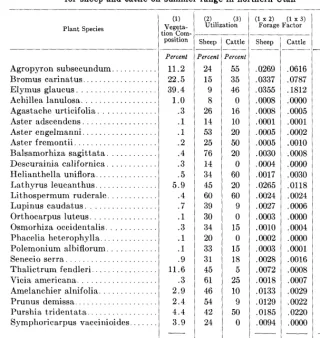
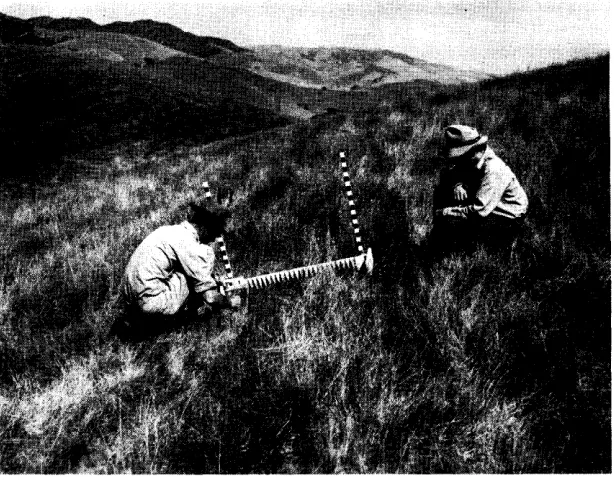
The floral composition of the pastures and actual utilization of species by sheep and cattle at the end of the grazing season are shown in Table 1. The composition per- centages for t’he two area,s were averaged in order to calculate the theoretical grazing capacity for com- mon use if both cattle and sheep were to graze the entire area simultaneously. Utilization percent- ages were obtained by averaging weight estimates from 14 individual estimators who had previously re- ceived 4 weeks training in the determination of utilization. The forage factor for sheep and cattle individually was obtained by mul- tiplying the actual degree of utiliza- tion from each by the composition percentage.
The forage factor was 2034 for sheep and .3728 for cattle, thus the area was theoretically 1.83 times more suited for cattle than for sheep (Table 1). However, if the higher forage factor for either cattle or sheep is used for each plant species the total becomes .4339. This figure represents the forage factor for‘ common use and is materially higher than either the forage factor for cattle or for sheep. Thus, by common use, the area can be 2.13 times more effectively used than by sheep alone and 1.16
Table 1. Vegetation composition, utilization when fully grazed, and for sheep and cattle on summer range in northern Utah
Plant Species
Agropyron subsecundum. ... Bromus carinatus ... Elymus glaucus ... Achilles lanulosa. ... Agastache urticifolia. ... Aster adscendens ... Aster engelmanni. ... Aster fremontii. ... Balsamorhiza sagittata. ... Descurainia californica ... Helianthella uniflora ... Lathyrus leucanthus ... Lithospermum ruderale. ... Lupinus caudatus ... Orthocarpus luteus. ... Osmorhiza occidentalis. ... Phacelia heterophylla. ... Polemonium albiflorum. ... Senecio serra ... Thalictrum fendleri ... Vicia americana. ... Amelanchier alnifolia. ... Prunus demissa. ... Purshia tridentata ... Symphoricarpus vaccinioides.
. . . . . . . . . . . . . (1) Vegeta- tion Com-
position 11.2 22.5 39.4 1.0 .3 .l .I .2 .4 .3 .5 5.9 .4 .7 .l .3 .l .l .9 11.6 .3 2.9 2.4 4.4 3.9 ‘ercent 24 15 9 8 26 14 53 25 76 14 34 45 60 39 30 34 20 33 31 45 61 46 54 42 24 ‘ercent 55 35 46 0 16 10 20 50 20 0 60 20 60 9 0 15 0 15 18 5 25 10 9 50 0 .0269 .0337 .0355 .0008 .0008 .OOOl .0005 .0005 .0030 .0004 .0017 .0265 .0024 .0027 .0003 .OOlO .0002 .0003 .0028 .0072 .0018 .0133 .0129 .0185 .0094
.0616 .0616 .0787 .0787 .1812 .1812 . 0000 .0008 .0005 .0008 .OOOl .OOOl .0002 .0005 .OOlO .OOlO .0008 .0030 . 0000 .0001 .0030 .0030 .0118 .0265 .0024 .0024 .0006 .0027 . 0000 .0003 .0004 .OOlO . 0000 .0002 .OOOl .0003 .0016 .0028 .0008 .0072 .0007 .0018 .0029 .0133 .0022 .0129 .0220 .0220 . 0000 .0094
100.0 .2034 .3728
times more effectively used than by cattle alone.
Assuming that past stocking of 5.0 acres per cow and 9.14 acres per animal unit of sheep is correct stocking, the entire area consisting of 2800 acres would support 306 animal units of sheep, whereas, if it were stocked with cattle, the grazing capacity would be 560 animal units. However, as shown in Table 2 more effective use is theoretically possible under common use when stocked with 422 animal units of cattle and 230 animal units of sheep which is about 65 percent cattle and about 35 percent sheep or 1.83 times more cattle than sheep because of the suitability ratio. In this manner a total of 652 animal units grazing for three months is obtained.
The total capacity of the area under common use was calculated
Sheep Iattle Sheep Cattle -
- -
(1 x 2) (1 x 3) Forage Factor
--
__- .4339
by adding the total capacity when grazed by cattle alone (560 animal units) and the total capacity when grazed by sheep alone (306 animal units) and in like manner adding the forage factor for cattle (.3728) and sheep (.2034) giving a total of 866 animal units with a total forage factor of .5763. Thus, if the theo- retical forage factor .5763 would have a total capacity of 866 animal units then the forage factor .4339 (Table 1) for common use would have a total grazing capacity amounting to 652 animal units.
It is assumed by these calculations that common use is not excessive use but instead the grazing of each kind of stock is complementary to the other. This may not always be true under range conditions but observations indicate that it is not an unreasonable assumption.
12 C. WAYNE COOK
have calculated conversion ratios by determining the suitability of ranges for one class of livestock or big game compared to another. If the range is equally suited to both kinds of animals being considered, the conversion is usually based upon the nutritional requirement of the animal which is in turn based upon average weight or upon sur- face area of the body.
Conversion ratios or equivalents are used by range managers to cal- culate the number of sheep that can be added when a certain number of cattle are removed or vice versa. These, as previously stated, gen- erally are calculated from the suitability of the range for the kind of animal being considered. These ratios are obtained from the forage- acre factors or forage factors cal- culated for each kind of animal when the conventional range survey or range inventory is made. Forage factor is derived from a summation of the products of the percent com- position of each species on the range times the palatability or preference index for the type of animal being considered. Palatability indexes or preference index figures for each kind of animal must be determined separately for all forage species present and forage-acre factors calculated independently by using separate palatability lists. The ratio of the forage-acre factor obtained for cattle and the forage-acre factor obtained for sheep is considered the
suitability rating to be used when converting from one animal to the other. Thus, if the factor is twice as high for sheep as for cattle, the range is considered capable of furnishing twice as much sheep forage as cattle forage. Actual conversion ratios can, therefore, be calculated from this suitability rating plus some measure of normal forage requirement. For example, one cow may require 5 times as much forage as one sheep. This 5: 1 ratio, however, becomes 10: 1 in the above case where the range is twice as suitable to sheep.
Conversion equivalents are not constant as sometimes believed but change with each shift in livestock numbers from one kind of animal to another unless a complete change is made. The calculated grazing capacities presented in Table 2 show that the conversion equiva- lents vary greatly when various combinations of sheep and cattle are grazed but remain constant after the point of most effective use is reached when changing from cattle to sheep or from sheep to cattle.
The conversion equivalents for each change in livestock combina- tion shown in Table 2 apply only when a complete change is made from one kind of livestock to the other. For instance when changing from common use to cattle alone, when 468 animal units of grazing are now being obtained by cattle
Table 2. Calculated grazing capacity in animal units when grazed by both sheep and cattle with various numbers of each or by each class alone. The right hand
columns show conversion ratios when changing from common use to a single use
Ratio of Cattle and Sheep under Common Use Conversion Ratio Conversion Ratio
Cattle I Sheep
, Ch”C”a”:E to 1 Chy$iie”,” to -
Alzimal units Percent Animal units Percent
306 0 0 100
422 33.4 141 66.6
536 52.4 281 47.6
652 64.7 422 35.3
621 75.4 468 24.6
591 87.0 514 13.0
560 / 100 560 0
Animal
wits Animal units Animal zmits
306 1.83 -
281 1.49 0.18
255 1.09 0.18
230 0.60 0.18
153 0.60 0.33
77 0.60 0.45
0 - 0.55
and 153 animal units of grazing obtained by sheep, the calculated conversion equivalent is 0.60. Thus, removing the 153 animal units of sheep will permit increasing cattle from 468 to 560 animal units entail- ing a loss of 153 animal units of sheep grazing to gain only 92 units of cattle grazing. The conversion ratio between these figures is 1:0.60; therefore, for each animal unit of sheep grazing removed only 0.60 animal units of cattle grazing can be added. However, when the area is grazed by 281 animal units of sheep and 141 animal units of cattle the conversion equivalent is 1.49. If 281 animal units of sheep are removed and replaced by cattle, 419 animal units are gained in total grazing capacity. This increase is brought about by a shift toward greater efficiency because cattle numbers are considerably lower than desirable, whereas, the loss in grazing capacity in the first case was a result of shifting toward cattle numbers which were already above desired numbers for most efficient common use.
If the shift is being made from common use to sheep alone, total grazing capacity is reduced in every case. For example, by removing 141 animal units of cattle only 25 ani- mal units of sheep can be added or by removing 514 animal units of cattle only 229 animal units of sheep can be added. However, in both cases greatest grazing capacity is still obtained by common use.
Summary and Conclusions Common use of summer range in the intermountain area results in more uniform utilization than is obtained by single use provided the combined numbers of each kind of animal are commensurate with forage production.
COMMON USE OF RANGE 13
habits of the two kinds ocf livestock and to evaluate the desirabilities of common use compared to single use.
Cattle ate considerable quant)ities of the grasses, moderate amounts of the forbs and only limited quan- tities of the browse, whereas, sheep ate sparingly of the grasses and consumed large quantities of the forbs and browse.
Assuming that present stocking capacity was correct and that the heaviest utilization on any particu- lar species by either kind of animal was obtained under common use, the area would furnish 652 animal
units of grazing when stocked with the proper proportions of sheep and cattle. However, if the entire area were grazed by cattle alone it would furnish grazing for 560 animal units and when grazed only by sheep, it would furnish 306 animal units of grazing. Thus, the area would furnish more grazing from common use than from single use and was judged 1.83 times more suitable for cattle than for sheep.
Calculated grazing capacities un- der various combinations of sheep and cattle showed that conversion ratios for replacing one kind of animal with another are not con-
stant until after the point of most effective use is reached when chang- ing from one kind of animal to another.
LITERATURE CITED
JARDINE, JAMES T. AND MARK ANDER- SON. 1919. Range management on the national forests. U. S. Dept. Agric. Bul. 790. 98 pp.
SAMPSON, A. W. 1952. Range manage- ment principles and practices. John Wiley and Sons Inc., New York. 570 pp.
STODDART, LAURENCE A. AND ARTHUR D. SMITH. 1943. Range manage- ment. McGraw-Hill Book Company Inc., New York. 347 pp.
REORGANIZATION OF THE U. S. DEPARTMENT OF AGRICULTURE
The reorganization of the U. S. Department of Agriculture, as announced by Secretary Benson,
November 1, 1953, established four main groups
of service agencies :
(1) Federal-States Relations: Agricultural Re- search Service, Forest Service, Federal Ex- tension Service, Soil Conservation Service, Agricultural Conservation Program Service and Farmer Cooperative Service
(2) Marketing and Foreign Agriculture: Agri- cultural Marketing Service, Foreign Agri- cultural Service and Commodity Exchange Authority
(3) Agricultural Stabilization: Commodity Stabilization Service, Federal Crop Insurance Corporation and Community, County, and State Committees
(4) Agricultural Credit: Farmers Home Ad- ministration, Farm Credit Administration and Rural Electrification Administration Changes affecting the research and regulatory
activities in range management were largely
centered in the Federal-States Relations group.
Reassignments to the Agricultural Research Service from other agencies include: research on farm management, land economics and agri- cultural finance from the former Bureau of Agri- cultural Economics : all soil conservation research
except that required for the national soil survey from the Soil Conservation Service; research on range management (except that on forest ranges and adjacent integrated non-forest lands) and on grass and control of undesirable plants from the Forest Service.