Attacks
Hassan Qahur Al Mahri, Leonie Simpson, Harry Bartlett, Ed Dawson, and Kenneth Koon-Ho Wong
Queensland University of Technology, George St, Brisbane 4000, Australia [email protected]
{lr.simpson,h.bartlett,e.dawson,kk.wong}@qut.edu.au
Abstract. This paper considers the security of the Offset Two-Round (OTR) authenticated encryption mode [9] with respect to forgery at-tacks. The current version of OTR gives a security proof for specific choices of the block size (n) and the primitive polynomial used to con-struct the finite fieldF2n. Although the OTR construction is generic, the security proof is not. For every choice of finite field the distinctness of masking coefficients must be verified to ensure security. In this paper, we show that some primitive polynomials result in collisions among the masking coefficients used in the current instantiation, from which forg-eries can be constructed. We propose a new way to instantiate OTR so that the masking coefficients are distinct in every finite field F2n, thus generalising OTR without reducing the security of OTR.
Keywords: Authenticated encryption, OTR, confidentiality, integrity, forgery attack, tweakable block cipher, symmetric encryption, AEAD
1
Introduction
Block ciphers are fundamental cryptographic primitives used in many encryp-tion algorithms and message authenticaencryp-tion codes. A convenencryp-tional block cipher encryption algorithm E accepts two inputs: a secret and random k-bit key K
and ann-bit input stringM. The output is ann-bit stringC, so the block cipher is represented as a mapE:K × {0,1}n
→ {0,1}n where
Kis the key space. To process large amounts of data, the message is divided into blocks of sizen, and a block cipher has to be used in an appropriate mode of operation. Various block cipher modes of operation have been suggested, either to provide confi-dentiality or integrity assurance, or to provide both conficonfi-dentiality and integrity assurance in a single design in a notion called Authenticated Encryption (AE). In Authenticated Encryption with Associated Data (AEAD), some portions of the message (the associated data) do not require confidentiality but still require integrity assurance.
take three inputs: key K, input message M and tweak T. Tweakable block ciphers can be represented as a map Eb : K × T × {0,1}n → {0,1}n where T
is the tweak space. The purpose of the tweak is to differentiate messages and it should be easier to change the tweak rather than changing the key. Liskov, Rivest and Wagner suggest two approaches for constructing tweakable block ciphers that are provably secure as long as the underlying block cipher is secure. These constructions can be represented asE(∆h⊕E(Mi)) andE(Mi⊕∆h)⊕∆h where ∆h is a universal hash function operating as the tweak. However, these constructions need two keys that should be independent of each other.
DOUBLING MASKING TECHNIQUE. Halevi and Rogaway [5] proposed a tweakable block cipher mode of operation called EME that provides only confi-dentiality. This mode uses the doubling masking technique, where a secret mask-ing value is used in processmask-ing each block. This secret value is initially obtained asL= 2E(0n), and then each time a different value is needed the previous value ofLis doubled. This results in a series of masking values: 2L,22L,23L, . . . ,2mL. The multiplication is performed in the finite fieldF2n by multiplying two input
polynomials and finding the reminder modulo a primitive polynomial.
The doubling masking technique is very fast and efficient. In hardware im-plementation, the doubling is equivalent to a conditional of either a shift or shift and XOR operations. When n = 128 and the finite field F2128 is constructed
using the commonly used primitive polynomial f(x) = x128+x7+x2+x+ 1,
the doubling is as follows:
2L=
(
L1 if MSB(L) = 0
(L1)⊕012010000111 if MSB(L) = 1
where is a 1-bit logical left shift operation and MSB stands for the most significant bit.
XE AND XEX CIPHERS. Using the sequence of masking values 2L,22L, . . . ,2mL, Rogaway [11] describes two new approaches for tweakable block ciphers. These are known as XE and XEX ciphers, and are represented asEb:E(Mi⊕2i−1L) or
b
E:E(Mi⊕2i−1L)⊕2i−1Lrespectively. Rogaway proves that these designs are secure up to the birthday bound for a certain range of i values. These designs use a single key for both the block encryption operation and to initialise the sequence of masking values used as the tweaks.
When a new value is needed which is outside the range of masking values 2L, 22L,. . ., 2mL, a value 2hugeL is used such thathuge is much greater than
m. For the primitive polynomialf(x) =x128+x7+x2+x+ 1, Rogaway chooses
2hugeas 3 and shows that this is far away from the offsets 2L,22L, . . . ,2mL. In addition, 3 is easy to calculate as 3 = 2⊕1; therefore, 3Lcan be XOR-ed with the checksum of plaintext blocks to obtain the authentication tag as in OCB1 [11].
in such cases and lead to simple forgery attacks. Because of this, the choice of values for 2huge must be investigated for every choice of finite field and its distinctness from the series of masking values must be verified.
OTR MODE. Several block cipher modes of operation that have been proposed for AEAD use the doubling masking technique as in XE and XEX ciphers. One such mode is Offset Two-Round (OTR) [9] proposed by Minematsu and defined for any block sizen. A version of OTR mode called AES-OTR [8] was submitted to the CAESAR competition [2]. The security proof of OTR requires that all input masks are distinct; however, the masks used in OTR and AES-OTR have only been proved to be distinct for a specific choice of n and the primitive polynomial defining the finite field.
OUR CONTRIBUTION. Firstly, we show that the current instantiation of OTR uses masking coefficients that are not always distinct in fields based on other primitive polynomials, including whenn6= 128. We show that using the current instantiation with other primitive polynomials can result in non-distinct masking values that can be exploited in forgery attacks against the scheme. This is a problem with most modes that use the doubling masking technique.
Secondly, we propose an alternative set of masking coefficients so that OTR can use the same set of coefficients for any block sizenand any primitive poly-nomial, without affecting the security provided by this scheme. That is, our work generalises the OTR mode using the technique of doubling masking, and removes the requirement for the user to perform huge prior calculations in order to ensure that the masks do not overlap.
Note that this work does not imply that OTR mode or AES-OTR are inse-cure. Note that this solution may also apply to other similar block cipher modes that use the doubling masking technique, such as OCB1 [11], ELmD [4] and AES-COPA [1].
2
Basic Notations
For simplicity and consistency, we follow the notation used in the original OTR document [10].
{0,1}∗ : the set of all finite-length binary strings.
ε : the empty string.
K :k-bit key used for the block cipher and tweak initialisation.
n : the block length of the block cipher.
N : the nonce that is changed for each message.
m : the number of blocks in the plaintext message.
l : the number of chunks of two blocks in the plaintext message.
M[2i−1] : the odd block in theithchunk of the plaintext message.
M[2i] : the even block in theithchunk of the plaintext message.
C[2i−1] : the odd block in theithchunk of the corresponding ciphertext message.
C[2i] : the even block in theithchunk of the corresponding ciphertext message.
A : the associated data that need only authentication.
X||Y : the concatenation of the stringsXandY.
|X|a : max{d|X|/ae,1}. n
←−X : returns (X[1], X[2], . . . , X[x]) wherex=|X|n,|X[i]|=nfori < xand |X[x]| ≤n.
X : the 10∗padding written asXk10n−|X|−1.
msbc(X) : the firstcbits ofXprovided that|X| ≥c.
E : the block cipher encryption function under the keyK.
T A : the authentication tag obtained from associated data.
T E : the authentication tag obtained from plaintext message.
T : theτ-bit final authentication tag of OTR scheme.
3
OTR Description
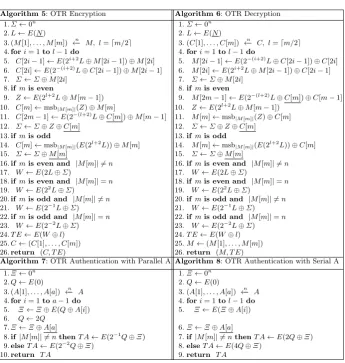
Offset Two-round (OTR) is an authenticated encryption block cipher mode that is online, one-pass and each segment of two consecutive blocks can be processed in parallel. OTR mode has a similar structure to OCB mode [11], but OTR uses only the forward function of the block cipher for both encryption and decryption algorithms. The OTR operation is illustrated in Table 1 and Fig. 1.
The OTR algorithm accepts the following inputs: Key K ∈ {0,1}k, Nonce
N ∈ {0,1}j for 1≤j ≤n−1, Associated Data A ∈ {0,1}∗ and Plaintext
M ∈ {0,1}∗ and has the following outputs: Ciphertext C ∈ {0,1}∗ and Tag
T ∈ {0,1}τ. The OTR encryption algorithm consists of two algorithms known as cores: an encryption core EFE and authentication core AFE. The OTR en-cryption core divides a plaintext message M into chunks, each containing two plaintext blocks. Then, each chunk is encrypted using two different masks. These two masks are doubled to obtain other two masks for the next chunk and so on. The authentication core can process the associated data in either of the two ways: parallel or serial. OTR uses a variant of the PMAC1 scheme [11] to authenticate associated data in parallel, and uses a variant of the OMAC mode [6] to authenticate associated data serially.
The authentication tag T in OTR is generated in two different ways. For parallel associated data, a dedicated mask (depending on the last chunk) is XOR-ed with the checksum of plaintext blocks and the result is encrypted to obtainT E. The final tagT is obtained by XOR-ing T E with the resultant tag
T Aof authenticating the associated data. (T =T E⊕T A.) For serial associated data, the associated data tag T A is used with the Nonce to obtain the secret tweakL. In this case, the plaintext tagT E will be the final tagT.
4
The Current Instantiation of OTR Mode
Initially, OTR was designed using different instantiation values for the masking coefficients. A proof that OTR is secure for the instantiation whenn= 128 and using the primitive polynomialf(x) =x128+x7+x2+x+ 1 is given in [10].
Table 1.OTR algorithm [9].
Algorithm 1: OTR Encryption Core Algorithm 2: OTR Decryption Core 1.Σ←0n
1.Σ←0n
2.L←E(N) 2.L←E(N)
3. (M[1], . . . , M[m]) ←n− M, l=dm/2e 3. (C[1], . . . , C[m]) ←n− C, l=dm/2e
4.fori= 1tol−1do 4.fori= 1tol−1do
5. C[2i−1]←E(2i−1L⊕M[2i−1])⊕M[2i] 5. M[2i−1]←E(2i−13L⊕C[2i−1])⊕C[2i]
6. C[2i]←E(2i−1
3L⊕C[2i−1])⊕M[2i−1] 6. M[2i]←E(2i−1
L⊕M[2i−1])⊕C[2i−1] 7. Σ←Σ⊕M[2i] 7. Σ←Σ⊕M[2i]
8.ifmis even 8.ifmis even
9. Z←E(2l−1L⊕M[m−1]) 9. M[2m−1]←E(2l−13L⊕C[m])⊕C[m−1]
10. C[m]←msb|M[m]|(Z)⊕M[m] 10. Z←E(2l−1L⊕M[m−1])
11. C[2m−1]←E(2l−1
3L⊕C[m])⊕M[m−1] 11. M[m]←msb|M[m]|(Z)⊕C[m]
12. Σ←Σ⊕Z⊕C[m] 12. Σ←Σ⊕Z⊕C[m]
13.ifmis odd 13.ifmis odd
14. C[m]←msb|M[m]|(E(2l−1L))⊕M[m] 14. M[m]←msb|M[m]|(E(2l−1L))⊕C[m]
15. Σ←Σ⊕M[m] 15. Σ←Σ⊕M[m]
16.ifmis even and |M[m]| 6=n 16.ifmis even and |M[m]| 6=n
17. T E←E(2l−1
33
L⊕Σ) 17. T E←E(2l−1
33
L⊕Σ) 18.ifmis even and |M[m]|=n 18.ifmis even and |M[m]|=n
19. T E←E(7.3.2l−1
L⊕Σ) 19. T E←E(7.3.2l−1
L⊕Σ) 20.ifmis odd and |M[m]| 6=n 20.ifmis odd and |M[m]| 6=n
21. T E←E(2l−1
32
L⊕Σ) 21. T E←E(2l−1
32
L⊕Σ) 22.ifmis odd and |M[m]|=n 22.ifmis odd and |M[m]|=n
23. T E←E(7.2l−1
L⊕Σ) 23. T E←E(7.2l−1
L⊕Σ)
24.C←(C[1], . . . , C[m]) 24.M←(M[1], . . . , M[m])
25.return (C, T E) 25.return (M, T E)
Algorithm 3: OTR Authentication with Parallel A Algorithm 4: OTR Authentication with Serial A 1.Ξ←0n 1.Ξ←0n
2.Q←E(0) 2.Q←E(0)
3. (A[1], . . . , A[a]) ←n− A 3. (A[1], . . . , A[a]) ←n− A
4.fori= 1toa−1do 4.fori= 1tol−1do
5. Ξ←Ξ⊕E(Q⊕A[i]) 5. Ξ←E(Ξ⊕A[i]) 6. Q←2Q
7.Ξ←Ξ⊕A[a] 6.Ξ←Ξ⊕A[a]
8.if|M[m]| 6=nthenT A←E(3Q⊕Ξ) 7.if|M[m]| 6=nthenT A←E(2Q⊕Ξ) 9.elseT A←E(32Q⊕Ξ) 8.
elseT A←E(4Q⊕Ξ)
10.return T A 9.return T A
field, the user has to prove that the chosen masks for that instantiation of OTR are distinct and do not overlap. This requires discrete log computations. Using discrete log computation, Rogaway proves in [11] that certain sets of masks are distinct from each other and provide unique representation. He considers very specific choices: when n= 128 or n= 64 and when the finite field is based on certain commonly used primitive polynomials.
Fig. 2 Encryption of AES-OTR with parallel ADP. Fmt denotes the function Format, and a box with underline andXdenote the 10∗padding of inputX.
Time denoteσprivandt′in the privacy bounds (Theorems 3.1 and Theorem 3.3). For Table 2, Data, Verify, and Time denoteσauth,qv, andt′in the authenticity bounds (Theorem 3.2 and Theorem 3.4). The inclusion of Verify in Table 2 is redundant sinceσauthincludesqvandτ is 128 for the parameter sets here, however, we explicitly present it to make clear thatqv≪τ is a security condition, which is meaningful ifτis small. Strictly speaking, the Data figures in the tables should be slightly smaller with respect to the bounds, say Data 64 in Table 1 ofaes128otrpv1andaes256otrpv1is 64−log2(c) with
c=√6 from Theorem 3.1.
As an additional security goal, we claim that the length of nonce can be changed without key renewal, provided all nonces are unique for all encryptions, for both parallel and serial ADP versions. This setting does not change the security bounds of Section 3. In addition, the security of serial ADP holds as far as a pair of AD and nonce (A, N) is unique for all encryption queries, for privacy and authenticity notions.
Table 1 Security goal for confidentiality (privacy).
aes128otrpv1 aes128otrsv1 aes256otrpv1 aes256otrsv1
Confidentiality Data Time Data Time Data Time Data Time
(Privacy) 64 128 64 128 64 256 64 256
Table 2 Security goal for integrity (authenticity).
aes128otrpv1 aes128otrsv1 aes256otrpv1 aes256otrsv1
Integrity Data Verify Time Data Verify Time Data Verify Time Data Verify Time (Authenticity) 64 128 (τ) 128 64 128 (τ) 128 64 128 (τ) 256 64 128 (τ) 256
3 Security Analysis
Provable Security Paradigm. AES-OTR has a provable security based on the assumption that AES is a pseudorandom function. Below we provide a brief explanation on the security model we consider, which is common to many nonce-based AEAD blockcipher modes.
5
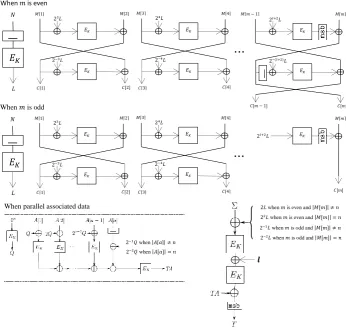
Fig. 1.OTR encryption operation with parallel associated data [9].
For generic instantiations of OTR using block sizes and primitive polynomials other than those already examined, there is a risk that a user may not select suitable masking coefficients for the instantiation. This open problem motivates us to seek a more robust definition of OTR in which the masking coefficients are distinct for any choice of finite field. Note that this will be applicable to OTR and also to any design which uses the doubling masking technique.
In our analysis, we take a similar approach to Bost and Sanders’ work [3]. We consider two special forms of primitive polynomial, different to those discussed in [3], and which lead to a collision for the currently used masking coefficients.
Case 1: Primitive polynomial of the form f(x) =xn+x+ 1.
Many primitive polynomials can be found in this trinomial form f(x) =
xn+x+1 [12]. In this case,xnwill be equal tox+1. That is, 3 will be equivalent to 2nand it is not 2hugeas the current instantiation assumes. Therefore, a collision can be found between 3Land 2nLas long asl > n.
Case 2: Primitive polynomial of the form f(x) =xn+x2+ 1.
This is another form of trinomial, and in this case,xnwill be equal tox2+ 1.
That is, 5 (which is equal to 32 in
F2n) will be equivalent to 2n. In OTR, 32 is
used when the last blockM[m] is not a full block (|M[m]| 6=n).
5
Proposed Attacks
in-tended recipient. We assume that the attacker knows both the plaintext message and its corresponding ciphertext using a single query of the OTR oracle.
Suppose that a plaintext messageM is as follows:
M = (M[1], M[2], . . . , M[m])
such that the number of blocksm=|M|n is odd and the number of chunks of two blocks l > n+ 1 where l =dm/2e. This message is encrypted using OTR and results in the ciphertextC:
C= (C[1], C[2]. . . , C[m]).
5.1 Case 1 collisions
In this case, as noted in Sect. 4, 3L = 2nL. Suppose that the last block is a full block (|M[m]|=n). A forged ciphertext messageC? can be constructed as follows:
C?[1] =M[2(n+ 1)−1]
C?[2] =M[1]⊕M[2(n+ 1)]⊕C[2(n+ 1)−1] =M[1]⊕E(M[2(n+ 1)−1]⊕2nL)
C?[i] =C[i], 3
≤i < m
C?[m] =C[m]⊕C[1]⊕M[2(n+ 1)−1]
Decrypting C? will give the same value for all plaintext blocks except for
M?[2] andM?[m] as follows:
M?[1] =E(C?[1]
⊕3L)⊕C?[2]
=E(M[2(n+ 1)−1]⊕3L)⊕M[1]⊕E(M[2(n+ 1)−1]⊕2nL) =M[1]
M?[2] =E(M?[1]⊕L)⊕C?[1] =E(M[1]⊕L)⊕M[2(n+ 1)−1]
M?[m] =E(2l−1L)
⊕C?[m]
=E(2l−1L)⊕C[m]⊕C[1]⊕M[2(n+ 1)−1] =M[m]⊕C[1]⊕M[2(n+ 1)−1]
Let Σ0 be the checksum of all even plaintext blocks of message M except
M[2] and the last block M[m]. That is,
Σ0 =Σ⊕M[2]⊕M[m]
Therefore, the checksum of plaintext blocks for the forged message is:
Σ?=Σ0⊕M?[2]⊕M?[m]
=Σ0⊕E(M[1]⊕L)⊕M[2(n+ 1)−1]⊕M[m]⊕C[1]⊕M[2(n+ 1)−1] =Σ0⊕E(M[1]⊕L)⊕C[1]⊕M[m]
BothCand the forged messageC? produce the same checksum value. Thus,C? will produce the same tagT asC, and will be accepted as genuine.
5.2 Case 2 collisions
For this case, suppose that the message M has also the following features:
|M[m]| 6=n,M[1] = 0n andM[2(n+1)−1] = ({1,0}jk10∗) for 1≤j < n. IfM
is encrypted using OTR the pair (C, T E) is obtained. From this pair, an attacker can calculate E(L) = C[1]⊕M[2]. A new pair (C?, T E?) can be constructed from this such that C? =C?[1] =msb
j(M[2(n+ 1)−1]⊕E(L)) and the tag
T E?=C[2(n+ 1)−1]⊕M[2(n+ 1)].
Decrypting the forged pair (C?, T E?) will give:
M?[1] =msbj(E(L))⊕C?[1]
=msbj(E(L))⊕msbj(M[2(n+ 1)−1]⊕E(L)) =msbj(M[2(n+ 1)−1])
Σ?=M?[1] =M[2(n+ 1)−1]
Therefore, the tagT E0 of the received ciphertext will be:
T E0=E(Σ?⊕32L)
=E(M[2(n+ 1)−1]⊕32L) =E(M[2(n+ 1)−1]⊕2nL) =C[2(n+ 1)−1]⊕M[2(n+ 1)] =T E?
Thus, the forged pair (C?, T E?) will be considered as a valid message. This clearly demonstrates the integrity assurance mechanism is flawed.
6
Proposed Solution
In Sect. 5 we demonstrated that, for certain forms of primitive polynomial, col-lisions occur between masking values which can be exploited in forgery attacks. This implies that the current choice of masking coefficients cannot be used in a generic construction of OTR. For every choice of finite field the distinctness of the masking values must be verified to ensure the design is secure against forgery attacks.
choice of mask depending on two message features: whether the number of blocks
m is even or odd; and whether the last block is a full block (|M[m]| = n) or not. To provide resistance against forgery attacks, it is important that when the multipliers of 2l−1Lin these masks are considered as powers of 2, the differences
between the indexes of any pair of multipliers must be much greater than the maximum possible length (number of blocks) of any plaintext message. This will prevent an attacker forcing collisions between masks by changing the message length (inserting or deleting blocks). We suggest the following design changes to avoid collisions between masks without having to find multipliers at such large distances from one another.
PROPOSED INSTANTIATION OF ENCRYPTION/DECRYPTION CORE We propose two minor modifications, as shown in Table 2 and Fig. 2, to provide a generic version of OTR. Firstly, we set the masking values for odd blocks to start from 23L, the masking values for even blocks to start from 2−3Land define the
four masks to be XOR-ed with the checksum of plaintext blocks as follows:
• 22Lwhenmis even and|M[m]| 6=n
• 2Lwhenmis even and|M[m]|=n
• 2−2Lwhenmis odd and|M[m]| 6=n • 2−1Lwhenmis odd and|M[m]|=n
These choices ensure that the masks will not collide regardless of the primitive polynomial being used. The values 2−1Land 2−2Lcan easily be obtained fromL
with the right shift operation instead of the left shift used in the current scheme. Secondly, we slightly redesign the last step in the process used to compute the tag, separating the XOR of checksumΣ and the number of chunksl in the plaintext message. This will prevent an attacker exploiting the tag computation by compensating between these two variables. In our proposal, changing either variableΣ orlwill not have a clear effect on the other. The cost of this change is one extra block cipher call. However, this extra block cipher call makes the generic OTR design more robust.
PROPOSED INSTANTIATION OF AUTHENTICATION CORE As noted is Sect. 3, the authentication core can process the associated data in two modes: serial or parallel. For serial associated data, the same design will be used as it uses only two masks: 2Q and 22Q. These masks are distinct regardless of
the primitive polynomial used. For parallel associated data, we only change the masks used with the last blockA[a]. OTR (Fig. 1) uses the masks 2a−13L and
2a−132Lwhen
|A[a]| 6=nand|A[a]|=nrespectively. However, there is no need for these two masks to be very far away from each other, as changing the number of blocks ain the associated data will directly affect the accumulated tag T A. Thus, the two masks we suggest for the last block are 2−1L and 2−2L when |A[a]| 6=nand|A[a]|=nrespectively.
Table 2.Proposed OTR algorithm.
Algorithm 5: OTR Encryption Algorithm 6: OTR Decryption 1.Σ←0n
1.Σ←0n
2.L←E(N) 2.L←E(N)
3. (M[1], . . . , M[m]) ←n− M, l=dm/2e 3. (C[1], . . . , C[m]) ←n− C, l=dm/2e
4.fori= 1tol−1do 4.fori= 1tol−1do
5. C[2i−1]←E(2i+2L⊕M[2i−1])⊕M[2i] 5. M[2i−1]←E(2−(i+2)L⊕C[2i−1])⊕C[2i]
6. C[2i]←E(2−(i+2)L⊕C[2i−1])⊕M[2i−1] 6. M[2i]←E(2i+2L⊕M[2i−1])⊕C[2i−1]
7. Σ←Σ⊕M[2i] 7. Σ←Σ⊕M[2i]
8.ifmis even 8.ifmis even
9. Z←E(2l+2
L⊕M[m−1]) 9. M[2m−1]←E(2−(l+2)
L⊕C[m])⊕C[m−1] 10. C[m]←msb|M[m]|(Z)⊕M[m] 10. Z←E(2l+2L⊕M[m−1])
11. C[2m−1]←E(2−(l+2)
L⊕C[m])⊕M[m−1] 11. M[m]←msb|M[m]|(Z)⊕C[m]
12. Σ←Σ⊕Z⊕C[m] 12. Σ←Σ⊕Z⊕C[m]
13.ifmis odd 13.ifmis odd
14. C[m]←msb|M[m]|(E(2l+2L))⊕M[m] 14. M[m]←msb|M[m]|(E(2l+2L))⊕C[m]
15. Σ←Σ⊕M[m] 15. Σ←Σ⊕M[m]
16.ifmis even and |M[m]| 6=n 16.ifmis even and |M[m]| 6=n
17. W←E(2L⊕Σ) 17. W←E(2L⊕Σ)
18.ifmis even and |M[m]|=n 18.ifmis even and |M[m]|=n
19. W←E(22L⊕Σ) 19. W←E(22L⊕Σ)
20.ifmis odd and |M[m]| 6=n 20.ifmis odd and |M[m]| 6=n
21. W←E(2−1
L⊕Σ) 21. W←E(2−1
L⊕Σ) 22.ifmis odd and |M[m]|=n 22.ifmis odd and |M[m]|=n
23. W←E(2−2
L⊕Σ) 23. W←E(2−2
L⊕Σ) 24.T E←E(W⊕l) 24.T E←E(W⊕l)
25.C←(C[1], . . . , C[m]) 25.M←(M[1], . . . , M[m])
26.return (C, T E) 26.return (M, T E)
Algorithm 7: OTR Authentication with Parallel A Algorithm 8: OTR Authentication with Serial A 1.Ξ←0n 1.Ξ←0n
2.Q←E(0) 2.Q←E(0)
3. (A[1], . . . , A[a]) ←n− A 3. (A[1], . . . , A[a]) ←n− A
4.fori= 1toa−1do 4.fori= 1tol−1do
5. Ξ←Ξ⊕E(Q⊕A[i]) 5. Ξ←E(Ξ⊕A[i]) 6. Q←2Q
7.Ξ←Ξ⊕A[a] 6.Ξ←Ξ⊕A[a] 8.if|M[m]| 6=nthenT A←E(2−1
Q⊕Ξ) 7.if|M[m]| 6=nthenT A←E(2Q⊕Ξ) 9.elseT A←E(2−2Q⊕Ξ) 8.
elseT A←E(4Q⊕Ξ)
10.return T A 9.return T A
7
Security Bounds for OTR Using the New Masking
Coefficients
This section discusses the impact of changing the input masks on the security bounds of OTR. Firstly, all of proposed masks for OTR have the form 2j. Since 2 is the generator of the finite field F2n and the order of this field is 2n−1,
this assures that 2j = 2j0
iffj =j0 for anyj ≤2n
−1. Therefore, these masks will not collide for any collection of blocks with a length less than (2n−1
−3), which is well beyond the message length restriction of 2n/2 blocks imposed by
the designer of OTR. Thus, the collision attacks discussed in Sect. 5 are now precluded.
⋯
𝐿 𝐶[1] 𝐶[2]
𝑀[1]
2−3𝐿 23𝐿
𝐸𝐾
𝐸𝐾
𝑀[2]
𝐸𝐾 𝑁
𝐶[4] 𝐶[3]
𝑀[3]
2−4𝐿 24𝐿
𝐸𝐾
𝐸𝐾
𝑀[4] 𝑀[𝑚 − 1]
𝐶[𝑚] 𝐶[𝑚 − 1]
2−(𝑙+2)𝐿 2𝑙+2𝐿
𝐸𝐾
𝐸𝐾
𝑀[𝑚] When 𝑚 is even
⋯
𝐿 𝐶[1] 𝐶[2]
𝑀[1]
2−3𝐿 23𝐿
𝐸𝐾
𝐸𝐾
𝑀[2]
𝐸𝐾 𝑁
𝐶[4] 𝐶[3]
𝑀[3]
2−4𝐿 24𝐿
𝐸𝐾
𝐸𝐾
𝑀[4]
𝐶[𝑚]
2𝑙+2𝐿 𝐸𝐾
𝑀[𝑚]
When 𝑚 is odd
𝒍
2𝐿 when 𝑚 is even and 𝑀[𝑚] ≠ 𝑛 22𝐿 when 𝑚 is even and 𝑀[𝑚] = 𝑛
2−1𝐿 when 𝑚 is odd and 𝑀[𝑚] ≠ 𝑛 2−2𝐿 when 𝑚 is odd and 𝑀[𝑚] = 𝑛 When parallel associated data
2−1𝑄 when 𝐴[𝑎] ≠ 𝑛 2−2𝑄 when 𝐴[𝑎] = 𝑛
Fig. 2.Proposed OTR encryption diagram with parallel associated data.
above paragraph, the proposed masks are guaranteed to be different from each other; thus, the same security bounds for OTR still hold.
Finally, our proposed modification to OTR adds one extra block cipher call, as shown in Fig. 2. This step is required in order to avoid using a mask with a base other than 2. The probability that an attacker can guess the tag successfully is still 1/2τ where isτ the tag length. Therefore, the security of OTR will not be degraded with the new instantiation method.
8
Conclusion
OTR is a block cipher mode of operation for AEAD that uses a doubling masking technique. OTR is designed to be applicable for any block size nbut currently requires a suitable choice to be made for the finite field F2n used for doubling
distinctness of the masking values. This has only been proved for specific choices of primitive polynomial in the particular cases ofn= 64 andn= 128.
In this paper, we show that the masks used in the current instantiation of OTR are not distinct for certain choices of finite field. Using these choices, we demonstrate practical forgery attacks against OTR. Thus, the generic form of the OTR design is not secure.
We propose two minor modifications to OTR to make the generic version of this scheme more robust. We do this by specifying a set of masks that are distinct in every finite fieldF2n. This enables OTR to work with any finite field
without invalidating the security claimed. Note that this work does not imply that the versions of OTR described in [8, 9] are insecure.
9
Acknowledgements
Hassan Al Mahri would like to acknowledge the scholarship for this research from the government of the Sultanate of Oman.
References
1. Andreeva, E., Bogdanov, A., Luykx, A., Mennink, B., Tischhauser, E., Yasuda, K.: AES-COPA,http://competitions.cr.yp.to/caesar-submissions.html(2014) 2. Bernstein, D.: Cryptographic Competitions: CAESAR,http://competitions.cr.
yp.to/caesar-call.html(2014)
3. Bost, R., Sanders, O.: Trick or Tweak: On the (In)security of OTR’s Tweaks. Cryptology ePrint Archive, Report 2016/234,http://eprint.iacr.org/(2016)
4. Datta, N., Nandi, M.: ElmD, http://competitions.cr.yp.to/
caesar-submissions.html(2014)
5. Halevi, S., Rogaway, P.: A Parallelizable Enciphering Mode. In: Topics in Cryptology–CT-RSA 2004, pp. 292–304. Springer (2004)
6. Iwata, T., Kurosawa, K.: OMAC: One-key CBC MAC. In: International Workshop on Fast Software Encryption, pp. 129–153. Springer (2003)
7. Liskov, M., Rivest, R., Wagner, D.: Tweakable Block Ciphers. In: Advances in Cryptology–CRYPTO 2002, pp. 31–46. Springer (2002)
8. Minematsu, K.: AES-OTR, http://competitions.cr.yp.to/
caesar-submissions.html(2014)
9. Minematsu, K.: Parallelizable Rate-1 Authenticated Encryption from Pseudoran-dom Functions. Cryptology ePrint Archive, Report 2013/628, http://eprint. iacr.org/(2013)
10. Minematsu, K.: Parallelizable Rate-1 Authenticated Encryption from Pseudoran-dom Functions. In: Advances in Cryptology–EUROCRYPT 2014, pp. 275–292. Springer (2014)
11. Rogaway, P.: Efficient Instantiations of Tweakable Blockciphers and Refinements to Modes OCB and PMAC. In: Advances in Cryptology–ASIACRYPT 2004, pp. 16–31. Springer (2004)
![Table 1. OTR algorithm [9].](https://thumb-us.123doks.com/thumbv2/123dok_us/7987706.1325513/5.595.137.479.131.482/table-otr-algorithm.webp)
![Fig. 2Fig. 1.Encryption of AES-OTR with parallel ADP. Fmt denotes the function Format, and a box OTR encryption operation with parallel associated data [9]](https://thumb-us.123doks.com/thumbv2/123dok_us/7987706.1325513/6.595.137.477.96.306/encryption-parallel-denotes-function-encryption-operation-parallel-associated.webp)