VOLUME 4
July 1951
Number 4
In this Issue
Editorial-Range Fifth-Columnists....Fred H. Kennedy
219
The Halogeton Problem in Utah's Ranges
L.A. Stoddart et al.
223
Electric Fence for Distribution of Cattle in a Range
Grazed by Sheep and Cattle... Arthur D. Miles
228
Utilization of Winter Range Forage by Sheep
Lisle R. Green et al.
233
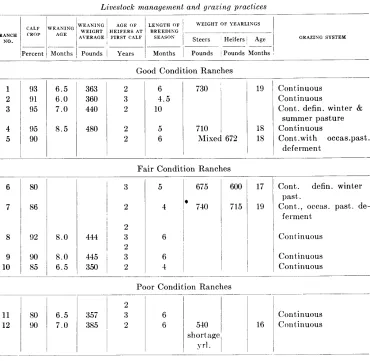
Effects of Range Condition on Livestock Production
J.S. McCorkle and Arnold Heerwagen
242
Status of Browse on Ranges of Eastern Oregon and
Eastern Washington... ... Glenn E. Mitchell
249
Vegetational Changes on a 25 Year Subsere in the Loess
Hill Region of Central Nebraska
John W. Voigt
254
Effects of Fire on a Mixed Grass-Shrub Range in Southern
Arizona... ... R.R. Humphrey and A.C. Everson 264
Uncommon Occurrence on Buffalograss
Richard D. Burr
267
Use of Aerial Photographs and Sub-sampling in Range
Inventories .. ... ... .Robert W. Harris
270
Abstracts... ... ... ... ... 279
Book Reviews:
Report of President's Water Resources Policy
Commission... ... Herbert C. Hanson
284
Manual of the Grasses of the United States
(Hitchcock-Chase)... .... Alan A. Beetle
286
Midwestern Farm Handbook....Lester R. Branson
287
Current Literature... ... ... Grant A. Harris
288
News and notes .. ... ... ... ... 292
With the Sections... ... ... ... 298
Society Business ... ... ... ... 301
Published Quarterly by
Journal of
Volume 5, Number d, . July, 1951RAN’GE
MANAGEMENT
Editorial
Range Fifth-Columnists
vv
E, the people who use the range, are not the fifth-columnists to whom I refer, so hold your fire. We who live in this world have merely created the conditions making it possible for fifth-columnists to flourish, whether they be plants or animals.My terminology refers to the great mass of so-called noxious weeds which invade our range lands. Their tactics are less scrupulous and more enduring than the human enemies of free men. They are just as difficult to cope with in the order of the plant kindgom as it, is to deal xit,h the plotting Communists of 1951 in the kingdom of man. They are a tough lot, unsurpassed in silent, unobservable infiltration tactics, and once established, they are here to stay. About GO years ago \\‘e reached our peak in the use of range by livestock in the United States. Since that time the peak load has been gradually reduced, and in many sections of the West the decline is still with us. For example, Oregon’s sheep population reached an all-time high about 1910, with 2,700,OOO sheep, almost entirely dependent on range. Today it. is less than 7OQOO0, and a large percent, of these graze in relatively small pasture flocks on farms and ranches rest of the summit of the Cascade Mountains. I am not quest,ioning the fact that the peak load was probably far in excess of the ability of t,he range
as a whole to carry, or the fact that many acres were unwittingly plowed and taken out of range production for a time, or the fact that our big-game load is much greater than it was GO years ago. I am merely emphasizing the point that there was at least enough forage at that time to permit the development of a load far in excess of anyt,hing we could imagine carrying under present range conditions.
220 FRED H. KENNEDY
West, 500 million are in poor condition with uncertain trends in condition. If this estimate of condition is half accurate, there is and has been a whale of a lot of country made available for the settlement of the fifth-columnist horde of noxious and undesirable plants. And believe me, these invaders have used every opportunity to take over, to become permanently fixed as part of the land- scape, and to expand in many instances at the expense of good, sound plant citizens. They are still aggressively at it. Let’s look at a few of the leading range fifth-columnists in the West. Our good old enemy St. Johnswort, alias Klamath weed, alias goatweed, and scientifically known as Hypericum per- for&urn, a native of France and England,
’ arrived on the east coast of the United
States in about 1700. Its first appearance in the West of record was near Ft. Seward, California, about 1900. Since that time it has done an effective ex- panding job. In 1913 it first appeared in the Snake River countiy north of the Wallowa Mountains in Oregon.. In 1924 it was discovered on the Bison Range north of Missoula, Montana, and several ’
years ago it was reported as far east as the headwaters of the Musselshell River in central Montana. Today this fifth columnist can boast of thousands of acres of range land as being well invaded in northern California, western and northeastern Oregon, and northeastern Washington along with adjacent Idaho. It is a rootstalk-producing perennial, is practically worthless as a forage plant, and is poisonous to all kinds of livestock; especially injurious to animals with white skin.
At the present time no comment on noxious weeds in the West would be complete without mentioning the most popular newcomer, Halogeton. This late
arrival, which was discovered first near Deeth, Nevada, in 1935, has lost no time in becoming well established in the general areas east and south of that concerned with Klamath weed. Maybe the invaders have a treaty on territorial responsibilities. Since 1935 Halogeton has invaded in force the sagebrush and shadscale ranges in northern Nevada, southern ldaho, and northwestern Utah. It has a good toe hold in southeastern Oregon, northeastern California, a few counties in eastern Utah, and a spot or two in Montana and Wyoming. There has been much publicity on this plant and more will be written. It’s an annual, is poisonous to livestock, is drought resistant, has very strong seeding habits, and looks somewhat like Russian thistle. Halogeton and St. Johnswort are just two of the clan. There are many more. Some may be less spectacular in a regional sense but of more concern locally than the two mentioned culprits. Recently an Interagency Committee com- posed of representatives of state and federal land-managing agencies in the Columbia River Basin was organized to analyze the noxious-weed situation in the Basin. At its first meeting, the com- mittee decided that over 20 plants were sufficiently important in their effect on cultivated and range lands to place them on the noxious list. A preliminary survey of national forest ranges in the Columbia River Basin revealed that over 500,000 acres are infested with these plants. I don’t have the information on other lands in the Basin, but I know that this represents only a small percent of the total area infested.
There doesn’t seem to be much ques- tion about the practicability of handling the situation on cultivated lands. It was
EDITORIAL 221
“In most states, someone, somewhere, is doing something about weed control on cropland, but little is being done on range lands. ’ ’ This may not be entirely
true, but it does spell out in a very few words the crux of the situation. Many private operators and public land ad- ministrators are quite skeptical about the economics involved in the control or eradication prospects on range lands. Perhaps they should be skeptical. The costs are high, but I wonder about the basis for determining the economics?
For example, during the summer of 1950, a cattleman using the Chelan National Forest grazed 500 yearling heifers and steers on his forest allotment. The cattle were weighed before they entered the range and again two months later when they were taken off. The gain amounted to 90,000 pounds of beef on the hoof. As you would suspect,
the native mountain range which pro- duced this average gain of 3 pounds per head per day is in very good condition and free of noxious plants. This is a lot of production for one range, especially at the present prices of beef. But now comes the pay-off: our red friend St. Johnswort was discovered last season for the first time in the Okanogan Valley in Washington which is the location of the headquarters ranch for the 500 grass- fat yearlings. In fact, one of the areas infested was actually on this operator’s ranch.
Now in determining the economics, do we assess the control charges to the few acres infested, or do we distribute it over all the adjacent range lands which are threatened? I vote for the latter. There is more at stake than just the few acres now taken over by this plant. The range economy of the entire valley is concerned. The problem is comparable to that with the human Reds. The best
solution is to stop them before they get started, and to eliminate the conditions which are favorable for their develop- ment. This means that someone will have to do something now, and on a scale which will effectively nip the infestation in the bud and prevent its spread to other areas.
The Director of Agriculture for the State of Nevada told me that had suffi- cient funds been available in the late 30’s, he could have corralled and made our foe Halogeton impotent. Maybe yes and maybe no; I’m not sure that the job could have been done, but it would have been worth trying. At least the rancher in Idaho who allegedly went out of business because of this plant would have thought so. I don’t believe the eradication job after Halogeton was first found should have been the responsi- bility of the State of Nevada only. Also, I don’t believe it should have been left up to the landowner on whose land it was found nor to the railroad responsible for hauling the seed. The responsibility should rest with all of us, and the ob- jective of the American Society of Range Management definitely places a responsibility on this organization.
.
There is not space enough here to prescribe a specific course of action to deal with these range plant fifth-colum- nists, even if I had one to prescribe. However, I do believe that the serious- ness of the situation justifies its con- sideration as a concrete project for the Range Society to promote and carry through to a satisfactory conclusion. In other words, the Society should chart the course and do what is necessary to get the job done.
222 FRED H. KENNEDY
Northwest. Last year, by cooperative plantAs now absorbing range lands. Mem- arrangement among private, state, bers of the Society should think it over. county, and federal foresters, almost one The problem is a real challenge to all million acres of spruce budworm infested of us.-Fred H. Kennedy, Assistant timberland was successfully treated in Regional Forester, Division of Range Oregon and Washington. Perhaps this and Wildlife Management, Pacific North- all-out approach is something to think west Region, U. S. Forest Service, about for the control of the noxious Portland, Oregon.
GRASSLAND FARMING
The Halogeton Problem on Utah’s Ranges
L. A. STODDART; HOWARD CLEGG; BEN S. MARKHAM; AND GEORGE STEWART
Utah State Agricultural College, Logan; Rancher, Tooele; U. S. Bureau of Land Management, Salt Lake City; and Intermozmtain Forest and Range Experiment Station, Ogden
T
HIS report was prepared by theCommittee on the Halogeton problem in Utah, Utah Section, American Society of Range Management.
The poisonous weed Halogeton glomera- tus was unintentionally introduced into the United States, probably from south- ern Russia, in about 1930; was first identified in Nevada in 1935; moved into western TJtah and southern Idaho in about 1940; and was recognized as a poisonous plant in 1942 (3). It has since invaded California, Oregon, Wyoming, and Montana. Halogeton now occurs in western Utah from Idaho south to Iron County and from Nevada east to the cultivated lands. Focal points are Boxel- der and Tooele Counties. Isolated in- festations were discovered in 1950 in San Juan, Emery, and Grand Counties in eastern Utah, indicating that the plant had crossed a natural geographic barrier, the Wasatch Mountains, and now threat- ens millions of acres previously not in- fested.
Halogeton has caused serious losses in range sheep in Nevada, Idaho, and Utah. In one instance it is reliably known to have killed 1620 sheep, substantially all of one herd in three days. Twelve sheep- men are reported to have left the business because of this weed in southern Idaho. Cattle are less likely than sheep to be poisoned because they are less likely to eat a toxic quantity. Losses are known to occur, however.
Utah’s ranchers are only now becoming aware of the danger of Halogeton despite its 10 years residence in the state. Nu- merous stat,e and federal agencies also
are suddenly fired with determination to fight this invader. As a result, desperation programs are being undertaken by many private land owners and government divisions, some of which are a waste of
time and money-in fact, many may
actually aggravate the poisoning problem. An example of this latter is spraying or burning, sometimes after the Halogeton, an annual, has cast its seed and died. Such programs may kill perennial shrubs which normally compete with Halogeton, leaving the ground bare and prime for dense growth of Halogeton the following spring.
Because of the confusion which gener- ally exists concerning Halogeton, includ- ing such extreme prophecies that it will eliminate the western livestock business, the Utah Section decided to offer its technical services to the state in an at- tempt to put the true picture before livestock growers and to recommend an action program. In summer of 1950, the section appointed a committee to study the problem and to draw up a proposed program. This program was approved by section officers and released to extension people, federal land management person- nel, livestock growers, and to many others such as weed committees, highway com- missions, and railroads. It is now the basis of action programs by these groups which may do much to save money and prevent poisoning. This appears to be a good example of how the Range Society sections can serve their areas. The com- mittee report is submitted here because it is believed that it will interest other sections who may want to adopt action
224 L. A. STODDART ET AL. programs on this or similar range
problems.
ECOLOGY OF HALOGETON Following are a series of ecological facts known about Halogeton which have a bearing upon its control and management.
1. It is an annual plant characteristic of arid regions and adapted to rapid invasion of bare soils (Fig. 1). Its presence indicates disturbance of normal conditions and may result from overgrazing, plowing, scraping or any other action which dis- turbs or destroys natural vegetation.
2. It produces highly viable seed by the thousands, many of which are at- tached to wing-like bracts enabling them to be blown rapidly to great distances. They possibly are carried also by live- stock. Once it invades an area, the entire range will become seeded in a matter of very few years. Thereafter, the plant will appear on all sites to which it is adapted within the area if competition does not keep it out.
3. The plant is extremely drought re- sistant, tolerates high soil salt content, and a soil pH of 8.5 or more (6). Soil type and elevation do not appear to limit its distribution. It does not occur, however, in high elevations where precipitation is sufficient to support good density of other plants. Only in dry and, often, alkaline deserts is other vegetation scarce enough to permit abundant growth of Haloge- ton. Therefore, poisoning is likely to re- main a problem largely of desert winter range.
4. The toxic substances are soluble oxalates which occur in concentrations up to about 20 percent (4) and which when consumed cause rapid decline in blood calcium to about 25 percent of normal (5). At maximum oxalate con- centration, only 6 to 8 ounces of air-dry Halogeton will kill a 100 pound sheep (5). The concentration present in the
plant decreases with leaching by fall rain and snow to a level which is much less dangerous generally by mid-winter
(3). Unusual precipitation may delay this date, however, and late-winter deaths are known to occur.
5. The plant is non-palatable, es- pecially to cattle, if other feed is plentiful. Fall, especially after the first frost and after softening rains or snow, seems to be the period of highest palatability as well as high poison concentration. Salt hunger has been advanced as a factor encouraging animals to eat Halogeton, but research work appears to discredit this theory (4).
6. Feeding experiments have shown that animals with native forage in their stomachs can consume twice the normally lethal dose of Halogeton without injury, therefore, if plenty of good feed is avail- able on the range along with Halogeton, poisoning is unlikely. There appears to be no reliable evidence to substantiate the common opinion that emaciation or abor- tion result from eating less-than-lethal amounts of Halogeton.
7. Halogeton can be killed by both 2,4-D and 2,4,5-T sprays, but often, repeated spraying is necessary. In Idaho, best kills have been obtained by heavy ester forms applied in mid-summer at 2 pounds per acre (1, 6). These sprays also kill broad-leaved native forage plants, thus removing natural competition against any new Halogeton plants which may invade the area.
226 L. A. STODDART ET AL.
as tentative solutions to the Halogeton problem.
1. Support of state and federal legis- lation for establishment of a research program on all phases of the Halogeton problem, including (a) conditions of poisoning, its causes and prevention; (b) ecology of the plant and its method of propagation; (c) chemical, biological, and mechanical means of eradication; and (d) range management practices dis- couraging growth of the plant and mini- mizing livestock losses.
2. Immediate surveys by competent range ecologists to determine extent of isolated invasions such as those in eastern IJtah, and in Wyoming and Montana. These should be followed by such action programs as seem desirable, possibly in- cluding intensive spraying aimed at com- plete eradication of Halogeton.
3. Increased, emphasis of range seeding within major areas of Halogeton distribu- tion wherever crested wheatgrass is well adapted. Especial emphasis should be given to seeding road-sides and other dis- turbed areas. Care should be exercised to avoid plowing or disturbing natural vege- tation preparatory to grass seeding unless a grass stand can be assured because such mechanical operation spreads and plants Halogeton seed and removes competition. Dense stands of Halogeton are known to result if grass should fail to replace the native vegetation.
4. A program within major areas of infestation to discourage mechanical dis- turbance of soil and uncontrolled spraying which tend to leave soil bare. This has especial significance along roads and high- ways where present maintenance practices tend to encourage the spread of Haloget on.
5. A program of improved range man- agement and less intense grazing on areas where Halogeton grows interspersed with native vegetation and where artificial
revegetation is infeasible because of low precipitation or high soil alkalinity. This program will serve (a) to increase natural- vegetation competion and hence reduce Halogeton and (b) to increase palatable native vegetation available to grazing animals and hence reduce Halogeton con- sumption to such a low level that no one animal will eat an injurious amount.
6. Educate sheep herders so they can recognize Halogeton readily and show them the areas in which it grows so t,hey can avoid roads, trails, and bedrounds which are dangerous. This is especially important between September and ,Janu- ary when the plant may be more palatable and when poison is not yet leached from the plant.
7. A program of increased supple- mental feeding to prevent hungry sheep from consuming excess amounts of Halo- geton. This is of especial importance when trailing or bedding sheep on Halo- geton areas and when liberating hungry sheep from corrals, trucks, or shipping cars. Adequate salting of livestock pos- sibly may be of benefit also.
8. A campaign of education to acquaint people of the West with Halogeton iden- tification and ecology. This would in- clude publication of bulletins by State Extension Services, encouragement of talks to rancher groups about Halogeton, and display of the plant in offices of county agent,s, in store windows, etc. Since this committee report was originally released, bulletins have been issued (1, 2) in Idaho and Nevada. The objectives of this program would be (a) to enable herders to avoid the plant or to practice approved range and livestock manage- ment procedures where the plant is pres-
HALOGETON IN UTAH 227
peration measures to eliminate the plant from areas where it is now established.
Halogeton will never be eliminated from the intermountain deserts and solu- tion of the problem is good management ofi_ranges and livestock. Burning, scrap- ing, spraying and other control measures are likely to increase rather than decrease Halogeton and should be attempted only after scientific study of each specific case by a capable ecologist. It is our opin- ion that the Halogeton problem is a serious one but that there is no founda- tion for fear that the western livestock business faces destruction. Good manage- ment will enable stockmen to combat this problem without insurmountable losses.
LITERATURE CITED
1. ERICKSON, L. C., E. W. TISDALE, H. I,. MORTON, AR;D GEORGE ZAPPETTINI. 1951.
.
Halogeton, Intermountain Range Menace. Univ. of Idaho, Agric. Expt. Station and Forest, Wildlife, and Range Experiment Sta. Circular 117.
2. Nevada State Department of Agriculture. 1950. Halogeton glomeratus, a poisonous plant in Nevada. Carson City, Nevada. 3. STOD~ART, L. A., A. H. HOLMGREN, AND C.
W. COOK. 1949. Important poisonous plants of Utah. Special Report No. 2. Utah Agricultural Experiment Station. 4. University of Nevada, Agricultural Experi- ment Station. 1948. Annual Report of the Board of Control for the Fiscal Year Ending June 30, 1948. Reno, Nevada. 5. University of Nevada, Agricultural Experi-
ment Station. 1949. Annual Report of the Board of Control for the Fiscal Year Ending June 30, 1949. Reno, Nevada. 6. ZAPPETTINI, GEORGE, AND HOWARD L. MOR-
TON. 1950. Report on Halogeton inves- tigations for field day Cassia County September 1,195O. Mimeo. Univ. of Idaho, Moscow.
TWO BLADES OF GRASS
And he gave it for his opinion, that whoever could make two ears of corn, or two blades of grass, to grow upon a spot of ground where only one grew before, would deserve better of mankind, and do more essential service to his country, than the whole race of politi- cians put together.
Jonat,han Swift
Electric Fence for Distribution
of Cattle on a
Range Grazed by Sheep and Cattle
ARTHUR D. MILES
Rancher, Livingston, Montana
E
LECTRIC fence has been in service on the ranch since the fall of 1943 . . . eight years. The charged one-wire fence has now been adapted to the range as a permanent improvement, and 40 miles of it have been built,.If. labor had been available, the ex- pensive and inadequate permanent type of “strength” fence would probably still be in use. The need of distributing and holding cattle on a range already used by sheep was adequately solved, however, by the use of the electric fence.
The use problem consisted of grazing areas that were left ungrazed by the sheep, or areas where herding was difficult. Much coarse grass, that the sheep found unpalatable, was left on many areas, while other spots were cronped extremely close. Many of the better sheep feeds were’ being supressed, not only by the sheep, but by the coarser grasses. Reg- ular barb-wire fence, with its high costs, would be unduly expensive for enclosing these many range areas that have part of the palatable forage consumed by the sheep.
TYPE OF COUNTRY
The range consists of high foot hills that are steep-rising from the valley floors as much as two thousand feet. A favorable moisture condition of 30 to 40 inches annually has clothed these steep slopes with luxuriant forage; con- sisting mainly of bunch grass, but a good admixture of browse species is also pres- ent. Water is found in numerous springs and creeks, but there are many good
.
grass areas that are a considerable dis- tance from water. It has been to many of these steep and distant areas that the electric fence has been instrumental in drifting the cattle (Fig. IA).
The grasses on the north slopes are mainly fescues (Festuca spp.) and redtop (,4grostis alba), with some wheatgrasses (Ayropyron spp.), being similar to the Pacific bunch grass type. The south slopes are composed of wheatgrasses, needle grass (Stipa comata) and salt- grass (Distichlis spicata). These types grade into each other as the altitude in- creases and ot’her species become more prominent, as timothy (Phlcztm pratense)
and mountain brome (Bronzus margina-
tus).
NATURE OF THE FEKCING Areas that have coarse cattle feed, along with the necessary water, are en- closed. The fences run on the level or easy grade-up and down hill fencing, as occurs frequently with fences built on section lines, being avoided. Steep and eroding areas are not included in the enclosures, if it is feasible to fence around them. Pockets where cattle might tend to collect and overgraze are eliminated by the contour nature of the fencing. Many of the fences run along the lower side of springs and creeks, the cattle being per- mitted to graze out both directions from the water and up the hillsides.
cent, as small breaks frequently occur on the larger slopes, giving rise to minor north and south slopes.
The cattle are pastured on some south slope areas in late fall and early winter. They are not allowed to grace many of the south slope areas at all, these being reserved for the sheep. The cattle are also excluded from all areas that are closely used by the sheep. The creek bottoms, north slopes and higher areas are pastured by the cattle during the summer. Wind swept areas on both north and south slopes are reserved for winter
CONSTRUCTION OF TAE FENCE
Considerable time is needed to choose the location of a proposed fence. Grades need to h? laid out, brush pat,ches cir- cumvented or a way thru discovered, range types considered, and the needs and movements of the cattle studied. After the location is decided upon, the fenw is erected with startling ease and rapidity.
Three men can construct three-fourths of a mile of fence in a day with ready cut and pointed post’s. Posts are placed a rod and half apart, depending upon condi-
grazing. The shop mow about the range in seasonal camps, having access to all aY?BS.
The electric fence allows the sherp to grazr and move about unrest,rictcd. The single wire is 36 to 40 inches above the ground--well above the sheep. The sheep disturh the fences very little during their grazmg, and it is not nrcessary for the herders to make openings in the fences to facilitate easier movement of the sheep, as it often is in regular typr fences.
The cattle more along the contour nnd easy grade fence lines, drifting to good grass in far corners and on steep slopes. In other pastures cattle graze st,eep slopes quite readily, since they are held on them and not, alloved to seek lowr areas.
tions, requiring ahout tn-o hundred posts to the mile.
The fence is economical. The present day construction costs of B well built electric fence with trcatrd posts, comes to $150 per mile. A regular type fence in this locality using four hnrb wires, costs from $400 to $800 a mile.
Maintenance
230 ARTHUR D. MILES
Charging
“Hot shot” batteries (six-volt dry cells) are used to charge the fences. In 1949 the battery cost of keeping 240 head of cattle in from four to six separate bunches dur- ing the year was $75.00.
On some pastures two or three chargers are employed, depending upon conven- ience. The parts of fences that run along alfalfa meadows are put on separate circuits to lessen the chances of failure. Green plants, as alfalfa (Medicago sativa) and Canada thistle (Cirsium arvense), that grow underneath the fence, furnish “ground” connections during all seasons, especially during the dry Au- gusts. The fence affords little shock when the ground is dry, covered with dead cover or dry snow. Green plants and wet ground conditions provide good electrical
conduction, and therefore make the
charge in fence effective. The very plants that would tempt cattle out of a dry pas- ture (as alfalfa) have been instrumental in keeping them in, since they furnish good ground connections. ’
Keeping the fence cllar
It has been necessary to mow or reduce the growth of bushes and other tall plants that come in contact with the wire. The need for this is severe only along the creek bottoms and the more moist and fertile habitats. Canada thistle, wild car- rot (Leptotaenia multi$da), and giant rye grass (Elymus condensatus) are par- ticularly troublesome. A hand scythe is used t)o trim plants on the uplands. In the lower area, mowing or spraying is resorted to. Ten miles of fence can be mowed in a day with a power mower, and even a greater amount can be sprayed in a day with regular spray equipment. Even though the fence has been left untrimmed at different times, the cattle have not strayed. The charge in the fence becomes weak and ineffect’ive on being
shorted out; the battery runs down sooner. Green plants and growing brush, when in contact with the wire, reduce the charge considerably.
On the upland areas about the only plants that interfere are the giant rye grass and an occasional patch of brush. It is generally easier to go around these than to trim them. The heads of the wheat grasses often touch the fence in the fall, but because of their dry nature in that season, they have little effect in reducing the charge of the fence.
“CREEPING”
Where a one-wire fence is used, the suckling calves “creep” on the adjacent pastures, and if the enclosed areas border alfalfa or grain fields, the calves “creep” on these. Damage to the grain and hay is not severe, although noticeable. The calves that have access to these special pastures do well.
A second wire, six or eight inches below the top wire serves to restrain the “creep- ing” of the calves. The pastures border- ing the highway and several others, are fenced with two wires (Fig. 2A).
A training fence is set up in the corral while the calves are being weaned. Turned out to the green fall grass ten days after being taken from the cows, the weaned calves stay within the fence. Only one wire is necessary to restrain them if it is at the right height.
Occasionally a short yearling has gone into its second summer still small enough to “creep.”
PROBLEMS ENCOUNTERED The fence, as we use it, has proved satis- factory. It is different, however, as com- pared to a regular type fence. The elec- tric fence, although inexpensive and scanty in appearance, does a remarkably good job of holding cattle.
ELECTRI” FEKCE 231
though. An unseen kink in the mire might seasons hsw not broken out during fol- causr u break, or the cattle might rub lowing dry summer8 or stormy winters over a corner post. Then there might, be (Fig. 2s).
an overlooked spot in the construction
where the vire is too high, or too low. ADarTaBILlTY AND USE
Seldom have the cattle gotten out when Whether or not the electric fence could the charger is off or- the fence grounded be used on other ranges and sections of out. Concerted effort is made to keep the country is a question. Certainly it has the fences that are in use, in good repair proved adaptable to this range. Possibly and charged at all times; any trouble with a two-wire fence, one being a ground wire, the charge or the condition of the fence could be used in dryer areas. No need for is immediately taken care of. a tmo-wire fence of such type has been Dry weather originally wa8 some con- found on our range. The high-voltage or tern. It was thought that the cattle “dry” post on most fence chargers might would break out, since the charge in the serve under dry renditions.
fencr scp:mtrs rhe creek lrott,on, from al-
fence is not very effective during dry seasons. The year 1949 was R drought year. Forage production fell far below the average and the grass \~its green for only a short while in the spring. The fence rorked satisfactorily and no cattle got out. The high voltage or “Dry” post on the chargers are used occasionally during long dry periods.
None of the cattle have gone thru a charged fence during the green grass seasons, a time when the fence is ex- tremely effective; neither have yearlings turned out in the spring, nor ner~ly ac- quired cattle. Stock that have become used to the fence during the green grass
Our mngc, with a capacity of 2000 sheep, now carries 1200 sheep and 200 head of cattle. Greater use is being made of the coarser grasses, stimulating the finer grasses and weeds. Severe over use and trailing has been curtaikd in many places. Corners, creek bottoms and areas t,hat are used very little by the sheep are now utilized by the cattle.
SUMMARY
232 ARTHUR D. MILES
is possible to graze both sheep and cattle on t)he same range with the use of the electric fence, obtaining good distribution and moderate use.
The electric type fence is easy to con- struct and it is economical. Maintenance is not difficult. The flexibility of lines of the electric fence enables it to follow the contours of the ground, thereby leading the cattle to high ground and distant corners. The sheep are able to move about the range unobstruct’ed by the one wire fence.
There are some aspects of electric fenc- ing that are new and different, such as the
“creeping” of the calves, and the neces- sity of keeping the fence row trimmed and the wires charged.
The fence has done the job of holding cattle thru the vicissitudes of eight years. It has held mature cattle that have never seen an electric fence before, and it holds calves that are used to running under the wire all summer before they are weaned. Better utilization of the range, with improved plant vigor and better cover, has become possible with the multiple use of sheep and cattle. The electric fence has made this multiple nse econom- ically feasible.
BRIEFS
How many times have fine ideas and fine plans been stopped before they started be- cause someone was too quick to say, “No, it can’t be done!”
Stephen Douglas 4k
Criticism nothing.
is something you can avoid by saying nothing, doing nothing and being
Utilization of Winter Range Forage by Sheep’
LISLE R. GREEN AND LEE A. SHARP, C. WAYNE COOK, AND LORIN E. HARRIS
Research Fellows, Associate Research Professor, and Chairman, Institute of Nutrition, Utah Agricultural Experiment Station, Logan, Utah
T
0 obtain basic information on the sheep’s diet under winter range conditions, a study was conducted on a typical desert range in west-central Utah. The purpose was to determine which forage plants were eaten, factors which affect the selection, amount con, sumed daily, and factors which limit consumption. With this information, rec- ommendations can be made that are in keeping with sound management prac- tices.The study area consisted of two sheep allotments in three broad valleys in a region of low parallel mountain ranges. The mountain chains average seven or eight miles in width, are often steep, and contain numerous coves and canyons which furnish winter grazing for sheep. The valley basins are from 10 to 15 miles in width, flat near their centers, and slope gently upward to the mountains (Fig. 1).
This region has an annual precipitation of 6 or 7 inches, occurring principally as spring rains and winter snows, with occasional summer showers. Sub-zero temperatures usually occur during the winter for extended periods. The sum- mers have long periods of drought with maximum midday temperatures above 90°F.
Soils of the region are highly variable. Poor drainage, coupled with low pre-
l Publication approved by Director, Utah Agricultural Experiment Station, November 10; 1950. Investigation supported in part by a grant from Swift and Co., and the Inter- national Minerals and Chemical Corp., Chi- cago, Ill.
cipitation result in concentrations of soil salts at some place in the soil profile. This appears near the surface on the valley bottoms but is found at somewhat greater depths on the foothill slopes.
REVIEW OF LITERATURE
A method designed to measure the forage consumption and diet of grazing sheep must consider the abundance and composition of the vegetation, habits of the animal, season of year or stage of plant growth, climatic conditions, and management practices (3-6).
Doran (6) found that the relative amount of time ewes spent grazing grasses, weeds, and browse was closely correlated with the relative abundance of each class of plant. Stapledon and Jones (15) and Cook, et al. (2) have shown sheep to be highly selective in their diet, preferring the more succulent leaves and twigs to the coarser stems. Smuts and Marias (14) found that forage consumption increased or de- creased almost proportionately to in- creased or decreased average daily weight of sheep. Stapledon and Jones (15)
found that the quantity of herbage consumed by grazing sheep varied widely from day to day, believed to be caused by varying moisture content of the herbage, or possible varying botanical and chemical composition of the pastur- age. Woodman, et al. (16) found that sheep consumed more pounds of. dry matter when on green pasture than when subsisting out -of -doors on diets composed of hay, swedes, and concentrates.
sumption have been used more in the field of pasture research than in range research. A rommon pmrrdurr used hy pasture investigators (8, 9, 12, 15) con&s of clipping the forage from a represcntutivc section of the ILI‘CLL bcforc grazing and from another representative section after grazing. The dilferenre hetwm the t,wo figwcs rrprrsmts the amount consumed. The disadrantages of this procedure hare been rerieved by Garrigus and Rusk (11).
feed intake could be determined for animals on pasture if wxne “tracer” mxteri:d ~oold be found. Experiments hy thew inwstigators vith silica. as the tracer matrrial provrd unsatisfactory because of the inclusion of sorw soil in the diet. Forbes and Gerrigus (8) have shorn that the lignin-ratio tech- niqur rould he used to determine feed intake of grazing animals. The lignin- ratio method is based on the assumption that lignin, R constituent of plant ma-
Another approach to the problem of determining forage consumption is the dry matter ratio m&hod (11). This procedure involves the collection of the feces voided each day by the grazing animal, and the determination of digesti- bility of the dry matter consumed in digestion stalls either with the same animals to be used in the grazing trials (11) or with similar animals (16). The forage consumption is then calculated using the pereentagc digestibility of the dry matter and the dry matter voided each day in the feces.
Gallup, et al. (10) emphasized t,hat
terinl, is not digested by the animal. Forage consumpt,ion is then determined from the percentage of lignin in the forage, the quantity of dry matter ex- creted, and thelignin in the dry matter excreted, RS follows: pounds of dr,y matter consumed =
pounds dry matter excreted X
percent lignin in dly matter .~ excreted
c-cent lignin in dry mat,ter consumed.
METIIOD OF PROCI:DUHE
UTILIZATION OF WINTER RANGE 235 1947-48 on typical saltbush range in the
Great Basin area of Utah.
The diet of the grazing animals was determined by the “before and after” method used by Cook, et al. (3) which consisted of random sampling of all forage species before grazing and again after grazing. The difference in weight between the before-grazing sample and t,he after-grazing sample was a measure of the percentage utilization of each species.
Percent utilization and forage pro- duction for each species were used to calculate the composition of the diet. On each area grazed at approximately weekly intervals from three to six 900-foot transects were established for collecting plant material. Grazing periods within the season were arbitrarily sepa- rated on the basis of days spent in local grazing areas.
Samples were analyzed for lignin as outlined by Ellis, et al. (7). Then, by difference between before-grazing and after-grazing samples, lignin content of the diet was determined.
The forage consumption of w-ether lambs and yearlings was determined for each grazing period by the use of the lignin-ratio method (7). Forage coa- sumption for older sheep was calculated by using the 0.73 power of the body weight as outlined by Brody (1).
Feces were collected in each period from w-ethers by means of specially constructed fecal bags attached to the animal. Collections were started four days after the beginning and continued until the close of each grazing period. The bags were emptied once daily. The feces Were accumulated for the period.and preserved in a mixture of 97 parts alcohol and 3 parts hydrochloric acid. At the close of the period, the accumulated feces of each animal were weighed, thoroughly mixed, and a 2 pound aliquot obtained
.
for oven dry matter and lignin determi- nation.
RESULTS AND DISCUSSION The winter grazing season normally begins early in November, and sheep start to leave the winter range in early April, most herds having left the area by the last of April. Continuous sampling followed this same schedule as closely as
possible.
Some browse plants, Utah juniper
(Juniperus utahensis), pinon pine (Pinus monophylla), and other less important species, totaled 8.53 percent of the species composition but normally were not grazed. These plants were sampled only occasionally, or not at all. Sampled forage averaged 91.47 percent of the total plant composition and was calcu- lated in all cases to represent more than 98 percent of the forage grazed.
During the 1946-47 grazing season data were obtained from a rather ex- tensive area where two sheep herds grazed. During the second winter the study was conducted on only one sheep allotment and with one small band of experimental sheep.
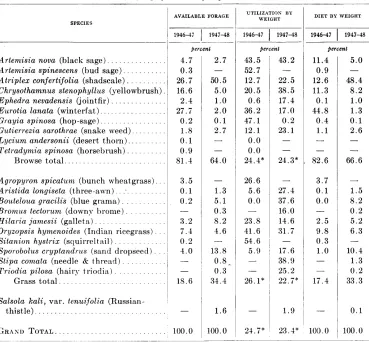
Forage production, utilization, and composition of the diet
Browse produced an average of 73 percent of the forage available to the sheep during the winter seasons, grasses produced 26 percent and a forb (Rus- sian-thistle) one percent.
236 LISLE R. GREEN ET AL.
were removed by grazing and shattering The species composing the diet varied as the season progressed and the prefer- markedly from time to time, as influenced ence decreased accordingly. by site, weather, abundance of species
In spite of the variation in degree of present, and intensity of use.
use for the forage classes among periods, Shadscale was generally abundant on the percent of the seasonal diet composed most areas and produced the largest
TABLE 1
Average available forage, utilization, and composition of the diet for two winter grazing seasons 19QS-48 by species and forage classes
SPECIES
Artemisia nova (black sage) . Artemisia spinescens (bud sage). Atriplex confertifolia (shadscale) . Chrysothamnus stenophyllus (yellowbrush), Ephedra nevadensis (j ointfir) . . . . Eurotia Zanata (winterfat) . . Grayia spinosa (hop-sage).
Gutierrezia sarothrae (snake weed) Lycium andersonii (desert thorn). Tetradymia spinosa (horsebrush).
Browse total..
Agropyron spicatum (bunch wheatgrass). Aristida Zongiseta (three-awn) :. Bouteloua gracilis (blue grama) Bromus tectorum (downy brome) Hilaria jamesii (gallet a)
Oryzopsis hymenoides (Indian ricegrass) Sitanion hystrix (squirreltail)
Sporobolus cryptandrus (sand dropseed). Stipa comata (needle k thread) Triodia pilosa (hairy triodia)
Grass total.
Salsola kali, var. tenuifolia (Russian- thistle)...
GRAND TOTAL..
AVAILABLE FORAGE
1946-47 1 1947-48
percent 4.7 0.3 26.7 16.6 2.4 27.7 0.2 1.8 0.1 0.9 81.4 3.5 0.1 0.2 - 3.2 7.4 0.2 4.0 - - 18.6
- 1.6 - 1.9 -
100.0 100.0 21.7* 23.:* 100.0 2.7 - 50.5 5.0 1.0 2.0 0.1 2.7 - - 64.0
43.5 43.2 52.7 - 12.7 22.5 20.5 38.5 0.6 17.4 36.2 17.0 47.1 0.2 12.1 23.1 0.0 - 0.0 - 24.4* 24.3*
- 26.6 1.3 5.6 5.1 0.0 0.3 - 8.2 23.8 4.6 41.6 -_ 54.6 13.8 5.9 O.S_ - 0.3 - 34.4 26.1’
UTILIZATION BY WEIGHT
1946-47 I 1947-48 1946-47 1 1947-48
percent percent
- 27.4 37.6 16.0 14.6 31.7 - 17.6 38.9 25.2 22.7*
DIET BY WEIGHT
11.4 5.0 0.9 - 12.6 48.4 11.3 8.2 0.1 1.0 44.8 1.3 0.4 0.1 1.1 2.6
- -
- -
82.6 66.6
3.7 - 0.1 1.5 0.0 8.2
- 0.2
2.5 5.2 9.8 6.3 0.3 - 1.0 10.4
- 1.3
- 0.2
17.4 33.3
0.1
100.0
* DVei$rted average.
of grass and browse was almost directly quantity of available forage (Table 1). proportional to the abundance of .the However, the degree of use was never respective forage classes. However, some heavy. The weighted utilization for the individual species constituted a much winter seasons ranged from 13 to 22
UTILIZATION OF WINTER RANGE 237
the seasonal diet. Use was heaviest during the fore-part of the winter before seeds and leaves had shattered ap- preciably. Later use was lighter except while other species were covered by snow. In the spring, even the new suc- culent shoots were but lightly utilized. Black sage was available only in the foothills and seldom dominated extensive areas. However, it was available to sheep in small quantities most of the season. Its sparseness prevented it from becoming important in the diet, but it was closely used on all areas where it was present. The utilization was occasionally as high as 65 percent of the current year’s growth. This removed most growth that was readily accessible.
Winterfat produced a large quantity of forage on many sections of the winter range, but either because of past overuse or unfavorable growing conditions, it did not produce more than 7 percent of the total available forage on any of the lower foothill areas. Some were entirely lacking in this species. However, in some of the valley basins pure stands were found. These areas were generally grazed when light snows occurred or when sheep wanted to move out of the foothills. Winterfat was readily eaten everywhere it occurred. Where it was dominant, the use was often as high as 60 percent, compared to only 15 to 20 percent utiliza- tion in mixed stands where it made up less than 10 percent of the vegetation composition.
Bud sage was not abundant probably because of its high palatability and resulting overuse in past years. Sheep frequently grazed 70 percent of this species during the first grazing contact. This represented all that they could readily take, and only stumps of shoots and a limited amount of leafy material
protected by coarse wood remained.
Yellowbrush was present on most of
the grazing allotments and occasionally represented as much as one-third’ of the available forage. The use of yellowbrush appeared to be determined by site. When it occurred on the alluvial slopes, use was light and often negligible, and where the species was grazed it appeared to be the same plants that had been grazed year after year. When the species occurred in the rocky foothills, use was usually heavy, often destructively so.
Snakeweed was found on most areas but seldom exceeded 3 percent of the total herbage production. Only on local areas where past overuse was evident did this species become abundant. Snake- weed was lightly used throughout most of the season, and contributed less than 3 percent to the average seasonal diet. Jointfir was not abundant on most of the range -and received light use in most areas. However, during periods of heavy snow this plant was used rather
heavily and constituted appreciable
amounts of the diet for brief intervals. Hop-sage was not widely distributed over the range and did not become im- portant in the diet except during the early spring when new growth was eaten. Blue grama, a low growing grass, was unavailable to grazing a large portion of the winter because of snow, but in the relatively snow-free periods it occasion- ally produced as much as 10 percent of the total available forage and made up a substantial portion of the diet. During years of poor forage production this species produces only limited available forage because of low growth.
Sand dropseed was present in various quantities. Around old bed grounds and along sheep trails it was abundant but was only moderately utilized. When other species were plentiful this species was used lightly or not at all.
238 LISLE R. GREEN ET AL.
from 3 to 8 percent of the total available feed. Forage produced by this species is somewhat coarse and only moderately palatable to sheep, yet, it is a plant that withstands drought and abuse well.
Indian ricegrass was distributed
sparsely over most of the grazing allot-
ments and occasionally produced as
much as 25 percent of the total forage. This species is one of the most palatable grasses throughout the winter grazing season and produces early spring growth which is highly preferred and generally grazed heavily before animals leave the winter range.
Squirreltail was green most of the winter and was closely used, but only a small quantity was available, so it was not an important species in the diet. Most plants were found under the pro- tection of shrubs and not available to the grazing sheep.
Three-awn grass produced a coarse, wiry forage that was not particularly palatable. This species never made up more than 2 percent of the .diet. It was abundant only around old bed grounds and sheep drive ways or where the range showed past abuse.
Needle-and-thread grass was not abun- dant, but its green growth within the old leaf sheath made it rather palatable to sheep and locally it constituted ap- preciable quantities of the diet.
Bunch wheatgrass occupied only local areas in the foothill-cedar types, there- fore, representing a rather small per- centage of the total available forage. This species was moderately used and represented about 4 percent of the diet during the 1946-47 winter grazing season. Downy bromegrass was not present on most areas but occurred locally on old bed grounds and overused ranges where the soils did not contain a high content of salts. Even though it is a winter annual, growth was not available until
spring. Only slight use was made of mature plants remaining from the pre- vious year.
Hairy triodia was present only sparsely on small areas in the rocky foothills. The foliage was green most of the winter, however, the extremely low growth was not readily accessible to the animals and did not contribute any appreciable quan- tity to the diet.
Overused ranges generally showed a greater quantity of snakeweed, yellow- brush, three-awn grass, sand dropseed and downy bromegrass compared to ranges in good condition.
TABLE 2
Average amount of forage consumed daily in each period by lambs averaging 85 pounds in weight compared to amount of -forage avail- able per acre.
PERIOD DATE
1 Nov. 26 to Dec. 18 2 Dec. 18 to Jan. 13 3 Jan. 13 to Feb. 3 4 Feb. 3 to March 10 5 March 10 to April 3
IRY MATTER PRODUCED
PER ACRE
1
pounds pounds 641.9 2.04 250.5 3.21 383.5 3.04 278.1 3.71 260.2 2.99
JRY MATTER CONSUMED DAILY PER HEAD
All species that were being used to a degree greater than 40 to 50 percent were scarce and in a weakened state of
production. This suggests that even
though winter range plants may be in a dormant state, they cannot thrive under a management system that allows more than half their annual forage production to be removed by grazing.
Daily forage consumption
On ranges that produce forage of low quality, the amount of feed consumed daily often determines whether or not a nutritional deficiency occurs in the diet of the grazing animal.
UTILIZATION OF WINTER RANGE 239
eight wether lambs and yearlings, from which feces collections were taken pro- vided the means of evaluating forage consumption. This phase of the study was carried on only during the grazing season of 1947-48.
The least aniount of forage consumed per day (Table 2) was at the beginning of winter grazing season (period 1). This was thought to result from the handling of the animals and from a decrease in grazing time on the range. In addition
considerably. The variation cquld be accounted for by cold weather, heavy snows, and grazing time on the range. However, the daily average voided for each period was rather uniform. From this study it seemed that amount of forage produced per acre was not a factor determining the daily consumption by grazing sheep. More important ap- peared to be the time actually spent grazing, which was directly influenced by the time the sheep were out on the
TABLE 3
Forage consumption by lambs and yearling wethers and calculated forage consumption oj an average sheep in each age class of an average range herd when using collection yearlings as the basis,
compared to the recommended allowance of the National Research Council for pregnant ewes
SHEEP AGE CLASS
Collect ion lambs. ... Collection yearlings ...
Lambs. 79 2.65
Yearlings. .117 3.47
3yr.... 137 3.85
4 yr. 137 3.88
5 to 6 yr.. 133 3.79
Over 6 yr.. 129 3.69
Average. . 122 3.56
1
AVERAGE FEED CONSUMED DAILYI
AVERAGE RECOMMENDED ALLOR-
WEIGHT Periods ANCE OF NATIONAL
RESEARCH COUNCIL*
~ Feb. S-Mar. 10 1 Mar. 11-Apr. 4 ( Avg.
3.71t 3.39t
.-
pounds
2.99t 2.78-t
---___
2.14 2.83 3.13 3.13 3.05 2.99 2.88
fiounds
3.35t 3.00
3.09t 3 :20 _--_- --_---
2.40 2.79
3.15 /
3.20
3.51 3.61
3.51 / 3.61
3.42 3.50
3.34 3.39
3.22 3.35
* Oven dry basis.
t Determined by the lignin ratio method. .
the range was dry and the sheep were range and indirectly by climatic con- watered infrequently. After the sheep ditions and the character of the forage. became accustomed to being handled This, of course, is assuming that at no and carrying the fecal bags, experimental time was the range overgrazed and that procedure had little effect upon forage adequate forage was available except
consumption. when covered by snow.
Consumption increased after period one until the last period when there was a slight decrease. During this pkriod some spring growth appeared and sheep spent much of the time traveling in search of green forage.
Daily quantities of feces voided varied
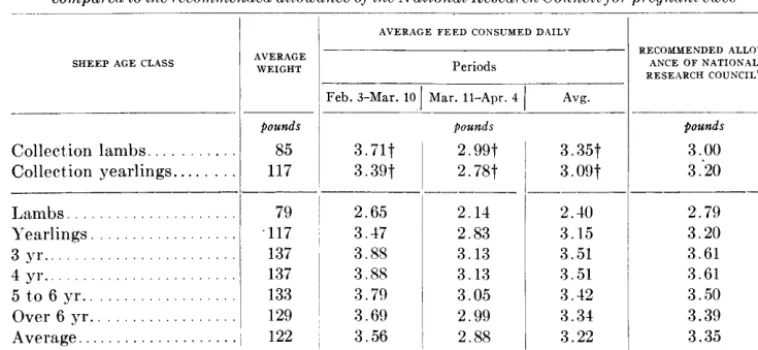
Forage consumption by age classes The average daily forage consumption of lambs and yearlings, as compared with
the recommended allowances of the
240 LISLE R. GREEN ET AL. sumption of the lambs used for collection
was 3.35 pounds compared to 3.09 pounds for the yearlings. The yearlings weighed an average of 32 pounds more than the lambs, yet the daily forage in- take was 0.26 pounds less. The recom- mended allowance for an 85pound lamb is 3.00 pounds of moisture-free forage daily which is 0.35 pounds less than was actually determined (Table 3). The recommended allowance for a 117-pound yearling is 3.20 pounds of forage daily or 0.11 pounds more than was actually calculated in the present study. Since the National Research Council has al- lowed for a margin of safety, it appears that the data collected from yearling wethers are in close agreement with the recommended forage allowance. How- ever, it appears that the recommended allowance for lambs is too low, especially under range conditions, since these sheep consumed more than the recommended allowance and left the winter range with only a slight gain.
Brody (1) has proposed that the 0.73 power of the body weight could be used to calculate the feed consumption of different age groups of maintenance sheep. Using wether yearlings as the basis, calculations have been made in Table 3 for other age classes of sheep in an average range herd. There is close agreement between the National Research Council allowances and the calculated forage consumption.
From these data it appears that yearling wethers can be used to obtain forage consumption of all age classes of sheep except lambs.
SUMMARY
A study was conducted on typical saltbush desert range in westcentral Utah during the years 1946 to 1948 to determine t’he quantity of forage avail- able to sheep during the winter grazing
season, the composition of the diet, and the daily forage consumption.
The forage was sampled by the “before and after” method which consisted of random sampling of all forage species before grazing and again after grazing. The difference in weight between the before-grazing sample and the after- grazing sample was a measure of the percentage utilization of each species.
Average total production was com- posed of 73 percent browse, 26 percent grass, and 1 percent forbs.
Average utilization for browse and grass was about the same, approximately 24 percent for each forage class. During the first part of the grazing season browse species received heavier use than ,
grasses, but with advancement of season the utilization of grasses increased and utilization of browse decreased.
The percent of the seasonal diet composed of grass and browse was almost proportional to. the abundance of each forage class on the range. This was not true, however, for individual species. Percent utilization for certain species varied widely and was dependent upon plant association, weather conditions, and general character of the individual plants.
Overused ranges generally had a greater quantity of snakeweed, yellowbrush, three-awn grass, sand dropseed, and downy bromegrass compared to ranges judged to be in good condition.
UTILIZATION OF
and indirectly by climatic conditions and character of the forage.
Average dally forage consumption of wether lambs weighing 85 pounds was 3.35 pounds compared to 3.09 pounds for yearlings weighing 117 pounds. The yearlings weighed an average of 32 pounds more than the lambs, yet, the daily forage intake was 0.26 pounds less. The data collected from yearling wethers is in close agreement with the recom- mended allowances of the National Re- search Council; however, it appears that the recommended allowance for lambs is too low for range conditions since all ex- perimental lambs consumed more than the recommended allowance and left the win- ter range with only slight gains.
If lambs are used as a basis for calcu-
lating forage consumption for older
animals by the 0.73 power function of the body weight, dry matter intake is too high but yearlings give figures that are in close agreement with the recom- mended allowances of the National Re- search Council.
LITERATURE CITED
1. BRADY, S. 1945. Bioenergetics nud growth. Reinhold Publishing Corpora- tion, New York.
2. COOK, C. J., C. W. COOK, AND L. E. HAR-
RIS. 1948. Utilization of northern Utah summer range plants by sheep. Jour. For. 46 : 416-425.
3. COOK, C. W., L. E. HARRIS, AND L. A. STODDART. 1948. Measuring the nutri- tive content of a foraging sheep’s diet under range conditions. Jour. Animal Sci. 7 : 170-180.
4. CULLEY, M. J. 1947. Grazing habits of cat>tle. Southwestern Forest and Range Expt. Sta. Res. Note 21.
5. DIXON, J. S. 1934. A study of the lif? his- tory and food habits of mule deer in Cali- fornia. Part II. Food Habits. Calif. Fish and Game 20: 315-354.
WINTER RANGE 241
6. 7. 8. 9. 10. 11. 12. 13. 14. 15. 16.
DORAN, C. W. 1943. Activities and graz- ing habits of sheep on summer ranges. Jour. For. 41: 253-258.
ELLIS, G. H., G. MATRONE, AND L. A. MAYNARD. 1946. Method for the deter- mination of lignin and its use in animal nutrition studies. Jour. Animal Sci. 5: 285-297.
FORBES, R. M., AND W. P. GARRIGUS. 1948. Application of lignin ratio tech- nique to the determination of the nutri- ent intake of grazing animals. Jour. Ani- mal Sci. 7 : 373-383.
FUELLE~IAN, R. P., AND W. L. BURLISON. 1939. Pasture yields and consumption under grazing conditions. Amer. Sot. Agron. Jour. 31: 399-412.
GALLUP, W. D., AND C. S. HOBBS. 1944. Desiccation and analysis of feces in di- gestion experiments with steers. Jour. Animal Sci . 3 : 326-332.
GARRIGUS, W. P., AND H. P. RUSK. 1939. Some effects of the species and stage of maturity of plants on the forage con- sumption of grazing steers of various weights. Ill. Agr. Exp. Sta. Bul. 454. KLINGMAN, D. L., S. R. MILES, AND G. D.
MOTT. 1943. The cage method for de- termining consumption and yield of pas- ture herbage. Amer. Sot. Agron. Jour. 35 : 739-746.
National Research Council. 1949. Rec- ommended nutrient allowances for do- mestic animals. No. V. Recommended nutrient allowances for sheep. A report of the Committee on Animal Nutrition, revised.
SMUTS, D. B., AND J. S. C. MARAIS. 1940. The dry matter consu&ption of sheep on natural grazing in the Transvaal. Onderstepoort Jour. of Vet. Sci. and Anim. Indus. 14 : 403-413.
STAPLEDON, R. G., AND M. G. JONES. 1927. The sheep as a grazing animal and as an instrument for estimating the productivity of pastures. Welsh Plant Breeding Sta. Aberystwyth Bul. Ser. H. No. 5: 42-54.