Detecting the Age of the Fish through Image
Processing using its Morphological Features
G.T.Shrivakshan1 , Dr.C. Chandrasekar 2 1 Department of Computer Science, Swami Vivekananda Arts & Science college,
Villupuram, TamilNadu, India.
2Associate Professor, Department of Computer Science Periyar University
Salem, TamilNadu, India
Abstract- This paper deals with detecting the age of the fish through its morphological features using image processing. The age of the fish is calculated with growth rate in body length. The length of the fish is being calculated using edged detection technology. In this paper it uses the edged detection algorithm, Sobel Filter and Gabor Filter. Gabor filter for texture, pattern extraction and geometrical shape feature extraction to find the fishes distinctive dark lines that mark the body and tail. The feature based scaling by which the length of the fish is calculated through which the age of the fish can be computed.
Key words:
Image processing, Feature extraction, Edge detection, sobel filter.
I. INTRODUCTION
Beneath the sea there are unexplored area on earth, the underwater world has unlimited attraction to marine scientist. In this research, it tries to resolve the complexity in finding the age of fish through its morphological features. It uses the image processing [6][7] concept to extract the fish image. With the image of the fish it passes through several analysis to find the age of the fish, for which it uses edge detection technology followed by sober filter to compute the length of the fish and another method using Gober filter for texture, pattern extraction and geometrical shape feature extraction to find the fishes distinctive dark lines that mark the body and tail. In this paper the sample fish coilia ectenes taihuensis, the lake of China which is being taken for study. To
compute the Length of the fish it uses the weight formula which is as follows.
The von Bertalanffy growth formulae [1][2] of the fish were determined to be:
Lt=349.3384(1-exp (-0.354(t-0.0319))) (2)
The growth rate of the body length decreased gradually with increasing age. The acceleration of growth rate was positive from age 1 to 3.1 years, thereafter was negative. From this we can identify the age of the fish by its length feature correspondingly its weight also. To detect the length of the fish, in this paper it uses the edge detection technology, calculate the tip of the head to the pectoral fin and followed by the distance between the pectoral fin to dorsal fin then dorsal fin to tail which gives the length of the fish through which it can calculate the age of the fish. The paper describes the techniques to extract the morphological features of the fish through the video image processing [8][9], the fish features are obtained. A new technique called oblique projection
W=6.430x10⁻⁶xL2.8603(r=0.9980) (1)
W=Weight L=Length
Wt=121.0399[121.0399(1-exp(-0.3549t-0.0319))]3 (3) Wt=Body Weight at age t
segmenta particular
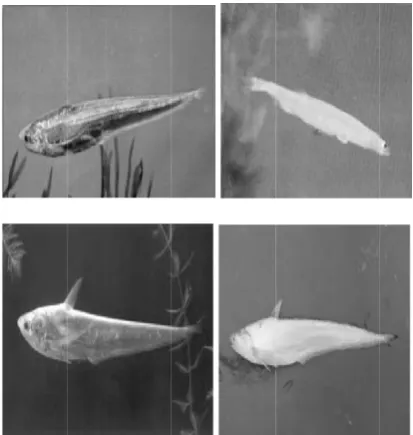
Fig 1: D morpholo
Fig 2: D fish A. Image Edge det There are However categorie method maximum image. T crossings find edge gradient Laplacian compare detection
ation has be r features of th
Depicting the ogical features
Different imag
II. ME e processing a ection algorit e many ways r, the most es, gradient
detects the m and minimu The Laplacia s in the seco es. This edges method (Rob n method (M
the feature e n using the La
een develop he fish.
length of the s (fins)
ges of coilia e
ETHODOLOG lgorithm: thm
to perform th may be gr and Laplacia edges by um in the firs an method s nd derivative s of an image berts, Prewitt Marrs-Hildret extraction usin aplacian. It se
ed that ext
e fish throug
ectenes taihue
GY
he edge detec rouped into an. The grad looking for t derivative o earches for e of the imag detected using t, Sobel) and th). It can ng the Sobel eems that altho
tracts h its
ensis ction. two dient the of the zero ge to g the d the then edge ough
it does do bet suffers from constructed u still work be method suffe The difficult images and t features. Ano wavelets. S wavelet tran essentially ed diagonal edg is nearly equ edge detectio easily extend demonstrated to be rando limitation in for finding t algorithm in threshold wh in this paper threshold val the high inte detection tech B. Algorithm Wavelet Tran
1. An be d whic 2. The back crea
3. The
4. A n aver
5. Go thres repe the o been
tter for some f mismapping s using individu etter. It shou ers the same d ties are due
the inability t other method Specifically a
nsform [3] dge maps of t es in an imag uivalent to th on methods, i d our edge d d. Generally th
omly chosen this paper, it the initial thr stead of cho hich may not l r it proposes lue as one of ensity that is hnology. m for finding
nsformation:
initial thresho done by takin ch has high in
image is seg kground pixe ating two sets: a) G1 =
pixels)
b) G2 =
(backgro the value mth colum average of ea a) m1 = ave b) m2 = ave new threshol rage of m1 and a) T’ = (m1 back to step shold compu eating until th one before it n reached).
features (i.e.th some of the li ually selected ld also be no drawbacks as
to large con to handle lar of detecting e a two-dimen of the ima the vertical, h ge. Although t he gradient a it does offer detection to m
he threshold v n but to ov t formulates a reshold value oosing a rand
lead to the rig a new way f the edge pix more advant
the threshold
old (T) is cho ng one of the ntensity.
gmented[5] in els as desc {f(m,n):f(m,n {f(m,n):f ound pixels) (n
e of the pixel mn, nth row) ach set is comp erage value of erage value of d is created d m2
+ m2)/2 two, now u uted in step he new thres (i.e. until con
he fins), it still ines. A morph points would oted that this mismapping ntrast between
rge translation edges is using nsional Harr age produces horizontal and the Haar filter and Laplacian the ability to multiscales as value [10] has vercome this a new method [10]. In this dom value as ght prediction
of taking the xel which has tages in edge
d value in the
osen, this can e edge pixels
nto object and ribed above )>T} (object f(m,n)≤ T} note, f(m,n) is located in the
puted. fG1 fG2
d that is the
This iterative algorithm is a special one-dimensional case of the enhanced k-means clustering algorithm, which has been proven to converge at a local minimum—meaning that a different initial threshold may give a different final result. In this wavelet algorithm it imposes multi-threading concept which is the modification concept that is done in the existing algorithm to identify the coilia ectenes taihuensis fish in this work. The Wavelet transformation is being applied in the sample coilia ectenes taihuensis fish.
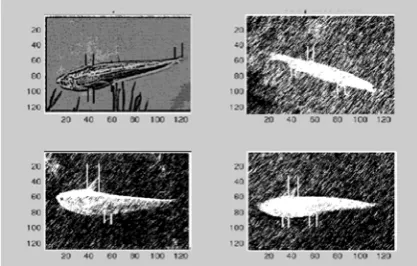
Fig 3: Vertical Sobel Filter
Fig 4: Horizontal Sobel Filter In the fig 1 & 2, it is clearly able to distinguish the various morphological features of the fins especially the head, pectoral fin, dorsal fin and tail fin. The length of the fish can be computed using the various horizontal and vertical Sobel filters. In this paper it also adopts another methodology for finding the length of the fish using image scaling. This section describes the vision processing algorithm . The algorithm combines a series of existing filters commonly found in the vision literature, with a
new segmentation filter called Pattern Extraction (see Fig. 5).
C. Image Grading
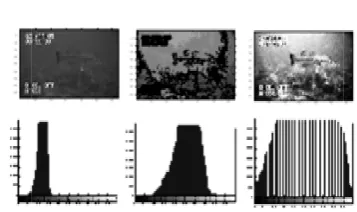
To reduce computation, the input original color images are converted to grayscale and the pixel values are limited in the interval (0,1). Due to underwater light limitations, images are underexposed and blurry. The poor contrast forces grey values to concentrate into a small range. To remedy this, intensities are adjusted linearly to maximize the range, and histogram equalization method is used to stretch contrast so that all grey-levels have similar likelihoods, (see Fig. 6).
Fig 5: Image Processing System
D. Pattern Extraction by Gabor filter
Pattern Extraction is the problem of breaking an image into components within which the texture is constant. In this case, the target fish's tail and body consist of obvious and regular orientation stripes. To extract these features, a single oriented Gabor filter of spatial-frequency is proposed. The method is not only effective in extracting the patterns, but is efficient since only a single texture extraction filter is required. The Gabor filter is orientation selective. Its kernels are Fourier basis elements that are multiplied by Gaussians, meaning they respond strongly at image points where there are components that locally have a particular spatial frequency and orientation. If s(x,y) is a complex sinusoidal known as the carrier, and w r(x,y) is a 2-D Gaussian-shaped function known as the envelope, the Gabor filter is a complex function g(x,y):
g(x,y) = s(x,y) x ωr(x,y) (4)
The sinusoidal is defined in terms of the spatial frequencies (u0, v0) and the carrier phase P as
Intensity & contrast Scaling
Pattern Extraction
Oblique Projection
Feature Extraction Position
Estimation f(x,y)
follows. s(x,y)= ex The Gau scales th envelope angle, an envelope
ωr (x,y)=K
rotation o (x-x0) = +
(y-y0) = -(
Fig 6: Im intensity image.
Each quadratur convenie parts of complex D Fourie
T = exp (j g(x, y) = K
T1 = exp ( T2 = J (-2 g (u,v) = k
The Gab with the i
xp(j2π(u0x + u0y
ssian envelop he envelope e axis, de nd (x0,y0) def e.
K exp (pi(a2(x-x
Note that t operation such
(x-x0)cosθ + (y
(x-x0)sinθ + (y-y
mages and rela gradient ima
complex Gab re (out of ently located a complex f Gabor fun er transform of
(2π (u0x + v0y) K exp (-π (a2
(x-(-π (((u - u0)2r)/ π(x0(u – u0) + k/ab exp T2
bor filter is input image I(
0y)+P)
pe is defined i magnitude, efines the e fines the peak
x0)2r + b2(y-y0)2
the subscript h that: y-y0)sinθ
y0)cosθ
ated bars (a) or age, and (c) th
bor consists o phase by in the rea function. Now nction in spac f this Gabor is
) + P
-x0)2r + b2(y-y0)
/a2) + ((v – v 0)2 y(v – v0) + p))
used as a ke (x,y), input im
(5)
in Eq. 3, whe (a,b) scale envelope rota
k location of
2r) (6)
r represen
(7)
riginal images he contrast se
of two function y 90 degr
l and imagi w we have ce domain. Th s as follows
)2r))T (8)
r)/b2) exp T1
(9)
ernel to conv mage to produc
ere K the ation f the
ts a
s, (b) ealed ns in rees), inary the he 2-volve ce: imagabout(x,y regabout(x,y) =
By apply the fish and except for establishes a projection finding length
E. Oblique Pr In this step o features are ground. Afte Filter, a thres values of 0 or Fig. 7 a), o pattern, and water grass) overlap with image into a the number o results in tw background second is a sh smooth and projection of With this his patterns is co in which the threshold tha interval is d Ytailstop] such produces: Ytailstart = max (
ytailstop = max (y
The peak withi
ymax = max (y|y
If the slope o ymax] and [ym mmin, it is d found. If th outside the from the ima in the top and 7c). In a simi horizontal his black pixels
) = l(x.y) im = l(x,y) real
ying the Gab d its local b
the tail and a good basis segmentation h of the fish.
rojection Segm f the vision pr
extracted fr er the image i shold is applie r 1. In observi only the fish
some backgr remain. The the backgroun a vertical histo of black pixels wo separate curve with harp and narro low curve. f the tail and stogram, a se onducted to p fish is locate at characteriz defined as ro that a scan
(y|Hv(y) > A)
y|Hv(y) < A, y <
in this interval i
yЄ [ytailstart,ytailst
of the histogra max, ymax+δ] h determined th
e slope cond interval [ytai age, effective d bottom porti ilar fashion, th stogram Hh(x),i in each colum
mag(g(x,y)) l(g(x,y))
bor filter, the background d body fea for the follo which will
mentation rocessing, the rom the rem is processed ed to force pix
ing the resulti tail pattern, round pattern fish patterns nd. Projecting ogram Hv(y) s in each row shapes. The no defining ow spike prot This second body feature earch for the produce an int ed. If A is a p zes the tail w ows belonging from the top
(11)
< ytailstart) (12)
is determined b
top]) (13)
am within inte have magnitu hat the fish t ditions are sa ilstart,ytailstop] a ely eliminating
ions of the im he image is pr i.e. summing mn of the im
(10)
e majority of are removed atures. This owing feature be useful in
e body and tail maining back-by the Gabor xels to take on ing image (see body center ns (i.e. have limited g the threshold i.e. summing of the image e first is the g shape. The truding from a d shape is a es, (Fig. 7 b)
tail and body terval of rows predetermined width, the tail g to [Ytailstart
of the image
by:
ervals [ymax- δ udes less than
tail feature is atisfied, rows are subtracted g background mage, (see Fig
pattern d spike. Th constant case, a s define a resides. C to remov fish,(see only the t
Fig 7: O after Ga projectio and bott Oblique p F. Featur
In this st black pix one repre the body describe leftmost (U2(i),V2 interval. defined a
U0(i) = (U
V0(i) = (V
Fit a stra to find t length of
dominates the he body patter
amplitude ad earch for thes n interval of Columns outs ve backgroun
Fig. 7d). W tail and body
Oblique Projec abor filter an
n curve, (c) t tom backgro projection. re Extraction
tage of the im xels of the ima esenting the ta y feature. The the position a and the rig 2(i)) are determ
The central p as follows:
U1(i) + U2(i))/2
V1(i) + V2(i))/2
ight line to th the body's ce f the fish is cal
e histogram rn is also evid djacent to the se two feature f columns in side this inter
nd on the t What remains
features.
ction Segmen nd threshold. the image aft ound, and (d
mage processi age are model ail feature and ese two lines and orientatio ght-most pixe mined for eac points (U0(i),V
(14)
(15)
he tail. A simil entral line th lculated.
with an obv dent as a regio tail spike. In es is conducte n which the val are subtra two sides of
is an image
ntation: (a) Im (b) The ver ter subtracting d) the horizo
ing, the remai led with two l d one represen
are later use on of the fish. els (U1(i),V ch row in the V0(i))of the tai
lar process is hrough which
vious on of n this ed to fish acted f the
with
mage rtical g top ontal
ining lines, nting ed to
The V1(i)), e tail il are
used h the
G. Results an From the abo ectenes taihue tabulated in T
Table 1. Tru length(mm) of Age
The body length
Back calculated length Theoretical body length
The graph de length:
Fig 8: The fi and length of From the ab predictable th
This paper des from its image length of the efficient image the length of th sober vertical f for finding the
relative posit Gabor filter Oblique pr background, the above two the age of the
nd Analysis ove algorithm ensis fish [5] Table1
ue, back calcu f Coilia ectenes
1 2 102 179
103 176
101 175
epicting the ag
igure gives th f the fish bove explanat
hrough the ima CONCL
scribes a syste . The core of th e fish with its e processing a he fish are edg filter and horiz e length of the
tion of the fis to extract t rojection se The length o o methods. Fr e fish can be c
ms the length is being comp
ulated and th taihuensis by a
3 4
230 2
226 2
227 2
ge of the fish
he relation bet
ion the age o age processin LUSION
m for finding he paper focuse s morphologic algorithms are ge detection alg ontal filter. An fish is gober fi
sh. The algor texture, a new egmentation of the fish is
rom the leng calculated. Th
of the Coilia puted which is
heoretical body age (years)
4 5 272 284
268 289
264 289
relative to its
tween the age
of the fish is ng algorithms.
age of the fish s on finding the cal features an used to extrac gorithms mainly nother algorithm ilter which uses
rithm uses a w filter called to remove calculated by gth of the fish he limitation is
a s
y
s
e
s
h e n t y m s
the while the uncertainty in fish size and feature lengths decreased the accuracy of relative range estimation. Despite the success in finding the length of the fish over several images, the algorithm has several limitations. It is assumed that only one fish be present in each frame.
REFERENCES
[1] Bertalanffy, L. von 1938. “A quantitative theory of organic growth (Inquiries on growth laws. II)”. Human Biol. 10: pp.181-213.
[2] Bertalanffy, L. von 1960. “Principles and theory of growth. In Fundamental aspects of normal and
malignant growth”. Pp 137-259. W. W.
Nowinski ed. Elsevier, Amsterdam.
[3] David Stanhill and Yehoshua Y. Zeevi, “ Two-Dimensional Orthogonal Filter Banks and Wavelets with Linear Phase”, IEEE transactions on signal processing, vol. 46, no. 1, january 1998. Pp 183-190
[4] Pierre-Louis Bazin, Dzung L. Pham, “Topology correction of segmented medical images using a fast marching algorithm”, Computer Methods and Programs in Biomedicine, November 2007, volume 88, issue 2, pp182-190.
[5] QI-QUN CHENG and DA-RULU, “PCR-RFLP
“Analysis of cytochrome b gene does not support Coilia ectenes taihuensis being a subspecies of Coilia ectenes”. In Indian Academy of Sciences. Journal of Genetics, Vol. 84, No. 3, December 2005 pp.307-310
[6] Rafael C. Gonzalez, and Richard E. Woods, “Digital image processing”, Pearson-Prentice Hall, 2005.
[7] Raman Maini Dr. Himanshu Aggarwal ,
“International Journal of Image Processing
(IJIP)”, Volume 3, Issue 1, 2002, pp1 to 12. [8] Rife J, “Automated robotic tracking of gelatinous
animals in the deep ocean”. PhD thesis, Stanford
University, Stanford,California,,
December,2003.
[9] Ritendra datta, dhiraj joshi, jia li, and james z. Wang , “Image Retrieval: Ideas, Influences, and Trends of the New Age” The Pennsylvania State University ACM Computing Surveys, Vol. 40, issue 2, Article 5, Publication date: April 2008, pp 1-60.
[10]Terzija Nataša, Geisselhardt Walter, “Robust digital image watermarking based on complex
wavelet transform”, Proceedings of the 9th