THE INTRODUCTION OF EDUCATIONAL TECHNOLOGY INTO ELEMENTARY SCHOOLS IN CYPRUS: A CRITICAL ANALYSIS OF THE IMPLEMENTATION OF AN INNOVATION
by
Yiasemina Karagiorgi
A thesis submitted in fufilment of the requirements for the Ph.D. degree of the University of London
ABSTRACT
This thesis researches the implementation of educational computing in Cypriot elementary schools. In the past, educational broadcasting, another innovation in educational technology, failed to be institutionalised. An experimental programme for computer introduction has been running since 1994 in twenty seven pilot schools. The similarities in the implementation process of the two initiatives suggest that computing is likely to follow the fate of broadcasting. To avoid this, the factors key to the process, Cypriots' perceptions and implementation conditions, need to be explored.
Examination of Cypriots' perceptions resulted in several findings, indicating that although individuals favour introduction of the innovation in theory, implementation is problematic at the practical level. First, most Cypriot parents, children and teachers support the introduction of new technologies in schools but they lack consensus as to the educational use of computers. Second, although actors hold favourable attitudes towards computing, several dimensions of these attitudes that emerge as a result of my research - personal, educational, general - are not found to be different between pilot and non - pilot populations. Third, the average pilot teacher is shown to be at an early stage of implementation with high "self" concerns, rather than "task" or "impact" ones. Interesting differences in the views, attitudes and concerns show the heterogeneity of actors, likely to lead to different reactions to implementation. Exploration of implementation conditions shows that some aspects of the innovation such as introduction of resources into schools have succeeded but others such as access to hardware, software and supplementary material are problematic. This centralised initiative with its considerable flexibility at the school level enabled the emergence of different groups of teachers in terms of involvement. As such involvement is minimal, computing at the moment is not integrated successfully into existing learning and teaching practices. However, different practices, shaped by individual teachers, were developed in pilot schools. The profile of teachers in terms of views, attitudes and concerns and the conditions available were shown to have an important effect on the extent and quality of their involvement
ACKNOWLEDGMEWI'S
llávTa OTOV yOU OOU Va'XEic TI7V lBdKq
To ç6áatpov CKCI clv' o npoopiapóq c-au. AAAÔ pq 6ioCciq To Tal5I SuiAou.
KaA(n'cpa XPo via noAAã vu Siapictae,
hal ycpoq nb v' apaeiq aro vqol, nAoUasoç t 600 KtpSiacç arov Spopo,
pq npoorSoKwvTaq nAoUTq va as Swcei q IBÔKq.
H lUáKq a' tSwoc T' wpaio TaI5I Xwplç auTl)v 5ev Ba '6yaivcq orov Spopo.
'AAAa 5ev EXci vu cc Swoci ma
K, 0V ITTWXIK1 TIJV 6pciç, 13 IBÔKIJ 5ev ac yeA ace. ETch oovpóq rrou Eyiveq, pe rôaq nelpa,
ij5q Ba TO KaTôAa6eq oi IOôKeç TI Ofjpolvouv.
(Kwv.nuvi',vou Ka8dçq, "IOáKq")
Your mind should ever be on Ithaca Your reaching there is your prime goal. But do not rush your journey anywise. Better that it should last for many years, and that, now old, you moor at Ithaca at last, a man enriched by all you gained upon the way, and not expecting Ithaca to give you further wealth
For Ithaca has given you the lovely trip. Without her you would not have set your course. There is no more that she can give. If Ithaca seems then too lean, you have not been deceived. As wise as you are now become, of such experience
you will have understood what Ithaca stands for. (Konstantinos Kavafis, "Ithaca'I
The journey to my Ithaca has been long and stressful, lovely and rewarding at
the same time. Reaching my destination is important However, the experiences I have gained during these last years "on my way" have been really valuable. I could not have survived without the support of many wonderful people, to whom I feel the need to express my gratitude and appreciation.
To my advisors Prof. Jon Ogborn, Dr Harvey Mellar and Dr Vanessa Barker for their patience, guidance and supervision.
• To my family and friends for their love and understanding.
TABLE OF CONTENTS
CHAPTER1: INTRODUCTION...I
1.1. BACKGROUND TO THE STUDY...1
1.2. THE CONTEXT OF THE STUDY ...I 1.3. THE EXPERIMENTAL PROGRAMME FOR COMPUTER INTRODUCTION...5
1.4. THE AIMS AND RESEARCH QUESTIONS ...6
1.5. SIGNIFICANCE OFTFIIS STUDY...8
1.6. THEORETICAL ASSUMPTIONS...10
1.7. ORGANISATION OF THE THESIS ...11
CHAPTER2: LiTERATURE REVIEW...12
2.1. INNOVATION...13
2.1.1. The concept of innovation...13
2.1.2. The study of educational change ...13
2.1.3. The context of educational change: the process, its development, factors involvedand strategies/models applied...15
2.1.3.1 The process of change: various schemes...15
2.1.3.2. The development of change: different phases ...17
2.1.3.3. Factors affecting change...19
2.1.3.4. Strategies and models of implementation...20
2.1.4. Reaction to educational change: different theories and perspectives ...21
2.1.4.1. Adoption and rejection of innovations ...22
2.1.4.2. The inadequacy of the technological perspective...22
2.1.4.3. The alternatives political and cultural approaches...24
2.1.5. A recent study on change: Fullan's work ...25
2.1.5.1. The implementation perspective...26
2.1.5.2. The phenomenological approach...27
2.1.5.3. The factors of change ...28
2.2. EDUCATIONAL TECHNOLOGY...30
2.2.1. Physicalist approach ...30
2.2.2. Systems approach...31
2.2.3. Integrated approach...31
23. EDUCATIONAL COMPUTING: SUCCESS IN IMPLEMENTATION...33
2.3.1. Rationales for introduction of educalional computing ...33
2.3.2. The concept of success: qualitative and quantitative dimensions...34
2.3.3. International implementation practices: minimal success...35
2.33.1 A general overview...35
2.33.2 Some innovative projects ...36
-4-2.4. ACFORS IN IMPLEMENTATION: ATI1TUDES AND CONCERNS .39
2.4.1. People's attitudes...40
2.4.1.1. The nature of attitudes... 2.4.1.2. The role of attitudes in implementation: general trends...41
2.4.2. People's concerns...47
2.4.2.1. The nature of concerns...47
2.4.2.2. The role of concerns in implementation: general trends...49
2.5. ACFORS IN IMPLEMENTATION: PRACTICAL ASPECTS AND CONDiTIONS...53
2.5.1. The complexities of teaching...53
2 5.2. Problems in implementation conditions...53
2.5.3. Action research: a possible solution ...55
2.6. CONCLUSION...56
CHAPTER3: METhODOLOGY ...58
3.1. RESEARCH DESIGN AND METHODOLOGICAL CONSIDERATIONS...58
3.1 1. Goals in conductingresearch...58
3.1.2. An overview of the research design ...59
3.1.3. Methodological considerations ...60
3.2. HISTORICAL RESEARCH FOR EDUCATIONAL COMPUTING AND BROADCASTING...63
3.2.1. Objectives and method...63
3.2.2. Nature of the data collected...63
3.2.3. The analysis...65
3.2.4. Limitations...66
3.3. A QUANTiTATIVE SURVEY OF ACTORS' VIEWS, AT1TI1JDES AND CONCERNS...67
3.3.1. Objectives and method...67
3.3.2. Nature of the data collected...69
3.3.2.1. Development ...69
3.3.2.2. Piloting...74
3.3.2.3. Administration...75
3.3.3. The analysis...76
3.3.4. Limitations...81
3.4. RESEARCH INTO THE IMPLEMENTATION PRACTICES ...82
3.4.1. Objectives and method...82
3 4.2 Nature of data collected...83
3.43.Theanalysis...84
3.4.4. Limitations...86
4.1. THE IMPLEMENTATION PROCESS .88
4.1.1. Educational Broadcasting...88
4.1.1.1. Initiation...88
4.1.12. Planning and administration...88
4.1.13. Implementation...89
4 1.2. Educational Computing...93
4.1.2.1 Initiation...93
4.1.2.2 Planning and administration...93
4.1.23. Implementation...95
4.1.3. Comparison of the two innovations...97
4.2. FACTORS KEY TO THE PROCESS ...102
4.2.1. Educational Broadcasting... 102
4.2.1.1. The actors' perceptions... 102
4.2.1.2. The conditions... 103
4.2.2. Educational Computing... 106
4.2.2.1. The actors' perceptions... 106
4.2.2.2. The conditions... 107
4.2.3. Comparison of the two innovations... 110
42.3.1 The actors' perceptions ... 111
4.3.2.2 The conditions ... 112
4.4. CONCLUSION... 114
CHAPTER 5: ACTORS' VIEWS, ATI1TUDES, CONCERNS. 116 5.1. CFIARACFERISTICS OF THE ACTORS ... 116
5.1.1. Response rates...116
5.1.2. Demographics...117
5.1.3. Computer background...117
5.2. VIEWS ON IMPLEMENTATION ASPECIS...123
5.2.1. General trends in views...123
5.2.1.1. Beliefs on computer introduction...123
5.2.1.2. Reaction to goals for computer introduction...127
51.13. Teachers training needs, problems, media use ...128
5.2.2. Nature of views ...130
5.2.2.1. Supportive statements ...131
5.2.2.2. Opposing statements...133
5.2.2.3. Implementation comments...134
5.3. AlTITUDES TOWARDS EDUCATIONAL COMPUTING ...138
5.3.1. General trends in attitudes... 138
53.1.1. Semantic differential instrument... 138
5.3.1.2. Computer attitude scales... 139
532 NaturecIattitudes ... 141
5.3.2.2. Factors related to demographic and computer
backgroundvariables ...147
5.4. TEACHERS' CONCERNS...151
5.4.1.Generaltrendsinconcerns...151
5.4.1.1. Highest Stages of concern ...151
5.4.1.2. The profile of the average Cypriot teacher...152
5.4.1.3. Using demographic and computer background variables to show characteristics of groups of teachers...154
5.42 Natureofconcerns ...162
5.5. CONCLUSION...163
CHAFFER6: IMPLEMENTATION PRACI10ES AND FACTORS...166
6.1. SURVEY STATISTICS: ALL PILOT SCHOOLS...166
6.1.1. Response rates...167
6.12 Hardware...167
6.1.3. Software...169
6.1.4. Curriculum integration: use...170
6.1.5. Problems and needs...172
6.1 6. Suggestions/Comments...174
6.2. SELECTED PILOT SCHOOLS ...177
6.2.1. Background: Characteristics of the schools ...177
6.2.1.1. The actors' perceptions: views, attitudes and concerns...178
6.2.1.2. The conditions...184
6.22. The implementation practices: Factors for consideration...185
6.2.2.1. Clarity and Complexity...186
6.2.2.2. Consensus and conflict about the change ...189
6.2.2.3. Quality and practicality of change ...190
6.2.2.4. Central office direction, commitment and support...191
6.2.2.5. Process of implementation and institutionalisation...192
6.2.2.6. Professional development and assistance ...193
62.2.7. Implementation monitoring and problem solving...194
6.2.2.8. Principal's leadership ...194
62.2.9. Community support...195
6.2.2.10. Environmental stability...196
623. The impact of factors on aspects of success...196
62.3.1. Quantitative aspect: Extent of computing integration in regularpractices...197
62.32. Qualitative aspect: Patterns of use ...198
63. CONCLUSION...200
CHAFFER 7: FINDINGS, IMPUCATIONS AND RECOMMENDATIONS ...202
7.1.1. What can be learned by the comparison between educational
broadcastingand educational computing?...202
7.1.2. What are the general trends and nature of actors' views, attitudes and concernsabout educational computing?...203
7.1.3. In what ways do several key factors influence integration of computing intoschool practices?...207
7.2. TYING THE THREADS TOGETHER THE IMPLEMENTATION PROCESS ANDTHE CYPRUS CONTEXT ...210
7.2 1. The Cyprus context ...210
7.2.2. The implementation process of educational computing in Cyprus...211
7.2.3. The future of educational computing in Cyprus chances for success...213
7.3. RECOMMENDATIONS ...214
7.4. DISCUSSION...218
7.4.1. Looking backwards: Reflections on the literature ...218
742. Looking backwards: Reflections on the methodology...220
7.5. LOOKING FORWARD: IDEAS FOR FURTHER RESEARCH ...221
7.6. CONCLUDING REMARKS ...222
REFERENCES...224
APPENDICES...255
I. Stages of Concern Questionnaires - Results ... 256
A.Percentile score means and other variables... 256
B.Peak Stages of concern and other variables...257
II. Computer Attitude Scales - Results ...258
A.FactorAnalysis...258
B.ANOVA - Factor scores ... 266
C.Semantic differential instrument... 272
ifi. Other questionnaire items - Results ...273
A.Behefs on computer introduction... 273
B.Goals for computer introduction... 275
C. Teachers' training needs, problems, media use...278
1V. Instruments for data collection...279
A.Questionnaires... 279
B. Other documents...330
LIST OF FIGURES AND TABLES
Figures
Figure1.1 MAP OF CYPRUS (Districts)...2
Figure2.1. I-IIJBERMAN'S "SYSTEMS IN CHANGE"...15
Figure2.2 BOLAMS FRAMEWORK...16
Figure2.3 HAVELOCKS "CYCLE OF INNOVATIONS...17
Figure2.4 FULLAN'S OVERVIEW OF IMPLEMENTATION...28
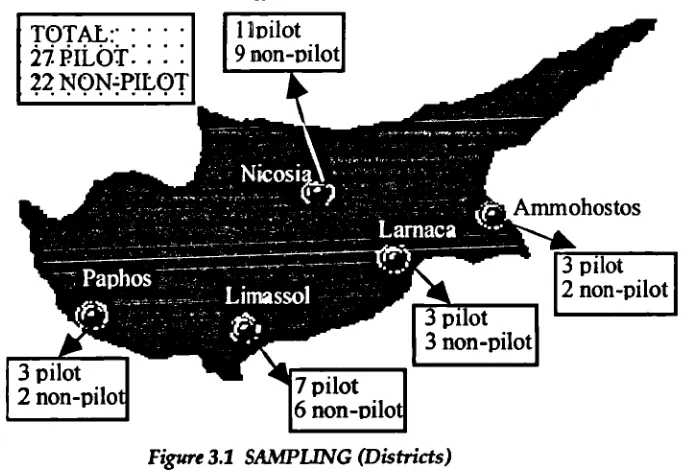
Figure3.1 SAMPLING (Districts)...68
Figure3.2 FACTOR SCREE PLOT - PARENTS, CHILDREN...79
Figure3.3 FACTOR SCREE PLOT - TEACHERS...79
Figure 5.1 PARENTS ANt) STUDENTS - COMPUTER AVAILABILITY...118
Figure 5.2 TEACHERS, PARENTS, STUDENTS - FREQUENCY OF COMPUTER USE ...119
Figure 5.3 STUDENTS - WAYS OF COMPUTER USE AT HOME AND AT SCHOOL...120
Figure 5.4 TEACHERS AND PARENTS - LEVEL OF COMPUTER PROFICIENCY ...120
Figure5.5 TEACHERS - TRAINING...121
Figure5.6 TEACHERS - SOURCE OF TRAINING...121
Figure5.7 TEACHERS - DURATION OF TRAINING...121
Figure 5.8 LEVEL OF EDUCATION FOR COMPUTER INTRODUCTION...123
Figure5.9 NUMBER OF COMPUTERS AT SCHOOL...124
Figure5.10 WAYS OF COMPUTER INTRODUCTiON...125
Figure5.11 SUBJECTS FOR COMPUTER USE ...125
Figure 5.12 COMPUTER 1NTRODUCFION IN CYPRUS ELEMENTARY SCHOOLS...126
Figure5.13 AWARENESS ABOUT COMPUTER INTRODUCTiON...126
Figure5.14 TEACHERS -TRAINING NEEDS...128
Figure 5.15 TEACHERS - PROBLEMS ANTICIPATED/EXPERIENCED...129
Figure5.16 TEACHERS - USE OF TECHNOLOGIES...129
Figure5.17 STUDENTS - SCHOOL CHILD ATFENDS...139
Figure5.18 COMPOSITE FROM ALL PILOT SCHOOLS, 1996...153
Figure 5.19 AGE: PERCENTiLE SCORE MEANS - STAGES OF CONCERN ...156
Figure 5.20 GENDER: PERCENTILE SCORE MEANS - STAGES OF CONCERN ...156
Figure 5.21 HIGHEST EDUCATION LEVEL: PERCENTILE SCORE MEANS - STAGES OFCONCERN...157
Figure 5.22 POSITION: PERCENTiLE SCORE MEANS - STAGES OF CONCERN...157
Figure 5.23 TRAINING: PERCENTILE SCORE MEANS - STAGES OF CONCERN ...159
Figure 5.24 PROFICIENCY: PERCENTILE SCORE MEANS - STAGES OF CONCERN...159
Figure 5.25 OWNERSHIP: PERCENTILE SCORE MEANS - STAGES OF CONCERN...160
Figure 5.27 FREQUENCY OF USE (HOME): PERCENTILE SCORE MEANS -STAGES
OFCONCERN...161
Figure6.1 ALL PILOT SCHOOLS - GOALS FOR COMPUTER USE ...172
Figure 6.2 ALL PILOT SCHOOLS - PROBLEMS ASSOCIATED WITH COMPUTER USE...173
Figure6.3 ALL PILOT SCHOOLS - NEEDS ...174
Figure 6.4 SELECTED SCHOOLS-I-HGHEST STAGES OF CONCERN...183
Figure 6.5 SELECTED SCHOOLS-FREQUENCY OF USE AND STAGES OF CONCERN...183
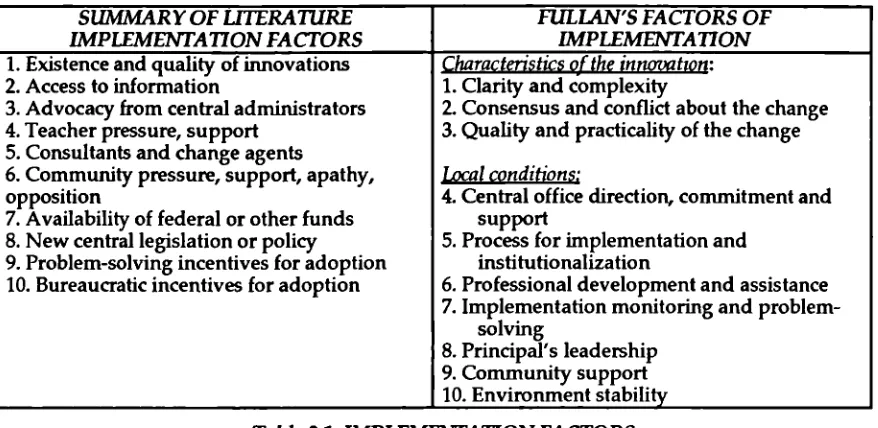
Tables Table2.1 IMPLEMENTATION FACTORS...29
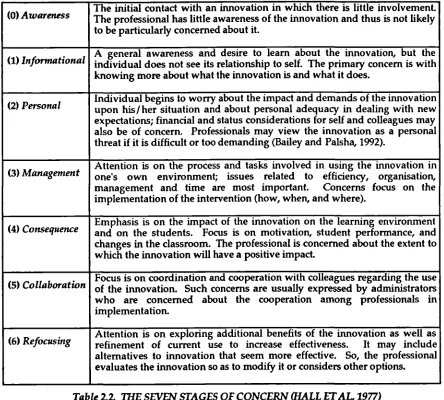
Table 2.2 THE SEVEN STAGES OF CONCERN (HALL ET AL, 1977)...48
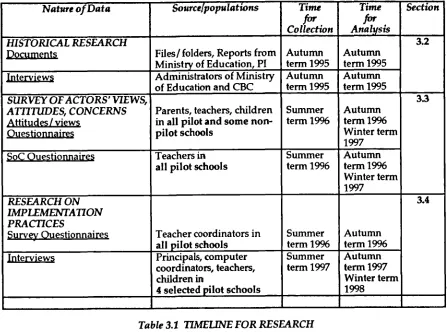
Table3.1 TIMELINE FOR RESEARCH...60
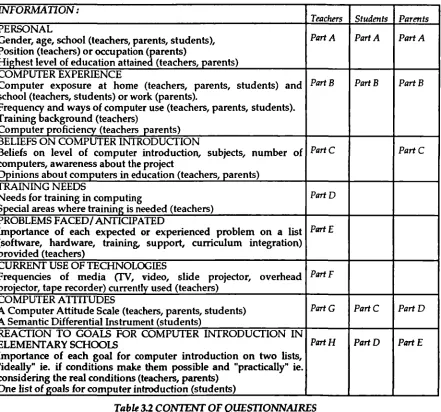
Table3.2 CONTENT OF QUESTIONNAIRES...70
Table3.3 ITEMS OF TEACHERS' COMPUTER A1T1TITDE SCALE...71
Table 3.4 ITEMS OF PARENTS' COMPUTER ATI1TUDE SCALES ...71
Table 3.5 iTEMS OF CHILDREN' S COMPUTER ATF1TUDE SCALE...72
Table 3.6 iTEMS OF cHILDREN'S SEMANTIC DIFFERENTIAL INSTRUMENT...72
Table3.7 CONTENT OF COORDINATORS' QUESTIONNAIRES...83
Table 4.1 iMPORTANT YEARS: INTRODUCTION OF EDUCATIONAL TELEVISION ...90
Table 4.2 IMPORTANT YEARS: INTRODUCFION OF EDUCATIONAL RADIO ...91
Table 4.3 TIMETABLE FOR INTRODUCTION OF EDUCATIONAL COMPUTING...% Table 4.4 IMPORTANT EVENTS: INTRODUCTION OF EDUCATIONAL COMPUTING...97
Table 4.5 COMPARISON BETWEEN THE TWO INNOVATIONS: THE PROCESS...98
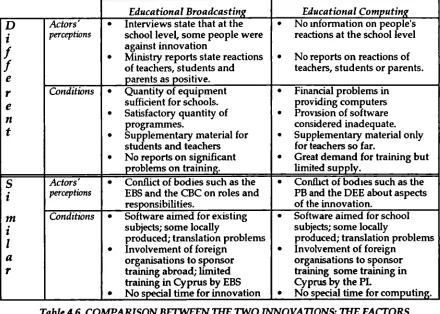
Table 4.6 COMPARISON BETWEEN THE TWO INNOVATIONS: THE FACTORS...111
Table5.1 RESPONSE RATES...116
Table 52 RANKING OF GOALS FOR PAREN1S, TEACHERS, STUDENTS ...127
Table 5.3 CATECORISATION AND FREQUENCIES OF RESPONDENTS' VIEWS...130
Table 5.4 STUDENTS- SEMANTIC DIFFERENTIAL INSTRUMENT...138
Table5.5 PARENTS ' COMPUTER AlTITUDE SCALE...140
Table5.6 STUDENTS' COMPUTER AlTITUDE SCALE ...140
Table5.7 TEACHERs' COMPUTER AlTITUDE SCALE...141
Table5.8 FACTORS FOR PARENTS ...143
Table5.9 FACTORS FOR STUDENTS ...144
Table5.10 FACTORS FOR TEACHERS (PILOT, NON-PILCYF)...145
Table 5.11 FREQUENCY OF HIGHEST AND SECOND HIGHEST STAGE ...152
Table 5.12 DESCRWFIVE SUMMARY OF SOC PERCENTILE SCORE MEANS...153
Table 5.14 CORRELATION MATRIX FOR STAGES OF CONCERN .162
Table6.1 RESPONSE RATES OF COMPUTER COORDINATORS...167
Table6.2 ALL PILOT SCHOOLS -HARDWARE AVAILABLE...168
Table6.3 ALL PILOT SCHOOLS -HARDWARE LOCATION ...169
Table 6.4 ALL PILOT SCHOOL S - SOFTWARE PER SUBJECF AREA...169
Table 6.5 ALL PILOT SCHOOLS - FREQUENCY OF USE PER GRADE LEVEL...170
Table 6.6 CURRICULUM SUBJECTS DELIVERED USING COMPUTERS PER GRADE LEVEL...171
Table 6.7 SELECTED SCHOOLS- CHARACTERISTICS OF THE PERSONNEL...178
Table6.8 SELECTED SCHOOLS- VIEWS OF THE PERSONNEL...180
Table6.9 SELECTED SCHOOLS- ATTITUDES OF THE PERSONNEL ...181
Table 6.10 SELECTED SCHOOLS- ATF1TUDES OF THE PERSONNEL AND FREQUENCY OF USE ...182
Table 6.11 SELECTED SCHOOLS- HIGHEST STAGES OF CONCERN...182
ABBREVIATIONS USED
ACICES: Advisory Committee for the Introduction of Computers in Elementary Schools ANOVA: Analysis of Variance
CBAM: Concerns-Based Adoption Model CBC: Cyprus Broadcasting Corporation CD Rom: Compact Disc Read Only Memory CD: Compact Disc
CDU: Curriculum Development Unit
CETO: Council for Educational Television Overseas CPA: Cyprus Pedagogical Academy
DEE: Director of Elementary Education EBS: Educational Broadcasting Service EU: European Union
Fig: Figure
IT: Information Technology M.Ed: Ministry of Education PB: Planning Bureau
P1: Pedagogical Institute SD: Standard Deviation SoC: Stages of Concern
SoCQ: Stages of Concern Questionnaire
SPSS: Statistical Package for the Social Sdences TV: television
UK: United Kingdom
CHAPTER 1: INTRODUCTION
Educational innovation is not what it seems—if it ever were! It is not a magic short cut to an educational wonderland. It is difficult, time-consuming, energy-exhausting, and often costly. (p. 104, Dalin, 1978 in Shaeffer, 1990)
1.1. BACKGROUND TO THE STUDY
My interest in educational innovation began with the introduction of educational broadcasting in Cyprus. As an elementary school student, I remember radio programmes and television broadcasts invading my classroom and then disappearing without an explanation. Later on, as a student teacher, I questioned the reasons for this. I discovered that people believed that the innovation "failed" to survive the first years of enthusiasm mainly because of the teachers' inability to adapt.
Some years ago, as a school teacher this time, I was pleasantly surprised to find
out that the Ministry of Education planned the introduction of information technology in elementary schools. My colleagues and students were excited about the potential impact of computers on teachers' practice and pupils' learning. However, I feared that this process could follow the same path as educational broadcasting. I assumed that despite the different contexts, factors affecting the innovations could be similar. So, I decided to explore the implementation of broadcasting and computing in Cyprus to obtain information
about these factors. I decided to review broadcasting briefly and concentrate
mainly on computing, currently implemented to indicate if computing is likely to be successful.
Before I proceed to explain my aims and research questions, there is a need to set
the context of the study, by referring to Cyprus and its educational system.
12. THE CONTEXT OF THE STUDY
A brief overview
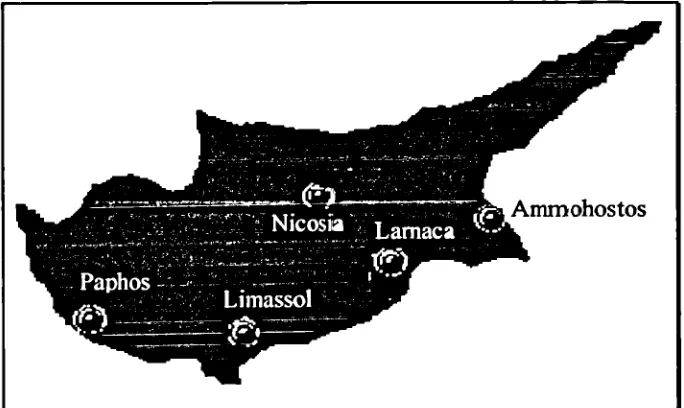
The context for this thesis is Cyprus (Fig. 1.1), the third largest island in the Eastern Mediterranean. The population is 741,000 (1996) with Greek (78%),
Turkish (18%) and others (4%).
rate of growth on the other. In terms of development, Cyprus is dassified as a "high income economy" (World Development Indicators, 1997; World Development Report, 1998), ranked 29th out of 156 countries for 1996 and a "high human development" country, as 23rd out of 174 (Human Development Report, 1996 in World Guide 1997-98). However, Unesco (1997) does not include Cyprus in the list of "developed" countries. So, we could specify the island as a country with a strong economic potential that lies between the developed and developing world.
Since 1974, as a result of the Turkish invasion and the division of Cyprus into two separate communities - Greek and Turkish - there are two autonomous educational systems. In this thesis, any reference to Cyprus relies on statistics and data provided by the official government (Greek) of the island.
Figure 1.1 MAP OFCIPRLIS (Districts)
The educational system of Cyprus
Education either public or private, is compulsory through to age 15. Public education is free through to age 18. There are six years of elementary education for ages 6-12. Secondary education extends over six years for ages 12-18 and is divided into two cydes: the lower (gymnasium) and the upper (lyceum or technical school). After secondary school, students can attend post-graduate institutions at home - the University of Cyprus was founded in 1992 - or overseas. The general aims of the Cyprus educational system are as follows:
The creation and the development of a freely thinking democratic individual characterised by an equilibrium of morals and cognitive capacities, healthy in body, actively and creatively involved in life. Such individuals are expected to contribute to the social, scientific, economic and cultural progress of the state and to promote co-operation, mutual understanding and love among all fellow human beings whether or not they belong to the same community/country, and the prevalence of freedom, justice and peace. (p. 15, Marcou, 1997)
Higher education is particularly valued by people on the island. Schatzman (1990) supports that there is a great desire for education since families tend to send children abroad and students attend special classes to prepare for university admission exams. Dailman (1986) stresses that Cyprus differs from the rest of Europe in the belief that education is the country's greatest capital asset. In 1986, Cyprus was third in the world in proportion of university students to the population. In 1992, 58% of students continued studies beyond the secondary level with 25% studying abroad (Statistics Report on Education). Bradshaw (1993) mentions that the system produces highly qualified graduates. Elementary teachers are mainly trained at the University of Cyprus, which has replaced the Cyprus Pedagogical Academy (CPA that offered a three-year
educational bureaucracy to contribute to the educational development of their country.
Innovations in Cyprus
The introduction of innovations is shaped by conditions of the specific local
context. Cyprus is a good place to study innovation for several reasons.
First, in its effort for development the country has been struggling with change in all aspects of life: political, economic and social. Therefore, educational authorities tend to adopt new ideas at the macro and micro level, aiming at the quantitative and qualitative improvement of education (Karagiorges, 1986). For example, in 1995, the interest of Cyprus to join the EU began to put pressure on the educational system to place Europe in a central position in the curricula. As a result of constant changes and revisions, Cypriot education is characterised by a dynamism, that is not usual in other educational systems (Maratheftis, 1992). Innovations are valued in Cyprus and Cypriots are oriented to progress and hold positive attitudes about new ideas (Persianis, 1991).
Of interest are also the structure and decision making processes of the educational system. As I have already mentioned, the education system of Cyprus is highly centralised and decisions and formulations of policy are controlled by the Ministiy of Education. The Ministry of Education often initiates ideas for change, which are then disseminated to the schools. On the other hand, education is the joint concern of other actors as well such as the public in general, and the teachers and parents in particular, that influence implementation. As Theofilides (1986) suggests, elementary schools are semi-autonomous institutions and teachers can develop initiatives within the special general guidelines provided by the Ministry. The curriculum development model is therefore integrated: from centre (Ministry) to periphery (schools) and from periphery (schools) to centre (Ministry).
In the past, the absence of a university or serious research centre has resulted in importing educational knowledge from other countries. This knowledge has taken the form of a series of innovations that have bombarded the educational system of the island since 1960. These innovations concern mainly the content, the methods, the teaching materials and the methods of evaluation and are intended to make the educational system more flexible and effective. Some of them such as the introduction of technical and vocational education in 1960, the introduction of the Lyceum of Optional Subjects in 1980, the restructuring of the National Curriculum in 1981 and 1994 have been institutionalised. Others, mainly those concerning methods are not. This thesis focuses on an innovation currently implemented in Cyprus elementary schools: educational computing. In the next section I provide an overview of this particular innovation.
1.3. THE EXPERIMENTAL PROGRAMME FOR COMPUTER INTRODUCTION
After its initial experimental introduction during 1986-88 in some pilot schools, computer science acquired the status of a compulsory subject in the first grade of the secondary education lyceum and an optional supplementary subject in the second and third grade. So, educational computing was first introduced in Cyprus as a subject per se and as a field of specialisation in lyceums.
In 1991 a committee was set up to prepare an implementation plan for the introduction of computers as tools in elementary schools. This plan referred to five phases of experimental introduction from 1991 until 1995 (Table 4.3). Following this, the experimental programme for computing introduction, directed by the Ministry of Education began in a number of elementary pilot schools at the national level. In 1993-94 there were eight pilot schools, which
-5-increased by sixteen during the following year. Later on, the pilot schools became twenty-seven, with the addition of another three schools.
Several steps were taken towards implementation of the innovation, described in detail in section 4.1.2. Limited resources - software, hardware - were delivered to all pilot schools. Some teachers received training in computers from the Pedagogical Institute. One of the teachers in these schools undertook the role of the computer coordinator; later one of the computer coordinators in each district became the district coordinator. The Curriculum Development Unit for educational computing was established to visit schools and provide help.
However, the policy was open- ended. As I discuss in Chapter 4, the Advisory Committee for the Introduction of Computers in Elementary Schools outlined that computers should be used for "the enrichment and support of existing curricula subjects". Other than this general aim, no further specialised goals were given. Pilot schools received an innovation package comprising financial support, physical facilities and teaching material along with brief implementation guidelines. Schools used their discretion in putting the package into practice. In general, this approach to educational computing involved a combination of centralised initiative and largely decentralised implementation responsibility.
Since the launching of this initiative, a number of years have elapsed but the level of implementation, that is actual use in pilot schools, remains low. The change is not yet institutionalised, that is established in all Cyprus elementary schools. Therefore, it is worth examining the implementation processes to reveal what is happening in schools and identify which factors influence existing practices.
14. THE AIMS AND RESEARCH QUESTIONS
To approach the first part of this problem thoroughly, I decided to research into educational broadcasting since its development in Cyprus could highlight the various factors, required for an innovation to succeed. So, initially I attempted to answer the following question, guided by two sub-questions:
1. What can be learned by the comparison between educational broadcasting and educational computing?
• How does the implementation process of the two innovations evolve? • What are the factors key to this process?
My findings indicated dose similarity between the computing and the educational broadcasting initiative (section 4.1.3). This comparison showed that actors' perceptions as well as implementation conditions were critical in the process. This pointed me to study existing literature on actors and implementation, outlined in Chapter 2 (section 2.4). In light of my findings and the literature search, I decided to focus on different groups of actors - parents, teachers and children - and find out about their views, attitudes and concerns about computers in general and the experimental programme in particular. The understanding of the trends in people's views, attitudes and concerns about educational computing could not be possible without also examining the nature of these constructs. Therefore, a new research question along with three specific sub-questions emerged:
2. What are the general trends and nature of actors' views, attitudes and concerns about educational computing?
• What are the general trends and nature of actors' views on implementation aspects?
• What are the general trends and nature of actors' attitudes towards the innovation?
• What are the general trends and nature of involved teachers' concerns about the innovation?
Finally, taking into consideration the findings of the first two research questions, I decided to approach the second part of my research problem and investigate the ways in which factors influence implementation practices. Since information on existing practices in pilot schools was limited, I aimed to describe implementation patterns, revealing the extent and the content of educational computing. Then, I aimed to focus on the factors which prevent individuals from adopting the innovation by addressing the following question:
3. In what ways do several key factors influence integration of computing into school practices?
• What is the role of actors and their views, attitudes and concerns in implementation practices?
• What is the role of practical conditions in implementation practices?
A variety of quantitative and qualitative methods were used to answer these research questions; these are described in detail in Chapter 3.
1.5. SIGNIFICANCE OF THIS STUDY
This thesis has several important dimensions which add to its uniqueness and signify the importance of the research questions above: focus on Cyprus; educational broadcasting; actors' views, attitudes, concerns; the implementation process.
The Cyprus context
One of the originalities of this study is the fact that it deals with the Cyprus context. I wifi, therefore, highlight the implementation process as it is shaped by the characteristics of Cyprus, such as the centralised organisational structure, the conflicting ideologies and the orientation towards development. The focus on Cyprus has two important implications.
First, I provide significant insight into existing educational practices, often overlooked in Cyprus. The educational system lacks the mechanisms or personnel for systematic evaluation of the results and processes of curricula implementation and school activities. As educational research is scarce, judgements on practices are often based on superficial "observations". So, my findings can contribute to the future educational development of the island.
could illuminate the innovation process to all those concerned with educational computing in other parts of the world.
Lessons from the past
The overview of educational broadcasting illuminates and deepens our understanding of implementation and gives a "time" perspective on the analysis of key factors. A thorough description of what happened creates a historical record, of value when implementing something similar, particularly when the program no longer exists (King et al, 1987). This is significant, considering that there is still a need at the international level for a better consciousness of the implicit ideologies and the pedagogical philosophy (Hayter, 1974; Dieuzeide, 1997) underlying technology applications to education. The lessons learned from implementation of broadcasting, as examined by this study, could apply to the initiation of other innovations, which will surely continue in the future.
Focus on actors' views, attitudes, concerns
Considerable literature focuses on the area of actors and implementation (section
2.4). Some theorists such as Olson (1988) blame under-users and non-users of innovations for inadequate confidence or competence, reluctance or fears. Others, such as Cuban (1986) refute the attribution of innovation failure to teachers' inability to maximise the potential of new technologies.
In this study, more light is thrown on the area of actors and the nature of their attitudes and concerns that are likely to impact on implementation. This study shows that attitudes are multi-faceted, highly complex constructs with various factors. Concerns, on the other hand, are examined as stages on a developmental
continuum, useful to indicate the current level of innovation adoption.
Emphasis on the process
Finally, although this is one of many implementation studies on the introduction of new technologies, conducted in various parts of the world, it adopts a
different perspective. Most of these studies measure final outcomes against predetermined goals, so they provide a summative evaluation. They do not dearly explain how failure comes about since what happens between the input and the output - the throughout stage - remains a "black box".
In contrast, this study depicts and analyses the process of implementation1 concentrating on how it occurs. Such research generates new knowledge and
of innovations but also explain the rationales behind the introduction of new practices in Cyprus.
1.6. THEORETICAL ASSUMPTIONS
The aspect of success: qualitative and quantitative
Literature suggests that educational technology, from an integrated perspective, involves not only resources but also processes and people. Innovation is "a planned and deliberate idea, object or practice, perceived as new by individuals" (Nicholls, 1983). Successful institutionalisation is characterised by the integration of the innovation into regular practices - here, the process of putting an innovation into practice in classrooms. In educational technology, success means incorporation of innovations to the educational system as integral to the teaching-learning function, not just as marginal, enrichment activities.
Success of educational computing, within the context of this thesis, does not imply revolutionary effects on education. It means including the best applications into daily schooling practice along with high degrees of teacher involvement. Of interest to this study is not only the quantitative aspect of success, but also a qualitative view in terms of "what is implemented". Unfortunately, internationally, despite enthusiasm for computing, we cannot as yet describe successful integration into the teaching and learning processes. Some outstanding efforts remain isolated pockets of excellence. Computers tend to be used mainly as add-ons to the existing curriculum. As a result, practices are merely at a superficial level of change or even non-change.
Perspectives adopted: implementation; phenomenological; problems as friends Most programs falter during implementation, while the interaction between the innovation and its setting is maximised. Implementation is concerned with the nature and extent of actual change as well as the processes involved. This "implementation perspective" is central to this thesis (section 2.1.5.1).
The assumption that computer introduction is complex and fraught with
problems right from its inception underpins this research. However, as Fullan (1993) points out, change is "a journey in uncertainty" while excitement and problems are often "our friends". This thesis helps us to understand this process so as to improve education.
1.7. ORGANISATION OF THE THESIS
Chapter 2 provides a literature review focusing on innovation, educational technology and the concept of success as well as people's attitudes about and concerns towards change along with practical aspects and conditions. In Chapter 3, the methodological framework is outlined, highlighting the strategies for data collection. Results are presented in Chapters 4, 5 and 6. In Chapter 4, there is a background analysis of the introduction of broadcasting in elementary education. The story is provided along with some critical remarks on the factors involved in the process. I then describe the experimental plan for computer introduction in Cyprus elementary schools through relevant government documents and draw comparisons between broadcasting and computing. An analysis of parents', teachers' and children's views and attitudes towards computing follows in Chapter 5. Pilot teachers' levels of concerns about educational computing are also outlined. In Chapter 6,1 discuss implementation issues through statistics on all pilot schools and interview data on four selected pilot schools so as to illustrate reflections on existing practices. Finally, I summarise the main findings of this thesis and discuss implications for Cyprus in Chapter 7. In this last chapter I also proceed to recommendations for the successful introduction of computing in Cyprus schools, focusing on higher teacher involvement, darification of goals for educational computing and provision of favourable conditions.
CHAPTER 2: LITERATURE REVIEW
There is nothing as practical as good theory.
There is nothing as theoretical as good practice. (Kurt Lewin in Fullan, 1982)
This chapter explores important concepts from theoretical and practical perspectives. I darify terms basic to this study, induding "innovation" and "educational technology" to minimise possible misunderstandings. The literature reviewed draws heavily on the Anglo-American experience enabling research findings to be related to the UK and the US. This helps to provide the international perspective to my work.
I begin by addressing the issue of innovation from the "implementation" and "phenomenological" perspectives. Section 2.1 illustrates the developmental nature of innovation over time, the various phases encountered, the factors affecting change and the strategies or models employed. Various approaches for reflecting on change processes are presented. Then, I discuss Fullan's work, that is fundamental for this study because I adopt several of his perspectives.
Second, I review the state of the art of educational technology and define the concept from an "integrated" perspective, involving products, processes and people in section 2.2.
Next, in section 2.3 I describe success in educational computing in both quantitative and qualitative terms. An overview of international figures demonstrates minimal integration of new technologies in existing practices and points to the significant role of actors, especially teachers, in implementation. Actors' views are believed to play an important part in implementation. So, in section 2.4 I discuss individuals' attitudes and concerns about educational change in general and educational computing in particular. While attitudes about the innovation are mostly reported as positive, they are multi-faceted with different dimensions. I also review the area of teachers' concerns which develop on a continuum and are believed to be consistent with the level of adoption.
2.1. INNOVATION
2.1.1. The concept of innovation
The terms "change", "reform" and "innovation" are often used interchangeably in this thesis. However, I consider the first two as too generic and vague for this context-specific study, so "innovation" is probably a more appropriate term.
Bolam (1975) defines "change" as a family of concepts, induding accidental or unintentional movements and shifts. Educational change, in particular, is vague in regard to scope and precise in regard to importance. "Reform" is considered as embracing a cluster of innovations (Vandenberghe, 1988), usually meant to affect the system as a whole, or an important part of it. Both "change" and "reform" may signify dramatic alternation in the status quo (Havelock, 1970) or just a continuous reappraisal of existing practices (Nicholls, 1983). Change and reform aim to achieve quality in teaching, resources, structure or organisation. Innovation, is distinguished from change and reform by being more discrete in nature, limited to particular subjects or practices (Shaeffer, 1990) and intentional (Bolam, 1975). Huberman (1973) defines innovation as "an improvement which is measurable, deliberate, durable and unlikely to occur frequently". The Organisation for Economic Cooperation and Development (0EcD) classifies four types of innovation: those concerned with objectives and functions; with organisation and administration of an educational system; with role definitions and relationships; with the curriculum, its aims, content, methods and evaluation (Verspoor, 1989). Innovations in educational technology are multi-faceted, so can be placed in more than one of these categories. For this study, I adopt the comprehensive definition of Nicholls (1983) which captures all relevant aspects of the concept
an innovation is an idea, object or practice perceived as new by an individual or individuals, which is intended to bring about improvement in relation to desired objectives, which is fundamental in nature, planned and deliberate. (p.4)
In this definition, the key word is "improvement". The focus is not on "innovation for the sake of innovation" but on "innovation for improvement". However, this thesis does not examine the quality and efficiency of specific innovations but assumes that implementation is desired, so emphasis is shifted towards the process rather than the product itself.
2.1.2. The study of educational change
The necessity for educational change is often prompted by the interdependence of education and social, political and economic realities (Shaeffer, 1990). Additionally, the scope of educational change is determined by cultural and technological influences (Tobin and Sharon 1 1984). The interaction of these forces continuously differentiates educational goals, so educators must become skilled experts in managing the dynamics of change (Lewis, 1991; Fullan, 1993).
Hawkridge (1987) points out that in each decade or so something "new" arrives on the educational scene. Numerous efforts and prects to introduce educational innovations in both industrialised and developing countries have occurred (Green, 1972; Nisbet, 1975). For example, in the US during the period 1959-1969 billions of dollars were spent on "all manner of educational innovation" (Snider, 1992).
The process of educational change was investigated later (Fullan, 1992). The 1960s were called the "adoption era" because educators were preoccupied with how many innovations were being taken on. Around 1970, innovation got a bad name since programs were introduced for the sake of change leading to the first implementation studies. Results were dramatic and discouraging. Confusion derived from mistakes in practice led to easy "failure" theories such as that of educational "conservatism". Educational systems were regarded as likely to retain their status quo and maintain existing goals (Baker and 0' Neil, 1989; Blenkin et al, 1992; Stoddard and Niederhauser, 1993). Educators were blamed for preserving their own security. The inefficiency of "failure" rationales resulted
in the emergence of various approaches in viewing innovation, discussed in section 2.1.4.1.
accordingly (Verspoor, 1989; Rust and Dalin, 1990). Although I make much reference to the developed world in this thesis, my aim is not to regard the developed world as a role model. Useful condusions are drawn from linking research findings to countries such as the UK or the US. However, the uniqueness of Cyprus, as the setting that lies between the developed and developing world, is seriously taken into consideration while setting the context in section 1.2 and discussing the findings of the study in section 7.2.
2.1.3. The context of educational change: the process, its development, factors involved and strategies/models applied
Drawing upon English and American experience, the failure of planned change led researchers to a doser look at the practical aspects of school innovation (Holt, 1987; Cohen, 1988). This resulted in extended research and theory formation on the process of change and its development. Several studies examined the major factors involved: the system, the actors, the innovation and the process. Theorists have also investigated and dassified the strategies for implementation. All these aspects are presented here to highlight the complexity of educational change and suggest the need for understanding effective implementation.
2.1.3.1 The process of change: various schemes
Educational change is viewed differently by the three theorists, whose work I discuss in this section. However, a common characteristic is that they all view change as based on a network of "relationships".
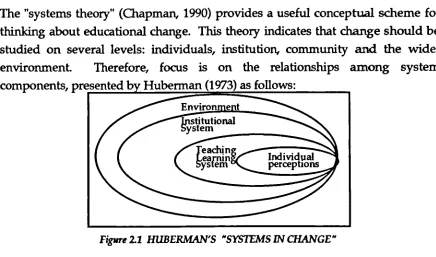
The "systems theory" (Chapman, 1990) provides a useful conceptual scheme for thinking about educational change. This theory indicates that change should be studied on several levels: individuals, institution, community and the wider environment Therefore, focus is on the relationships among system components, presented by Huberman (1973) as follows:
eac1nn,_._7j_ IRec ._ perceptions
Figure 2.1 HUBERMAN'S "SYSTEMS IN CHANGE"
new program perseveres, new relationships form between subsystems which later become regularised.
Bolam (1975) provides a useful heuristic framework (Fig. 2.2) for examining the process or "cyde" of educational change involving four major factors; the change agent, the innovation, the user system and the process of innovation over time.
Dimension 1: Systems Change
Before
I
Agent Innovation UserI Change
lAgent
I
UserDuring
2: Innovation
I
Innovation UserAfter Agent _________
Figure 22 BOL4M'S FRAMEWORK
The first dimension includes the change agent, innovation and user. The change agent may be a teacher, a centre, a local authority or the national government. The key characteristic is an authority relationship with the user and possible access to the strategies described later in section 2.1.3.4. The innovation is the second system. This is constantly defined, changed and redefined as a result of experience and the differing perceptions of the people involved. Factors which bear directly upon the success of an innovation are relevance and magnitude, compatibility of the innovation with existing values and practices, costs and benefits. The user is targeted by the change agent. Individuals and organisations respond differently to innovations according to their personal or professional characteristics, contextual environment and structure.
Havelock (1970) also adopts this notion of a "cycle of innovations" and suggests the following scheme:
Agent as DrOCeSS helDer Pressure to change
Disturbance tasSatisfction
s,JDissatisfaction Decision to
Agent as
\.
noiication DiagnosisI (
solutionFigure 2.3 HAVELOCK'S "CYCLE OF INNOVATIONS"
Fig. 2.3 suggests a problem-solving model in this "cycle". The user has the problem to resolve so guidance from outside sources is needed during a process of reaction to the innovation. This model is further explained in section 2.1.3.4 since users are critical to this thesis.
So, we see that change involves different systems and is a "cycle" that is a process that develops along the time dimension. The users are problem-solvers and they are at the very "heart" of innovation. In this context, I proceed to the stages or phases involved in educational change.
2.1.3.2. The development of change: different phases
A number of writers including Shaeffer (1990) suggest that innovations move from initial conception to full functioning: from design to adoption and maturation. The phases encountered are: initiation, planning, implementation, evaluation and institutionalisation. In section 4.1 I provide an insight to these phases for the introduction of educational broadcasting and computing. Here I give a brief overview of these five stages.
The second stage is planning. This phase involves preparation of strategies and sometimes, experimentation. Here the approach used by planners along with their understanding of educational change is important. Planners need to consider the contextual factors and constraints operating in specific innovations. Third is implementation, that is putting an innovation into practice in classrooms. Chapman (1990) defines implementation as "the extent to which a program is actually used" (p. 195). During this process, there are some critical points for success such as the inputs and resources needed, the procedures established and the management of the innovation plan. Efforts to conceptualise implementation generally take one of two forms. The "fidelity" perspective is the exploration of the extent to which actual use of the innovation corresponds to intended use. Alternatively, the "organisational change" perspective, adopted by this study, involves consideration of implementation as a mutually adaptive process.
The fourth stage, evaluation, is the systematic application of research procedures in assessing the design, implementation and utility of a project. Evaluation reflects the relevance, effectiveness and impact of an intervention, in the light of its objectives (Nevo, 1986). This stage is integral to educational policy-making (Chinapah, 1990) and can be also viewed as a political activity (Kinnaman, 1992). Evaluation potentially indicates parental and teacher concerns in order to involve them in an experiment. However, certain dangers are involved. First, measuring the success of change is difficult (Stephens, 1990). Second, since education itself has a lengthy internal cycle, the impact of particular inputs is often visible only after a long process of complicated cause-effect relationships. Third, as Flores (1981) points out, early evaluation produces pressures that distort project development and undermine users' confidence. Innovation, therefore, requires certain protection from inspection to be established successfully.
responsible for lack of success. Huberman (1973) distinguishes factors that inhibit the process of change in the "input", the "output" and the "throughput". Such factors are of particular interest to this study, so I refer to them more extensively in the following section.
2.1.3.3. Factors affecting change
Reviewing literature in this area indicates that the factors involved in educational change comprise four categories: system, actors, innovation and process.
First consideration is the "system". Shaeffer (1990) refers to this as the context in which the innovation is located and its adaptive capability at the macro-level and the school-level. Educational institutions are unique because they often carry their own socio-cultural norms and ability to implement change. Bassett (1970) focuses on the structure of a system which can be centralised or decentralised and the function which can be formal or informal. Miles (1964) refers to the particular characteristics of educational systems: diffusion rates are slow while ideological beliefs may block effective innovation. Nisbet (1975) and Chapman (1990) consider factors such as community support and cultural issues as well as infrastructure aspects including funds, equipment, buildings and personnel. Second are the "actors". Shaeffer (1990) suggests that the greatest barrier to change is altering people's beliefs and values. Persons or groups, external to or within the system have the power to stimulate or nurture innovations (Miles, 1964). The interdependence of innovators and other groups involved is critical. Implementers' personal characteristics, adequacy of training and prior experience are also important (Chapman, 1990). Teachers in particular are considered responsible for making innovations effective at a practical level.
Third are the characteristics of the "innovation" itself. Miles (1964) and Shaeffer (1990) mention a wider range of properties including complexity, cost, technical validity and scientific credibility. Associated materials, implementation support and innovation/system congruence are reported as likely to affect adoption. Chapman (1990) describes programme factors such as clarity of characteristics, specificity of intended outcomes, adequacy of resources and supervision.
design of educational change programmes is of interest to Verspoor (1989) who describes five basic aspects of the process: implementation, effective administrative infrastructures, flexible strategies, arrangements for systematic
learning from experience and eventual early institutionalisation. Nisbet (1975) further points to the need for evaluation feedback to the innovating team.
All these factors are carefully considered in this thesis during examination of both innovations. Information is provided on the "system", so the specifications of Cyprus as a setting have been highlighted in Chapter 1 (section 1.2). Because of the phenomenological approach adopted, the "actors" are surveyed extensively through questionnaires so as to reveal their views, concerns and attitudes (Chapter 5). Although focus is not on the quality of the "innovation" itself, the innovation's characteristics as perceived by the actors in their interviews are outlined (Chapter 6). Finally, the implementation "process" described by documents and interviews reveals certain problems and deepens our understanding of individuals' reluctance to adopt (Chapter 4). For the purposes of this thesis, factors are categorised into two groups: the "actors" on one hand and the "conditions" which include the "process", the "setting" and the "innovation" on the other.
2.1.3.4. Strategies and models of implementation
Strategies of implementation are the means intended to facilitate an optimum level of adoption. As Kingsley (1993) points out, strategic management is concerned with helping change processes in effective ways. However, these strategies do not provide solutions to the practical problem of implementation. A number of writers induding Chin, 1967 (in Bassett, 1970), Bennis et al, 1969 (in
Bolam, 1974, 1975; Chin and Benne, 1972) and Sieber, 1972 (in Whiteside, 1978)
refer to three basic strategies: the empirical-rational, the normative - re-educative and the power-coercive.
The "empirical-rational" strategy suggests that educational practice changes as more valid ideas displace less valid ones. This theory affirms a belief in a science of education. The underlying assumption is that people are reasonable and will respond best to rational examination and demonstration. The focus is, therefore, on "research, development and dissemination" (RDD model). Productive research
centres, training and publications are emphasised.
but the strategy is most effective when people collaborate. This strategy assumes that the innovation is like a manufactured object which passes unchanged from developer to user. Effective innovation in this model requires a change of attitudes, values and skills as well as activation of forces within the user system. Third is the "power-coercive" strategy and refers to forms that the exercise of power takes in effecting educational change. Such forms are legislation, court decisions, provision of funds and use of authority. This strategy depends upon access to political, legal, administrative and economic resources.
All three approaches may feature in a country's plans but the balance between them varies. Cyprus seems to employ all strategies in the implementation of both educational broadcasting and computing. The first strategy is promoted through top-down guidelines. The second strategy of changing people's attitudes through extensive training is often discussed but unlikely to apply because of limitations. Finally, the third strategy appears in the usual allocation of administrative and economic resources in an effort to implement changes. However, proper legalisation of innovations related to new methods through establishment in the National Curriculum is often neglected.
In terms of models, except from the RDD model mentioned above, three more are
discussed in the literature. According to Havelock (1969, 1971 in Nicholls, 1983), one is the "social interaction" model (SI). This approach involves individuals working in informal networks in unsystematic ways. This model emphasises diffusion and movement of messages from person to person and system to system. In the "problem solving" (PS) model the user is seen as an active
participant The stages form a cycle, beginning with a "felt need" which is articulated as a problem followed by a search for solutions, one of which is selected and applied. Finally, the linkage" model unifies the three preceding paradigms (RDD, sI, PS) by highlighting the need for linkage procedures. This
model is probably the most accurate representation of the real situation in many countries (Stokldng, 1995) including Cyprus.
This section has deepened our understanding of innovation by reference to the process of change and its development, factors, strategies and models. This understanding will be inadequate unless we proceed to a sound theoretical exploration of the causes for adoption and rejection of innovations.
2.1.4. Reaction to educational change different theories and perspectives
technological approach in studying change is often not satisfactory, so other perspectives are needed, namely the political and cultural perspectives.
2.1.4.1. Adoption and rejection of innovations
Five types of hypotheses about the conditions in which innovations are accepted, rejected or modified are apparent (Hurst, 1983). "Endemic conservatism" suggests that human beings naturally resist change preferring stability and continuity. "Variable conservatism" asserts that individuals, organisations and societies vary in their innovativeness, some being more receptive to change than others. "Properties of innovations" refers to the characteristics of the innovation which can determine its reception. "Communication hypotheses" assume that various transmission variables affect responses to innovation. Finally, "situational or decision analysis" models the process of change, said to determine acceptance behaviour.
This thesis does not test any of the hypotheses mentioned above. Instead, I seek to reveal the factors in implementation and concentrate on reactions of individuals. Hurst (1974) suggests that the conservatism of teachers is often blamed for failure. As we will see, a good deal of this conservatism is no more than a quite justifiable reluctance to have one's time wasted and one's labour increased for diminished returns.
To avoid such "simplistic" failure theories a more comprehensive framework of innovation adoption and rejection is needed. So, I refer to the two perspectives, discussed by Hurst (1983): "control" and "change". These paradigms are two coherent and internally consistent alternative approaches for examining social phenomena. The choice between them depends on value and belief systems as well as prevailing power structures.
2.1.4.2. The inadequacy of the technological perspective
The "control" paradigm sees innovation as a process of adaptation and adjustment by which the social system seeks to maintain control in order to survive. This is also known as the "dominant" perspective.
determined by the manner in which it is conveyed to a target audience. So, failure is due to improper communication of the innovation to users.
In education, the "control" paradigm seems related to the so-called "technological paradigm" which dominated studies of change from the fifties to the early seventies. This perspective is associated with terms such as "logistic", "technocratic", "infrastructural" or "centre-periphery" (Shaeffer, 1990). Here, the teaching process and particular innovations are based on scientific principles and explicit knowledge which can be improved rationally and empirically through a systematic process. So, emphasis is on specific inputs such as new materials, media or methods. The underlying assumption is that users are rationalists who will accept and implement change without objection, provided that it is explained to them. Studies adopting this perspective often centre on exploring the statistical relationship between factors and change outcomes.
This thesis does not accept this paradigm. I explain the grounds on which this perspective is considered inadequate in discussing innovation success.
Third1 this approach discusses the characteristics of individuals and institutions and their interactions in terms of simple behavioural and institutional assumptions. Emphasis is placed on the characteristics of individuals rather than the structural properties of the social system. So, understanding adoption is seen as based on individual-level psychological reductionism.
Therefore, this perspective fails to provide a satisfactory explanation of the outcomes. So, there is a need to adopt other perspectives in studying change. The emerging alternatives place emphasis on the interaction between various interest groups involved in the process, as we will see in the analysis of the "change" paradigm that follows. As this thesis adopts this second paradigm, we will view the related approaches in greater depth.
2.1.4.3. The alternatives: political and cultural approaches
The "change" paradigm assumes no underlying stability and views change as a normal feature and a political process. Contradictions of viewpoints between groups or individuals are resolved through conflict or negotiation, in which it is possible to intervene but scarcely to control.
Within the "change" paradigm, there are two approaches: the "conflict/dependency" models (political perspective) and the "phenomenological" or "situational" analysis (cultural perspective).
organisational level. Therefore, emphasis is on implementation work in school and the interaction among groups which influence outcomes.
The "phenomenological" perspective is more individualistic It starts from the premise that behaviour is determined by people's varied models of the world or definitions of reality. The key elements are the individual's or social group's definition of its own situation, values and knowledge as well as the logic and politics of its decisions for action. This is also known as the "cultural perspective". This assumes that society is fragmented and each group has a strong subculture. Conflict still exists but is based on shared values of different groups and on what the processes of change and education mean to each group. The belief system of the groups involved and the cultural context are emphasised. Several theorists including Fuflan (discussed in detail in section 2.1.5) favour this perspective which views change as an evolutionary process that comes about through interaction and compromise at the school level rather than through technological planning or political conflict at the system level.
This study adopts the "change" paradigm, considering change as a matter of historical, political and logical conflict between competing and contradictory values, interests, ideologies and conceptions of the world. Conflict, as I have stressed in section 1.2 is an important characteristic of the Cypriot context So, this perspective is appropriate because it analyses innovations as generated through the interaction of individuals not only with a structural system of incentives but also with societal structures. This is clearest in the development of new educational technologies such as computers, television and radio, of interest to this thesis. The weakness perhaps lies in the difficulty of turning more plausible descriptions into useful prescriptive and diagnostic tools since the degree to which social change can be controlled is very slight.
Researchers adopting both political (with the exception of the Marxists) and cultural approaches place more emphasis on the study of implementation. This indicates a shift from the "technological" paradigm to the "implementation" paradigm, badly negleded in the past, which now becomes the key to
understanding innovation failure or success.
2.1.5. A recent study on change: FulIan's work
So far, I have shown that this thesis adopts the "change" paradigm and the
"political/cultural" approach to change that leads to the "implementation"
the Netherlands. Fullan's work draws upon experience a&id literature from the US, Canada and the UK.
Fullan (1993) proposes a new paradigm on change through eight basic lessons:
You can't mandate what matters; change is a journey, not a blueprint; problems are our friends; vision and strategic planning come later; individualism and collectivism must have equal power; neither centralization or decentralization works; connection with the wider environment is critical for success; evely person is a change agent (p. 21).
Of special importance to this study is Fuilan's view of change as a process, where problems are likely to arise: "problems are inevitable, but the good news is that you can't learn or be successful without them" (section 1.6). This is also consistent with the "change" paradigm, involving conflict. This study refers extensively to problems arising, while examining the innovations of interest later on since awareness of such problems can lead to improvement.
Now, we will discuss three of Fullan's assumptions adopted by this study: the implementation perspective, the phenomenological approach and the factors of change.
2.1.5.1. The implementation perspective
The problem of implementation is that of translating ideas into action. Thinking up what seems to be a good idea is one thing; putting this into practice is another. Most efforts to implement educational innovations prove unsuccessful while most studies do not explain how "failure" comes about. As I have mentioned in section 1.5, what happens between the input and output - the throughout stage - remains a mystery and that could lead to a superficial level of
change or even non-change (Rahman, 1987; Lam, 1991; Mgijima, 1991).
A growing interest in the implementation of innovations in schools (Bergman, 1981 in Grunberg and Summers, 1992) led to Fullan's "implementation perspective" (1995). As already mentioned in section 2.1.3.2 implementation is concerned with the nature and extent of actual change, as well as the processes influencing how and what changes are achieved. There are two main reasons why it is important to focus on implementation (Fuilan, 1992). First, it is
impossible to know what has changed without attempting to conceptualise and
measure this directly; we cannot interpret the outcomes or their absence if we do
individual and institutional development allowing us to put innovations themselves into perspective.
Fullan insists that not all change is progress, or even meant to be. Failure to implement an ill-conceived or a poorly-developed policy or a bad idea is obviously a good thing. This is relevant to the "pathos of implementation": faithful implementation is sometimes undesirable, because the idea is bad; sometimes impossible because power won't permit it; and often unforeseeable because it depends on people's contributions as well as content. This thesis does not explore whether the particular innovations are "good" or 'bad". I assume that the products are promising new ideas and are worth implementing.
2.1.5.2. The phenomenological approach
Fullan's approach is explicitly phenomenological providing an examination of innovation as it impinges on various actors involved in the process (Huberman,. 1992 in Fullan, 1992). Significant changes have no reality beside local actors' views since actions or inactions are determined by people's perceptions. Implementation rides heavily on enlightened mixtures of users' charisma, knowledgeability, power, competence and needs.