(will be inserted by the editor)
IR-CP-ABE: Identity Revocable Ciphertext-Policy
Attribute-Based Encryption for Flexible Secure Group-Based
Communication
Weijia Wang · Bing Li · Zhijie Wang · Qiuxiang Dong · Dijiang Huang
Received: date / Accepted: date
Abstract Ciphertext-Policy Attribute-Based Encryp-tion (CP-ABE) is an access control mechanism over encrypted data and well suited for secure group-based communication. However, it also suffers from the fol-lowing problem, i.e., it is impossible to build all de-sired groups. For example, if two group members have exactly the same attributes, how to construct a group including only one of the two members? Obviously, at-tributes alone cannot distinguish these two members, therefore existing CP-ABE solutions do not work. To address this issue, in this paper, we present a new CP-ABE scheme (called IR-CP-CP-ABE) that incorporates an Identity-based Revocation capability. With IR-CP-ABE, an access policy will be constructed by not only group members’ attributes but also their identities. To build a group, first, build a candidate group based on all de-sired group members’ attributes; second, remove unde-sired members by revoking their identities. By evaluat-ing the security and efficiency of a proposed construc-tion, we show that the IR-CP-ABE scheme is secure and efficient for practical applications.
Keywords Group-based Secure Communication · Ciphertext-Policy Attribute-Based Encryption · ID Revocation·Security·Efficiency
Weijia Wang
the School of Science, Beijing Jiaotong University, Beijing, China
E-mail: [email protected]
Bing Li, Zhijie Wang, Qiuxiang Dong, Dijiang Huang Arizona State University, Tempe, AZ, US
E-mail:{bingli5, zwang134, qiuxiang.dong, dijiang}@asu.edu
1 Introduction
Ciphertext-Policy Attribute-Based Encryption (CP-ABE) provides a scalable mechanism of encrypting data where the data owner defines the access policy, and then the data user needs to hold the attribute set to decrypt the ciphertext. Thus far, CP-ABE mainly focuses on secure file-sharing in cloud computing. The main bene-fit derived from CP-ABE is the ability of untrusted or semi-trusted cloud servers to store sensitive or confiden-tial files while data owners still preserve the access con-trol over these files. Another context in which CP-ABE would be beneficial is in distributed computing and peer-to-peer networks. Different from cloud computing, there exists no centralized server after system setup. In these large-scale networks, access control and security can become untenably complex. Individual users are sending data to groups of recipients. Recipients, based on different levels of trust, need-to-know, and other identity attributes, are entitled to access different data streams. CP-ABE is the perfect candidate for these sce-narios. Senders can encrypt data using an access policy, send it out widely, and all the intended recipients will be able to decrypt the data while unintended recipients will not. CP-ABE drastically reduces the complexity of providing fine-grained access control for large-scale, high-security-demanding peer-to-peer networks.
is no way to construct a group which only includes {Alice, Bob}or{Bob, Carol}.
To address this issue, in this paper, we present a new Identity (ID) Revocable CP-ABE scheme (IR-CP-ABE) that incorporates an ID-based Revocation capa-bility. IR-CP-ABE addresses this issue by incorporat-ing the identity revocation capability into the CP-ABE scheme, where attributes are allocated normally accord-ing to users’ privilege, and a unique ID is assigned to each user. During the key generation procedure, the user’s ID is incorporated into the private key of each attribute. It works by first specifying attribute literals in conjunctive/disjunctive normal forms as an attribute policy tree to cover the recipients of the target group with the minimum redundancy, and then removing the unintended recipients by incorporating ID revocation. As such, it makes it possible to build all possible groups that may not be constructed solely by attributes.
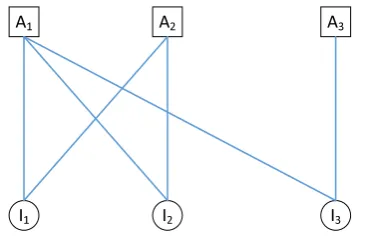
We herein illustrate how IR-CP-ABE makes it pos-sible where the group construction cannot solely rely on attribute literals. In Fig. 1, Ai(i ∈ [1,3]) denotes the i-th attribute and Ij(j ∈ [1,3]) denotes the j-th user’s identity. This example shows that it is impossible to construct the user groups{I1, I3}, {I2, I3} by using
only attributes. Nonetheless, with the help of identity revocation, they can be expressed in the form of
ϭ Ϯ ϯ
/ϭ /Ϯ /ϯ
Fig. 1 An example of subgroups cannot be established based on users’ assigned attributes.
Of-Product Expression as follows: {I1, I3}=A1I2,
{I2, I3}=A1I1.
Lewko et al. propose a similar approach to con-structing groups more flexibly. Their focus is on public key encryption schemes and Key-Policy ABE schemes. In this paper, we focus on flexible group construction in CP-ABE schemes. CP-ABE scheme supporting negated clauses [1,?,?] allows to revoke individuals by conjunc-tively adding the AND of negations of undesired mem-bers’ identities. In all of these schemes, each identity is
mapped to an individual attribute. However, all these schemes lack efficacy in bandwidth terms. Among these schemes, the scheme in [2] is the most efficient one. Through efficiency comparison (Section 4), we can con-clude that our scheme is more efficient. Our research contributions are summarized as follows:
– By incorporating identities into the secure group construction, IR-CP-ABE is capable to construct some groups which are impossible to construct by previous CP-ABE schemes.
– IR-CP-ABE simplifies the secure group construc-tion by reducing the number of attributes and/or attribute policy trees;
– The presented solution is proved to be secure under selective security model;
– Performance analysis and evaluation shows that IR-CP-ABE does not increase the storage, computa-tion, and communication complexity of the existing CP-ABE schemes, thus practical for real-world ap-plications.
The remainder of this paper is organized as follows. Section 2 presents the system preliminaries and security assumptions. Section 3 elaborates the construction of IR-CP-ABE. Section 4 presents the performance analy-sis and evaluation. Section 5 discusses the related work. Section 6 concludes this paper. The security proof is presented in Appendix A.
2 Preliminaries
In this section, we present the foundations that are re-quired to build the IR-CP-ABE scheme.
2.1 Access Structure
Access StructureWe follow the same definition pre-sented in [3]. Let {P1, P2, . . . , Pn} be a set of parties. A setA⊆2{P1,P2,...,Pn} is monotone if ∀B, C ifB ∈A and B ⊆C then C ∈ A. An access structure is a set
A of non-empty subsets of {P1, P2, . . . , Pn}, i.e.,A ⊆ 2{P1,P2,...,Pn}\{∅}. The sets in Aare defined as autho-rized sets, and sets that do not belong toAare defined as unauthorized sets.
the access structure A to refer to a monotone access structure.
2.2 Linear Secret Sharing Schemes
Linear Secret Sharing Schemes (LSSS) [3] plays an im-portant role in our schemes, and it is defined as follows: Linear Secret Sharing Schemes(LSSS).A se-cret sharing schemeI over a set of parties is linear over
Zp if
– the shares for each party form a vector overZp;
– a share-generating matrix for I has l rows and n columns. For alli= 1, . . . , land eachi-th row ofM, we define ρ(i) as the party labeling row i. For the column vectorv= (s, r2, r3, . . . , rn) wheres∈Zpis the shared secret, andM v is the vector ofl shares of the secret s for I where r2, r3, . . . , rn ∈ Z are randomly chosen and the share (M v)i belongs to partyρi.
According to the definition described above, every linear secret sharing-scheme according to the above def-inition also enjoys the linear reconstruction property and it is defined as follows: assume I is an LSSS for the access structure AandS∈Ais an authorized set, we define I ⊂ {1,2, . . . , l} as I = {i : ρi ∈ S}. Ac-cordingly, there exist constants {wi ∈ p}i∈I such that
∑
i∈Iwiλi=swhere{λi}are valid shares of any secret sand these constants{wi}can be derived in polynomial time.
2.3 Algorithms of IR-CP-ABE
The ID-revocable ABE is comprised of four algorithms, and the implications of the algorithm are elaborated as below:
– Setup(U,I): Given the attribute universe descrip-tionU and the identity setI, the TA publishes its public keyP K but keeps its master keyM SK; – KeyGen(M SK, S, ID): GivenM SK, the user’s ID
and attribute setS, the TA issues private keysSK; – Encrypt(P K,(M, ρ),M,{IDj}): Given the public keyP K, the LSSS matrixM and its corresponding mappingρto each attribute, the messageMand the revoked ID set{IDj}, the data owner generates the ciphertext and sends it to a public place for storage; – Decrypt(CT, SK): Given the ciphertext CT, the data user derives the messageMby decrypting with its private keySK.
2.4 Security Model for ID Revokable CP-ABE
We now present the full security definition for IR-CP-ABE systems which derive from the security definitions for identity-based revocation framework [4] and general CP-ABE systems [5]. In the IR-CP-ABE security defi-nition, we need to consider stronger adversaries whose attributes satisfy the attribute access policy of the chal-lenge ciphertext but whose identity is in the revocation set.
Init: The adversaryAcommits to the challenge access structure A∗ and the revoked identity setID∗ and send this to the challenger.
Setup: The challenger runs the setup algorithm. The master secret keyMSKis kept secret and the public parameters PKare given toA.
Phase1: The adversaryAmakes repeated private key queries (Si,IDi)i∈[1,q1] where ifSi satisfiesA
∗ then
the identityIDi=ID∗.
Challenge: A submits two equal length mes-sagesM0andM1. In addition, the adversary gives
a challenge LSSS access structure A∗ = (M∗, ρ∗) and a set ID∗ of revoked identities such that ID∗ must include all identities that were queried. The challenger picks up a random coin b, and encrypts Mb under the access structure A∗ and the revoked identity setID∗. Then the challenge ciphertextCT∗ is sent toA.
Phase2: RepeatPhase1with the restriction that the queried sets of (Si,IDi)i∈[q1+1,q]where ifSisatisfies
A∗ then the identityIDi=ID∗.
Guess: The adversary outputs a guess bitb′ ofb. De-fine AdvA=|Pr[b′ =b]−1
2|as the advantage of the
adversaryAwinning the game.
The advantage of an adversary A in this game is defined as Pr[b′ =b]−12. Note that the above model can easily be extended to handle chosen-ciphertext at-tacks by allowing for decryption queries in Phase 1 andPhase 2.
Definition 1 An identity revocable CP-ABE scheme is secure if all polynomial time adversaries have at most a negligible advantage in the above game.
We say that a system is selectively secure if we add an Init stage before setup where the adversary commits to the challenge access structureM and the revocation ID setS. All of our constructions will be proved secure in the selective security model.
2.5 Bilinear Maps
order q generated by a Bilinear Diffie-Hellman (BDH) parameter generator G. Correspondingly we set up a bilinear map systemS = (q,G,GT, e) where edenotes a computable bilinear map e: G×G→ GT with the following properties:
– Bilinearity: ∀G,W ∈ G, ∀a, b ∈ Z, e(Ga, Wb) = e(G,W)ab ;
– Non-degeneracy:GandW are the generators ofG, e(Ga,Wb)̸= 1;
– Computability:e(G,W) is efficiently computable. In our system,we setG=W and makeG,G,GT public.
2.6 Assumptions
We now present theq-type complexity assumptions that we will depend on to prove the security of our systems. This assumption is formulated on prime order bilin-ear groups, denoted by modified decisional q-parallel BDHE, which is similar to the Decisional Parallel Bi-linear Diffie-Hellman Exponent (q-parallel BDHE ) As-sumption [5].
The modified decisional q-parallel Bilinear Diffie-Hellman problem is defined as follows. We select a group
Gof prime orderpand a random generatorgofGand random exponentsa, s, b1, b2,· · ·, bq ∈Zp. Given
y={g, gs, ga,· · · , g(aq), , g(aq+2),· · · , g(a2q)}
∀1≤j≤qga/bj,· · ·, ga q/b
j, , gaq+2/bj, ..., ga2q/bj
∀1≤j≤qga·s/bj,· · ·, g(a q·s/b
j),
it is hard to distinguish e(g, g)aq+1s
∈ GT from any random elementR inGT.
An algorithm B that outputs z ∈ {0,1} has ad-vantage ϵ in solving the modified decisional q-parallel BDHE inGif
|Pr[B(y, T =e(g, g)aq+1s) = 0]−Pr[B(y, T =R) = 0]| ≥ϵ. The modified decisional q-parallel BDHE assumption holds if only negligible advantage exists for any algo-rithm to solve the modified decisionalq-parallel BDHE problem in polynomial time.
Proof: We briefly show that theM-q-parallel-BDHE assumption is generically secure. The generic proof tem-plate of BBG [5] and [6] is used. Using the terminology from BBG we need to show thatf =aq+1sis
indepen-dent of the polynomialsP andQ. We setQ={1}since all given terms are in the bilinear group.P is set to be
P ={1, s,∀i∈[1,2q],j∈[1,q],i̸=q+1ai, ai/bj, ai·s/bj}.
We could choose a generatoruand setg=u∏j∈[1,q]bj. All the above terms are substituted by a set of polyno-mials with the maximum degree 3q+ 1.
Now, we check whether f is symbolically indepen-dent of any two polynomials inP and Q. To realizef fromP andQ, a term of the form am+1sis needed. It
can be seen that no such terms can be realized from the product of any two polynomialsp, p′∈P. To form such a term, a polynomial with a single factor ofsis needed. Ifs is used as pthen p′ has to be aq+1 which doesn’t
exist inP. If we setp=ai·s/bj, there always existsbj, which cannot be canceled. Based on the BBG frame-work, we can conclude that theM-q-parallel-BDHE as-sumption is generically secure.
3 Our Construction
In this section, we present the IR-CP-ABE scheme. We first present the construction of one ID revocation, which is represented as OIDR-CP-ABE. A multiple-ID revocation scheme, denote as MIDR-CP-ABE, is also presented. The main challenge to achieve multiple-ID revocation is due to the collusion problem. Our scheme can prevent collusion issue, and the security proofs are presented in Appendix A.
3.1 Notation Illustration
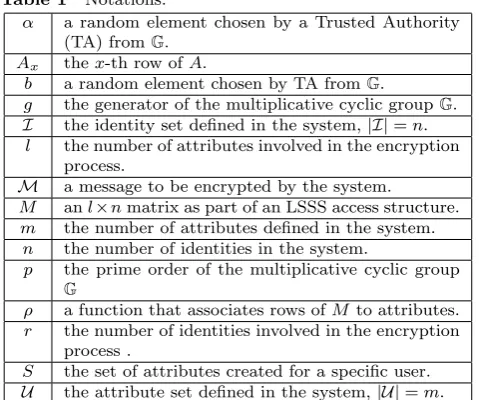
Before going into details of each scheme, we first present common notations that are used in the following sec-tions, as shown inTABLE 1.
Table 1 Notations.
α a random element chosen by a Trusted Authority (TA) fromG.
Ax thex-th row ofA.
b a random element chosen by TA fromG.
g the generator of the multiplicative cyclic groupG.
I the identity set defined in the system,|I|=n. l the number of attributes involved in the encryption
process.
M a message to be encrypted by the system.
M anl×nmatrix as part of an LSSS access structure. m the number of attributes defined in the system. n the number of identities in the system.
p the prime order of the multiplicative cyclic group
G
ρ a function that associates rows ofMto attributes. r the number of identities involved in the encryption
process .
S the set of attributes created for a specific user.
3.2 One-ID Revocation for CP-ABE Scheme (OIDR-CP-ABE)
a. Setup(U,I)
The Setup algorithm takes an attribute set U and an identity setI as inputs, where|U|=mand |I|= 1. It chooses a groupGof prime orderp, a generatorg, and mrandom group elementsh1, h2,· · · , hm∈Gthat are associated with them attributes in the system. It also chooses random exponents α, b∈Zp.
Therefore, the public key is in the form:
P K={g, gb, gb2, e(g, g)α, hb1,· · ·, hbm}.
The Master secret key is in the form:
M SK={α, b}.
b. KeyGen(MSK,S,ID)
Sis the attribute set of userID∈ I.KeyGenalgorithm chooses a random t∈Zp and generates secret keys for userIDas follows:
SK= (K=gαgb2t,{Kx= (gb·IDhx)t}∀x∈S, L=g−t).
c. Encrypt(PK,(M, ρ),M,ID1)
Encryptalgorithm takes inputs as an LSSS access struc-ture (M, ρ) and the functionρassociates each row ofM to corresponding attributes. ID1 is the identity to be
revoked. LetM be anl×n′matrix. TheEncrypt algo-rithm first chooses a random vectorv= (s, y2,· · ·, yn′)∈
Zn′
p . These values will be used to share an encryption exponent s. For k ∈ [1, l], it calculates λk = v ·Mk, where Mk is the vector corresponding to thex-th row ofM. Then, for messageM, the ciphertext is presented as follows:
C=Me(g, g)αs, C0=gs,
ˆ
C={Ck∗ =gb·λk, C′ k = (g
b2·ID 1hb
ρ(k))
λk}
k∈{1,···,l}.
d. Decrypt(CT,SK)
CT is the input ciphertext with access structure (M, ρ) andSK is a private key for a setS:
CT = (C, C0,C,ˆ (M, ρ)).
Suppose that S satisfies the access structure and let I ⊂ {1,2, ..., l} be defined as I = {i : ρ(i) ∈ S}. Let {ωi ∈ Zp}i∈I be a set of constants such that if
{λi} are valid shares of any secret s according to M, thenΣi∈Iωiλi =s. If the identityID combined in the
SK is not equal to the revocation identity ID1 in the
ciphertext, we can perform
e(C0,K)
(∏
i∈I[e(Kρ(i),Ci∗)·e(L,C′i)]ωi)1/(ID−ID1 ) =e(gs, gαgb2t)/(∏
i∈I[e((g b·IDh
ρ(i))t, gb·λi)
·e(g−t,(gb2·ID1hb ρ(i))
λi)]ωi)1/(ID−ID1)
=e(g, g)αs·e(g, g)b2st/e(g, g)b2t∑i∈Iλiωi =e(g, g)αs.
Theorem 1 Suppose the modified decisionalq-parallels
BDHEchallenge assumption holds. Then no poly-time adversary can selectively break OIDR-CP-ABE with a challenge matrix of sizel×n, wheren < q.
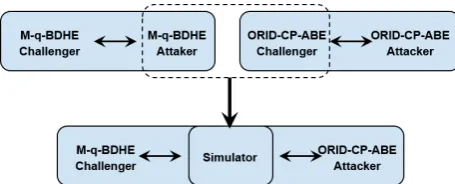
Proof Based on the attack model presented in Section 2.4, to prove the security of our scheme, we utilize the reduction technology Fig. 2, where a simulator is constructed to simulate a real attributed-based cryp-tography environment for attackers by answering their queries and programming the challenge access structure and revoked identity into the public parameters. Com-pared with the CP-ABE security model [5], where one only considers the situation that the queried attribute set does not satisfy the challenge policy, during the pri-vate key query procedure (Phase 1), our scheme consid-ers that the queried attribute set can satisfy the chal-lenge policy when the corresponding user is a revoked user. To address the presented security challenges, we construct a new matrix nearly equal to the challenge LSSS matrix and use it to simulate the environment. In the follows, we present the detailed proof.
Fig. 2 The reduction of our scheme to the M-q-BDHE problem.
Init The simulator takes in a modified decisional q -parallelBDHE challenge{−→Y , T}. Then the adversary declares the revoked userIDc and gives the simulator the challenge access structure (M, ρ), where M hasn (less than q) columns. Let the challenge matrix M = (−→M1,
−→
M2, ...,
−→
Ml)T, where each row vector
−→
Mi = (Mi,1,
Mi,2, ...Mi,n) for 1≤i≤l.
Setup The simulator chooses a random value α′ and lets e(g, g)α =e(g, g)α′e(ga, gaq
) to implicitly set α= α′+aq+1. Moreover, it implicitly setsb=aby
comput-ing the public parameters asg, gb =ga, gb2 = (ga2) To embed the revocation identificationIDc and the chal-lenge access structure in the public parametersh1, ..., hU,
we regard the challenge matrixM as a row vector set and divide it into three subsetsM′,M′′andM′′′ such that M′ ∪M′′∪M′′′ = M and M′ ∩M′′ ∩M′′′ = ∅. Specifically, M′, M′′ and M′′′ are initially set to be empty set. Define the n-dimension vectors −→e = (1,0, ...,0) and −→µ = (a2, a3, ..., an+1). For i = 1 to l,
if−→Mi is linearly independent onM′ and −→e cannot be linearly expressed byM′∪{−→Mi}, then we merge−→Miinto M′; if−→Miis linearly independent onM′ and−→e can be linearly expressed byM′∪{−→Mi}, then we merge
−→
Miinto M′′′; if−→Mi is linearly dependent onM′, then we merge
−→
Mi into M′′. As a result, M′ is a linear independent vector group while each vector in M′′ can be linearly expressed by M′. Although −→e cannot be spanned by M′, it can be linearly expressed by M′ merged with each vector inM′′′. Therefore, each vector inM can be linearly expressed by M′∪ {−→e}.
Next, we describe how the simulator ”programs” the public parameters hb1, hb2, ..., hbU. Let X denote the set of indices i, such that ρ(i) = x. Assume that there arem vectors inM′ and letM′ = (−→M1′,−→M2′, ...,−−→Mm′ )T. For each i ∈ X, its corresponding row vector −→Mi can be written as εi0−→e +εi1
−→
M1′ +εi2
−→
M2′ +...+εim
−−→
Mm′ , where (εi0, εi1, ..., εim)∈Zpm. For each
−→
Mi, we define a
corresponding vector−→Mi∗, where−→Mi∗=εi1
−→
M1′+εi2
−→
M2′+ ...+εim
−−→
Mm′ . As a result, we get a new vector group M∗= (−→M1∗,−→M2∗, ...,−→Ml∗) and each −→Mi∗ in is in the span of M′. By choosing a random value zx, the simulator programshxandhbxas:
hx=gzxg−aIDc ∏ i∈X
g(εi1−→M1′+εi2−→M2′+,...,+εim−−→Mm′)·−→µ /bi
=gzxg−aIDc(∏ i∈X
n
∏
j=1
gMi,j∗ a j+1/b
i).
hbx=gzxg−a 2ID
c(∏ i∈X
n
∏
j=1
gMi,j∗ a j+1/b
i).
IfX is an empty set, we sethbx=gzx. Then the sim-ulator publishes the above parameters (g, gb, gb2
,hb
1, hb2,
· · ·, hb
U, e(g, g)α) as the public key. We observe that the public parameters are distributed randomly as the real system and both the revoked identification and the challenge matrix are reflected in the simulation’s con-struction of the parameterhb
x.
Phase I The algorithm simulates to answer private key queries. In the general CP-ABE security model [5], one only considers the weaker case, that is, the queried attribute set does not satisfy the challenge policy. In this case, to construct the private keys for the unsat-isfied attribute set I, the simulator can find a vec-tor −→ω = (ω1, ..., ωn) ∈ Zp such that ω1 = −1 and
− →ω ·−→M
i = 0 for all i where ρ(i) ∈ I. Such a vector must exist, as the target vector−→e is not in the span of the rows in the challenge matrix M corresponding to the setI [5]. As a result, by utilizing−→ω, the simulator can cancel the item of the formgaq+1 in generating the queried private key.
In our selective security model, we consider a stronger adversary querying the private key of an attribute set which satisfies the challenge policy. Due to the autho-rized attribute set, the above mentioned vector→−ω with ω1=−1 and−→ω ·Mi = 0 corresponding to the queried attribute set does necessarily not exist. To overcome the problem, at the beginning we program the public parameterhx based on the challenged policy row sub-setM′. Since each−→Mi∗ is in the span ofM′ while−→e is not in the span ofM′, we can still find a vector−→ω with ω1=−1 and−→ω ·
−→
Mi∗= 0, where 1≤i≤m.
Therefore, the simulator selects a random value r and calculates the private keyLas
L=gr+−→ω·−→ν =gr ∏ i=1,...,n
(gaq−i)ωi,
which implicitly sets the randomnesstas
t=r+−→ω · −→ν =r+ω1aq−1+ω2aq−2+, ...,+ωnaq−n,
where−→ν = (aq−1, aq−2, ..., aq−n+2).
By doing this, we can first cancel out thegq+1that
the simulator does not know withgαin building theK component as
K=gα′ga2r ∏ i=0,...,n−2
(gaq+i)ωi.
Kx=(gzxga(IDd−IDc)
∏
i∈X
g−−→Mi∗·−→µ /bi)(r+−→w·−→ν)
=gzx(r+−→w·−→ν)ga(IDd−IDc)(r+→−w·−→ν)
·∏
i∈X
g(Mi1∗a2+,...,+Min∗an)(r+ω1aq−1+,...,+ωnaq−n)
=gzx(r+−→w·−→ν)ga(IDd−IDc)(r+→−w·−→ν)
·∏
i∈X
g(Mi1∗a2+,...,+Min∗an)r
·∏
i∈X n
∏
j=1
n
∏
k=1,k̸=j
gMij∗ωkaq+j−k+1.
Challenge In this phase, the adversary provides to the simulator two challenge messagesM0,M1with the
challenge matrixM of dimension at mostncolumns. First, The simulator flips a coin β and creates the ciphertext componentC=MβT ·e(gs, gα
′
). Then the simulator chooses random valuey2′, y3′, ..., y′n and share the secretsusing the vector
−
→v = (s, y′
2, y′3, ..., y′n).
Next, it calculates
λk=−→v ·(εk0−→e +εk1
−→
M1′ +εk2
−→
M2′ +...+εkm−−→Mm′ )
=−→v ·(εk0−→e +
−→
Mk∗).
And it generates the ciphertext componentCk∗as:
Ck∗=g
as(Mk1∗ +εk0)· n
∏
i=2
gMki∗y′i
Fork= 1, ..., n, we defineXk as the set of the index i in such that ρ(i) =ρ(k). Finally, the simulator builds the ciphertext componentCk′ as:
Ck′ =(ga2IDcgzxg−a2IDc ∏ i∈Xk
g−−→Mi∗·−→µ /bi)λk
=gzxλk ∏ i∈Xk
g(Mi1∗a 2+M∗
i2a
3+,...,+M∗ ina
n+1)λ k/bi.
Phase IISame as phase I.
Guess The adversary will eventually output a guess β′ of β. The simulator then outputs 0 to guess that T = e(g, g)saq+1 if β′ = β; otherwise, it outputs 1 to indicate that it believesT is a random group element in GT . When T is a tuple the simulator B gives a perfect simulation so we have that
P r[B(−→X , T =e(g, g)saq+1) = 0] = 1
2+AdvA.
When T is a random group element, the message Mβ is completely hidden from the adversary and we haveP r[B(−→X , T =R) = 0] = 12. Therefore,Bcan play the modified decisional q-parallels BDHE game with non-negligible advantage.
3.3 Multiple-ID Revocation for CP-ABE Scheme (MIDR-CP-ABE)
a.Setup(U,I)
The algorithm takes an attribute setU and an identity setI as input where|U|=mand|I|=n. It chooses a groupGof prime orderp, a generatorpandmrandom group elementsh1, h2,· · ·, hm∈Gthat are associated
with the m attributes in the system. It also chooses random exponentsα, b∈Zp.
Therefore, the public keys are output as:
P K={g, gb, gb2, e(g, g)α, hb1,· · ·, hbm}.
The Master secret key is:M SK ={α, b}.
b. KeyGen(MSK,S,ID)
S is the attribute set of user ID ∈ I. The algorithm chooses a randomt∈Zp and derive the secret keys as follows:
SK= (K=gαgb2t,{Kx= (gb·IDhx)t}∀x∈S, L=g−t).
c. Encrypt(PK,(M, ρ),M,S)
It takes the input as an LSSS access structure (M, ρ) and the functionρassociates rows of M to attributes. IDjis assumed to be the identity which will be revoked. LetM be anl×n′matrix. The algorithm first chooses a random vectorv= (s, y2,· · ·, yn′)∈Zn
′
p . These values will be used to share the encryption exponent s. For x ∈ [1, l], it calculates λx =v·Mx, where Mx is the vector corresponding to thex-th row ofM. Letr=|S| and IDj denote thej-th identity in S. The algorithm chooses randomµ1, ..., µr∈Zp such thatµ=µ1+...+
µr. It generates the first part of ciphertext:
C=Me(g, g)αsµ, C0=gsµ,
C1∗,1=gb·λ1µ1, C′
1,1= (g
b2·ID 1hb
ρ(1))
λ1µ1
· · · Cl,∗1=gb·λlµ1, C′ l,1= (gb
2·ID 1hb
ρ(l))
λlµ1
C1∗,2=gb·λ1µ2, C′
1,2= (gb
2·ID 2hb
ρ(1))
λ1µ2
· · · Cl,∗2=gb·λlµ2, C′ l,2= (g
b2·ID 2hb
ρ(l))
λlµ2
· · ·
C1∗,r=gb·λ1µr, C′
1,r = (gb 2·ID
rhb ρ(1))
λ1µr
· · · Cl,r∗ =gb·λlµr, C′ l,r= (g
b2·ID rhb
ρ(l))
d. Decrypt(CT,SK)
CT is the input ciphertext with access structure (M, ρ) and SK is a private key for a set S. Suppose that S satisfies the access structure and letI ⊂ {1,2, ..., l} be defined as I = {i : ρ(i) ∈ S}. Let {ωi ∈ Zp}i∈I be a set of constants such that if {λi} are valid shares of any secret s according to M, then Σi∈Iωiλi = s. If the identity ID combined in the SK is not equal to the revocation identity IDj in the ciphertext, we can perform
e(C0,K)
∏
i∈I(
∏r
j=1[e(Kρ(i),Ci,j∗ )·e(L,Ci,j′ )]
1/(ID−IDj))ωi
=e(gsµ, gαgb2t)/∏ i∈I(
∏r j=1[e((g
b·IDh
ρ(i))t, gb·λiµj)
·e(g−t,(gb2·ID jhb
ρ(i))
λiµj)]1/(ID−IDj))ωi
=e(gsµ, gα)·e(gsµ, gb2t)/∏ i∈I(
∏r j=1[e(g
b·ID·t, gb·λiµj) ·e(htρ(i), gb·λiµj)·e(g−t, gb2·IDj·λiµj)
·e(g−t, hb·λiµj ρ(i) )]
1/(ID−IDj))ωi
=e(g, g)αsµ·e(g, g)b2sµt/∏ i∈I(
∏r j=1[e(g
b·ID·t, gb·λiµj) ·e(g−t, gb2·IDj·λiµj)]1/(ID−IDj))ωi
=e(g, g)αsµ·e(g, g)b2sµt ·1/∏
i∈I( ∏r
j=1[e(g, g)
b2tλiµj(ID−IDj)]1/(ID−IDj))ωi
=e(g, g)αsµ·e(g, g)b2sµt/∏ i∈I(
∏r
j=1e(g, g)
b2tλiµj)ωi
=e(g, g)αsµ·e(g, g)b2sµt/∏
i∈I(e(g, g)
(∑r
j=1µj)b 2tλ
i )ωi =e(g, g)αsµ·e(g, g)b2sµt/e(g, g)b2tµ∑i∈Iλiωi
=e(g, g)αsµ.
Theorem 2 Suppose the modified decisionalq-parallels
BDHEchallenge assumption holds. Then no poly-time adversary can selectively break MIDR-CP-ABE with a challenge matrix of size l ×n and r revocation IDs, wherer, n < q.
It is obvious that the public parameters and private key structure of MIDR-CP-ABE is same as those of OIDR-CP-ABE. Furthermore, the ciphertext structure of MIDR-CP-ABE is essentially an extension for that of OIDR-CP-ABE. Therefore here we can directly implant the proof of OIDR-CP-ABE with some replacements of one revocation ID to a revocation ID set summation. We present the proof briefly as following.
Proof Suppose A attacks our construction with a re-voked user set and a challenge matrix M where both dimensions are less thanq. We show how to build sim-ulator, B, that plays the modified decisional q-parallel BDHE problem.
Init The simulator takes in a modified decisional q -parallelBDHE challenge{−→Y , T}. Then the adversary declares the revoked user set (IDc1, IDc2, ..., IDcr) and
gives the simulator the challenge access structure (M, ρ),
whereM hasn(less thanq) columns. LetM = (−→M1,
−→
M2,
· · ·,−→Ml)T, where each row vector
−→
Mi = (Mi,1, Mi,2,
· · ·, Mi,n) for 1≤i≤l.
Setup The simulator chooses a random value α′ and lets e(g, g)α =e(g, g)α′e(ga, gaq
) to implicitly setα= α′+aq+1. Moreover, it implicitly setsb=aby
comput-ing the public parameters asgb=ga and gb2 = (ga2). The challenge matrixMis divided into three subsets M′,M′′andM′′′ such thatM′∪M′′∪M′′′ =M and M′∩M′′∩M′′′=∅. Their generation method is same as that in the proof of OIDR-CP-ABE so that each vector inM can be linearly expressed byM′∪{−→e}. Define the n-dimension vectors−→e = (1,0, ...,0). Let X denote the set of indicesi, such that ρ(i) =x. Assume that there is m vectors inM′ and let M′ = (−→M1′,
−→
M2′, ...,
−−→
Mm′ )T. For eachi∈X, its corresponding row vector−→Mican be written asεi0−→e +εi1
−→
M1′+εi2
−→
M2′+...+εim
−−→
Mm′ , where (εi0, εi1, ..., εim) ∈ Zpm. For each
−→
Mi, we define a
cor-responding vector−→Mi∗, where −→Mi∗ =εi1
−→
M1′ +εi2
−→
M2′ +
...+εim−−→Mm′ . As a result, we get a new vector group M∗ = (−→M1∗,−→M2∗, ...,−→Ml∗) and each −→Mi∗ in it is in the span ofM′. By choosing a random valuezx, the simu-lator programhb
x as:
hx=gzxg−a∑rι=1IDcι(∏ i∈X
n
∏
j=1
gMi,j∗ a j+1/b
i).
hbx=gzxg−a2∑rι=1IDcι(∏ i∈X
n
∏
j=1
gMi,j∗ aj+1/bi).
IfX is null, we sethbx=gzx. Then the simulator pub-lishes the above parameters as public key.
Phase ISince each −→Mi∗ is in the span of M′ while −→e is not in the span ofM′, we can still find a vector−→ω withω1 =−1 and−→ω ·
−→
Mi∗= 0, where 1≤i≤m. The simulator selects a random valuer′ and calculates the private keyLas
L=gr′ ∏ i=1,...,n
(gaq−i)ωi,
K=gα′ga2r′ ∏ i=0,...,n−2
(gaq+i)ωi,
implicitly setting the randomnesstast=r′+ω1aq−1+
Kx=gzx(r+→−w·−→ν)ga(IDd−∑rι=1IDcι)(r+→−w·−→ν)
·∏
i∈X g(Mi1∗a
2+,...,+M∗ ina
n)r
·∏
i∈X n
∏
j=1
n
∏
k=1,k̸=j
gMij∗ωkaq+j−k+1.
Challenge The adversary provides to the simulator M0,M1 with the matrix M of dimension at most n
columns.
First, The simulator flips a coinβ, chooses random values µ1, µ2, ..., µr such that ν = ν1+ν2+...+νr,
and creates the ciphertext component C = Mβ(T · e(gs, gα′))ν. Then the simulator chooses random value y2′, y3′, ..., y′n and share the secretsusing the vector
−
→v = (s, y′
2, y′3, ..., y′n).
Next, it calculates
λk=−→v ·(εk0−→e +εk1
−→
M1′ +εk2
−→
M2′ +...+εkm
−−→
Mm′ )
=−→v ·(εk0−→e +
−→
Mk∗).
And it generates the ciphertext componentCk∗as:
Ck,γ∗ =gasνγ(M
∗ k1+εk0)·
n
∏
i=2
gMki∗yi′
Fork= 1, ..., n, we defineXk as the set of the index i in such that ρ(i) =ρ(k). Finally, the simulator builds the ciphertext componentCk′ as:
Ck′ =(ga2∑rι=1IDcιgzxg−a2∑rι=1IDcι ∏ i∈Xk
g−−→Mi∗·−→µ /bi)λkνγ
=gzxλkνγ ∏ i∈Xk
g(Mi1∗a2+Mi2∗a3+,...,+Min∗an+1)λkνγ/bi.
Phase IISame as phase I.
GuessThe adversary will eventually output a guessβ′ ofβ. The simulator then outputs 0 ifβ′=β; otherwise, 1. When T is a tuple, B gives a perfect simulation so we have that
P r[B(−→X , T =e(g, g)saq+1) = 0] = 1
2+AdvA.
WhenT is a random group element,Mβ is completely hidden from the adversary and we have P r[B(−→X , T = R) = 0] = 12. So B can play the modified decisional q-parallelBDHEgame with non-negligible advantage.
4 Performance Evaluation
In this section, the two schemes proposed in this pa-per are evaluated in terms of their computation, stor-age, and communication performance. The evaluation is performed in three parts: Firstly, we analyze the per-formance complexity of presented revocation schemes compared to the original CP-ABE scheme. Secondly, we implement the IR-CP-ABE schemes based on PBC library [7]. A computation performance evaluation is conducted including comparison with CP-ABE scheme. Finally, we present an experimental study to show the benefit of using IR-CP-ABE scheme for secure group construction.
4.1 Computation, Storage, and Communication Complexity Analysis
Following the notations provided inTABLE 1, a com-parative analysis is carried out among the OIDR-CP-ABE scheme, the MIDR-CP-OIDR-CP-ABE scheme, the origi-nal CP-ABE scheme which are scheme is built on, the unbounded non-monotonic CP-ABE scheme (the last scheme in Yamada’s paper, and we just call it Yamada’s scheme in this paper) [2]. In Yamada’s scheme, it pro-vides a general approach by incorporating ”Not” logic on one or multiple attributes. Revoking a user, it can simply consider user’s ID as an attribute. However, this scheme can significantly increase the attributes man-agement overhead when the group size is large. To mea-sure these schemes’ performance, we present four evalu-ated functions,i.e.,Setup(),KeyGen(),Encrypt(), and Decrypt(). The analysis is carried out corresponding to the same function in each scheme on computation cost, storage cost, and communication cost.
4.1.1 Computation Complexity Analysis
In these four schemes, there are mainly four types of operations that are time-consuming: Pairing, Exponen-tiation, Multiplication, and Inversion. According to [8], the most computation-intensive operations arePairing andExponentiation. Thus, in this section, we evaluate the number ofPairing andExponentiation operations for each function as metrics for computation complex-ity. The complexity of all the schemes involved in a number ofParings and Exponentiations are presented inTABLE 2andTABLE 3respectively.
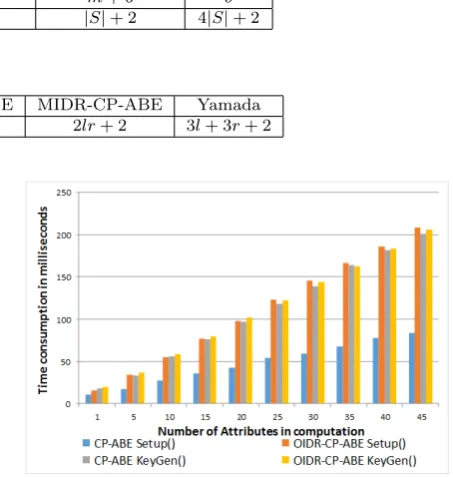
Table 2 Computation Complexity Comparison in the Number of Pairing Operations
Function CP-ABE OIDR-CP-ABE MIDR-CP-ABE Yamada
Setup() 1 1 1 1
KeyGen() 0 0 0 0
Encrypt() 0 0 0 0
Decrypt() 2|I|+ 1 2|I|+ 1 2|I|r+ 1 (2|I|+ 1)r+ 3|I|
Table 3 Computation Complexity Comparison in Exponentiation Operations
Function CP-ABE OIDR-CP-ABE MIDR-CP-ABE Yamada
Setup() 3 m+3 m+3 2
KeyGen() |S|+ 2 |S|+ 3 |S|+ 3 6|S|+ 7 Encrypt() 3l+ 2 2l+ 3 (2l+ 1)r+ 2 5l+ 5r
Decrypt() |I| |I| |I|r |I|
and MIDR-CP-ABE, the number of exponentiations is m+ 3, where m is the number of attributes defined globally as illustrated in TABLE 1.
For all the schemes, there is no need for any pairing operation in key generation process. Exponentiation op-eration is the key contributor to the cost in KeyGen() function for all four schemes. In CP-ABE, the number of exponentiations needed is|S|+ 2. In both OIDR-CP-ABE and MIDR-CP-OIDR-CP-ABE, this number is increased to |S|+ 3. This increase comes from the fact that not only a random valuetbut also the ID of the user is used as the exponent in the key component for each attribute. In Yamada, the number is 6|S|+ 7.
ForEncrypt()function, the computation cost in terms of pairing is the same for CP-ABE, OIDR-CP-ABE, MIDR-CP-ABE and Yamada. The number of exponen-tiation operations is significant in differentiating the computation cost among these schemes. In CP-ABE, it takes 3l+2 exponentiations and in OIDR-CP-ABE, the number of exponentiations is 2l+3. Herelis the number of attributes involved in the encryption process. Thus, the encryption cost of the OIDR-CP-ABE scheme is lower than CP-ABE. Comparatively, in MIDR-CP-ABE, the number is increased to (2l+ 1)r+ 2, herer is the number of IDs that are revoked in the ciphertext. In the Yamada scheme, the number of exponentiation op-erations is 5l+ 5r.
In CP-ABE, the number of pairing needed for De-crypt() is 2|I|+ 1, where I is the set of attributes in-volved in the decryption process. It requires the same amount of pairing in OIDR-CP-ABE. However, 2|I|r+1 pairing operations are needed in MIDR-CP-ABE due to the fact that it conducts more computation for each of the IDs that are revoked. It shows that the com-putation overhead from exponentiation operations is less than pairing operations. The Yamada scheme in-curs more pairing operations in decryption compared with our schemes.
The numbers of exponentiations in CP-ABE, OIDR-CP-ABE, MIDR-CP-ABE and Yamada are|I|,|I|,|I|r, |I|rand|I|respectively.
4.1.2 Storage and Communication Cost Analysis
The storage cost and communication cost are evalu-ated separately. From storage perspective, the main overhead is from Setup() and KeyGen() functions, in which both functions create secret materials that need to be stored locally. For communication cost, the func-tion Encrypt() is evaluated as results from this func-tion constitute the ciphertext of transmitted messages. There is no additional storage or communication cost forDecrypt() function as the result is directly used as plaintext. The storage for temporary variables that are normally used in computer memories are not consid-ered. Only those needed for final results of each func-tion are counted. Based on our implementafunc-tion, which is further illustrated in the next section, each element is stored as an element t data structure. Therefore, the number of elements is used as a metric for storage and communication cost analysis.TABLE 4 andTABLE 5summarize the cost corresponding to each function in all the four schemes.
In Setup() function, the storage costs are almost the same as the first three schemes, which is related with the number of all attributes in the system. In the Yamada scheme, this cost is a constant.
Table 4 Storage Cost Comparison
Function CP-ABE OIDR-CP-ABE MIDR-CP-ABE Yamada
Setup() m+ 4 m+ 6 m+ 6 9
KeyGen() |S|+ 2 |S|+ 2 |S|+ 2 4|S|+ 2
Table 5 Communication Cost Comparison
Function CP-ABE OIDR-CP-ABE MIDR-CP-ABE Yamada Encrypt() 2l+ 2 2l+ 2 2lr+ 2 3l+ 3r+ 2
Based on the analysis presented above, it can be seen that the proposed schemes are more computation intensive. Between the two schemes, OIDR-CP-ABE performs better than MIDR-CP-ABE in computation, storage, and communication. The costs for OIDR-CP-ABE have the same order of complexity as CP-OIDR-CP-ABE scheme, which means the presented solution does not incur significant overhead compared to CP-ABE. How-ever, the new functional benefits for revoking users is useful in many applications. Compared with Yamada, both of our schemes suffer from higher public parame-ters storage, while the private key storage is only quar-ter of that in Yamada. Since private keys are often stored in tamper-resistant memory, which is more costly, our scheme is more suitable for small devices with con-strained storage. As for the communication costs, com-pared with Yamada, our schemes are much more effi-cient when there is only one identity.
4.2 Implementation and Testing Results
The proposed schemes are implemented in C language using PBC library [7] on Ubuntu 14.04 64bit operating system. The hardware configuration for the machine that runs the experiment is: Intel i7 Quad-core CPU at 2.60GHz; 8GB memory. To test the relations between the amount of attributes involved and the time con-sumption, we fix the number of IDs revoked to 1 and increase the number of attributes that are involved in each of four functions Setup(), KeyGen(), Encrypt(), and Decrypt(). The time consumption of these func-tions are tested separately. Comparison is made for each function between CP-ABE scheme and OIDR-CP-ABE scheme. For each attribute setting, the experiments are run ten times and the average values are used as pre-sented inFig. 3andFig. 4.
As can be seen in the figure, the time consump-tion for all the four funcconsump-tions are generally linear to the number of involved attributes. The difference in time consumption for KeyGen() function is relatively small between two schemes. The most significant time differ-ence happens with Setup() function. The time cost in
Fig. 3 Relations between the amount of attributes and time consumption for key assignment.
Fig. 4 Relations between the amount of attributes and time consumption for communication.
under this scenario is acceptable for real-world applica-tions.
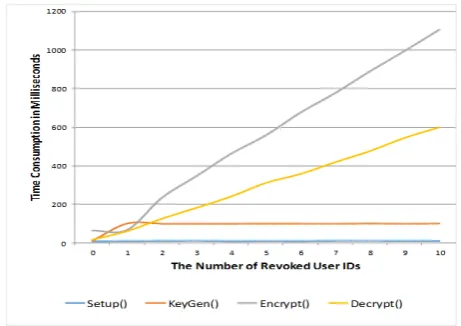
Fig. 5 Relations between the amount of revoked IDs and time consumption.
To further explore the influence on the time con-sumption from the number of IDs revoked, a second ex-periment is conducted with a fixed number of attributes and changing the number of revoked IDs. In this exper-iment, the number of attributes is set to 20 and the number of revoked IDs is gradually increased from 0 to 10. The evaluation result is shown inFig. 5for MIDR-CP-ABE scheme. It can be seen that the time consump-tion of Setup() andKeyGen() are not sensitive to the number of IDs revoked. This is because both functions do not have the revoked ID list involved in their opera-tions. TheEncrypt()function is sensitive to the number of revoked IDs. BothEncrypt()andDecrypt()follow a linear trend in Fig. 5. When the number of revoked IDs is greater than 9, with 20 attributes involved, the overall time cost forEncrypt()increases over 1 second.
4.3 The Advantage of IR-CP-ABE in Secure Group Construction
In this subsection, we did simulation to demonstrate that IR-CP-ABE supports much more ID groups than CP-ABE does. Assume there exists 5 attributes in the system and the number of identities increases from 10 to 30. In addition, the probability pfor each attribute to be assigned to an identity belongs to [20%,40%,60%, 80%,100%]. For each number value of identities and p value, the simulation ran 10 times to retrieve the av-erage number of different ID groups generated by CP-ABE and that generated by IR-CP-CP-ABE.
Fig. 6illustrates that the ratio of the average num-ber of different ID groups generated by CP-ABE to that
Fig. 6 The ratio of the average number of ID groups generated by CP-ABE to that generated by IR-CP-ABE
generated by IR-CP-ABE is very small. The reason is that IR-CP-ABE could construct a very large number of different ID groups by combining all the IDs associ-ated with the selected attributes first and then revoking any IDs, while CP-ABE can only generate ID groups based on attributes. Note that the ratio decreases when the number of identity increase, as the number of ID groups generated by IR-CP-ABE increases with the or-der of exponentiation. In addition, the ratio reaches its minimum when the number of identities is fixed and p= 100% because CP-ABE can only generate one ID group in this case. This implies IR-CP-ABE provides a more comprehensive solution in group construction than CP-ABE.
5 Related Work
The first fully functional Identity Based Encryption (IBE) scheme was proposed in [9]. In IBE, an identity or ID is a string one-to-one mapped to each user. A user can acquire a private key corresponding to his/her ID in an off-line manner from trusted authority and the ID is used as public key. The ciphertext encrypted by a particular ID can only be decrypted by the user with corresponding private key, i.e., the encryption is one-to-one.
proposed so far, namely Key Policy Attribute Based Encryption (KP-ABE [12]) and Ciphertext Policy At-tribute Based Encryption (CP-ABE[13]). In KP-ABE, each ciphertext is associated with a set of attributes and each user’s private key is embedded with an access pol-icy. Decryption is enabled only if the attributes on the ciphertext satisfy the access policy of the user’s private key. In CP-ABE [13–15, 1, 16], each user’s private key is associated with a set of attributes and each ciphertext is encrypted by an access policy. To decrypt the message, the attributes in the user private key need to satisfy the access policy. The key difference between identity and attribute is identities are many-to-one mapped to users while attributes are many-to-many mapped to users. Thus, to simulate a constant size conjunctive header, one needs to encrypt the message using each receiver’s identity and the size of ciphertext is linearly increasing.
ABE is a special case of functional encryption [17] which is superset of identity-based encryption, search-able encryption [18] [19], predicate encryption [15], etc. Another interesting related research topic is attribute-based authentication. Since nowadays, there are so many bots and malicious entities over the Internet [20] [21] [22] [23], whereas attribute-based encryption is iden-tity less, our ABE scheme with ideniden-tity revocable fea-ture can be used to construct an authentication scheme which not only proves the attributes of the data senders but also their identities.
Boldyrevaet al. [24] proposed an identity-based scheme with efficient user revocation capability. It applies key updates with significantly reduced computational cost based on a binary tree data structure and it is resis-tance against chosen-ciphertext attack. Nevertheless, Libert et al. [25] noticed the security problem left by Boldyreva that its security can only be proved in the selective-ID setting where adversaries need to reveal the victims’ identities at the beginning of the game. Con-sequently, they proposed an identity-based encryption scheme with stronger adaptive-ID sense to address the remaining issue. Liet al. [26] first introduced outsourc-ing computation in identity-based encryption and psented a revocable in the server-aided settings. As a re-sult, it achieves constant computation cost at public key generator and private key size at user, and the user does not have to contact public key generator for key update. Chenet al. [27] presented an identity-based encryption scheme based on lattices to realize efficient key revoca-tion. Binary tree data structure is utilized to achieve logarithmic complexity in key updates. EASiER [28] architecture is described to support fine-grained access control policies and dynamic group membership based on attribute-based encryption. It relies on a proxy to participate in the decryption and enforce revocation,
such that the user can be revoked without re-encrypting ciphertexts or issuing new keys to other users. Lewko et al. [4] two novel broadcast encryption schemes with effective user revocation capability. The first scheme is selectively secure in the standard model, and the sec-ond scheme achieves adaptive security by exploiting dual encryption technique. The ciphertext size only re-lates to the number of revoked users and the size of public/private keys are constant. Yu et al. [29] pro-posed an attribute-based data sharing scheme where each attribute gets three distinct values for its positive form, negative form as well as ”don’t care” form. It ad-dressed the issue of attribute revocation by relying on a semi-trustable online proxy to perform re-encryption and take most laborious tasks. Li et al. [30] proposed an ABE scheme that supports efficient communication group set up and management. With such scheme, the group membership information is protected through a specially hidden attribute policy.
In the literature, there are several revocation mech-anisms proposed for CP-ABE. In [31], Sahaiet al pro-posed an indirect revocation mechanism. In this revo-cation mechanism, the trusted authority has to be on-line all the time to update and distribute the secret key information to non-revoked users. In [32], a direct revocation mechanism was proposed where there is re-vocation list to be specified directly in the encryption algorithm so that the ciphertext cannot be decrypted by the users in the revocation list. Liu and Wong [33] pro-posed a Traitor tracking approach (LW for short) that also supports user revocation with a very constrained situation, where it construct a user’s ID to be a pair of integers from a predefined matrix. Therefore, a trusted authority is required to manage the mapping between a user and assigned unique pair of integers in order to al-low a user to perform Traitor’s ID checking. Whereas, in our scheme we allow a user’s ID to have semantic meanings. Thus, we do not need a trusted authority to maintain the mapping table for ID checking. From the perspective of efficiency, in the LW scheme the encryp-tion computaencryp-tion overhead and ciphertext size depends on the number of revoked users, thus not scalable to apply in networks with constrained resources.
6 Conclusions and Future Work
In this paper, we presented a new identity revocable CP-ABE scheme to improve the group management capability of existing CP-ABE solutions. With IR-CP-ABE, groups can be constructed in a much more flexible way compared with the previous CP-ABE schemes.
to explicitly specify which users need to be revoked in the revocation list. Ideally, revoked users should not be known by any group users. Second, a delegation scheme is desired to delegate all attributes and private key gen-eration. Thus, revoking a delegator’s ID will results in revoking a group of users in an efficient manner. A user can only get his/her attributes and private keys from one of the delegators. Moreover, a federated delegation approach is desired, in which a user can use his/her at-tributes and private keys generated from different del-egators.
Acknowledgements This research is supported by Naval Research Lab (NRL) with grant number N00173-15-G017. The research work is conducted during Professor Weijia Wang’s visit at Secure Networking And Computing (SNAC) research group, Arizona State University, US.
References
1. R. Ostrovsky, B. Waters, inProceedings of the 14th ACM conference on Computer and communications security (ACM New York, NY, USA, 2007), pp. 195–203 2. S. Yamada, N. Attrapadung, G. Hanaoka, N. Kunihiro,
inInternational Workshop on Public Key Cryptography (Springer, 2014), pp. 275–292
3. A. Beimel, Secure schemes for secret sharing and key distribution(Technion-Israel Institute of technology, Fac-ulty of computer science, 1996)
4. A. Lewko, A. Sahai, B. Waters, inSecurity and Privacy (SP), 2010 IEEE Symposium on(IEEE, 2010), pp. 273– 285
5. B. Waters, in Public Key Cryptography - PKC 2011 (Springer-Verlag, 2011), pp. 53–70
6. D. Boneh, X. Boyen, E.J. Goh, inAnnual International Conference on the Theory and Applications of Crypto-graphic Techniques (Springer, 2005), pp. 440–456 7. B. Lynn. The pairing-based cryptography library (2006).
URL https://crypto.stanford.edu/pbc/
8. B. Li, A.P. Verleker, D. Huang, Z. Wang, Y. Zhu, in Com-munications and Network Security (CNS), 2014 IEEE Conference on (2014), pp. 391–399
9. D. Boneh, M. Franklin, SIAM Journal of Computing 32(2), 586 (2003)
10. A. Sahai, B. Waters, pp. 457–473 (2005)
11. M. Pirretti, P. Traynor, P. McDaniel, B. Waters, in Pro-ceedings of the 13th ACM conference on Computer and communications security (ACM, 2006), p. 112
12. V. Goyal, O. Pandey, A. Sahai, B. Waters, Proceedings of the 13th ACM conference on Computer and commu-nications security pp. 89–98 (2006)
13. J. Bethencourt, A. Sahai, B. Waters, in IEEE SP’07 (Oakland, CA, 2007), pp. 321–334
14. L. Cheung, C. Newport, in ACM conference on Com-puter and Communications Security (Alexandria, Vir-ginia, USA, 2007), pp. 456–465
15. J. Katz, A. Sahai, B. Waters, inProc. of EUROCRYPT 2008 (Springer-Verlag, 2008), pp. 146–162
16. V. Goyal, A. Jain, O. Pandey, A. Sahai, in Automata, languages and programming (Springer, 2008), pp. 579– 591
17. L. Allison, O. Tatsuaki, S. Amit, T. Katsuyuki, W. Brent, inTheory and Applications of Cryptographic Techniques (Springer-Verlag, 2010), pp. 62–91
18. Q. Dong, Z. Guan, L. Wu, Z. Chen, in Interna-tional Conference on Web-Age Information Management (Springer, 2013), pp. 729–740
19. D. Boneh, G. Di Crescenzo, R. Ostrovsky, G. Persiano, in Eurocrypt, vol. 3027 (Springer, 2004), vol. 3027, pp. 506–522
20. F. Morstatter, L. Wu, T.H. Nazer, K.M. Carley, H. Liu, in Advances in Social Networks Analysis and Mining (ASONAM), 2016 IEEE/ACM International Confer-ence on(IEEE, 2016), pp. 533–540
21. L. Wu, F. Morstatter, X. Hu, H. Liu, Big Data in Com-plex and Social Networks pp. 123–152 (2016)
22. L. Wu, J. Li, X. Hu, H. Liu, inProceedings of the 2017 SIAM International Conference on Data Mining(SIAM, 2017), pp. 99–107
23. L. Wu, X. Hu, F. Morstatter, H. Liu, inICWSM (2017), pp. 696–699
24. A. Boldyreva, V. Goyal, V. Kumar, inProceedings of the 15th ACM conference on Computer and communications security(ACM, 2008), pp. 417–426
25. B. Libert, D. Vergnaud, in Topics in Cryptology–CT-RSA 2009 (Springer, 2009), pp. 1–15
26. J. Li, J. Li, X. Chen, C. Jia, W. Lou, Computers, IEEE Transactions on64(2), 425 (2015)
27. J. Chen, H.W. Lim, S. Ling, H. Wang, K. Nguyen, in Information Security and Privacy(Springer, 2012), pp. 390–403
28. S. Jahid, P. Mittal, N. Borisov, inProceedings of the 6th ACM Symposium on Information, Computer and Com-munications Security(ACM, 2011), pp. 411–415 29. S. Yu, K. Ren, W. Lou, Computer Networks54(3), 377
(2010)
30. B. Li, Z. Wang, D. Huang, in2013 IEEE Global Commu-nications Conference (GLOBECOM) (2013), pp. 861– 866
31. A. Sahai, H. Seyalioglu, B. Waters, in Advances in Cryptology–CRYPTO 2012 (Springer, 2012), pp. 199– 217
32. N. Attrapadung, H. Imai, inInternational Conference on Pairing-Based Cryptography (Springer, 2009), pp. 248– 265