Multimodal dialogue segmentation with gesture post-processing
Kodai Takahashi, Masashi Inoue
Yamagata University3-16, 4 Jyonan, Yonezawa, Japan [email protected]
Abstract
We investigate an automatic dialogue segmentation method using both verbal and non-verbal modalities. Dialogue contents are used for the initial segmentation of dialogue; then, gesture occurrences are used to remove the incorrect segment boundaries. A unique characteristic of our method is to use verbal and non-verbal information separately. We use a three-party dialogue that is rich in gesture as data. The transcription of the dialogue is segmented into topics without prior training by using the TextTiling and U00 algorithm. Some candidates for segment boundaries – where the topic continues – are irrelevant. Those boundaries can be found and removed by locating gestures that stretch over the boundary candidates. This filtering improves the segmentation accuracy of text-only segmentation.
Keywords:Multimodal, Dialogue, Segmentation
1.
Introduction
In this paper, we address two issues of automatic multimodal dialogue segmentation. The first issue is the lack of explicitness in the segmentation algo-rithm. Assuming that multimodality plays an impor-tant but complex role in structuring dialogues, differ-ent modalities are often exploited simultaneously in topic segmentation. For example, words, prosody, mo-tion, interaction cues, and speaker intention and role were jointly used for segmentation and achieved bet-ter results (Hsueh and Moore, 2007). We explicitly divide the segmentation process into speech-content-based topic segmentation and gesture-spanning-speech-content-based post-processing to avoid blackboxing. The second is-sue is the lack of copious amounts of training data for the algorithms used for statistical learning. Often, access to large amounts of training data enables mod-els that are learnt by statistical algorithms to outper-form the on-the-fly algorithms. However, many mul-timodal dialogues are unique in themselves and the problem of training and test data mismatch cannot be avoided. To overcome this limitation, the pro-posed method is entirely unsupervised and there is no necessity to train any model prior to the segmen-tation of incoming dialogue data. We combined the gesture-based post-processing with two text segmen-tation algorithms, namely, TextTiling (Hearst, 1997) and U00 (Utiyama and Isahara, 2001), and experimen-tally compared the segmentation accuracy obtained in both cases. The initial results are promising; the ges-tural information succeeded in filtering out the irrele-vant segmentations and yielded higher precision scores without compromising on recall scores.
2.
Background
Multimodality has been of interest to researchers work-ing on dialogue analysis. Various dialogue units have been targeted for automatic identification, especially around local phenomena of dialogue, such as utter-ances and turns. Multimodal annotation for dialogue
acts are bundled into functional segments (Bunt et al., 2012). However, there is no established definition for larger dialogue units. In the field of natural language processing, topic segmentation of text has been de-veloped attempting to achieve better automatic sum-marization and information retrieval. We can use the concept of topic segmentation in multimodal dialogue as well. However, direct application of existing seg-mentation algorithms is insufficient because of the ir-regularities of spoken text, such as fragmentation and lack of semantic information. We have to alleviate the differences between the written text and the spoken words by leveraging multimodality. Although there have been attempts to exploit multimodalities, ges-tures in particular, in localized phenomena such as sentence unit identification (Chen et al., 2006), turn-taking, anaphora resolution, and discourse segments (Xiong and Quek, 2006), relatively little has been done to exploit them in global dialogue phenomena such as dialogue topics and dialogue flows.
3.
Method
3.1.
Topic Segmentation Algorithms
Initial
Topic
Segmentation
Final
Topic
Segmentation
1 2 3
1 2 3
1 2
Gesture
Filtering
Gesture Spanning Over Boundary
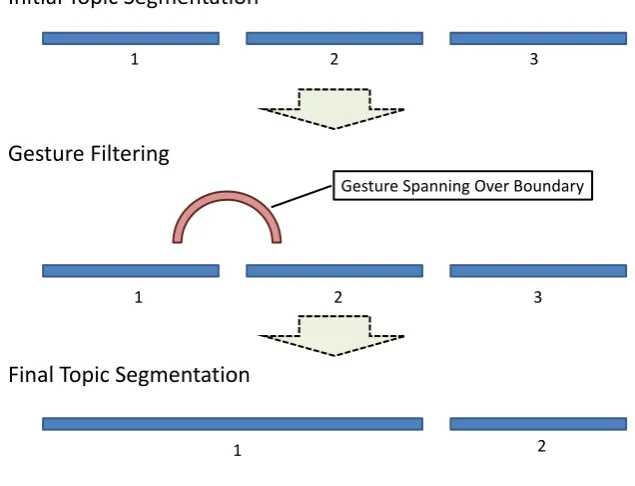
Figure 2: Schematic procedure of post-processing after dialogue segmentation.
such mapping, we identify the utterance that contains the word associated with a boundary candidate. Then, the end time of the utterance is used as the temporal information for the boundary candidate. The tempo-ral boundary candidates are sent to the gesture-based filter as defined in Table 3.
Experimentally, we compared four settings: 1) Text-Tiling only, 2) TextText-Tiling and gesture combined, 3) U00 only, and 4) U00 and gesture combined. The output of the TextTiling algorithm depends on the window size parameter. We examined window sizes that generate boundary candidates larger than the true boundary numbers.
In evaluating the correspondence between estimated boundaries and human-annotated boundaries, it should be noted that the time information might not match exactly because the boundaries have ranges. Therefore, we relaxed the matching condition: if the boundary candidate falls within the 10-second time range of a boundary (five seconds before and after the human-defined boundary), the boundary candidate is considered successful.
4.3.
Experimental Results
When the TextTiling algorithm was used, the effect of gesture-based post processing was mixed as shown in Table 5. For window sizes 11 and 13, the use of gesture post-processing decreased the F-score because of the drop in the recall scores. In the case of win-dow size 12, the F-score increased after post-processing and achieved the highest precision of 0.22 as shown in TT-4 in Table 5. When U00 algorithm was used,
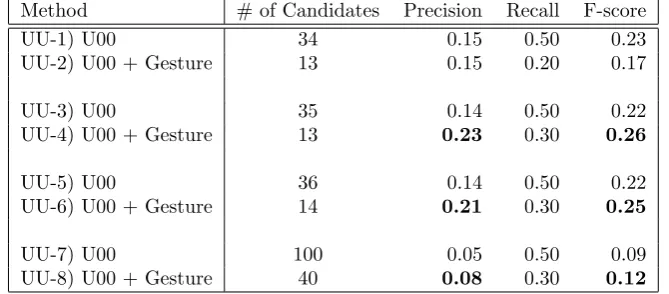
gesture-based post processing could improve the seg-mentation results as shown in Table 6. Although the U00 algorithm comes with model selection function-alities to determine the optimal number of segments, for the purpose of comparison, we specified the num-ber of segment candidates. After applying gesture fil-ters, we obtained better precision rates and lower recall rates except in the case when the number of candi-dates was 34. Despite the worsened recalls, the overall performance measured in terms of F-scores improved. It should be noted that the precision value could be higher if we expand the current 10-second matching range .
5.
Extension
Table 3: Relationship between topic boundary candidates and gesture occurrences. The notation follows Allen’s definition of temporal relationships and is extended to include ternary relationships(Allen, 1983). Utterances are represented by ’U’ characters, gestures are represented by ’G’ characters, and boundary candidates are represented by ’B’ characters that always come after ’U’s.
Relation Symbol Inverse Pictoral Example Action
U and B before G < > UUUB Do nothing
GGG
U equal G = = UUUB Do nothing
GGG
U meets G m mi UUUB Do nothing
GGG
U overlaps G o oi UUUB Do nothing
GGG
U and B during G d di UUUB Do nothing
GGGGGG
U starts G s si UUUB Do nothing
GGGGG
U finishes G f fi UUUB Do nothing
GGGGG
G bridges Us b - UUUBUUU Remove candidate
GGGG
G within B w - UUUBBB Remove candidate
GG
G enters B en - UUUBB Do nothing
GG
G exits B en - UUUBB Do nothing
GG
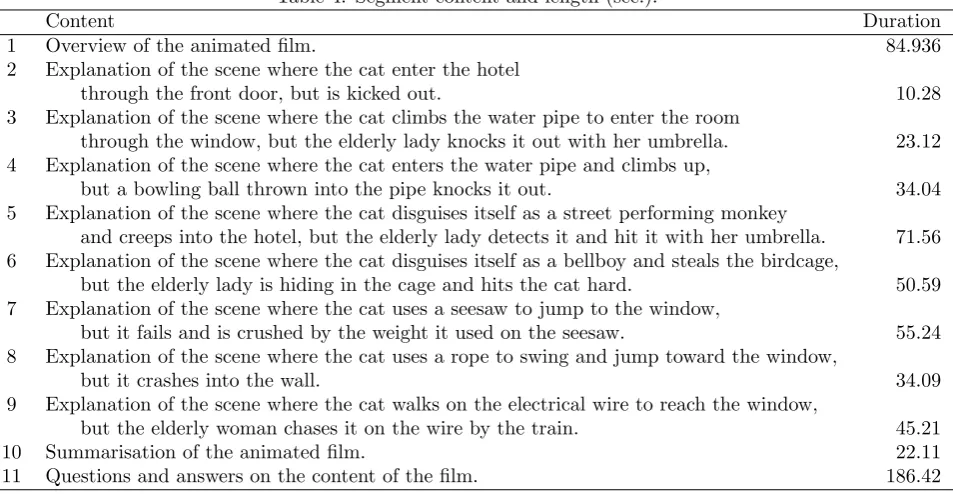
Table 4: Segment content and length (sec.).
Content Duration
1 Overview of the animated film. 84.936
2 Explanation of the scene where the cat enter the hotel
through the front door, but is kicked out. 10.28
3 Explanation of the scene where the cat climbs the water pipe to enter the room
through the window, but the elderly lady knocks it out with her umbrella. 23.12 4 Explanation of the scene where the cat enters the water pipe and climbs up,
but a bowling ball thrown into the pipe knocks it out. 34.04 5 Explanation of the scene where the cat disguises itself as a street performing monkey
and creeps into the hotel, but the elderly lady detects it and hit it with her umbrella. 71.56 6 Explanation of the scene where the cat disguises itself as a bellboy and steals the birdcage,
but the elderly lady is hiding in the cage and hits the cat hard. 50.59 7 Explanation of the scene where the cat uses a seesaw to jump to the window,
but it fails and is crushed by the weight it used on the seesaw. 55.24 8 Explanation of the scene where the cat uses a rope to swing and jump toward the window,
but it crashes into the wall. 34.09
9 Explanation of the scene where the cat walks on the electrical wire to reach the window,
but the elderly woman chases it on the wire by the train. 45.21
10 Summarisation of the animated film. 22.11
11 Questions and answers on the content of the film. 186.42
could not observe a change in word usage when work-ing on one puzzle piece, and then changwork-ing to another piece. Because our method is based on text segmen-tation, our method is not applicable when the target dialogues do not have clear topic shifts.
6.
Conclusion
Table 5: Results for post-processing where TextTiling was used as the base algorithm. Method Window Size # of Candidates Precision Recall F-score
TT-1) TextTiling 11 28 0.14 0.40 0.21
TT-2) TextTiling + Gesture 11 11 0.09 0.10 0.10
TT-3) TextTiling 12 23 0.09 0.20 0.12
TT-4) TextTiling + Gesture 12 9 0.22 0.20 0.21
TT-5) TextTiling 13 13 0.15 0.20 0.17
TT-6) TextTiling + Gesture 13 5 0.20 0.10 0.13
Table 6: Results for post-processing where U00 was used as the base algorithm. Method # of Candidates Precision Recall F-score
UU-1) U00 34 0.15 0.50 0.23
UU-2) U00 + Gesture 13 0.15 0.20 0.17
UU-3) U00 35 0.14 0.50 0.22
UU-4) U00 + Gesture 13 0.23 0.30 0.26
UU-5) U00 36 0.14 0.50 0.22
UU-6) U00 + Gesture 14 0.21 0.30 0.25
UU-7) U00 100 0.05 0.50 0.09
UU-8) U00 + Gesture 40 0.08 0.30 0.12
our method are that it is explicit, not in a black-box, and does not require the preparation of training data. Our initial experiment suggests that the method could improve the precision scores in segmentation given by the text-only methods moderately affecting the recall scores. Further, we found that the effect of post-processing depended on the base text segmentation al-gorithm.
A disadvantage of our approach may be the lower accu-racy in comparison with supervised approaches. The difference in performance should be examined in dia-logue domains for which training data are readily avail-able. In addition, other modalities such as gaze and head-nodding would be utilized in either the pre- or post-processing in our framework.
7.
Acknowledgements
This research was partially supported by the Grant-in-Aid for Scientific Research 24500321.
8.
References
Allen, J. F. (1983). Maintaining knowledge about temporal intervals. Commun. ACM, 26(11):832– 843, November.
Bunt, H., Kipp, M., and Petukhova, V. (2012). Us-ing DiAML and ANVIL for multimodal dialogue an-notations. InProceedings of the Eight International Conference on Language Resources and Evaluation (LREC’12), Istanbul, Turkey, May.
Chandlee, J. and Veilleux, N. (2010). Gestural cues of discourse segmentation. InSpeech Prosody, Chicago, IL, May.
Chen, L., Harper, M., and Huang, Z. (2006). Using maximum entropy (ME) model to incorporate ges-ture cues for SU detection. In International Con-ference on Multimodal Interaction, pages 185–192, Banff, Canada, June.
Hearst, M. A. (1997). TextTiling: segmenting text into multi-paragraph subtopic passages. Comput. Linguist., 23(1):33–64, March.
Hsueh, P.-Y. and Moore, J. D. (2007). Combining multiple knowledge sources for dialogue segmenta-tion in multimedia archives. InAssociation of Com-putational Linguistics, pages 1016–1023, Prague, Czech Republic, June.
Tokunaga, T., Iida, R., Terai, A., and Kuriyama, N. (2012). The REX corpora: A collection of multimodal corpora of referring expressions in col-laborative problem solving dialogues. In Proceed-ings of the Eight International Conference on Lan-guage Resources and Evaluation (LREC’12), Istan-bul, Turkey, May.
Utiyama, M. and Isahara, H. (2001). A statistical model for domain-independent text segmentation. In Proceedings of the 39th Annual Meeting on As-sociation for Computational Linguistics, pages 499– 506.
Xiong, Y. and Quek, F. (2006). Hand motion oscil-latory gestures and multimodal discourse analysis.