Supervised Within-Document Event Coreference using Information
Propagation
Zhengzhong Liu, Jun Araki, Eduard Hovy, Teruko Mitamura
Carnegie Mellon University5000 Forbes Avenue, Pittsburgh, PA
[email protected], [email protected], [email protected], [email protected]
Abstract
Event coreference is an important task for full text analysis. However, previous work uses a variety of approaches, sources and evaluation, making the literature confusing and the results incommensurate. We provide a description of the differences to facilitate future research. Second, we present a supervised method for event coreference resolution that uses a rich feature set and propagates information alternatively between events and their arguments, adapting appropriately for each type of argument.
Keywords:event coreference, information extraction, event coreference evaluation
1.
Introduction
Coreference resolution, the task of linking surface mentions to their underlying discourse entities, is an important task in natural language processing. Most of the early work fo-cused on coreference of entity mentions. Recently, event coreference has attracted attention on both theoretical and computational aspects. However, most event coreference work is preliminary and applied in quite different circum-stances, making comparisons difficult or impossible. In this paper, we first provide an overview of all the relevant literature to identify the ways each experiment differs from the others. Our claim here is that the comparisons to related work in prior papers are not really appropriate due to these differences. This makes future research difficult. We then present a supervised approach to event coreference, and describe a method for propagating information between events and their arguments that can improve results. In our method, different argument types support different methods of propagation. For these experiments, we annotate and use a corpus of 65 documents in the Intelligence Community (IC) domain that contains a rich set of within-document coreference links (Hovy et al., 2013).
2.
Related Work
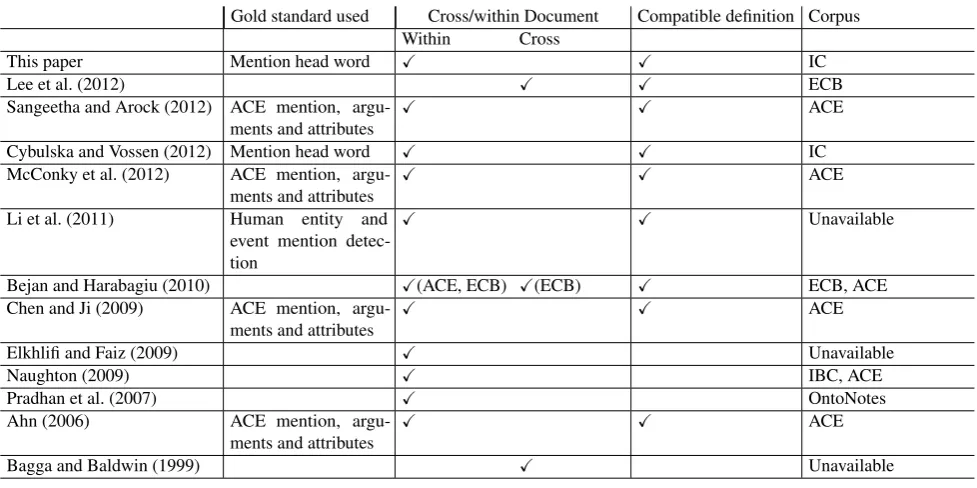
Table 1 summarizes recent work on event coreference reso-lution. For the reasons below, only one supervised system (Ahn, 2006) and two unsupervised (Bejan & Harabagiu, 2010; Cybulska & Vossen, 2012) on within-document event coreference are suitable as a basis for ongoing comparison.
2.1.
Problem definition:
Different approaches use different definitions of the problem (see Compatible Definition column). However, as discussed in recent linguistic studies (Recasens et al., 2011; Hovy et al., 2013), the existence of different types and degrees of coreference makes it necessary to agree on the definition of cofererence before performance can be compared. The lack of clarity about what coreference should encompass rules out several systems for comparison. OntoNotes created restricted event coreference (Pradhan et al., 2007), corefer-ring only some nominalized events and some verbs, and
not reporting event-specific results. Both Naughton (2009) and Elkhlifi and Faiz (2009) worked on sentence-level coref-erence, which is closer to the definition of Danlos (2003). However it is unclear when one sentence contains multi-ple event mentions, and hence these are not comparable to systems that process more specific coreference units.
2.2.
Dataset and settings:
Early work by Bagga and Baldwin (1999) conduct exper-iments only on cross-document coreference. Recent ad-vanced work on event coreference is by Bejan and Harabagiu (2010) and Lee et al. (2012) use the ECB corpus1(or a re-fined version2) to evaluate performance, which is annotated mainly for cross-document coreference. In this corpus, within-document coreference is only very partially anno-tated; most difficult coreference instances are not marked.
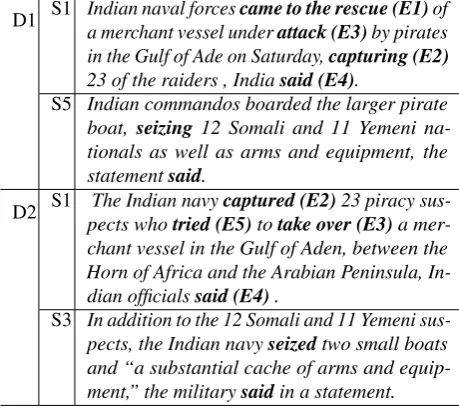
D1 S1 Indian naval forcescame to the rescue (E1)of
a merchant vessel underattack (E3)by pirates in the Gulf of Ade on Saturday,capturing (E2)
23 of the raiders , Indiasaid (E4).
S5 Indian commandos boarded the larger pirate boat, seizing 12 Somali and 11 Yemeni na-tionals as well as arms and equipment, the statementsaid.
D2 S1 The Indian navycaptured (E2)23 piracy
sus-pects whotried (E5)totake over (E3)a mer-chant vessel in the Gulf of Aden, between the Horn of Africa and the Arabian Peninsula, In-dian officialssaid (E4).
S3 In addition to the 12 Somali and 11 Yemeni sus-pects, the Indian navyseizedtwo small boats and “a substantial cache of arms and equip-ment,” the militarysaidin a statement.
The examples above are extracted from two documents from the ECB. Dxand Sxdenote document id and sentence id respectively. In both documents S1 is annotated once, but not in the rest of the article. In D1, we find in S5 the event mention “seizing” which should actually be coreferent with
1http://adi.bejan.ro/data/ECB1.0.tar.gz 2
Gold standard used Cross/within Document Compatible definition Corpus Within Cross
This paper Mention head word X X IC
Lee et al. (2012) X X ECB
Sangeetha and Arock (2012) ACE mention, argu-ments and attributes
X X ACE
Cybulska and Vossen (2012) Mention head word X X IC McConky et al. (2012) ACE mention,
argu-ments and attributes
X X ACE
Li et al. (2011) Human entity and event mention detec-tion
X X Unavailable
Bejan and Harabagiu (2010) X(ACE, ECB) X(ECB) X ECB, ACE Chen and Ji (2009) ACE mention,
argu-ments and attributes
X X ACE
Elkhlifi and Faiz (2009) X Unavailable
Naughton (2009) X IBC, ACE
Pradhan et al. (2007) X OntoNotes
Ahn (2006) ACE mention, argu-ments and attributes
X X ACE
Bagga and Baldwin (1999) X Unavailable
Table 1: Recent computational approaches to event coreference resolution.
“capturing (E2)” in D1;S1. In D2;S3, we find a more tricky case: the mention “seized”, which has semantics similar to “captured” but is not coreferent due to different patients. The cross-document case also doesn’t seem to compatible with our definition. In ECB, “attack (E3)” in D1;S1 is annotated as coreferent with “take over (E3)” in D2;S1, which we believe is wrong: at best, the attack is only a part of the attempt to take over the merchant vessel.
Goyal et al. (2013) use a distributional semantic approach on event coreference. However, they didn’t adopt a con-ventional evaluation setting. They draw from the IC corpus an equal number of positive and negative testing examples, which is different from the natural data distribution.
2.3.
Gold standard annotations used:
Recent work using the ACE 2005 corpus3(Chen & Ji, 2009; Chen et al., 2009; Sangeetha & Arock, 2012; McConky et al., 2012; Ahn, 2006) agrees with our definition of coreference. However, the ACE corpus annotations, in addition to event mentions, also include argument structures, entity ids, and time-stamps. Most coreference systems on the ACE corpus make use of this additional information. This makes them impossible to compare to systems that do not make this simplifying assumption. It also makes results achieved on ACE hard to compare to results on corpora without this additional information. Among these work, only Ahn (2006) reported some results using system generating arguments, we compare our system against it.
2.4.
Availability
Li et al. (2011) use a hand-annotated web corpus, which is not publicly available for comparison.
In summary, anyone wanting to work on within-document event coreference has to obtain a corpus that is fully anno-tated, that does not include additional facilitating
informa-3
http://www.itl.nist.gov/iad/mig/tests/ace/2005/doc/
Total Avg.
Event Mention 2678 41.2
Non-elliptical Domain Event Mention
1998 30.7
Reporting Event Mention 669 10.29
Full coreference relations 1253 21.6 Subevent relations (parent-child) 455 8 Membership relations (parent-child) 161 2.9
Table 2: Corpus Statistics
tion, whose definition of coreference respects the theoretical considerations of partial coreference, and that has other sys-tems freely available for comparison. Meeting these criteria is not easy. The closest work we find is by Cybulska and Vossen (2012) and Bejan and Harabagiu (2010), both adopt unsupervised methods for event coreference. Ahn (2006) also reported results on ACE by swapping gold standard annotations with system results.We compare our system to their results on their corresponding corpus.
3.
Corpus
Pairwise MUC B3 CEAF-e BLANC
IC corpus R P F R P F R P F R P F R P F
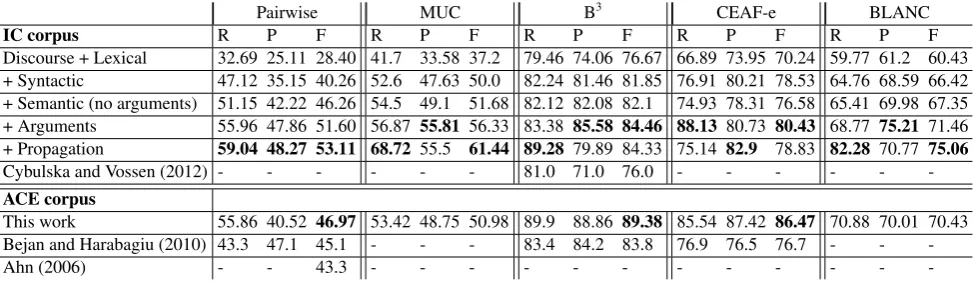
Discourse + Lexical 32.69 25.11 28.40 41.7 33.58 37.2 79.46 74.06 76.67 66.89 73.95 70.24 59.77 61.2 60.43 + Syntactic 47.12 35.15 40.26 52.6 47.63 50.0 82.24 81.46 81.85 76.91 80.21 78.53 64.76 68.59 66.42 + Semantic (no arguments) 51.15 42.22 46.26 54.5 49.1 51.68 82.12 82.08 82.1 74.93 78.31 76.58 65.41 69.98 67.35 + Arguments 55.96 47.86 51.60 56.87 55.81 56.33 83.38 85.58 84.46 88.13 80.73 80.43 68.77 75.21 71.46 + Propagation 59.04 48.27 53.11 68.72 55.5 61.44 89.28 79.89 84.33 75.14 82.9 78.83 82.28 70.77 75.06 Cybulska and Vossen (2012) - - - 81.0 71.0 76.0 - - - -ACE corpus
This work 55.86 40.52 46.97 53.42 48.75 50.98 89.9 88.86 89.38 85.54 87.42 86.47 70.88 70.01 70.43 Bejan and Harabagiu (2010) 43.3 47.1 45.1 - - - 83.4 84.2 83.8 76.9 76.5 76.7 - -
-Ahn (2006) - - 43.3 - - -
-Table 3: Evaluation results and comparisons
naive feature set. By looking at the pairwise performance, however, we see that current best F-score is only about 50%. There are still many challenges in event coreference.
6.
Discussion
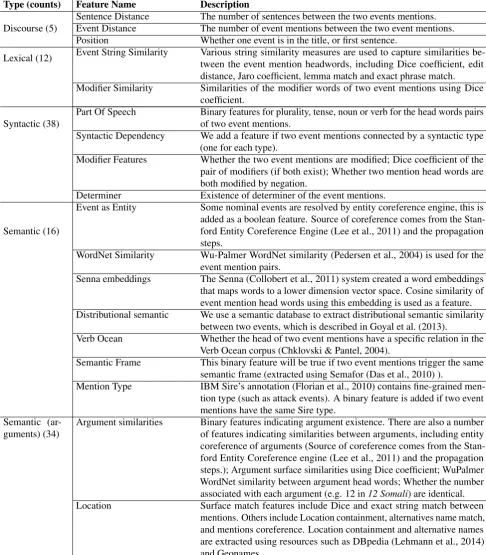
The evaluation results show that almost all types of fea-tures help to improve the performance over all metrics rather consistently. However, preliminary error analysis shows that some events are still clustered incorrectly even when arguments match. We argue that limitations in argument ex-traction and entity coreference prevent these features from contributing directly to correct coreference decisions. On the other hand, the results of propagation show that new in-formation helps to find more links but inevitably comes with a drop in precision. We consider that modeling event and ar-guments holistically like Lee et al. (2012) would help guide the propagation. By inspecting the data, we hypothesize that the main benefits brought by the propagation scheme is to match arguments of two coreferent events. If the ar-guments are nominal events, they will be then marked as coreferent due to the feature ”Event as Entity” (See Seman-tic features in table 4). In the following example, if the two event mentions ”planning” are marked as coreference, then the corresponding argument ”attack” will be also marked as coreference.
A member of the Islamic militant movement HAMAS suspected ofplanninga suicideattackagainst Israel sur-rendered to Palestinan police here after a six-hour shootout on Friday.
HAMAS’s military wing, was on the run from both Pales-tinian and Israeli police forplanninganti-Israeliattacks.
This hypothesis is also in line with our observation that prop-agation can only be performed for one round, because the nominal event themselves are unlikely to have other nom-inal events as arguments. Such interactions between event mentions also remind us that conference can be possibly improved by other types of event relations, such as subevent relations.
Furthermore, the system tends to merge clusters where the event mention head words are the same because the head word feature receives a high weight in the model, even when this is not appropriate. More work should be performed on disambiguating such difficult cases.
7.
Conclusion and Future Work
In this paper we first describe why most previous work on coreference is not directly comparable to one another, for a variety of reasons. In particular, reports of high coreference performance on one corpus do not really transfer over to other corpora or other definitions of coreference. Event coreference is not a solved problem.We then present a simple supervised pairwise event coref-erence system. We show that rich linguistic features, es-pecially event arguments, can improve event coreference performance. Argument specific information propagation further help finding new relations. In the future, we propose to implement propagation based on temporal and other types of event relations.
8.
Acknowledgments
This research was supported in part by DARPA grant FA8750-12-2-0342 funded under the DEFT program. Any opinions, findings and conclusion or recommendations ex-pressed in this material are those of the authors and do not necessarily reflect the view of DARPA or the US govern-ment. We gratefully acknowledge anonymous reviewers for their valuable comments.
References
Ahn, D. (2006). The stages of event extraction. ARTE ’06 Proceedings of the Workshop on Annotating and Reason-ing about Time and Events, 1–8.
Bagga, A., & Baldwin, B. (1998). Algorithms for scoring coreference chains.In The First International Conference on Language Resources and Evaluation Workshop on Linguistics Coreference, 563–566.
Bagga, A., & Baldwin, B. (1999). Cross - Document Event Coreference: Annotations, Experiments, and Ob-servations. ACL-99 Workshop on Coreference and Its Applications.
Bejan, C., & Harabagiu, S. (2010). Unsupervised event coreference resolution with rich linguistic features. Pro-ceedings of the 48th Annual Meeting of the Association for the Association for Computational Linguistics(July), 1412–1422.
Breiman, L. (2001). Random forests. Machine Learning,
45(1), 5-32.
Type (counts) Feature Name Description
Discourse (5)
Sentence Distance The number of sentences between the two events mentions. Event Distance The number of event mentions between the two event mentions. Position Whether one event is in the title, or first sentence.
Lexical (12) Event String Similarity Various string similarity measures are used to capture similarities be-tween the event mention headwords, including Dice coefficient, edit distance, Jaro coefficient, lemma match and exact phrase match. Modifier Similarity Similarities of the modifier words of two event mentions using Dice
coefficient.
Syntactic (38)
Part Of Speech Binary features for plurality, tense, noun or verb for the head words pairs of two event mentions.
Syntactic Dependency We add a feature if two event mentions connected by a syntactic type (one for each type).
Modifier Features Whether the two event mentions are modified; Dice coefficient of the pair of modifiers (if both exist); Whether two mention head words are both modified by negation.
Determiner Existence of determiner of the event mentions.
Semantic (16)
Event as Entity Some nominal events are resolved by entity coreference engine, this is added as a boolean feature. Source of coreference comes from the Stan-ford Entity Coreference Engine (Lee et al., 2011) and the propagation steps.
WordNet Similarity Wu-Palmer WordNet similarity (Pedersen et al., 2004) is used for the event mention pairs.
Senna embeddings The Senna (Collobert et al., 2011) system created a word embeddings that maps words to a lower dimension vector space. Cosine similarity of event mention head words using this embedding is used as a feature. Distributional semantic We use a semantic database to extract distributional semantic similarity
between two events, which is described in Goyal et al. (2013).
Verb Ocean Whether the head of two event mentions have a specific relation in the Verb Ocean corpus (Chklovski & Pantel, 2004).
Semantic Frame This binary feature will be true if two event mentions trigger the same semantic frame (extracted using Semafor (Das et al., 2010) ).
Mention Type IBM Sire’s annotation (Florian et al., 2010) contains fine-grained men-tion type (such as attack events). A binary feature is added if two event mentions have the same Sire type.
Semantic (ar-guments) (34)
Argument similarities Binary features indicating argument existence. There are also a number of features indicating similarities between arguments, including entity coreference of arguments (Source of coreference comes from the Stan-ford Entity Coreference engine (Lee et al., 2011) and the propagation steps.); Argument surface similarities using Dice coefficient; WuPalmer WordNet similarity between argument head words; Whether the number associated with each argument (e.g. 12 in12 Somali) are identical. Location Surface match features include Dice and exact string match between
mentions. Others include Location containment, alternatives name match, and mentions coreference. Location containment and alternative names are extracted using resources such as DBpedia (Lehmann et al., 2014) and Geonames.
Table 4: List of features (with counts) in the pairwise model.
Graph-based Methods for Natural Language Process-ing(August), 54–57.
Chen, Z., Ji, H., & Haralick, R. (2009). A pairwise event coreference model, feature impact and evaluation for event coreference resolution. Proceedings of the Work-shop on Events in Emerging Text Types(3), 17–22. Chinchor, N., & Sundheim, B. (1993). Muc-5 evaluation
metrics.Proceedings of the 5th conference on Message understanding, 69–78.
Chklovski, T., & Pantel, P. (2004). VERB OCEAN : Mining the Web for Fine-Grained Semantic Verb Relations. Pro-ceedings of Conference on Empirical Methods in Natural Language Processing (EMNLP-04), 33–40.
Collobert, R., Weston, J., Bottou, L., Karlen, M., Kavukcuoglu, K., & Kuksa, P. (2011, November). Natu-ral language processing (almost) from scratch. J. Mach. Learn. Res.,999888, 2493–2537.
Rela-tions to Solve Event Coreference in Text. SemRel2012 in conjunction with LREC2012, 60–67.
Danlos, L. (2003). Event coreference between two sentences.
Computing Meaning,77, 271–288.
Das, D., Schneider, N., Chen, D., & Smith, N. (2010). Proba-bilistic frame-semantic parsing.Proceedings of the North American Chapter of the Association for Computational Linguistics Human Language Technologies Conference (NAACL 2010),3.
Elkhlifi, A., & Faiz, R. (2009). Automatic annotation approach of events in news articles.International Journal of Computing & Information Sciences,7(1), 40–50. Finkel, J., Grenager, T., & Manning, C. (2005).
Incorpo-rating non-local information into information extraction systems by gibbs sampling. Proceedings of the 43nd Annual Meeting of the Association for Computational Linguistics.
Fleiss, J. L. (1971). Measuring nominal scale agreement among many raters. Psychological Bulletin,76(5), 378– 382.
Florian, R., Pitrelli, J. F., Roukos, S., & Zitouni, I. (2010). Improving mention detection robustness to noisy input.
Proceedings of the 2010 Conference on Empirical Meth-ods in Natural Language Processing, 335–345.
Goyal, K., Jauhar, S. K., Sachan, M., Srivastava, S., Li, H., & Hovy, E. (2013). A Structured Distributional Semantic Model for Event Co-reference. Proceedings of The 51st Annual Meeting of the Association for Computational Linguistics.
Hall, M., Frank, E., Holmes, G., Pfahringer, B., Reutemann, P., & Witten, I. H. (2009). The weka data mining software: an update. SIGKDD Explor. Newsl.,11(1), 10–18. Hovy, E., Mitamura, T., Verdejo, F., Araki, J., & Philpot, A.
(2013). Events are Not Simple: Identity, Non-Identity, and Quasi-Identity. The 1st Workshop on EVENTS: Definitin, Detection, Coreference and Representation, NAACL-HLT 2013 Workshop, 21–28.
Lee, H., Peirsman, Y., Chang, A., Chambers, N., Surdeanu, M., & Jurafsky, D. (2011). Stanford’s multi-pass sieve coreference resolution system at the conll-2011 shared task. Proceedings of the Fifteenth Conference on Com-putational Natural Language Learning: Shared Task, 28– 34.
Lee, H., Recasens, M., Chang, A., Surdeanu, M., & Jurafsky, D. (2012). Joint Entity and Event Coreference Resolution across Documents.Proceedings of the 2012 Conference on Empirical Methods in Natural Language Processing and Natural Language Learning.
Lehmann, J., Isele, R., Jakob, M., Jentzsch, A., Kontokostas, D., Mendes, P. N., . . . Bizer, C. (2014). DBpedia - a large-scale, multilingual knowledge base extracted from wikipedia.Semantic Web Journal.
Li, P., Zhu, Q., & Zhu, X. (2011). A Clustering and Rank-ing Based Approach for Multi-document Event Fusion.
12th ACIS International Conference on Software Engi-neering, Artificial Intelligence, Networking and Paral-lel/Distributed Computing, 159–165.
Luo, X. (2005). On coreference resolution performance met-rics. Proceedings of the conference on Human Language Technology and Empirical Methods in Natural Language
Processing, 25–32.
McConky, K., Nagi, R., Sudit, M., & Hughes, W. (2012, March). Improving event co-reference by context ex-traction and dynamic feature weighting. 2012 IEEE In-ternational Multi-Disciplinary Conference on Cognitive Methods in Situation Awareness and Decision Support, 38–43.
Mendes, P., Jakob, M., Garcia-silva, A., & Bizer, C. (2011). DBpedia spotlight: shedding light on the web of docu-ments. Proceedings of the 7th Conference on Semantic Systems, 1–8.
Naughton, M. (2009). Sentence Level Event Detection and Coreference Resolution. Unpublished doctoral disserta-tion, National University of Ireland, Dublin.
Ng, V., & Cardie, C. (2002). Improving machine learn-ing approaches to coreference resolution.Proceedings of the 40th Annual Meeting of the Association for Computa-tional Linguistics (ACL)(July), 104–111.
Pedersen, T., Patwardhan, S., & Michelizzi, J. (2004). Word-net::similarity: measuring the relatedness of concepts.
Demonstration Papers at HLT-NAACL 2004, 38–41. Pradhan, S., Moschitti, A., Xue, N., Uryupina, O., & Zhang,
Y. (2012). CoNLL-2012 shared task: Modeling multilin-gual unrestricted coreference in OntoNotes.Proceedings of the Sixteenth Conference on Computational Natural Language Learning (CoNLL 2012).
Pradhan, S., Ramshaw, L., Weischedel, R., MacBride, J., & Micciulla, L. (2007, September). Unrestricted Coref-erence: Identifying Entities and Events in OntoNotes.
Proceedings of the International Conference on Semantic Computing (ICSC 2007), 446–453.
Recasens, M., & Hovy, E. (2011). Blanc: Implementing the rand index for coreference evaluation. Natural Language Engineering,17, 485–510.
Recasens, M., Hovy, E., & Mart´ı, M. A. (2011). Identity, non-identity, and near-identity: Addressing the complex-ity of coreference. Lingua,121(6), 1138–1152.
Sangeetha, S., & Arock, M. (2012). Event Coreference Resolution using Mincut based Graph Clustering. Inter-national Journal of Computing & Information Sciences, 253–260.