Computational Linguistics and Chinese Language Processing
Vol. 18, No. 2, June 2013, pp. 1-18 1 © The Association for Computational Linguistics and Chinese Language Processing
Assessing Chinese Readability using Term Frequency
and Lexical Chain
Yu-Ta Chen
∗, Yaw-Huei Chen
∗, and Yu-Chih Cheng
∗Abstract
This paper investigates the appropriateness of using lexical cohesion analysis to assess Chinese readability. In addition to term frequency features, we derive features from the result of lexical chaining to capture the lexical cohesive information, where E-HowNet lexical database is used to compute semantic similarity between nouns with high word frequency. Classification models for assessing readability of Chinese text are learned from the features using support vector machines. We select articles from textbooks of elementary schools to train and test the classification models. The experiments compare the prediction results of different sets of features.
Keywords: Readability, Chinese Text, Lexical Chain, TF-IDF, SVM.
1.
Introduction
Readability of an article indicates its level in terms of reading comprehension of children in general. Readability assessment is a process that measures the reading level of a piece of text, which can help in finding reading materials suitable for children. Automatic readability assessment can significantly facilitate this process. There are other applications of automatic readability assessment such as the support of building a web search engine that can distinguish the reading levels of web pages (Eickhoff, Serdyukov, & de Vries, 2010; Miltsakaki & Troutt, 2008) and the incorporation into a text simplification system (Aluisio, Specia, Gasperin, & Scarton, 2010). Traditional measures of text readability focus on vocabulary and syntactic aspects of text difficulty, but recent work tries to discover the connections between text readability and the semantic or discourse structure of texts (Feng, Elhadad, & Huenerfauth, 2009; Pitler & Nenkova, 2008).
Most of the existing work on automatic readability assessment is conducted for English
∗
Department of Computer Science and Information Engineering, National Chiayi University, Chiayi, Taiwan, R.O.C.
2 Yu-Ta Chen et al.
text. In contrast, research on readability assessment for Chinese text is still in its initial stage. This paper investigates the appropriateness of using lexical cohesion analysis to improve the performance of Chinese readability assessment. More specifically, we build lexical chains, which are sequences of semantically related terms, in an article to represent the lexical cohesive structure of texts, and then derive features from the result of lexical chaining to capture the lexical cohesive information. Consisting of term frequency features and lexical chain features, various combinations of features are evaluated for generating prediction models on Chinese readability using support vector machines (SVMs). The prediction models are trained and tested on articles selected from textbooks of elementary schools in Taiwan. The results are compared for different sets of features.
This paper is organized as follows. Section 2 introduces related work in readability assessment and lexical cohesion analysis. Section 3 discusses the research methodology of our analysis, including problem definition, text processing, feature deriving, and prediction model building. Section 4 presents the experiments and the experimental results. Section 5 gives conclusions and directions for future work.
2.
Related Work
This section briefly surveys existing work in the areas of readability assessment and lexical cohesion analysis.
2.1
Readability Assessment
Traditional readability formulae for English are based on shallow features such as average sentence length and average number of syllables per word to approximate syntactic and vocabulary difficulty in text (Kincaid, Fishburne Jr., Rogers, & Chissom, 1975; McLaughlin, 1969). However, this kind of measure makes strong assumptions about text difficulty and may not be always reliable.
Assessing Chinese Readability using Term Frequency and Lexical Chain 3
Some researchers suggest that text readability can be measured by factors in semantic aspect in addition to vocabulary and syntactic ones. Aluisio et al. (2010) consider the ambiguity ratio of terms for each part-of-speech (POS) as a feature for assessing text readability in Portuguese. Feng, Jansche, Huenerfauth, & Elhadad (2010) use some features inspired by cognitive linguistics to measure text readability, such as the number of named entities and the distribution of lexical chains in an article.
Some Chinese-specific factors, such as radical familiarity, number of strokes, geometry or shape of characters, are also considered (Lau, 2006). However, it is unclear whether these character-level features can truly benefit the readability assessment on Chinese text. Recently, machine learning based approaches also have been proposed for accessing Chinese readability (Chen, Tsai, & Chen, 2011; Sung, Chang, Chen, Cha, Huang, Hu, & Hsu, 2011).
2.2
Lexical Cohesion Analysis
Two properties of texts are widely used to indicate the quality of a text, coherence and cohesion. According to Morris and Hirst (1991), coherence refers to the fact that there is sense in a text, while cohesion refers to the fact that elements in a text tend to hang together. The former is an implicit quality within the text, whereas the latter is an explicit quality that can be observed through the text itself. Observing the interaction between textual units in terms of these properties is a way of analyzing the discourse structure of texts (Stokes, 2004). Discourse structure of a text is sometimes subjective and may require knowledge from the real world in order to truly understand the text coherence. However, according to Hasan (1984), analyzing the degree of interaction between cohesive chains in a text can help the reader indirectly measure the coherence of a text. Such cohesion analysis is more objective and less computationally expensive.
4 Yu-Ta Chen et al.
Lexical chaining is a technique that is widely used as a method to represent lexical cohesive structure of a text (Stokes, 2004). A lexical chain is a sequence of semantically related words in a passage, where the semantic relatedness between words is determined by the above-mentioned lexical cohesive ties usually with the help of a lexicographic resource such as a thesaurus. Lexical chains have been used to support a wide range of natural language processing tasks including word sense disambiguation, text segmentation, text summarization, topic detection, and malapropism detection.
Different lexicographic resources capture different subset of the lexical cohesive ties in text. Morris and Hirst (1991) use Roget’s thesaurus to find cohesive ties between words in order to build lexical chains. WordNet (Fellbaum, 1998) is an online lexical database and has predominant use in information retrieval and natural language processing tasks, including lexical chaining. The major relationship between words in WordNet is synonymy, and other types of relationships such as hypernymy and hyponymy are defined among synsets, sets of synonymous words, forming a semantic network of concepts.
Assessing Chinese Readability using Term Frequency and Lexical Chain 5
Figure 1. Top level definition of a word sense in E-HowNet.
Figure 2. Bottom level expansion of the definition of a word sense in E-HowNet.
It has been suggested that coherent texts are easier to read (Feng et al., 2010), and some previous studies have used lexical-chain-based features to assist in readability assessment of English text (Feng et al., 2009; Feng et al., 2010). Some other ways of modeling text coherence are also used for readability assessment, such as the entity-grid representation of discourse structure and coreference chains (Barzilay & Lapata, 2008; Feng et al., 2009; Pitler & Nenkova, 2008). However, none of these discourse-based factors are tested on Chinese text for estimating readability. In this paper, we evaluate a combination of term frequency features and lexical chain features for generating classification models on Chinese readability.
3.
Assessing Readability using SVM
This section presents the methodology adopted for assessing readability of Chinese text using SVM. We first explain the problem of readability assessment, basic concepts of SVM classification, and the system design. Then we describe how we conduct the text processing
教授 N {human|人:
domain={education|教育}, predication={teach|教: agent={~} },
location={InstitutePlace|場所:
domain={education|教育}, telic={or({study|學習: location={~} },
{teach|教:
location={~} }
) },
qualification={HighRank|高等} }
} 教授 N {老師:
6 Yu-Ta Chen et al.
step, followed by the features we use for representing each article in the corpus. Finally, we discuss the performance measures used in the experiments.
3.1
Problem Definition
Various types of prediction models have been tested on the task of readability assessment in previous research (Aluisio et al., 2010; Heilman, Collins-Thompson, & Eskenazi, 2008), including classification and regression models. Since several studies obtain better results when using SVM classification than regression models (Feng et al., 2010; Petersen & Ostendorf, 2009; Schwarm & Ostendorf, 2005), in this paper we treat the problem of Chinese readability assessment as a classification task where SVM is used to build classifiers that predict the reading levels of given texts.
Readability can be classified according to grade levels, but the difference between adjacent grades may be insignificant, which makes the classification result less accurate. More importantly, grade-level readability is too fine for many applications and a broader range of readability level is more practical. For example, the U.S. government surveyed over 26,000 individuals aged 16 and older and reported data with only five levels of literacy skills (National Center for Education Statistics, 2002). Therefore, we divide reading skills of elementary school students into three levels: lower grade, middle grade, and higher grade, where lower grade corresponds to the first and second grade levels, middle grade corresponds to the third and fourth grade levels, and higher grade corresponds to the fifth and sixth grade levels.
In this paper, we try to evaluate different combinations of features for predicting the reading level of a text written in traditional Chinese as suitable for lower grade or middle grade. We will build one prediction model for lower grade level and another prediction model for middle grade level. These binary SVM classifiers can be combined to solve the multiclass problem of predicting the reading level of an article (Duan & Keerthi, 2005; Hsu & Lin, 2002).
Assessing Chinese Readability using Term Frequency and Lexical Chain 7
3.2
Text Processing
After the data set is collected, each article is undergone a word segmentation process as a pre-processing step before deriving features from the texts. Word segmentation is done using a word segmentation system provided by Academia Sinica (CKIP Group; n.d.). The segmentation result is stored in XML format, where POS-tags are attached to all words and sentence boundaries are marked.
It is reported by Yang and Petersen (1997) that chi-square test (χ2
) performs better than other feature selection methods such as mutual information and information gain in automatic text classification. Therefore, we use chi-square test to evaluate the importance of terms in the corpus with respect to their discriminative power among reading levels. The chi-square test is used to test the independence of two events, which, in feature selection, are the occurrence of the term and the occurrence of the class. Higher chi-square test value indicates higher discriminative power of the term to the classes. For each prediction model, we compute chi-square test value for each term in the corpus. Such information will benefit our feature derivation process described below. We do not perform stop word removal and stemming because Collins-Thompson and Callan (2005) report that these processes may harm the performance of classifier on lower grade levels.
3.3
Feature Deriving
The use of term frequencies as the primary information for assessing Chinese readability has been investigated (Chen, Tsai, & Chen, 2011), where TF-IDF values of the terms with high discriminative power are used as features for SVM classification. This paper investigates the appropriateness of using lexical cohesion analysis to improve the performance of Chinese readability assessment. Therefore, we build lexical chains for both the training and testing documents and deriving features from the lexical chains to capture the lexical cohesive aspect of the texts.
Assessing Chinese Readability using Term Frequency and Lexical Chain 11
4.1
Experiment Environment
The program modules for the experiments are written in Java programming language running on a PC with Microsoft Windows environment, Intel Core 2 Quad CPU, and 2GB of RAM. The corpus used as empirical data is stored in a Microsoft Access database. The lexicographic resources used for lexical semantic similarity computation in the experiments are stored as pure-text files in CSV format. LIBSVM is used for learning and testing SVM prediction models.
4.2
Empirical Data
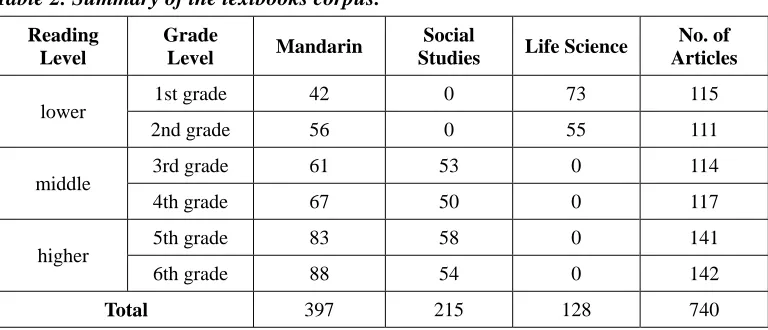
The corpus used as empirical data consists of articles selected from the textbooks of elementary schools in Taiwan. We collect the digital versions of the textbooks of three subjects, Mandarin, Social Studies, and Life Science, for all of the six grade levels from publishers Nan I and Han Lin, resulting in a total number of 740 articles. Table 2 shows details of the collected data set.
Table 2. Summary of the textbooks corpus.
Reading Level
Grade
Level Mandarin
Social
Studies Life Science
No. of Articles
lower 1st grade 42 0 73 115
2nd grade 56 0 55 111
middle 3rd grade 61 53 0 114
4th grade 67 50 0 117
higher 5th grade 83 58 0 141
6th grade 88 54 0 142
Total 397 215 128 740
4.3
Experiment Design
In each experiment, we use one set of features with a fixed parameter setting and target a certain grade level. We equally divide the corpus into five data sets to support 5-fold cross validation, and we present the average precision, recall, F-measure, and accuracy of the five folds.
12 Yu-Ta Chen et al.
dash followed by the code name for that option, attached to the end of the feature type indicator.
4.4
Experiments on Lexical Chain Features
To test the capability of lexical chain features on Chinese readability assessment, the lexical chain features listed in Table 1 are used and the results are shown in Table 3 and Table 4.
Table 3. Result of classifier for lower grade using lexical chain only.
Feature set Precision Recall F-measure Accuracy
lc-1-2-3-4-5 0.76 0.57 0.65 0.81
Table 4. Result of classifier for middle grade using lexical chain only.
Feature set Precision Recall F-measure Accuracy
lc-1-2-3-4-5 0.70 0.83 0.76 0.68
4.5
Comparison with TF-IDF Features
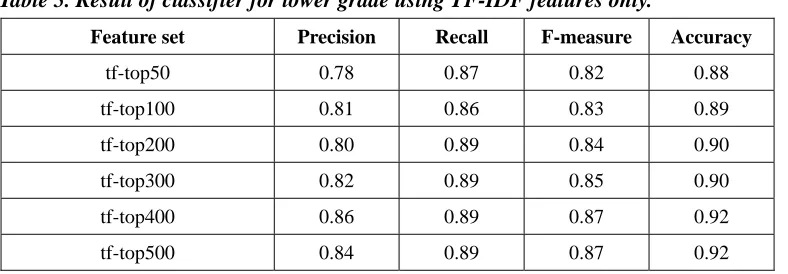
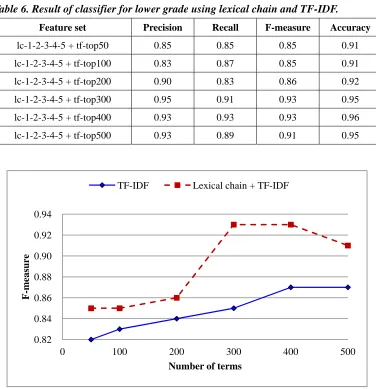
It is interesting to see whether incorporating a small number of TF-IDF features into lexical chain features can produce the same or even better results. We first use TF-IDF features generated from top 50 to top 500 terms to produce classifiers for lower grade. The precision, recall, F-measure, and accuracy of the classifiers using different number of TF-IDF features are shown in Table 5. Then, we add the five lexical chain features to the TF-IDF feature sets and repeat the same experiments. Their precision, recall, F-measure, and accuracy values are shown in Table 6. Figure 5 illustrates line graphs generated from F-measure values of the two tables, from which we find that the overall performance is improved for lower grade classifiers when using a combination of TF-IDF features and lexical chain features.
Table 5. Result of classifier for lower grade using TF-IDF features only.
Feature set Precision Recall F-measure Accuracy
tf-top50 0.78 0.87 0.82 0.88
tf-top100 0.81 0.86 0.83 0.89
tf-top200 0.80 0.89 0.84 0.90
tf-top300 0.82 0.89 0.85 0.90
tf-top400 0.86 0.89 0.87 0.92
Assessing Chinese Readability using Term Frequency and Lexical Chain 13
Table 6. Result of classifier for lower grade using lexical chain and TF-IDF.
Feature set Precision Recall F-measure Accuracy
lc-1-2-3-4-5 + tf-top50 0.85 0.85 0.85 0.91
lc-1-2-3-4-5 + tf-top100 0.83 0.87 0.85 0.91
lc-1-2-3-4-5 + tf-top200 0.90 0.83 0.86 0.92
lc-1-2-3-4-5 + tf-top300 0.95 0.91 0.93 0.95
lc-1-2-3-4-5 + tf-top400 0.93 0.93 0.93 0.96
lc-1-2-3-4-5 + tf-top500 0.93 0.89 0.91 0.95
Figure 5. Result of classifier for lower grade.
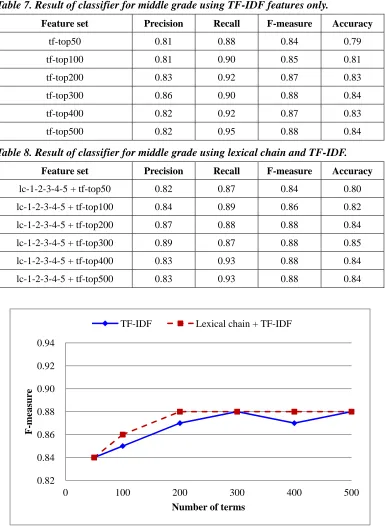
The same set of experiments is conducted for the middle grade classifiers. Precision, recall, F-measure, and accuracy values of classifiers generated from TF-IDF features and the combination of TF-IDF and lexical chain features are shown in Table 7 and Table 8, respectively. The line graphs of F-measure values are shown in Figure 6, where the combined TF-IDF and lexical chain features generate the same or better F-measure in all cases. Therefore, incorporating a small number of TF-IDF features into lexical chain features is recommended for middle grade classifiers.
0.82 0.84 0.86 0.88 0.90 0.92 0.94
0 100 200 300 400 500
F-measure
Number of terms
14 Yu-Ta Chen et al.
Table 7. Result of classifier for middle grade using TF-IDF features only.
Feature set Precision Recall F-measure Accuracy
tf-top50 0.81 0.88 0.84 0.79
tf-top100 0.81 0.90 0.85 0.81
tf-top200 0.83 0.92 0.87 0.83
tf-top300 0.86 0.90 0.88 0.84
tf-top400 0.82 0.92 0.87 0.83
tf-top500 0.82 0.95 0.88 0.84
Table 8. Result of classifier for middle grade using lexical chain and TF-IDF.
Feature set Precision Recall F-measure Accuracy
lc-1-2-3-4-5 + tf-top50 0.82 0.87 0.84 0.80
lc-1-2-3-4-5 + tf-top100 0.84 0.89 0.86 0.82
lc-1-2-3-4-5 + tf-top200 0.87 0.88 0.88 0.84
lc-1-2-3-4-5 + tf-top300 0.89 0.87 0.88 0.85
lc-1-2-3-4-5 + tf-top400 0.83 0.93 0.88 0.84
lc-1-2-3-4-5 + tf-top500 0.83 0.93 0.88 0.84
Figure 6. Result of classifier for middle grade.
0.82 0.84 0.86 0.88 0.90 0.92 0.94
0 100 200 300 400 500
F-measure
Number of terms
Assessing Chinese Readability using Term Frequency and Lexical Chain 15
5.
Conclusions
This paper focuses on evaluating the effect of lexical cohesion analysis, more specifically, the effect of features based on lexical chains and term frequency, on the performance of readability assessment for Chinese text. The experiments produce satisfactory results on the textbooks corpus. Combining lexical chain and TF-IDF features usually produces better results, suggesting that both term frequency and lexical chain are useful features in Chinese readability assessment.
Future work can be done to have more articles annotated with reading levels or resort to other types of corpora where reading levels are inherent. On the other hand, lexical cohesion is only one of several aspects of text cohesion, and other aspects of text cohesion may also have some impact on the task of readability assessment. Several existing models of text cohesion, such as Coh-metrix and entity grid representation, try to model other aspect of text cohesion and have been extensively used in other natural language processing tasks such as writing quality assessment. Future work can be done to verify whether these models can benefit the task of readability assessment for Chinese text.
Acknowledgments
This research was supported in part by the National Science Council of Taiwan under Grant NSC99-2511-S-415-007-MY2.
Reference
Aluisio, S., Specia, L., Gasperin, C., & Scarton, C. (2010). Readability assessment for text simplification. In NAACL-HLT 2010: The 5th Workshop on Innovative Use of NLP for Building Educational Applications.
Barzilay, R., & Lapata, M. (2008). Modeling local coherence: An entity-based approach. Computational Linguistics, 34(1), 1-34.
Chall, J. S., & Dale, E. (1995). Readability revisited: The new Dale-Chall readability formula. Cambridge, MA: Brookline Books.
Chang, C.-C., & Lin, C.-J. (n.d.). LIBSVM: A library for support vector machines. Software available at http://www.csie.ntu.edu.tw/~cjlin/libsvm
Chen, Y.-H., Tsai, Y.-H., & Chen, Y.-T. (2011). Chinese readability assessment using tf-idf and svm. In International Conference on Machine Learning and Cybernetics (ICMLC2011), Guilin, China.
CKIP Group. (n.d.). A Chinese word segmentation system, http://ckipsvr.iis.sinica.edu.tw/ CKIP Group. (2009). Lexical semantic representation and semantic composition - An
16 Yu-Ta Chen et al.
CKIP Group. (2010). Academia Sinica Balanced Corpus (Version 3.1). Institute of Information Science, Academia Sinica.
Collins-Thompson, K., & Callan, J. (2005). Predicting reading difficulty with statistical language models. Journal of the American Society for Information Science and Technology (JASIST), 56(13), 1448-1462.
Dai, L., Liu, B., Xia, Y., & Wu, S. (2008). Measuring semantic similarity between words using HowNet. In International Conference on Computer Science and Information Technology 2008, 601-605.
Dong, Z. (n.d.). HowNet knowledge database. http://www.keenage.com/
Duan, K.-B., & Keerthi, S. S. (2005). Which is the best multiclass SVM method? An empirical study. In Proceedings of the Sixth International Workshop on Multiple Classifier Systems.
Eickhoff, C., Serdyukov, P., & de Vries, A. P. (2010). Web page classification on child suitability. In Proceedings of the 19th ACM International Conference on Information and Knowledge Management.
Fellbaum, C. (Ed.). (1998). WordNet: An electronic lexical database and some of its applications. Cambridge, MA: MIT Press.
Feng, L., Elhadad, N., & Huenerfauth, M. (2009). Cognitively motivated features for readability assessment. In Proceedings of the 12th Conference of the European Chapter of the ACL, 229-237.
Feng, L., Jansche, M., Huenerfauth, M., & Elhadad, N. (2010). A comparison of features for automatic readability assessment. In The 23rd International Conference on Computational Linguistics (COLING 2010): Poster Volume, 276-284.
Halliday, M. A. K., & Hasan, R. (1976). Cohesion in English. Longman.
Hasan, R. (1984). Coherence and cohesive harmony. In J. Flood (Ed.), Understanding reading comprehension: Cognition, language and the structure of prose (pp. 184-219), Newark, DE: International Reading Association.
Heilman, M., Collins-Thompson, K., and Eskenazi, M. (2008). An analysis of statistical models and features for reading difficulty prediction. In Proceedings of the 3rd ACL Workshop on Innovative Use of NLP for Building Educational Applications, 71-79. Hsu, C.-W., Chang, C.-C., & Lin, C.-J. (2010). A practical guide to support vector
classification. http://www.csie.ntu.edu.tw/~cjlin/papers/guide/guide.pdf
Hsu, C.-W. & Lin, C.-J. (2002). A comparison of methods for multiclass support vector machines. IEEE Transactions on Neural Networks, 13(2), 415-425.
Kincaid, J. P., Fishburne R. P., Jr., Rogers, R. L., & Chissom, B. S. (1975). Derivation of new readability formulas (Automated readability index, Fog count and Flesch reading ease formula) for Navy enlisted personnel. Research Branch Report 8-75. Chief of Naval Technical Training: Naval Air Station Memphis.
Assessing Chinese Readability using Term Frequency and Lexical Chain 17
Lin, S.-Y., Su, C.-C., Lai, Y.-D., Yang, L.-C., & Hsieh, S.-K. (2009). Assessing text readability using hierarchical lexical relations retrieved from WordNet. Computational Linguistics and Chinese Language Processing, 14(1), 45-84.
McLaughlin, G. H. (1969). SMOG grading - A new readability formula. Journal of Reading, 12(8), 639-646.
Miltsakaki, E., & Troutt, A. (2008). Real time Web text classification and analysis of reading difficulty. In Proceedings of the 3rd Workshop on Innovative Use of NLP for Building Educational Applications.
Morris, J., & Hirst, G. (1991). Lexical cohesion computed by thesaural relations as an indicator of the structure of text. Computational Linguistics, 17(1), 21-48.
National Center for Education Statistics. (2002). Adult literacy in America (3rd ed.). Washington, D. C.: U.S. Dept. of Education.
Petersen, S. E., & Ostendorf, M. (2009). A machine learning approach to reading level assessment. Computer Speech and Language, 23, 89-106.
Pitler, E., & Nenkova, A. (2008). Revisiting readability: A unified framework for predicting text quality. In Proceedings of the Conference on Empirical Methods in Natural Language Processing, 186-195.
Schwarm, S. E., & Ostendorf, M. (2005). Reading level assessment using support vector machines and statistical language models. In Proceedings of the 43rd Annual Meeting of the ACL, 523-530.
Stenner, A. J. (1996). Measuring reading comprehension with the Lexile framework. In Fourth North American Conference on Adolescent/Adult Literacy.
Stokes, N. (2004). Applications of lexical cohesion analysis in the topic detection and tracking domain. (Ph.D. Thesis), Department of Computer Science, National University of Ireland, Dublin.
Sung, Y.-T., Chang, T.H., Chen, J.-L., Cha, J.-H., Huang, C.-H., Hu, M.-K., & Hsu, F.-Y. (2011). The construction of Chinese readability index explorer and the analysis of text readability. In 21th Annual Meeting of Society for Text and Discourse Process, Poitiers, France.
Yang, Y., & Pedersen, J. O. (1997). A comparative study on feature selection in text categorization. In Proceedings of the Fourteenth International Conference on Machine Learning, 412-420.
18 Yu-Ta Chen et al.