ParsCit: An open-source CRF reference string parsing package
Isaac G. Councill
∗, C. Lee Giles
∗, Min-Yen Kan
†∗College of Information Sciences & Technology
The Pennsylvania State University
{icouncil,giles}@ist.psu.edu
†Department of Computer Science
National University of Singapore [email protected]
Abstract
We describe ParsCit, a freely available, open-source implementation of a reference string parsing package. At the core of ParsCit is a trained conditional random field (CRF) model used to label the token sequences in the reference string. A heuristic model wraps this core with added functionality to identify reference strings from a plain text file, and to retrieve the citation contexts. The package comes with utilities to run it as a web service or as a standalone utility. We compare ParsCit on three distinct reference string datasets and show that it compares well with other previously published work.
1.
Introduction
In scholarly works, we acknowledge the past contribution of fellow scientists by referring to their work through for-mal citations. Scientific papers often conclude with a sec-tion that lists referenced works in the form of a reference list or bibliography. This form of acknowledgment is cru-cial in helping readers and reviewers to relate the current work to its context within the research community’s dis-course.
An ongoing focus within the bibliographic research com-munity is the automatic creation of citation networks from underlying source documents. A prerequisite to programat-ically recovering links between referring and referred-to documents requires a machine to understand the structure of the strings in a reference section. Each reference string1 can be viewed as a set of fields (e.g., author, title, year, jour-nal) that are represented as a surface string, with implicit cues such as punctuation to assist in recovering the encoded data. While parsing these reference strings at the end of a document is often straightforward for human readers, the sheer diversity of different standards espoused by different communities, coupled with inadvertent errors on the part of authors, makes this process difficult to automate.
Many methods have been proposed to deal with this se-quence labeling problem (Peng and McCallum, 2004; Giles et al., 1998). In this paper we describe our implementation of ParsCit, a system that uses a core of machine learned methods coupled with a heuristic processing framework. While many methods that use machine learning have been proposed for this exact problem (Huang et al., 2004; Cortez et al., 2007), our contribution lies in 1) devising new fea-tures useful for this problem, 2) automatically extracting ci-tation contexts, 3) packaging our results as a software mod-ule that can be called on a standalone basis or as a web service, and 4) making our code open-source for the com-munity’s benefit.
1We use “reference string” to refer to an item in the
refer-ence section at the end of a document, and“citation” to refer to the pointers used in the body of the main text of a document.
In the remainder of this paper, we discuss the core learning model, and detail the pre- and post-processing steps that wrap the sequence labeling model into a working service. We then describe the implementation details and usage of the toolkit, and conclude with a comparison with related work.
2.
Learning Model
We first formally define the problem to be solved. We say that a reference string R is first broken down into a sequence of tokens {r1, r2, ..., rn}. Each token is to be assigned the correct label from a set of classes C =
{c1, c2, ..., cm}. Evidence used in classifying some token
rican be any data that can be derived from the surface ref-erence string, as well as previously-assignedr1...ri−1 clas-sifications.
This sequence labeling problem is common to a large set of NLP tasks, including part-of-speech tagging, chunking, and semantic role labeling. It also embodies the reference parsing problem tackled here, in which the classes are the metadata fields such as author, title, journal, etc. In our im-plementation, a total of 13 classes are labeled, correspond-ing to common fields used in bibliographic reference man-agement software (e.g., EndNote, BibTeX).
We use a conditional random field (Lafferty et al., 2001) formalism to learn a model from labeled training data that can be applied to unseen data. This learning model scales well, handling large sets of possibly overlapping (i.e., con-ditionally dependent) features. We have engineered our features to rectify the classification errors made by models created from previous work. We list the general category of features used by the ParsCit system below; the number of individual features used to represent each category are given in parentheses.
Token identity (3): We encode separate features for each
token in three different forms: 1) as-is, 2) lowercased, and 3) lowercased stripped of punctuation.
the computer science domain and analyzing performance on the CRF sequence decoding alone.
7.1. Cora
The Cora dataset is derived from one of the first stud-ies in automated reference string parsing (Seymore et al., 1999). This dataset created a gold standard for 200 refer-ence strings sampled from various computer scirefer-ence publi-cations. These citations were segmented into thirteen dif-ferent fields – “author”, “booktitle”, “date”, “editor”, “insti-tution”, “journal”, “location”, “note”, “pages”, “publisher”, “tech”, “title”, and “volume” – reflective of BibTeX fields that might be used to generate the references themselves. Table 1 gives the field accuracy and F1of ParsCit, trained using ten-fold cross validation, compared to the original CRF-based system (Peng and McCallum, 2004) that in-spired our work. Note that the Cora dataset does not fur-ther segment the author field into individual authors; so our evaluation is done by regarding any contiguous “author” fields as a single field.
Field ParsCit Peng
Precision Recall F1 Acc. F1 Author 98.7 99.3 .99 99.9 .99 Booktitle 92.7 94.2 .93 97.7 .94
Date 100 98.4 .99 99.8 .99
Editor 92.0 81.0 .86 99.5 .88 Institution 90.9 87.9 .89 99.7 .94 Journal 90.8 91.2 .91 99.1 .91 Location 95.6 90.0 .93 99.3 .87
Note 74.2 59.0 .65 99.7 .81
Pages 97.7 98.4 .98 99.9 .99
Publisher 95.2 88.7 .92 99.4 .76
Tech 94.0 79.6 .86 99.4 .87
Title 96.0 98.4 .97 98.9 .98
Volume 97.3 95.5 .96 99.9 .98
Average* 95.7 95.7 .95 – .91
Table 1: Field reference string parsing performance on the Cora dataset using 10-fold cross validation. Averages are micro averages for ParsCit and macro averages for (Peng and McCallum, 2004).
We follow the the experimental methodology of the orig-inal experiments done in (Peng and McCallum, 2004) as closely as possible, using ten-fold cross validation with 50-line slices of the training data. The results above show that the core module of ParsCit that performs reference string segmentation performs satisfactorily, and is largely compa-rable to Peng and McCallum’s original CRF based system. The publicly-available implementation of ParsCit comes loaded with a model trained over the full Cora dataset.
7.2. CiteSeerX
In order to characterize ParsCit’s performance within its largest deployment context, CiteSeerX, a separate data set was generated by randomly sampling 200 reference strings from the approximately 14 million strings within the Cite-SeerX system at the time of the evaluation. Each reference string was manually labeled in the very same manner as the Cora data set. This sample contains reference strings in a
wide variety of formats. Table 2 shows the results of ap-plying ParsCit to the CiteSeerX data set. Interestingly, per-formance deteriorates significantly for all fields, indicating that the Cora data set may not be representative of the va-riety of reference string formats found within the computer science domain. However, results are still good for most fields and very good for author, title, and date fields, which are the most critical fields for citation matching, a hallmark feature of the CiteSeerX and Cora systems.
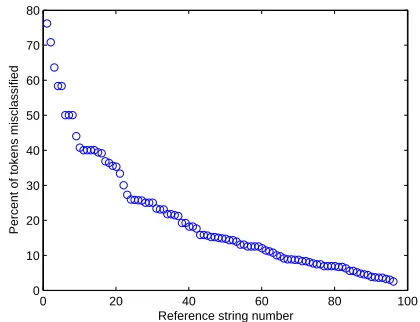
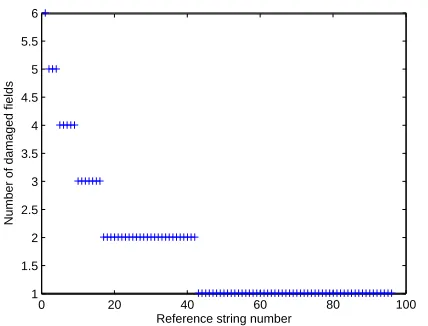
Further analysis of the mistakes that were made on the Cite-SeerX data set reveals that most errors affect only small portions of the reference string decoding. Approximately 51% of the strings were decoded perfectly. For the 49% of strings where mistakes were made, Figure 1 shows the dis-tribution of the percentage of tokens within the strings that were misclassifed, showing that only a small percentage of strings were damaged by more than 25%. Figure 2 further shows that only 7% of all strings contained misclassifica-tions in more than two separate fields.
Field Precision Recall F1
Author 95.8 95.7 .96
Booktitle 72.5 92.9 .81
Date 98.8 89.8 .94
Editor 95.6 51.1 .67
Institution 70.9 76.7 .74 Journal 88.0 78.6 .83 Location 91.9 78.4 .85
Note 88.9 17.2 .29
Pages 90.3 91.5 .91
Publisher 88.7 74.8 .81
Tech 76.1 70.0 .73
Title 91.9 93.9 .93
Volume 89.3 85.0 .87
Table 2: Field reference string parsing performance on the CiteSeerXdataset.
0 20 40 60 80 100
0 10 20 30 40 50 60 70 80
Percent of tokens misclassified
Reference string number
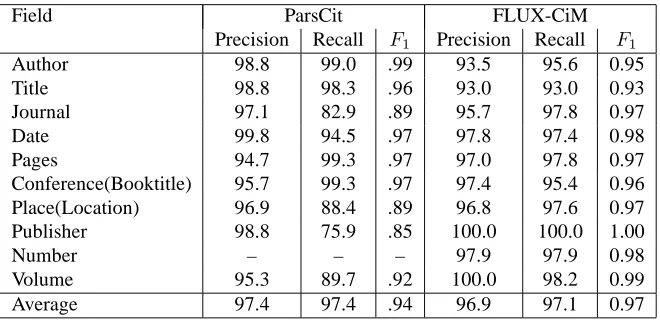
Field ParsCit FLUX-CiM Precision Recall F1 Precision Recall F1
Author 98.8 99.0 .99 93.5 95.6 0.95
Title 98.8 98.3 .96 93.0 93.0 0.93
Journal 97.1 82.9 .89 95.7 97.8 0.97
Date 99.8 94.5 .97 97.8 97.4 0.98
Pages 94.7 99.3 .97 97.0 97.8 0.97
Conference(Booktitle) 95.7 99.3 .97 97.4 95.4 0.96 Place(Location) 96.9 88.4 .89 96.8 97.6 0.97
Publisher 98.8 75.9 .85 100.0 100.0 1.00
Number – – – 97.9 97.9 0.98
Volume 95.3 89.7 .92 100.0 98.2 0.99
Average 97.4 97.4 .94 96.9 97.1 0.97
Table 3: Field reference string parsing performance on the FLUX-CiM dataset.
con. The approach takes a four stage approach of blocking, matching, binding and joining. The last step is comparable to ParsCit’s final step of breaking up a continguous fields such as “author” into component fields with the same tag. As stated earlier FLUX-CiM performs markedly well with respect to journal articles where the fields of “volume” and “number” are prevalent.
Retrieving citation contexts has been a key feature in Cite-Seer and nascent digital libraires. Approaches continue to be heuristically-driven, in both this system and (Powley and Dale, 2007). Work continues in the community to utilize citation contexts to discern a citation’s function and com-pile a summary of how a work influences or is described by others (Teufel et al., 2006; Wu et al., 2006; Schwartz et al., 2007).
9.
Conclusion
We have introduced ParsCit, an open-source package for locating reference strings, parsing them and retrieving their citation contexts3. ParsCit employs state-of-the-art ma-chine learning models to achieve its high accuracy in refer-ence string segmentation, and heuristic rules to locate and delimit the reference strings and to locate citation contexts. ParsCit has been successfully deployed within CiteSeerX4,
a large-scale digital library of computer science publica-tions that has recently been released. It is hoped that by making the source of the ParsCit package open to all that the community at large can benefit from its use in further-ing natural language, digital library and scholarly dissemi-nation research. ParsCit is one of the tool deliverables as-sociated with the ACL ARC project, described in a separate LREC paper (Bird et al., 2008).
In current work, we plan to continue evaluating and tun-ing ParsCit by taktun-ing advantage of more traintun-ing data. We welcome feedback from the community in using ParsCit.
10.
Acknowledgments
The authors thank Yong Kiat Ng for his prior work on a maximum entropy based precursor to the current ParsCit. Min-Yen Kan’s work on the project was generously sup-ported by AcRF Tier 1 grant R-252-000-288-112. Isaac
3
Available athttp://wing.comp.nus.edu.sg/parsCit/.
4http://citeseerx.ist.psu.edu
Councill and C. Lee Giles are partially supported by NSF CRI 0454052.
11.
References
Steven Bird, Robert Dale, Bonnie J. Dorr, Bryan Gib-son, Mark T. Joseph, Min-Yen Kan, Dongwon Lee, Brett Powley, Dragomir R. Radev, and Yee Fan Tan. 2008. The ACL anthology reference corpus: A refer-ence dataset for bibliographic research. In Language
Re-sources and Evaluation Conference.
Robert D. Cameron. 1997. A universal citation database as a catalyst for reform in scholarly communication. First
Monday, 2(4).
Eli Cortez, Altigran S. da Silva, Marcos Andr´e Gonc¸alves, Filipe Mesquita, and Edleno S. de Moura. 2007. Flux-cim: flexible unsupervised extraction of citation meta-data. In JCDL ’07: Proceedings of the 2007
Confer-ence on Digital Libraries, pages 215–224, New York,
NY, USA. ACM.
C. Lee Giles, Kurt D. Bollacker, and Steve Lawrence. 1998. Citeseer: an automatic citation indexing system. In DL ’98: Proceedings of the third ACM conference
on Digital libraries, pages 89–98, New York, NY, USA.
ACM Press.
I-Ane Huang, Jan-Ming Ho, Hung-Yu Kao, and Wen-Chang Lin. 2004. Extracting citation metadata from online publication lists using BLAST. In Proc. of the
Eighth Pacific-Asia Conference on Knowledge Discovery and Data Mining (PAKDD-04), Sydney, Australia, May.
Michael Jewell. 2000. ParaCite: An overview. http://paracite.eprints.org/docs/overview.html.
John D. Lafferty, Andrew McCallum, and Fernando C. N. Pereira. 2001. Conditional random fields: Probabilistic models for segmenting and labeling sequence data. In
ICML ’01: Proceedings of the Eighteenth International Conference on Machine Learning, pages 282–289, San
Francisco, CA, USA. Morgan Kaufmann Publishers Inc. Steve Lawrence, C. Lee Giles, and Kurt Bollacker. 1999. Digital libraries and autonomous citation indexing.
IEEE Computer, 32(6):67–71.
Fuchun Peng and Andrew McCallum. 2004. Accurate in-formation extraction from research papers using condi-tional random fields. In In Proceedings of Human
Lan-guage Technology Conference / North American Chapter of the Association for Computational Linguistics annual meeting, pages 329–336.
Brett Powley and Robert Dale. 2007. Evidence-based in-formation extraction for high accuracy citation and au-thor name identification. Recherche d’Information
As-sist.
Ariel Schwartz, Anna Divoli, and Marti Hearst. 2007. Multiple alignment of citation sentences with conditional random fields and posterior decoding. In Proceedings of
the 2007 Joint Conference on Empirical Methods in Nat-ural Language Processing and Computational NatNat-ural Language Learning (EMNLP-CoNLL), pages 847–857,
June.
Kristie Seymore, Andrew McCallum, and Roni Rosenfeld. 1999. Learning hidden markov model structure for in-formation extraction. In AAAI’99 Workshop on Machine
Learning for Information Extraction.
Simone Teufel, Advaith Siddharthan, and Dan Tidhar. 2006. Automatic classification of citation function. In
Proceedings of the 2006 Conference on Empirical Meth-ods in Natural Language Processing, pages 103–110,
Sydney, Australia, July. Association for Computational Linguistics.
Jien-Chen Wu, Yu-Chia Chang, Hsien-Chin Liou, and Ja-son S. Chang. 2006. Comutational analysis of move structures in acdemic abstracts. In COLING/ACL