ii
Pieter .P van den Bosch: Moral Intelligence for IT production
Master Philosophy of Science, Technology and Society
Supervised by
Prof.dr. Philip Brey (Department of Philosophy, UTwente) Dr. Aimee van Wynsberghe (Department of Values, Technology and Innovation, TUDelft) Dr. Luís Ferreira Pires (Faculty of Electrical Engineering, Mathematics & Computer Science, UTwente)
Location
UTwente, Enschede The Netherlands August 21, 2017
Moral Inteligence for IT Production
Find more info at: Ethics4industry.com
Preface ...v
Summary: Moral Intelligence for IT production ...1
Chapter 1: Introduction to Value Sensitive Design ...3
1.1 Introduction to Design for Value ... 4
1.2 Extending VSD towards the IT industry ... 6
1.3 Research question for extending VSD towards the IT industry ... 6
Chapter 2: Challenges to Value Sensitive Design ...8
2.1
Operational problems with VSD ... 8
2.2
Philosophical problems with VSD ... 9
2.3
The Research Design & Approach ...10
2.4
The scope of extending VSD towards an industry framework ...10
2.5
Practical cases that will be used throughout the thesis ...11
2.6
Conclusion and reflection ...12
Chapter 3: A case for building Moral Intelligence ... 13
3.1
Charting ethical culture within Tech companies situated in Enschede ...13
3.2
Conclusion and reflection ...15
Chapter 4: Cultivating Moral Intelligence for VSD ... 17
4.1
Introduction ...17
4.2
The contemporary methods of VSD ...17
4.3
Analysis of the tripartite methodology of VSD ...18
4.4
Cultivating Moral Intelligence with technology and methods ...20
4.5
Operationalisation of an ethical capturing component ...20
4.6
Towards anticipation of technology assessment and methods of ethical analysis ..20
4.6.1
Ethical Technology Assessment ...21
4.6.2
Techno Ethical Scenario Approach ...21
4.6.3
ETICA ...21
4.6.4
Anticipatory Technology Ethics ...22
4.6.5
Combining all methods to cultivate Moral Intelligence ...23
4.7
A value capturing model that promotes Moral Intelligence ...24
4.8
Conclusion and Reflection ...26
Chapter 5: VSD and Design Methodology ... 27
5.1
Introduction ...27
5.2
Embedding VSD in production methods ...27
5.3.1
The link between VSD and production methodologies ...28
5.4
Methods of development and industry standards ...28
iv
5.4.2
The philosophy of Agile development ...29
5.4.3
The Scrum approach (an iterative approach) ...30
5.4.4
The Continuous Integration Approach (CI) ...31
5.4.5
The Model Driven Development (MDD) Approach: Core Concepts ...32
5.5
Conclusion and reflection ...33
Chapter 6: Moral Intelligence in practice ... 34
6.1
Introduction ...34
Step 1: Capture within the Moral Intelligence Framework ...34
Step 2: Design within the Moral Intelligence Framework ...34
6.2
How to solve the philosophical questions in practice (2.1-2.3) ...35
6.3
How to solve the operational problems (2.1-2.4)? ...39
6.4
Building community tools with object orientated languages ...41
6.4.1
Sharing code through community, a modular approach ...41
6.4.2
How to capture values technically using Moral Intelligence systems? ...41
6.5
Step 3: Deploy within the Moral Intelligence Framework ...48
6.6
Suggestion for a Moral Intelligence deployment framework ...50
Chapter 7: Overview and conclusion ... 56
Future Research ...59
Afterword ...60
Appendix ... 61
Appendix A Questions asked during the interviews ...61
Appendix B Company Contact information ...63
Appendix C Step 1: Capture Framework Blueprint ...64
Appendix D Step 2: Design Framework Blueprint ...65
Appendix E VSD/Moral Intelligence Team Matrix Roles ...66
Appendix F Step 3: Deployment Framework Blueprint ...67
Appendix G Ethical Checklist ...68
Appendix H Brainstorm Session ...69
Appendix I Mission and for Vision Moral Intelligence ...70
Appendix J Quantitative research ...71
Appendix K Introduction to Contemporary Ethical Theory ...73
Appendix L Quick Start Guide ...80
Preface
Innovative technology has always fascinated me. When I was six years old, my father programmed a Yahtzee Dice Game in Visual Basic on our home computer. It was fascinating for me to see the aspects of design and seeing code being written right there on the screen. Later, he gave my brother and me a book that taught us how to program that same game. We saw how our words were being translated into actions, as if it was magic. That was the turning point when I knew what to do in my life—something creative that included designing and writing software.
I was creating technology on a very small level in a safe, a controlled environment then. Twenty five years later, I present this Master‘s thesis as a result of my bachelor‘s background in Business Engineering (Technische Bedrijfskunde, HBO education), the courses that I took during the Master ‘s degree of Business Administration, and finally finishing the Master ‘s degree Philosophy of Science, Technology and Society at the University of Twente.
Many IT projects I have worked on involved engineering, analysing business contexts, and collaborative work with industry leading companies, which inspired me to write this thesis. The most challenging aspect was how to connect three different domains with each other—namely, philosophy and ethics; software engineering; and business. This ultimately led to a multidisciplinary framework for management, ethicists, engineers, and consultants to incorporate ethics throughout their design.
Perhaps the most interesting aspect of technology creation is connecting the dots that ultimately create technology, such as merging different perspectives, views, systems, and the incorporation of corporate dynamics. Future innovations and breakthrough discoveries may all depend on how well these elements integrate and are supported throughout development. This, of course, is a big challenge for the world.
With this Master‘s thesis, I hope to contribute a complete new methodological framework to support ethical development throughout design processes.
Firstly, I would like to express my sincere gratitude to my advisor Prof. Brey for his continuous support, guidance, patience, motivation, and knowledge during my Master‘s thesis.
Besides my advisor, I would like to thank the rest of my thesis committee: Dr. Aimee van Wynsberge for her insightful comments and encouragement, but also for the hard questions that led me to widen my research from various perspectives.
Finally, my deep and sincere gratitude goes to my family for their continuous and unparalleled love, help, and support. I would not be writing a Master‘s Thesis if it wasn‘t for them. My (adoptive) parents brought me to the Netherlands where I could partake in higher education that has culminated in me finishing my university Master‘s degree. I am sincerely thankful for this.
ABSTRACT
1
Moral Intelligence for IT production
Intelligence is the ability to adapt to change -Stephen Hawking
Summary: Moral Intelligence for IT production
There is a need to consider values in designs and one major approach that has been proposed is Value Sensitive Design (VSD). Value Sensitive Design is a theoretically grounded approach that accounts for human values in a principled and comprehensive manner throughout technology design processes. It employs an integrative and iterative tripartite methodology, consisting of conceptual, empirical, and technical investigations. It was developed by Batya Friedman and Peter Kahn at the University of Washington from the late 1980s to the early 1990s (Friedman, Kahn, & Borning, 2008).
However, a major problem has been formulated for VSD: ―Perhaps the most apparent challenge of engaging in VSD outside the academic laboratory is the inevitability of confronting competing values within varied design contexts‖ (Zimmer & Manders-Huits, 2009, p6). In other words, VSD somehow lacks the methods of confronting competing values in different design contexts. Several problems have been addressed within the operationalisation of VSD, which will be dealt with in this thesis.
Following up on these problems, the following research question has been formulated:
“How can Value Sensitive Design be extended towards the IT industry and integrated in the design and production process of IT companies?”
To answer the research question, two distinct sub-questions were formulated:
How to embed ethics in VSD and in production so that values can be operationalised?
How to operationalise VSD within a corporate IT setting and look at these design contexts? Why is this thesis so important, you may ask? Contemporary VSD literature provides insights into the problems during VSD operations and the issue of confronting competing values during the practice of VSD (Borning & Muller, 2012; Davis & Nathan, 2013; Friedman, 1999; Grunwald, 2001; Lanzo, 2003; Maedche, 2017; Manders-Huits, 2011; Pesch, 2015; Spiekermann, 2015; van den Hoven, Vermaas, & van de Poel, 2015; Zimmer & Manders-Huits, 2009).
In order to solve such problems, a novel theoretical framework is developed to support the incorporation of ethical values into the theory and
methods of VSD. This theoretical framework can be used to build a monitoring and reporting learning system, which I refer to as a moral framework that can be iteratively used throughout the development of a technology. This moral framework here refers to a ―Moral Intelligence framework‖ (providing pragmatic steps, logic, and problem solving) that contains three unique components that explicate several important methods.
Step 1) A Moral Intelligence Capture component, which allows any person to start capturing ethical issues by choosing from a selection of capture methods to gather ethical data on different levels of technology. Its major function is to allow learning and data collection (intelligence).
Step 2) A Moral Intelligence Design framework that deals with the varied design disciplines within the IT industry and links this to captured values and tooling. Its major function is to allow ethical monitoring during development and iterative improvements within teams throughout design.
Step 3) A Moral Intelligence Deployment framework that allows for the integration of Moral Intelligence within important corporate contingencies that may speed up the process of adopting Moral Intelligence within corporate cultures. The deployment framework includes seven distinct systems that are related to the incorporation of Moral Intelligence within industry contexts. Its major function is to report ethical improvement back to all organisational levels within a company.
These components are described in detail herein and will form pragmatic steps for companies to embed ethics within their production methods. The foundation of Moral Intelligence has been built on parts of the tripartite methodology of VSD (I prose that Moral Intelligence can also be a standalone operational theory, not necessarily dependent on VSD, but still embodying its tripartite methodology.) This is done intentionally so that Moral Intelligence can grow as a separate theory but also fall back on VSD theory when necessary. Promoters of VSD may also see this as a benefit to adopt more theories of Moral Intelligence, without feeling their core VSD values are threatened.
A strong focus on innovation within the IT industry context
Following up on the proposed Moral Intelligence Framework, several methods of design were made explicit to allow for a unique integration of VSD into building technology processes (Van Wynsberghe, 2012). Industry standards — e.g. Model Driven Development (MDD), Agile Development, and Scrum — are scrutinised and the best parts are taken together to form a pragmatic and integrative approach. Qualitative interviews have also been provided from three IT companies (InterDC, El Niňo BV, CAPE Groep BV) situated in Enschede, The Netherlands, to strengthen the foundation of the steps to be taken. These companies provide a better argument for the developed VSD approach and also aim to provide practical knowledge for a possible match between VSD, Moral Intelligence, and design disciplines. This investigation of industry standards gathers and unifies the disciplines and experiences that are already available within current industry practices, which may not always be taken into account by ethicists. This especially includes the roles of the engineer, consultant, and ethicist, which are unified by presenting a Moral Intelligence ‗disciplinary matrix‘ to allow improved teamwork during a collaborative project to collect specifications or to build a product together.
Changing the IT industry with the these novel methods
This thesis takes active leadership in creating pragmatic steps for VSD implementation within the IT industry by connecting the ethical and engineering worlds through creation of a pragmatic framework. While the VSD literature covers some models of development, I argue that many do not fit the progress of engineering in practice because disciplines also have to be taken into account, which is harder to describe. Essentially, what is missing is an approach that goes in-depth within the disciplines found in an organisation and that effectively tries to link with VSD. In response, an intuitive and iterative three-step model is presented to ease this adoption. Moral Intelligence Capture, Design and Deploy allows for the ethical specification of all steps required throughout development. This method is evaluated with leading industry standards and has been cross-examined with three real business cases in this thesis.
Moreover, it is extremely important to look at design disciplines and to make these more explicit when integrating VSD. While models of development are largely discussed in theory, real-life situations and disciplines are harder to describe because of the context. This is apparent when we think about specific cases of coding, development methodologies, and corporate contingencies such as corporate culture.
In other words, there is an important gap between the VSD philosophy and its practitioners. Although some organisational factors have been analysed, no specific recommendation has been given,
whereas this thesis develops an important deployment framework that can be used by ethicists, developers, consultants, engineers, businesses, and management.
To support further innovation for VSD and Moral Intelligence research, a website (Ethics4industry.com) and component platform (capture, design & deploy) showcase the components developed during this thesis as suggestions to take active leadership in Moral Intelligence and to execute the recommendations herein. The methods, cases, and theory are presented on this website and a mission, vision, and roadmap have been published to support ethical actions and as practical reporting tools. With the right leadership and vision (executing learning, monitoring and reporting), the developed components can be adopted by corporations to further build a Moral Intelligence system that can be scaled and implemented within small to large enterprises.
Research Highlights
Throughout this thesis, new important building blocks for VSD are developed for integration within the IT industry.
This thesis examines industry standard design methodologies to find a possible match for VSD and important engineering disciplines: e.g. VSD is extended for use by engineers, IT consultants, ethicists, and many more disciplines.
Central for the improvement of VSD is Moral Intelligence, introduced as a core component of VSD, which allows for learning, monitoring, and reporting ethical issues.
A full Capture, Design and Deployment method for VSD is developed for incorporation within a corporate IT setting.
Three business cases are used to provide insight into the field of engineering to uncover possible matches between VSD and engineering.
This thesis aims to bridge the gap between philosophical problems, the engineering domain, and management theory that are involved when adopting VSD in corporate settings.
CHAPTER 1
3
Introduction to Value Sensitive Design
Action is the foundational key to all success.
(Pablo Picasso, n.d.)
Chapter 1: Introduction to Value Sensitive Design
Welcome to today‘s design challenges and the problems for the next revolution in IT design. What are these problems and challenges? Well, technology seems to have virtually no limits, which forces us to think ethically about certain changes technology can bring.
If you want to check someone‘s personal information, Google may be a good starting point or you can try your luck with Facebook. If you want to build an invasive application as a software engineer, the risks can be found in the privacy scandals that surrounded Facebook in 2013 (Kelly, 2013) and the NSA scandals (―Edward Snowden: Leaks that exposed US spy programme,‖ 2014), which include use without explicit permissions, the GPS functions, background data mining, or hidden third-party services that are broadly available now. People using smartphones may not be aware what other functions are active in the background. These misuses of technology can heavily conflict with a person‘s highly appreciated values of privacy or consent.
Another example of the influence of technology and the concerns that it brings is the Apple VS FBI case (Kharpal, 2016), which marked one of the highest-profile clashes in the debate over encryption and data privacy between the government and a technology company. Law enforcement authorities, e.g. the FBI, say that encryption used by the likes of Apple makes it harder for them to solve cases and stop terrorist attacks. Technology firms such as Google and Microsoft have kicked back, saying that encryption is key to protecting user data from hackers. Apple objected to the FBI's demand that Apple build a back door into the iPhone because they believed it was wrong and would set a dangerous precedent. Luckily for Apple, a hearing was postponed after the government reported it had found a third party that could unlock the iPhone, which resulted in the FBI dropping the case.
These examples highlight that while IT holds great power, there are also many cases of intrusive applications that can conflict with people‘s privacy or consent. Scandals like the ones listed above raise important ethical questions, such as whether engineers and other individuals have a responsibility to develop products with due consideration for the consequences of the product‘s intended and un-intended user features. Do engineers have a responsibility to consider their duties to design good products? Should engineers
be trained to reflect on their professional role as designers or developers?
This raises the important question: how can we make ―good‖ IT design really work in a corporate setting? As these questions are being raised more frequently about technology and ethical values by media or academia, society and developers may require a better design methodology to produce more ethically-valued products throughout the production process.
Fundamental questions like these will be answered in this thesis. To acknowledge these problems, firstly a very important question that we should ask ourselves is ―can technology have embedded values?‖ Is there a relationship between the technologies we use every day and the values we hold dear as a society?
According to the embedded values approach, the answer is ―yes‖, which holds that computer systems and software are capable of harbouring embedded or ―built-in‖ values (Brey, 2009). For example, computer programs can be supportive of privacy and the free flow of information, or instead go against the realisation of such values.This shows how the technologies we use daily can have a direct impact on the values we appreciate in society.
Values can, for example, through their incorporation in technology, shape the space of action of future users, i.e., they can affect the set of affordances of and constraints to users (Maedche, 2017). Every design, artefact, and system is shaped by the values, ideas, and world views of the designer and builder. That applies to architecture, software engineering, product design, synthetic biology, material science, and civil engineering. A design is a consolidated set of choices made by designers, developers and engineers. Via their designs for systems and artefacts, they come to have an incredible impact on the lives of others: cables, code, search and reach algorithms, standards, ontologies, authorization matrices, menus, voting procedures, aggregation mechanisms, recommender systems, reputation systems (Maedche, 2017, p298).
Another way to think about these artefacts is to see them as social-technical artefacts. They affect us not only by their physical or material properties, but also by properties they acquire as systems and devices embedded in lager material and social networks and webs of meaning (Nissenbaum, 2010, p6).
technology engineering process to minimise the impact on people‘s values.
1.1 Introduction to Design for Value
In order to shape these environments in which we function as moral beings in a responsible way, we need to express or ‗‗design in‘‘ our shared moral values. ‗Design for Value‘ recognizes design as a far richer process since it can realize our functional requirements and our moral values. Design for Values integrates design with our values and allows an active value-driven steering of and intervention in technological development. Design and designers can be frontloaded with moral and social values so they can realize these values and be held accountable (van den Hoven et al., 2015,p3). Values should therefore be seen as a sort of supra or non-functional requirements for which we can and ought to design. Moreover, it will become more and more important in the future to design systematically for moral, legal and social requirements (Maedche, 2017).
The practice of Design for Value is characterized by a diversity of approaches, theoretical backgrounds, designed values, and application domains.
Introduction to Value Sensitive Design
Value Sensitive Design (VSD) represents a pioneering endeavour to proactively consider human values throughout the process of technology design (van den Hoven et al., 2015). VSD is primarily concerned with values that centre on human wellbeing, human dignity, justice, welfare, and human rights. Value-Sensitive Design connects the people who design systems and interfaces with the people who think about and understand the values of the stakeholders affected by the systems (Friedman, 1999).
Value Sensitive Design emerged in the 1990s as an approach to the design of information and computer systems that account for human values in a principled and comprehensive manner throughout the design process. VSD emphasises the moral perspective (e.g. privacy, security, trust, human dignity, physical and psychological wellbeing, informed consent, intellectual property) and also accounts for usability (e.g., ease of use), conventions (e.g., standardisation of technical protocols), and personal predilections (e.g., colour preferences) within a graphical interface (―VSD: projects,‖ 2011).
Central to a Value Sensitive Design approach are analyses of direct and indirect stakeholders; distinctions among designer values, values explicitly supported by the technology and stakeholders; individual, group and societal levels of analysis; the integrative and iterative conceptual, technical, and empirical investigations; and a commitment to progress, not perfection.
VSD Theory
VSD is related to values in a two-fold way. First, it starts from the observation that design and technology may impact upon values: (new) technology developments may enhance, threaten, or transform existing values. For example, the advent of social networking sites has changed existing conceptions of privacy, especially for younger generations. Secondly, values are fostered and built into design by means of VSD; it seeks to identify values considered to be of importance for a target group, say a certain company, society, or user group, and subsequently safeguards these values by designing them into technology (Manders-Huits, 2011, p4).
VSD researchers
Batya Friedman is currently a professor in the Information School, Adjunct Professor in the Department of Computer Science, and Adjunct Professor in the Department of Human-Cantered Design and Engineering at the University of Washington where she directs the Value Sensitive Design Research Lab. Batya pioneered VSD, an approach to account for human values in the design of information systems. First developed for human-computer interactions, VSD has since been used in information management, human-robotic interactions, computer security, civil engineering, applied philosophy, and land use and transportation.
5
Peter H. Kahn, Jr. is a Professor in the Department of Psychology and Director of the Human Interaction With Nature and Technological Systems (HINTS) Lab. The HINTS Lab seeks to address two world trends that are powerfully reshaping human existence from a psychological stance: (1) the degradation, if not destruction, of large parts of the natural world, and (2) unprecedented technological development, both in terms of its computational sophistication and pervasiveness. He received his Ph.D. from the University of California, Berkeley, in 1988.
His publications have appeared in journals such as Child Development, Developmental Psychology, Human-Computer Interaction, and Journal of Systems Software, as well as in proceedings such as CHI, HRI, and Ubicomp (―Peter Kahn,‖ n.d.).
VSD and other engineering domains
VSD has been embraced by a broad range of domains. Dr. Aimee van Wynsberge, has been investigating ethics and value incorporation within the field of robotics (Van Wynsberghe, 2012). Prof. M. J. den Hoven has been investigating ethics and information technology with research interests in the Technology, Computer Ethics, Value Sensitive Design, Responsible Innovation and Privacy topics (―TU Delft: Prof. M.J. (Jeroen) van den Hoven,‖ n.d.). Prof . Sarah Spiekermann is author of the book ―Ethical IT Innovation: A Value-based System Design Approach‖. Her main research interests are electronic privacy, disclosure behaviour, and ethical computing (Spiekermann, 2015). Alan Borning is a professor in the Department of Computer Science and Engineering at the University of Washington and an adjunct professor in the Information School. His current research interests are in human-computer interactions, particularly as applied to tools for civic engagement and for improving public transit information systems, and in using and extending Value Sensitive Design in this work (―Alan Borning - CROW 2016,‖ 2016).
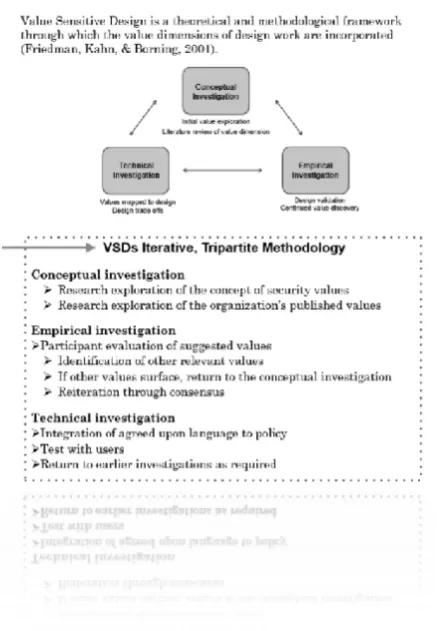
Methods of VSD Technical, Conceptual and Empirical Investigations
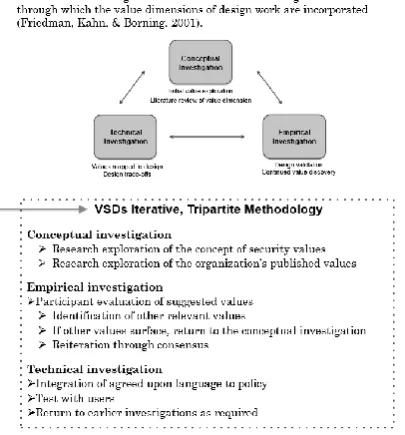
Design occurs through a tripartite investigation consisting of three phases:conceptual, empirical, and technological. These investigations are intended to be
iterative, allowing the designer to modify the design continuously. Examples are given of these tripartite investigations in the illustration below.
Figure 1.1:
http://cec.nova.edu/research/fall_2013_poster_session/documents/Dian ne%20Blitstein%20Solomon.pdf
Conceptual investigations
In short, conceptual investigations involve no costly empirical analyses, but instead thoughtful consideration of how stakeholders might be socially impacted by one‘s technological designs. It focuses on the philosophically informed analyses of the central constructs and issues under investigation. This includes questions like, What are values? Whose values should be supported in the design process? What do values such as privacy mean? (Friedman, H. Kahn Jr, & Borning, 2001).
Technical investigations
Technical investigations focus on how existing technological properties, features, and underlying mechanisms support or hinder human values (Friedman, H. Kahn Jr, & Borning, 2001).
Emperical investigations
[image:10.595.316.536.101.417.2]Examples of VSD projects in practice
Currently, VSD is mainly practiced in Research and Development (R&D) environments. The vsdesign.org website displays several projects in which VSD research has been carried out. Fewer projects, however, focus on the IT industry.
Only one published project showcased on the vsdesign.org website that was carried out in the IT industry was the Microsoft COOP project.
1.2 Extending VSD towards the IT industry
VSD happens to be mostly practiced in the lab instead of being widely used in the IT industry (Miller, Friedman, & Jancke, 2007). From vsdesign.org sources, it may be concluded that VSD is not well known in industry perhaps due to the minimal amount of completed industry projects or that the VSD methodology is not yet promoted and adapted to fit with the IT industry yet. VSD is mainly used for small research teams of R&D projects, such as robotic pets & the elderly, robotic pets & preschoolers, or a research project on urban areas called UrbanSim (―VSD: projects,‖ 2011). VSD is also often seen as costly and manipulated by managers to increase the efficiency of a project (Zimmer & Manders-Huits, 2009).
In this thesis, an approach for expanding the VSD theory to use in the IT industry is proposed. Information technology is the use of any computers, storage, networking, and other physical devices, infrastructure, and processes to create, process, store, secure, and exchange all forms of electronic data (Rouse, n.d.). I will also include all IT activities that involve software building, particularly taking software development companies as an example.
The software industry consists of that part of computer programming that is traded between software-producing organisations and corporate or individual software consumers (Campbell-Kelly, 2003). Core activities include programming services and selling software products.
According to some researchers, VSD is not successful when it comes to the implementation and operationalisation of values for applications in technical designs (Zimmer & Manders-Huits, 2009). I argue that this can be due to the fact that product development
and design in an IT context are often guided by a (regulatory) production methodology and, within the approach of VSD, this crucial analysis and implementation is lacking. I will show why this analysis is key and how it can be carried out as part of the VSD approach. For all the benefits that VSD provides, it is still somewhat difficult to standardise VSD methods because they does not do a good enough job of creating a regulatory (ethical) framework.
For example, engineers have been taught to work using their own ―workflow‖ and have some degree of freedom but are mostly guided by the industrial context, such as production methodology, tooling, and the company structure. This means their procedures often don‘t include ethics or, even worse, fail to look at values that may be at stake outside the scope of the project. Also, certain types of development or design methodology that engineers work with may limit their ability to reflect on their actions, whereas other types do not. In other words, to be effective, a better regulatory framework may be required that can guide or lead people.
Essentially, during this thesis, we may ask ourselves whether guiding design is really enough to promote VSD. I aim to develop a method that not only steers ethics in IT development but also takes a leading role in its operationalisation by creating a methodologically rich approach that takes active leadership by developing the appropriate ethical tools and managerial instruments. The research question that will provide guidance for developing these tools is stated next.
1.3 Research question for extending VSD
towards the IT industry
I formulate my research question as follows:
How can Value Sensitive Design be extended towards the IT industry and be integrated in the design and production process of IT companies?
In order to extend VSD outside the labs, one may first ask what current problems VSD faces when extended outside labs? Contemporary literature may provide very interesting insights into VSD problems and
Project Description: Microsoft COOP
The CodeCOOP is a groupware application designed to help Microsoft Research employees who participate in engineering activities to (a) share information (including code) and (b) build community. An internal web application, the CodeCOOP, supports two types of content: a code repository (including the ability to post and search code) and conversations (including the ability to ask questions, reply to questions, as well as search prior questions and answers). In addition, the CodeCOOP implements an email digest to manage the information flow of requests. This project represents one of the first efforts to extend the theory and methods of Value Sensitive Design to an industry setting, thus providing a proof-of-concept for the viability of this approach within industry (―VSD: projects,‖ 2011).
7
challenges. This will provide a roadmap for VSD improvement. After knowing the current situation, an approach may be developed to extend VSD outside lab settings.
Sub-question one
What are the current problems within VSD methodology when extending VSD outside labs?
Sub-question two
What approach can be developed to overcome problems so that VSD can be better extended towards the IT industry?
CHAPTER 2
Challenges to Value Sensitive Design
Coming together is a beginning, Keeping together is progress, Working together is success.
(Ford, n.d.)
Chapter 2: Challenges to Value Sensitive Design
VSD was introduced in the previous chapter, as was the suggestion to extend VSD towards the IT industry. To develop an approach, a sub-question was formulated:
What are the current problems within VSD methodology when extending VSD outside labs?
Contemporary VSD literature indicates that VSD still has some remaining challenges in its practices. Literature on ―Next Steps for Value Sensitive Design‖ (Zimmer & Manders-Huits, 2009) chart interesting continuing problems for VSD and its extension outside labs (Miller et al., 2007). Zimmer & Manders-Huits have a very powerful statement on VSD: ―Perhaps the most apparent challenge of engaging in Value-Conscious Design/VSD outside the academic laboratory is the inevitability of confronting competing values within varied design contexts‖ (Zimmer & Manders-Huits, 2009, p6).
According Zimmer & Manders-Huits, the first problem is the inevitability of confronting competing values within a varied design context. I argue that the design context can be seen as a regulatory framework for developers addressing tooling and production methodologies that often don‘t match the integration of values. In other words, it is essential to build support for values and in order to do this, we need to confront values with the specific design context. But, what are these design contexts? These remain to be determined and are not made explicit by Zimmer & Manders-Huits.
Secondly, several important problems have been addressed, which I have categorised as operational problems (e.g. confronting, competing values in practice) and philosophical problems (e.g. the theory for VSD). Operational problems are defined as the processes or activities required so VSD can function within an organisational context and philosophical problems including examining what a good ethical approach would be.
In practical operationalisation, questions are more for designers, technical staff, management, and everyone involved within the corporate and practical context (e.g. daily operations). The philosophical issues need to be supported by ethical theory and often come
to the surface when operational problems are discovered by a team, which forces ethical reflection due to bad consequences.
2.1
Operational problems with VSD
The below operational problems have been formulated by Zimmer & Manders-Huits. Some may sound similar. I have included them intentionally to chart VSD trends and to provide a holistic view of the VSD situation. Operational problems are defined as the processes or activities required to make VSD applicable within an organisational context.
The first problem we encounter, according Zimmer & Manders-Huits, is:
“The difficulty to properly explicate and translate ethical considerations to workable requirements and specifications for the other project participants actually building the system” (Zimmer & Manders-Huits, 2009, p4).
Often the values that are discovered can‘t be easily put into a design context even if specific requirements have been formulated. Technology design is constructed in the literature as an ambiguous term. What is the design processes to which VSD refers? How can the values be operationalised? How will ethical considerations be incorporated into design processes? This general question seemingly conflicts with a workable design context.
The problem is how to operationalise values so they can be incorporated into technological design.
It is also problematic to information on supporting values throughout the full development process. For a design team, it is very often difficult to put ethical considerations on the roadmap and continuously worked on them. One example is a project management team who did not share the same commitment or appreciation of the demands as a previous team. This can lead to a hostile working environment.
The creation of a hostile environment (Zimmer & Manders-Huits, 2009, p4-5)
9
guidelines and protocols for product development. Some companies stimulate openness and fairness towards employees, while other companies may create a hostile environment with not much room for innovation or awareness of the product‘s risks. A hostile environment may be created by managers, a team member, protocols, or the lack of the right resources. According to Sarah Spiekermann author of ethical IT innovation, Value creation or destruction through IT regularly plays out not only on the individual level but also at the corporate and societal level (Spiekermann, 2015,p15).
The rejection of ethical concerns to expedite the project (Zimmer & Manders-Huits, 2009, p4)
In sum, these four questions show that there are operational concerns regarding the operationalisation of VSD. During this thesis, an approach will be developed to solve these concerns.
2.2
Philosophical problems with VSD
Artefacts are believed to have a kind of morality. According to Verbeek, artefacts have moral relevance given their role in mediating one‘s experience and practices. He describes technology mediation whereby technology helps to shape human actions and perceptions and create new practices and ways of living (Verbeek, 2008, p92). Designers materialise morality; consequently, technology design is inherently a moral activity. Choosing values over the other design factors can therefore be morally problematic.
Sara Spiekermann discusses in her work that we must built machines that actively embrace, embed and foster values. She begins with mentioning that knowledge, freedom, autonomy, security, health, friendship and dignity are undoubtedly important for everyone. She began with mentioning the knowledge value, outlining how building information for the machine age requires ethical conduct at all stages of the knowledge creation process. For people to thrust machines and machine operations, data and information must be collected in a legitimate way. Data quality and transparency is important for data aggregation (Spiekermann, 2015,p152).
Extending this line of thought, three challenges have been introduced related to VSD in an industrial context versus an academic one: (2.1) Confronting competing values, (2.2) identifying the role the values advocate, (2.3) the justification of a value framework (Zimmer & Manders-Huits, 2009). I will explain these problems step-by-step.
Confronting competing values
Rather than benefiting from working within the academic sphere, committed to the primacy of designing for moral values, design contexts outside academia often include stakeholders whose goals might come into conflict with the protection of these values.
Zimmer & Manders claim that, for a fully engaged and pragmatic application of VSD to be successful, it must ensure that values are not only discovered and clarified, but also consciously and deliberately built into design, even if such an embedding of values conflicts with other design objectives. This means, however, that values also generate conflict during their selection.
For all the benefits VSD promotes, it lacks ethical theory to make choices about these value conflicts (will be further explained also in Chapter 4). However, when you participate in VSD, it can also be seen as an ethical (moral) activity, as explained earlier. Furthermore, during a brainstorm session with van Wynsberge (see Appendix H), several reasons why VSD includes ethics were discovered. First of all, decisions to resolve value conflict are ethical reasoning. This manifests itself throughout design: what is a good (technical) design and what is bad (technical) design for users? Moreover, these values manifest in the resulting technology artefact, which forces us to think about the accountability of designers and the technology itself. Who will be responsible for an autonomous robot when bad things happen? Will that be the designer or the robot?
While all this seems like an operational problem due to practical situations, I also refer this problem to VSD core methods and its evaluation. To allow a better confrontation of competing values, we have to allow for a framework for the discovery of ethical issues within the technological artefact first. Unfortunately, VSD lacks ethical theory about design or the interpretation of competing values. How should we deal, for example, with the designer‘s versus the user‘s values? How can we make a balanced choice?
This raises some questions: what method could be designed for confronting competing values? How can we gather values based on ethical theory? How to use them in a technology context? All of these questions will be answered in Chapter 4 and later chapters.
Identifying the role of the values advocate (Zimmer & Manders-Huits)
In VSD, ethical judgment is required, which is often provided by a person, such as a values advocate. However, there is no clear role for this value advocate in software development. Zimmer & Manders envision an array of roles that the values advocate can take within a particular design context. It is suggested that a leadership role is most preferred.
The justification of a value framework
According to the contemporary literature (Zimmer & Manders-Huits, 2009) and also an interview with Dr. Van Wynsberge, VSD lacks ethical theory for the interpretation of values. What is good design in the first place and how will values fit? While VSD focuses on values, it does not mention ethics in general so, importantly, an ethical framework for VSD is missing. It does not include a normative framework as consequentialism, virtue ethics, or deontology ethics do. Each company deals with design in a different way and current production methods and methodologies are robust systems that don‘t allow VSD to be used in an effective manner. These problems ultimately lead to a more general question that I have formulated to account for these issues:
How we can embed an ethical approach in VSD and have VSD supported throughout production
A research strategy is now required, which will be explained in the next section. This research strategy will answer question two of the previous chapter ―What approach can be developed to overcome problems so that VSD can be better extended towards the IT industry?‖
2.3
The Research Design & Approach
Now that VSD problems have been formulated, I argue that engineers have been taught to work using their own ―workflow‖ with some degree of freedom, but are mostly guided by production methodology, tooling, and company structure that can cause most operational problems (1.1-1.4) mentioned earlier. In essence, this specifically means that procedures often don‘t include ethics considerations. In addition, certain types of development or design methodologies limit engineers to be flexible and to reflect on their actions, whereas other types do not.
To successfully bridge this gap, I explicate a design context. I will explain several IT standard design methodologies and analyse how to hook VSD into these to create a new adjusted approach to bridge the gap between important VSD theory and its operationalisation (1.1, 1.2, 1.3, 1.4).
To embed ethical reasoning in VSD that will provide a good basis for the problems 2.1, 2.2, 2.3, 2.4, I will develop a new approach that allows for gathering values and the usage of ethical theory in VSD.
How can Value Sensitive Design be extended towards the IT industry and be integrated in the design and production process of IT companies?
Research strategy to solve the above research question:
1 How to operationalise VSD within a corporate IT Setting?
In order to answer this, the below questions need to be addressed:
1.1) How to solve the difficulty of properly explicating and translating ethical considerations into workable requirements and specifications for project participants who are actually building the system?
1.2) How to solve the problem of operationalising the values so they can be incorporated into technological design?
1.3) How to solve the creation of a hostile environment?
1.4) How to solve the rejection of ethical concerns to speed up the project?
2 How to embed ethics in VSD and in production so that values can be operationalised?
In order to answer this, the below questions need to be solved:
2.1) How to embed an ethical approach in VSD and in production?
2.2 How to confront competing values?
2.3) How to identifying the role of the values advocate?
2.4) How to select the justification of a value framework?
2.4
The scope of extending VSD
towards an industry framework
Now that the sub-questions have been formulated, an approach needs to be developed to solve these problems. Because many problems have been addressed (e.g. theoretical, operational, and philosophical), an integrative approach is suggested with an organisational context that covers the above aspects. In the following chapter overview, this approach is explained in detail.
Analysis framework by chapter
In this thesis, three dimensions will be covered to extend VSD towards the IT industry. These dimensions are Methodology and methods (reflection on the VSD philosophy to provide a basis for 2.1, 2.2, 2.3, 2.4), Production (deals with the embedment within corporate settings 1.1, 1.2, 1.3 and 1.4) and concrete
Interventions (suggested tools and synergy of all the mentioned problems).
Chapters 3-4
11
companies situated in Enschede, The Netherlands. Operational problems were earlier discussed but I argue that more background info may be required e.g. that of interesting IT companies to link methodology and methods to the practice. Therefore, several interviews were held to scrutinise ethical culture at IT companies and to investigate how VSD may be incorporated.
Chapter 3 answers: What is the current ethical culture and ethical practice at IT companies situated in Enschede? What may be developed to improve ethical culture?
Chapter 4 answers: what could be a moral framework that integrates with VSD to justify the value framework
to ultimately help solve the problems
(2.1)(2.2)(2.3)(2.4)?
Chapters 5-6
Part ll, Production (Embedding and Integration), translates the right basic set of tools and instruments for VSD. In this part, embedding and the integration/balancing of values will be a key focus. I aim to develop a production method to create a VSD community that could operate in an IT setting.
Chapter 5 answers: what design context could be compatible with VSD to answer (1.1-1.4)?
Chapter 6 answers: how to integrate VSD outside the academic laboratory and confront values within design contexts and apply (2.1, 2.2 2.3)? What kind of tools may be developed?
Chapter 7
Finally in Part lll, a list of interventions, tools and instruments are suggested to benefit practice. The list of interventions, tools and instruments may be used by anyone interested in incorporating VSD within an IT context. I argue that the dimensions covered in the thesis will form the basis of a solid VSD production methodology for industry. Below is an overview of the chapters and their pragmatic approach.
Table 2.1 Overview of the framework used in this thesis to extend VSD towards the IT Industry
2.5
Practical cases that will be used
throughout the thesis
In order to provide both useful theoretical and practical knowledge, three companies will be interviewed (qualitative interviews) to provide cases of practical inquiry. These companies are all very active in the IT industry but in different branches (e.g. one data storage vs. two software developers). They will be scrutinised and interviewed about their design context, its flexibility in development, and their available resources for a VSD methodology that can provide a better understanding of practices within the industry but also their view on incorporating ethics or VSD.
The aim of using practical cases is that companies and VSD can mutually benefit from each other by allowing industry knowledge and VSD methodology to come together. These three companies may produce the following benefits for building a stronger implementation case:
1. They may be used to develop a long-term plan for VSD supported by organisational theory and vice versa.
2. They may help to get more insights of the current IT industry standards and the adoption of VSD practices within these standards.
a. E.g. they could help to explicate VSD processes throughout organisations. b. Allow for a critical reflection on VSD
methodology, e.g. by extending the roles of participants.
Table 2.2 VSD Industry Extensions
Extending VSD to industry by cases
Company name Company type Production
method
CAPE Groep BV1, situated in Enschede, The Netherlands Supply chain integrator, IT consultant Model Driven Development (MDD)
InterDC2, situated in Enschede, The Netherlands
Data warehouse and webhosting company
Agile development
El Niňo3
, Situated in Enschede, The Netherlands Software development company Continuous integration (CI)
TriMM4, Situated in Enschede, The Netherlands Web-development company Scrum
1 Capegroep.nl 2 InterDC.nl 3
Elnino-ict.nl 4
Trimm.nl l
•Methodology and methods
•Ethical investigations and corporate cases (Chapter 3-4)
ll
•Production
•Embedding, integration, and balancing values within production ,methodology (Chapter 5-6)
lll
•Practice
2.6
Conclusion and reflection
Several core problems were formulated in this chapter that chart a possible roadmap for extending VSD outside the labs. As an answer to the core problems, during the thesis, Methodology and Methods, Production and Practice will be developed to form the basis steps to extend VSD towards the IT industry.
The research design proposed in this chapter forms the steps and building blocks to create a new holistic VSD for IT approach answering the philosophical problems and the operational problems.
CHAPTER 3
13
A Case for Building Moral Intelligence
If you are working on something exciting that you really care about, you don't have to be pushed.
The vision pulls you.
(Steve Jobs | Values.com, n.d.)
Chapter 3: A case for building Moral Intelligence
3.1 Charting ethical culture within Tech companies situated in Enschede
In the previous chapter, operational and philosophical problems were discussed and it was explained that VSD lacks ethical theory for the interpretation of values (Zimmer & Manders-Huits, 2009). How do these questions relate to practice? In order to get a better understanding on where VSD and ethics would fit within the practice of IT companies, several IT companies situated in Enschede were interviewed at the beginning of this research. Because the companies are not familiar with VSD, questions were asked about ethics to provide useful insight in the current ethical culture and ethical practice at IT companies situated in Enschede (see Appendix A). Their insights may lead to possible understandings of ethical conflicts.
The first company that was interviewed is the data warehouse, ―InterDC‖, situated in Enschede. Its core activities are providing server storage, infrastructure, and web hosting.
CASE I
Interview Summary: Roland Kamphuis, CEO, InterDC, Enschede (Data Warehouse, small-sized company). The following are the questions asked:.
1. What are the potential areas where you could include ethics in your IT company?
InterDC stresses the importance of keeping the data of their customers secure and the importance of data protection for both the digital and the physical world (e.g. the physical servers stored in the data warehouse). ―It is important that the personal data does not become publicly known or found freely on the web,‖ CEO, Roland Kamphuis, emphasises.
Having the access to ethics and knowing what to do in specific cases would help the data centre to steer development by providing guidelines to safely use software and to explicate how customers could behave more responsibly.
Furthermore, Roland mentions that the delegation of this responsibility and creating awareness is important. ―We need to ask ourselves, what does our software do for customers? And how do you control your information?‖ The CEO mentions that he could envision great benefits in the creation of an operational guide for escalations and security: ―How do you create safety or create applications that do not steal private information?‖
2. What are the positive and negative effects of incorporating ethics in different IT development economics in your company?
For InterDC, good ethical software development costs a lot of money and therefore time and investment, which is mentioned as a negative aspect. On the positive side, good marketing and Corporate Social Responsibility (CSR) can boost the quality of the company and also contribute to creating a better environment (e.g. having less waste and reducing their CO2 footprint).
3. What are the main decision-making aspects when deciding between the incorporation of ethics or not in production?
Roland mentions that they have to be sure that the cost will be covered and that a return of investment is the most important aspect.
4. What are the general implementing problems/challenges managers, staff, and/or developers face when implementing ethics/VSD or an ethically justified methodology?
often usability is important for customers and this is likely to be prioritised before ethics. Customers tend to find new software features more important than the possible ethical implications. Roland mentions that values are often discovered when something goes wrong (and not analysed in the prospective sense).
The scalability of technology and maintenance are also seen as being problematic. Roland mentions that making sure his costs are covered and that a return of investment is important to invest in ethical design.
CASE Il
Interview Summary: Michael, CEO El Niňo-ICT, Enschede (Software development company, mid-sized company).
1. What are the potential areas of including ethics in your IT company?
Michael, the CEO of El Niňo-ICT mentions that good security in his IT company is essential. They have to encrypt their customer hosting data and save passwords accordingly to maintain the privacy of information. Employees cannot leak private data and this has to be ensured by the organisation. Their most important stakeholders are customers and partners and they have to make sure that their knowledge is also not leaked to competitors or any other third parties. Michael mentions when you have a third party hosting company, it is essential to be fair to customers. If this hosting party is has unusual activities and all you care about is the payment, this is obviously also not very ethical. You have to ensure your customers are also safe with third parties.
2. What are the positive and negative effects of incorporating ethics on different IT development economics in your company?
Michael mentioned that being unethical can be easy in the short term, but can lead to losing a lot of happy customers in the long term. In this way, it is better to have some ethical awareness. ―We think a long-term investment is more important over a short one in this sense,‖ Michael says. ―For example, if we sell open source, we can resell this for e.g. ten thousands Euros or we can be fair about the invested time. If a customer needs a blog site, we can use an open source system or build the system from the ground up. We are not forcing our customers and we are transparent about their options.‖
3. What are the main decision-making aspects when deciding between the incorporation of ethics or choosing none to be adopted in production?
Michel mentioned that long-term relationship building is most important after economic factors.
4. What are the general implementing problems/challenges managers, staff, or developers face when implementing ethics or an ethically justified methodology?
―It is important to train employees to be safe with data and specify categories of knowledge. Knowing what is important for a customer or knowing what issues can be dangerous.‖
For the implementation of a VSD methodology, we will look if it is easy to be quickly applied, measurable, practical, and the customer has to see that it is useful. It also depends on the type of software; Michael mentions that an ecommerce system (e.g. online store) is different than a sales software program. Within design, different information is required to look at a per software solution.
―Besides a checklist, a good test would be useful, usage with stakeholders, or a monitoring system that can benefit the IT world.‖ Michael mentioned the possibility of VSD to be integrated within their Continuous Integration (CI) development method.
―Each time a code is created, you can analyse your code and install plug-ins, and the server will check the code for unsafe functions. It will give errors and denotes which files need to be checked.‖ Michael mentions that it would be possible to develop multiple VSD systems that would fit within the CI method.
Analysis of the ethical concerns provided by these companies
The questions asked during the interview sketched some practical cases in which companies may be looking for a solution where ethics may help them. In the above cases, the companies also stressed that it is important to intervene correctly. InterDC mentioned the importance of delegating responsibility and that the creation of awareness is important. An important question that was raised is: how do you control your information? Roland mentioned that plans and specifications can contradict the corporate process and the original intended production. Also, the scalability of technology or maintenance is seen as very problematic. Michael of El Niňo-ICT mentioned that it is important to train employees to be safe with data.
To sum up the concerns, I have created a schematic overview of the issues that were described by the interviewees.
15
(1) Gathering ethical knowledge (e.g. to support maintenance)
The companies require a system that they can consult to obtain ethical knowledge. Companies may experience a great benefit when they learn how to incorporate ethical reasoning within their company. A learning system that helps companies may be a great way to introduce ethics within the corporate setting.
(2) Ethical issues should be applied quickly, be measurable, and should be practical.
The ethical interventions should be measurable and also be practical, according to these business cases. Measuring ethics means that a monitoring and reporting system would be essential to measure the effects of ethical interventions within the organisation.
(3) Scaling technology easily
Scaling technology is seen as problematic by Roland. He refers to the intervention that his company made with the alarm system. Therefore, scaling technology the right way when implementing ethics is essential.
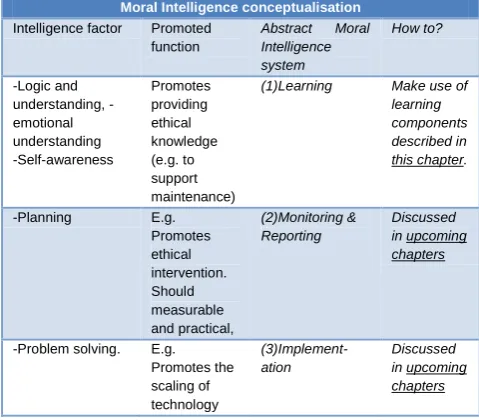
As mentioned earlier, Sarah Spiekermann began with the knowledge value, outlining how building information for the machine age requires ethical conduct at all stages of the knowledge creation process (Spiekermann, 2015,p152). I will build further on this emphasis and suggest that knowledge in the form of ethical reasoning should be embedded within a company. Because ethical reasoning can be embedded in knowledge systems and different forms, I will refer to ethical reasoning from now on as ―Moral Intelligence‖. ‗Intelligence‘ has been defined in many different ways, including one's capacity for logic, understanding, self-awareness, learning, emotional knowledge, planning, creativity, and problem solving (Legg & Hutter, 2007).
―Moral‖ intelligence implicates this same reasoning but within the category of making moral decisions. For my own conceptualisation of Moral Intelligence within a business perspective, Moral Intelligence allows for the organisational or individual capacity to understand right from wrong and to behave (plan, do, check, and act) based on the value that is believed to be right. This is the special part where ethics is required, e.g. during production. I argue that the notion of Moral Intelligence can defined in abstract form as the theoretical knowledge, justifications, and the actions that are involved in making ethical decisions. Moral Intelligence can make the same usage of understanding, logic, planning, creativity, and all the forms that are also present within other kinds of intelligence.
For a better understanding, I conceptualise Moral Intelligence as a complete learning system to provide logic and knowledge. Secondly, to promote intelligent planning, the system should incorporate monitoring and reporting. To promote creativity, the
system should promote implementation for creating self-awareness and problem solving. This conceptualisation is described below.
Table 3.1
Moral Intelligence conceptualisation Intelligence factor Promoted function Abstracted system -Logic and understanding, emotional understanding Promotes providing ethical knowledge (e.g. to support
maintenance)
A learning
system
-Planning Promotes ethical intervention. This should be measurable and practical
A Monitoring & Reporting system -Self-awareness -problem solving. Promotes the scaling of technology An Implementation system
In an abstracted definition of a Moral Intelligence system, learning (e.g. by ethical theory, methods, practice) can be a primary component to promote logic and understanding. Monitoring and reporting can promote planning and problem solving will primarily promote implementation.
Having this model raises a further question to address: Who should have Moral Intelligence? I argue that Moral Intelligence can be beneficial for the organisation at large or individuals, such as programmers, designers, or managers to create awareness of the implications of technology. It allows for the incorporation of a system that guides and regulates ethical inquiry, but also creates a general scope to think about. To successfully implement Moral Intelligence, however, I suggest a design and deployment framework in the following chapters that deal with these in a more practical way on how to deploy learning, monitoring, and implementation. Companies may find a great benefit in having access to Moral Intelligence: e.g. companies may steer product design better to gain more quality, reduce negative feedback from their clients, the community, or it can be used to benefit the planet, people, or profit. I argue that, when looking at the big picture, Moral Intelligence is the key to ultimately solve the embedding of an ethical approach in VSD and confronting values more transparently.
3.2 Conclusion and reflection
As already explained during the interviews, it would be useful for CEOs of IT companies to
Intelligence is cultivated — e.g. by knowing how to use ethical theory and gather ethical data — the next step would be to look further into the adoption of these methods in design processes.