Experiments with Small-sized Corpora in CBMT
Monica Gavrila Hamburg University
gavrila@informatik. uni-hamburg.de
Natalia Elita Hamburg University
elita@informatik. uni-hamburg.de
Abstract
There is no doubt that in the last couple of years corpus-based machine translation (CBMT) approaches have been in focus. Each of the ap-proaches has its advantages and disadvantages. Therefore, hybrid approaches have been developed. This paper presents a comparative study of CBMT approaches, using three types of systems: a sta-tistical MT (SMT) system, an example-based MT (EBMT) system and a hybrid (EBMT-SMT) sys-tem. We considered for our experiments three lan-guages, from different language families: Roma-nian, German and English. Two different types of corpora have been used: while the first is manually created, the latter is automatically built.
1 Introduction
There is no doubt that in the last couple of years corpus-based machine translation (CBMT) ap-proaches have been in focus. Among them, the statistical MT (SMT) approach has been by far more dominant, but the example-based machine translation (EBMT) Workshop at the end of 20091 and the new open-source systems (e.g. OpenMa-TrEx – see section 2.3) showed a revived interest in the EBMT and hybrid approaches.
The unclear definitions and the mixture of ideas make the difference between the two CBMT ap-proaches difficult to distinguish. In order to show the advantages of one or another method, compar-isons between SMT and EBMT (or hybrid) sys-tems have been presented in the literature. To get advantage of positive sides of both CBMT ap-proaches, hybrid systems have been developed. The results, depending on the data type and the systems considered, seem to be positive for var-ious approaches. The marker-based EBMT sys-tem described in (Way and Gough, 2005)
outper-1
computing.dcu.ie/˜mforcada/ebmt3/ - last accessed on June 21st, 2011.
formed the SMT system presented in the same pa-per. In (Smith and Clark, 2009) the hybrid EBMT-SMT system is outperformed by a Moses-based SMT system. In both papers the language pair un-der consiun-deration is English - French.
In this paper we compare several CBMT ap-proaches, using three MT systems: an SMT system (Mb SMT), an EBMT system (Lin −
EBM TREC+) and a hybrid (EBMT-SMT) sys-tem (OpenMaTrEx). MT experiments are run for two language pairs, in both directions of transla-tion: Romanian English (en), Romanian (ro)-German (ge). In contrast to other authors, for example (Smith and Clark, 2009), we use small-sized domain-restricted corpora for training. It is usually believed that small-size copora bet-ter fit into the EBMT environment. The use of small-sized copora for SMT has been tried be-fore: (Popovic and Ney, 2006) present results for Serbian-English and a training data size of approx. 2.6K sentences. However, to our knowledge, no comparisons among CBMT systems using small-sized data have been published.
Even more, for the language pairs employed in this paper no other comparative studies have been published. Nevertheless, separate results for EBMT and SMT have been presented: EBMT re-sults in (Irimia, 2009)2and SMT in (Cristea, 2009) and (Ignat, 2009). All these experiments use for training and testing the JRC-Acquis corpus.
Our paper is organized as follows: the follow-ing section presents the MT systems employed. In Section 3 the data used is described and the trans-lation results are interpreted. The paper ends with conclusions and further work.
2 System Description
In this section we present the three CBMT sys-tems we used: an SMT system (Mb SMT), an
2Only English and Romanian have been under
considera-tion.
EBMT system (Lin−EBM TREC+) and a hy-brid (EBMT-SMT) system (OpenMaTrEx).
2.1 The SMT System: Mb SMT
The pure SMT system (Mb SMT) follows the de-scription of the baseline architecture given for the Sixth Workshop on SMT3 at the EMNLP 2011 Conference.Mb SMTuses Moses4, an SMT sys-tem that allows the user to automatically train translation models for the language pair needed, considering that the user has the necessary paral-lel aligned corpus. More details about Moses can be found in (Koehn et al., 2007).
While running Moses, we used SRILM – (Stol-cke, 2002)– for building the language model (LM) and GIZA++ – (Och and Ney, 2003) – for obtain-ing word alignment information. We made two changes to the specifications given at the Work-shop on SMT: we left out the tuning step and we changed the order of the language model (LM) from 5 to 3. Leaving out the tuning step has been motivated by results we obtained in experiments which are not the topic of this paper, when com-paring different settings for the SMT system. Not all tests for the system configuration which in-cluded tuning showed an improvement. Chang-ing the LM order has been motivated by results reported in the SMART project5.
2.2 The EBMT System:Lin−EBM TREC+
Lin−EBM TREC+is an EBMT system which combines the linear EBMT approach with the template-based one – see (McTait, 2001) for the classification of EBMT approaches and the defi-nition of a template. Before starting the transla-tion, training and test data are pre-processed (such as tokenization and lowercasing) as in the Moses-based SMT system. We use a token6-index in order to reduce the search space in the match-ing process. In case the test sentence is found in the training corpus during the matching procedure, its translation represents the output. Otherwise, the alignment and recombination steps are per-formed. The matching procedure is an approach based on surface-forms, focusing in recursively
3www.statmt.org/wmt11/baseline.html
- last accessed on July 14th, 2011.
4
www.statmt.org/moses/ - last accessed on July 14th, 2011.
5
www.smart-project.eu - last accessed on July 14th, 2011.
6A token is represented by a word form, a number or a
punctuation sign.
finding the longest common substrings. The align-ment information is extracted from the GIZA++ output of the Mb SMTsystem. The longest tar-get language (TL) aligned subsequences are used in the recombination step, which is based on 2-gram information and word-order constraints. In Lin − EBM TREC+ ideas from the template-based EBMT approach are incorporated in the recombination step, by extracting and imposing three types of word-order constraints: First word constraints; Constraints extracted from the target language side of a template; Constraints extracted from both sides of a template. More information about the system, templates and how combinations of constraints influence the evaluation results has been presented in (Gavrila, 2011).
2.3 The Hybrid System: OpenMaTrEx
OpenMaTrEx is a free (open-source) EBMT sys-tem based on the marker hypothesis (Dandapat et al., 2010).
The marker hypothesis (Green, 1979) is a uni-versal psycholinguistic constraint which states that natural languages are ’marked’ for complex syn-tactic structures at surface form by a closed set of specific lexemes and morphemes. That is, a basic phrase-level segmentation of an input sentence can be achieved by exploiting a closed list of known marker words to signalize the start and end of each segment.
OpenMaTrEx consists of a marker-driven chun-ker, several chunk aligners and two engines: one is based on the simple proof-of-concept monotone recombinator (called Marclator7) and the other uses a Moses-based decoder (called MaTrEx8).
The system uses GIZA++ for word alignments and IRSTLM9to obtain the LM. The complete ar-chitecture of OpenMaTrEx is described in (Danda-pat et al., 2010) and (Stroppa et al., 2006). Open-MaTrEx can be run in two modes: Marclator and MaTrEx. In the MaTrEx mode it wraps around the Moses statistical decoder, using a hybrid transla-tion table containing marker-based chunks as well as statistically extracted phrase pairs. For our ex-periments we followed the training and translation steps as described in (Dandapat et al., 2010). Only
7
www.openmatrex.org/marclator/ - last ac-cessed on July 1st, 2011.
8
www.sf.net/projects/mosesdecoder/ - last accessed on July 1st, 2011.
9http://hlt.fbk.eu/en/irstlm- last accessed
the results of the run in MaTrEx mode (the hybrid MT architecture) are shown in the current article, as this is the usual way to use OpenMaTrEx, ac-cording to its developers.
2.3.1 Marker Words Files
In this subsection we present the marker words files for Romanian developed during this research. The markers for English and German have been already contained in the system: The English markers were derived from the Apertium English-Catalan dictionaries10; The German markers were extracted from the “Ding” dictionary by Sarah Ebling11.
We extracted the markers for Romanian during the experiments presented in this paper by con-sidering the morpho-syntactic specifications from MULTEXT-East12and Wikipedia13.
The set of markers for Romanian consists of the chunking and non-chunking punctuation that has been acquired from the English marker words file. The other word categories included in the file are: determiners, pronouns (personal, demonstra-tive, possessive, interrogademonstra-tive, relative), preposi-tions, conjunctions (coordinative and subordina-tive), (cardinal) numerals, adverbs and auxiliary verbs.
Definite articles and weak forms of the personal pronouns are two examples of clitic forms in Ro-manian. We have not considered the definite ar-ticles as markers, as they appear within the word as endings (e.g. ro: dosareLE – en: THE files). Personal pronouns separated by a hyphen have not been included in the set of markers (e.g. ro: LE-am citit– en:I read THEM).
Some of the determiners are ambiguous, as they can also be pronouns or numerals (e.g. ro. O fatˇa) – en: A girl; ro: ia-O– en: take IT; ro: O parˇa s¸i douˇa mere– en: A pear and two apples). Only given the context it can be determined whether the word is a determiner, a numeral or a pronoun. In order to avoid ambiguity, indefinite articles were introduced as determiners in the set of markers and the categorydeterminer pronounwas included only once under the category of pronouns.
10www.apertium.org/?id=whatisapertium\
&lang=en- last accessed on June 21st, 2011.
11
www-user.tu-chemnitz.de/˜fri/ding/ -last accessed on June 21st, 2011.
12
nl.ijs.si/ME/V4/msd/html/msd-ro.html -last accessed on July 1st, 2011.
13ro.wikipedia.org/wiki/Parte_de_
vorbire- last accessed on July 1st, 2011.
There are currently 366 Romanian, 307 English and 656 German markers. Both German and Ro-manian have diacritics: in case of German - both versions (with and without diacritics) of the same marker word are included in the file. In case of Ro-manian, we created two separate sets of markers: one with and one without diacritics.
3 Evaluation
In this section, before the evaluation results are presented, we describe the training and test data used in the experiments.
3.1 Data Description
We used for the evaluation two different types of corpora, both having the same size: RoGER, a manual of an electronic device, and JRC-AcquisSM ALL, a sub-part of JRC-Acquis which contains regulations of the European Union (EU). RoGER is a domain-restricted parallel corpus, including four languages (Romanian, English, German and Russian). It is manually aligned at sentence level. Moreover, the text is manually pre-processed, by replacing concepts such as numbers and web pages, with ’meta-notions’ – for exam-ple numbers withNUM. It contains no diacritics. More information about the RoGER corpus can be found in (Gavrila and Elita, 2006).
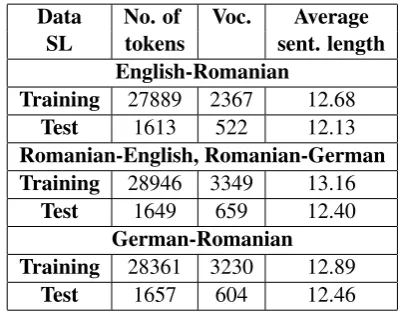
Its small size (2333 sentences) is compensated by the correctness of the translations and tence alignments. We randomly extracted 133 sen-tences, which we used as test data for all three MT systems. The rest of 2200 sentences repre-sent the training data. Statistical information about RoGER is shown in Table 1.
Data No. of Voc. Average SL tokens sent. length
English-Romanian Training 27889 2367 12.68
Test 1613 522 12.13
Romanian-English, Romanian-German Training 28946 3349 13.16
Test 1649 659 12.40
German-Romanian Training 28361 3230 12.89
Test 1657 604 12.46
Table 1: RoGER statistics (SL= source language, voc.=vocabulary, sent.=sentence or sentences).
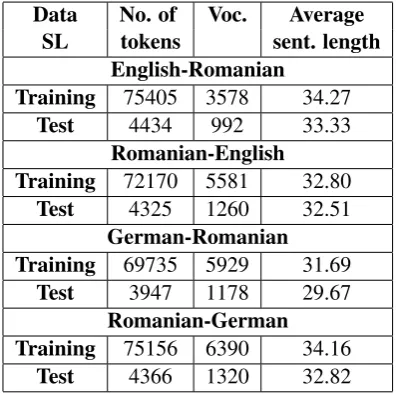
JRC-AcquisSM ALL, is a sub-corpus of the JRC-Acquis (Steinberger et al., 2006). To analyze how the systems behave in case of another type of small-sized corpus, 2333 sentences have been randomly extracted from the center of the whole JRC-Acquis data. These sentences form the JRC-AcquisSM ALL corpus. From this data, 133 sentences have been randomly selected as test data. The rest of 2200 remain as training data. JRC-AcquisSM ALL has not been manually verified or modified. More information about the corpus can be found in Table 2.
Data No. of Voc. Average SL tokens sent. length
English-Romanian Training 75405 3578 34.27
Test 4434 992 33.33
Romanian-English Training 72170 5581 32.80
Test 4325 1260 32.51
German-Romanian Training 69735 5929 31.69
Test 3947 1178 29.67
Romanian-German Training 75156 6390 34.16
Test 4366 1320 32.82
Table 2: JRC-AcquisSM ALLstatistics.
The three languages used in this paper present different morphological and syntactical charac-teristics. As English has been used quite of-ten in MT experiments, for a better understand-ing of the translation challenges, we will briefly describe Romanian and German in the following paragraphs .
Romanian is a lesser resourced language with a highly infected morphology and high demand for translation after joining the European Union in 2007. It is a Romance language, with influ-ence from Slavic languages especially on vocab-ulary and phonetics. Features, such as its inflec-tional system, or the three genders, make difficult the adaptation of language technology systems for other family-related languages.
German is a Germanic language, which is also inflected and presents a 3-gender system and well defined inflection classes. Two special features are represented by the verbs with particles (the sepa-ration of the particle from the verb inside the sen-tence and the challenge that the particle can be
am-biguous) and the compounds. Compounds in Ger-man are normally written as single words, without spaces or other word boundaries.14
Analyzing Tables 1 and 2 ifferences in the text style can be also noticed in the average length of the sentences: between 12 and 13 tokens for RoGER and between 29 and 34 for JRC-AcquisSM ALL. The total number of tokens and the vocabulary size reinforce the differences be-tween the languages: the vocabulary size for the inflected languages is higher as the one for En-glish; the total numbers of tokens for German is lower, as German uses more compounds.
3.2 Automatic Evaluation Results
We evaluated the obtained translations automat-ically by using the BLEU (bilingual evaluation understudy) score. BLEU measures the number of n-grams, of different lengths, of the system out-put that appear in a set of references. More in-formation on BLEU can be found in (Papineni et al., 2002). We considered the twelfth version of the BLEU implementation from the National Insti-tute of Standards and Technology (NIST)15: mte-val v12.
Although BLEU is criticized in the research en-vironment, the choice of the metrics is motivated by our resources (software, linguistic resources, etc.) and, for comparison reasons, by results re-ported in the literature. Due to lack of data and fur-ther translation possibilities, the comparison with only one reference translation is considered.
The obtained results are presented in Tables 3 (for RoGER)and 4 (for JRC-AcquisSM ALL). In the following subsection we will analyze these re-sults.
3.3 Interpretation of the Results
In order to be able to analyze better the results, we examined the test data set from two points of view: the number of out-of-vocabulary words (OOV-words) and the number of test sentences al-ready found in the training data. Both aspects have a direct influence on the translation quality and
14The longest German word verified to be
ac-tually in (albeit very limited) use is Rindfleische-tikettierungs¨uberwachungsaufgaben¨ubertragungsgesetz, which, literally translated, is “beef labelling supervision duty assignment law” [from Rind (cattle), Fleisch (meat), Etikettierung(s) (labelling), ¨Uberwachung(s) (supervision), Aufgaben (duties), Ubertragung(s) (assignment), Gesetz¨ (law )].
15www.itl.nist.gov/iad/mig//tests/mt/
Mb SMT Lin−EBM TREC+ Open-MaTrEx English – Romanian
0.4386 0.3085 0.4320
Romanian – English
0.4765 0.3668 0.4663
German – Romanian
0.3240 0.2646 0.2564
Romanian – German
0.3405 0.2894 0.3058
Table 3: BLEU results (RoGER).
Mb SMT Lin−EBM TREC+ Open-MaTrEx English – Romanian
0.4801 0.3550 0.4446
Romanian – English
0.4904 0.3910 0.4771
German – Romanian
0.2811 0.2167 0.2468
Romanian – German
0.2926 0.2458 0.2433
Table 4: BLEU results (JRC-AcquisSM ALL).
evaluation results. These results for RoGER and JRC-AcquisSM ALLare presented in Tables 5 and 6.
No. OOV-words Sent. in the (% from voc. size) training corpus
English-Romanian 60 (11.49%) 37 (27.8%)
Romanian-English 84 (12.75%) 34 (25.5%)
German-Romanian 101 (16.72%) 31 (23.3%)
Romanian-German 84 (12.75%) 34 (25.5%)
Table 5: Analysis of the test data set (RoGER).
It could be noticed that all systems work better for English-Romanian (both directions of transla-tions) than for German-Romanian (both directions of translations). The lower results for the transla-tion directransla-tion German-Romanian can be also ex-plained by the number of OOV-words and sen-tences found in the training data. We notice a similar behavior for both corpora for Romanian-English, in both directions of translation. For
No. OOV-words Sent. in the (% from voc. size) training corpus
English-Romanian 72 (7.25%) 38 (28.5%)
Romanian-English 129 (10.23%) 33 (24.8%)
German-Romanian 171 (14.51%) 41 (30.82%)
Romanian-German 160 (12.12%) 40 (30.0%)
Table 6: Analysis of the test data set (JRC-AcquisSM ALL).
all three MT systems the results for Romanian-English are better than for Romanian-English-Romanian. Generally, also the results for Romanian-German are better than the ones for German-Romanian. This behavior could mean that building the output for Romanian is more difficult than for the other two languages. Moreover, the German compound nouns could cause data-sparsity.
Compared with the other systems Mb SMT works the best. OpenMaTrEx has the results quite close to the ones of Mb SMT. It is better than the EBMT system with only two exceptions: for German-Romanian and the RoGER data or for Romanian-German and the JRC-AcquisSM ALL data, Lin− EBM TREC+ gives slightly better results than OpenMaTrEx. While comparing the Mb SMTand OpenMaTrEx, we obtained results similar to the ones in (Smith and Clark, 2009)16. The difference is only the corpus size: (Smith and Clark, 2009) used a large-sized corpus (the Eu-roparl corpus) in their experiments.
4 Conclusions and Further Work
In this paper three corpus-based MT systems have been compared using the same test and train-ing data. MT experiments were made for two language pairs (English, Romanian-German), in both directions of translation. Two small-sized domain-restricted corpora of different types were used in the experiments – a framework which is thought to better fit the EBMT approach. In order to establish which system is really the best, as the BLEU score has been criticized in the last couple of years, a manual analysis of the results is currently being made. Splitting
Ger-16A one-to-one comparison is not possible, as the training
man compounds to avoid data sparsity is our next action point. We also need to test the systems with larger copora to analyze how the quality of translation changes when the size of the corpus is progressively incremented. Other interesting as-pects we consider is running OpenMaTrEx under the Marclator mode and testing how changing (in-creasing) the list of markers influences the results.
References
Dan Cristea. 2009. Romanian language technol-ogy and resources go to europe. Presentated at the FP7 Language Technology Informa-tive Days, January, 20-11. To be found at: ftp://ftp.cordis.europe.eu/pub/fp7/ict/docs/language-technologies/cristea en.pdf - last accessed on 10.04.2009.
Sandipan Dandapat, Mikel L. Forcada, Declan Groves, Sergio Penkale, John Tinsley, and Andy Way. 2010. Openmatrex: A free/open-source marker-driven example-based machine translation system. InIceTAL’10, pages 121–126.
Monica Gavrila and Natalia Elita. 2006. Roger - un corpus paralel aliniat. InResurse Lingvistice s¸i In-strumente pentru Prelucrarea Limbii Romˆane Work-shop Proceedings, pages 63–67, 63-67, December. Workshop held in November 2006, Publisher: Ed. Univ. Alexandru Ioan Cuza, ISBN: 978-973-703-208-9.
Monica Gavrila. 2011. Constrained recombination in an example-based machine translation system. In Vincent Vondeghinste, Mikel L. Forcada, and Heidi Depraetere, editors,Proceedings of the EAMT-2011: the 15th Annual Conference of the European Associ-ation for Machine TranslAssoci-ation, pages 193–200, Leu-ven, Belgium, May. ISBN 9789081486118.
Thomas R.G. Green. 1979. The necessity of syntax markers: Two experiments with artificial languages.
Journal of Verbal Learning and Verbal Behavior, 18(4):481 – 496.
Camelia Ignat. 2009. Improving Statistical Align-ment and Translation Using Highly Multilingual Corpora. Ph.D. thesis, INSA - LGeco- LICIA, Strasbourg, France, June, 16th. It can be found on: http://sites.google.com/site/cameliaignat/home/phd-thesis - last accessed on 3.08.09.
Elena Irimia. 2009. Ebmt experiments for the english-romanian language pair. InProceedings of the Re-cent Advances in Intelligent Information Systems, pages 91–102. ISBN 978-83-60434-59-8.
Philipp Koehn, Hieu Hoang, Alexandra Birch, Chris Callison-Burch, Marcello Federico, Nicola Bertoldi, Brooke Cowan, Wade Shen, Christine Moran, Richard Zens, Chris Dyer, Ondrej Bojar, Alexandra
Constantin, and Evan Herbst. 2007. Moses: Open source toolkit for statistical machine translation. In Annual Meeting of the Association for Compu-tational Linguistics (ACL), demonstration session, Prague, Czech Republic, June.
Kevin McTait. 2001. Translation Pattern Extrac-tion and RecombinaExtrac-tion for Example-Based Ma-chine Translation. Ph.D. thesis, Centre for Compu-tational Linguistics, Department of Language Engi-neering, PhD Thesis, UMIST.
Franz Josef Och and Hermann Ney. 2003. A sys-tematic comparison of various statistical alignment models. Computational Linguistics, 29(1):19–51.
Kishore Papineni, Salim Roukos, Todd Ward, and Wei-Jing Zhu. 2002. Bleu: a method for automatic eval-uation of machine translation. InProceedings of the 40th Annual Meeting on Association for Computa-tional Linguistics, Session: Machine translation and evaluation, pages 311 – 318, Philadelphia, Penn-sylvania. Publisher: Association for Computational Linguistics Morristown, NJ, USA.
Maja Popovic and Hermann Ney. 2006. Statistical machine translation with a small amount of bilin-gual training data. In LREC-2006: Fifth Interna-tional Conference on Language Resources and Eval-uation. 5th SALTMIL Workshop on Minority Lan-guages: Strategies for developing machine transla-tion for minority languages, pages 25–29, Genoa, Italy, May.
James Smith and Stephan Clark. 2009. Ebmt for smt: A new ebmt-smt hybrid. In Mikel L. Forcada and Andy Way, editors,Proceedings of the 3rd Intyerna-tional Workshop on Example-Based Machine Trans-lation, pages 3–10, Dublin, Ireland, November, 12-13.
Ralf Steinberger, Bruno Pouliquen, Anna Widiger, Camelia Ignat, Tomaz Erjavec, Dan Tufis, and Daniel Varga. 2006. The jrc-acquis: A multilin-gual aligned parallel corpus with 20+ languages. In
Proceedings of the 5th International Conference on Language Resources and Evaluation (LREC’2006), Genoa, Italy, May, 24-16.
Andreas Stolcke. 2002. Srilm - an extensible lan-guage modeling toolkit. InProc. Intl. Conf. Spoken Language Processing, pages 901–904, Denver, Col-orado, September.
Nicolas Stroppa, Declan Groves, Andy Way, and Kepa Sarasola. 2006. Example-based machine translation of the basque language. In Proceedings of AMTA 2006 – 7th Conference of the Association for Ma-chine Translation in the Americas, pages 232–241, Cambridge, MA, USA., August.