Adversarial Learning Based Semantic Correlation
Representation for Cross-Modal Retrieval
Lei Zhu1,2 , Jiayu Song1, Xiangxiang Wei1,2, and Ju Long1,2,*
1 School of Computer Science and Engineering, Central South University, Changsha, 410083, PR China;
[email protected] (L.Z.); [email protected] (J.S.); [email protected] (X.W.);
2 Network Resources Management and Trust Evaluation Key Laboratory of Hunan Province, Changsha,
410083, PR China
* Correspondence: [email protected];
Abstract:With the rapid development of Internet and the widely usage of smart devices, massive
multimedia data are generated, collected, stored and shared on the Internet. This trend makes cross-modal retrieval problem become a hot issue in this years. Many existing works pay attentions on correlation learning to generate a common subspace for cross-modal correlation measurement, and others uses adversarial learning technique to abate the heterogeneity of multi-modal data. However, very few works combine correlation learning and adversarial learning to bridge the inter-modal semantic gap and diminish cross-modal heterogeneity. This paper propose a novel cross-modal retrieval method, named ALSCOR, which is an end-to-end framework to integrate cross-modal representation learning, correlation learning and adversarial. CCA model, accompanied by two representation model, VisNet and TxtNet is proposed to capture non-linear correlation. Beside, intra-modal classifier and modality classifier are used to learn intra-modal discrimination and minimize the inter-modal heterogeneity. Comprehensive experiments are conducted on three benchmark datasets. The results demonstrate that the proposed ALSCOR has better performance than the state-of-the-arts.
Keywords:Cross-modal retrieval; Adversarial learning; Semantic correlation; Deep learning;
1. Introduction
With the rapid development of Internet and the widely usage of smart devices, huge amounts of multimedia data with various modalities, such as images, texts, videos and audios, etc. are generated, collected, stored and shared on the Internet, as shown in Fig.1. For example, multimedia sharing services such as Flickr, Pinterest, YouTube shares massive images and videos with textual descriptions. Online encyclopedia such as Wikipedia and Baidu baike stores a tremendous amount of items with texts, images covering knowledges in various fields. Online Social networks, such as Twitter, Facebook and Sina Weibo, provide platforms for users to share their lives by millions of tweets and posts with texts, images or short videos. Other applications on mobile platform, such as Instagram and Douyin, make it possible to share pictures and short videos anytime and anywhere. These multi-modal data are usually used to describe the same events, scenes or objects in our daily life, and users always have the need to search relative multimedia data by the queries of different modalities. This retrieval paradigm is called cross-modal retrieval [1–3], which attracts more and more attentions in the community of multimedia.
In the last decade, lots of approaches have been proposed to address the problem of cross-modal retrieval. The main challenge focused by many researchers is to learn a common subspace in which the representations or embeddings of different modalities can be measured via distance function. Canonical Correlation Analysis (CCA) [4] is a widely used statistical method, which is employed by Rasiwasia et al. [5] to find the correlations between representations of different modalities to learn the common subspace. Following [5], several CCA based researches, such as [6–9] have been presented to
Figure 1.Some examples of multi-modal data from Twitter, YouTube and Flickr.
support cross-modal retrieval. Inspired by deep neural networks (DNN) that play an important role of multimedia analysis and pattern recognition, a number of researchers [10–14] exploit DNN to improve the performance of retrieval by learning the non-linear correlations between modalities.
Motivation.The previous cross-modal retrieval approaches aims to learn a common semantic
subspace in which the representations of different modalities can be measured easily. However, very few works combine correlation learning and adversarial learning to bridge the inter-modal semantic gap and diminish cross-modal heterogeneity together. To overcome this challenge, for the first time, this paper proposes to combine cross-modal correlation learning and adversarial learning and develop an end-to-end framework to learn bridge the semantic gap and diminish the cross-modal heterogeneity. Different from the existing studies [15–18], we combine deep CCA based cross-modal correlation learning and adversarial learning to not only learn the semantic correlations to bridge the semantic gap between different modalities, but implement a better cross-modal distribution alignment to diminish the cross-modal heterogeneity.
Our Method.We propose a novel cross-modal retrieval approach, calledAdversarialLearning
basedSemanticCOrrelationRepresentation (ALSCOR). It is a combination of cross-modal correlation learning and adversarial learning. For the cross-modal correlation learning, inspired by deep CCA technique, we design a cross-modal deep representation CCA model which consists of a two-branches network, VisNet and TxtNet. The VisNet is a CNN based model that recieves image samples and maps them into deep representations. The TxtNet is realized by word2vec model, BiLSTM model and a text convolution network, which aims to learn deep representations of texts. The CCA model accompanied by these two model is used to learn the inter-modal correlation. Besides, an intra-modal classifier is used to learn the intra-modal discriminative information. In addition, inspired by generative adversarial network, a modality classifier is utilized to diminish the cross-modal heterogeneity, which is realized by discriminating representations of different modalities.
Contributions.The main contributions of this paper can be summarized as follows:
knowledge, this work is the first time to improve the retrieval performance by using deep CCA, BiSLTM, CNN and adversarial learning together.
• To learn the inter-modal non-linear correlation, a two-branches cross-modal correlation model is developed, which is a integration of VisNet, TxtNet and CCA. The VisNet realized by CNN is to generate deep visual representations, and TxtNet is implemented by word2vec, BiLSTM and CNN to learn deep textual representations. An intra-modal classifier is utilized to learn the intra-modal discrimination, and the modality classifier plays the discriminator to diminish the cross-modal heterogeneity in an adversarial manner.
• Comprehensive experiments on three benchmark datasets are condcuted. We compare the proposed method with 8 state-of-the-arts. The results demonstrate that our method has great performance for cross-modal retrieval.
Roadmap.The remainder of this paper is organized as follows: the related works are reviewed
in Section2. In Section3, we give the definition of cross-modal retrieval and the related techniques, including cross-modal similarity measurement, deep CCA and GAN. In Section4, the framework of ALSCOR is introduced in details, including the architecture and the loss. Our experimental results are presented in Section5, and finally we draw the conclusion in Section6.
2. Related Work
In this section, we review existing studies concerning cross-modal retrieval and deep learning, which are relative to our study. To the best of our knowledge, this work is the first to combine deep CCA method and adversarial learning technique to overcome cross-modal retrieval tast.
2.1. Cross-Modal Retrieval
Cross-modal retrieval is a significant problem in the area of multimedia computing [19–26], which aims to find out the similar enough objects of one modality in the multimedia database by a query of different modality. Due to the exponential growth of amount of multimedia data, this task attracts a large number of attentions in recent years. CCA [27] is an important statistic method to seek the linear correlation between two sets of variates, which is utilized by many studies for cross-modal retrieval. For example, [5] is the first work using CCA to address cross-modal retrieval. In this work, Rasiwasia et al. modeled images and texts by SIFT features and hidden topic model respectively, and then maps the cross-modal representations into a common subspace by CCA. Wang et al. [6] proposed a method called Unsupervised Discriminant Canonical Correlation Analysis (UDCCA), which utilizes normalized spectral clustering to compute class membership. Zu et al. [7] proposed a novel approach named Canonical Sparse Cross-view Correlation Analysis (CSCCA) to consider structure and cross view information. Gong et al. [8] presented a three-view CCA approach that incorporates a third view to model semantic information to improve the retrieval performance. Zhang et al. [9] proposed a method named mixture of probabilistic CCA (MixPCCA) to model the nonlinear correlations between different modalities. Shao et al. [28] presented hypergraph semantic embedding (HSE) approach to model latent semantics from text to regularize the deep CCA subspace. Wang et al. [29] developed a novel correlation subspace learning method by integrating structured sparsity regularization and intra-modal information to achieve better performance. For cross-modal image clustering problem, Jin et al. [30] proposed a CCA based multimodal feature fusion method to characterize the multimodal correlations between the visual features in images and semantic features in captions. Different from the existing researches, we combine deep CCA and adversarial learning method to learn better representations with modality invariance, which can implement feature distribution alignment between different modalities.
multi-modal Latent Dirichlet Allocation (tr-mmLDA) method to capture correlations between cross-modal data. Blei et al. [34] presented correspondence latent Dirichlet allocation method to learn the joint distribution of multi-modal data. Jia et al. [35] proposed a method named Multi-modal Document Random Field to model the relations between different modalities. Lu et al. [36] model the cross-modal retrieval problem as a listwise ranking problem, and proposed a method named Latent Semantic Cross-Modal Ranking (LSCMR) to learn a latent space. Yu et al. [37] utilized LDA to model texts, which is to learn latent semantic relations between texts and images. Zoghbi et al. [38] used bilingual LDA and CCA to model textual and visual data in the task of cross-modal attribute recognition. Instead of LDA, in this work we utilize biLSTM and CNN model to generate deep representations of texts, which is to capture more high-level semantic features.
2.2. Deep Learning
As a very powerful technique, deep learning [39–41] is used to overcome several challenges of multimedia analysis and retrieval, such as image classification [42], object recognition [43], video retrievsal [44], multi-modal/cross-modal retrieval [45], etc. Wei et al. [46] proposed to use deep CNN to learn visual representations for cross-modal retrieval, which performs much better than traditional hand-crafted features. He et al. [47] employed convolution-based networks to generate both visual and textual representations. Shen et al. [48] introduced a method, Textual-Visual Deep Binaries (TVDB), to encode semantics of informative images and long textual descriptions. Yang et al. [49] presented an end-to-end deep learning architecture to generate compact cross-modal hash codes from intra-modal and an inter-modal view. Cao et al. [50] developed a collective deep quantization (CDQ) method, which is an end-to-end deep architecture to jointly learn deep cross-modal representation and quantizers. Hu et al. [51] presented a method named Dense Multimodal Fusion (DMF) to generate joint representations hierarchically, which can learn the correlations in different levels. Gu et al. [52] proposed to use generative model to learn not only the global abstract features but also the local grounded features.
Inspired by [53], several studies utilized adversarial learning to improve the cross-modal representation learning. Wang et al. [15] is the first to use adversarial learning method to combat cross-modal retrieval problem. Zhang et al. [16] proposed to adversarial learning based method to learn attention mask for cross-modal feature generation. Wen et al. [17] introduced a new cross-modal similarity transferring (CMST) method by adversarial learning. This method is to learn common representation subspace via quantitative similarities in single-modal representation subspace. Shang et al. [18] deveoped a dictionary learning based adversarial cross-modal retrieval technique, which makes the transformed features maintain the inherent statistical characteristics of original features. Unlike the existing studies, we combine deep CCA method and adversarial learning to not only learn the semantic correlations between different modalities, but implement a better cross-modal distribution alignment.
3. Preliminary
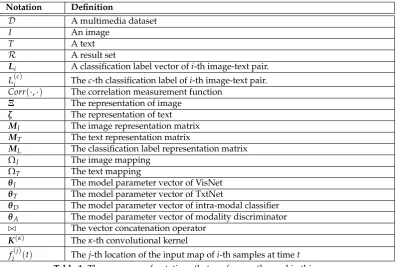
In this section, we firstly formalize the definition of cross-modal retrieval and the related notions. Besides, the cross-modal correlation measurement is proposed. In addition, two important techniques, i.e., deep CCA and LSTM are introduced, which are related to our method. Table1summarizes the notations frequently used in this paper to facilitate the discussion.
3.1. Problem Definition
Definition 1 (Cross-Modal Retrieval). Without losing generality, consider a multimedia dataset that
Notation Definition
D A multimedia dataset
I An image
T A text
R A result set
Li A classification label vector ofi-th image-text pair.
L(ic) Thec-th classification label ofi-th image-text pair.
Corr(·,·) The correlation measurement function
Ξ The representation of image
ζ The representation of text
MI The image representation matrix
MT The text representation matrix
ML The classification label representation matrix
ΩI The image mapping
ΩT The text mapping
θI The model parameter vector of VisNet
θT The model parameter vector of TxtNet
θD The model parameter vector of intra-modal classifier
θA The model parameter vector of modality discriminator
./ The vector concatenation operator
K(κ) Theκ-th convolutional kernel
fi(j)(t) Thej-th location of the input map ofi-th samples at timet
Table 1.The summary of notations that are frequently used in this paper
different modalities. Cross-modal retrieval aims to return a set of dataRof one modality, which are correlative enough to the query of another modality, namely,
R={Y|Y∈ D,Y0∈ D \ R,Corr(XQ,Y)≥Corr(XQ,Y0)} (1)
where Corr(·,·)is a cross-modal correlation measurement that is to measure the corrleations between two objects of different modalities.
This work focuses on two most common modalities on the Internet, i.e., imageIand textT. Two corresponding retrieval tasks are studied: (1) image-to-text retrieval that is to find correlative texts by a image query and (2) text-to-image retrieval that is to find correlative images by a text query. According to Definition1, these two tasks can be formalized as
RI2T={T|T∈ D,T0 ∈ D \ RI2T,Corr(IQ,T)≥Corr(IQ,T0)}, (2)
RT2I ={I|I∈ D,I0∈ D \ RT2I,Corr(TQ,I)≥Corr(TQ,I0)}. (3)
Suppose that the multimedia datasetD={hI1,T1i,hI2,T2i, ...,hIn,Tni}containsnpairs of image and text. Each pairs has a classification label vector denoted asLi={L(11),Li(2), ...,L(ic)} ∈Rc, wherecis the number of the classifications. If thei-th object belongs to thej-th classification, theL(ij)=1, otherwise L(ij)=0. The representations of imageIiand textTiare denoted asξi = (ξi(1),ξi(2), ...,ξi(γI))∈RγI and ζi= (ζ(i1),ζ(i2), ...,ζi(γT))∈RγT, whereγIandγTare the number of demensions, and generallyγI 6=γT. Therefore, for the multimedia datasetD, the image representation matrix, the text representation matrix and the classification label matrix are denoted asMI = (ξ1,ξ2, ...,ξn)∈RγI×n,MT= (ζ1,ζ2, ...,ζn)∈ RγT×n, andML= (L1,L2, ...,Ln)∈Rc×n, respectively.
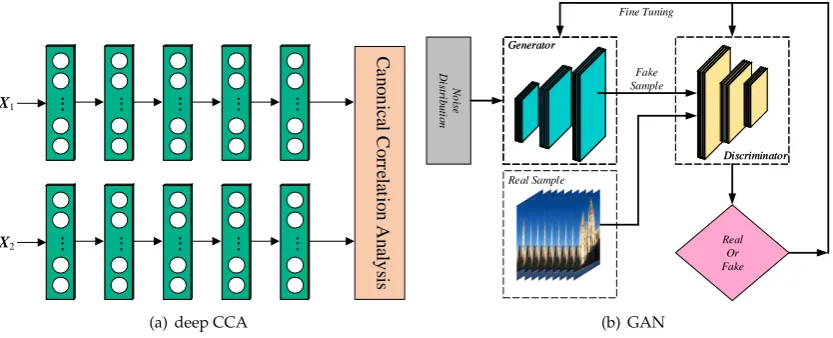
C a n o n ic al C o rr el at io n A n al y sis ... ... ... ... ... ... ... ... ... ... X1 X2
(a) deep CCA
N o is e D is tr ib u tio n Discriminator Discriminator Generator Generator Real Sample Fake Sample Real Or Fake Fine Tuning (b) GAN
Figure 2.The structure of deep CCA and GAN.
of representations are hard to be aligned. These two limitations hinder the correlation measurement of cross-modal data. Thus, two cross-modal mappings,ΩI((I1,I2, ...,In))andΩT((T1,T2, ...,Tn))need to be learnt to project images(I1,I2, ...,In)and texts(T1,T2, ...,Tn)into a common semantic subspace, in which the representations of images and texts have the similar distributions and the semantic concepts can be aligned. Formally,
ΩI((I1,I2, ...,In)):(I1,I2, ...,In)→(ξ1ˆ , ˆξ2, ..., ˆξn)∈Rγ×n, (4)
ΩT((T1,T2, ...,Tn)):(T1,T2, ...,Tn)→(ζ1ˆ , ˆζ2, ..., ˆζn)∈Rγ×n, (5) where(ξˆ1, ˆξ2, ..., ˆξn)and(ζˆ1, ˆζ2, ..., ˆζn)are the representation matrix of images and texts in the common semantic subspace. Therefore, the correlations between multi-modal data can be measured via distance function in this space. Inspired by Pearson correlation, we propose the cross-modal correlation measurement as follows:
Definition 2 (Cross-Modal Correlation Measurement). Given an image Ii and a text Tj, the
representations of Ii and Tj in the common semantic subspace are ξˆi and ζˆj, the cross-modal correlation between Iiand Tjis measured by the following equation:
Corr(Ii,Tj) = ∑ γ
k=1(ξˆ
(k)
i −µξˆi)×(ζˆ
(k)
j −µζˆj)
q
∑γ
k=1(ξˆ
(k)
i −µξˆi) 2×
r
∑γ
k=1(ζˆ
(k)
j −µζˆj) 2
(6)
whereµξˆi andµζˆj are the averages ofξˆiandζˆj, respectively.
3.2. Deep Canonical Correlation Analysis
Deep CCA is an extension proposed by Andrew et al. [54], which is a combination of linear CCA and deep neural network to learn the non-linear correlation between two views. As shown in Fig.2(a), the deep CCA consists of a coupledd-layer fully-connected neural networks. The input instances of view 1 and view 2 are denoted asX1 ∈Rm1 andX2 ∈Rm2, respectively. The output of the first neural network layer areh1
1 =s(W11X1+b11)∈ Rc1 andh12 =Σ(W21X2+b12)∈ Rc2, where W11∈Rc1×m1andW1
2 ∈Rc2×m2 are the matrices of weight,b11andb12are the vectors of bias,Σ(·)is a non-linear activation function. The second layer recieves the outputs of the first layer and generates its outputsh12=Σ(W12h11+b21)∈Rc1 andh2
2=Σ(W22X2+b22)∈Rc2. For the last layer, the outputs are f1(X1) =Σ(W1dhd
−1 1 +bd
−1
1 )∈Roand f2(X2) =Σ(W2dhd −1 2 +bd
−1
X2, namelyCorr(f1(X1),X2). Letθ1= (W11, ...,W1d,b11, ...,bd1)andθ2= (W21, ...,W2d,b12, ...,bd2)be the network parameter vectors of view 1 and view 2, the objective function is:
(θ∗1,θ∗2) =arg max
(θ1,θ2)
Corr(f1(X1;θ1),f2(X2;θ2)). (7)
This objective function can be optimized by gradient descent method on the training set. LetH1∈Ro×n and H2 ∈ Ro×n be the representations matrices generated by top-layer networks, wheren is the number of training samples. Let ¯H1 = H1− 1nH11and ¯H2 = H2−n1H21be the centered matrices,
ˆ
Σ11 = n−11H¯1H¯
0
1+r1I, ˆΣ22= n−11H¯2H¯ 0
2+r2I, ˆΣ12= n−11H¯1H¯ 0
2, where1∈Ro×ois an all-1 matrix,Iis an identity matrix,r1andr2are the regularization terms. Here suppose thatr1>0 andr2>0, thus both of ˆΣ11and ˆΣ22are positive definite. As the total correlation of the top-kcomponents of matrices H1andH2is the sum of the top-ksingular values ofT =Σˆ11−1/2Σˆ12Σˆ−221/2, letk= o, the correlation betweenH1andH2can be computed by the following equation:
Corr(H1,H2) =tr(T0T)−1/2. (8) Let the singular value decomposition of matrixTbeT =U DV0, then
∂Corr(H1,H2)
∂H1
= 1
n−1(2∇11H¯1+∇12H¯2), (9)
∂Corr(H1,H2)
∂H2
= 1
n−1(2∇22H¯2+∇12H¯2), (10) where
∇11=−1
2Σˆ −1/2 11 U DU
0Σˆ−1/2
11 , (11)
∇22=−1
2Σˆ −1/2 22 U DU
0Σˆ−1/2
22 , (12)
∇12=−1
2Σˆ −1/2 11 UV
0Σˆ−1/2
22 . (13)
3.3. Generative Adversarial Netwrok
Generative Adversarial Netwrok (GAN) [53] is an unsupervised learning approach, which is used for several multimedia tasks, such as image generation, 3D reconstruction, super-resolution, etc. As shown in Fig.2(b), GAN consists of two component: a generatorGand a discriminatorD. The generator aims to synthetize forged image according to real samples, and the discriminator is to recognize whether the inputs are the productions of generator or the natural images. The training process is equivalent to a two-player zero-sum game: the generatorGendeavours to produce synthetic samples more similar to the real samples, while the discriminatorDvigorously to identify whether the inputs is from the distribution ofGor the natural distribution. At last, these two models achieve a dynamic equilibrium: the generated samples are similar enough to the natural distribution, while the discriminatorDcannot discriminate the real and synthetic samples. Let a narual image sample beI that obey natural random distributionP(I),z∈Rγbe a random vector from distributionPz(z). The generatorG(I;θG)aims to mapzto a synthetic sampleG(z;θG). The discriminatorD(I;θD)receives G(z;θG)as input and outputs the discriminant resultD(G(z;θG);θD)which is the probability that G(z;θG)is generated fromG. Thus, this game process can be formulated as an minimax optimization, formalized by the following objective function:
arg min
... VisNet FC -L ay er Conv-1 Conv-2 Conv-3 Conv-4 Conv-5 Max Pooling Max Pooling Max Pooling FC -L ay er Conv-1 Conv-2 Conv-3 Conv-4 Conv-5 Max Pooling Max Pooling Max Pooling ... FC-1 FC-2 TxtNet W ord 2ve c LSTM
..
.
..
.
LSTM LSTM LSTM LSTM LSTM LSTM LSTM ... .....
.
..
.
Bi LSTM image-text pair Images TextsText Embeddi ng
C o n v o lu tio n a l F il te rs M a x P o o li n g Input Layer C1 C2 Cn Image Or Text Modality Discriminator Intra-modal Cl assi fier Image Repr esentation
Text Representation C o rre la tio n L os s D is c ri m ina tion L os s ... CNN FC -L ay er FC-1 FC-2 A dv er sa ri al L os s Loss
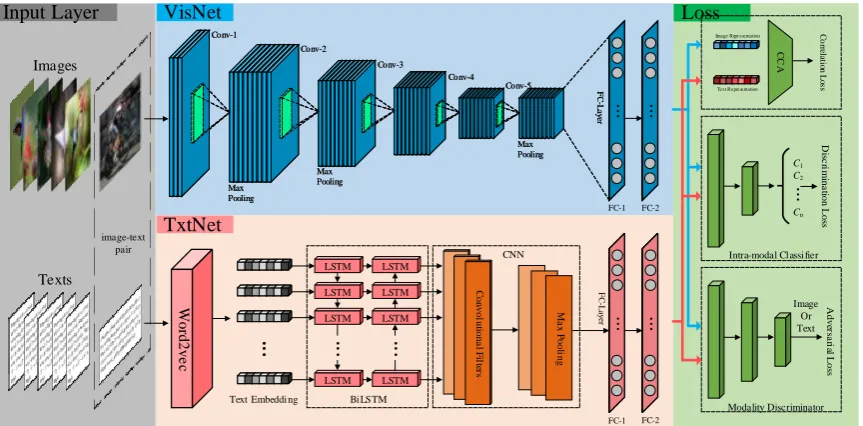
Figure 3. The architecture of the proposed ALSCOR. ALSCOR is an end-to-end framework of cross-modal retrieval. It has three layers: (1) Input layer that feeds image-text paris into the cross-modal representation layer; (2) cross-modal Representation layer includs two models: VisNet and TxtNet; (3) Loss layer contains three model. CCA model is used to learn the correlations between representations of image and text via correlation loss. Intra-modal Classifier model is to learn the intra-modal discriminative representations via discrimination loss. The modality discriminator is used to learn modality-invariant representations via adversarial loss.
whereθGandθDare the model parameters ofGandD, respectively.EI∼Pn(I)[·]andEz∼Pz(z)[·]are the expectations, and
EI∼Pn(I)[logD(I;θD)] = Z
IPn(I)log(D(I;θD))dI, (15) Ez∼Pz(z)[log(1−D(G(z;θG);θD))] =
Z
zPz(z)log(1−D(G(z;θG);θD))dz. (16) The generator G and discriminator D are trained in an alternate and iterative manner. For the generatorG, the objective is to minimize the loss function to produce more authentic samples to fool the discriminatorD. By contrast, for the discriminatorD, the objective is to maximize the loss. Formally, the objective functions are:
arg min
G LGAN(G,D) = Z
IPn(I)log(D(I;θD))dI (17) arg max
D LGAN(G,D) = Z
zPz(z)log(1−D(G(z;θG);θD))dz (18)
4. The Method
To learn a common subspace and bridge the semantic gap between different modalities, we propose an effective end-to-end framework, namedAdversarialLearning basedSemanticCOrrelation
Representation (ALSCOR), which is a combination of cross-modal correlation learning and adversarial learning. In this section, we introduce this method in details.
4.1. The Architecture of ALSCOR
Overview. The general architecture of the proposed ALSCOR is illustrated in Fig.3, which
traditional deep CCA that uses two deep fully connected networks, ALSCOR utilizes a deep CNN for image representation and a integration of BiLSTM and convolutional network for text representations. Specifically, this is an end-to-end framework of cross-modal retrieval. It has three layers: (1)Input
layer, (2)cross-modal Representation layerand (3)Loss layer. The input layer contains a multimedia
collection, and it feeds image-text paris into the next layer, namely cross-modal representation layer. Cross-modal Representation layer is a two-way deep neural network structure, which includs two models to learn deep representations of image and text, respectively. The one is VisNet, which is implemented by deep convolutional network to learn the deep representations of images. The other is TxtNet, which is generate text representations via a comnination of word2vec model, BiLSTM network and text convolutional network. The Loss layer contains three models. CCA model is used to learn the correlations between representations of image and text via correlation loss. Intra-modal Classifier model is to learn the intra-modal discriminative representations via discrimination loss. The modality discriminator is used to learn modality-invariant representations via adversarial loss.
VisNet. VisNet is a CNN based model to generate deep representations of images, formally,
(ξ(i1),ξi(2), ...,ξi(γI)) = VisNet(Ii;θI), whereθI is the model parameter vector. Compared with deep fully-connected neural networks in deep CCA method, CNN is more powerful to capture high-level visual semantic information from images. In our approach, we utilize AlexNet [42], a well-known CNN model to implement VisNet. Specifically, it has five convolutional layers and two fully-connected layers. The input images are resized to 224×224×3, which are fed into the first convolutional layer. The first convolutional layer has 96 kernels of size 11×11×3. The second convolutional layer has 256 kernels of size 5×5×96. The third convolutional layers has 384 kernels of size 3×3×256. The fourth convolutional layers has 384 kernels of size 3×3×192. The fifth convolutional layers has 256 kernels of size 3×3×192. Following the last convolutional layer, there are two fully-connected layers that have 4096 neurons each. The second full-connected layer output 4096-demensional feature representations, namelyγI=4096.
TxtNet. TxtNet is a combination of word2vec, BiLSTM network and CNN model, which is to
generateλ-demensional text representations, namely (ζ(i1),ζ(i2), ...,ζ(iγT)) = TxtNet(Ti;θT), where θT is the model parameter vector. The word2vec model receives the inputs and generates a set of word embeddings(v1,v2, ...,vn), wherenis the number of the words. Compared to the traditional representation method (such as BoW), word2vec can capture both semantic and synthactic information of text. Following word2vec model, a BiLSTM model is used to encode the contextual information from both the previous and future context. For each of the directions, the LSTM has three gates: the input gatei, forget gate f and output gateo. At the timet, the each state in the LSTM is:
i(t) =σ(Wi[h(t−1),v(t)] +bi) (19) f(t) =σ(Wf[h(t−1),v(t)] +bf) (20) o(t) =σ(Wo[h(t−1),v(t)] +bo) (21) ˜
C(t) =tanh(Wc[h(t−1),v(t)] +bc) (22) C(t) =i(t)×C˜(t) + f(t)×C(t−1) (23) h(t) =o(t)×tanh(C(t)) (24) where h(t) is the hidden vector, σ is the sigmoid function,Wi,Wf,Wo, bi, bf, bo are the model parameter vectors. The output of the BiLSTM is the concatenation of the outputs of two LSTMs, namelyh(t) =h1(t)./h2(t), where./is the vector concatenation operator.
sizem×m, i.e.,K= (K(1),K(2), ...,K(κ)). For thej-th location of the input map, the calculation can be formalized as follows:
fi(j)(t) =g( m
∑
i=1h(t+i−1)T∗K(i)+b) (25) whereg(·):R7→Ris a non-linear activation function,bis a bias,∗is the convolutional operator. For thei-th kernelK(i), it slides across the input feature map step-by-step and generate the feature map as follows:
fi(t) = (fi(1)(t),f
(2)
i (t), ...,f
(H−m+1)
i (t)) (26)
whereHis the size of the input map. All the feature maps are denoted as(f1(t),f2(t), ...,fm(t)), which are fed into the max-pooling layer, namely,
(fˆ1(t), ˆf2(t), ..., ˆfm(t)) =max(f1(t),f2(t), ...,fm(t)) (27) wheremax(·)is the function to select the maximal element of each feature vector.
To restraint overfitting, before the fully-connected layers, a drop-out operation is used to randonly discards a part of outputs of max-pooling, shown as follows:
(ζ(i1),ζi(2), ...,ζ(iγT)) =Wf c×(fˆ1(t), ˆf2(t), ..., ˆfm(t))TM+β (28) where Wf c and β are the parameters of the fully-connected layers, is the is the elementwise multiplication operator,Mis a masking vector of Bernoulli random variables.
4.2. The Loss
In the loss layer, three modules are used to learn the common semantic subspace. The CCA module aims to learn the correlation between images and texts by correlation loss, which recives the deep representations from VisNet and TxtNet. The intra-model classifier is to learn the intra-modal discriminations by using the classification labels of image-text pairs via discrimination loss. The modality classifier plays an role of discriminator in GAN, which is to diminish the heterogeneity between representations of different modalities via adversarial loss.
Correlation Loss. The CCA module integrated with VisNet and TxtNet forms a end-to-end
non-linear correlation learning model to maximize the cross-modal correlation. According to deep CCA, the correlation loss is formalized as follows:
Lcorr(Ii,Ti;θI,θT) =Corr(VisNet(Ii;θI),TxtNet(Ti;θT)). (29) Therefore, the correlation learning is to optimize the following objective function:
(θ∗I,θ∗T) =arg max
(θI,θT)
Lcorr(Ii,Ti;θI,θT),∀hIi,Tii ∈ D. (30)
The optimal parameters(θ∗I,θ∗T)are calculated by using gradient of the correlation objective on the training setD. The optimization can be followed the equation9to13.
Discrimination Loss.The intra-modal classifier is to maintain the discrimination of multi-modal
data after the cross-modal non-linear mapping. It is realized by predicting the categories label of the cross-modal data in the common semantic subspace. Specifically, this model is a feed-forward neural network followed by a softmax layer, which is to recieves the representations of different modalites in the common subspace and output a probability distribution of categories. In our scheme, the cross-entropy loss is used to implement the discrimination loss, shown as follows:
Ldisc(Ii,Ti;θI,θT,θD) =−1 m
m
∑
i=1whereP(·)is the probability distribution of categories,θDis the parameter vector of the classifier,mis the number of samples in each mini-batch during the training.
Adversarial Loss. Inspired by GAN, the adversarial learning in our method is realized by a
modality classifierD, which works as the discriminator to identify the representation is generated from an image and a text. Accroding to [15], this model is implemented by a three-layer feed-forward neural network with parameterθA. The representations generated from image modality are assigned with label 01, and the represenations generated from text modality are assgined with label 10. The loss function can be formalized as follows:
Ladv(Ii,Ti;θI,θT,θA) =−1
n n
∑
i=1mi(logD(VisNet(Ii;θI);θA) +log(1−D(TxtNet(Ti;θT);θA)))
(32)
wheremi is the ground-truth modality label of each representation.
Adversarial Learning.For the adversarial learning process, we incorporate the correlation loss
(equation29), discrimination loss (equation31) and adversarial loss (equation32), and optimize them as a min-max game, shown as follows:
(θ∗I,θ∗T,θ∗D) = arg min
(θI,θT,θD)
(αLcorr(Ii,Ti;θI,θT) +δLdisc(Ii,Ti;θI,θT,θD)−εLadv(Ii,Ti;θI,θT,θ∗A)), (33)
θ∗A =arg max
θA
(αLcorr(Ii,Ti;θ∗I,θ∗T) +δLdisc(Ii,Ti;θ∗I,θ∗T,θ∗D)−εLadv(Ii,Ti;θI,θT,θA))), (34)
∀hIi,Tii ∈ D.
whereα,δandεare the weight parameters for these three loss terms. The training can be realized by
using a stochastic gradient descent algorithm.
5. Experiments
In this section, we present the performance evaluation of the proposed method and the comparison with several state-of-the-arts on four multimedia datasets. The experimental setup is introduced in section5.1, the implementation details of the proposed method is described in section5.2, and the performance evaluation and comparison are shown in section5.3.
5.1. Experimental Setup
Datasets.Our experiments are conducted on three benchmark multimedia datasets: Wikipedia [5],
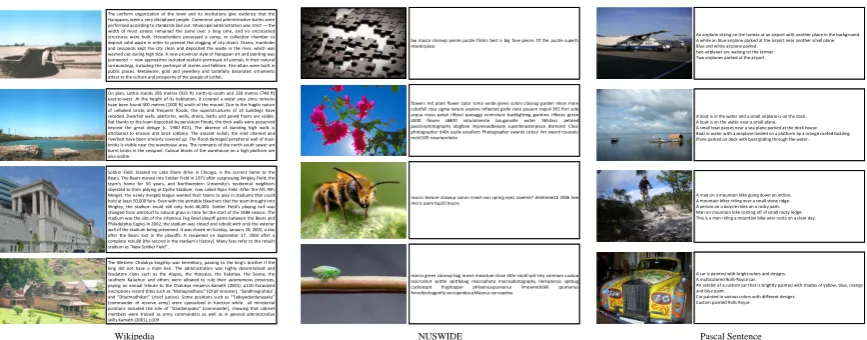
NUS-WIDE [55], andPascal Sentence [56], which are widely used in multi-modal/cross-modal retrieval tasks. The detailed descriptions are presented as follows. Some samples of these datasets are shown in Fig.4.
• Wikipedia. Wikipedia (https://en.wikipedia.org/wiki/) dataset is generated from the
An airplane sitting on the tarmac at an airport with another plane in the background. A white an blue airplane parked at the airport near another small plane. Blue and white airplane parked.
two airplanes are waiting on the tarmac Two airplanes parked at the airport.
A boat is in the water and a small airplane is on the dock. A boat is on the water near a small plane. A small boat passes near a sea plane parked at the dock house. Boat in water with a seaplane landed on a platform by a orange roofed building Plane parked on deck with boat gliding through the water.
A man on a mountain bike going down an incline. A mountain biker riding over a small stone ridge. A person on a bicycle rides on a rocky path. Man on mountain bike coming off of small rocky ledge. This is a man riding a mountain bike over rocks on a clear day.
A car is painted with bright colors and designs. A multicolored Rolls-Royce car.
An exhibit of a custom car that is brightly painted with shades of yellow, blue, orange and blue paint.
Car painted in various colors with different designs. Custom painted Rolls Royce
An airplane sitting on the tarmac at an airport with another plane in the background. A white an blue airplane parked at the airport near another small plane. Blue and white airplane parked.
two airplanes are waiting on the tarmac Two airplanes parked at the airport.
A boat is in the water and a small airplane is on the dock. A boat is on the water near a small plane. A small boat passes near a sea plane parked at the dock house. Boat in water with a seaplane landed on a platform by a orange roofed building Plane parked on deck with boat gliding through the water.
A man on a mountain bike going down an incline. A mountain biker riding over a small stone ridge. A person on a bicycle rides on a rocky path. Man on mountain bike coming off of small rocky ledge. This is a man riding a mountain bike over rocks on a clear day.
A car is painted with bright colors and designs. A multicolored Rolls-Royce car.
An exhibit of a custom car that is brightly painted with shades of yellow, blue, orange and blue paint.
Car painted in various colors with different designs. Custom painted Rolls Royce bw macro closeup pieces puzzle flickrs best a big fave pieces Of the puzzle superb
masterpiece
flowers red plant flower color roma verde green colors closeup garden nikon mare colorfull rosa sigma natura explore reflected giallo cielo passion napoli 365 fiori sole acqua rosso petali riflessi paesaggi controluce backlighting giardino riflesso gocce d300 flowre sb800 naturalmente bouganville woter 365days petaled passionphotography abigfave impressedbeauty superbmasterpiece diamond Class photographer d40x ysplix excellent Photographer awards colour Art award rosacelo mcb1105 rosariocelotto
macro texture closeup canon insect eos spring eyes saveme7 deleteme10 2006 bee micro azem top20 macro
macro green closeup bug insect miniature close little small spit tiny common cuckoo macroshot spittle spittlebug macrophoto macrophotography hemipteran spitbug cuckoospit froghopper philaenusspumarius limowreck666 spumarius forcelticdragonfly cercopoidea philaenus cercopidea bw macro closeup pieces puzzle flickrs best a big fave pieces Of the puzzle superb masterpiece
flowers red plant flower color roma verde green colors closeup garden nikon mare colorfull rosa sigma natura explore reflected giallo cielo passion napoli 365 fiori sole acqua rosso petali riflessi paesaggi controluce backlighting giardino riflesso gocce d300 flowre sb800 naturalmente bouganville woter 365days petaled passionphotography abigfave impressedbeauty superbmasterpiece diamond Class photographer d40x ysplix excellent Photographer awards colour Art award rosacelo mcb1105 rosariocelotto
macro texture closeup canon insect eos spring eyes saveme7 deleteme10 2006 bee micro azem top20 macro
macro green closeup bug insect miniature close little small spit tiny common cuckoo macroshot spittle spittlebug macrophoto macrophotography hemipteran spitbug cuckoospit froghopper philaenusspumarius limowreck666 spumarius forcelticdragonfly cercopoidea philaenus cercopidea The uniform organization of the town and its institutions give evidence that the
Harappans were a very disciplined people. Commerce and administrative duties were performed according to standards laid out. Municipal administration was strict — the width of most streets remained the same over a long time, and no encroached structures were built. Householders possessed a sump, or collection chamber to deposit solid waste in order to prevent the clogging of city drains. Drains, manholes and cesspools kept the city clean and deposited the waste in the river, which was washed out during high tide. A new provincial style of Harappan art and painting was pioneered — new approaches included realistic portrayals of animals in their natural surroundings, including the portrayal of stories and folklore. Fire-altars were built in public places. Metalware, gold and jewellery and tastefully decorated ornaments attest to the culture and prosperity of the people of Lothal. On plan, Lothal stands 285 metres (935 ft) north-to-south and 228 metres (748 ft) east-to-west. At the height of its habitation, it covered a wider area since remains have been found 300 metres (1000 ft) south of the mound. Due to the fragile nature of unbaked bricks and frequent floods, the superstructures of all buildings have receded. Dwarfed walls, platforms, wells, drains, baths and paved floors are visible. But thanks to the loam deposited by persistent floods, the dock walls were preserved beyond the great deluge (c. 1900 BCE). The absence of standing high walls is attributed to erosion and brick robbery. The ancient nullah, the inlet channel and riverbed have been similarly covered up. The flood-damaged peripheral wall of mud-bricks is visible near the warehouse area. The remnants of the north-south sewer are burnt bricks in the cesspool. Cubical blocks of the warehouse on a high platform are also visible.
Soldier Field, located on Lake Shore Drive in Chicago, is the current home to the Bears. The Bears moved into Soldier Field in 1971 after outgrowing Wrigley Field, the team's home for 50 years, and Northwestern University's residential neighbors objected to their playing at Dyche Stadium, now called Ryan Field. After the AFL-NFL Merger, the newly merged league wanted their teams to play in stadiums that could hold at least 50,000 fans. Even with the portable bleachers that the team brought into Wrigley, the stadium could still only hold 46,000. Soldier Field's playing turf was changed from astroturf to natural grass in time for the start of the 1988 season. The stadium was the site of the infamous Fog Bowl playoff game between the Bears and Philadelphia Eagles.In 2002, the stadium was closed and rebuilt with only the exterior wall of the stadium being preserved. It was closed on Sunday, January 20, 2002, a day after the Bears lost in the playoffs. It reopened on September 27, 2003 after a complete rebuild (the second in the stadium's history). Many fans refer to the rebuilt stadium as "New Soldier Field".
The Western Chalukya kingship was hereditary, passing to the king's brother if the king did not have a male heir. The administration was highly decentralised and feudatory clans such as the Alupas, the Hoysalas, the Kakatiya, the Seuna, the southern Kalachuri and others were allowed to rule their autonomous provinces, paying an annual tribute to the Chalukya emperor.Kamath (2001), p110 Excavated inscriptions record titles such as ''Mahapradhana'' (Chief minister), ''Sandhivigrahika'', and ''Dharmadhikari'' (chief justice). Some positions such as ''Tadeyadandanayaka'' (commander of reserve army) were specialised in function while all ministerial positions included the role of ''Dandanayaka'' (commander), showing that cabinet members were trained as army commanders as well as in general administrative skills.Kamath (2001), p109
The uniform organization of the town and its institutions give evidence that the Harappans were a very disciplined people. Commerce and administrative duties were performed according to standards laid out. Municipal administration was strict — the width of most streets remained the same over a long time, and no encroached structures were built. Householders possessed a sump, or collection chamber to deposit solid waste in order to prevent the clogging of city drains. Drains, manholes and cesspools kept the city clean and deposited the waste in the river, which was washed out during high tide. A new provincial style of Harappan art and painting was pioneered — new approaches included realistic portrayals of animals in their natural surroundings, including the portrayal of stories and folklore. Fire-altars were built in public places. Metalware, gold and jewellery and tastefully decorated ornaments attest to the culture and prosperity of the people of Lothal. On plan, Lothal stands 285 metres (935 ft) north-to-south and 228 metres (748 ft) east-to-west. At the height of its habitation, it covered a wider area since remains have been found 300 metres (1000 ft) south of the mound. Due to the fragile nature of unbaked bricks and frequent floods, the superstructures of all buildings have receded. Dwarfed walls, platforms, wells, drains, baths and paved floors are visible. But thanks to the loam deposited by persistent floods, the dock walls were preserved beyond the great deluge (c. 1900 BCE). The absence of standing high walls is attributed to erosion and brick robbery. The ancient nullah, the inlet channel and riverbed have been similarly covered up. The flood-damaged peripheral wall of mud-bricks is visible near the warehouse area. The remnants of the north-south sewer are burnt bricks in the cesspool. Cubical blocks of the warehouse on a high platform are also visible.
Soldier Field, located on Lake Shore Drive in Chicago, is the current home to the Bears. The Bears moved into Soldier Field in 1971 after outgrowing Wrigley Field, the team's home for 50 years, and Northwestern University's residential neighbors objected to their playing at Dyche Stadium, now called Ryan Field. After the AFL-NFL Merger, the newly merged league wanted their teams to play in stadiums that could hold at least 50,000 fans. Even with the portable bleachers that the team brought into Wrigley, the stadium could still only hold 46,000. Soldier Field's playing turf was changed from astroturf to natural grass in time for the start of the 1988 season. The stadium was the site of the infamous Fog Bowl playoff game between the Bears and Philadelphia Eagles.In 2002, the stadium was closed and rebuilt with only the exterior wall of the stadium being preserved. It was closed on Sunday, January 20, 2002, a day after the Bears lost in the playoffs. It reopened on September 27, 2003 after a complete rebuild (the second in the stadium's history). Many fans refer to the rebuilt stadium as "New Soldier Field".
The Western Chalukya kingship was hereditary, passing to the king's brother if the king did not have a male heir. The administration was highly decentralised and feudatory clans such as the Alupas, the Hoysalas, the Kakatiya, the Seuna, the southern Kalachuri and others were allowed to rule their autonomous provinces, paying an annual tribute to the Chalukya emperor.Kamath (2001), p110 Excavated inscriptions record titles such as ''Mahapradhana'' (Chief minister), ''Sandhivigrahika'', and ''Dharmadhikari'' (chief justice). Some positions such as ''Tadeyadandanayaka'' (commander of reserve army) were specialised in function while all ministerial positions included the role of ''Dandanayaka'' (commander), showing that cabinet members were trained as army commanders as well as in general administrative skills.Kamath (2001), p109
Wikipedia NUSWIDE Pascal Sentence
Figure 4.Some image-text pairs in Wikipedia, NUS-WIDE and Pascal Sentence dataset.
• NUS-WIDE.NUS-WIDE (https://lms.comp.nus.edu.sg/wp-content/uploads/2019/research/
\NUS-WIDE/NUS-WIDE.html) dataset is a real-world web image dataset which contains 269648 images and the associated tags from Flickr, with a total number of 5018 unique tags. Each image in NUS-WIDE corresponds to 81 ground truth labels and 1000 text tags. We select the labeled images which belong to the 21 largest categories for experiments. The training set has 114117 samples and the testing set contains 76303 samples. Following the experimental settings in [55], the hand-crafted features of iamges are 500-demensional SIFT descriptions based BoVW vectors and the textual features are 1000-demensional BoW vector.
• Pascal Sentence. Pascal Sentence (http://vision.cs.uiuc.edu/pascal-sentences/) dataset aims
to support for pattern analysis, statistical modeling and computational learning, which is a subset of Pascal VOC. It contains twenty categories, including aeroplane, bicycle, bird, boat, bottle, bus, car, cat, chair, cow, dining table, dog, horse, motorbike, person, potted plant, sheep, sofa, train, tv. The training set consists of 10103 images with 23374 objects such that there are approximately 500 training objects per category. To compare with CNN representations, we generate 1024-demensional SIFT based BoVW feature vectors for images, and 100-demensional topic probability features by LDA and BoW for texts.
Compared Approaches. To verify the effectiveness of the proposed method, we compare the
proposed ALSCOR with 8 approaches on these three datasets. The brief introduction of these approaches are shown as follows:
• CCA.CCA [27] is a multivariate statistical analysis method to find the linear correlation between two multivariate random variables. It is widely used in many multi-modal/cross-modal retrieval tasks.
• DCCA. Deep Canonical Correlation Analysis [54] (DCCA for short) is an extension of CCA
to learn complex nonlinear transformations of two representation vectos via two deep neural networks.
• TVKCCA.Three-view Kernel Canonical Correlation Analysis [59] (TVCCA for short) contains
three views: two modalities views and a semantic views. It aims to learn a common subspace for visual, textual and semantic information via kernel CCA to achieve a better separation of data that belong to different categories.
• SM.Semantic Matching [5] (SM for short) is to map image and text to a high-level semantic subspace by using multi-class logisic regression. In this common semantic space, the natural correspondences between cross-modal representation can be captured.
• Deep-SM.Deep Semantic Matching [46] (Deep-SM for short) is a deep learning based method
• RE-DNN.Regularized Deep neural network [11] (RE-DNN for short) to generate high-level representations of different modalities. This approach learns a joint model that captures both intra-modal and inter-modal relationships by an intra-modal regularization.
• Corr-AE.Correspondence Autoencoder [10] (Corr-AE for short) is built by correlaing hidden
representations with only common information of two uni-modal autoencoder. It incorporates representation learning and correlation learning into a single process.
• ACMR.Adversarial Cross-Modal Retrieval [15] (ACMR for short) is an adversarial learning
based method to generate modality-invariant representations. This method minimizes the gap between different representations belong to the same categories, while maximizes the distances among semantically different data.
Performance Metrics. In our experiments, two cross-modal retrieval tasks are considered:
image-to-text (I2T) retrieval and text-to-image (T2I) retrieval. The I2T retrieval is to retrieve similar texts from an image query, and the I2T retrieval is to find similar images from a text query. To evaluate cross-modal correlation learning, Pearson correlation coefficient is used to measure the correlation between different representations:
Pearson(X,Y) = Cov(X,Y)
σXσY
= ∑
n
i=1(Xi−µX)×(Yi−µY) q
∑n
i=1(Xi−µX)2× q
∑n
i=1(Yi−µY)2
(35)
To comprehensive evaluate the retrieval performance, Precision-Recall curves (PR-Curves) are used in these experiments, in which
Precision= TP
TP+FP, Recall= TP TP+FN.
Besides, based on precision and recall, mean Average Precision scores (mAP) are calculated for the global performance evaluation. mAP is an important measurement to evaluate the global performance of retrieval algorithm, which is calculated via the following equation:
mAP= 1
|Q|Q
∑
∈QAP(Q),AP(Q) = 1 N
R
∑
r=1PQ(r)Φ(r),
(36)
whereQis the query set,Nis the number of results that is correlative to the query,Ris number of results,PQ(r)is the precisionof the current queryQ,Φ(r)is an indicator function. If ther-th result is
correlative to the query,Φ(r) =1, otherwiseΦ(r) =0.
Experimental Environment. All the experiments are run on a workstation with Intel(R) CPU
Xeon 2.60GHz, 16GB RAM and NVIDIA GeForce GTX 1080 GPU with 8GB memory running Ubuntu 16.04 LTS Operation System. All algorithms in the experiments are implemented in Python.
5.2. Implementation Details
In our experiments, VisNet is realized by a pre-trained AlexNet whose the model parameters are provided by [60]. Then, we fine-tune this model on Wikipedia, NUS-WIDE and Pascal Sentence datasets. Specifically, the first five convolutional layers are initialized by the pre-training parameters, and the last two fully-connected layers are initialized by a Gaussian distributionG(µ,σ2), where µ = 0,σ = 0.01. All the training samples are resized to 256×256×3 without cropping. For the
Methods Wikipedia NUS-WIDE Pascal Sentence
Img2Txt Txt2Img Average Img2Txt Txt2Img Average Img2Txt Txt2Img Average
CCA 21.01 17.84 19.43 38.17 36.80 37.49 11.21 12.06 11.64
DCCA 29.58 28.12 28.85 41.50 36.82 39.16 15.83 15.10 15.47
TVKCCA 20.13 22.06 21.09 39.50 40.39 39.95 14.85 15.42 14.89
SM 23.34 28.51 25.93 39.16 42.37 40.77 18.74 21.12 20.14
Deep-SM 39.90 35.43 37.67 57.80 62.55 60.18 44.63 48.05 46.34
RE-DNN 28.23 24.25 26.24 39.25 41.82 40.54 20.28 22.54 21.41
Corr-AE 32.63 36.10 34.37 31.93 38.63 35.28 29.86 28.35 29.36
ACMR 50.33 61.71 56.02 58.41 57.85 58.13 60.48 59.75 60.12
ALSCOR 51.05 63.58 57.32 60.88 65.26 63.07 63.92 68.41 66.17
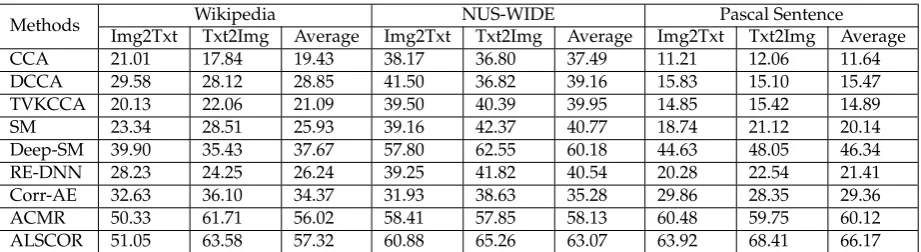
Table 2. The performance (mAP @50 IN %) of the proposed method and the compared methods on Wikipedia, NUS-WIDE and Pascal Sentence for image-to-text (Img2Txt) retrieval, text-to-image (Txt2Img) retrieval and average performance.
gradient descent (SGD) algorithm with a mini-batch size of 128 is used to optimize the training, and the momentum is set to 0.8, the weight decay is set to 0.0005 to reduce the training error, the dropout ratio in each layer is set to 0.5. For the training of TxtNet, word2vec model is implemented by Skip-gram. We pre-train this model on Wikipedia corpus by using SGD algorithm, the margin is set to 0.2. The word2vec model outputs 100-demensional word embeddings from the input texts, which are fed into the BiLSTM network. Following the settings in [61], the dimension of LSTM output vectors is 141 for one direction. On all datasets, the mini-batch size is set to 100.
5.3. Performance Evaluation
In this section, we show the performance evaluation of the proposed method on Wikipedia, NUS-WIDE, and Pascal Sentence datasets, and conpared it with 8 cross-modal retrieval approaches. The experimental results are reported in Table2and Fig.5.
Experiments on Wikipedia Dataset. We compare the proposed ALSCOR with CCA, DCCA,
TVKCCA, SM, Deep-SM, RE-DNN, Corr-AE, ACMR on Wikipedia dataset. From Table 2 we can see that for both Img2Txt and Txt2Img task, our method (Img2Txt=51.05%, Txt2Img=63.58%) not only defeats the traditional approaches such as CCA (Img2Txt=21.01%, Txt2Img=17.84%), DCCA (Img2Txt=29.58%, Txt2Img=28.12%), TVKCCA (Img2Txt=20.13%, Txt2Img=22.06%), SM (Img2Txt=23.34%, Txt2Img=28.51%), etc., but also outperform the adversarial learning based method ACMR (Img2Txt=50.33%, Txt2Img=61.71%). This is mainly because the proposed ALSCOR has more powerful semantic representation. That means our method can capture more abstract concepts information to bridge the semantic gap. On the other hand, the performance of adversarial learning based methods, i.e., ACMR and ALSCOR, are much better than others, which verifies the adversarial learning can strongly support the common semantic subspace learning.
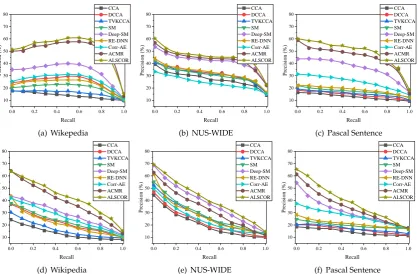
Fig.5(a) and Fig.5(d) illustrate the Precision-Recall curves of CCA, DCCA, TVKCCA, SM, Deep-SM, RE-DNN, Corr-AE, ACMR and ALSCOR on Wikipedia dataset. From Fig.5(a), it is obvious that with the increasing of recall, the precision of ALSCOR and ACMR rise gradually and then drop rapidly near recall=1.0. Unsurprisingly, they performns much better than others over all values of recall. This verifies the improvement brought from adversarial learning once again. Similar to the discussed above, the precision of ALSCOR is a bit higher than ACMR for both Img2Txt retrieval and Txt2Img retrieval, which is because the advanced cross-modal representation learning model (the combination of VisNet and TxtNet).
Experiments on NUS-WIDE Dataset.We evaluate the performance of CCA, DCCA, TVKCCA,
0 . 0 0 . 2 0 . 4 0 . 6 0 . 8 1 . 0 1 0 2 0 3 0 4 0 5 0 6 0 7 0 8 0 P re ci si o n ( % )
R e c a l l
C C A D C C A T V K C C A S M D e e p - S M R E - D N N C o r r - A E A C M R A L S C O R
(a) Wikepedia
0 . 0 0 . 2 0 . 4 0 . 6 0 . 8 1 . 0 1 0 2 0 3 0 4 0 5 0 6 0 7 0 8 0 P re ci si o n ( % )
R e c a l l
C C A D C C A T V K C C A S M D e e p - S M R E - D N N C o r r - A E A C M R A L S C O R
(b) NUS-WIDE
0 . 0 0 . 2 0 . 4 0 . 6 0 . 8 1 . 0 1 0 2 0 3 0 4 0 5 0 6 0 7 0 8 0 P re ci si o n ( % )
R e c a l l
C C A D C C A T V K C C A S M D e e p - S M R E - D N N C o r r - A E A C M R A L S C O R
(c) Pascal Sentence
0 . 0 0 . 2 0 . 4 0 . 6 0 . 8 1 . 0 1 0 2 0 3 0 4 0 5 0 6 0 7 0 8 0 P re ci si o n ( % )
R e c a l l
C C A D C C A T V K C C A S M D e e p - S M R E - D N N C o r r - A E A C M R A L S C O R
(d) Wikipedia
0 . 0 0 . 2 0 . 4 0 . 6 0 . 8 1 . 0 1 0 2 0 3 0 4 0 5 0 6 0 7 0 8 0 P re ci si o n ( % )
R e c a l l
C C A D C C A T V K C C A S M D e e p - S M R E - D N N C o r r - A E A C M R A L S C O R
(e) NUS-WIDE
0 . 0 0 . 2 0 . 4 0 . 6 0 . 8 1 . 0 1 0 2 0 3 0 4 0 5 0 6 0 7 0 8 0 P re ci si o n ( % )
R e c a l l
C C A D C C A T V K C C A S M D e e p - S M R E - D N N C o r r - A E A C M R A L S C O R
(f) Pascal Sentence
Figure 5. Precision-Recall curves for image-to-text query and text-to-image query on Wikipedia, NUS-WIDE and Pascal Sentence dataset. (a) Wikipedia Img2Txt Query. (b) NUS-WIDE Img2Txt Query. (c) Pascal Sentence Img2Txt Query. (d) Wikipedia Txt2Img Query. (e) NUS-WIDE Txt2Img Query. (f) Pascal Sentence Txt2Img Query.
Different from the experiment on Wikipedia, Deep-SM performs better, which achieve Img2Txt=57.80% and Txt2Img=62.55%. However, it still connot defeat ALSCOR. Meanwhile, the performance of other methods is far behind the proposed method.
Fig.5(b) and Fig.5(e) show the comparison of ALSCOR and other 8 approaches on NUS-WIDE dataset for Img2Txt and Txt2Img, respectively. Fig.5(b) tells us that for Img2Txt retrieval, the precision of ALSCOR, ACMR and Deep-SM are close, which are higher than other five approaches obviously. Specifically, in the recall internal[0.1, 0.8], these top-3 approaches are not sensitive to the changing of recall. Like the situation on Wikipedia, the performance of ALSCOR is better than ACMR. On the other hand, for Txt2Img retrieval, the performance gap between the top-3 methods and others is not so obvious, and the precision of Deep-SM is a little bit higher than ACMR. However, ALSCOR is still the best for all value of recall. This verifies effectiveness of the proposed ALSCOR.
Experiments on Pascal Sentence Dataset. The experimental results of the proposed ALSCOR
and CCA, DCCA, TVKCCA, SM, Deep-SM, RE-DNN, Corr-AE, ACMR on Pascal Sentence dataset are shown in the right collumn of Table2. On this multimedia dataset, our method ALSCOR is still the best. It achieves mAP = 63.92% for Img2Txt task and mAP = 68.41% for Txt2Img task, which are obvious higher than ACMR (mAP = 63.92% for Img2Txt and mAP = 68.41% for Txt2Img), the most competitive opponent. The precision of other hand-crafted feature based methods, i.e., CCA, TVKCCA and SM, etc., are much lower than the two former. On the other hand, similar to the above experiments, the precision of ALSCOR for Txt2Img is better than Img2Txt. This is mainly because the textual semantics is easier to be learnt than images, and the combination of BiLSTM and CNN model can capture more high-level concept informaion from texts.
learning based approaches are much more powerful than others for Img2Txt retrieval. On the other hand, in Fig.5(f), the superiority of them is not so obvious for Txt2Img retrieval, but they are still defeat other methods. Compared with ACMR, the proposed ALSCOR performns better.
6. Conclusions
In this paper, a novel cross-modal approach, adversarial learning based semantic correlation representation (ALSCOR) is proposed to address cross-modal retrieval problem. This approach is a combination of adversarial learning and cross-modal correlation learning. To bridge the semantic gap between different modalities, a deep learning based cross-modal correlation learning model is developed, which is integrated two branches (VisNet and TxtNet) to learn cross-modal representations and uses CCA model to learn the cross-modal correlation. Besides, a modality classifier is utilized to implement adversarial learning, which is to learn modality-invariant representations. In addition, an intra-modal classifier is used to capture the intra-modal discriminant information. We conduct comprehensive experiments on three benchmark datasets to evaluate the performance of the proposed method and compare it with 8 state-of-the-arts. Experimental results shows that the proposed ALSCOR has better performance than the state-of-the-arts.
Author Contributions:Conceptualization, L.Z. and J.L.; methodology, L.Z.; software, J.S. and X.W.; validation, L.Z. and X.W.; formal analysis, L.Z. and J.L.; investigation, J.S.; data curation, L.Z.; writing–original draft preparation, L.Z.; writing–review and editing, L.Z. and J.L.; visualization, X.W.; supervision, J.L.; project administration, J.L.; funding acquisition, J.L.
Acknowledgments: This work was supported in part by the National Natural Science Foundation of China (61702560, 61472450, 61972203), the Key Research Program of Hunan Province (2016JC2018), project (2018JJ3691) of Science and Technology Plan of Hunan Province, and the Research and Innovation Project of Central South University Graduate Students (2018zzts177).
Conflicts of Interest:The authors declare no conflict of interest.
References
1. Wang, K., Yin, Q., Wang, W., Wu, S., & Wang, L. (2016). A comprehensive survey on cross-modal retrieval.
arXiv preprint arXiv:1607.06215.
2. Baltrušaitis, T., Ahuja, C., & Morency, L. P. (2018). Multimodal machine learning: A survey and taxonomy.
IEEE transactions on pattern analysis and machine intelligence, 41(2), 423-443.
3. Liu, X., Hu, Z., Ling, H., & Cheung, Y. M. (2019). MTFH: A Matrix Tri-Factorization Hashing Framework for
Efficient Cross-Modal Retrieval. IEEE Transactions on Pattern Analysis and Machine Intelligence.
4. Thompson, B. (1984). Canonical correlation analysis: Uses and interpretation (No. 47). Sage.
5. Rasiwasia, N., Costa Pereira, J., Coviello, E., Doyle, G., Lanckriet, G. R., Levy, R., & Vasconcelos, N. (2010,
October). A new approach to cross-modal multimedia retrieval. In Proceedings of the 18th ACM international conference on Multimedia (pp. 251-260). ACM.
6. Wang, S., Gu, X., Lu, J., Yang, J. Y., Wang, R., & Yang, J. (2014, August). Unsupervised discriminant canonical
correlation analysis for feature fusion. In 2014 22nd International Conference on Pattern Recognition (pp. 1550-1555). IEEE.
7. Zu, C., & Zhang, D. (2016). Canonical sparse cross-view correlation analysis. Neurocomputing, 191, 263-272.
8. Gong, Y., Ke, Q., Isard, M., & Lazebnik, S. (2014). A multi-view embedding space for modeling internet
images, tags, and their semantics. International journal of computer vision, 106(2), 210-233.
9. Zhang, B., Hao, J., Ma, G., Yue, J., Zhang, J., & Shi, Z. (2015). Mixture of probabilistic canonical correlation
analysis. Journal of Computer Research and Development, 52(07), 1463-1476.
10. Feng, F., Wang, X., & Li, R. (2014, November). Cross-modal retrieval with correspondence autoencoder. In
Proceedings of the 22nd ACM international conference on Multimedia (pp. 7-16). ACM.
11. Wang, C., Yang, H., & Meinel, C. (2015, November). Deep semantic mapping for cross-modal retrieval. In
2015 IEEE 27th International conference on tools with artificial intelligence (ICTAI) (pp. 234-241). IEEE.
12. Srivastava, N., & Salakhutdinov, R. (2012, July). Learning representations for multimodal data with deep
13. Cai, G., Feng, Y., & Lin, Q. (2017, December). Cross-modal retrieval based on deep correlated network. In 2017 3rd IEEE International Conference on Computer and Communications (ICCC) (pp. 1226-1231). IEEE.
14. Peng, Y., Huang, X., & Qi, J. (2016, July). Cross-Media Shared Representation by Hierarchical Learning with
Multiple Deep Networks. In IJCAI (pp. 3846-3853).
15. Wang, B., Yang, Y., Xu, X., Hanjalic, A., & Shen, H. T. (2017, October). Adversarial cross-modal retrieval. In
Proceedings of the 25th ACM international conference on Multimedia (pp. 154-162). ACM.
16. Zhang, X., Lai, H., & Feng, J. (2018). Attention-Aware Deep Adversarial Hashing for Cross-Modal Retrieval.
In Proceedings of the European Conference on Computer Vision (ECCV) (pp. 591-606).
17. Wen, X., Han, Z., Yin, X., & Liu, Y. S. (2019). Adversarial Cross-Modal Retrieval via Learning and Transferring
Single-Modal Similarities. arXiv preprint arXiv:1904.08042.
18. Shang, F., Zhang, H., Zhu, L., & Sun, J. (2019). Adversarial cross-modal retrieval based on dictionary learning.
Neurocomputing, 355, 93-104.
19. Ngiam, J., Khosla, A., Kim, M., Nam, J., Lee, H., & Ng, A. Y. (2011). Multimodal deep learning. In Proceedings
of the 28th international conference on machine learning (ICML-11) (pp. 689-696).
20. Srivastava, N., & Salakhutdinov, R. R. (2012). Multimodal learning with deep boltzmann machines. In
Advances in neural information processing systems (pp. 2222-2230).
21. Mroueh, Y., Marcheret, E., & Goel, V. (2015, April). Deep multimodal learning for audio-visual speech
recognition. In 2015 IEEE International Conference on Acoustics, Speech and Signal Processing (ICASSP) (pp. 2130-2134). IEEE.
22. Baltrušaitis, T., Ahuja, C., & Morency, L. P. (2018). Multimodal machine learning: A survey and taxonomy.
IEEE Transactions on Pattern Analysis and Machine Intelligence, 41(2), 423-443.
23. Wang, Y., Wu, L., Lin, X., & Gao, J. (2018). Multiview spectral clustering via structured low-rank matrix
factorization. IEEE transactions on neural networks and learning systems, 29(10), 4833-4843.
24. Zhu, L., Long, J., Zhang, C., Yu, W., Yuan, X., & Sun, L. (2019). An Efficient Approach for Geo-Multimedia
Cross-Modal Retrieval. IEEE Access, 7, 180571-180589.
25. Cukurova, M. (2019). Learning analytics as AI extenders in education: Multimodal machine learning
versus multimodal learning analytics. In Proceedings of the Artificial Intelligence and Adaptive Education Conference (pp. 1-3).
26. Zhang, C., Lin, Y., Zhu, L., Zhang, Z., Tang, Y., & Huang, F. (2019). Efficient region of visual interests search
for geo-multimedia data. Multimedia Tools and Applications, 78(21), 30839-30863.
27. Hotelling, H. (1992). Relations between two sets of variates. In Breakthroughs in statistics (pp. 162-190).
Springer, New York, NY.
28. Shao, J., Wang, L., Zhao, Z., & Cai, A. (2016). Deep canonical correlation analysis with progressive and
hypergraph learning for cross-modal retrieval. Neurocomputing, 214, 618-628.
29. Wang, S., Zhuang, F., Jiang, S., Huang, Q., & Tian, Q. (2015). Cluster-sensitive Structured Correlation
Analysis for Web cross-modal retrieval. Neurocomputing, 168, 747-760.
30. Jin, C., Mao, W., Zhang, R., Zhang, Y., & Xue, X. (2015, February). Cross-modal image clustering via canonical
correlation analysis. In Twenty-Ninth AAAI Conference on Artificial Intelligence.
31. Blei, D. M., Ng, A. Y., & Jordan, M. I. (2003). Latent dirichlet allocation. Journal of machine Learning research,
3(Jan), 993-1022.
32. Yakhnenko, O., & Honavar, V. (2009, April). Multi-modal hierarchical Dirichlet process model for predicting
image annotation and image-object label correspondence. In Proceedings of the 2009 SIAM International Conference on Data Mining (pp. 283-293). Society for Industrial and Applied Mathematics.
33. Putthividhy, D., Attias, H. T., & Nagarajan, S. S. (2010, June). Topic regression multi-modal latent dirichlet
allocation for image annotation. In 2010 IEEE Computer Society Conference on Computer Vision and Pattern Recognition (pp. 3408-3415). IEEE.
34. Blei, D. M., & Jordan, M. I. (2003, July). Modeling annotated data. In Proceedings of the 26th annual
international ACM SIGIR conference on Research and development in informaion retrieval (pp. 127-134). ACM.
35. Jia, Y., Salzmann, M., & Darrell, T. (2011, November). Learning cross-modality similarity for multinomial