Need of a consistent and convenient nucleus identification in
ENDF files for the automatic construction of the depletion chains
Pietro Mosca1,aand Claude Mounier1,b
1CEA-Saclay, Gif-sur-Yvette, France
Abstract. The automatic construction of evolution chains recently implemented in GALILEE system is based on the analysis of several ENDF files : the multigroup pro-duction cross sections present in the GENDF files processed by NJOY from the ENDF evaluation, the decay file and the fission product yields (FPY) file. In this context, this paper highlights the importance of the nucleus identification to properly interconnect the data mentioned above.
The first part of the paper describes the present status of the nucleus identification among the several ENDF files focusing, in particular, on the use of the excited state number and of the isomeric state number. The second part reviews the problems encountered during the automatic construction of the depletion chains using recent ENDF data. The process-ing of the JEFF-3.1.1, ENDF/B-VII.0 (decay and FPY) and the JEFF-3.2 (production cross section) points out problems about the compliance or not of the nucleus identifiers with the ENDF-6 format and sometimes the inconsistencies among the various ENDF files. In addition, the analysis of EAF-2003 and EAF-2010 shows some incoherence be-tween the ZA product identifier and the reaction identifier MT for the reactions (n,pα) and (n,2np).
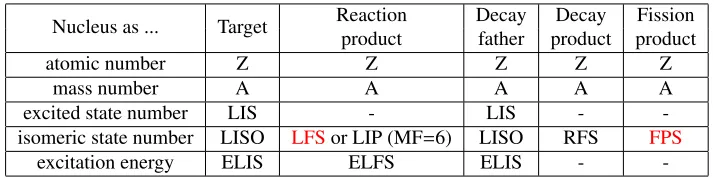
As a main result of this work, our suggestion is to change the ENDF format using sys-tematically the isomeric state number to identify the nuclei. This proposal is already compliant to a huge amount ENDF data that are not in agreement with the present ENDF format. This choice is the most convenient because, ultimately, it allows one to give human readable names to the nuclei of the depletion chains.
1 Introduction
The automatic construction of evolution chains for depletion and transport codes like MENDEL[1] and APOLLO3R [2] is one of the last novelty in the nuclear data processing system GALILEE[3]. In this context, this paper highlights the importance of a correct nucleus identification to properly interconnect the depletion data (decay modes, production cross sections and fission product yields).
Normally, when producing depletion chains, the reactor physicists expect usual human readable names of nuclei based on the triplet (proton number Z, mass number A, isomeric state number). For instance, Am242M stands for the first isomeric state of Am242, its corresponding triplet is (95,242,1). The identifier (Z, A, isomeric state number) is in general preferred, because the isomeric states are
ae-mail: [email protected] be-mail: [email protected]
the selection of the excited states of a nucleus with a significant half-life for depletion calculations and moreover the use of the excited state number is not convenient because roman alphabetical letters would be insufficient. Unfortunately, the various nuclear data in ENDF format[4], which are necessary to automatically construct an evolution chain, use different incomplete identifiers for products coming from the fission, from the nuclear reactions and from the decay. Depending on the kind of data, triplets such as (Z, A, excited state number) and (Z, A, isomeric state number) can be used. Moreover, even if the ENDF format specifies the excited state number for the reaction products, in some evaluations it can occur that the isomeric state number is provided in place.
The problems above mentioned are discussed in this paper according to the following structure. First, a description of the way to identify a nucleus in the depletion data processing is analyzed. Then some anomalies of nucleus identification while processing JEFF-3.1.1, JEFF-3.2, EAF-2003, EAF-2010 and ENDF/B-VII.0 evaluations are pointed out.
2 Nucleus Identification
In GALILEE system the production of the evolution chains is based on the analysis of:
• the decay data present in file (8,457) to recover the decay modes of each unstable nucleus (father) and the resulting stable or unstable nuclei (daughters),
• the independent fission product yields (FPY) that are contained in file (8,458), to extract the yields of the fission products (daughters) for each fissile nucleus (father),
• the production cross section of reaction products present in the GENDF files processed by NJOY [5] from the ENDF evaluations, which describe in files (8-9-10, any MT) the production reactions of a nucleus (father) and the corresponding products (daughters).
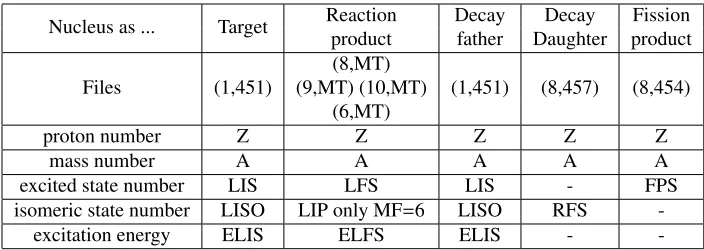
Table 1 summarizes the nucleus identifier for all this kind of data.
Nucleus as ... Target Reaction Decay Decay Fission
product father Daughter product
Files (1,451)
(8,MT)
(1,451) (8,457) (8,454) (9,MT) (10,MT)
(6,MT)
proton number Z Z Z Z Z
mass number A A A A A
excited state number LIS LFS LIS - FPS
isomeric state number LISO LIP only MF=6 LISO RFS
-excitation energy ELIS ELFS ELIS -
-The identification of a nucleus-father can be carried out using the file (1,451) that is present in all these three types of data. This file characterizes a nucleus by: its proton number Z, its mass number A, its excited state number LIS, its isomeric state number LISO (LISO<=LIS) and its energy of excitation ELIS. The ELIS value can be hardly used as item of identification because the levels of nucleus excitation can be very close each other, but it is useful for checking purpose. The description of the nuclei-daughters is instead less rich.
The production cross section of a given product is identified by the Z, A and LIS parameters in ENDF format[4, p. 158]. However, according to the NJOY 2012 manual[5, p. 250] in the GENDF processing, the excited state number LFS is interpreted as the isomeric state number of the product.
In File 6 the isomeric state number LIP and the excitation energy ELIS are provided.
In decay files, the excited state of the decay products is defined by the isomeric state number RFS [4, p. 163].
Lastly, the fission products are identified by the excited state number FPS [4, p. 159].
In this context, the lack of homogeneity among all these files is potentially a source of errors when connecting these data together. If one disposes of an exhaustive description of each nucleus like in file 1, the identification can be carried out using the different keys (Z, A, excited state number) or (Z, A, isomeric state number). Nevertheless, a significant burden in the development would be avoided using a unique identifier everywhere like the triplet (Z, A, isomeric state number), which allows ultimately one to give useful names to nuclei.
Starting from these points, for the first version of GALILEE system, the JEFF-3.1.1 files that describe the reaction products have been modified substituting to the LIS the LISO parameter for some nuclei in order to allow the correct connection with the decay data.
For the following version of GALILEE system, some check tools have been developed in order to better track inconsistencies in nucleus identification.
A first control is now available between the Z and A parameters of the product and those obtained from the MT number of the reaction. If an inconsistency is tracked, the Z and A parameters deduced from the reaction are used in place of those of the product. Besides, a new control is now carried out among the daughters from cross section and FPY evaluations and those in decay. A warning is displayed on the console if a nucleus is not included in the decay data base and correspondingly the list of isomers of the decay data base is printed to help the identification of the product. This approach is based on the idea that the list of nuclei in decay data base is in principle the most complete available.
3 Decay data and Fission product yields evaluation
The coherence between decay and FPY evaluations is practically guaranteed by the fact that one needs the information contained in decay in order to calculate the evaluated cumulative fission prod-uct yields (MF=8,MT=459) from independent fission yields (8,454). While processing JEFF-3.1.1 and ENDF/B-VII.0 we observed that the fission products are identified using the triplet (Z,A,LISO) without compliance with the ENDF-6 format. Besides, in JEFF-3.1.1 all the decay products and all the fission products are included in the decay father list, while in the ENDF/B-VII.0 some radioactive products and more than one hundred fission products are not part of the decay father list.
4 Analysis of EAF-2003 and EAF-2010
In EAF-2003 evaluation all the reaction products derived from the file 8 are identified with the triplet (Z,A,LISO) instead of (Z,A,LIS) and the excitation energy of the isomeric state is set to zero. The same rule is adopted in EAF-2010.
The Np246, U243 and Am250 have been deleted because they are not included in the ENSDF [6] data base. The Bi207M, Sb131M and Ru109M have been substituted by the corresponding daughters Bi207, Sb131 and Ru109 resulting fromγ-decay almost instantly (half-life of the order of theμs in accordance with the ENSDF data base) to account their contribution in the evolution chain.
5 Analysis of JEFF-3.2
The analysis of the JEFF-3.2 shows that more than one hundred reaction products are identified in compliance with the ENDF-6 norm using the LIS parameter and that the reaction product Os197 is not included in the decay data base.
To manage identification problem, we used the information present in decay (LIS, LISO and ELIS), in reaction product (LIS) and in the ENSDF database following this procedure. If two metastable nuclei one from decay and one from the files of production cross sections have the same triplet (Z, A, LIS) then the name of the nucleus in decay data base, which is defined using the LISO, is assigned. Otherwise, we identify the ELIS, which corresponds to the LIS of the reaction product, thanks to the ENSDF data base, and the isomer of the decay data base with the closest ELIS energy, names the nucleus (LIS=LISO+1 very often). In this way, most of the nucleus identification prob-lems are removed. Moreover, to avoid any lack in the evolution chain, the Os197 has been substituted by its daughter Ir197, which is produced byβ−decay.
To illustrate the difficulty created mixing the nucleus identifiers, we consider the well-known case of the (n, γ) reaction of Am241. Two nuclei are produced by this reaction: the Am242 (LFS=2, LISO undefined) and the Am242 (LFS=0, LISO undefined). As target nuclei (MF=8), one can find the Am242 (LIS=3,LISO=1) and the Am242 (LIS=0,LISO=0) according to the file 451. In JEFF-3.1.1 decay data, these three father-nuclei Am242 (LIS=0,LISO=0), Am242 (LIS=2,LISO=1) and Am242 (LIS=141,LISO=2) are described. In this case, the correct decay modes can be attached to Am242 (LFS=2, LISO undefined) using the LFS identifier. No target can be found adopting the excited state number while one exists if the isomeric state number is used.
6 Conclusion
The importance of a homogeneous and direct identification of the nuclei among the different kind of data is crucial for the production of the evolution chains. Decay data should play a major role because it contains the most exhaustive nucleus description based on the quintuplet (Z,A,LIS,LISO,ELIS). For each target nucleus, all the reaction products and the fission products in ENDF evaluations should be included in the decay database as father.
To produce automatically depletion chain, the non compliant ENDF-6 evaluations of FPY and EAF that use (Z,A,LISO) combined with recent complete decay data are very practical. The nightmare begins when compliant and non compliant ENDF-6, which adopt different identification keys, are used together. The checking tool writen permits to overcome this situation but with a somewhat huge amount of human work.
Nucleus as ... Target Reaction Decay Decay Fission product father product product
atomic number Z Z Z Z Z
mass number A A A A A
excited state number LIS - LIS -
-isomeric state number LISO LFSor LIP (MF=6) LISO RFS FPS
excitation energy ELIS ELFS ELIS -
-With these modifications, no changes in NJOY are needed and the automatic chain construction can be carried out with high reliability. Moreover, the JEFF-3.1.1, ENDF/B-VII.0 files of fission prod-uct yields do not need to be changed as well as EAF-2003 and EAF-2010, because these evaluations are already compliant with our proposition. Ultimately, in recent evaluations, few reaction products files need to be modified using the same isomeric state number of the decay data.
References
[1] S. Lahaye et al., “First verification and validation steps of the MENDEL release 1.0 cycle code system”, Proceedings of PHYSOR2014, Kyoto, Japan, September 28 – October 3 (2014).
[2] H. Golfier et al., “APOLLO3: a common project of CEA, AREVA and EDF for the development of a new deterministic multi-purpose code for core physics analysis”, Proceedings of Mathematics and Computation Topical Meeting, Saratoga Springs, USA, May 3-7 (2009).
[3] M. Coste-Delclaux, “GALILEE: A nuclear data processing system for transport, depletion and shielding codes”, Proceedings of PHYSOR 2008 Topical Meeting, Interlaken, Switzerland, September 14-19 (2008).
[4] Cross Section Working Group, “ENDF-6 formats manual, Data Formats and Procedures for the Evaluated Nuclear Data File”, Technical Report BNL-90365-2009, Rev. 2, 2012. Edited by A. Trkov, M. Herman and D. A. Brown, October 24, 2012
[5] R. E. MacFarlane, D. W. Muir, R. M Boicourt and A. C. Kahler, “The NJOY Nuclear Data Pro-cessing System,Version 2012” , Technical Report LA-UR-12-27079 Rev, LANL (2012).
[6] “Evaluated Nuclear Structure Data File,” http://www.nndc.bnl.gov/ensdf/(2015).