IJEDR1502106
International Journal of Engineering Development and Research (www.ijedr.org)575
Quality Implementation Strategy in Manufacturing
Industries: A Case Study
1M.S.Khan, 2Susmit Saha 1Associate Professor, 2PG Scholar 1,2
School of Mechanical Engineering, KIIT University, Bhubaneswar, India
________________________________________________________________________________________________________
Abstract - Since the release of ISO 9000 in 1987 as a tool of Quality Management System it has been revised many times till
2008. ISO 9001:2008 is one of the most widely accepted quality management tool in manufacturing as well as service industries globally. In this thesis, the implementation practice of ISO 9001:2008 has been studied with respect to Indian manufacturing industries. Ten most critical factors of ISO 9001:2008 are selected from the literature. A questionnaire survey was carried out with approximately fifty two Indian manufacturing companies which are considered to be spread in five zones. The correlation between the critical factors are found out which are then used to find out the pair-wise matrix in AHP (Analytical Hierarchical process) technique for prioritization of the critical factors in Indian scenario. The results show a different sequence of important critical factors between the Global and Indian industries that implement ISO 9001:2008 . Finally, a case study has been carried out to find out the gaps between the priority vectors of critical factors of the Indian manufacturing companies and the company selected for study. Suggestions has been recommended to the management of the company in order to improve its productivity.
Index Terms - ISO 9001:2008; Critical Factors; Analytical Hierarchical Process (AHP), Pearson Correlation
________________________________________________________________________________________________________ I. INTRODUCTION
Now a day's Quality Management System is practiced in the industry and service sectors to reach a higher level of degree of excellence and having the potentiality in the productivity. Quality Management System not only gives attention to the business structure of an organisation , but it also watch out for the permanent settlement of operations for the process of management that clarifies the requirements which are essential to achieve the goals. Various quality management systems are being extensively implemented in manufacturing as well as service industries [1]. The main purpose of following up Quality Management System is to contribute with an excellent performance in the administration with good quality of leadership, customer satisfaction which will ultimately enhance the efficiency and competitiveness in this aggressive development edge. By increasing the capabilities and competitive aggressiveness towards customer satisfaction , an expanding number of various manufacturing and service industries are acquiring a quality management system. Sorting out with various instances, quality management system has been established with association under certification of ISO 9001:2000 which later revised to ISO 9001:2008 of standard. The main intention of this standard comprises to serve the companies of several sizes of any sector to follow up and engage with efficient quality management system by increasing the power in designing , producing and delivering quality products and services. The various standard guidelines of procedures and controlling of proper documentation for a quality management system always helps an organisation to find out the mistakes , contour its performance and maintaining a coherent quality level [2].
In many instances, ISO 9001 norms emerged as a front runner as a Quality Management System tool to provide the industry with clear objectives in the production of machinery or providing the service at an international level. The ISO 9001 norms are set of standards which provides the direction on processes and control. The ultimate aim of these standards is to satisfy both external and internal customers as well as employees , suppliers, etc. It has been argued that the norms of ISO 9001 are well accepted by the organizations. However , other factors such as acceptance of the new system by employees remain unsolved [3].
When the ISO 9001 system is carried out effectively , its benefits increase its cost by mending the performance of any organisation and constructing a sustainable competitive advantage, so, if the ISO 9001 standard is empathized with a positive manner driving out as a tool for promotion and marketing there would be substantial benefit both internally and externally to the organisation. It is not necessary that introducing quality management system in an organisation will always provide good results. This happens due to the inefficient execution of the standards [4]. Various researchers have suggested variety of factors which might have an adverse effect in the implementation of a quality standard. Augustyn and Pheby (2000) observed that there is a need to determine the critical factors that influence the effective implementation of a quality standard. If we make we comparisons between manufacturing industries and service sector , the later had always lagged behind, not only in terms of the implementation of the standards but also in comprehending the related conceptions of "total quality management" and "continuous improvement". The intention of this study is to carry out an factual investigation of various critical factors for an efficient execution of ISO 9001 standard in various manufacturing industries. In attempting so, the study not only assess comparative importance of variety of critical factors but also develop the inherent structure of these critical factors [5].
II. LITERATURE REVIEW
IJEDR1502106
International Journal of Engineering Development and Research (www.ijedr.org)576
[6]. The potency of the older versions of the ISO 9001 ; i.e. ISO 9001:1994 is counted on the approach of an organisation towards the distinguished critical factors. There are various organisation which have met with various troubles throughout the process of the standard ISO 9001 certification and later also [5]. Skilful factors for successful implementation of ISO 9001 quality model are one of the key areas of investigation now a days by several authors. The reason being the ground reality of the company where ISO 9001 is being implemented [7] . The society , of employees, the management, the environment, etc play a great role while finalizing the factors that affect the implementation process . Therefore, the critical success factors are obviously dependent on many situations [8]. There are many perfection success factors for quality system implementation, such as the involvement of top managers towards the motivation of the employees. From the rigorous literature review it is evident that different authors identified different critical factors of ISO 9001 in their respective study. This may be because of the sectors selecting for their study. (Diogo Almeida, Jorge Muniz Junior and Antionio Fernando Branco Costa) in their study ten critical factors were identified after 51 papers analysed by them for the last 20 years, related to the implementation strategies and important critical factors of ISO 9001:2008. It also consider both manufacturing and service sector over various countries [9,10]. Table 1 shows the list of ten critical factors in a sequence.Table 1: Sequence of Critical Factors Proposed Globally [10] A Top Management Commitment
B Team Commitment
C Training for the Team Involved
D Defined Responsibilities and Authorities Between the Team Involved E Schedule for Implementation
F Quality Orientated Culture in the Organization G Resource Allocation
H Integration Between the Areas Involved I Management System Without Bureaucracy
J Awareness Regarding Importance of ISO9001:2008
III. IDENTIFIED CRITICAL FACTORS
Top Management Commitment
Quality management system along with senior management can work more efficiently just like our heart. It can help the organisation to improve their performance with ongoing techniques and exercise. Frequently Top Management includes the board of directors and they have only the right to contemplate all terms and conditions while inspecting and applying the company vision and objectives.
Top Management has many responsibilities. Some are
a) Consulting with the organisation and make them know about the importance of meeting with the customers as well as the importance of static and dynamic requirements.
b) Setting firmly the policy of the quality. c) By ensuring the objectives of quality. d) Carrying out the reviews of management. e) Checking out the resources availability. Typical goals of top management:-
a) To satisfy the customers with the products and services that fulfil their requirements and exceed their expectations. b) To increase the efficiency and profitability of the product.
c) As a quality leader, to company's reputation. d) To reduce the cost and burden.
e) To appreciate and to satisfy every employee in the organisation. f) To improve the quality objectives continuously.
Top management works like our nervous system. It gives instructions to the Quality Management system how to perform. To drive any large organisation, it is very important to communicate with the employees, making a plan and to apply those plans in proper and effective way. The senior most management should take the report of the progress time to time in various ways. Team Commitment
IJEDR1502106
International Journal of Engineering Development and Research (www.ijedr.org)577
help them to make themselves dedicated towards their project work. Once they become devoted to the resources of the project, they will be able to find new ideas, agendas to improve the quality and efficiency. Team work will help them to set meetings, discuss about the pros and cons and to resolve it very fast. Performing quality system procedures in a team is very effective way of working.Training for Team Involved
Often programs are organised to train the members of the team. These programs help them to communicate with each other which in turn motivate them for cooperation and they together find the solution of any problem. The team members actively seek opportunities at work place to become involved in relevant decisions, there by contributing their talent and ideas to the organisation success. to manage various products or tasks, consequently the organisation needs to provide opportunities to the team members for meaningful involvement. The training programs include different skills, techniques and tricks which help the employees to complete their daily task more efficiently. When an organisation value their employees with care, dignity , respect and training then the employees leave with the organisation for long period. Employees work with only that organisation which helps them to get opportunities to develop their skills. Training a team has many benefits:-
a) The members will able to know the power of unity. b) Training empowers the longevity.
c) Strategic alignment is empowered .
d) Proper use of human resources with individual roles and responsibilities is encouraged.
Quality management system affects a lot on all aspects and areas in an organisation. So, the team members should be provided the training regarding quality management system. The training programs must elaborate the need and concept of Quality Management system and what impacts it will show in an organisation. The training program should be conducted in such a way to train not only the team members but also the higher officials where the training would have an overall impacts on the strategic goals, formation of organisational structure, culture, change and development , influence of organisation on people and people's influence on the organisation. Side by side primary training is also very important which includes writing procedures, work a nd instructions, quality manuals, laboratories management, testing procedures etc.
Defined Responsibilities and Authorities Among the Involved Team
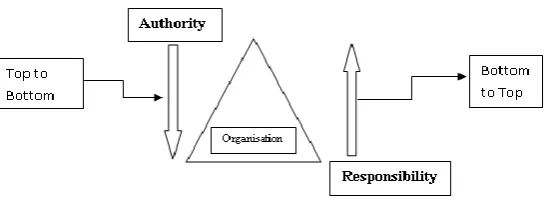
Organisation consists of many subsystems popularly known as division of labour. Division of labour consists of not only the division of tasks but also the division of responsibilities and authorities among the team members. For the implementation of ISO standards properly, both the managers and the team members have to perform together and at their best. Then only an effective result can be obtained towards the implementation of ISO standards. Power and authority flows from top to bottom and responsibilities flows from bottom to top. The people at different levels of authority should know their responsibilities as well as scope and limitations of their power. They should not miss use it. The person at top level management has highest authority. A person with responsibilities and without dignity and authority leads to his/her dissatisfaction. So, for successful completion of task, a person must be given proper authority along with responsibilities.
Figure 1: Authorities and responsibilities
Schedule for Implementation
In large scale companies, programs and trainings are made time to time for the implementation of quality management system which proves to be effective also. But in small scale companies, quality management system implementation is documented once throughout the organisation. In the implementation phase, the selected areas are evaluated for the effectiveness of the system. If the selected areas show high effectiveness, then it consequently raises the level of confidence for the management and employees towards implementation of QMS.
Quality Oriented Culture in the Organisation
IJEDR1502106
International Journal of Engineering Development and Research (www.ijedr.org)578
involved in the work of quality maintenance. Some forums are established to keep the eye on the quality maintenance across the organisation.a) Let the team members at all levels know that they should perform their work at their best and increase quality initiatives b) Regularly organise different events like group discussions, case studies, small project works etc to develop needful ideas. c) Establish quality circles and motivate each employee to participate.
d) Spread awareness to increase the quality and its benefits for the organisation.
e) Set up a reward and recognition system to praise best working person with respect to quality. Resources Allocation
Resources work as a fuel to run any organisation. These resources are machinery tools, money, real estate, labour, equipments, technologies, natural resources, financial resources etc. This is considered as the main factor of production for producing goods and services. Resources allocation is the strategy of deciding that where the available resources should be used properly in the production of products and services. In resource allocation process, it is very important to find the conditions under which the strategy used leads to efficient output and can be improved to be beneficial for both the parties. When a company sets its goal and vision, then depending on that the resources allocation planning is made. The goal and target of an organisation is decided on the basis of earlier achievements and success. Once the company decide their objectives then accordingly sufficient resources are allocated to fulfill the target. Each specific department make their budget and take the fund to fulfill some important functions such as buying raw materials and equipments, surveying the market, herring man power etc.
Integration Between Areas Involved
Different functions performed by different persons in an organisation need to be combined together so as to achieve the goal of organisation. This is called integration. If departments work independently without having regard to each other, it may make achievement of common goal uncertain and difficult. Hence the effort made by the different people working in different functional areas need to be integrated through hierarchy of authority. Similarly integration should also be made between manufacturing, suppliers, R&D, and marketing for achieving sustainable competitive advantage. This integration leads to gain profit and increase sales. The company performance will be best when there will be the best integration among manufacturing, suppliers and R&D. A number of issues must be considered when different functional areas are integrated in production planning and control.
Management System Without Bureaucracy
Bureaucracy is a complicated way of managing the environment and the system of an organisation. It includes strict rules, regulations, and patterns, procedures to drive the system and to find the solution of a problem. Bureaucratic management is much authorised, non-flexible and very structured. So, it is very fair and highly efficient. Characteristics of bureaucratic management are perfect division of labour, coordination, and integration, conscious rationality, strict hierarchy of authority, maintains continuing system and to make promotions depending on competitions. Thus there are some positivity and negativity in bureaucratic management. Rules, regulations, procedures etc are important to run an organisation but flexibility is also important for smooth run. Otherwise these strict rules and procedures will make the system slow to perform according to changing environment and it will limit the efficient expected result.
Awareness Regarding Importance Of ISO 9001:2008
It gives advantages to the employees , organisation and customers . Awareness shows the profit expected by an organisation. This program invites everyone to participate along with suppliers of materials and components. The program also pays attention to higher level of participation. This helps to get the support and commitment of all levels of employees.
IV. PURPOSE
1. The critical factors of ISO 9001 which have been reported in the literature has been employed to get the responses from the Indian manufacturing industries.
2. Prioritization of these critical factors have been carried out in Indian manufacturing scenario.
3. The correlations between the factors are analysed in order to get a deep insight into the implementation processes. 4. A pilot study is carried out in which the overall responses are compared with the company's responses in order to find
the gaps therein and subsequent suggestions to the managers.
V. METHODOLOGY AND RESULT ANALYSIS
The sequence of above ten critical factors of ISO 9001:2008 identified from the literature have been assumed to be the best factors suited considering the global situations of the industries. In this study an attempt has been made to find out the sequence of the above ten critical factors in the Indian manufacturing industries.
The response of various manufacturing industries are compiled which has been described below. A questionnaire survey has been used to explore the use of ISO 9001:2008 implementation in Indian manufacturing companies. The main consideration of the design of the questionnaire in this survey was to keep it simple and concentrated in order to get an proper response rate.
IJEDR1502106
International Journal of Engineering Development and Research (www.ijedr.org)579
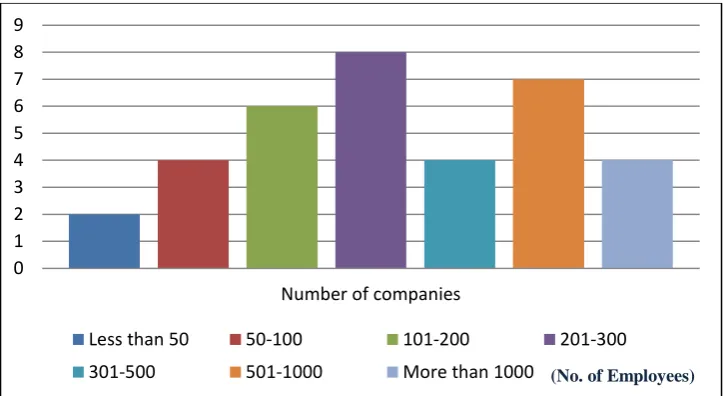
From the figure 2 it is evident that 8 number of companies surveyed have number of employees around 200 to 300. Similarly 7 companies having number of employees around 500 to 1000 . However, 4 companies show more than 1000 number of employees in their respective firms. Six respondents are found out as newly registered companies having minimum of around 100 employees. Four companies having 300 to 500 number of employees.Figure 2: Number of employees in the companies surveyed
The following figure indicates the pattern of registration of ISO 9001:2008 (Figure-3).
Figure 3 : ISO 9001:2008 registration year of number of companies
With reference to the survey report 12 number of companies have their ISO 9001:2008 registration from 2011. Eight companies are having this ISO 9001:2008 registration from more than five years. Moreover, most of the companies surveyed are at least more than five years of registration under ISO 9001:2008 baring 2 to 3 companies which are less than 5 years of registration.
The objective is to find the priority of ten critical factors in Indian scenario. There are many methods such as Analytical hierarchical Process(AHP), Artificial Neural Network(ANN), Fuzzy, etc are available to determine the priority of factors. However, AHP is one of the most easy and widely used method to find out the priority vectors or the weightage of factors.
VI. CORRELATION AND PRIORITIZATION OF CRITICAL FACTORS
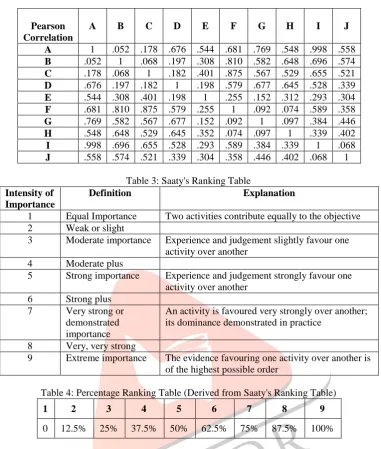
Pair-wise matrix is a mandatory requirement for prioritization by AHP. In order to get the pair-wise matrix the average of the company have been used to get the correlation between the factors. As per the questionnaire each critical factors have some five to six questions under it. The average of the response has been taken as the responses of the particular critical factor. Usually different company responded differently for each factor . For example, if company 1 gives emphasis on factor A, company 2 may give more importance to factor F depending upon their products, number of employees, market share and the location. Therefore it is essential to know the relationship between these factors over the combined view of all companies. Hence correlation between the factors has been found out using a statistical package (SPSS 20.0). The Pearson correlation table has been shown in table 2 below. From this correlation table and Saaty's Ranking Scale a pair wise Matrix is developed which will be used for calculating prioritizing vectors in AHP. The Saaty's Ranking table gives 9 scales of absolute numbers. These scales are converted proportionately into percentage as shown below (Table 3).
Table 2: Pearson Correlation Between Different Critical Factors 0
1 2 3 4 5 6 7 8 9
Number of companies
Less than 50 50-100 101-200 201-300
301-500 501-1000 More than 1000 (No. of Employees)
0 5 10 15
Number of companies
Less than 1 year From 1 - 2 year From 2 - 3 year
From 3 - 5 year More than 5 year
IJEDR1502106
International Journal of Engineering Development and Research (www.ijedr.org)580
Pearson Correlation
A B C D E F G H I J A 1 .052 .178 .676 .544 .681 .769 .548 .998 .558
B .052 1 .068 .197 .308 .810 .582 .648 .696 .574
C .178 .068 1 .182 .401 .875 .567 .529 .655 .521
D .676 .197 .182 1 .198 .579 .677 .645 .528 .339
E .544 .308 .401 .198 1 .255 .152 .312 .293 .304
F .681 .810 .875 .579 .255 1 .092 .074 .589 .358
G .769 .582 .567 .677 .152 .092 1 .097 .384 .446
H .548 .648 .529 .645 .352 .074 .097 1 .339 .402
I .998 .696 .655 .528 .293 .589 .384 .339 1 .068
J .558 .574 .521 .339 .304 .358 .446 .402 .068 1 Table 3: Saaty's Ranking Table
Intensity of Importance
Definition Explanation
1 Equal Importance Two activities contribute equally to the objective 2 Weak or slight
3 Moderate importance Experience and judgement slightly favour one activity over another
4 Moderate plus
5 Strong importance Experience and judgement strongly favour one activity over another
6 Strong plus 7 Very strong or
demonstrated importance
An activity is favoured very strongly over another; its dominance demonstrated in practice
8 Very, very strong
9 Extreme importance The evidence favouring one activity over another is of the highest possible order
Table 4: Percentage Ranking Table (Derived from Saaty's Ranking Table)
1 2 3 4 5 6 7 8 9
0 12.5% 25% 37.5% 50% 62.5% 75% 87.5% 100%
From table 4 along with the correlation between the critical factors, the pair-wise matrix is formed . For example, if the value of the correlation between factor A and factor D is 0.676 or we can say 67.6%. With the help of the brainstorming session , experts have helped us to know whether factor A is more prior than factor D or vice-versa. If factor A possess 67.6% more than factor D than in the pair-wise matrix A is more prior than D, whereas D will have the reciprocal of that value with respect to A in the pair-wise matrix. 67.6% will possess a whole number 6 or 7 depending upon the nearest value in the pair-wise matrix according to the percentage ranking. In this way the complete pair-wise matrix of the ten critical factors which are discussed above in sequence and tabulated in the following table. To prioritize the critical factors an online software of AHP (BPMSG AHP priority calculator) is used. The following table shows the result of the online AHP software.
Table 5: Pair-Wise Matrix
Critical
Factors A B C D E F G H I J A 1 1 2 6 5 6 7 5 9 5
B 1 1 2 2 3 7 5 6 6 5
C 0.50 0.50 1 2 4 8 5 5 6 5
D 0.17 0.50 0.50 1 2 5 6 6 5 3
E 0.20 0.33 0.25 0.50 1 3 2 3 3 3
F 0.17 0.14 0.125 0.20 0.33 1 1 1 5 3
G 0.14 0.20 0.20 0.17 0.50 1 1 1 4 4
H 0.20 0.17 0.20 0.17 0.33 1 1 1 3 4
I 0.11 0.17 0.17 0.20 0.33 0.20 0.25 0.33 1 1
J 0.20 0.20 0.20 0.33 0.33 0.33 0.25 0.25 1 1
IJEDR1502106
International Journal of Engineering Development and Research (www.ijedr.org)581
national ranking sequence. First five critical factors are same in both global and national ranking. According to the priority vectors which has been calculated through AHP shows a different behaviour in the last five critical factors. The Indian scenario of the critical factors are shown in Table 7 along with their priority vectors. In order to know the consistency of the result found out by AHP where nationalised ranking has been determined we need to calculate the consistency ratio (CR). It is found out to be 0.076 which is below 0.1, the maximum value of CR.Table 6: Comparison of Critical Factor
Table 7: Nationalised Ranking of the Critical Factors
Ranks Factors Criteria Vectors
1 a Top Management Commitment 0.26623
2 b Team Commitment 0.20324
3 c Training for the team involved 0.17238
4 d Fixed Responsibilities and Authorities Among the involved Team 0.12337
5 e Schedule for implementation 0.06823
6 f Resource Allocation 0.04240
7 g Integration Between the Areas Involved 0.04035
8 h Quality Orientated Culture in the Organization 0.03963
9 i Awareness regarding the Importance of ISO 9001:2008 0.02455
10 j Management System Without Bureaucracy 0.01959
VII. GAP ANALYSIS
The following table shows the gaps between the normalised value of critical factors in case of a company(Magadh Industry) and nationalised priority vectors (Table 8).
Table 8: Gap Analysis
Nationalised Ranking of the critical
factors
Priority vectors from AHP
analysis (Nationalised)
(Y)
Actual average value of a company
from the survey
Normalized Value of Magadh Industry
(X)
Gap/ Difference
(X-Y)
A 0.26623 2.833333 0.0988 - 0.16743
B 0.20324 2.75 0.0959 - 0.10734
C 0.17238 3 0.1046 - 0.06778
D 0.12337 3.5 0.1221 - 0.00127
E 0.06823 4 0.1395 0.07127
F 0.04240 2.5 0.0872 0.0448
G 0.04035 3 0.1046 0.06425
H 0.03963 2.833333 0.988 0.94837
I 0.02455 2 0.0697 0.04515
J 0.01959 2.25 0.0785 0.05891
Category Vectors Ranks Category
A 0.26623 1 A
B 0.20324 2 B
C 0.172388 3 C
D 0.123373 4 D
E 0.068231 5 E
F 0.039638 8 G
G 0.042401 6 H
H 0.040355 7 F
I 0.019595 10 J
J 0.024551 9 I
Global Ranking
IJEDR1502106
International Journal of Engineering Development and Research (www.ijedr.org)582
Figure 3: Identified gaps while implementing critical factors ofISO 9001:2008 in the selected company
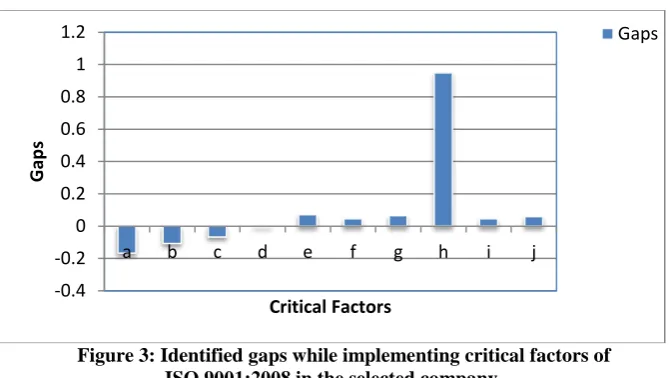
From the above table and figure (Table 8 and figure 3), it can be observed that the first four factors need some improvement in the selected manufacturing industry for the study . Top management commitment (factor a ) required to be emphasized more among the four factors such as factor b, c and d . In order to cope up with the implementation strategy of ISO 9000:2008 in national level, the management of the selected manufacturing industry should consider some changes in their top level managerial activity. Some of the suggestions that can be extended to the company are as follows;
Regular consultation with the employees regarding the importance of the customers and their requirements . Emphasize more on quality of the product and the priority of the production.
The other factors that the company may give stress on management review, resources allocation, rewards to the employees and their safety , etc.
The other six factors more or less are at par with the national level sequence of the critical factors of ISO 9001:2008 . Surprisingly factor h (Quality orientated culture in the organization) shows a very high positive value of gaps (+0.94837). This indicates that the employees of this organisation have a clear conception of quality culture. This is a very good sign of continuous improvement of the company .
VIII. CONCLUSIONS
The questionnaire survey for the manufacturing companies covering five zones of India shows a different sequence of the implementation strategy of ISO 9001:2008 than the global sequence. The correlation between the ten selected critical factors have been found out and analysed in order to get a deep insight into the implementation processes. The first five critical factors of global sequence which are mentioned in the literature shows same weightage as in Indian scenario whereas the next five factors varies in their implementation strategy both in international and national ranking. A case study with a manufacturing industry shows some deviations in implementation strategy of ISO9001:2008. The first four critical factors shows low implementation of ISO 9001:2008. The next six factors are at par with the national level of ISO 9001:2008 implementation. However, a critical factor " Quality orientated culture in the organization" exhibits a high implementation rate of ISO 9001:2008 which adds to continuous improvement of the company .
This sequence of critical factors have been found out by using AHP with the help of survey data for less number and selected manufacturing companies. However, the number of companies can be increased and service industries be added to it in order to get a robust result. The prioritization of critical factors can also be carried out with other techniques such as ANN, Fuzzy, etc which can be compared with this result.
REFERENCES
[1]. Magd, H.A.E., “An investigation of ISO 9000 adoption in Saudi Arabia”, Managerial Auditing Journal, Vol. 21 No. 2, pp.
132-47, 2006.
[2]. Magd, H., “ISO 9001:2000 in the Egyptian manufacturing sector: perceptions and perspectives”, International Journal of
Quality & Reliability Management, Vol. 25 No. 2,pp. 173-200, 2008.
[3]. Angelogiannopoulos, D., Drossinos, H. and Athanasopoulos, P, “Implementation of a quality management system according to the ISO 9000 family in a Greek small‐sized winery: a case study”, Food Control, Vol. 18 No. 9, pp. 1077‐85, 2007.
[4]. Wahid, R. A., Corner, J., “Critical success factors and problems in ISO 9000 maintenance”, International Journal of Quality & Reliability Management, 26(9), 881-893, 2009.
[5]. Augustyn, M.M. and Pheby, J.D, “ISO 9000 and performance of small tourism enterprises: a focus on Westons Cider
Company”, Managing Service Quality, Vol. 10 No. 6, pp. 374-88, 2000.
[6]. Oakland, J., Total Quality Management – Text with Cases,2nd ed., Butterworth-Heinemann Professional Publishing, Oxford, 1995.
-0.4 -0.2 0 0.2 0.4 0.6 0.8 1 1.2
a b c d e f g h i j
Gap
s
Critical Factors
IJEDR1502106
International Journal of Engineering Development and Research (www.ijedr.org)583
[7]. Evangelos L. Psomas, Christos V. Fotopoulos, Dimitrios P. Kafetzopoulos, "Critical factors for effective implementationof ISO 9001 in SME service companies", Managing Service Quality: An International Journal, Vol. 20 Iss: 5, pp.440 - 457, 2010.
[8]. Lin, C.I. and Jang, W.Y, “Successful ISO 9000 implementation in Taiwan. How can we achieve it, and what does it mean?”, International Journal of Productivity and Performance Management, Vol. 57 No. 8, pp. 600‐22 , 2008.
[9]. Lee, P.K.C., To, W.M. and Yu, B.T.W, “The implementation and performance outcomes of ISO 9000 in service organizations. An empirical taxonomy”, International Journal of Quality & Reliability Management, Vol. 26 No. 7, pp. 646‐62, 2009.
![Table 1: Sequence of Critical Factors Proposed Globally [10] Top Management Commitment](https://thumb-us.123doks.com/thumbv2/123dok_us/8403173.1386171/2.595.61.552.209.625/table-sequence-critical-factors-proposed-globally-management-commitment.webp)