Available online: https://edupediapublications.org/journals/index.php/IJR/ P a g e | 664
Trusted Sharing for Multi-Authority data in Public Cloud
Storage using ABE
Mohammed Siddique1& Syeda Asra2
1M-Tech, Dept. of CSE,APPA Institute of Engineering and Technology, Vidya Nagar,
Kalaburgi.
2Associate professor,Dept. of CSE, APPA Institute of Engineering and Technology, Vidya
Nagar, Kalaburgi. Abstract
Property predicated Encryption (ABE) is
viewed as a promising cryptographic
leading execute to guarantee information
proprietors' immediate control over their
information in broad daylight distributed
storage. The prior ABE plans include just a
single domination to keep up the entire
property set, which can bring a solitary
point bottleneck on both security and
execution. Consequently, some
multi-domination plans are proposed; in which
various ascendant elements discretely keep
up disjoint quality subsets. Nonetheless, the
single-point bottleneck issue stays unsolved.
In this paper, from another point of view, we
lead a limit multi-power CP-ABE get to
control conspire for open distributed
storage, assigned TMACS, in which
numerous ascendant substances together
deal with a uniform quality set. In TMACS,
profiting by (t; n) { t - any one Ascendancy,
n - no of Ascendant entities} limit mystery
sharing, the ace key can be shared among
different ascendant elements, and a licit
utilizer can cause his/her mystery key by
interfacing with any t ascendant substances.
Security and execution examination comes
about demonstrate that TMACS is not just
certain protected when not as much as t
ascendant substances are bargained,
however withal vigorous when no not as
much as t ascendant elements are alive in
the framework. Moreover, by effectively
cumulating the conventional
multi-domination conspire with TMACS, we build
a half and half one, which slakes the
situation of traits radiating from various
ascendant elements and accomplishing
security and framework level heartiness.
Key words: - CP-ABE, Threshold Secret
Sharing, Multi-Authority, Public Cloud
Storage,
Access Control, Attributes-Based
Available online: https://edupediapublications.org/journals/index.php/IJR/ P a g e | 665
1. INTRODUCTION
TO execution calculation, distributed
computing has drawn delight imperatives of
information stockpiling and high broad
considerations from both scholarly and
industry. [1]-[2]Distributed storage is a vital
settlement of distributed computing , which
gives lodging to information proprietors to
outsource information to store in cloud by
means of Internet. Notwithstanding many
focal points of distributed storage, there still
stay sundry testing hindrances, among
which, protection and security of clients'
information have turned out to be real
issues, particularly openly distributed
storage.[3] Customarily, an information
proprietor stores his/her information in
confided in servers, which are for the most
part controlled by a plenarily put stock in
director. In any case, in broad daylight
distributed storage frameworks, the cloud is
generally kept up and overseen by a
semi-trusted outsider (the cloud supplier).
[4]Information is no longer in information
proprietor's trusted areas and the information
proprietor can't trust on the cloud server to
lead secure information get to control.
Therefore, the safe get to control pickle has
turned into a basic testing issue out in the
open distributed storage, in which
conventional security advancements can't be
straightforwardly connected.
[5]Characteristic predicated Encryption
(ABE) is viewed as a standout amongst the
most ideal plans to lead information get to
control out in the open mists for it can
guarantee information proprietors'
coordinate control over their information
and give a fine-grained get to control
settlement. Till now, there are numerous
ABE plans proposed, [6]which can be
partitioned into two classifications:
Key-Policy Attribute-predicated Encryption
(KP-ABE, for example, and iphertext-Policy
Attribute-predicated Encryption (CP-ABE,
for example, . In KP-ABE plans, unscramble
keys are related with get to structures while
ciphertexts are just named with unique
quality sets. Despite what might be
expected, in CP-ABE plans, information
proprietors can characterize an get to
strategy for each record predicated on
clients' traits, which can guarantee
proprietors' more straightforward control
over their information. Consequently,
contrasted and KP-ABE, CP-ABE is a
favored winnow for planning access control
for open distributed storage.[7]In most
subsisting CP-ABE plots there is just a
Available online: https://edupediapublications.org/journals/index.php/IJR/ P a g e | 666
administration and key circulation. This one
and only power situation can bring a solitary
point bottleneck on both security and
execution. Once the domination is
bargained, an enemy can simply acquire the
one and only specialist's lord key, at that
point he/she can cause private keys of any
credit subset to decode the absolute
scrambled information. In addition, once the
one and only power is slammed, the
framework completely can't function
admirably. Consequently, these CP-ABE
plans are still far from being broadly used
for get to control out in the open distributed
storage. But some multi-command CP-ABE
plans have been proposed, regardless they
can't manage the difficulty of single-point
bottleneck on both security and execution
said above. In these multi-authority CP-ABE
plans, the entire quality set is isolated into
different disjoint subsets and each property
subset is as yet kept up by just a single
domination. But the enemy can't increase
private keys of all qualities in the event that
he/she hasn't bargained all ascendant
elements, trading off at least one ascendant
elements would make the foe have a greater
number of benefits than he/she ought to
have. In addition, the enemy can acquire
private keys of solid traits by trading off
straight out at least one ascendant
substances. In mix, the single point
bottleneck on execution is not yet explained
in these multi-authority CP-ABE plans.
Crash or disconnected of a solid authority
will make that private keys of all properties
in quality subset kept up by this command
can't be incited and circulated, which will
even now impact the entirety
framework's effectual operation. [8]In this
paper, we propose a strong and obvious limit
multi-authority CP-ABE get to control plot,
designated TMACS, to manage the
single-point bottleneck on both security and
execution in most subsisting plans. In
TMACS, various ascendant substances
mutually deal with the entire characteristic
set however nobody has full control of any
solid property. Since in CP-ABE plans, there
is dependably a mystery key (SK) used to
induce trait private keys, we present (t;n)
edge mystery sharing into our plan to
allocate the mystery key among ascendant
elements. In TMACS, we reclassify the
mystery enter in the customary CP-ABE
plots as ace key. The exordium of (t;n) edge
mystery sharing ensures that the ace key
can't be acquired by any authority alone.
TMACS is not just undeniable secure when
Available online: https://edupediapublications.org/journals/index.php/IJR/ P a g e | 667
traded off, yet moreover vigorous when no
less than t ascendant substances are alive in
the framework. [9]To the best of our
awareness, this paper is the principal attempt
to address the single point bottleneck on
both security and execution in PABE get to
control conspires out in the open distributed
storage.
2. RELEGATED WORK 2.1Existing System
In most subsisting CP-ABE plots there is
just a single power in charge of property
administration and key conveyance.
[3]-[4]This one and only domination situation
can bring a solitary point bottleneck on both
security and execution. Once the power is
traded off, an enemy can effortlessly get the
one and only expert's lord key, at that point
he/she can incite private keys of any credit
subset to decode the solid encoded
information. Also, once the one and only
domination is smashed, the framework
completely can't function admirably.
Subsequently, these CP-ABE plans are still
a long way from being broadly used for get
to control in broad daylight distributed
storage. [6]Though some multi-power
CP-ABE plans have been proposed, regardless
they can't manage the scrape of single-point
bottleneck on both security and execution
specified previously. In these
multi-domination CP-ABE plans, the entire trait
set is isolated into different disjoint subsets
and each quality subset is as yet kept up by
just a single power. Though the foe can't
increase private keys of all qualities in the
event that he/she hasn't bargained all
ascendant elements, trading off at least one
ascendant elements would make the enemy
have a greater number of benefits than
he/she ought to have.
2.2Proposed System
In this paper, we propose a hearty and
obvious edge multi-domination CP-ABE get
to control conspire, assigned TMACS, to
manage the single-point bottleneck on both
security and execution in most subsisting
plans. [5]In TMACS, various ascendant
elements mutually deal with the entire
property set yet nobody has full control of
any solid characteristic. Since in CP-ABE
plans, there is dependably a mystery key
(SK) used to induce characteristic private
keys, we present (t,n) limit mystery sharing
into our plan to distribute the mystery key
among ascendant substances. The prelude of
(t; n) edge mystery sharing ensures that the
ace key can't be gotten by any authority
alone. TMACS is not just obvious secure
Available online: https://edupediapublications.org/journals/index.php/IJR/ P a g e | 668
are traded off, however furthermore strong
when no not as much as t ascendant
substances are alive in the framework. To
the best of our comprehension, this paper is
the primary attempt to address the single
point bottleneck on both security and
execution in CPABE get to control plots in
broad daylight distributed storage.
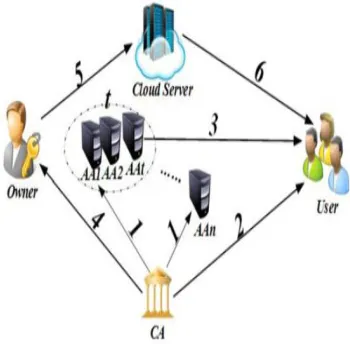
3. IMPLEMENTATION 3.1Certificate authority (CA):
The endorsement domination is an
ecumenical trusted element in the
framework that is in charge of the
development of the framework by building
up framework parameters and characteristic
open key (PK) of each property in the entire
quality set. CA acknowledges clients and
AAs' enlistment asks for by allotting a novel
uid for each licit utilizer and a remarkable
profit for every AA. CA moreover chooses
the parameter t about the limit of AAs that
are included in clients' mystery key era for
each time. Be that as it may, CA is not
included in AAs' lord key sharing and
clients' mystery key era. Therefore, for
instance, CA can be administration
associations or venture divisions which are
in charge of the enlistment
3.2Attribute Authorities (AAs)
The quality ascendant substances focus on
the assignment of trait administration and
key era. In addition, AAs remove a portion
of the duty to build the framework, and they
can be the executives or the supervisors of
the application framework. Not the same as
other subsisting multi-power CP-ABE
frameworks, all AAs together deal with the
entire trait set , notwithstanding, any of AAs
can't dole out clients' mystery keys alone for
the ace key is shared by all AAs. All AAs
coordinate with each other to allot the ace
key. By this betokens, every AA can pick up
a bit of ace key offer as its private key, at
that point every AA sends its relating open
key to CA to induce one of the framework
open keys. With regards to incite clients'
mystery key, every AA just ought to induce
its comparing mystery key autonomously.
That is to verbalize, no correspondence
among AAs is required in the period of
clients' mystery key era.
3.3Data Owner:
The information proprietor (Owner)
scrambles his/her record and characterizes
get to approach about who can access
his/her information. Most importantly, every
proprietor encodes his/her information with
a symmetric encryption calculation like AES
Available online: https://edupediapublications.org/journals/index.php/IJR/ P a g e | 669
get to approach over a quality set and
encodes the symmetric key under the
arrangement as indicated by trait open keys
picked up from CA. Here, the symmetric
key is the key used in the previous
procedure of symmetric encryption. From
that point onward, the proprietor sends the
entire scrambled information and the
encoded symmetric key to store in the cloud
server. Be that as it may, the proprietor
doesn't depend on the cloud server to lead
information get to control. Information put
away in the cloud server can be picked up
by any information buyer. Regardless of
this, no information purchaser can pick up
the plaintext without the quality set
satisfying the get to strategy.
3.4Data Consumer (User):
The information purchaser (Utilizer) is
doled out with an ecumenical utilizer
personality uid from CA, and applies for
his/her mystery keys from AAs with his/her
distinguishing proof. The utilizer can
liberatingly get the ciphertexts that he/she is
interested with from the cloud server.
He/She can unscramble the encoded
information if and just if his/her quality set
slakes the get to strategy obnubilated inside
the scrambled information.
3.5 Cloud Server:
The cloud server does only give a stage to
proprietors putting away and sharing their
scrambled information. The cloud server
doesn't direct information get to control for
proprietors. The scrambled information put
away in the cloud server can be downloaded
liberatingly by any information shopper.
Algorithm:
The FH-CP-ABE scheme consists of below
operations:
1) (PK, MSK) ← Setup(1κ):
The probabilistic operation takes a security
parameter κ as information and yields open
key PK and ace mystery key MSK.
2) (SK) ← KeyGen(P K, M SK, S):
The operation inputs PK, MSK and an
arrangement of characteristics S and causes
a mystery key SK.
3) File Encrypted Data ←
FileEncrypt(FileData m, ContentKey ck):
The operation inputs File Data m and
Content Key ck and using of substance key
ck we can scramble the record information
and store in cloud.
4) (CT) ← Encrypt (PK, ck, A):
The operation inputs PK, ck = {ck1... ckk}
and a progressive get to tree A. Finally, it
causes a coordinated ciphertext of substance
keys CT.
Available online: https://edupediapublications.org/journals/index.php/IJR/ P a g e | 670
The calculation inputs PK, CT which
incorporates a coordinated get to structure
A, SK depicted by an arrangement of traits
S. On the off chance that the S coordinates
some portion of A, some substance keys
cki(i ∈ [1, k]) can be unscrambled. On the
off chance that it coordinates the entire An,
all the substance keys can be decoded. At
that point, the comparing documents mi(i ∈
[1, k]) will be unscrambled with the
substance keys by the symmetric decoding
calculation.
Fig 1 Architecture Diagram 4. EXPERIMENTAL RESULTS
Fig 2 CA User Request Page
Available online: https://edupediapublications.org/journals/index.php/IJR/ P a g e | 671
Fig 4 AA Attribute Generate For User
5. File Upload
6.File Download
5. CONCLUSION
In this paper, we propose a beginning edge
multi-command CP-ABE get to control plot,
assigned TMACS, out in the open
distributed storage, in which all AAs
mutually deal with the entire property set
and allocate the ace key a. Gaining by (t;n)
limit mystery sharing, by collaborating with
any t AAs, a licit utilizer can induce his/her
mystery key. In this manner, TMACS avoids
any one AA being a solitary point bottleneck
on both security and execution. The
investigation comes about demonstrate that
our get to control plot is strong and secure.
We can simply find compatible estimations
of (t;n) to make TMACS not just secure
when not as much as t ascendant elements
are traded off, yet also vigorous when no not
as much as t ascendant substances are alive
in the framework. Besides, predicated on
efficiently combining the customary
multi-command plot with TMACS, we withal
build a mixture conspire that is more
advantageous for the credible situation, in
which qualities radiate from various
authority sets and different ascendant
elements in a domination set mutually keep
up a subset of the entire property set. This
improved plan tends to properties radiating
from various ascendant substances as well as
withal security and framework level
heartiness. The most effective method to
conceivably separate the estimations of (t;n)
in principle and configuration advanced
collaboration conventions will be tended to
in our future work..
6. REFERENCE
[1] Wei Li, Kaiping Xue, Yingjie Xue, and
Available online: https://edupediapublications.org/journals/index.php/IJR/ P a g e | 672
Verifiable Threshold Multi-Authority
Access Control System in Public Cloud
Storage ieee transactions on parallel and
distributed systems, vol. 27, no. 5, may
2016.
[2] S. Kamara and K. Lauter,
“Cryptographic cloud storage,” in Proc. 14th
Financial Cryptography Data Security, 2010,
pp. 136–149.
[3] K. Ren, C. Wang, and Q. Wang,
“Security challenges for the public cloud,”
IEEE Internet Comput., vol. 16, no. 1, pp.
69–73, Jan.-Feb. 2012.
[4] A. Sahai and B. Waters, “Fuzzy
identity-based encryption,” in Proc. 24th Annu. Int.
Conf. Theory Appl. Cryptographic Techn.,
2005, pp. 457–473.
[5] R. Ostrovsky, A. Sahai, and B. Waters,
“Attribute-based encryption with non-monotonic access structures,” in Proc. 14th
ACM Conf. Comput. Commun. Security,
2014, pp. 195–203.
[6] A. Lewko, T. Okamoto, A. Sahai, K.
Takashima, and B. Waters, “Fully secure
functional encryption: Attribute-based
encryption and (hierarchical) inner product
encryption,” in Proc. 29th Annu. Int. Conf.
Theory Appl. Cryptographic Techn., 2010,
pp. 62–91.
[7] V. Goyal, O. Pandey, A. Sahai, and B.
Waters, “Attribute-based encryption for fine-grained access control of encrypted data,” in Proc. 13th ACM Conf. Comput.
Commun. Security, 2006, pp. 89–98.
[8] N. Attrapadung, B. Libert, and E.
Panafieu, “Expressive keypolicy
attribute-based encryption with constant-size
ciphertexts,” in Proc. 14th Int. Conf.
Practice Theory Public Key Cryptography,
2011, pp. 90–108.
[9] J. Bethencourt, A. Sahai, and B. Waters,
“Ciphertext-policy attribute-based encryption,” in Proc. IEEE Symp. Security
Privacy, 2007, pp. 321–334.
[10] B. Waters, “Ciphertext-policy attribute-based encryption: An expressive, efficient, and provably secure realization,” in Proc.
14th Int. Conf. Practice Theory Public Key