Green Charge Utilizing Renewable Sources
Shivaji D. Somwanshi1, Prof. Ajay S. Wadhawe2
Research Scholar (M.E.), Dept of ECE, SSIEMS, Parbhani, Maharashtra, India1 Head of Electrical Dept, SSIEMS, Parbhani, Maharashtra, India2
ABSTRACT: As the population increases need for the electricity also increases day by day but unfortunately due to limited conventional sources people are facing lots of electricity cut, increase in electricity prices and load shading problems especially in summer season. Putting some contribution into the mission of MNRE (ministry of new and renewable energy) which brings energy security during transportation and distribution. India has launched the Jawaharlal Nehru National Solar Mission (JNNSM) in 2009 with ambitious target of installing 20,000MW of renewable energy solar power in the country by 2022, in order to meet such target the paper presents a cost effective, eco friendly and flexible system. Proposed system generates energy using one or more renewable energy sources to meet energy requirement at individual’s homes/buildings to “make our mother earth a better place to live”. Our paper focused mainly on generation of solar power as well as some contribution of small hydro power also. Using these renewable sources system can generate efficient green energy by installing them at different and appropriate places at homes/building. The generated energy is stored in battery and which is utilized for running different appliances. We can see the total renewable generation on LCD display and also on personal computer. In case of cloudy days if energy generation is insufficient we are taking Grid support to run the load. Generation of energy through renewable energy source helps to reduce energy bills and are environment friendly. Saving energy is likely to generate energy!!
KEYWORDS: Solar power, small hydro power, Battery, Inverter, Grid, ARM LPC2148, MATLAB, Embedded C.
I. INTRODUCTION
India is faster growing country and industrial development is faster and therefore requirement of electricity is important issue. Today everyone know that electricity prices are continuously increasing and the cause behind this hikes is depletion of the sources of electricity. The main energy sources in India are Coal, hydro, Gas, Nuclear, Oil and other renewable sources. Out of above the renewable energy sources are free and are easily available to produce more electricity out of them. Also generating energy out of fossil fuels like coal, natural gas and petroleum, they are burned and used to evaporate large amounts of water which is hazardous to environment Therefore it is essential to generate energy using natural resources for least damage to environment. We can use three different energy generation sources which may results in lower transmission losses. We need effective and practical approaches for energy generation and saving of energy, as energy is a driver of development almost in every field [4]. We can take power from the grid if battery charging is not enough for requirement similarly we can transmit energy over the grid when battery is fully charged. The main objective of this paper is to generate energy using renewable sources as solar, Hydro.
II. LITERATURE SURVEY
III. PROPOSED SYSTEM
Generation of energy by means of renewable sources at home in small amount also makes a huge difference to the energy generation to the world as well as issues regarding global warming. Fig.1 shows the block diagram of the green charge. To minimize the demand of electricity from utility grid and reduce electric bills we have developed a system named as Energy Budget using Green Charge. The system consist of ARM7 LPC2148 microcontroller which monitors and controls the whole system .The renewable energy sources solar and hydro can be easily built to provide energy at home/buildings/offices. The main advantage of the system is that when both sources solar and hydro are not available means sunlight is insufficient and hydro turbines are idle at that time the generated power from solar/ hydro sources is not able to charge battery bank, in such circumstances our high efficient ARM7 LPC2148 microcontroller immediately switch the load from battery bank to grid. The information regarding renewable energy generation from individual sources as well as grid status, battery charge status, inverter status all such data is displayed on LCD in real time and can be stored on the pc by transmitting data serially using MATLAB software. Our system consists of three main energy sources; solar, hydro and grid.
Fig.1: Block diag. of proposed system
IV. HARDWARE DESCRIPTION
A. MICROCONTROLLER:
In this system we are using ARM7 LPC2148 microcontroller, which is heart of our project. ARM is faster compared to other controllers since it can process 32bit data simultaneously. When we are performing real time operations we need faster processing. In other 8bit controllers like 8051, PIC, AVR data processing is slower as they process 8 bits of data at a time. Also pipelining concept in ARM makes this MCU much faster because, while executing one instruction it can takes other instruction & process them in pipelining queue simultaneously.
More I/O pins, port0 & port1. More peripherals can be interfaced.
Built in10 bit ADC with 14 channels.
32KB on chip static RAM.
512KB Flash ROM with In-System Programming (ISP) and In-Application Programming (IAP).
Vectored Interrupt Controller.
Two 32-bit timers, Watchdog Timer, PWM unit
CPU clock up to 60 MHz, On-chip crystal oscillator and On-chip PLL.
128 bit wide interface enables high speed 60MHz operation.
Fig.2: CIRCUIT SCHEMATIC OF GREEN CHARGE
B. Battery: Used to store the energy in the form of electric charge. In this system 12V battery is used. It has the capacity of 7AH. This battery is Sealed Lead-Acid Battery. This is a maintenance free battery. Also this battery is easily available in market. C10 types of batteries are used in solar systems.
Technical Specifications:
Voltage Voc = 12V Capacity = 7AH
Type = C10 (Sealed Maintenance Free Lead-Acid Battery) Max Charging Current = 1.4A
Stand By use= 13.6V - 13.8V Cycle Use= 14.1 - 14.4V
Monocrystaline, Multicrystaline etc. Both technologies are commercially used because mono has little high cost compared to multi/ polycrystalline SPV module but efficiency is slightly higher than multi/ polycrystalline SPV module.
Technical Specifications:
Make- Mexico-solar
Open circuit voltage (Voc)-22.20V Short circuit current (Isc) –0.59A Voltage at Pmax (Vm) – 18.50V Current at Pmax (Im) - 0.54A Rated maximum power (Pmax)- 10Wp Cell technology – Poly-si
D. Hydro Turbine: Hydro power generation is based on the conversion from potential to kinetic energy. Hydro power generation is termed as several names and categories such as small hydro generation (typically for generation of 1 to 20MWatts), micro hydro generation (micro hydro system typically producing up to 100KWatt), Pico hydro generation (hydro power generation under 5KWatt). In this proposed system the principle of micro hydro generation and Pico hydro generation is used in combination. The power output of such hydro sensors is calculated by equation P=Q*H/k, where Q is the flow rate in gallon per minute, H is the head loss, and k is a constant of 5,310 gal*ft/min*kW. For a system with a flow rate of 500 gallons per minute and head loss of 60 feet, the theoretical maximum power output is 5.65kW.
Technical Specifications:
Max output voltage- 24V Max. Output current- 300mA
Casing material – nylon/glass fibre, polyfarmaldehyde.
V. SOFTWARE IMPLEMENTATION AND DESCRIPTION
Required software for the system is developed in embedded c using Keil, and then code is compiled and embedded in LPC2148. MATLAB GUI is recommended for accessing generation information on remote PC.
VI. ALGORITHM
Step: 1 Start (Power ON the system)
Step: 2 initialize all the peripherals (UART, ADC, LCD, etc)
Step: 3 Get battery voltage by converting it to a digital value, to know status of battery
Step: 4 if battery fully charged, then stop charging & connect extra generated energy to the utility grid. Go to step 6
Step: 5 if battery is not fully charged, then start battery charging & disconnect utility grid from system. Go to step 6
Step: 6 send various parameters such as solar voltage, solar current, wind voltage, wind current to a PC through UART, & display on screen
Step: 7 also display these parameters on LCD
VII. RESULT AND DISCUSSION
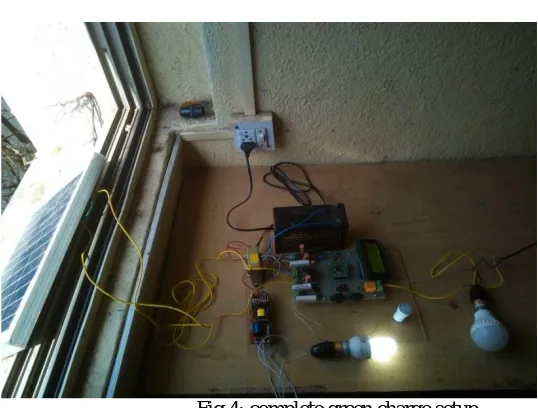
Fig.4: complete green charge setup.
In this section we will discuss about the results of our proposed paper. This system is designed for generation of energy using solar plates and micro hydro generator source. It also manages the required electricity at homes/ building and accordingly connects/disconnects the grid. This data is transmitted on LCD and PC serially. Fig.4 shows complete green charge system with renewable energy sources as well as grid connected load. Fig.5 shows the result of generation through the renewable sources RENGEN=0006 and the available voltage and currents of solar/ hydro/ battey etc, and accordingly inverter status INV ON because all renewable sources are available and battery has enough chareged to drive load.
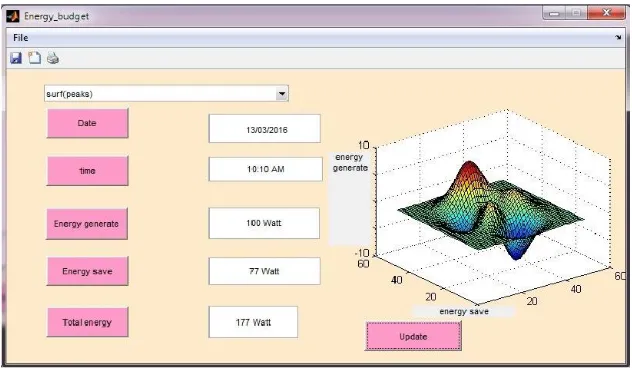
Fig 6: when renewable sources output is too low and battery voltage is low, load connection will be on GRID MATLAB GUI window of calculation of generated electricity on day and hour basis and is displayed on computer and is shown in Fig 7.
Fig.7: MATLAB GUI
VIII. CONCLUSION
Generation of energy using renewable sources solar and hydro, management of grid and renewable sources and contributing MNRE’s mission[6] is the main goal of our project. Proposed system always monitors state of battery charge and as per the status of voltage and current microcontroller takes action if battery is discharge below low cut point microcontroller connects the battery starts charging through the available source renewable sources. This concept also leads to the energy budget in the houses using different kind of sensors and it can be developed as future scope of this system.
REFERENCES
[1] “ Lini Mathew”, Hybrid Renewable Energy System, International Journal of Electronic and Electrical Engineering. ISSN 0974-2174, Volume 7, Number 5 (2014), pp. 535-542
[3] “Geetha Prakash” ,Harnessing Wind Energy to power Sensor Networks for Agriculture, 2014 International Conference on Advances in Energy Conversion Technologies (ICAECT)
[4] Prof. Chetan singh solanki, dept.of energy science and engineering, IIT Powai, Mumbai, Solar Photovoltaic Technology and systems: a manual for technicians trainers and engineers, PHI Learning publication pvt. Ltd. 11-Jan -2013
[5] “ Indrajeet Prasad” Smart Grid Technology: Application and Control, International Journal of Advanced Research in Electrical, Electronics and Instrumentation Engineering, vol.3, Issue 5, May 2014
[6] MNRE web search, https://en.wikipedia.org/wiki/ministry_of_New_and_Renewable _Energy
BIOGRAPHY