Available online: https://edupediapublications.org/journals/index.php/IJR/ P a g e | 1611 Abstract: As we've got currently confined energy
resources and machine power, knowledge aggregation from multiple detector nodes is completed victimisation simple approaches like averaging. WSN’s area unit very often unattended, they are extraordinarily liable to node compromising assaults. As a result creating it essential to see trustiness of information and name of detector nodes is efficacious for WSN. unvarying Filtering algorithms are learned to be terribly helpful during this explanation. Such algorithms participate in knowledge aggregation and supply trustiness comparison to the nodes among the shape of weight explanations.These algorithms at the same time combination knowledge from over one sources and furnish a trust estimation of those sources, by and huge in an exceedingly style of corresponding weight explanations allotted to knowledge supplied with the help of every and each supply.
Key Words:Collusion Attacks,data ggregation,Iterative Filtering Algorithm,wireless sensor network.
I. INTRODUCTION
A wi-fi detector network (WSN) includes a gaggle of these nodes that have the ability to expertise, system knowledge and maintain a correspondence with every and each alternative by method of a wireless affiliation. Wireless detector networks (WSN’s), the event in detector technology has created it viable to own terribly tiny, low powered sensing instruments set with programmable cipher, multiple parameter sensing and wi-fi message capability. Also, the low rate makes it possible to own a network of thousands or monumental quantities of those sensors, thereby up the consistency and accuracy of knowledge and therefore the space coverage. Wi-fi detector networks gift knowledge concerning isolated buildings, wide-unfold environmental alterations, then forth. Wireless detector network (WSN) may be a network approach ingrained of spatially
disbursed gadgets creating use of wireless detector nodes to look at bodily or environmental crisis, the same as sound, temperature, and movement. Trust and repute programs have an enormous role in aiding operation of a large vary of distributed programs, from wireless detector networks and e-commerce infrastructure to social networks, with the help of providing Associate in Nursing assessment of trustiness of members in such disbursed programs. A trustiness comparison at Associate in Nursingy given moment represents an mixture of the habits of the contributors the maximum amount as that moment and wishes to be effective among the presence of varied forms of faults and malicious habits. There square measure a amount of incentives for attackers to control the believe and standing millions of contributors in a very distributed method, and such manipulation will severely impair the performance of any such procedure. the foremost necessary goal of malicious attackers square measure aggregation algorithms of trust and repute systems. A detector network is intended to participate in a very suite of highlevel processing duties resembling detection, track, or categorization. Measures of potency for these tasks square measure smart outlined, together with discovery of false alarms or misses, classification errors, and monitor fine. as a result of the procedure power of terribly low power processors dramatically will increase, normally pushed by demands of cell computing, and because the fee of such technology drops, WSNs can possible be equipped to return up with the cash for hardware which is able to place into result additional refined knowledge aggregation Associate in Nursingd believe assessment algorithms; an illustration is that the latest emergence of multi-core and digital computer programs in detector nodes.
Secure Analysis Of Data Aggregation Technique
For Wireless Sensor Network
M.Pranitha1, D.Upender2,P.Srinivas Rao3
1M.Tech ,CSE, Jayamukhi Institute Of Technological Sciences,Warangal,India
2Assistant professor,CSE, Jayamukhi Institute Of Technological Sciences,Warangal,India
Available online: https://edupediapublications.org/journals/index.php/IJR/ P a g e | 1612 Fig.1: An operating system of a WSN
Iterative Filtering (IF) algorithms area unit associate appealing different for WSNs considering that they solve every issues - information aggregation and information trait analysis - utilizing one repetitive methodology. Such trustworthiness estimate of each sensor is based on the distance of the readings of this type of sensor from the estimate of the correct values, acquired in the earlier circular of iteration by some type of aggregation of the readings of all sensors. Such aggregation is mainly a weighted normal; sensors whose readings tremendously range from such estimate are assigned less trustworthiness and consequently in the aggregation system within the ability round of new release their readings are given a control weight.
II. RELATED WORKS
In this paper [3] He, W., Liu, X., Nguyen, H. V., Nahrstedt, k., and Abdelzaher, T, they reward one privacy -retaining data aggregation scheme for additive aggregation capabilities, which can be huge to approximate MAX/MIN aggregation perform. The primary process Cluster-based private data Aggregation (CPDA) -leverages clustering protocol and algebraic residences of polynomials. It has the competencies of incur less conversation overhead. The second scheme Slice–mix-aggregate(intelligent) builds on cutting strategies and the associative property of addition.
In[4] Carlos R. Perez-Toro, Rajesh okay. Panta, Saurabh Bagchi on this paper RDAS, a robust data aggregation protocol that use a fame-founded strengthen to admire and cut off cruel nodes in a sensor network. RDAS is centered on a hierarchical cluster form of nodes, where a cluster head clarify data from the cluster nodes to find out the vicinity
of an occasion. It makes use of the repetition of a couple of nodes experience an occasion to decide what data must have been reported by each node. RDAS is able to execute accurate data aggregation within the presence of independently hateful and collude nodes, as good as nodes that attempt to compromise the integrity of the fame method by using lying about other nodes‟ conduct.
In [1] S. Ganeriwal, L. Okay. Balzano, and M. B. Srivastava, Our work can also be carefully concerning the believe and reputation programs in WSNs. Authors proposed a common reputation framework for sensor networks in which every node develops a reputation estimation for different nodes by way of looking its neighbors which make a believe neighborhood for sensor nodes within the network.
In [6] Suat Ozdemir ,Yang Xiao presents data aggregation is the system of summarizing and combining sensor data with a purpose to lower the quantity of data transmission in the network. As wireless sensor networks are often deployed in faraway and adverse environments to transmit sensitive messages, sensor nodes are susceptible to node compromise attacks and security issues equivalent to data confidentiality and integrity are very foremost. As a consequence, wi-fi sensor procedure protocols, e.g., data aggregation protocol, need to be deliberate with safety in mind. This paper investigate the connection between protection and data aggregation method in wi-fi sensor networks. A taxonomy of secure data aggregation approach is given through surveying the current “state-of-the-art” work in this neighborhood. Moreover, based on the existing gain data of, the open study areas and future study directions in relaxed data aggregation thought are supplied.
In [8] X.-Y. Xiao, W.-C. Peng, C.-C. Hung, and W.-C. Lee proposed a trust situated framework which employs correlation to realize inaccurate readings. Additionally, they presented a ranking framework to accomplice a stage of trustworthiness with every sensor node founded on the number of neighboring sensor nodes are assisting the sensor.
III. NETWORK MODEL
Available online: https://edupediapublications.org/journals/index.php/IJR/ P a g e | 1613 and area unit capable of wireless communications.
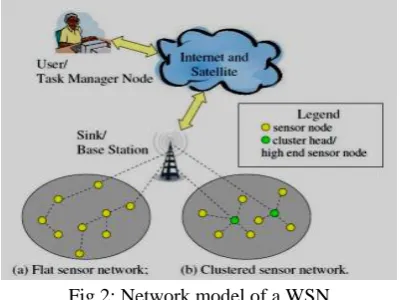
once a WSN is deployed during a sensing space, these device nodes are going to be chargeable for sensing irregular hobbies or for accumulating the detected knowledge of the atmosphere. inside the case of a device node detection associate degree abnormal occasion or being set to sporadically file the detected knowledge, it'll send the message hop-byhop to a particular node, referred to as a sink node..
Fig.2: Network model of a WSN
The sink node will then inform the supervisor via the internet. The sensor nodes are divided into disjoint clusters, and every cluster has a cluster head which acts as an aggregator. Information are periodically together and aggregated by way of the aggregator.
Fig. 3: Cluster head communication
IV. PROPOSED METHOD
Within the wireless sensor community contains sensor nodes these sensor nodes are scattered then deployed environment within the network and then to form the cluster ,each cluster has a cluster head after which data send to the aggregator node earlier than sending base station to verify the data, if any, error in the data, then to estimate the value utilising parameters such as bias and variance and in addition estimate MLE utilizing an iterative
filtering algorithm The proposed approach architecture view can also be proven in Fig.4.
Fig .4 Proposed system architecture
Available online: https://edupediapublications.org/journals/index.php/IJR/ P a g e | 1614 A. Bias Estimation
All sensors may have some errors in their readings. Such error is denoted as et
s Of sensor is and it is
modelled by the Gaussian distribution random variable with bias bs And variance σs. Let rs
Denotes the true value of the sensor at time t. Sensor readings xst can be written as
xst =rs+ ets (1)
Since there is no true value, the error value of sensors is not to be found. But the difference values of such sensors are calculated with the equation given below. Let δ = δ(i, j)be an estimator for mutual difference of sensor bias.
(2)
variable and m be the number of readings for each sensor.Then the expected value is calculated by minimizing the obtained value with respect to the mean value and the equation is given below δ(i, j)=ai-aj ≈ bi-bj (3)
B. Variance Estimation
With the known values of bias estimated from the equation 3 the variance of sensor errors are calculated.Each sensor bias value is substracted from the sensor readings.By using the error difference value from the equation 2 we can get the variance value as a squared difference of each sensor error and the bias value.This varies upto the last sensor reading and is defined as
(4)
C. Maximum Likelihood Estimation
The unbiasing sensor readings are extracted and take place with help of the bias estimated result which is calculated from the above section.After that the variance estimated result from equation 4 is considered.and the extracted unbiasing sensor is used to make the maximum likelihood estimation with variance value By differentiating the likelihood function the true values are obtained and are measured in the form of weighted average. It is defined as (5)
Thus it estimates the reputation vector without any
iteration. Hence the computational complexity of the estimation is less than the existing IF algorithms.
V. CONCLUSION
Data aggregation mechanisms together with information averaging procedures are analysed. Network model proposed with the aid of Wagner is described for sensor network community. Adversary items with their assumptions are reviewed. New refined collusion attack situations along with its affect on wi-fi sensor networks is defined. As soon as computational power of very low power processors drastically improves, future aggregator nodes will likely be competent of performing extra tricky data aggregation algorithms, as a consequence making wi-fi sensor networks less vulnerable.
REFERENCES
[1] S. Ganeriwal, L. K. Balzano, and M. B. Srivastava, “Reputationbased framework for high integrity sensor networks,” ACM Trans. Sen. Netw., vol. 4, no. 3, pp. 15:1–15:37, Jun. 2008.
[2] Y. Yang, X. Wang, S. Zhu, and G. Cao, “SDAP: a secure hop by hop data aggregation protocol for sensor networks,” in MobiHoc, 2006, pp. 356–367.
[3] He, W., Liu, X., Nguyen, H. V., Nahrstedt, K., and Abdelzaher, T. 2011. “Privacy preserving data
aggregation for information collection "ACM
Transaction Sensor Network. Article 6 (August 2011.DOI = 10.1145/1993042.199)3048.
[4] H.-S. Lim, Y.-S. Moon, and E. Bertino, “Provenancebased trustworthiness assessment in sensor networks,” in Proceedings of the Seventh International Workshop on Data Management for Sensor Networks,
ser. DMSN ‟10, 2010, pp. 2–7.
[5] S. Roy, M. Conti, S. Setia, , and S. Jajodia, “Secure data aggregation in wireless sensor networks,” Information Forensics and Security, IEEE Transactions on, vol. 7, no. 3, pp. 1040–1052, 2012.
[6]H.-L. Shi, K. M. Hou, H. ying Zhou, and X. Liu, “Energy efficient and fault tolerant multicore wireless
sensor network: E2MWSN,” in Wireless
Communications, Networking and Mobile Computing (WiCOM), 2011 7th International Conference on, 2011, pp. 1–4.
Available online: https://edupediapublications.org/journals/index.php/IJR/ P a g e | 1615
wireless networks,” Department of Computer Science, Johns Hopkins University, Tech, Tech. Rep., 2004.
[8] X.-Y. Xiao, W.-C. Peng, C.-C. Hung, and W.-C. Lee, “Using SensorRanks for in-network detection of faulty readings in wireless sensor networks,” in Proceedings of the 6th ACM international workshop on Data engineering for wireless and mobile access, ser. MobiDE
‟07, 2007, pp. 1–8.
[9]. J. Bahi, C. Guyeux, and A. Makhoul, “Efficient and robust secure aggregation of encrypted data in sensor networks,” in Fourth International Conference on Sensor Technologies and Applications, July 2010.