ISSN (Print) : 2320 – 3765 ISSN (Online): 2278 – 8875
I
nternational
J
ournal of
A
dvanced
R
esearch in
E
lectrical,
E
lectronics and
I
nstrumentation
E
ngineering
(An ISO 3297: 2007 Certified Organization)
Vol. 4, Issue 11, November 2015
A Broad Study on Mobile Cloud Computing
As Forthcoming Mobile Applications
Dr. G. Shankar Lingam1
Professor, Dept. of CSE, Chaitanya Institute of Technology & Science, Warangal, Telangana, India1
ABSTRACT:In recent years mobile applications and mobile devices are developing unexpectedly. With the increase of the mobile packages and cloud computing principles, cloud computing has becoming a capacity technology for mobile offerings. Mobile cloud computing integrates the cloud computing into mobile surroundings and overcomes the problems associated with performance, environment and safety. The paper presents the study on mobile cloud computing applications, challenges, existing solutions and techniques to triumph over the challenges. This paper also discusses Sanscode, a crossplatform cloud computing device advanced by way of Cyber design Works to cope with the underlyinginteroperability issues. We notice that Sanscode should provide a realistic opportunity response which supports a great deal of iCloud's functionality with several extra functions.
KEYWORDS:Cloud Computing, Data storage, iCloud, Cloud Services, Mobile Applications
I. INTRODUCTION
Data can now not be visible to be in anyonearea at anybody time, nor can it's seen asbelonging to anybody person. The 'Cloud' as itis typically known, may be taken into consideration as acollective system of statistics storage withcommunity connections that can be accessed viaany tool utilizing a popular Internetconnection. Although we've got witnessed anincrease inside the reputation of cloud computingsystems in recent years, many argue that thetechnologies underpinning such systemshave existed since the delivery of the web. Infact, the Cloud is often similar to the internet whichhas emerged as more flexible and ubiquitous asinformation technology preserve toenhance. Furthermore, we can still argue thatthe syncing and storing of information amongdevices in a cloud system (also known as‘cloud storage’) ought to not be categorized ascloud computing, but alternatively ‘distributedsystem’, as proper cloud computing impliessome parallel/allotted statistics processingacross massive-scale networks. Nevertheless,this paper will use the term cloud to refer tothe facts storage element of cloud computinginstead of the latter (more preferred) facts processing implementation.
II. RELATED WORK
Weiguang Song et. Al. [1] summarize the center concepts ofMobile Cloud Computing [MCC] with the aid of growing a fundamental conceptmodel of Mobile Cloud Computing. Major problems faced byMCC are mentioned including balance of WI-FI connectivity,tackling the unnecessary battery usage etc. Also, few feasibleanswers are recommended. Qureshi et. Al. [2] discusses about themobile cloud computing generation and proposes theimplementation strategies for Mobile Cloud Computinganswers together with General Purpose Mobile Cloud Computing(GPMCC) and Application Specific Mobile Cloud Computing(ASMCC). Certain limitations inclusive of network availability andbandwidth are targeted. Two aspects of safety troubles consisting ofmobile tool safety and cloud safety are addressed.
LeGuan et. Al. [3] addresses the challenges in Mobile CloudComputing layout along with network latency, restricted bandwidthand availability. In order to analyze Mobile Cloud Computinggeneration, an idea version is proposed which includescontext management, resource scheduling, and user andtransmission channel. A Cloud structure of Mobile CloudComputing is defined for organization of Mobile CloudComputing structures. Application partition and offloading andvarious context aware services are defined in brief.
ISSN (Print) : 2320 – 3765 ISSN (Online): 2278 – 8875
I
nternational
J
ournal of
A
dvanced
R
esearch in
E
lectrical,
E
lectronics and
I
nstrumentation
E
ngineering
(An ISO 3297: 2007 Certified Organization)
Vol. 4, Issue 11, November 2015
of mobile computing (MC) and cloud computing (CC) which has inherited high mobility andscalability. The proposed machine inside the paper explains theprecept of MCC, traits, recent research paintings, andfuture research developments. Proposed device analyzes the functionsand infrastructure of mobile cloud computing and alsoanalyzes the challenges of mobile cloud computing.
Ashwin Weiguang Song et. Al. [1] summarize the core ideas ofMobile Cloud Computing [MCC] by growing a primary ideaversion of Mobile Cloud Computing. Major problems confronted by way ofMCC are discussed inclusive of balance of wi-fi connectivity,tackling the needless battery usage and so forth. Also, few viablesolutions are counseled. Qureshi et. Al. [2] discusses about themobile cloud computing technology and proposes theimplementation methods for Mobile Cloud Computinganswers which include General Purpose Mobile Cloud Computing(GPMCC) and Application Specific Mobile Cloud Computing(ASMCC). Certain limitations along with network availability andbandwidth are targeted. Two components of protection issues together withmobile device security and cloud security are addressed. LeGuan et. Al. [3] addresses the demanding situations in Mobile CloudComputing layout inclusive of network latency, limited bandwidthand availability. In order to investigate Mobile Cloud Computinggeneration, a concept version is proposed which incorporatescontext control, resource scheduling, purchaser andtransmission channel. A Cloud structure of Mobile CloudComputing is defined for enterprise of Mobile CloudComputing systems. Application partition and offloading andnumerous context conscious offerings are explained briefly.
Dejan et.Al. [4] addresses numerous mobile cloud procedures. Anassessment of numerous possibilities of Mobile Cloud Computingis given. Native and web applications are too extremes ofmobile applications. The price version of elastic mobile cloudprograms is described.Han Qi et. Al. [14] discuss Mobile cloud computing (MCC) asan improvement and extension of mobile computing (MC) andcloud computing (CC) which has inherited excessive mobility andscalability. The proposed device in the paper explains theprinciple of MCC, characteristics, recent research work, andfuture studies developments. Proposed machine analyzes the functionsand infrastructure of cell cloud computing and additionallyanalyzes the challenges of mobile cloud computing. AshwinWeiguang Song et. Al. [1] summarizes the middle ideas ofMobile Cloud Computing [MCC] through growing a basic ideaversion of Mobile Cloud Computing. Major problems confronted byMCC are discussed which include balance of wireless connectivity,tackling the needless battery utilization and so on. Also, few possibleanswers are suggested. Qureshi et. Al. [2] discusses about themobile cloud computing generation and proposes theimplementation methods for Mobile Cloud Computinganswers including General Purpose Mobile Cloud Computing(GPMCC) and Application Specific Mobile Cloud Computing(ASMCC). Certain limitations together with network availability andbandwidth are targeted. Two aspects of security issues includingmobile tool protection and cloud safety are addressed.
LeGuan et. Al. [3] addresses the challenges in Mobile CloudComputing layout along with network latency, limited bandwidthand availability. In order to analyze Mobile Cloud Computinggeneration, a concept model is proposed which incorporatescontext management, resource scheduling, client andtransmission channel. A Cloud structure of Mobile CloudComputing is defined for organization of Mobile CloudComputing systems. Application partition and offloading andnumerous context aware offerings are defined in brief.
ISSN (Print) : 2320 – 3765 ISSN (Online): 2278 – 8875
I
nternational
J
ournal of
A
dvanced
R
esearch in
E
lectrical,
E
lectronics and
I
nstrumentation
E
ngineering
(An ISO 3297: 2007 Certified Organization)
Vol. 4, Issue 11, November 2015
CloudComputing is described for organisation of Mobile CloudComputing systems. Application partition and offloading andnumerous context conscious services are explained briefly.
Dejan et.Al. [4] addresses several mobile cloud techniques. Anassessment of diverse possibilities of Mobile Cloud Computingis given. Native and net programs are too extremes ofmobile packages. The value version of elastic mobile cloudprograms is defined.Han Qi et. Al. [14] speak Mobile cloud computing (MCC) asa development and extension of mobile computing (MC) andcloud computing (CC) which has inherited excessive mobility andscalability. The proposed system in the paper explains theprecept of MCC, traits, recent studies work, andfuture studies traits. Proposed machine analyzes the functionsand infrastructure of mobile cloud computing and alsoanalyzes the demanding situations of mobile cloud computing. Ashwin et. Al. [17] makes a specialty of the capabilities of the mobile and cloudlandscape. New elegance of packages known as Cloud MobileHybrid [CMH] packages and a Domain Specific Language[DSL] are described.
The proposed system define Cloud-mobilehybrid as a group of utility that has a Cloud based totallyback-stop and a cellular device front-stop. Using a single DSLscript, proposed gadget is capable of generating a diffusion ofCMH packages. These programs are composed ofa couple of combos of local Cloud and cellapplications. The proposed device also reduces thecomplexities of the platform. Dejan et. Al. [19] discuss aboutthe mobile groups which introduce new necessitiesas compared to conventional on-line internet groups. On the otherhand, cloud computing is emerging as computing concept thatgives the computational resources on call for and abstractionof technical information from the clients. The paper proposesMobile Community Cloud Platform (MCCP) as a cloudcomputing device which could impact the overall capacity ofmobile network boom. An analysis of the middlenecessities of common mobile networks is supplied.
Hung et. Al. [7] analyzes the overall performance of many mobileprograms that are weak due to loss of computationassets, garage, and bandwidth and battery ability. Toovercome this, application is rebuilt the usage of the cloud services.The proposed system explains a framework to execute themobile application in cloud based virtualized environmentwith encryption, and isolation to defend againstunauthenticated cloud companies. Results display the executionof mobile application with the assistance of offloading the workload withgreen application level migration approach via mobilenetworks. The migration of utility shape one tool toanother is simple and short inside the proposed machine.
Ricky et. Al.[10] builds an elastic cellular cloud computing infrastructureby introducing eXCloud device. EXCloud is a middlewaresystem which permits assets to be incorporated and useddynamically. In eXCloud, a Stack-on-Demand (SOD)technique is used to assist computation mobility inside themobile cloud surroundings. The proposed system assessmentshows that stack-on-call for version complements state of the artby using growing the computation and reducing migrationoverhead and latency. Ricky et. Al. [21] discuss that mobilecloud computing allows mobile packages to use the largeassets in the clouds. In order to make use of the assets,migration of the computation among mobile nodes and cloudnodes is necessary. Therefore, a particularly portable andtransparent migration technique is wanted. The paper makes use of aJava byte code transformation method for undertaking migrationwithout effecting everyday execution. Asynchronous migrationapproach is used to permit migrations to take place trulyanywhere in the user codes. The proposed Twin MethodHierarchy minimizes the overhead from country-restorationcodes in everyday execution.
Milos et. Al. [5] discusses the Biometric programs together withfingerprint identity, face, or iris scanning. Theseapplications simply paintings in a laboratory setting wherein thepatron laptop has unlimited access to the throughput andcomputational assets of the network. The problem basedright here is on the battery energy of the tool and the throughputof the conversation channel of the client node to the cloud.The paper explains the mobile cloud computing method forbiometric programs inclusive of fingerprint identification, facereputation and iris popularity. Debessay et. Al. [6] analyzesand research the effect of cloudlets in interactive mobile cloudapplications. In order to observe the effect, cloudlet communityand carrier structure is proposed. This structure focuseson file modifying, video streaming, and collaborative chatting.The overall performance profits with the use of clouds are shown by means ofsimulation consequences.
ISSN (Print) : 2320 – 3765 ISSN (Online): 2278 – 8875
I
nternational
J
ournal of
A
dvanced
R
esearch in
E
lectrical,
E
lectronics and
I
nstrumentation
E
ngineering
(An ISO 3297: 2007 Certified Organization)
Vol. 4, Issue 11, November 2015
safetyverification is accomplished. Saeid et. Al. [12] describes thereviewed and synthesized telephone augmentationprocesses. Generating excessive-end hardware is more expensive,power ingesting and time-consuming. Conserving neighborhoodassets through Cyber Foraging and Fidelity Adaptation arepossible and widely appropriate methods but they lack inproviding records protection. Reducing useful resource necessities iscompleted thru cloud computing and mashup era.
III. SYSTEM ARCHITECTURE
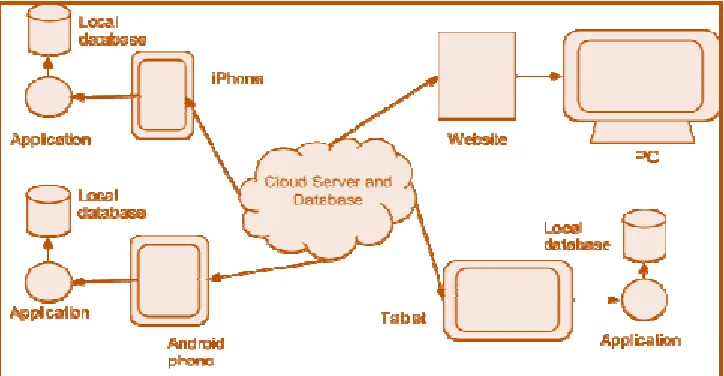
The majority of the software data is savedat the server side database within the shape ofJavaScript, HTML documents and SQL entries. Thisis depicted in Figure 1 as ‘Cloud Server andDatabase’.When a user to begin with downloads theapplication, a connection is made to theserver and creates a replica of the database tostore on the local tool. Once finished, theapplication has all of the essential records tofeature without connecting to a server. Inessence, any downloaded applications canadditionally have an "offline mode" for executionwhereas the tool isn't always linked to theInternet.
Figure 1: Mobile Apps/devices constructed using Sanscode extract datafrom the central repository to create their own local database
The software receives a version wide varietyrepresenting the model of the server'sdatabase it has downloaded and sends thisat the mobile tool.Each time the application is opened it testsif newer updates had been made available tothe server facet database. If so, it downloadsall of the new vital facts to update the neighborhooddatabase on the application device.If a change is made to the server side statistics,the server's model number is incremented;by means of evaluating the version number of theutility to the model wide variety of theserver, handiest the essential data that is wantedto replace the utility can be determinedand downloaded as opposed to downloadingthe complete database whenever.Thus, the above discussion highlights howSanscode enables the software data tostay regular throughout all devices, by way ofautomatically syncing any adjustments made tothe valuable data repository. Technically,whilst applications are executed the use ofSanscode, they're downloaded and cached(stored) within the neighborhood keep, letting thembe re/commenced thru Sanscode as desired. Thismakes putting in and updating applicationshighly simple (and seamless) to the user.
ISSN (Print) : 2320 – 3765 ISSN (Online): 2278 – 8875
I
nternational
J
ournal of
A
dvanced
R
esearch in
E
lectrical,
E
lectronics and
I
nstrumentation
E
ngineering
(An ISO 3297: 2007 Certified Organization)
Vol. 4, Issue 11, November 2015
download the statistics. This final pointlets in a utility to provide an indication ofthe download time and progress to the user.
V. CONCLUSION
This paper surveys the challenges, scope, procedures andsolutions within the region of Mobile Cloud Computing. The paperfocuses on Energy conservation in mobile devices, migrationtroubles, software development structures and the numerousmobile cloud computing programs. In this paper, we have proven how cloudcomputing has grown to be crucial to trendyday facts needs, with users having multipledevices throughout different structures. We alsotried the approach followed by means of Apple’siCloud and as compared it with Sanscode.
REFERENCES
[1]. Weiguang Song, Xiaolong Su, “Review of Mobile cloudcomputing”, IEEE 3rd International Conference onCommunication Software and Networks (ICCSN), Xi'an, 27-29 May 2011, pp 1- 4, Print ISBN: 978-1-61284-485-5, DOI:10.1109/ICCSN.2011.6014374.
[2]. ShahryarShafique Qureshi, Toufeeq Ahmad, KhalidRafique, Shuja-ul-islam “Mobile cloud Computing as futurefor Mobile Applications: implementation methods andchallenging issues”, IEEE International Conference on CloudComputing and Intelligence Systems (CCIS), Beijing, 15-17Sept. 2011, pp 467-471, Print ISBN: 978-1-61284-203-5,DOI: 10.1109/CCIS.2011. 6045111.
[3]. Le Guan, Xu Ke, Meina Song, Junde Song, “A Survey ofResearch on Mobile Cloud Computing”, 10th IEEE/ACISInternational Conference on Computer and InformationScience (ICIS), Sanya, China, 6-18 May 2011, pp 387-392,Print ISBN: 978-1-4577-0141-2, DOI: 10.1109/ICIS.2011.67.[4]. Dejan Kovachev, Yiwei Cao, Ralf Klamma, “MobileCloud Computing: A Comparison of Application Models,Information Systems and Database Technologies”, RWTHAachen University.
[5]. Milos Stojmenovic, “Mobile Cloud Computing forBiometric Applications”, Department of Informatics andComputation, 15th International Conference on NetworkBased Information Systems, Melbourne, 26-28 Sept. 2012, pp654-659, Print ISBN: 978-1-4673-2331-4, DOI:10.1109/NBiS.2012.147.
[6]. DebessayFesehaye, YunlongGao, KlaraNahrstedt,Guijun Wang, “Impact of Cloudlets on Interactive MobileCloud Applications”, IEEE 16th International EnterpriseDistributed Object Computing Conference, Beijing, 10-14Sept. 2012, pp 123-132, Print ISBN: 978-1-4673-2444-1,DOI: 10.1109/EDOC.2012.23.
[7]. Shih-Hao Hung, Chi-Sheng Shih, Jeng-PengShieh, ChenPang Lee, Yi-Hsiang Huang, “An Online MigrationEnvironment for Executing Mobile Applications on theCloud”, 5th International Conference on Innovative Mobileand Internet Services in Ubiquitous Computing, Seoul, June30 2011-July 2 2011, pp 20-27, Print ISBN: 978-1-61284-733-7 DOI: 10.1109/ IMIS .2011.77.
[8]. M.T Nkosi, F. Mekuria SM, “Cloud Computing forEnhanced Mobile Health Applications”, 2nd IEEEInternational Conference on Cloud Computing Technologyand Science, Indianapolis, Nov. 30 2010-Dec. 3 2010, pp 629-633, Print ISBN: 978-1-4244-9405-7, DOI: 10.1109/CloudCom.2010.31.
[9]. PengJianjing, ShenShenglin Fang, “Application ofMobile Cloud Computing in Operational Command TrainingSimulation System”, IEEE 12th International Conference onComputer and Information Technology (CIT), Chengdu, 27-29 Oct. 2012, pp 532-535, Print ISBN: 978-1-4673-4873-7,DOI: 10.1109/ CIT.2012. 116.
[10]. Ricky K. K. Ma, King Tin Lam, Cho-Li Wang,“eXCloud: Transparent Runtime Support for Scaling MobileApplications in Cloud”, International Conference on Cloudand Service Computing (CSC), Hong Kong, pp 103-110, PrintISBN: 978-1-4577-1635-5, DOI: 10.1109/CSC.2011.6138505.
[11]. Harshit Kharbanda, Manoj Krishnan, Roy H. Campbell.”Synergy: A Middleware for Energy Conservation in Mobiledevices”, IEEE International Conference on ClusterComputing (CLUSTER), Beijing, 24-28 Sept. 2012, pp 54-66,Print ISBN: 978-1-4673-2422-9, DOI:10.1109/CLUSTER.2012.64.
[12]. Saeid AbolfazliI, ZohrehSanaei, Abdullah Gani,”Mobile Cloud Computing: A Review on SmartphoneAugmentation Approaches”, First International Conference onComputing, Information Systems, and Communication, May2012, Singapore.
[13]. Yan Gu, Verdi March, Bu Sung Lee,”GMoCA:GreenMobile Cloud Applications”, First InternationalWorkshop on Green and Sustainable Software (GREENS),Zurich, 3-3 June 2012, pp 15-20, Print ISBN: 978-1-4673-1833-4, DOI: 10.1109/GREENS.2012.6224265.
[14]. Han Qi, Abdullah Gani, ”Research on Mobile CloudComputing: Review, Trend and Perspectives”, SecondInternational Conference on Digital Information andCommunication Technology and it's Applications (DICTAP),Bangkok, pp 195-202, Print ISBN: 978-1-4673-0733-8, DOI:10.1109/DICTAP. 2012.6215350.
[15]. Byung-Gon Chun, SunghwanIhm, PetrosManiatis,MayurNaik, “CloneCloud: Boosting Mobile Device
Applications Through Cloud Clone Execution”, eprint:arXiv:1009.3088, December 2012, DOI:2010arXiv1009.3088C.
[16]. Keerthi S. Shetty, Sanjay Singh, “Cloud BasedApplication Development for Accessing RestaurantInformation on Mobile Device using LBS”, InternationalJournal of UbiComp, Vol. 2, No. 2, 2011, pp 37-49, DOI:10.5121/iju.2011.2404.
[17]. Ashwin Manjunatha, AjithRanabahu, AmitSheth,KrishnaprasadThirunarayan “Power of Clouds In YourPocket: An Efficient Approach for Cloud Mobile HybridApplication Development”, IEEE Second InternationalConference on Cloud Computing Technology andScience[CloudCom], Indianapolis, Nov. 30 2010-Dec. 3 2010,pp 496-503, Print ISBN: 978-1-4244-9405-7, DOI:10.1109/CloudCom.2010.78.
ISSN (Print) : 2320 – 3765 ISSN (Online): 2278 – 8875
I
nternational
J
ournal of
A
dvanced
R
esearch in
E
lectrical,
E
lectronics and
I
nstrumentation
E
ngineering
(An ISO 3297: 2007 Certified Organization)
Vol. 4, Issue 11, November 2015
BIOGRAPHY