I
nternational
J
ournal of
A
dvanced
R
esearch in
E
lectrical,
E
lectronics and
I
nstrumentation
E
ngineering
(An ISO 3297: 2007 Certified Organization)
Vol. 5, Issue 6, June 2016
Copyright to IJAREEIE DOI:10.15662/IJAREEIE.20156.0506124 5477
Dynamic Modeling and Control for Solid
Oxide Fuel Cell (SOFC)
Neethu Mary1, Clint Augustine2, Shiny Joseph3, Sonsy Heartson4
M.Tech, Dept. of EIE, Vimal Jyothi Engineering College, Kannur, India1
Assistant Professor, Dept. of EIE, Vimal Jyothi Engineering College, Kannur, India 2
Associate Professor, Dept of Chemical Engineering, NIT, Calicut, India3
PhD Scholar, Dept of Chemical Engineering, NIT, Calicut, India4
ABSTRACT: Fuel cell systems offer clean and efficient energy production and are currently under intensive
development by several manufactures for both stationary and mobile applications. It is an electrochemical device that converts the chemical energy of gaseous fuel directly into electricity. This paper deals with the current status and control researche on SOFC technologies. Later, the transfer function of the fuel cell is derived by integrating the electrochemical cell reactions. The derived model includes the effect of activation, concentration and ohmic losses on the dynamic performance of SOFC. Within acceptable limits, the effect of Power demand variation on output voltage and real power output are investigated by using different controllers.
KEYWORDS: SOFC, PID, Self-tuning Fuzzy PID Controller
I.INTRODUCTION
Fuel cells convert the chemical energy of gaseous fuel directly into electricity by the electrochemical combination of a fuel with an oxidant. Absolutely harmless water is received as by-product ie., it is low to zero emissions. Fuel cells feature the potential for high efficiency (35-60%), quiet operation and high reliability due to the limited number of moving parts. They produce power electrochemically by passing a hydrogen-rich gas over an anode and air over a cathode, and introducing an electrolyte in between to enable exchange of ions. The effectiveness of the fuel cell depends on the type of electrolyte employed. Based on the type of electrolyte fuel cells are categorized as Polymer electrolyte fuel cell (PEFC), Alkaline fuel cell (AFC), Phosphoric acid fuel cell (PAFC), Molten carbonate fuel cell (MCFC) and Solid Oxide Fuel Cell (SOFC). Today, PAFCs have been successfully commercialized. The 200 kW PAFC on-site plant, the PC-25, was one of the first to enter the commercial market. Second generation fuel cells (SOFCs and MCFCs) are entered in the market in 2002. PEFCs are still in the development and testing phase [3]. SOFC is a type of fuel cell that appears to be one of the most promising fuel cell systems. Similar to other type of fuel cells, SOFC requires the fuel such as hydrogen, and oxidant reactants such as oxygen or air to electronically react at high temperature and generate electrical energy. Hydrogen is normally used as the fuel since it has high electrochemical activity, but carbon monoxide can be also used as the fuel together with hydrogen. The direct use of a hydrocarbon gas instead of hydrogen or carbon monoxide is also possible when operated as internal reforming.
the effect of activation, concentration and ohmic losses on the dynamic performance of SOFC. Control part is discussed in section III & IV and obtained results are analyzed in V and followed by the conclusion and reference.
II. MATHEMATICAL MODELING
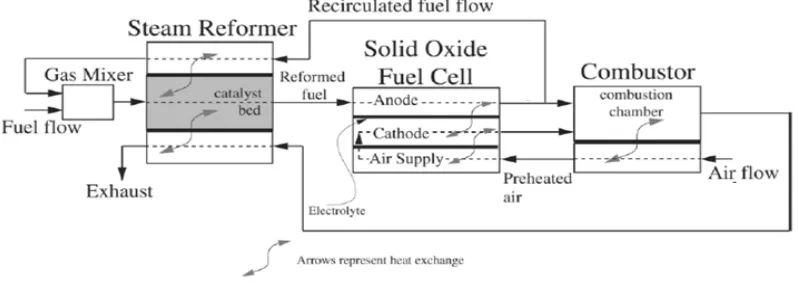
The system consists of three primary components, namely, the steam reformer, the fuel cell stack and the
combustor. Methane is chosen as the fuel for the system, with a molar flow rate of . The system is presented in
Fig(1). The reformer produces a hydrogen rich gas, which is supplied to the anode of the fuel cell. Electrochemical reactions occurring at the anode due to current draw results in a steam rich gas mixture at its exit. A known fraction of the anode exhaust is recirculated through the reformer into a mixing chamber where fuel is added. The mixing of the two fluid streams and pressurization is achieved in the gas mixer using an ejector or recirculating fuel pump. The steam reforming process occurring in the reformer catalyst bed is an endothermic process. The energy required to sustain the process is supplied from two sources, namely, the combustor exhaust that is passed through the reformer from two sources, namely, the combustor exhaust that is passed through the reformer and the aforementioned recirculated anode flow as shown in Fig. (1). The remaining anode exhaust is mixed with the cathode air, which has a molar flow rate of . The tubular construction of each cell causes the air to first enter the cell through the air supply tube and then reverse its direction to enter the cathode chamber. For steam reforming of methane, we consider a packed-bed tubular reformer with nickel-alumina catalyst [11].
Fig. (1) Schematic diagram of SOFC system.
The three main reactions in steam reforming of methane are:
+ => + 3
+ => +
+ 2 => + 4
Internal reforming reactions occur in the anode due to high temperatures and the presence of nickel catalyst. The primary electrochemical process is
At Anode:
2 + 2 => 2 + 4 2 + 2 => 2 + 4
At Cathode:
+ 4 => 2
The model used in this paper is based on the electrochemical properties (component material balance equations) and Nernst’s voltage equation. The temperature is assumed to be stable at all times. The model considers the system in its normal operating conditions; start-up; shut-down operations are far away from the nominal power production and hence are not considered in this paper.
I
nternational
J
ournal of
A
dvanced
R
esearch in
E
lectrical,
E
lectronics and
I
nstrumentation
E
ngineering
(An ISO 3297: 2007 Certified Organization)
Vol. 5, Issue 6, June 2016
Copyright to IJAREEIE DOI:10.15662/IJAREEIE.20156.0506124 5479
Assuming perfect gas behavior for hydrogen at the anode channel, we have
=
Defining
=
Where the derivative is with respect to time (s), we get
=
Splitting the hydrogen molar flow rate into its three components- the input flow rate, the output flow rate, and
the flow rate that takes part in the reaction- we have
= ( − − ) (1)
Similarly, for water vapor at the anode channel,
= (0− − ) (2)
Again, the process of oxygen inflow/ outflow/ reaction at the cathode channel is described by
= ( − − ) (3)
From the basic operation of the SOFC we know that four electrons are consumed for each moles of oxygen and two electrons for each moles of hydrogen. Water, however, is produced at the rate of one moles of every two electrons. From electrochemical properties it follows that
=
2 = 2 =
4 =
Assuming that the molar flow of a gas through the valve is proportional to its partial pressure inside the channel, we have
= and =
At the anode, and
=
At the cathode, now, substituting for the output flow rates and reaction flow rates in equations (1) and (2), and taking Laplace transforms, we obtain the following two equations for the anode channel (the transform of f(t) is denoted by F(S)):
( ) = / ( −2 ) (4)
Similarly
( ) = / (2 ) (5)
( ) = / ( − ) (6)
Where
= , = =
The inverse transforms of equations (4)-(6) will yield the time domain expressions for the three partial pressures
at constant molar flow rate and fuel cell stack current is given below:
( ) = 1/ 2 1−exp −
( ) = 1/ − 1−exp −
At steady state condition:
( ) = 1/ −2 (7)
( ) = 1/ 2 (8)
( ) = 1/ − (9)
Output voltage
The open circuit emf E, of a stack of cells in series is given by Nernst’s equation:
= + 2 ln
The following types of losses (or voltage drops or irreversibility) are generally considered in the literature: Activation loss: Activation loss caused by the slowness of the electrochemical reactions taking place on the surface of the electrode
=
∝ ln ,
Where is the electron transfer coefficient, n is the number of electrons (per mole) participating in the reaction,
is the current density, and , the exchange current density.
Concentration loss: Concentration loss (or mass transport loss) that results from the change in concentration of the reactants at the surface of the electrodes as the fuel is used:
= ln 1−
,
Where n is the number of electrons transferred per mole, is the current density, and , the limiting
current density.
Ohmic loss: Ohmic loss due to the electrical resistance of the electrodes and the electrolyte. This resistance, represented by r, depends upon the stack temperature
=
We obtain the steady-state SOFC stack terminal voltage is as:
= − − −
Fuel utilization is the ratio between the fuel flow that reacts and the input fuel flow.
=
Where
=
2 = 2
The ratio of hydrogen to oxygen flow rate is as:
=
I
nternational
J
ournal of
A
dvanced
R
esearch in
E
lectrical,
E
lectronics and
I
nstrumentation
E
ngineering
(An ISO 3297: 2007 Certified Organization)
Vol. 5, Issue 6, June 2016
Copyright to IJAREEIE DOI:10.15662/IJAREEIE.20156.0506124 5481
III. CONVENTIONAL CONTROLLER
PID (Proportional, Integral and Differential) controller is the most common form of feedback. In PID controller the basic idea is the examination of signals from sensors placed in the system, called feedback signals. PID as one of widely used control approaches has many advantages such as simple control structure, easy design and inexpensive cost etc. The PID controller has been used in different controlled plant. However it cannot get a good control effect when controlled system is nonlinear
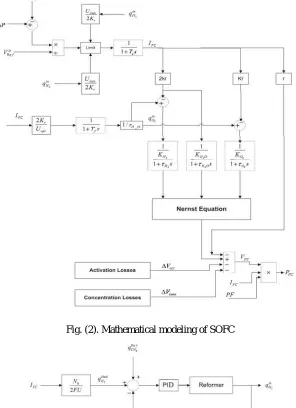
Fig. (2). Mathematical modeling of SOFC
Fig. (3): system with PID controller
andof higher order. Let’s consider Fig. (3), the above given unity feedback system, The PID controller is usually implemented as follows:
( ) = ( )− ( ) (2)
Wherek ,k, and k are the proportional, the integral, and the derivative gains respectively. The controller output,
the process output, and the set point are denoted as u(t),y (t)andy (t) respectively. A proportional controller (k )
will have effect of reducing the rise time, but never eliminates the steady-state error. An integral controller (k ) will
reduce the steady-state error but may make the transient response worse. A derivative controller (k ) will have an effect
on stability of the system, it reduces the overshoot, and improving the transient response.To getting the demand power from the system, we first derived the system equation then check its real time response. Then we designed a PID
controller to control the close loop function. Ziegler Nichols tuning rule is used to determine the value ofk , k and k
which is based on the transient step response of a plant. The obtained final values
arek = 961.53,k = 41.25,andk = 987.56
IV. SELFTUNING FUZZY CONTROLLER
The performance specifications of the systems such as rise time, overshoot, settling time and error steady state can
be improved by tuning parameters k , kandk of the PID controller. By developing self tuning fuzzy controllers,
these parameters can be modified online, according to the changes in the process condition without much intervention of an operator.
LotfiZadeh, the father of fuzzy logic is extend two valued logic, defined by the binary pair {0,1}, to the whole continuous interval [0, 1]. Fuzzy controllers use heuristic information in developing design the control of nonlinear dynamic system. A fuzzy control system is shown in Fig. 3. FLS is consist fuzzifier, rules, inference engine and output processor (defuzzifier) and that are interconnected. The fuzzifier converts the crisp value into Fuzzy Sets. It is needed to activate rules that are in terms of linguistic variables. The rules are the heart of an FLS. The rules are expressed as a collection of IF-THEN statements. The IF-part of a rule represents antecedent and the THEN part represents consequent. The fuzzified inputs activate the inference engine and the rule base to produce a Fuzzy Set output. The commonly used inferential procedure is minimum and maximum implication method. Defuzzification is necessary to obtain the crisp number as the output.
Here we used self tuning fuzzy PID and PID controller, that is, the three parameters such as proportional gain
( ), integral gain ( ) and derivative gain ( )of controllers are tuned by using fuzzy tuner. The co-efficient of the
classical controllers cannot be properly tuned for the SOFC with unpredictable parameter variation, hence tune
automatically the controller parameters such as , and values by using self tuning fuzzy PID controller. The
structure of the self tuning fuzzy PID controlleris shown in Fig. 4.
The proposed controller structures consist of a simple upper level controller and a lower level classical controller. The upper level controller provides a mechanism to select the gain of a classical PID and the lower level deliver the solution to a particular situation. Here we use the control structure as a rule based Mamdani fuzzy controller. It is used in the upper level and conventional PID controller is selected for the lower level.
In fuzzy structure, there are two inputs to fuzzy inference: error ( ) and change of error ( ) and three outputs
for each PID controller parameters respectively , and . The steps for designing aimed controller for the spherical
type of storage vessel are as follows:
a) Select the input and output parameters for the fuzzy controller. Here we choose the error signal and the change
I
nternational
J
ournal of
A
dvanced
R
esearch in
E
lectrical,
E
lectronics and
I
nstrumentation
E
ngineering
(An ISO 3297: 2007 Certified Organization)
Vol. 5, Issue 6, June 2016
Copyright to IJAREEIE DOI:10.15662/IJAREEIE.20156.0506124 5483
Fig. 3: A fuzzy control system
Fig. 4:The structure of the self tuning fuzzy PID controller
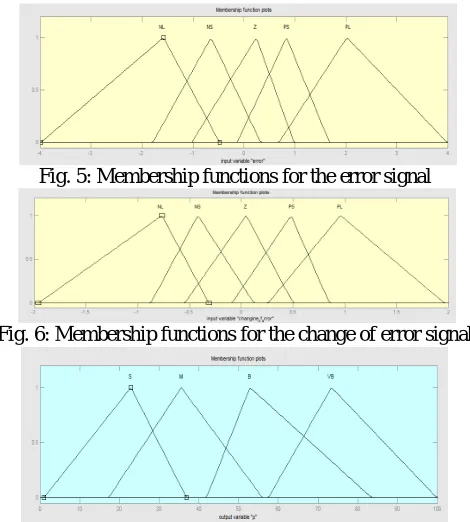
b) Then divide the universe of discourse into FSs. Fig. 5 and 6 show the input membership functions for the error
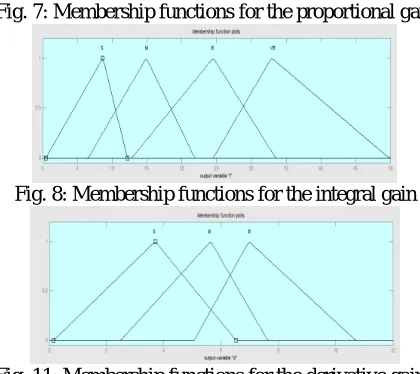
signal and change of error signal respectively. Here the universe of discourse is divided as Negative Large (NL), Negative Small (NS), Zero (Z), Positive Small (PS) and Positive Large (PL). Fig. 7 to 9 shows the output membership function for the proportional and the integral gains, whereas the universe of discourses is divided as Medium (M), Big (B) and Very Big (VB).
c) Write the rule base for the Self Tuning Fuzzy PID controller, based on experience and it is described in the
below given Table 1 - 3 correspondingly.
d) Use the algorithm of theamied controller : Centroid defuzzification is the best technique to obtain the crisp
output.
The degree of each membership function which was computed in the previous step of fuzzifications encountered by the subprogram called defuzzify and this after certain process it returns defuzzified output.
Fig. 5: Membership functions for the error signal
Fig. 7: Membership functions for the proportional gain
Fig. 8: Membership functions for the integral gain
Fig. 11: Membership functions for the derivative gain
TABLE 1: RULE BASE FOR THE PROPORTIONAL GAIN
e
∆e
N L
N S
Z P
S
P L
NL M S S S M
NS B M S M B
Z V
B
B M B V
B
PS B M S M B
PL M S S S M
TABLE 2: RULE BASE FOR THE INTEGRAL GAIN
e
∆e
N L
N S
Z P
S
P L N
L
B M S M B
NS B M M M B
Z V
B
B M B V
B
PS B M M M B
PL B M S M B
TABLE 3: RULE BASE FOR THE DERIVATIVE GAIN e
∆e
NL NS Z PS PL
NL M M B M M
NS M M B M M
Z S M B M S
PS M M B M M
I
nternational
J
ournal of
A
dvanced
R
esearch in
E
lectrical,
E
lectronics and
I
nstrumentation
E
ngineering
(An ISO 3297: 2007 Certified Organization)
Vol. 5, Issue 6, June 2016
Copyright to IJAREEIE DOI:10.15662/IJAREEIE.20156.0506124 5485
TABLE (2): PARAMETERS IN SOFC SYSTEM MODEL
Paramet er
Representation Value
Rated power 100 kW
Real power reference 100 kW
T Absolute temperature 1273 K
F Faraday’s constant 96487 C/mol
R Universal gas constant 8314 J/(kmol K)
Ideal standard potential 1.18 V Number of cells in series
in the stack
384
Constant = 6 0.996 x 10
-kmol/(sA)
Maximum fuel utilization 0.9 Minimum fuel utilization 0.8 Optimal fuel utilization 0.85
Valve molar constant for hydrogen
8.43 x 10
-4
kmol/ (s atm) Valve molar constant for
water
2.81 x 10
-4
kmol/ (s atm) Valve molar constant for
oxygen
2.52 x 10
-3
kmol/ (s atm) Response time for
hydrogen flow
26.1 s
Response time for water flow
78.3 s
Response time for oxygen flow
2.91 s
r Ohmic loss 0.126 Ω
Electrical response time 0.8 s Fuel processor response
time
5 s
Ratio of hydrogen to
oxygen
1.145
PF Power factor 1.0
, Exchange current density 20 mA/cm2
, Limiting current density 900
mA/cm2
A Cell area 1000 cm2
α Charge transfer
coefficient
0.5
n number of electrons (per mole); or sample size in
statistical tests
V.RESULT
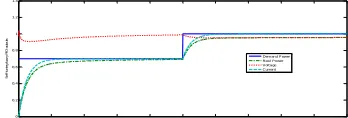
Assume a stand-alone SOFC system is operating with constant rated voltage 1 V and power demand 0.7 Watts. The schematic Simulink diagram is shown Fig (2). All parameters are the same as Table (2). At t=50 s, there is a step increase of power demand from 0.7 to 1.0 Watts.
A OPEN LOOP RESPONSE
The Fig. (12) shows that the open loop response of Pdem, Preal, Vfc, Ifc from the SOFC system. In the first 50 sec after power demand is increased, power real has a rapid increase due to the fast electrical response time in the fuel cells. Subsequently, power real increases slowly and continuously until reaching below the required power. This is due to the slow chemical response time in the fuel processor. The total response time of power real from 0.4 to 0.6 Watts is about 10s.
Fig (12): Open loop response of Pdem, Preal, Vfc, Ifc from the SOFC system
Fig (13): PID response of Pdem, Preal, Vfc, Ifc from the SOFC system
B PID RESPONSE
The Fig. (13) shows that the PID response of Pdem, Preal, Vfc, Ifc from the SOFC system. In the first 50 sec after power demand is increased, power real has a rapid increase due to the fast electrical response time in the fuel cells. Subsequently, power real increases slowly and continuously until reaching below the required power. This is due to the slow chemical response time in the fuel processor. The total response time of power real from 0.6 to 0.85 Watts is about 10 s.
C SELF TUNING FUZZY PID RESPONSE
The Fig. (7) shows that the Selftuning fuzzy PID response of Pdem, Preal, Vfc, Ifc from the SOFC system. In the first 50 sec after power demand is increased, power real has a rapid increase due to the fast electrical response time in the fuel cells. Subsequently, power real increases slowly and continuously until reaching the required power. The total response time of power real from 0.7 to 0.9 Watts is about 10 s.
Fig (7): Selftuning Fuzzy PID response of Pdem, Preal, Vfc, Ifc from the SOFC system
0 10 20 30 40 50 60 70 80 90 100 0 0.2 0.4 0.6 0.8 1 1.2 1.4 1.6 1.8 2 time Power demand Power real voltage output c urrent output
0 10 20 30 40 50 60 70 80 90 100
0 0. 2 0. 4 0. 6 0. 8 1 1. 2 Time P ID o u tp u ts Demand Power Real Power Voltage Current
0 10 20 30 40 50 60 70 80 90 100
0 0. 2 0. 4 0. 6 0. 8 1 1. 2 1. 4 Time Self tun ing f uzz y P ID ou tp uts
I
nternational
J
ournal of
A
dvanced
R
esearch in
E
lectrical,
E
lectronics and
I
nstrumentation
E
ngineering
(An ISO 3297: 2007 Certified Organization)
Vol. 5, Issue 6, June 2016
Copyright to IJAREEIE DOI:10.15662/IJAREEIE.20156.0506124 5487
VI.CONCLUSION
In this paper, the SOFC model developed in Matlab/SIMULINK environment is used to simulate the performance of the SOFC fuel cell. The response of the system to step changes in power demand are presented along with the analysis of the simulated results. It has been observed that the fluctuations in the output voltages in the power system due to demand power variations are taken care of by the SOFC very closely. The fuel cell system reduces the cost of power generation as well as the level of pollution. The Simulation results are presented for various dynamic characteristics of the Fuel cell system. The total response time of power real from 0.7 to 0.9 Watts is about 10 s in Self tuning Fuzzy PID controller and from 0.6 to 0.85 Watts is about 10 s in PID controller. The Self tuning Fuzzy PID controller can be considered stronger than PID controllers.
REFERENCES
1. NavadolLaosiripojanaa, WisitsreeWiyaratnb,WoraponKiatkittipongc, ArnornchaiArpornwichanopd, ApinanSoottitantawat,
SuttichaiAssabumrungrat; Reviews On Solid Oxide Fuel Cell Technology; Engineering Journal : Volume 13 ISSUE 1 ISSN 0125-8281 : Acceptance Date, Jan. 2009
2. Y. Zhu, K. Tomsovic; Development of models for analyzing the load-following performance of microturbines and fuel cells; Electric
Power Systems Research 62 (2002) 1/11
3. Ruchi Yadav, Gauri Shankar; Modelling and Simulation of Solid Oxide Fuel Cell; 2014 International Conference On Computation Of
Power, Energy, Information And Communication (ICCPEIC)
4. TVVS Lakshmi, P Geethanjali and Krishna Prasad S; Mathematical modelling of solid oxide fuel cell using Matlab/Simulink;
International Conference on Microelectronics, Communication and Renewable Energy (ICMiCR-2013)
5. Y. H. Li, S. S. Choi; An Analysis of the Control and Operation of a Solid Oxide Fuel-Cell Power Plant in an Isolated System; IEEE
Transactions On Energy Conversion, VOL. 20, NO. 2, JUNE 2005
6. N. Prema Kumar, K. Nirmala Kumari, K.M.Rosalina; Modeling Design of Solid Oxide Fuel Cell Power System for Distributed
Generation Applications; International Journal of Advanced Research in Computer Engineering & Technology (IJARCET) Volume 1, Issue 9, November 2012
7. Jaime Arriagada, Pernilla Olausson, AzraSelimovic; Artificial neural network simulator for SOFC performance prediction; Journal of
Power Sources 112 (2002) 54–60
8. Uday Kumar Chakraborty; Static and dynamic modeling of solid oxide fuel cell using genetic programming; Energy 34 (2009) 740–751
9. Francisco Jurado; Predictive control of solid oxide fuel cells using fuzzy Hammerstein models; Journal of Power Sources 158 (2006)
245–253
10. Tahar Allag and Tuhin Das; Robust Control of Solid Oxide Fuel Cell Ultracapacitor Hybrid System; IEEE Transactions On Control