Dropout Creates Dropout
*A.Kannan&**Dr.R.Rajendran*Ph.D Research Scholar, A.V.V.M Sri Pushpam College (Autonomous) Poondi, ThanjavurDt
** Research Supervisor, Department of Economics, A.V.V.M Sri Pushpam College (Autonomous) Poondi, ThanjavurDt
Abstract
The present paper analyses the link between the educational status of parents and the child. There exits the positive correlation between parents education and child’s education. Parent’s educational status plays a very important role in their child’s education.In this situation, the main objective of the paper is to know dropout creates dropout in the study area. How? This research conducted was by researcher on September, 2014, the name of the village is Poovanipattu. Poovanipattu village is located in AnikuthichanPanchayat, UdayarpalayamTaluk, Ariyalur District, Tamilnadu. There is a Government school functioning well, the name of the school “ Government (Addidravidar welfare) higher secondary school”. Primary school was started in 1944, primary school are being upgraded into middle class in the year 1987-88, Secondary class 1990-91 and higher secondary class 1992-93 in this study area.The necessary data have been collected from household survey through primary data. Primary data have been collected through a well structured questionnaire. Status rate method has been used for collecting data. Status rate means the proportion of all individuals in the population who have not completed high school and were not enrolled at a given point in time. The data have been collected only from scheduled caste student and from their family members. The selected student have been dropped in VI to X class age between14 to 24.This study concludes that the uneducated parent earnings income through daily work is very low compared to
other earnings. These families needed additional source of income for runningtheir family. Son and daughter are alternative income earner in poor families. This situation leads to dropout in school education and go to work. This circle continues in future again and again father to son,
Key words:
Dropout; reason ; Parents education
The present paper analyses the link between the educational status of parents and the child. There exits the positive correlation between parents education and child‟s education. Parent‟s educational status plays a very important role in their child‟s education.Turnbull (1983) has identified four basic parental roles- parents as educational decision makers; parents as parents; parents as teachers and parents as advocates. Since the parent's attitude is so important, it is essential that the home and school work closely, especially for children.
Review of literature
Pong &Ju (2000) founds that socio-economic status, most commonly measured by parental education and income, is a powerful predictor of school achievement and dropout behavior.
India indicatedthat the income of the father was linked to the continuity or discontinuity of the child in school; with the fathers of most drop outs not employed. If income levels are low, children may be called on to supplement the household‟s income, either through wage-earning employment themselves or taking on additional tasks to free up other household members for work.
Ersado (2005) talks of „the widely accepted notion that parental education is the most consistent determinant of child education (and employment decisions)‟. Higher parental/ household head level of education is associated with increased access to education, higher attendance rates and lower drop out rates.
Cardoso &Verner (2007) High parental income makes it convenient to provide more resource o support children‟s education, including access to better quality schools, private tuitions and more support for learning within home. Poverty still remains as one of the significant causes of children dropping out of school
In this situation, the main objective of the paper is to know dropout creates dropout in the study area. How? This research conductedwas by researcher on September, 2014, the name of the village is Poovanipattu. Poovanipattu village is located in AnikuthichanPanchayat, UdayarpalayamTaluk, Ariyalur District, Tamilnadu. There is a Government school functioning well, the name of the school “ Government (Addidravidar welfare) higher secondary school”. Primary school was started in 1944, primary school are being upgraded into middle class in the year 1987-88, Secondary class 1990-91and higher secondary class 1992-93 in this study area.
*Ph.D Research Scholar, ** Research Supervisor, Department of Economics, A.V.V.M Sri Pushpam College (Autonomous) Poondi, ThanjavurDt
The necessary data have been collected from household survey through primary data. Primary data have been collected through a well structured questionnaire. Status rate method has been used for collecting data. Status rate means the proportion of all individuals in the population who have not completed high school and were not enrolled at a given point in time. The data have been collected only from scheduled caste student and from their familymembers. The selected student have been dropped inVI to X class age between14 to 24.
The reason for drop out
The dropout problem is pervasive in the Indian education system. Many children who entered school are unable to complete education and multiple factors are responsible for children dropping out of school. Risk factor begin to add up even before student enroll in school include : poverty, low educational level of parents, the weak family structure pattern of schoolingof sibling, and lack of pre- school experience , family background and domestic problem create an environment which negatively affects the value of education. The consequences of youngsters who dropout before finishing secondary education ia dramatic, in terms of high unemployment and low life long earnings (suinthchug2011)
Data Analysis
1. Parents with low level of education are more likely to have non-school going children. Even if they attend the school. They tend to dropout in greater numbers (Brown 2001)
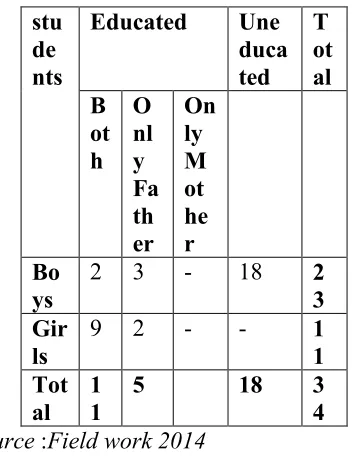
Table 1.Parent’s educational status of dropout students
stu de nts
Educated Une duca ted
T ot al B
ot h
O nl y Fa th er
On ly M ot he r Bo
ys
2 3 - 18 2
3 Gir
ls
9 2 - - 1
1 Tot
al 1 1
5 18 3
4 Source :Field work 2014
The above table 1.1 explains the parent‟s educational status of dropout students. Most of the dropouts comes from un educated parents family particularly for males. Even though Girls comes from educated parents family. They earning income is low level.
2. Unemployment and
underemployment are the major issues among them. Poverty is the major causes for the dropout rate among these families (Haroon sajjad2012). There are no employed parents in the dropout families. All are unemployed . They depends on daily wages for income sources.
3. Many researcher have foundedthe reason for dropout in school education. The main reason for school dropout is disinterest (Raina2009).The main causes of dropout of girls from school in rural areas are reluctance of parents and participation in domestic activities .Another major reason is problem of financial constraints(Nidhikotwal
2007). The reason for drop out may be many like, failure in academics.(khokar2005).The reason for school dropout was classified into four domains of attributed reasons i) Child-centered ii)Parent – centered. iii) Teacher- centered iv)
Environment –
centered.(Govindaraju2010)
The present paperfocused the reason for dropout from both student side and their family. This paper has identified the reasons through open answer from dropout student and their parents.
Table 2 The reason for dropout in the student view
Student reason
boys girls Total
Family financial constraints
3 8 11
Disinterest 13 3 15
Academic fail 5 - 5 Disable
parents
2 - 2
Low
understand in class
4 1 5
Peer groups 4 - 4
Father death 3 - 3
Sister marriage
1 - 1
Source : Field work 2014
The table 2 explains the reason for dropout in school education through student view.
and peer groups was linked with and these creates disinterest to discontinue school Table 3 The reason for dropout in the dropout parents view
Parents
reason Boys Girls Total Family
financial problem
2 5 7
Student 15 4 19
Peer groups 7 - 7
Father death 3 - 3
Family migrants
- 1 1
Parent sickness
1 1 2
Source : Field work 2014
The table 3 clearly express the reason for dropout through parents view. According to parents they says that they are interested to educatetheir children but they are no interested to continue the study. Girls automatically drop in school thinking their family financial situation. In short parents view flashed the reason for dropout one is children‟s mentality(19) with Peer groups(7) and family financial problems.The need to work for income by the child causes them to dropout of school. (Aguspriyambada 2005)
Table 4 working nature of the dropout student
Nature of the work
Boy s
Girl s
Tot al Constructi
on
19 - 19
Company 1 9 10
Driver 2 - -
Total 22 9 29
Source : Field work 2014
The table 1.7 shows that the nature of work of dropout students. Most of the students are going to construction work(19) and company work(10)especially girls in company work compared to boys.
Conclusion
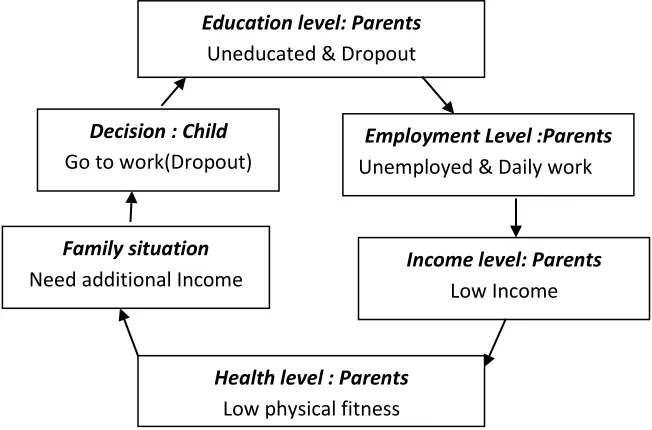
This study concludes that the uneducated parent earnings income through daily work is very low compared to other earnings. These families needed additional source of income for runningtheir family. Son and daughter are alternative income earner in poor families. This situation leads to dropout in school education and go to work. This circle continues in future again and again father to son, this concept is clearly explained in the below chart.
Education level: Parents
Uneducated & Dropout
Employment Level :Parents
Unemployed & Daily work
Health level : Parents
Low physical fitness
Family situation
Need additional Income
Decision : Child
Go to work(Dropout)
Income level: Parents
References :
1. Turnbull,(1983)-Systematic
Instruction of the Moderately and Severely Handicapped-(2nd Edition), Englewood Cliffs, New Jersey; Merill/ Prentice Hall
2. Chugh, S. (2004)-Why Children Dropout: Case Study of a Metropolitan City. New Delhi: Bookwell.
3. Ersado, L. (2005) Child labor and schooling decisions in urban and rural areas:
comparative evidence from Nepal, Peru, and Zimbabwe. World Development, 33(3): 455-480
4. Aguaspriyambada,
AseoSuryahadi&SudarnoSumario (2005)-WhatHappened to child labor in indonisea during the Economic Crises:The Trade-off between School and Work -Source from :www.smeru.or.id -Pp20 5. Brown.P.H&Park.A
(2002)-Education and poverty in rural china- Economics of Education Review 21(6) 523-541
6. Govindaraju.R,Venkatesan ( 2010)-A study on school Dropout in rural settings-Journal Psychology1(1)47-53
7. Haroonsajjad (2012)-Socio economic determinants of primary school Dropout : Evidence from southEast Delhi.
India- source
from.http://www.europeanjournal of social scinence.com
8. Khokar (2005)-Determinants of reasons of school Dropout in Delhi-Indian journal of Community Medichine-30(3)11-21
9. Nidhikotwal, Neelima&Sheetal Rani (2007)-Causes of school Dropouts among rural girls in Kathua District- journal of Human Ecology.22(1)57-59
10. Raina( 2009)-Summary of the talk given by vinodraina -source from: http://www.ashanet.org/princeton/talks/rai na.
11. Sunithachugh (2011)-Dropout in secondary education-A study of children living in slums of Delhi-NUEPA occasional paper-source from :www.neupa.org
12. Pong, S.L &Ju D.B (2000)-Effects of change in family structure and income on dropping out of middle and high school-Journal of Family issue-21(2), 147-169