Identity Based Partial Aggregate Signature Scheme
Without Pairing
S. Sharmila Deva Selvi1, S. Sree Vivek1,!, J. Shriram2, C. Pandu Rangan1,!
1Department of Computer Science and Engineering,
Indian Institute of Technology Madras.
[email protected],[email protected],[email protected].
2National Institute of Technology Trichy, India
Abstract. An identity based signature allows users to sign their documents using their private keys and the signature can be verified by any one, using the identity of the signer and public parameters of the system. An aggregate signature scheme is a digital signature scheme which allows aggregation of different signatures by different users on different messages. The primary objective of aggregate signature scheme is to achieve both computational and communication efficiency. Here, we propose an identity based aggregate signature scheme, which uses a variation of light weight Schnorr type identity based signature scheme, where in the signers need not agree upon a common randomness and the aggregation is done without having any kind of interaction among the signers. The scheme does not involve any pairing operations even for aggregate signature verification. It is computationally efficient since it avoids the costlier operation in elliptic curve groups (Bilinear Pairings). It should be noted that our signature achieves only partial aggregation because the private key of each user is generated by a randomized extract algorithm and hence a random value is to be propagated with each single signature generated.
Keywords:Identity Based Signature, Aggregate Signature, Partial Aggregation, Random Oracle Model, Provable Security.
1
Introduction
Many real-life applications, handle a collection of signed documents together rather than handling them individually. It is not hard to visualize such a scenario in Bank transactions, legal document processing (archiving and communicating) in a legal firm, digital attesta-tion related applicaattesta-tion and so on. In all the above applicaattesta-tions, generating, storing and transmitting a large number of signed documents arise naturally. An Aggregate Signature Schemecombines several signed documents, sayσ1, . . . , σton messagesm1, . . . , mtby users
U1, . . . , Ut and produces a single signed document σagg where size of σagg is substantially
smaller than sum of the sizes ofσi’s. This leads to a significant reduction in the
communica-tion cost because, it is only required to transmitσagginstead of transmittingσ1, . . . , σt in-dividually. A similar remark holds good even for storage requirements whenσaggis archived instead ofσ1, . . . , σt.
Certificate chains in hierarchical PKI (Public Key Infrastructure) systems consists of various signatures at different levels in the hierarchy. By using aggregate signature one can combine all these signatures and thus reduce the certificate length. Ordered sequential ag-gregation is used in communication between routers in a network where each router receives
!Work supported by Project No. CSE/05-06/076/DITX/CPAN on Protocols for Secure
the data and the signature of the previous router. The current router aggregates its own signature to the previous aggregate signature and routes it to the next router. This aggre-gated signature can be used to find the path travelled by the data from source to destination by verifying a single aggregate signature. Aggregate signatures can also be used in wireless network scenarios. Since the major constraint in wireless networks is communication com-plexity, the use of efficient aggregate signature helps in reducing the amount of data to be communicated.
Identity based aggregate signatures are considered to be more effective than PKI based aggregation because in the formar, only identities (which are very short when compared to group elements) of the signers have to be send along with the aggregate signatures, in order to facilitate verification. In PKI based system, efficient aggregation can be done but the identities, public keys and the certificates (issued by the Certifying Authority) of the public keys of the signers has to be send along with the aggregate signature. The signatures and certificates can be easily aggregated in PKI based system but then there is no known technique to aggregate the public keys. Many well known PKI based aggregate signatures are available in the literature [16, 2, 7, 15]. However, as the focus of this paper is on identity based aggregate signature scheme, we will not compare the PKI based schemes with ours. To the best of our knowledge, there are four provably secure identity based aggregate signature schemes [11], [21], [12] and [8]. It should be noted that all of them use bilinear pairing during the verification process. An identity based aggregate signature scheme is claimed to achieve partial aggregation if a part of the signature is aggregated, namely the part with the secret key component of signers is fully aggregated and the randomness part is propagated without aggregation. If both the parts in the signature are fully aggregated then the scheme is said to achieve full aggregation. We provide a brief survey about the efficiency and weakness of various identity based aggregate signature schemes.
Survey of Existing Schemes: Currently, in literature we have number of identity based aggregate signature schemes.
Xu et al. in [21] proposed an identity based aggregate signature scheme. This scheme uses Sakai et al.’s signature construct as the base signature scheme. This achieves partial aggregation but requires linear number of pairings during signature verification.
Xiangguo et al. gave a aggregate signature scheme [8] which uses the BLSR scheme [6] as the base signature scheme. In this scheme all the signers have to broadcast their own random values used for singing to all the cosigners so that everyone agrees upon a common randomness before the generation of aggregate signature. This result in quadratic communication complexity which is a big overhead. Mutual interaction between all the signers is not always a desirable event in aggregate signatures.
Javier Herranz came up with an identity based signature scheme [12] with partial aggre-gation. His scheme produces deterministic signature where the signature on a message will always be the same. It also uses linear number of pairing operations leading to inefficient verification.
Yiling et al. proposed an efficient aggregate signature scheme with full aggregation and constant pairing operations in [20]. But the scheme in [20] is not secure since universal forgery of the base signature scheme used in [20] is possible as shown in [18].
Wang et al. designed an identity based aggregate signature [19] and it is claimed to be the most efficient scheme. It uses constant pairing operation for signature verification. But the aggregate signature in this scheme [19] is not secure since universal forgery of signature of any user is possible in this scheme. The attack in Wang et al. scheme [19] is shown in [18].
prove them was actually not hard to solve in polynomial time, which was pointed out by Hwang et al. [13]. Their new scheme [4] was based on the hardness of a CDH-type problem that raised from their scheme and uses bilinear pairings. One more aggregate signature scheme, which achieves full aggregation is by Gentry and Ramzan [11]. The drawback of the scheme is, it requires interaction between all the signers whose signatures are to be aggregated before the signature generation process. The weakness of the scheme in [11] is briefly reported in the appendix of our paper. The first RSA based identity based aggregate signature scheme was proposed by Bagherzandi et al. [1]. This scheme uses two rounds of communication between the signers to generate a full aggregate signature, where the first round is to commit the random value shares (again by broadcasting the individual commitments as in [8]) and the second round is the aggregate signature generation round. Their scheme uses equivocable commitments and hence looses its generality and becomes less practical because of the overhead involved in broadcasting the commitments.
Our contribution: In this paper, we propose an identity based aggregate signature scheme whose key generation is similar to Javier Herranz’s identity based partial aggregate signa-ture scheme [12]. Our scheme does not require bilinear pairing operation during aggregate signature verification. This is achievable because the individual signature is a Schnorr-like signature. As in [12], our schemes do not have interaction among the signers before signa-ture generation which reduces the communication complexity to a large extent. However, in this scheme we are able to achieve only partial aggregation. We are able to achieve only partial aggregation (as defined by Javier Herranz [12]) because the extract algorithm is a randomized algorithm and the signature generation algorithm is also randomized. We for-mally prove the security of our scheme in the random oracle model. We also point out certain weaknesses in [11], which makes it unsuitable in real life. The weaknesses of the scheme are briefly reported in the appendix.
2
Preliminary
2.1 Bilinear Pairing
LetGbe an additive cyclic group generated byP, with prime orderq, andGT be a multi-plicative cyclic group of the same orderq. Let ˆebe a pairing defined as ˆe:G×G→GT. It satisfies the following properties. For anyP, Q, R "Ganda, b "Z∗
q
– Bilinearity: ˆe(aP, bQ) = ˆe(P, Q)ab. – Non Degenerate: eˆ(P, P)#= 1.
– Easily Computable: eˆ(P, Q) must be easily and efficiently computable.
2.2 Computational Assumptions
In this section, we review the computational assumption that is relevant to the protocol we discuss.
Discrete Logarithm Problem (DLP): Let (G,∗) be a multiplicative group of order
p,g ∈Gbe a generator ofGand h=gx ∈G, wherex∈Z
p be unknown. Giveng andh, the discrete logarithm problem is to findx.
An algorithmAhas an advantage"in solvingDLPG1 if
3
Generic Model
An identity based aggregate signature scheme (IBAS) consists of following six algorithms. – Setup:The private key generator (PKG) provides the security parameterκas the input
to this algorithm, generates the system parameters paramsand the master private key M sk. PKG publishesparamsand keepsM sksecret.
– KeyGen:The userUi provides his identityIDito PKG. The PKG runs this algorithm with identityIDi, paramsand M skas the input and obtains the private key Di. The
private key Di is sent to userUi through a secure channel.
– Sign:For generating a signature on a messagemi, the userUiprovides his identityIDi, his private key Di,paramsand messagemi as input. This algorithm generates a valid signatureσi on messagemi by userUi.
– Verify:This algorithm on input of a signatureσon messagemby userU with identity IDchecks whetherσis a valid signature on messagembyID. If true it outputs “V alid”,
else it outputs “Invalid”.
– Aggregate:On receiving the various signatures (σi)i=1to nfrom different users (Ui)i=1to n, any third party or one of the signers can run this algorithm and generate the aggregate signatureσaggfor the set of'message, identity(pairs (mi, IDi)i=1to n.
– AggregateVerify:This algorithm on input of an aggregate signatureσagg, the list for
(mi, IDi)i=1to n and theparamschecks whetherσagg is a valid aggregate signature on
mibyIDi for alli= 1 ton. If true, it outputs “V alid”, else outputs “Invalid”. – Token Generation:In some models of identity based systems, the PKG may generate
a random value that corresponds to the registered user at the time of registration / key generation. This value will be made public by the user. We refer this value as ’token’
and tokens are not used for any encryption schemes. These tokens will always be send as a part of the signature. This extended version of identity based signatures is not considered as violation because this token is used only for signing purpose. More on this have been discussed in section 5.
Important Remark: As encryption algorithms only use the publicly known identities of the user alone as public key, tokens are never used in encryption schemes. Since ours is an identity based signature scheme, introduction of token in our cryptosystem is not a violation of the definition of identity based system.
4
Security Model
4.1 Unforgeability
Gentry et al. in [11] proposed a formal model for aggregate signature scheme. Their scheme used a common randomness. We follow the security model proposed by Gentry et al. with slight variations since we do not have a common random value. An IBAS scheme is secure against existential forgery under adaptive-chosen-identity and adaptive-chosen-message at-tack if no probabilistic polynomial time algorithm A has non-negligible advantage in the following game.
– Setup phase: The challenger C runs the setup algorithm and generates the params
andM sk. ChallengerCgivesparamsto adversaryA.
– Training phase: After the setup,Astarts interacting with C by querying the various oracles provided by Cin the following way:
• Signing oracle:WhenAmakes a signing query withIDi, messagemi,C outputs a valid signatureσi onmi byIDi.
– Forgery phase: Aoutputs an aggregate signatureσAgg for signatures (σ)i=1to n from the users (IDi)i=1to n on messages (mi)i=1to n where there exists at least one target identity IDT ∈ {IDi}i=1to n, for which private key has not been queried for. The ad-versary A wins the game ifσagg is a valid aggregate signature and A has not queried for the signature from the signing oracle for (IDT, mT) pair on which it has generated the forgery.
AdvIBAS
A ={P r[A(V erif y(σagg) =valid)}
5
Identity Based Aggregate Signature scheme Without Pairings
(IBAS)
Normally, the public key of a user in identity based cryptography is obtained by hashing the user’s identity, which uniquely identifies him. In the identity based signature by Galindo et al. [10], we find an interesting and subtle difference between all existing schemes and [10]. In [10], Galindo et al. have used a Schnorr signature which in turn uses a purely random value chosen by the PKG to generate the private key of the user. This random value can be interpreted as a ’token’ which we discussed in section 3 on generic model of identity based aggregate signature scheme. This token along with the identity of the user is hashed together to obtain the public key corresponding the user. It should be noted that this is not a violation of the property of identity based cryptosystem with respect to digital signature schemes because, in a digital signature scheme all the components of a signature on an arbitrary message are generated by the signer who is in possession of the private key. Hence, the signer has to send the random value obtained with his private key from the PKG along with each signature he generates. The interesting part is that, if the signer or any potential forger tries to alter the random value obtained from the PKG for the signer, both will fail miserably in generating a valid signature because neither signer nor the forger will be able to generate a valid private key corresponding to the altered random value. We emphasize again that tokens can never be used for encryption schemes and can always be used in signature schemes. In Galindo et al.’s [10] paper, the componentgr is send by the PKG to the user. This component is called as’token’ in our convention.
Important Remark: Similar kind of key constructs for identity based cryptosystem can be seen in [9], [12] and [14]. In [9], an identity based key agreement protocol was proposed by Dario et al., in [12] a deterministic aggregate signature scheme was proposed by Javier Herranz and in [14] an identity based online/offline signature was proposed by Liu et al.. In this section, we describe a new identity based aggregate signature scheme based on the identity based signature scheme by Galindo et al. [10]. This scheme consists of six algorithms which are described below.
– IBAS.Setup:Letκbe the security parameter of the system. LetGbe a multiplicative
group of orderq. Choose a random generatorg ofG. Choose three cryptographic hash
functions which are defined as H1 : {0,1}∗×G−→ Z∗q, H2 : {0,1}∗ × {0,1}∗×G×
G −→ Z∗
q and H3 : {0,1}∗ × {0,1}∗ ×Z∗q ×G×G −→ Zq∗. Let s ∈R Z∗q be the master private key and the master public key is set to begs. The public parameters are
params='g, gs,G, H
1, H2, H3(and the master private keysis kept secret.
– IBAS.KeyGen: The user Ui provides his identityIDi to the Private Key Generator (PKG). The PKG runs this algorithm with IDi, paramsand master private key s as
• ComputesXi=gxi andqi =H1(IDi, Xi)mod q • Computesdi= (xi+sqi)mod q
• Outputs'qi, Xi, di(
The PKG sends 'qi, Xi, di(securely to the user Ui. The user Ui keeps the di as secret and'qi, Xi(as public. HereXi is called the token.
Remark:It is to be noted that the private keydiis a Schnorr signature on the identity
IDi and thus a user who is capable of producing another private key d"i for the same identity IDi or a private keyd""i for an arbitrary identity ID""i can effectively forge the underlying Schnorr signature. As a consequence, the private key generated by the PKG is secure and cannot be generated by any user by altering the token value, unless he knows the master private keys. Therefore, we do not consider token as a separate entity
for the formal proof of unforgeability of our scheme.
– IBAS.Sign: The user Ui who wishes to sign a message mi gives hisIDi, private key
di andparamsas input to this algorithm. The algorithm does the following to generate
the signature:
• Chooses a randomri∈Zq. • ComputesWi=gri
• Generatesh1i=H2(mi, IDi, Wi, Xi) • Generatesh2i=H3(mi, IDi, h1i, Wi, Xi) • Computesvi= (rih1i+h2idi)mod q
• Outputs'Xi, vi, h1i, h2i(as the signature ofIDi on messagemi.
Remark:Note that the token valueXiis also a component of the signature. Thus, the verifier need to know only the identity of the signer to perform verification.
– IBAS.Verify:Any user can run this verification algorithm. The user provides'Xi, vi, h1i, h2i(,
IDi, mi andparamsas input to this algorithm. The verification is done as follows:
• Computeqi=H1(IDi, Xi) • ComputeWi=
! gvi (Xi(gs)qi)h2i
"h−1 1i
• Check whether:
h1i
?
=H2(mi, IDi, Wi, Xi) and
h2i
?
=H3(mi, IDi, h1i, Wi, Xi)
• Output “V alid” if both the verifications pass, else output “Invalid”.
Correctness of the computation of Wi:
RHS =
!
gvi
(Xi(gs)qi)h2i "h−11i
= !
g(rih1i+h2idi) (Xi(gs)qi)h2i
"h−1 1i
= !
g(rih1i+h2i(xi+sqi)) (Xi(gs)qi)h2i
"h−1 1i
=!grih1ig(xi+sqi)h2i (Xi(gs)qi)h2i
"h−11i
=!grih1i(Xi(gs)qi)h2i (Xi(gs)qi)h2i
"h−11i
=#grih1i$h −1
1i =gri=W
i=LHS=Wi (as required) This shows that the above verification check is valid and consistent. Note that the verification can be done by anyone as it involves only publicly known parameters such as vi, Wi, h1i, h2i, gs, Xi, qi
– IBAS.Aggregate:This algorithm takes as input a set ofnsignatures{Xi, vi, h1i, h2i}i=1to n and the corresponding identity, message pairs'IDi, mi(, such that∀i= 1 ton'Xi, vi, h1i, h2i( is the signature on messagemi byIDi. The aggregation is done as follows:
vagg=
n %
i=1
The algorithm outputs the final aggregate signature 'Xi, vagg, h1i, h2i(i=1to n and the corresponding message identity pair{mi, IDi}i=1to n.
– IBAS.AggregateVerify:This algorithm takes the aggregate signature'Xi, vagg, h1i, h2i(i=1to n and the corresponding message identity pair{mi, IDi}i=1to nand performs the following
to verify the aggregate signature:
• Fori= 1 ton, computeqi=H1(IDi, Xi) • Fori= 1 ton, computeWi=
! gvi (Xi(gs)qi)h2i
"h−11i
• Fori= 1 ton, check whether:
Computeh1i ?
=H2(mi, IDi, Wi, Xi) and Computeh2i=? H3(mi, IDi, h1i, Wi, Xi) • Check whether gvagg =? &n
i=1
(Wi)h1i.&n i=1
(Xi)h2i.(gs)Pn
i=1qih2i. If all the above checks hold good, output “V alid” else output “Invalid”.
Correctness of the IBAS.AggregateVerify algorithm:
LHS=gvagg=gPn
i=1rih1i+Pni=1h2idi =gPni=1rih1i.gPni=1h2idi = &n
i=1
(gri)h1i.gPi=1n h2i(xi+sqi)= n & i=1
(Wi)h1i. n & i=1
(Xi)h2i.(gs)Pni=1qih2i=RHS
This shows that the aggregate verification test is correct and consistent.
6
Security Proof for IBAS
In this section, we prove the security of our identity based aggregate signature scheme (IBAS). We show that if a polynomial time bounded adversary exists who can break our scheme with non-negligible probability"" then we will be able to solve the discrete logarithm
problem with non-negligible probability "0. We prove that our scheme is secure against existential forgery under adaptive chosen message and adaptive chosen identity attack. We also use the oracle replay attack technique and forking lemma [17] to prove the security of our scheme.
Theorem 1. Our aggregate signature scheme IBAS is secure against existential forgery under adaptively chosen identity and adaptively chosen message attack, if there exists a polynomially bounded (t, ""
) adversaryAmakingqH1,qH2,qH3 hash queries,qS signcryption
queries andqEextraction queries, who can break our scheme with a non-negligible advantage
"", then there exists a DL solverC with a non-negligible advantage,
"0=
1 9.
10(qS+ 1)(qS+qH3+qH2).(1−qHqE 1).n
2k+1 .
1
qH1
"
and in polynomial time t0.
Proof. The adversaryAin adaptive chosen message and adaptive chosen identity attack has access to all the hash oracles, the signing oracle and the key extract oracle. The Challenger C uses the forgery by Ato solve the computational hard problem (DLP) with the help of oracle replay technique.Cis given an instance of the DL problem i.e giveng,h=gx
∈Gfor
– Setup Phase:Cchooses a groupGand a generatorgfor the groupG. Then,Cchooses a randoms∈Zq∗and calculatesgs.Chas all the three hash oraclesH1, H2, H3under his control. So he gives the public parametersparams='g, gs, H
1, H2, H3(to the adversary and keeps the master secret sto himself.
– Training Phase: A can ask for different queries toC. C responds correspondingly to the various queries by A. LetqE, qH1, qH2, qH3, qS be the maximum number of queries the adversary A can query to key extract oracle, three hash oracles and the signing oracle respectively. The various queries are as follows:
• OH1:There are two cases in this query.
∗ Aqueries theH1oracle withIDi, Xias input,Cchooses a randomqiand returns it toA.
∗ SometimesAcan query for the public key component corresponding to an iden-tityIDisinceAmight want to know the actualXicorresponding toIDi. When AqueriesIDi as theithquery,C does the following:
· If i=1,C sets IDT =IDi andXi =h, where h=gx, xis unknown andh is the part of the Discrete logarithm problem thatC wants to solve. ThenC stores'⊥, qi, IDi(in LH1 list.
· Ifi#= 1, choose a randomxi, qi ∈Zq∗, set Xi =gxi, returns 'qi, Xi(to the user such thatqi=H1(IDi, Xi) and store'xi, qi, IDi(inLH1list.
Csets the first identity queried byAfor the public key component, as the target identityIDT and it responds accordingly toA.Awill not know which identity is set as the target identity becauseAdoes not know the strategy for selecting the target identity. Ashould have asked for at least one query of this kind sinceA has to to know the public parameterXi of a particularIDi. The only other way for Ato know the Xi corresponding toIDi is through the private key extract queries. Let the maximum number of queries of this kind toH1 oracle beqH1∗ . • OExtract:WhenAqueries for private key ofIDi,C does the following:
∗ C checks theLH1 list.
∗ If the entry corresponding toIDiinLH1is of the form'xi, qi, IDi(, thenCsets
di=xi+sqi and returnsdi toA.
∗ If the tuple corresponding to IDi in LH1 is of the form '⊥, qi, IDi(, then C knows that IDi is the target identity and thenCaborts.
• OH2: WhenA queries for the hash of 'IDi, mi, Wi(, C checks theLH2 list. If the tuple is already present it returnsh1i toAelseCchooses a randomh1i and returns
h1i to Aand stores'h1i, Wi, IDi, mi(in the LH2 list.
• OH3: WhenA queries for the hash of 'IDi, mi, Wi, h1i(, C checks the LH3 list. If the tuple is already present then it returnsh2itoAelseCchooses a randomh2iand returnsh2i toAand stores'h2i, Wi, IDi, mi, h1i(in theLH3 list.
• OSign:WhenArequests for the signature on mi byIDi,Cdoes the following: ∗ IfIDi#=IDT thenC knows the private key ofIDi and can generate the
signa-ture as per the sign algorithm in the scheme and return'Xi, vi, h1i, h2i(as the signature ofIDi onmi. It also updates all the hashing lists correspondingly. ∗ IfIDi=IDT thenCdoes the following:
· Chooses a randomh1i, h2i, vi ∈Zq∗. · Setsvi =vi.
· SetsWi= (XT−h2i.g−s.qTh2i.gvi) 1 h1i.
is identical to the tuples generated (i.e.'h1i, Wi, IDi, mi(and'h2i, Wi, IDi,
mi, h1i( respectively), chooses a different vi, h1i, h2i and repeat the above process.
· Return'Xi, vi, h1i, h2i(toAas signature onmi byIDi
Although the signature'Xi, vi, h1i, h2i(was not generated using the actual signing algorithm. The signature generated is valid due to the following fact:
(XT)h2i.(Wi)h1i.(gs)qT.h1i= (XT)h2i.((XT−h2i.g−s.qTh2i.gvi) 1
h1i)h1i.(gs)qT.h1i = (XT)h2i.(XT−h2i).g−s.qTh2i.(gs)qT.h1i.gvi =gvi
This shows that 'Xi, vi, h1i, h2i(will convince A as a valid signature. There is no need to provide an aggregate oracle since the user can query the signing oracle repeatedly and do the aggregation himself.
– Forgery Phase:The adversaryAafter issuing all the queries finally generates an ag-gregate signature'X1, . . . , Xn, vagg, W1, . . . , Wn(on messages{mi}i=1to nby users with identities {IDi}i=1to nsuch thatIDi has signed messagemi.Awins the game if it is a valid aggregate signature and there is at least one signer IDk where k"{1. . . n} where
IDk=IDT andAhas not asked for a signature query on the corresponding'IDk, mk( pair to theOSignoracle (i.e it is not a trivial forgery). The adversaryAwill be able to do this forgery with a probability of"" which is expressed as follows:
Let " the advantage of the adversary breaking the scheme in existential forgery under
chosen target identity and adaptive chosen message. The places where the algorithm can abort are
• In extract case if the adversary asks for the extract query for the IDT then the algorithm aborts.qEis the maximum number of extract queries which the adversary can ask. Then the probability that he has not asked for any extract query forIDT is
P r[qE(IDi)#=IDT] = 1−
qE
q∗
H1
(1)
whereq∗
H1 is the maximum number ofH1 of type 2 allowed for the adversary. • After the forgery the algorithm may abort if the adversary has not used IDT as
one of the identities of the signers or ifA has used ami for the signature of IDT for which it has already asked the signing query. The probability thatAproduces a valid forgery is
P r[IDi=IDT for some i= 1, . . . , nandIDi=# IDT∀j= 1 ton j#=i] = 2.qn∗ H1
Combining the two probabilities we get the advantage of the adversary breaking our scheme in adaptive chosen message and adaptive chosen identity attack is given by
"" =".(1− qE
qH1∗
) n 2.qH1∗
(2)
Awill be able to produce a valid signature without knowing the secret key of the signer with probability
"=10(qS+1)(qS+qH3+qH2)
2κ .
as shown in [17]. Our signature scheme has parameters similar to those used in [17]. The
to σ2 in [17] which uses both the hash values and randomness. Since the construct has similar components as pointed out by Pointcheval we can use forking lemma in our proof. By using forking lemma C plays again with A with same random tape andH2 oracle but different H3 oracle. Then with a probability "
""
≥ 1
9, the adversary will be able to produce another valid aggregate signature for the set of users. That aggregate signature will be of the form 'X1, . . . , Xn, v
"
agg, W1, . . . , Wn(where allWi’s are same as
previous signature.C using the two valid aggregate signatures does the following:
vagg ='ni=1rih1i+'ni=1dih2i
vagg" = 'n
i=1rih1i+'ni=1dih " 2i
vagg−v
" agg=
'n
i=1di(h2i−h " 2i)
vagg−v
" agg−
'n
i=1i$=T di(h2i−h "
21) =dT(h2T−h " 2T)
C knows all the private keys other than the target identity’s private key.C also know all the hash values. Thus by dividing the final equation by (h2r−h
"
2i)C getdT. ButC knows that dT =xT +sqT. Thus the value ofxT +sqT is determined above. C know
s and qT. Thus from the computed value of xT +sqT, if C subtracts sqT, C can find the value of xT which is the solution for the given instance of the discrete logarithm problem, sincexT =xas per definition.
The total probability by which the challenger will be able to solve the Discrete logarithm problem is given by
"0=
10(qS+ 1)(qS+qH3+qH2)
2κ .(1−
qE
q∗
H1 ) n
2.q∗
H1 1
9 (3)
=10(qS+ 1)(qS+qH3+qH2).(1− qE q∗
H1).n 2.q∗
H1.9.2κ
(4)
=1 9.
10(qS+ 1)(qS+qH3+qH2).(1−qqE∗ H1).n
2κ+1 .
1
q∗
H1
(5)
Hence we have proved that if a polynomial time bounded adversary exists who can break our scheme with a non-negligible probability"0 thenCcan solve the discrete logarithm problem with non-negligible probability as shown. Thus our scheme is secure against existential forgery under adaptive chosen message and adaptive chosen identity attack. !
7
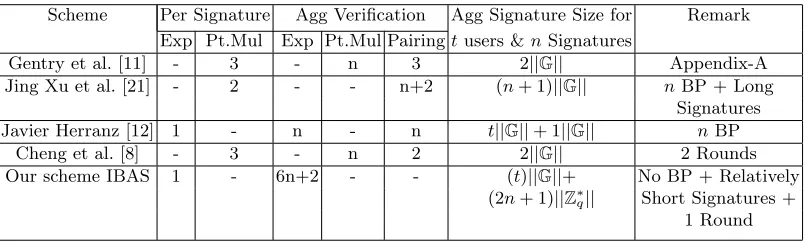
Efficiency Comparison:
In this section we compare the efficiency of our schemes with few existing schemes. We also give some remarks on the efficiency and merits of our schemes over others.
Few Remarks:
– In [11] all the signers have to agree upon a common valueω in order to produce a valid
aggregate signature. That will increase the communication complexity. Further weakness of [11] are explained in the appendix.
– Jing Xu et al. [21] achieve partial aggregation and also requires linear number of pairings. – Javier Herranz [12] also achieves partial aggregation and more over the scheme uses
Table 1.Comparing various aggregate signature schemes
Scheme Per Signature Agg Verification Agg Signature Size for Remark Exp Pt.Mul Exp Pt.Mul Pairingtusers &nSignatures
Gentry et al. [11] - 3 - n 3 2||G|| Appendix-A Jing Xu et al. [21] - 2 - - n+2 (n+ 1)||G|| nBP + Long
Signatures Javier Herranz [12] 1 - n - n t||G||+ 1||G|| nBP
Cheng et al. [8] - 3 - n 2 2||G|| 2 Rounds Our scheme IBAS 1 - 6n+2 - - (t)||G||+ No BP + Relatively
(2n+ 1)||Z∗
q|| Short Signatures +
1 Round
LEGEND:||G||- Size of one group element,||Z∗
q||- Size of oneZ∗q element.
– In Cheng et al. [8] scheme achieves full aggregation and also seems efficient. But in this scheme all the signers have to broadcast their respective randomness to other signers so that all agree upon a common randomness finally. This broadcast technique increases the communication complexity enormously and also it is rather like threshold signature and not like a pure aggregate signature.
– It has to be taken into account that the signing part is for each signer. So ifn signers
are signing the complexity in signing part will be multiplied by n.
– Our scheme IBAS achieves only partial aggregation but does verification without any pairing operation making it the most efficient scheme of all the above. We used a light weight schnorr based signature as proposed by Galindo et al. [10] which is highly efficient and practically implementable.
8
Conclusion
In this paper, we have considered an identity based signature in which the private key for a user is a Schnorr signature on his identity. This private key is generated by the PKG. Besides, the PKG sends a random ’token’ to every user along with his private key. This token cannot be altered by the user and the token can never be used in any identity based encryption scheme. Since, for encryption schemes, only identities are used as public keys. The presence of tokens in the scheme is not a violation to the definition of identity based scheme. However, the concept of’token’ can be cleverly deployed to avoid all pairing based computations in aggregate signature schemes. We have demonstrated that Galindo et al’s [10] signature scheme which uses the concept of’tokens’ can be used to design an aggregate signature scheme without pairing.
References
1. Ali Bagherzandi and Stanislaw Jarecki. Identity-based aggregate and multi-signature schemes based on rsa. In Public Key Cryptography - PKC 2010, volume 6056 of Lecture Notes in Computer Science, pages 480–498. Springer, 2010.
2. Mihir Bellare, Chanathip Namprempre, and Gregory Neven. Unrestricted aggregate signatures. InAutomata, Languages and Programming, 34th International Colloquium, ICALP 2007, vol-ume 4596 ofLecture Notes in Computer Science, pages 411–422. Springer, 2007.
3. Alexandra Boldyreva, Craig Gentry, Adam O’Neill, and Dae Hyun Yum. Ordered multisigna-tures and identity-based sequential aggregate signamultisigna-tures, with applications to secure routing. InACM Conference on Computer and Communications Security, CCS 2007, pages 276–285. ACM, 2007.
4. Alexandra Boldyreva, Craig Gentry, Adam O’Neill, and Dae Hyun Yum. Ordered mul-tisignatures and identity-based sequential aggregate signatures, with applications to se-cure routing. Cryptology ePrint Archive, Report 2007/438, 2007, Revised on 21-Feb-2010. http://eprint.iacr.org/.
5. Alexandra Boldyreva, Craig Gentry, Adam O’Neill, and Dae Hyun Yum. New multiparty signature schemes for network routing applications. ACM Transactions on Information and System Security (TISSEC), vol.12(no.1):1–39, 2008.
6. Dan Boneh. Bls short digital signatures. In Encyclopedia of Cryptography and Security. Springer, 2005.
7. Dan Boneh, Craig Gentry, Ben Lynn, and Hovav Shacham. Aggregate and verifiably encrypted signatures from bilinear maps. InAdvances in Cryptology - EUROCRYPT 2003, volume 2656 ofLecture Notes in Computer Science, pages 416–432. Springer, 2003.
8. Xiangguo Cheng, Jingmei Liu, and Xinmei Wang. Identity-based aggregate and verifiably encrypted signatures from bilinear pairing. In Computational Science and Its Applications -ICCSA 2005,, volume 3483 ofLecture Notes in Computer Science, pages 1046–1054. Springer, 2005.
9. Dario Fiore and Rosario Gennaro. Making the diffie-hellman protocol identity-based. Cryptol-ogy ePrint Archive, Report 2009/174, 2009. http://eprint.iacr.org/ (An extended abstract of this paper appears in the proceedings of CT-RSA 2010).
10. David Galindo and F. D. Garcia. A schnorr-like lightweight identity-based signature scheme. InIn Proceedings of 2nd African International Conference on Cryptology, AfricaCrypt 2009, Lecture Notes in Computer Science 5580, pages 135–148, 2009.
11. Craig Gentry and Zulfikar Ramzan. Identity-based aggregate signatures. InPublic Key Cryp-tography - PKC 2006, volume 3958 of Lecture Notes in Computer Science, pages 257–273. Springer, 2006.
12. Javier Herranz. Deterministic identity-based signatures for partial aggregation. The Computer Journal, vol-49(no-3):322–330, 2006.
13. Jung Yeon Hwang, Dong Hoon Lee, and Moti Yung. Universal forgery of the identity-based sequential aggregate signature scheme. InComputer and Communications Security, ASIACCS 2009, pages 157–160. ACM, 2009.
14. Joseph K. Liu, Joonsang Baek, Jianying Zhou, Yanjiang Yang, and Jun Wen Wong. Efficient online/offline identity-based signature for wireless sensor network. Cryptology ePrint Archive, Report 2010/003, 2010. http://eprint.iacr.org/.
15. Steve Lu, Rafail Ostrovsky, Amit Sahai, Hovav Shacham, and Brent Waters. Sequential ag-gregate signatures and multisignatures without random oracles. In Advances in Cryptology - EUROCRYPT 2006, volume 4004 of Lecture Notes in Computer Science, pages 465–485. Springer, 2006.
16. Gregory Neven. Efficient sequential aggregate signed data. InAdvances in Cryptology - EU-ROCRYPT 2008, volume 4965 of Lecture Notes in Computer Science, pages 52–69. Springer, 2008.
17. David Pointcheval and Jacques Stern. Security arguments for digital signatures and blind signatures. Journal of Cryptology, vol-13(no-3):361–396, 2000.
19. Zhu Wang, Huiyan Chen, Ding feng Ye, and Qian Wu. Practical identity-based aggregate signature scheme from bilinear maps.Journal of Shangai Jiatong University, vol-13(no-6):684– 687, 2008.
20. Yiling Wen and Jianfeng Ma. An aggregate signature scheme with constant pairing operations. InInternational Conference on Computer Science and Software Engineering, CSSE 2008, pages 830–833. IEEE Computer Society, 2008.
21. Jing Xu, Zhenfeng Zhang, and Dengguo Feng. Id-based aggregate signatures from bilinear pairings. InCryptology and Network Security, CANS-2005, volume 3810 ofLecture Notes in Computer Science, pages 110–119. Springer, 2005.
APPENDIX-A:
In this section, we show the various weaknesses of [11]. Though it is claimed to be currently the most efficient scheme it has the following weakness.
1. According to the scheme in [11], the signers have to store all the ω they have used
previously in a database in order to avoid the re-use of randomness. Every time the signer before signing needs to check whether the current ω was not previously used for
any signature generation on any message. This leads to increase in storage cost and checking cost, becoming a huge overhead.
2. Not only this, the common randomnessω chosen by the first signer should satisfy the
constraint that it was not used previously for signing any message by any o the other signers participating in the aggregation process. Even if n−1 signers agree and nth signer disagrees then they have to run the protocol again by picking up a newω value.
This accounts to a lot of wastage of time and network bandwidth.
3. Any signer, if he/she reuse aω value even once with or without his/her knowledge then
universal forgery of their signature is possible. The universal forgery of signature is as follows:
– Let'S1, T1(be a signature on m1byID using the valueω. – Let'S2, T2(be a signature on m2byID using the sameω – The signature components is of the form
S1=r1Pω+D1+c1D2 (6)
T1=r1P (7)
S2=r2Pω+D1+c2D2 (8)
T2=r2P (9)
where r1, r2 is unknown random numbers,Pω =H2(ω), c1 =H3(m1, ID, ω), c2=
H3(m2, ID, ω).
– Subtracting 6 from 8 we get
S∗= (r2−r1)Pω+ (c2−c1)D2 (10)
Dividing by (c2−c1) we get,S∗∗=r2c2−−r1c1Pω+D2
– Compute a new hash valuec3=H3(m3, ID, ω) wherem3 is some random message. – MultiplyS∗∗ byc3 and we getS
"
= r2−r1
– Dividing 6 byc1 and dividing 8 byc2 we get the two equations
S1" =
r1
c1
Pω+
1
c1
D1+D2 (11)
S2" =
r2
c2
Pω+
1
c2
D1+D2 (12)
– Subtracting 12 from 11 we get
S3" = (r1c1 − r2
c2)Pω+ ( 1 c1 −
1 c2)D1 – DividingS3" by (c11 −c21) we get
S3""= (rc11−
r2 c2) (c11−c12)Pω
+D1
S3""= r1c2−r2c1
c2−c1 Pω+D1
– AddingS"" toS" we getS3= (r2c2−−r1c1c3+r1c2c2−−r2c1c1 )Pω+D1+c3D2 – S3=r∗Pω+D1+c3D2 wherer∗= (rc22−−c1r1c3+r1c2c2−−rc12c1)
– We can deriveT3=r∗P also knowing theT1 andT2 values as follows: Multiplying T1 by (c2c2−−c3c1) and multiplying T2 by (
c3−c1
c2−c1) and adding the two we get
T3= (c2c2−−c3c1r1+c3c2−−c1c1r2)P
= (r2−r1 c2−c1c3+
r1c2−r2c1 c2−c1 )P
T3=r∗P
– ThusS3andT3is a valid signature on messagem3since its of the standard signature format of Gentry et al.’s scheme wherec3=H3(m3, ID, ω).
Thus universal forgery of signature is possible in case of Gentry et al.’s scheme. The signer has to be very careful that he/she does not reuse theω value. So the storage and
checking of all used ω values becomes essential in their scheme. The extension which
the authors have stated for using ω repeatedly is to get different private keys equal to
number of timesωis reused. That again is not a viable solution since the user will have
no idea as to how many times he will reuse ωif he does.